When businesses ask, "What is the average wage in the Philippines?", they're really asking two different questions. They need to know the official government statistic, but more importantly, they need to know the real-world market rate for the skilled talent they want to hire.
Think of the government's number as a car's sticker price—it’s a useful starting point, but it's rarely what you actually end up paying. This guide will help you understand that critical difference so you can budget effectively.
Understanding the Average Wage in the Philippines for 2026

To really get a handle on Philippine salaries, you have to look beyond a single, nationwide number. There’s a huge gap between the nationally reported average and what a company actually has to offer to attract skilled professionals in competitive fields like tech or finance.
The official figure, published by government agencies, lumps together every job imaginable—from low-wage agricultural work to high-paying executive roles. While it serves as a decent economic indicator, it’s not a practical guide for setting salaries in the modern business world, especially for specialized roles.
Official Averages vs. Market Realities
The numbers really tell the story here. According to the Philippine Statistics Authority's last major wage survey, the official average wage across all occupations was around 18,423 PHP per month. But if you try to hire a skilled professional for that amount today, you won’t get very far.
In reality, most skilled office-based professionals earn between 25,000 to 45,000 PHP monthly. That’s a massive 35% to 144% premium over the official average. You can see this gap clearly in the latest salary reports.
Understanding this difference is the first step to creating a competitive compensation strategy. Relying solely on government averages will likely lead to hiring challenges, as you'll be offering wages far below what top candidates expect and receive.
To give you a clearer picture for budgeting, we've put together a quick summary that contrasts the official government figures with the realistic market rates you'll encounter when hiring.
Philippine Average Wages at a Glance (2026 Estimates)
This table breaks down what you can expect to pay for different talent levels, moving from the broad national average to the specific rates for experienced hires.
| Wage Category | Estimated Monthly Salary (PHP) | Who This Applies To |
|---|---|---|
| Official National Average | ~19,000 PHP | Broad government statistic across all sectors, including agriculture and informal labor. |
| Entry-Level Skilled Professional | 22,000 – 30,000 PHP | Recent graduates and staff with 0-2 years of experience in roles like customer support or admin. |
| Mid-Level Skilled Professional | 30,000 – 60,000 PHP | Experienced staff with 3-5 years in their field, such as accountants, developers, or marketers. |
| Senior & Specialized Roles | 60,000 – 150,000+ PHP | Team leaders, project managers, and technical experts with specialized skills. |
As you can see, the salary you need to offer depends entirely on the role and experience level you're targeting. Using these market-based estimates will give you a much more realistic foundation for your hiring budget and talent strategy.
A Look Back at Philippine Wage Growth
To really get a handle on future costs, you have to look at the past. The story of salaries in the Philippines isn't just a list of numbers; it's a direct reflection of the country's impressive economic boom. Seeing where wages have been gives you a real feel for this dynamic market.
For any business planning to stick around for the long haul, this historical context is gold. It’s what helps you forecast labor costs and budget smartly beyond your first year. And the trend is crystal clear: salaries have been on a steady climb.
A Two-Decade Transformation
The Philippine economy has expanded significantly, and wages have naturally followed. This isn't some recent, temporary spike. It's a sustained pattern of growth that points to a maturing labor market and a rising demand for skilled professionals. For an employer, it means a competitive salary from five or ten years ago just won't cut it today.
This growth is one of the best signs of the country's economic health and the opportunities within it. Looking at the data from 2001 to 2018, the change is striking. The average wage shot up from a low of 5,798 PHP per month in 2001 to a peak of 13,487.30 PHP per month in 2018. That’s a 132% jump in under two decades.
This consistent wage growth signals a robust and expanding economy. However, it also presents a challenge for businesses managing operational costs. As salaries rise, fixed expenses like traditional office rent can squeeze budgets, making flexible operational models more attractive.
This sustained increase in the average wage in the Philippines has huge implications for how you should think about your operational footprint and manage those rising labor costs over time.
How to Plan for Rising Labor Costs
That unmistakable upward trend in salaries calls for a forward-thinking approach to managing your expenses. As wages keep climbing, companies stuck in long-term, expensive office leases often find their budgets getting tight, leaving less money to attract the talent they need.
This is exactly where more flexible operational models give you a real strategic edge. Think about it this way:
- Tighter Cost Control: A model like seat leasing helps you get a grip on overhead without being shackled to pricey, long-term real estate. All your IT, utilities, and facility management costs are bundled into one predictable monthly expense.
- Budget Flexibility: When your fixed costs are lower, you can put more of your budget toward what actually drives your business forward—hiring and keeping top talent with competitive salaries that stay current with the market.
- Easy Scalability: As you hire more people, you can simply add more "seats" without the massive headache and cost of finding and moving into a bigger office. In a market where labor costs are steadily increasing, that kind of agility is invaluable.
By adopting a more adaptable setup, your business can confidently ride the wave of rising Philippine wages. To explore more about how modern businesses are fine-tuning their operations, you might find other articles on our blog useful. This strategy frees you up to invest in your people, making sure you stay a top choice for talent in a competitive field.
A Regional Guide to Philippine Minimum Wages
Thinking of the Philippines as a single, uniform labor market is a common—and often expensive—mistake. The reality is far more nuanced. To truly get a handle on the average wage in the Philippines, you have to see the country for what it is: a collection of distinct regional economies, each with its own cost of living and wage structure.
Where you set up your business will have a massive impact on your labor costs. Think of this section as your strategic map to that varied landscape, guiding you through the high-cost hubs and contrasting them with more affordable, emerging provinces.
This chart paints a clear picture of the country's wage growth from 2001 to 2018, giving us some historical context for the regional differences we see today.
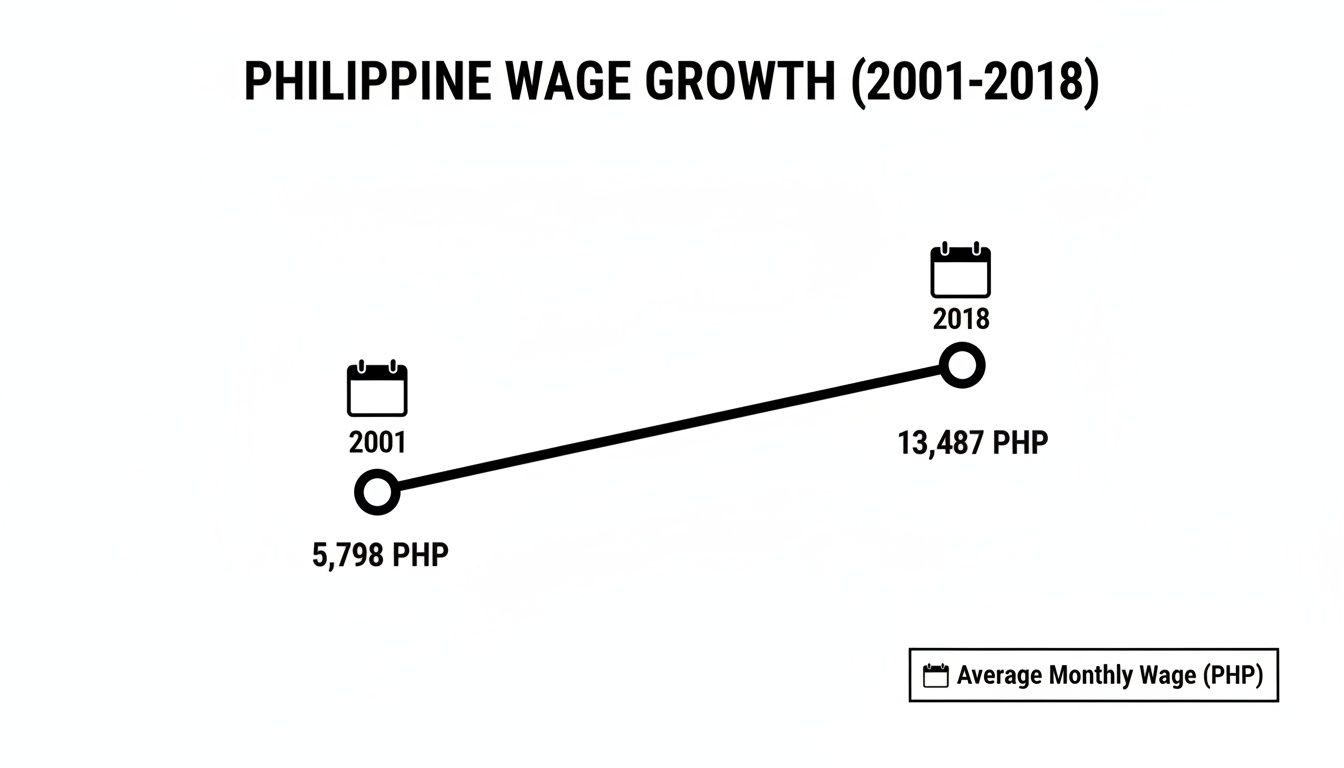
The data shows average wages more than doubled in under two decades. That upward trend is a key force that continues to shape pay scales across the country.
The Metro Manila Premium
Metro Manila is the nation's economic and political heart, so it naturally commands the highest wages. It's the most expensive place to operate, but it also offers the largest and most diverse talent pool. For any business needing highly specialized skills or wanting to be close to corporate headquarters, Manila is often the default choice.
But that premium comes at a steep price. The daily minimum wage in Metro Manila is significantly higher than anywhere else in the country, a direct reflection of a higher cost of living and fierce competition for top talent.
This regional wage variation creates a huge opportunity for smart business planning. By looking beyond the capital, companies can unlock substantial cost savings and tap into overlooked talent pools.
This approach isn't just about cutting costs; it's about reallocating your budget intelligently. The money you save on overhead can be put toward offering more competitive salaries in lower-cost areas, making you an employer of choice.
Exploring Cost-Effective Alternatives
For many businesses, the real opportunity lies outside the capital. A growing number of provinces and secondary cities offer a compelling mix of skilled labor and much lower operating costs. These regional wage differences aren't random—they're set by local wage boards to reflect the area's specific economic conditions.
Let’s look at the numbers. The daily minimum wage in the National Capital Region (NCR) is ₱610 for non-agricultural workers. In contrast, other key regions have minimums ranging from ₱404 to ₱560 per day. You can dig deeper into these differences with resources that track salary and labor data across the Philippines.
This wage gap isn't just a few pesos; it translates directly into significant monthly savings per employee, making these regions incredibly attractive for scaling your operations.
The table below breaks down the daily minimum wage for non-agricultural workers in Metro Manila compared to other strategic locations, highlighting the potential monthly savings.
Daily Minimum Wage Rates Across Key Philippine Regions (2024)
| Region | Minimum Daily Wage (PHP) | Estimated Monthly Cost Savings vs. Metro Manila |
|---|---|---|
| Metro Manila (NCR) | ₱610 | N/A |
| CALABARZON (Region IV-A) | ₱520 | ~₱1,980 per employee |
| Central Luzon (Region III) | ₱493-₱500 | ~₱2,420 per employee |
| Central Visayas (Region VII) | ₱468 | ~₱3,124 per employee |
| Davao Region (Region XI) | ₱462 | ~₱3,256 per employee |
Note: Monthly savings are estimated based on a 22-day work month.
As you can see, the financial argument for looking beyond Manila is compelling. By choosing a location like Cebu or Davao, you can reduce your baseline labor costs by over ₱3,000 per employee each month.
Here are a few hotspots gaining traction:
- Cebu: A major BPO and IT hub in its own right, Cebu offers a large, well-educated workforce with wages considerably lower than Manila's.
- Davao: As the largest city in Mindanao, it provides a stable business environment and access to a growing talent pool in the southern Philippines.
- Iloilo: Known for its emerging tech scene and strong university system, Iloilo is quickly becoming a top choice for businesses seeking that perfect balance of talent and affordability.
By strategically choosing your location, you can get much more out of your hiring budget. And when you combine this with a solution like seat leasing, the savings multiply. This model lets you tap into provincial talent without the massive capital expense and logistical headaches of building out your own office, giving you a lean, efficient, and high-quality operation.
Of course. Here is the rewritten section, crafted to sound natural, human-written, and expert-led.
How Industry and Experience Shape Salaries
Thinking about the average wage in the Philippines as a single number is like trying to describe a mountain range with one height measurement. While a nationwide average gives you a general lay of the land, the salary you’ll actually offer—or need to offer—depends almost entirely on two things: the industry you’re in and the candidate's years of experience.
The reality is that a senior software developer commands a salary worlds apart from an entry-level customer service agent. The specific skills you’re looking for and the demand for those skills create a massive salary spectrum. A role in the booming IT sector, for example, will naturally sit on a much higher pay scale than a position with similar seniority in retail.
This is exactly why generic averages can be so misleading when you're trying to set a budget. To attract the right talent, you have to get specific.
The Impact of Industry on Pay Scales
Some industries in the Philippines just pay more. It's a simple matter of supply and demand, often driven by a global talent shortage for certain skills. These high-growth sectors are pulling up salary expectations across the board for qualified professionals.
Just look at how wildly different the average annual salaries can be from one field to the next:
- Customer Service: A cornerstone of the BPO industry, with an average annual salary around ₱240,000.
- Accountant: A vital business function, averaging closer to ₱360,000 per year.
- Software Developer: A highly sought-after tech role, where the average jumps to ₱600,000 annually.
- Marketing Manager: A strategic leadership role, with average salaries often hitting ₱720,000 per year.
As you can see, a marketing manager can earn three times what a customer service agent does. This is why you can't build a realistic budget without first benchmarking against your specific industry.
How Experience Drives Salary Growth
If industry sets the salary ballpark, a professional's experience level determines where they sit in the stands. A candidate's journey from a fresh graduate to a senior expert is marked by significant salary jumps that reward their proven skills and growing track record.
Think of it as a salary ladder. Each rung represents a new level of mastery and responsibility, and the compensation rises with every step up.
A common mistake we see is underestimating the pay bump between a mid-level and a senior professional. Someone with 5+ years of solid experience isn't just slightly more expensive; they often command double the salary of an entry-level hire. You're paying for their ability to lead projects, mentor junior staff, and solve complex problems without hand-holding.
Here’s how that progression typically breaks down in monthly terms:
- Entry-Level (0-2 years experience): These are professionals who are still learning the ropes. They typically earn between ₱15,000 to ₱30,000 a month and need a fair amount of guidance.
- Mid-Level (3-5 years experience): Once they’ve proven themselves, their value and independence grow. Salaries here often range from ₱30,000 to ₱60,000 per month as they begin handling more complex work.
- Senior Roles (5+ years experience): These are your experts, team leads, and managers. Their pay can range anywhere from ₱60,000 to ₱150,000+ monthly, reflecting their leadership and specialized knowledge.
Understanding this progression is crucial. It ensures you’re budgeting the right amount for the level of expertise you actually need, whether you're hiring your first person on the ground or a seasoned leader to steer the ship.
Balancing Wages with the Local Cost of Living

A salary figure is just a number on a spreadsheet until you factor in its real-world purchasing power. A monthly salary of ₱40,000, for instance, paints two very different pictures. In a smaller provincial city, it can support a comfortable lifestyle. But in the heart of Metro Manila, that same amount can feel stretched to its absolute limit.
Understanding this dynamic is what separates a good employer from a great one. It shows you’re thinking beyond the numbers and recognizing that a wage isn't just a business expense—it's the tool your people use to build their lives.
When you grasp this, your compensation strategy shifts. You stop just trying to meet a market average and start aiming to provide genuine financial security. That’s a move that pays dividends in employee loyalty and retention.
Breaking Down Monthly Expenses
So, what does this look like on the ground? Let's take a young professional trying to make it in Metro Manila. A huge slice of their paycheck is gone before they even have a chance to save.
Here’s a rough sketch of where that money disappears:
- Housing: Rent for a simple studio or one-bedroom apartment in a safe, accessible area can easily eat up 30-40% of their income.
- Food: Between groceries, daily lunches, and the occasional meal out, food costs add up fast, especially as prices climb.
- Transportation: The daily grind of commuting, whether by public transit or a ride-hailing app, is another significant and unavoidable cost.
- Utilities and Communication: You can’t live without electricity, water, and a reliable internet connection, all of which come with non-negotiable monthly bills.
Suddenly, that ₱40,000 salary in Manila doesn't look so big. In contrast, that same income in a city like Iloilo or Bacolod goes much, much further, with lower rent and daily expenses leaving more room to breathe. While this guide is focused on the Philippines, seeing how these economic forces operate in other markets can be insightful. For a different perspective, you might check out the real cost of living in Mexico to compare.
A "good" salary is relative to its purchasing power. An offer that looks great on paper might be unappealing once a candidate does the math on their take-home pay after accounting for the high cost of urban living.
A Smarter Compensation Strategy
This is where smart location planning becomes your secret weapon. By building teams in more affordable regions outside the capital, you can offer salaries that are extremely competitive for the local market and give your employees a higher quality of life.
It's a true win-win. Your business unlocks significant operational savings, and your employees get to enjoy a comfortable lifestyle where their salary affords them more than just the basics. This thoughtful approach doesn't just cut costs; it builds a stronger, more stable, and more satisfied workforce.
Hiring Smarter with Data-Driven Budgeting
Knowing the average wage in the Philippines is one thing, but using that information to build a better team is where the real magic happens. This is the point where you move beyond the data and create a hiring strategy that actually saves you money while attracting top talent.
Think about what it would mean to build your team without being locked into a long, expensive office lease. A flexible setup lets you do just that. You can set up shop in more affordable regions and easily scale your team up or down, all without the crushing weight of traditional office overhead.
Focus Your Budget on Talent
When you don't have to worry about managing the facility, setting up IT infrastructure, or paying the utility bills, your budget suddenly opens up. All those funds can be funneled directly into what truly grows your business: the people.
You can finally offer competitive salaries that reflect what skilled professionals are actually worth in the market. That’s how you build a team that’s not just capable, but motivated and loyal.
This simple change flips your business model from a liability into an asset. Instead of pouring cash into real estate, you're investing it directly into the talent that drives your success.
To make sure your offers hit the mark every time, using modern salary benchmarking tools is a must. This takes the guesswork out of budgeting and helps you stay competitive and fair.
This is how you make wage data work for you. With a flexible operational base, you can confidently hire across the diverse Philippine labor market. By checking out the specific inclusions that reduce overhead in our seat leasing service, you can see how to sharpen your financial strategy. It's a straightforward approach that leads to smarter hiring, an optimized budget, and serious long-term savings.
Frequently Asked Questions About Philippine Wages
Alright, now that we've covered the averages, let's get into the practical details. When you're actually planning to hire someone, a few key questions always come up.
Think of this as the "on-the-ground" guide to compensation that goes beyond just the numbers on a spreadsheet.
Is 13th-Month Pay Mandatory?
Yes, without a doubt. In the Philippines, 13th-month pay is a mandatory benefit protected by law. It’s not a discretionary holiday bonus; it's a required part of an employee's annual compensation.
This payment is calculated as one-twelfth (1/12) of an employee's basic salary earned over the year. You're required to pay it out on or before December 24th, so it's crucial to factor this into your yearly budget from day one.
What Other Benefits Should I Budget For?
The salary you agree upon is just the starting point. To calculate your actual labor cost, you also need to account for several mandatory government contributions. These are non-negotiable and form the core of the social safety net for every Filipino employee.
- Social Security System (SSS): This covers pensions, disability, and maternity benefits.
- Philippine Health Insurance Corporation (PhilHealth): This is the national health insurance program.
- Home Development Mutual Fund (Pag-IBIG): This provides housing loans and savings for employees.
To truly attract and retain good talent, most companies go a step further. Offering competitive perks like private health insurance (often called HMO), performance bonuses, and allowances for things like meals or commuting is standard practice.
As a solid rule of thumb, plan on adding an extra 20-30% on top of an employee's base salary. This gives you a much more realistic estimate of your total employment cost once all mandatory and common benefits are included.
If you’re trying to navigate these specifics for your own team, our experts can provide clarity. You can learn more when you get in touch to discuss your hiring needs.
For a smarter, more cost-effective way to build your team in the Philippines, partner with Seat Leasing BPO. We handle the office, IT, and overhead so you can focus on hiring great talent. Visit us at https://seatleasingbpo.com to see how we can help you save up to 80% on operational costs.