You’re probably here because you asked a simple question, what is minimum wage in the philippines, and got a messy answer.
One website says one number. Another gives a different amount. A job candidate mentions a higher rate than the one your payroll spreadsheet shows. If you’re a foreign startup hiring your first employee, or a local BPO planning a new team, that confusion is normal. In the Philippines, minimum wage isn’t one national figure you can plug into a model and forget.
It’s a system. And if you treat it like a single number, you’ll misprice roles, underbudget payroll, or create compliance risk before operations even start.
For employers, that matters for more than legal reasons. Minimum wage affects hiring location, offer design, attrition risk, remote work policy, overtime exposure, and how realistic your seat cost or headcount plan really is. A company that hires in Metro Manila without understanding wage orders will make different decisions from one that builds in Central Luzon, Cebu, or a lower-cost region.
Navigating the Puzzle of Philippine Minimum Wage
A common scenario looks like this. A founder wants to hire a customer support rep in the Philippines. They search online, find ₱695 as the answer, then discover another page listing lower figures. By the end of the day, they’re asking whether they’re looking at old data, a different industry, or the wrong city.
That confusion comes from assuming the country uses one flat national wage floor. It doesn’t. Employers have to check the worker’s region, the applicable wage order, and sometimes the sector classification before making an offer. Even then, the legal minimum is only the starting point for budgeting.

For teams that are new to the country, it helps to start with the broader concept of understanding minimum wage requirements before getting into local wage orders and payroll setup. The Philippine version of that topic just has more moving parts than many founders expect.
Why this matters in real operations
The mistake I see most often is not dramatic underpayment. It’s incomplete planning. A business uses the posted daily rate as if it were the full employment cost, then gets surprised by scheduling premiums, mandatory benefits, and the practical need to pay above the floor to keep people.
The legal minimum answers only one question: the lowest base pay allowed. It doesn’t answer what it will take to hire and retain the person you actually need.
If you’re building a startup team, a remote support function, or a BPO seat plan, you need two answers at the same time. First, what’s legally required. Second, what’s commercially workable.
How Philippine Minimum Wage Is Actually Determined
The first thing to know is simple. The Philippines does not have one uniform national minimum wage. Wage-setting is regional, not centralized.
Under Republic Act No. 6727, the wage system is handled through the Department of Labor and Employment, or DOLE, and the Regional Tripartite Wages and Productivity Boards, or RTWPBs. These boards issue wage orders based on local conditions instead of applying a single countrywide rate.
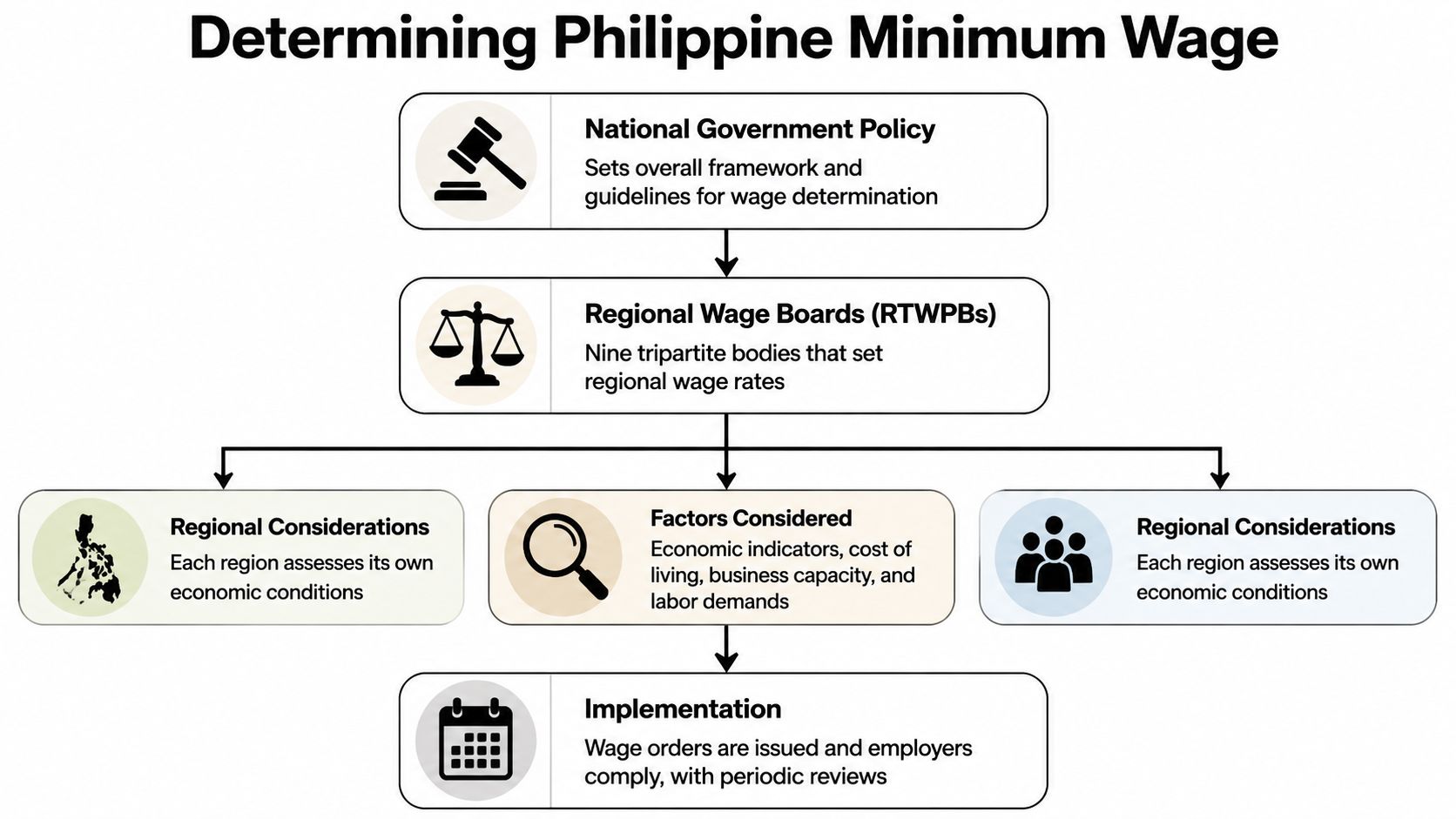
The rule-making structure
Think of the country as a set of separate wage environments. Metro Manila operates under different cost pressures than BARMM, Caraga, or other regions, so the boards don’t set identical rates.
According to GMA News reporting on wage board rates, minimum wage in the Philippines is determined regionally by the 16 Regional Tripartite Wages and Productivity Boards under DOLE, as mandated by Republic Act No. 6727. The same report notes that as of May 1, 2026, NCR non-agricultural daily minimum wage stands at ₱658–₱695 while BARMM ranges from ₱366–₱411.
That range alone explains why online searches feel inconsistent. Two sites can both be correct and still show very different numbers.
A quick explainer helps before you go deeper:
What employers should check before making an offer
The practical sequence is straightforward.
Confirm the work location
Wage compliance follows the employee’s region. If your staff member is based in NCR, use the NCR wage order. If they work from another region, check that region’s order.Identify the correct classification
Different rates may apply depending on whether the role falls under non-agriculture, agriculture, or another covered classification.Check the effective date of the wage order
A stale payroll template causes errors quickly. Wage orders change by issuance date, not by your hiring calendar.Review remote work implications
If you’re running a distributed team, don’t assume one Metro Manila benchmark applies to everyone.
Why the decentralized system changes business strategy
A lot of foreign employers treat wage compliance as a payroll admin task. In the Philippines, it’s also a location strategy issue. A startup choosing between Metro Manila and a provincial site isn’t only comparing rent, internet, or talent pool depth. It’s also choosing a wage environment with different compliance baselines and different hiring pressures.
Practical rule: Don’t approve compensation in the Philippines until HR or payroll has matched the role to the correct region and current wage order.
That one step prevents many of the avoidable mistakes I see in early-stage hiring.
A Map of 2026 Wages Regional and Sectoral Differences
If you want the short answer, the clearest benchmark is NCR at ₱695 per day for non-agricultural workers in 2026. But that number only answers part of the question.
The more useful answer is that wage levels vary widely across the country, and those differences affect where companies build teams, how they structure remote hiring, and what salary expectations they’ll face in practice.
According to Trading Economics data on Philippine minimum wages, as of 2026, the NCR daily minimum wage for non-agricultural workers stands at ₱695. The same source notes that NCR non-agriculture daily minimum wages averaged 382.29 PHP from 1989 to 2026, hit a record low of 89 PHP in 1989, and reached an all-time high of 695 PHP in 2025, a 7.8-fold nominal increase over 37 years.
A practical regional snapshot
For employers, the point isn’t just that wages differ. It’s that those differences can materially change a hiring plan.
| Region or benchmark | Daily wage reference | Practical meaning for employers |
|---|---|---|
| NCR non-agricultural | ₱695 | Highest common benchmark for office-based hiring in Metro Manila |
| Outside NCR typical range | ₱435 to ₱550 | Lower-cost payroll environments in many regions |
| BARMM | ₱366 to ₱411 | Among the lower regional wage bands cited in current reports |
| Caraga | ₱486 | Example of a regional rate outside the major Metro Manila benchmark |
Monthly conversions can mislead if used carelessly
Founders often want a monthly number because that’s easier for budgeting. That’s fine, but the conversion depends on how many paid workdays you assume.
For NCR, verified data places the daily minimum at ₱695, which can equate to roughly ₱15,100 to ₱18,070 monthly depending on the workday assumption used in the source set. That’s useful for rough budgeting, but your payroll model still needs the actual work schedule, holiday calendar, and premium pay exposure.
Sector and location matter more than many first-time employers expect
A lot of online summaries collapse everything into one headline number. That’s where misunderstandings start. Your support agent in Metro Manila, your back-office clerk in a different region, and your field or sector-specific hire may not sit under the same minimum wage framework.
For BPOs and startups, the strategic takeaway is simple:
- Use NCR as the premium benchmark when planning Metro Manila staffing.
- Expect lower legal floors outside NCR, but don’t assume lower total people cost automatically means better value.
- Treat region selection as an operating model decision, not only a payroll decision.
- Recheck rates before each hiring wave, because wage orders can change and recruiters often work from outdated figures.
A cheaper wage region can lower base payroll, but if the role needs niche skills or heavy supervision, the apparent savings may narrow fast.
That’s why I prefer to review wage rates alongside hiring difficulty, schedule design, and service-level expectations instead of treating them as a standalone line item.
Beyond the Daily Rate Your Employer Obligations
Paying the correct minimum wage is only the first layer of compliance. Employers also need to handle the rest of the payroll framework correctly. That includes premium pay rules, statutory benefits, and the practical question of whether the worker’s arrangement is employment or something else.
A common error is assuming that minimum wage compliance only means meeting the daily or monthly base. In practice, DOLE compliance is built from the whole pay structure.
What the minimum wage does and does not cover
The minimum wage generally sets the floor for covered employees. It doesn’t erase your obligation to apply labor standards such as overtime, holiday pay, night shift differential, and 13th-month pay where required by law. Probationary employees are still employees, so employers shouldn’t assume they can be paid below the applicable floor just because they’re on an introductory period.
You also need to account for mandatory government contributions such as SSS, PhilHealth, and Pag-IBIG in payroll administration. Those items are part of employer cost planning even though they’re separate from the wage order itself.
A practical compliance checklist
Use this as a working baseline before launching payroll:
- Match the employee to the correct wage order. Start with region and job classification, then verify the current rate and effectivity date.
- Apply premium pay correctly. Overtime, work on holidays, and night shifts create payroll obligations beyond the base daily rate.
- Include mandatory benefits and contributions. Don’t build budgets on base salary alone.
- Check probationary setups. Probation doesn’t remove minimum labor standards.
- Document payroll logic. If DOLE asks how you arrived at pay, you should be able to show the wage basis and calculations.
Remote-first teams need an extra layer of care
Remote work often creates false confidence. A founder thinks, “The employee works from home, so the setup is simpler.” Usually it’s the opposite. You need clearer documentation on location, hours, equipment policy, and pay treatment.
According to Corpenza’s 2026 guide for Philippine minimum hourly wage and remote workers, a practical compliance approach for BPO providers and corporates includes modeling remote worker pay at 1.2x the regional minimum, such as ₱835 per day for an NCR telecommuter under the Telecommuting Act RA 11165. The same source notes that HB 11376, proposing a ₱200 daily hike, could raise costs by 15-30% if passed.
That doesn’t mean every employer must use that exact multiplier. It does mean serious operators leave room above the legal floor when designing remote compensation.
If you’re comparing flexible operating models, it helps to review what’s included operationally in a managed setup such as workspace and backend support inclusions so payroll assumptions aren’t mixed up with office overhead assumptions.
If your payroll passes a spreadsheet test but fails in scheduling, documentation, or premium computation, it still fails.
Strategic Payroll Budgeting for BPOs and Startups
The best hiring plans in the Philippines don’t start with “What’s the minimum?” They start with “What does this role need to succeed, and in which region can we support that cost structure?”
That’s the difference between compliance budgeting and operational budgeting. Compliance tells you the floor. Strategy tells you whether the floor is enough.

Regional wage gaps create real options
For startups and BPO operators, regional differences can be useful if you approach them carefully. According to Emerhub’s hiring guide on Philippine minimum wage, Metro Manila is at PHP 695 per day, approximately PHP 18,070 per month, while Zamboanga Peninsula is PHP 439–464 per day. The same guide says this can create 20-30% payroll savings for agile businesses using lower-wage regions, while also noting that even the NCR wage is 21% below the poverty threshold, which can increase turnover risk.
That last point matters more than many finance teams expect. A lower payroll line can look efficient on paper but become expensive if you keep replacing people.
What works in practice
I usually advise employers to build a fully loaded cost-per-employee model before they sign an office lease or publish salary bands. That model should include:
- Base pay tied to the correct regional wage order
- Premium pay exposure if the role includes overtime, holidays, or night shifts
- Statutory contributions
- Equipment and connectivity support for remote or hybrid staff
- Attrition buffer if the role sits in a highly competitive talent market
Then pressure-test the model against service needs. A customer support role with strict schedule coverage may need stronger pay than a back-office role with more flexibility.
What doesn’t work
Three habits usually create avoidable payroll stress:
Hiring at the legal floor for skilled roles
You can do it. You may not keep the person.Using Metro Manila benchmarks for all regions
That creates distortion in both directions. Sometimes you overpay relative to local markets. Sometimes you underbudget for talent quality in more expensive areas.Separating payroll from workspace strategy
Headcount cost and operating setup affect each other. If you’re using managed office capacity, shared infrastructure, or seat leasing, model those together.
For businesses exploring flexible setups, providers such as Building 24 workspace solutions can be part of the planning mix when you’re comparing payroll, occupancy, and launch timing in one operating model.
Decision test: If you can’t explain why a role is based in a specific region beyond “the wage is lower,” your location strategy is still incomplete.
The Bigger Picture Wage Trends and Future Outlook
Many employers still ask the wrong long-term question. They ask whether the current minimum wage is affordable. The harder question is whether minimum wage-level compensation will remain workable for hiring and retention over the next planning cycle.
That’s where wage trends matter. Legal compliance may stay stable for a period, while labor pressure rises underneath it.
The gap between legal minimum and perceived fair pay
There’s a clear tension in the market. The legal wage floor exists, but many workers and labor groups argue that it doesn’t meet actual household needs. For employers, that gap shows up in candidate expectations, turnover, and pressure to offer more than the legal minimum even when no new wage order has taken effect.
According to Outsource Accelerator reporting on BPO wage demands, BPO employees are pushing for an approximately PHP 1,200 daily wage, far above the PHP 695 NCR rate, and 16 petitions for a PHP 1,200 NCR wage are pending a decision. The same report says this may pressure employers to budget 50-70% above the minimum to retain talent.
That doesn’t mean every role will move to that level. It does mean employers should stop treating current minimum wage as a stable market rate for all BPO hiring.
What to monitor if you run a team
If you manage payroll planning, keep an eye on these signals:
- Regional wage board updates that change legal baselines
- Pending legislation that could increase required pay
- Sector-specific labor pressure, especially in voice, support, and night-shift heavy operations
- Recruiter feedback about offer rejection patterns
- Voluntary attrition trends inside your own team
A business that waits for a formal wage increase before adjusting salary bands is often reacting too late.
How to budget under uncertainty
The cleanest approach is to build three payroll views:
| Budget view | What it assumes | When to use it |
|---|---|---|
| Compliance floor | Current legal minimum and statutory obligations | For legal baseline checking |
| Hiring market view | Pay level needed to fill roles reliably | For actual recruiting decisions |
| Pressure scenario | Higher pay assumptions if labor demands or law changes move faster | For board or management planning |
If you follow wage developments closely, a resource hub such as the Seat Leasing BPO blog can help teams track broader operating issues around staffing and setup, not only wage headlines.
Frequently Asked Questions on Philippine Wages
Does minimum wage apply to part-time workers and freelancers
For part-time employees, labor standards still matter. Employers should treat the wage order seriously and make sure pay is handled in line with lawful employment standards for covered workers.
For freelancers or independent contractors, the issue is classification. If the arrangement functions like employment, calling someone a freelancer won’t remove compliance exposure. That’s why contracts, control over working time, reporting lines, and supervision practices matter just as much as the label on the agreement.
Does minimum wage apply to probationary employees
Yes, probationary status doesn’t cancel minimum labor standards. If the worker is an employee and covered by the applicable wage order, the legal floor still applies. Probation is about evaluation period and regularization standards, not permission to pay below lawful rates.
How are kasambahay wages handled
Domestic workers, or kasambahay, are handled under a different framework from standard office or non-agricultural roles. The verified data includes an NCR kasambahay rate, which shows why employers shouldn’t assume one wage chart covers every worker type. If you’re hiring household support staff rather than office staff, check the correct category before preparing any contract or payroll setup.
What are the penalties for non-compliance
Non-compliance is not something employers should treat casually. The verified data states that employers face DOLE fines of up to ₱100,000 per violation for wage-related non-compliance under the cited framework. Beyond penalties, wage errors create back pay issues, employee complaints, and reputational damage.
What’s the safest approach for a new employer
Use a short rule set:
- Verify the region first
- Check the current wage order
- Confirm the worker classification
- Model total payroll cost, not only base wage
- Review offers with HR or counsel before rollout
That process is slower than copying a number from a blog post. It’s also cheaper than fixing payroll errors after hiring.
If you’re setting up a team and want a cleaner way to align workspace planning with hiring costs, Seat Leasing BPO offers flexible office and support setups that can help businesses separate payroll decisions from the burden of building infrastructure from scratch.