Your team may already outsource payroll, customer support, or data entry. Those systems run fine. The harder problem appears later, when growth starts depending on better judgment, not just better execution.
You need a deeper market read before entering a new region. You need financial analysis before raising capital. You need someone to review patent information, interpret a messy dataset, or turn scattered customer signals into a usable strategy. That is usually the moment people ask, what is a KPO, and how is it different from standard outsourcing?
A simple answer is this. KPO stands for Knowledge Process Outsourcing. It means hiring outside specialists to handle work that requires expertise, analysis, and decision support. It is less about moving tasks off your plate and more about adding high-level capability without building every function in-house from scratch.
For startups and smaller businesses, that matters even more. Many companies can afford routine outsourcing. Fewer can afford a full internal bench of analysts, researchers, legal specialists, and domain experts plus the secure infrastructure those teams need. Modern operating models have changed that equation, especially when flexible workspace and managed backend support make specialist teams easier to launch.
Beyond Simple Tasks The Growing Need for Expertise
A common growth scenario looks like this. A company has already cleaned up operations, outsourced routine admin work, and built repeatable processes. The machine runs well. Then leadership faces a different class of problem. The next decision is not about doing more work faster. It is about making better calls with limited time, limited information, and real money at stake.
A founder may need to decide whether a new market is worth entering. A services firm may need to know which client segment drives margin. A product team may need help testing whether an R&D path can turn into revenue. Those questions sit closer to consulting than clerical work. They depend on analysis, judgment, and context.
Where basic outsourcing stops helping
Traditional outsourcing works best when the work follows a clear process. Invoice handling, support tickets, and appointment scheduling fit that model. You define the steps, track turnaround time, and measure accuracy.
Expert work follows a different logic.
The input is often messy. The method is not always fixed. The person doing the work has to weigh evidence, choose an approach, and explain what the findings mean for the business. That is why KPO's value has grown. Companies still care about efficiency, but many of their biggest wins now come from sharper pricing decisions, better market selection, stronger compliance analysis, and faster access to specialist thinking.
A simple analogy helps. Basic outsourcing works like hiring extra hands for a well-written playbook. KPO works more like adding an experienced analyst or adviser who can help write the playbook when the situation is unclear.
Why this matters to smaller companies
Large enterprises can afford in-house teams across research, finance, legal support, and analytics. Startups and SMEs usually have a narrower budget and less room for hiring mistakes. They still need expert judgment, but they need a practical way to access it.
That is where modern KPO models become useful in operational terms. A business does not always need to build a full department from scratch, sign a long office lease, buy new infrastructure, and recruit every specialist one by one. It can set up a leaner model instead, using an external knowledge team and flexible arrangements such as seat leasing to lower the cost and setup burden.
Key takeaway: KPO gives smaller companies a way to add expert capability without carrying the full cost and complexity of building every specialist function internally.
The shift matters because the primary constraint for many growing companies is no longer task capacity. It is decision quality. When revenue, risk, product direction, or expansion plans depend on better analysis, access to expertise becomes a practical growth tool, not a back-office convenience.
Defining Knowledge Process Outsourcing
Knowledge Process Outsourcing means outsourcing work that depends on advanced expertise, analysis, and professional judgment. The output is not just completed activity. The output is insight.
A useful analogy makes the difference clearer. If BPO is like hiring someone to follow a recipe exactly, KPO is like hiring a master chef to design the menu, source the ingredients, and decide what should be served in the first place.
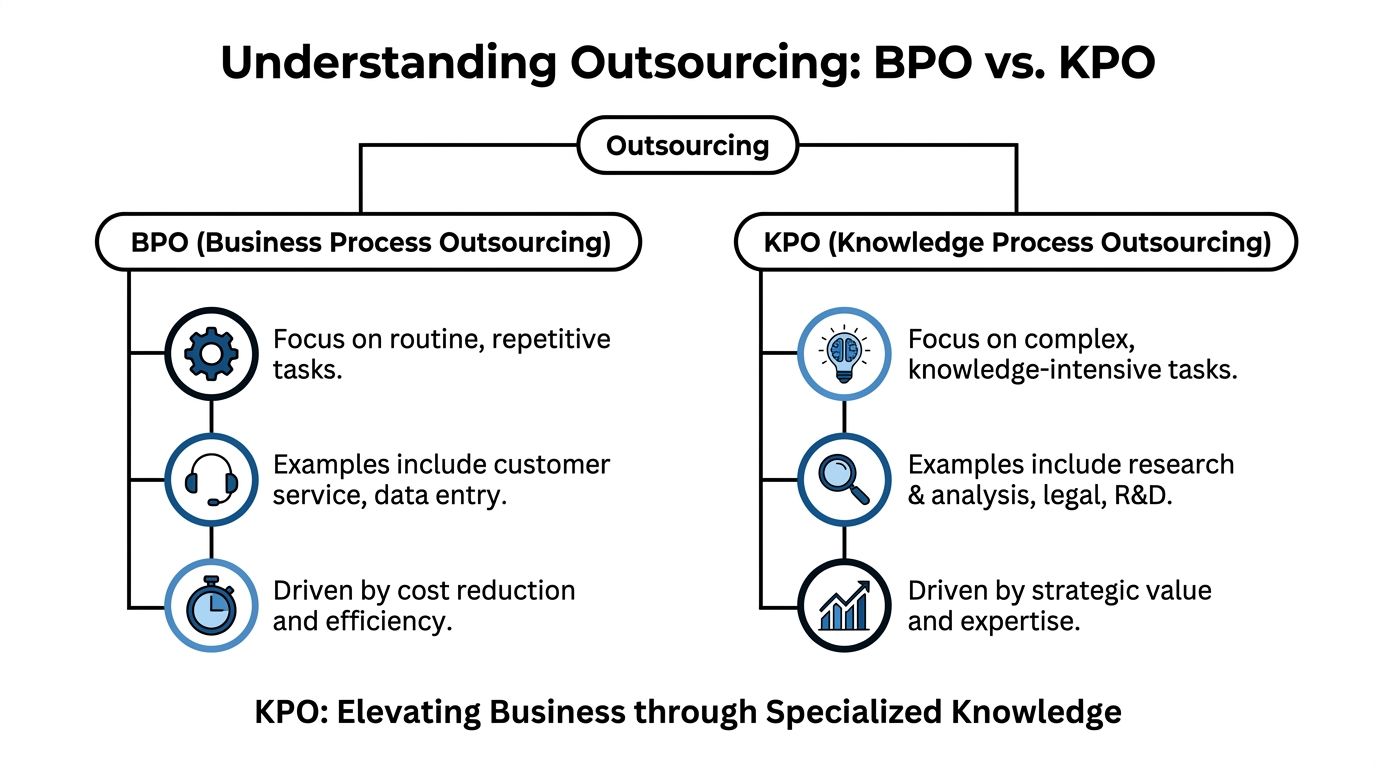
What makes KPO different
KPO work usually has three features.
- It requires judgment: The specialist must interpret information, not just process it.
- It depends on expertise: The work often calls for domain knowledge in fields like finance, law, healthcare, engineering, or research.
- It influences decisions: The result helps a company choose what to do next.
That last point is the most important. A KPO team is often close to strategy. It may support pricing, investment decisions, product direction, compliance analysis, or market entry planning.
What kinds of work count as KPO
The exact scope varies by industry, but common examples include:
- Market research and competitive intelligence
- Financial analysis and investment research
- Legal research and intellectual property support
- Data analytics and business insight generation
- Research and development support
- Specialized healthcare and clinical analysis
In each case, the provider is expected to bring more than effort. They bring method, interpretation, and informed recommendations.
A better mental model
Many readers get confused because the word outsourcing often implies a back-office cost play. KPO is broader than that.
Think of a KPO partner as an external extension of your company’s intellectual capacity. They do not just execute instructions. They help shape better instructions.
That is why businesses use KPO when they face questions that are expensive to answer badly. If your company needs analysis that will affect capital allocation, product investment, legal exposure, or market timing, KPO sits in the conversation.
KPO vs BPO Unpacking The Key Differences
People often treat KPO and BPO as the same model with different task difficulty. That misses the strategic difference.
BPO is mainly about moving defined processes to a specialist operator. KPO is about bringing in people who can analyze, interpret, and advise. One model is primarily execution-focused. The other is insight-focused.
KPO vs BPO At a Glance
| Criterion | Business Process Outsourcing (BPO) | Knowledge Process Outsourcing (KPO) |
|---|---|---|
| Primary focus | Operational efficiency and process delivery | Strategic value, analysis, and decision support |
| Nature of work | Rule-based, repetitive, process-driven | Judgment-based, analytical, expertise-driven |
| Typical examples | Customer service, data entry, payroll support | Financial analysis, research, legal support, advanced analytics |
| Talent profile | Process-trained staff | Domain specialists with deeper subject expertise |
| Management style | SOPs, scripts, workflow controls | Collaboration, briefs, review cycles, interpretation |
| Output | Completed transactions and service levels | Recommendations, models, research, insights |
| Best use case | Stable, repeatable tasks | Complex questions with business impact |
| Relationship type | Vendor-client, often transactional | Closer partnership, often consultative |
A practical way to choose
Use BPO when the process is known and success depends on consistency.
Use KPO when the question is still open and success depends on the quality of thinking.
For example:
- BPO fit: Handling inbound support tickets with standard resolution paths.
- KPO fit: Studying support ticket themes to identify product gaps, churn risk, and pricing friction.
One handles volume. The other extracts meaning.
Where teams get mixed up
Confusion usually happens in the middle zone, where a process includes both execution and analysis. Reporting is a good example. Sending a weekly report can be BPO. Redesigning the report, combining multiple sources, spotting patterns, and recommending action turns it into KPO.
This is also why internal knowledge systems matter. If your company wants outside specialists to produce useful work quickly, your briefs, documentation, and decision history need structure. A practical resource on that front is this guide to Knowledge Management best practices, which helps teams organize what experts need to work effectively.
Tip: If you can write a rigid script for the task, it is probably closer to BPO. If you need a specialist to challenge assumptions and interpret evidence, it is probably KPO.
Common KPO Services and Industries That Use Them
A founder is preparing to enter a new market. Customer data is scattered across tools, competitors are shifting prices, and investors want a credible forecast. The team does not need extra hands to process tickets or update spreadsheets. It needs specialists who can interpret evidence, pressure-test assumptions, and turn uncertainty into a recommendation.

That is the practical face of KPO. The work usually falls into a few common service areas, and each one supports a different business decision.
Data analytics and business insight
Many companies already have plenty of data. Their real problem is turning raw inputs into direction.
A KPO team can combine customer records, product usage data, CRM notes, and sales history into a clearer picture of what is happening and what the business should do next. That may include segmentation, trend analysis, forecasting, pricing analysis, churn signals, or scenario planning. If you want a plain-language explanation of one method often used in this work, this guide to predictive modeling is a helpful starting point.
This service is common in healthcare, finance, SaaS, e-commerce, and logistics because leaders in those fields make decisions under time pressure and with a lot of moving parts.
Market and business research
Market research in a KPO setting goes beyond collecting facts. It answers questions a leadership team is actively betting on.
A startup planning expansion might ask which customer segment is easiest to win first, which competitors are strongest in the mid-market, how pricing norms vary by region, or where demand is rising fast enough to justify a launch. A good KPO research team does more than gather articles. It compares sources, filters weak signals from strong ones, and produces a recommendation the business can act on.
That matters most when the cost of being wrong is high.
Financial and investment analysis
Financial KPO is often the easiest category to recognize because the output directly affects capital allocation. The work must be accurate, well-structured, and defensible.
Common examples include:
- Investment memos
- Valuation support
- Equity or sector research
- Risk reviews
- Financial modeling
This category is widely used in finance and healthcare, showing KPO is common in complex, high-stakes fields. A mistake in a financial model or diligence review can shape hiring plans, investor conversations, or acquisition decisions for months.
Legal and intellectual property support
Legal work is a good example of why KPO sits above routine processing. Some legal tasks follow a clear workflow. Others require careful interpretation.
KPO providers often support contract analysis, legal research, patent searches, compliance review, and intellectual property assessment. If a company is developing a new product, it may need to know whether a feature overlaps with existing patents or creates regulatory risk in a target market. That requires specialist judgment, not simple document handling.
Research-heavy sectors
Some industries depend on KPO because their decisions rest on technical detail and large volumes of information. In those settings, specialist support acts like an external bench of analysts the company can call on without building a full in-house department first.
Examples include:
- Healthcare and life sciences: clinical data review, medical analysis, research support
- Technology: product research, competitive mapping, technical documentation analysis
- Manufacturing: supply intelligence, process optimization research
- Professional services: legal research, due diligence, specialist reporting
For startups and SMEs, the practical question is often not whether expert work is needed. It is how to access that expertise without the fixed cost of building a full team from scratch. That is why many operators pair KPO with flexible delivery models and operating setups discussed on the seat leasing and outsourcing insights blog.
The Strategic Benefits and Inherent Challenges of KPO
KPO can be powerful, but it is not automatic. The same qualities that make it valuable also make it harder to manage than routine outsourcing.

Strategic benefits
The biggest benefit is access. A business can tap specialized talent without waiting to recruit, onboard, and build an entire department.
Another major advantage is speed. Studies indicate KPO adoption can yield 30 to 50 percent faster time-to-insight compared to in-house teams, according to the Wikipedia overview of knowledge process outsourcing. For businesses making decisions in fast-moving markets, that can be meaningful.
KPO also helps leadership protect internal attention. Instead of stretching a small team across every research and analysis need, managers can let internal staff focus on priorities only they can own, such as product vision, customer relationships, and executive decision-making.
Some organizations also use KPO to test a capability before committing to a permanent internal build. That is a practical way to reduce risk when demand is still uncertain.
Inherent challenges
The challenges are just as real.
Alignment risk
A specialist can be highly capable and still miss the mark if they do not understand your business context. Strong KPO work depends on clean briefs, access to the right information, and regular calibration.
Data and confidentiality concerns
KPO often touches sensitive information. That may include financial models, customer records, research data, legal documents, or product plans. Companies need strong controls over access, handling, and review.
Quality control is harder than in routine outsourcing
With repetitive process work, quality is easier to measure. In KPO, the output may be a recommendation, an interpretation, or a research conclusion. That means review standards need more nuance.
Practical rule: Before outsourcing a judgment-heavy function, decide how you will evaluate quality. Speed alone is not enough.
Communication gaps
A weak handoff causes expensive misunderstandings. Specialist work usually improves when the business provides examples, definitions, decision criteria, and feedback loops early.
KPO works best when both sides treat the relationship as collaborative, not transactional.
How to Launch Your KPO Function With a Modern Approach
For many businesses, the hardest part of KPO is not deciding they need it. The hardest part is setting it up in a way that is secure, practical, and affordable.
That is where modern operating models matter. A company no longer has to choose only between building a full in-house department and outsourcing everything in a loose, disconnected way. There is a middle option. You can design a KPO function that combines outside expertise with flexible infrastructure.

Start with the business question, not the org chart
The first mistake companies make is asking, “Who should we hire?” before asking, “What problem are we solving?”
A better sequence looks like this:
- Define the decision you need help with
Example: market entry, pricing, valuation support, patent research, customer analytics. - Identify the specialist capability behind that decision
That may be financial modeling, legal research, healthcare analysis, or data science. - Separate ongoing needs from project-based needs
Some KPO work is continuous. Some is best handled as a scoped engagement.
This keeps the function tied to outcomes rather than titles.
Build the operating environment early
A KPO function needs more than smart people. It often needs stable internet, secure devices, controlled access, cybersecurity support, collaboration tools, and a workspace that can be activated quickly. For startups and SMEs, flexible seat leasing has become useful. According to Pexly’s discussion of BPO and KPO models, modern seat leasing setups can provide a KPO-ready workspace with up to 80% cost savings on office setup, including core IT and cybersecurity infrastructure.
That matters because many smaller firms do not fail at strategy. They stall on implementation friction.
Use a hybrid launch model
A practical rollout often looks like this:
Phase one: Pilot one high-value function
Choose a problem that is important enough to matter but narrow enough to manage. Examples include competitor research for one market, one financial analysis workstream, or one structured data insight project.
Phase two: Standardize inputs
Create a simple package for the provider or specialist team:
- Business background
- Scope of work
- Definitions and assumptions
- Templates or sample outputs
- Review cadence
- Security rules
Good KPO relationships improve when the first brief is unusually clear.
Phase three: Add infrastructure that scales with demand
As needs grow, workspace and backend support become operational issues, not side details. Businesses comparing managed environments often review practical inclusions like connectivity, IT support, utilities, and security at https://seatleasingbpo.com/inclusions/.
Phase four: Decide what stays external and what moves in-house
Some capabilities should remain outsourced because they are specialized or uneven in demand. Others may become core enough to internalize later. KPO can be a permanent model or a bridge model.
Where seat leasing fits in
Most articles stop at “outsource expertise.” They do not address the physical and technical setup required to make that expertise usable.
Seat leasing helps in three ways:
- Faster deployment: You can activate a workable environment without a traditional office build-out.
- Lower setup burden: Core infrastructure is already in place.
- More flexibility: Teams can scale up or down without long-term real estate commitments.
For a startup, that can mean launching an analytics or research unit without taking on the full cost and distraction of office setup. For a larger business, it can mean creating an expansion pod for specialized work without slowing down internal teams.
Key takeaway: KPO strategy is not only about finding experts. It is about creating a reliable environment where expert work can happen quickly and securely.
A simple checklist before you begin
- Clarify the business outcome: What decision should this work improve?
- Choose the right work type: Research, analysis, legal support, financial modeling, or another specialist function.
- Confirm data access rules: Decide what can be shared and under what controls.
- Document quality standards: Define what “good” looks like before the first deliverable arrives.
- Pick an operating model: Remote specialist support, embedded team, or a hybrid setup using flexible workspace.
- Review after the first cycle: Improve the brief, not just the people.
A good KPO launch is rarely dramatic. It is structured, deliberate, and tied to a real business need.
Conclusion The Future of Business is Knowledge-Driven
KPO is not just another outsourcing label. It is a way to access specialized thinking when business decisions become too important for generic support.
If you came to this article wondering what is a KPO, the practical answer is simple. It is a model for outsourcing expertise, analysis, and judgment-heavy work that shapes strategy, not just operations.
For startups and smaller firms, the most important shift is that KPO is no longer reserved for companies with large budgets and long setup timelines. Flexible infrastructure and managed workspace models have made it easier to launch specialist functions without carrying the full burden of a traditional office build.
If you are evaluating how to put that kind of capability in place, https://seatleasingbpo.com/contact/ is one place to start the conversation.
If you need a flexible, lower-friction way to support a KPO team, Seat Leasing BPO offers workspace solutions designed for fast deployment, managed backend support, and reduced setup burden. It is a practical option for businesses that want to access specialized talent without taking on the full cost and complexity of building a traditional office environment first.