A lot of businesses hit the same wall at the worst possible moment. Sales finally lands a bigger account, delivery deadlines tighten, and someone in leadership realizes the team that won the work isn't the team that can execute it.
That's when resourcing in business stops being a planning exercise and becomes an operating problem. You can hire. You can contract. You can outsource. You can patch together a temporary team and hope the gaps don't show up in front of the client. Every option has a cost, but pressure comes from the trade-off behind the choice: how fast you need capacity, how much control you need over execution, and how much fixed cost the business can carry.
Teams often get into trouble because they treat resourcing as a headcount question. It isn't. It's a business design question. If you choose the wrong model, you don't just overspend. You slow delivery, overload managers, and lock yourself into a structure that no longer fits six months later.
The Strategic Role of Resourcing in Business Growth
A familiar scenario plays out in growing companies. The commercial team brings in new work. Operations says yes because saying no feels riskier. Then the bottlenecks surface all at once: no spare delivery capacity, no clear bench, no reliable hiring pipeline, and no time to build support functions around the new demand.
That's why resourcing belongs at the center of business strategy, not off to the side as an HR or finance task. It determines whether the company can absorb growth without breaking service quality. It also determines whether leadership stays focused on customers and product, or gets dragged into recruiting, onboarding, facilities, equipment, and team coordination.
The broader market has moved in the same direction. The global BPO sector is projected to reach $525 billion by 2030, growing at over 9% annually, and 70% of global businesses now outsource to reduce operational expenses, according to outsourcing market statistics. That doesn't mean every business should outsource by default. It means companies are rethinking how they access capacity.
Growth exposes weak resourcing decisions
The early version of a company can survive with improvisation. Founders fill gaps themselves. Managers carry extra work. Generalists stretch across functions. That approach stops working once delivery commitments become less forgiving.
Some of the most expensive mistakes happen when leaders hire too early, hire too narrowly, or hire for prestige instead of workload reality. The lesson in these early hiring mistakes is useful because it shows how fast a staffing decision can become a structural problem.
Practical rule: If a new deal requires immediate capacity, ask whether you need permanent headcount, temporary expertise, or ready-to-use operating infrastructure. Those are different needs, and they call for different solutions.
A strong resource model gives the business room to move. It lets leadership add capacity without committing to unnecessary overhead, and it keeps delivery from depending on heroic effort. That's the strategic role of resourcing in business. It protects momentum.
For companies evaluating more flexible operating setups, Seat Leasing BPO sits inside that broader shift toward lower-friction capacity planning.
What Exactly Is Business Resourcing?
Resourcing in business is the discipline of making sure the company has the right people, tools, budget, and time to deliver what it has promised. Not eventually. On schedule, at the right quality level, without grinding the team down.
A simple way to think about it is a race car pit crew. The driver matters, but the driver alone doesn't win. You need the crew, the equipment, the fuel strategy, and the timing. If one part is missing, the whole system slows down.

People are only one part of the equation
When most leaders say they have a resourcing issue, they usually mean they need more staff. Sometimes that's true. Often the underlying problem is narrower. They may need a specific skill, better role clarity, or coverage during a peak workload period.
The people side of resourcing includes:
- Skill fit. Can the team do the work at the level the client expects?
- Availability. Are those skills available to take on new demand?
- Management capacity. Does anyone have the bandwidth to lead the added work?
- Continuity. If one key person leaves, does delivery stall?
Many businesses overcorrect in this area. They hire full-time when the need is variable, or they bring in specialists without a plan for integration.
Tools and infrastructure shape output
A team without the right environment will underperform even if the talent is strong. In practice, resourcing includes software access, hardware, security controls, connectivity, desks, support coverage, and workflow systems.
That matters even more when businesses rely on external teams. Anyone trying to improve service operations should also understand the mechanics of optimizing customer experience through BPO, because service quality often depends on the surrounding operational setup, not just the people answering the queue.
Good resourcing removes friction before it shows up in delivery.
Budget decides your operating model
Budget is where strategy becomes real. Leadership has to decide what belongs in fixed cost and what should stay variable. A permanent employee, a freelancer, a managed provider, and a seat leasing arrangement may all solve the same immediate capacity issue, but they land very differently on cash flow and risk.
A few practical questions help:
| Resourcing pillar | What to ask |
|---|---|
| People | Do we need deep expertise, flexible capacity, or long-term ownership? |
| Tools | What systems, access, and support must be in place on day one? |
| Budget | Can we absorb fixed overhead, or do we need an operating expense model? |
| Time | How quickly does this resource need to be productive? |
Time is the constraint leaders underestimate
Time isn't just about recruitment speed. It includes setup time, onboarding, workflow alignment, and the delay between signing a client and getting a team fully productive. Businesses often discover that the hidden cost of resourcing isn't the invoice. It's the lost momentum while operations catches up.
If you're looking at practical operating setups and support models, the Seat Leasing BPO blog is useful as a reference point for how flexible infrastructure fits into wider workforce planning.
Comparing Resourcing Models From Hiring to Seat Leasing
Different resource models exist because businesses don't all need the same thing. Some need long-term ownership of a function. Some need burst capacity. Some need speed more than control. The mistake is pretending one model solves every operating problem.
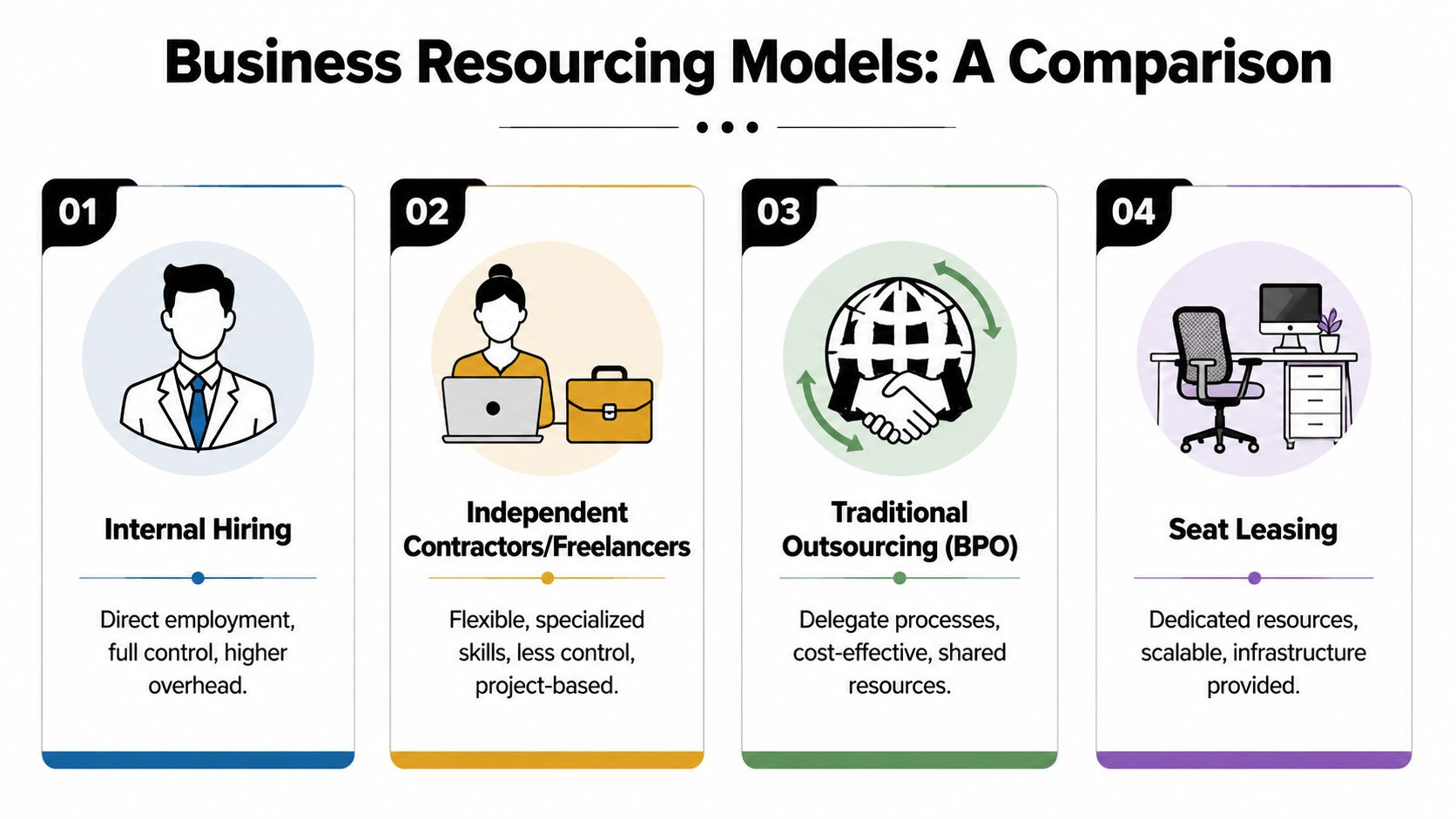
Outsourcing became a formalized business strategy in 1989, and current motivations include reducing costs (59%), focusing on core functions (57%), and solving capacity issues (47%), according to this history of outsourcing. That history matters because it explains why the market moved beyond the old hire-versus-outsource debate. Businesses wanted more nuanced models.
Internal hiring
Internal hiring gives the business the highest degree of direct control. People work inside your systems, report into your managers, and build institutional knowledge over time. If a function is core to your differentiation, this is often the strongest long-term option.
But internal hiring is slow and expensive to build around. The salary is only part of the decision. You also take on recruitment effort, onboarding, management load, equipment, workspace, compliance, and the risk of carrying fixed cost when demand softens.
Internal hiring works best when:
- The capability is strategic and should stay close to leadership.
- The workload is stable enough to justify permanent roles.
- The company can absorb setup friction and doesn't need immediate deployment.
It works poorly when demand is uncertain or the business is still testing its delivery model.
Independent contractors and freelancers
Freelancers are useful when the problem is narrow. You need a designer for a launch, a developer for a feature, a recruiter for a burst of hiring, or a finance specialist for a transition period. They can bring expertise quickly without adding full-time headcount.
The trade-off is continuity and coordination. Contractors are often effective at defined outputs, but they're not always built for integrated team operations. If the work depends on deep process knowledge, repeated collaboration, or day-to-day management visibility, the model gets harder to run.
A freelancer model is often strongest when:
- The scope is specific
- The work is project-based
- The business can tolerate some handoff risk
It's a weak fit when leaders need a stable team rather than a collection of individual contributors.
Traditional outsourcing
Traditional BPO works when the business wants to transfer an entire process or function to an external partner. Customer support, back-office processing, and standardized operational workflows often fit this model well.
The benefit is scale and operational maturity. The drawback is that companies can lose visibility if they outsource too much too quickly or hand off work that isn't well documented. Traditional outsourcing also tends to work best when the process is already defined. If the workflow is still changing every month, the handoff gets messy.
If your process is unstable, outsourcing will expose the instability. It won't fix it.
Seat leasing
Seat leasing is a useful middle path when the business wants some of the speed and cost flexibility of outsourcing, but with a more dedicated operating setup. Instead of building office infrastructure, IT support, connectivity, and facility operations from scratch, the business plugs into an environment that's already built for use.
That changes the trade-off. Leadership doesn't have to commit upfront to the full burden of facilities and support infrastructure, but it also doesn't have to hand over the entire operating model in the way a traditional outsourcing arrangement might require. For many teams, that's the actual sweet spot.
Side by side comparison
| Model | Cost structure | Speed to deploy | Control level | Scalability | Admin load |
|---|---|---|---|---|---|
| Internal hiring | Higher fixed overhead | Slower | Highest | Slower to expand or shrink | Highest |
| Freelancers | Variable, project-based | Fast for specific roles | Moderate to low | Flexible in bursts | Moderate |
| Traditional outsourcing | Operating expense oriented | Faster for process coverage | Lower direct control | Strong for repeatable functions | Lower internally |
| Seat leasing | More flexible than full office buildout | Fast when infrastructure is ready | Moderate to high, depending on setup | Strong for staged growth | Lower than internal build |
The practical choice comes down to one question: what kind of flexibility do you need? A lot of businesses say they need cheaper talent when what they really need is faster, lower-friction capacity with enough control to protect quality.
How to Build Your Strategic Resource Plan
A workable resource plan doesn't need a strategy department. It needs operational honesty. Most failures happen because leadership guesses future demand, overstates current capacity, or compares options using only salary cost instead of total delivery cost.
According to SHRM guidance on business-driven recruiting, businesses using data-driven forecasting achieve 25% to 40% improvements in resource utilization rates, and that kind of forecasting helps identify projected skill gaps, including a 15% to 20% shortfall in cybersecurity specialists. The point isn't that every company needs advanced forecasting software. The point is that planning beats intuition.
Start with demand, not org charts
Begin with the work that is coming. Look at committed projects, likely deals, seasonality, renewal risk, and support load. A spreadsheet is enough if the categories are clear.
Track:
- Upcoming delivery commitments by month or quarter
- Skill requirements attached to each project
- Peak periods where multiple demands overlap
- Dependencies such as IT setup, onboarding, training, or client approval
If your business handles technical or specialist workloads, some of the ideas in these resource allocation methods for AI projects are helpful because they force teams to think in terms of scarce skills and sequencing, not just headcount.
Audit current capacity honestly
Many plans go wrong at this stage. Leaders count every employee as available capacity, even when a large share of time is already spoken for by meetings, support work, rework, training, and management tasks.
A better audit includes:
- Named roles and actual skills, not just job titles
- Current allocation, including how much time is already committed
- Bench strength, if any exists
- Single points of failure, where one person carries critical knowledge
Field note: Capacity on paper isn't the same as usable capacity. If a team is already stretched, assigning new work only hides the gap for a few weeks.
Run a gap analysis
Once future demand and current capacity are visible, the gaps become easier to classify. Some are permanent. Some are temporary. Some are really infrastructure gaps dressed up as hiring problems.
Three common categories show up:
- Skill gap. The business lacks a capability, such as technical support or compliance expertise.
- Volume gap. The team has the skills but not enough hands for the current workload.
- Speed gap. The business could solve the problem eventually, but not in the required timeframe.
Each gap points toward a different answer. Permanent skill ownership may justify hiring. Burst demand may call for contractors. A speed-and-infrastructure gap may fit a more flexible operating model.
Compare options using total cost and execution risk
A salary comparison won't tell you enough. Build a simple decision sheet that includes direct cost, manager time, setup needs, delivery risk, and how easily the model can scale up or down.
| Option | Best use case | Hidden risk to check |
|---|---|---|
| Full-time hire | Long-term, core function | Slow ramp and fixed overhead |
| Contractor | Specialist, short-duration work | Fragmented ownership |
| Outsourced team | Repeatable process work | Weak process definition |
| Flexible workspace model | Fast team setup with lower infrastructure burden | Need for strong oversight and clear operating rules |
A strategic resource plan should leave you with one clear outcome: what you need now, what can wait, and which costs you're choosing to keep variable.
Resourcing in Action The Seat Leasing Advantage
The businesses that benefit most from flexible resourcing usually aren't looking for novelty. They're looking for relief. They need a way to add delivery capacity without signing up for every fixed cost and operational distraction that comes with building a full office environment from scratch.

That's especially true for startups and smaller firms. As this resourcing strategy discussion points out, there's a real gap in guidance for capital-constrained startups. Most resourcing advice assumes access to full-time hiring budgets and mature internal infrastructure. Many companies don't have that.
Where traditional advice breaks down
Take a common operating scenario. A startup has product traction and needs support, admin, or back-office capacity to keep up with customers. Hiring locally is possible, but office setup, IT support, internet, security, utilities, and facilities management all become parallel projects. Leadership suddenly spends time solving operating basics instead of product and revenue problems.
Traditional outsourcing can solve some of this, but it may also create distance if the company needs a more dedicated setup or wants tighter control over how the team works day to day.
Seat leasing fits the gap between those two extremes. It gives a business a ready environment to place and run a team without building the full support structure itself. The value isn't just lower cost. It's lower drag.
Why the model works operationally
A seat leasing setup works best when the business wants to stay focused on execution and avoid spending leadership time on office logistics and technical support. The model is particularly useful when the company needs to scale in stages rather than commit to a full permanent footprint all at once.
The advantage usually shows up in four places:
- Faster operational readiness because workspace infrastructure is already in place
- Lower capital burden because the business avoids building every support layer itself
- Better flexibility when team size changes with client demand
- More management focus on output instead of facilities and backend operations
For businesses evaluating what's included in these arrangements, reviewing seat leasing inclusions helps clarify the operational scope.
A short walkthrough of the model helps make the setup more concrete.
The real trade-off
Seat leasing is not magic. It doesn't remove the need for management discipline. Companies still need clear roles, defined workflows, onboarding, and performance oversight. If leadership treats the model as a way to avoid managing, the arrangement will underdeliver.
Use seat leasing when you want to reduce infrastructure burden, not when you want to outsource accountability.
What it does solve well is the agility-versus-cost problem. Instead of choosing between expensive internal buildout and less flexible outsourcing structures, the business gets a more adaptable operating base. For many companies, that's the difference between scaling carefully and getting trapped by their own overhead.
Measuring Success and Avoiding Common Pitfalls
A resource model isn't successful because it sounds efficient in a planning deck. It's successful when the business delivers on time, protects margin, and can scale without constant operational firefighting.
One of the most useful discipline shifts is to measure resourcing as an operating system, not just a staffing action. According to iCIMS on data-driven talent sourcing, predictive analytics can cut time-to-fill by 30% to 50%, and teams should track metrics such as source-of-hire, quality-of-hire, including 90-day retention above 85%, and cost-per-hire with a target below $4K for technical roles in BPO hubs. Even if your model isn't based on full-time hiring alone, the lesson still applies. Track what matters.
What to measure
Start with a compact scorecard. Too many metrics create noise. Too few metrics hide problems until they turn expensive.
Focus on measures such as:
- Resource utilization. Are people meaningfully occupied, or are you paying for idle capacity?
- Time-to-fill or time-to-deploy. How long does it take to convert a demand signal into productive capacity?
- Quality of hire or quality of placement. Are new resources stable and effective after onboarding?
- Project delivery reliability. Does the model support deadlines, or increase slippage?
- Management burden. Are leaders spending more time coordinating than they should?
A good scorecard should answer two questions. Did we add capacity fast enough, and did that capacity improve delivery?
Where companies get it wrong
The same mistakes show up across almost every resourcing model.
| Pitfall | What it looks like | Better approach |
|---|---|---|
| Buying on price alone | Lowest-cost option creates rework and oversight issues | Compare operating fit, not just invoice value |
| Vague scope | Teams start work without clear ownership or output definitions | Document tasks, handoffs, and success criteria |
| Weak onboarding | New resources wait for access, context, or decisions | Prepare systems, workflows, and reporting lines before day one |
| No manager assigned | External or hybrid teams drift because nobody owns outcomes | Name one operational owner internally |
| Overcommitting too early | Leadership locks into a structure before demand stabilizes | Scale in stages and review capacity regularly |
Practical safeguards
A few habits prevent most resourcing problems before they expand:
- Write the operating brief. Spell out responsibilities, tools, escalation paths, and expected outputs.
- Stage the rollout. Add capacity in steps instead of building for a future you haven't earned yet.
- Protect onboarding time. Even flexible models need context and process alignment.
- Review monthly. Workload, service levels, and staffing assumptions change faster than annual plans admit.
Strong resourcing decisions are rarely perfect on day one. They become effective because leaders review them early, fix friction quickly, and keep the model aligned with demand.
Resourcing in business works when it stays dynamic. The right answer today may become the wrong one after a product launch, a new client segment, or a change in cash flow. Good operators don't aim for a permanent answer. They build a system that can adapt without destabilizing the business.
If you need a more flexible way to scale your team without taking on the full burden of office setup, IT infrastructure, and long-term facility costs, Seat Leasing BPO offers a practical model worth evaluating. It's a strong fit for businesses that want to grow capacity, stay focused on core operations, and keep their cost structure adaptable.