A prospective client asks a simple question on a discovery call: “What quality assurance standards do you follow?” If your answer is vague, the client hears risk. If your answer sounds like a pile of policies nobody uses, the client hears bureaucracy.
Most service businesses hit this point earlier than expected. A startup lands bigger accounts. A BPO adds more teams, more shifts, more handoffs. A seat-leasing provider starts supporting clients who care about uptime, access control, incident response, and clean facilities, not just desk count and monthly price. Quality stops being a nice internal idea and becomes part of the buying decision.
The good news is that quality assurance standards don't have to mean building a huge compliance machine. In practice, they mean something much simpler and more useful: defining what “good” looks like, proving people can deliver it consistently, and catching drift before the client feels it.
What Are Quality Assurance Standards Really
The plain-English version is this: quality assurance standards are agreed rules for how work gets done, checked, and improved. They aren't just certificates framed on a wall. They're the operating discipline behind consistent service.
In a BPO or startup setting, that usually means you can answer practical questions without hesitation. How do you onboard a new client? Who checks setup readiness? How do you handle missed SLAs? What evidence shows that the process was followed? If the answer changes depending on who is on shift, you don't have a quality system yet.

Think of standards as a recipe book
A good recipe doesn't just list ingredients. It defines sequence, timing, checks, and what the finished result should look like. Quality assurance standards do the same thing for operations.
That matters because service businesses don't fail only from major breakdowns. They fail from variation. One team documents incidents well. Another doesn't. One supervisor escalates quickly. Another waits. One onboarding specialist confirms internet redundancy before go-live. Another assumes facilities already did it.
Practical rule: If two competent employees can perform the same client-facing task in two very different ways, the business is relying on individual effort instead of a standard.
The strongest global benchmark in this space is the ISO 9000 family, first published in 1987, with over 1.2 million ISO 9001 certificates issued worldwide according to ASQ's history of quality overview. ISO 9001 is widely used because it gives organizations a structured way to document processes, manage customer requirements, and drive continual improvement.
Why this matters for service teams
A lot of operators hear “standard” and think paperwork. The better way to think about it is trust at scale. Standards tell a client that your service doesn't depend on one excellent manager holding everything together.
For smaller teams, this often starts with basic SOP discipline. A practical reference for that is WhatPulse SOP implementation, especially if you're trying to turn tribal knowledge into repeatable workflows without overcomplicating things.
The most useful standards also force management decisions. ISO 9001 emphasizes a process-based approach, risk-based thinking, and management responsibility, which is exactly where service businesses tend to struggle when they grow. The issue usually isn't effort. It's that nobody has defined the control points clearly enough.
Major QA Standards for Service and BPO Environments
Not every business needs the same framework. Some need a formal certification path. Some need a BPO-specific performance model. Others need internal discipline more than an external badge.
The mistake is treating every quality framework as interchangeable. They aren't.
A quick comparison
| Standard/Framework | Primary Focus | Best For | Example Metric |
|---|---|---|---|
| ISO 9001 | Process control and continual improvement | Businesses that want a broadly recognized management system | Internal audit completion, corrective action closure |
| COPC | Customer operations performance | Contact centers and BPO operations with strong client SLA pressure | First-call resolution, service level attainment |
| TQM and Six Sigma | Culture plus measurement-driven improvement | Teams fixing recurring defects and variation in key workflows | Error rate, rework level, on-time SLA performance |
ISO 9001 for broad operational credibility
ISO 9001 is often the best fit when clients want evidence that your business is managed systematically. It works well for service organizations because it doesn't tell you exactly how to run your operation. It tells you to define your processes, control them, review them, and improve them.
That flexibility is useful in shared-service and seat-leasing environments, where your quality system may need to cover onboarding, helpdesk handling, workstation readiness, visitor access, incident logging, and vendor management under one umbrella.
COPC for BPO-heavy service delivery
COPC is more specialized. In practice, it fits best when customer contact operations are central to the business. If your service model depends on call quality, response handling, queue management, and service levels, a more operations-specific framework can be attractive.
The trade-off is complexity. A narrower, performance-heavy model can be excellent for mature client support operations, but it may be too much for an early-stage provider still trying to stabilize core delivery.
TQM and Six Sigma for fixing what keeps breaking
TQM and Six Sigma are useful when leadership doesn't just want standardization. They want fewer defects and tighter control over performance. According to Minitab's history of quality summary, Six Sigma was pioneered by Motorola in 1986 and set a benchmark of 3.4 defects per million opportunities. The same source notes that by the early 2000s, leading multinationals reported typical defect-reduction gains of 50–80% in critical processes and operating cost savings often in the 10–25% range.
Those ideas translate well into service operations because they turn quality into visible numbers. In BPO settings, that can mean first-call resolution, error rates, and on-time SLA performance rather than abstract statements about excellence.
The right framework is the one your team can actually run every week, not the one that sounds most impressive in a sales deck.
If your service quality depends on outside IT vendors, internet providers, or escalation partners, operational maturity matters just as much as internal process design. That's where evaluating reliable third party support solutions becomes part of quality assurance, not just procurement. For operators building client-ready environments, the practical side of facilities and infrastructure planning also matters, especially in models like BPO facility build-outs and workspace readiness.
The Real-World Benefits Beyond a Certificate
A certificate can open doors. It can help in procurement reviews. It can make your proposal feel less risky. But the deeper value of quality assurance standards shows up in daily operations.
When standards are working properly, managers spend less time arguing over what should have happened. The process already says. The checklist already exists. The review trail already shows whether the work met the mark.
Client trust comes from evidence
Clients rarely care about your internal quality language by itself. They care whether you can deliver the same standard on a normal Tuesday that you delivered during the sales process.
Modern quality systems are built around measurable criteria, not broad claims. The CDC/NCHS quality assurance guidance describes acceptable standards such as minimum response rates and maximum standard errors, and it notes that ISO 9001-based systems emphasize continuous measurement and statistical quality control. In a BPO setting, that translates into controls like defect-rate tracking and coding-accuracy checks.
That operating logic matters because trust grows when clients can see your thresholds, your reviews, and your corrective actions.
Rework is expensive even when nobody invoices for it
Service businesses often underestimate the cost of preventable mistakes because the loss appears as manager time, repeated tickets, client follow-ups, and team frustration rather than a line item.
A lightweight QA system reduces that hidden waste by forcing consistency in common tasks such as:
- New client onboarding: Shared checklists reduce setup misses and handoff confusion.
- Helpdesk response: Defined triage rules stop minor issues from aging into client escalations.
- Data handling: Review checkpoints catch errors before they reach the client.
- Facilities readiness: Cleaning logs, access checks, and workstation verification prevent avoidable complaints.
Teams don't need more reminders to “care about quality.” They need fewer ambiguous steps and better control points.
Better standards also help the team
People usually perform better when expectations are clear. A documented process lowers guesswork for new hires and lowers friction between departments. Operations, IT, HR, and facilities stop pushing responsibility back and forth because ownership is written down.
That also makes growth easier. If your quality depends on a few tenured employees remembering every exception, scaling will expose the weakness fast. If your quality depends on documented methods, measurement, and review, growth is far less chaotic.
Implementing a Lightweight QA System for Your Business
Most smaller businesses don't need a full quality department to get started. They need a simple system that the team can maintain without resentment. The practical approach is to start with one critical workflow, build control around it, and expand only after the first version works.
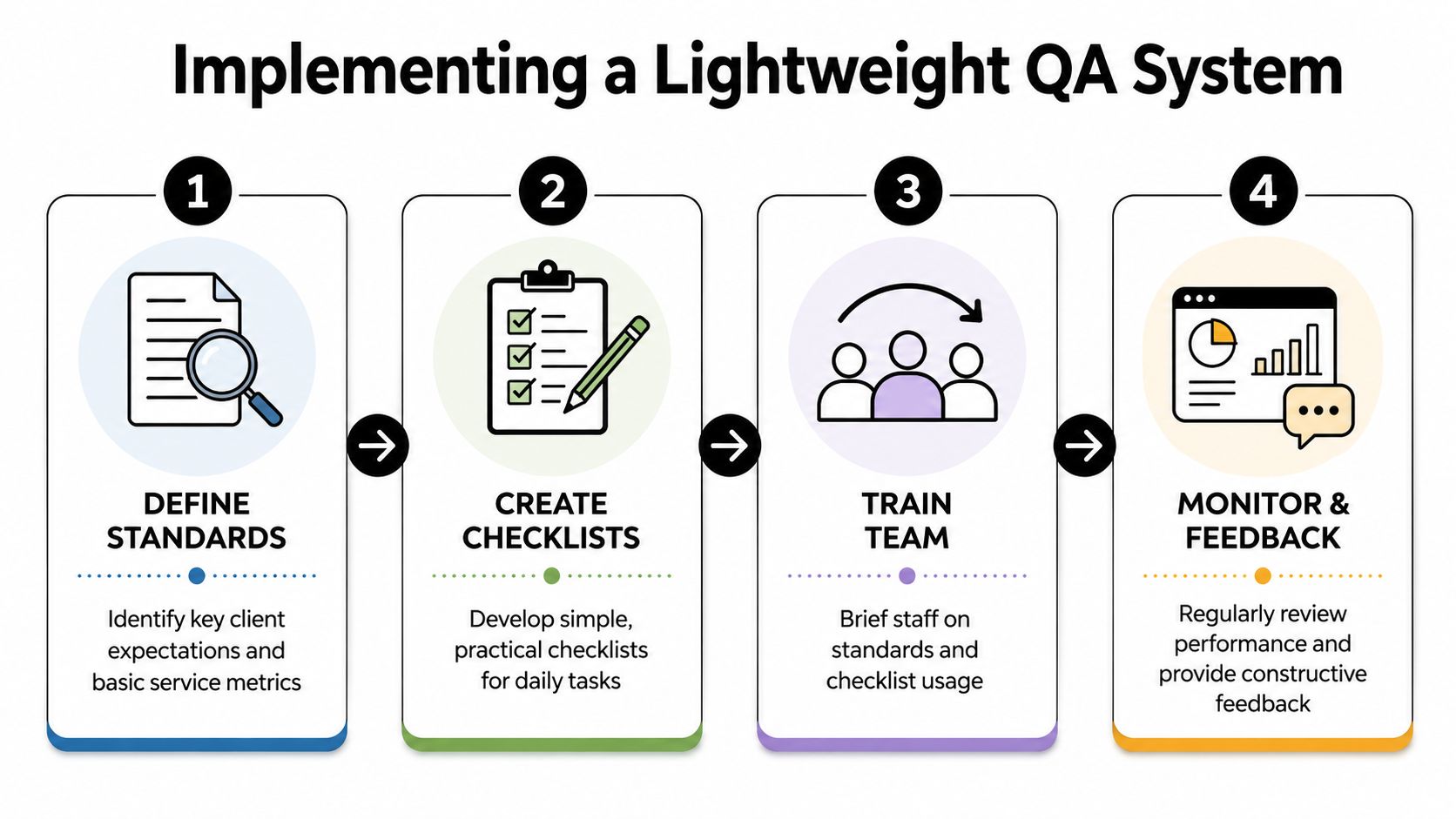
Start with one client-facing process
Pick a process that affects the client directly and happens often enough to improve. Good starting points include onboarding, workstation readiness, helpdesk escalation, incident reporting, or billing verification.
Don't begin with a giant manual. Begin where inconsistency already costs you time or credibility.
Document the current best method
Write down the best-known way to perform that task today. Keep it plain. A good first version often fits on one page.
Use simple prompts such as:
- Trigger: What starts the process?
- Owner: Who is responsible at each step?
- Sequence: What happens first, second, and last?
- Check: What confirms the task was done correctly?
- Record: Where is the evidence stored?
Add measurable checks
A standard without a check is just a preference. Build a few concrete control points into the workflow.
For a seat-leasing operation, those checks might include:
- Cleanliness verification: A pre-shift checklist signed by facilities.
- IT readiness: Confirmation that workstation login, network access, and headset function were tested.
- Internet reliability review: A documented escalation path when service degrades.
- Client communication check: A required update sent when any critical issue affects delivery.
The point isn't to create lots of metrics. The point is to choose the few checks that tell you whether the process is holding.
Train, then tighten
Run the process with the actual team. Ask where people get stuck, what they skip, and which parts create duplicate work. A quality system that ignores the way work really happens won't survive contact with the floor.
Many businesses fail at this stage. They adopt a generic manual and label it a standard. That's usually worse than having no manual at all. As the Data for Impact quality assurance approach notes, copying a generic QA manual can be worse than having none, and standards need to be context-specific and locally operationalized. For seat-leasing and BPO settings, that can mean standards for cleanliness, IT uptime, and internet reliability, each measured differently.
A useful standard is realistic, measurable, and tied to the actual operation. An impressive-looking document that nobody uses is overhead.
Review monthly, not endlessly
You don't need a committee meeting every week. A short monthly review is enough for a lightweight system. Look at failures, exceptions, and recurring complaints. Then decide whether the issue came from the process, the training, the tool, or ownership confusion.
A practical review rhythm looks like this:
- Check failures: Where did the process break?
- Check evidence: Was the checklist completed, and was it meaningful?
- Check trends: Are the same issues showing up repeatedly?
- Adjust one thing: Change one control point or one instruction at a time.
That sequence keeps the system alive without turning it into bureaucracy.
The Audit and Certification Process Explained
Once your internal system is stable, external audit becomes much less intimidating. Auditors aren't looking for perfection. They're looking for consistency between what your documents say, what your people do, and what your records prove.

What usually happens in an audit
The process varies by framework, but the common stages are familiar.
First, you choose a certification or assessment body. Then comes a document review. The auditor wants to see your procedures, scope, responsibilities, records, and internal controls before they start testing how the system works in practice.
After that, the auditor samples evidence. They may ask how incidents are logged, how training is tracked, how corrective actions are closed, or how management reviews problems. They also speak with staff to see whether the process is actually understood on the floor.
What auditors want to see
The simplest way to prepare is to gather evidence around a few basic questions:
- Do you define the process clearly: Written procedures, owner assignments, and approval controls.
- Do people follow it consistently: Interview responses, completed checklists, ticket records, and logs.
- Do you review failures: Nonconformance records, corrective action notes, and follow-up checks.
- Does management stay involved: Meeting notes, performance review summaries, and decision records.
The fastest way to lose credibility in an audit is to produce polished documents that frontline staff have never seen.
A short explainer can help teams understand what an external review feels like before it happens:
Vendor control matters more than many teams expect
For seat-leasing and BPO environments, a lot of service quality sits outside your direct hands. Internet carriers, maintenance providers, security vendors, hardware partners, and cleaning contractors all affect the client's experience.
That isn't a reason to exclude them from the QA system. It's a reason to include them. As reflected in federal acquisition guidance on contract quality assurance, quality oversight can extend to the subcontract level. In practical BPO terms, that means your standards should define audit points, service-level metrics, and escalation paths across the whole delivery chain.
If you're preparing for a formal review and want to assess your current setup, it's often worth starting with an operational conversation through the Seat Leasing BPO contact team. The point isn't the inquiry itself. It's forcing clarity around what evidence your operation can produce today.
Sample QA Checklist for Seat Leasing Clients
Clients evaluating a seat-leasing provider usually ask broad questions at first. Then they get specific very quickly. They want to know whether the environment is stable, secure, responsive, and managed with discipline.
The checklist below works two ways. A client can use it to evaluate a provider. A provider can use it internally to see whether its promises are supported by real controls.

Infrastructure and IT reliability
Start with the basics that shape daily service quality.
- Internet continuity: Is there a documented procedure for outages, failover handling, and client notification?
- Power resilience: Are backup arrangements tested and logged, not just mentioned in sales discussions?
- Workstation readiness: Is each seat checked for login access, peripherals, and connectivity before handover?
- Ticket ownership: Can the provider show who owns incidents from opening to closure?
A provider that answers these clearly usually has a working operating system behind the scenes.
Security and compliance controls
Clients don't need a lecture on policy names. They need evidence that access and data handling are controlled.
Ask for practical proof such as:
- Access rules: Visitor handling, badge or entry controls, and restricted area practices.
- Training records: Confirmation that staff receive privacy, security, or client-specific handling guidance.
- Incident handling: A documented process for reporting, escalating, and closing security-related issues.
- Asset control: Clear accountability for devices, replacements, and returns.
Service and support discipline
At this point, quality often becomes visible to the client.
A service team can recover from a problem quickly if ownership is clear. It usually can't recover from confusion.
Review whether the provider has:
| Checklist area | What good looks like |
|---|---|
| Onboarding | Defined handoff steps, readiness checks, and client sign-off points |
| Helpdesk | Response rules, escalation paths, and closure confirmation |
| Reporting | Regular performance summaries with issue follow-through |
| Change handling | Approval and communication process for service-impacting changes |
Facility and workplace standards
Shared environments need standards that are operational, not decorative.
Check whether the provider maintains:
- Cleaning schedules: Not just a promise of cleanliness, but recurring evidence.
- Environmental consistency: Noise control, temperature management, and common-area upkeep.
- Support responsiveness: A clear point of contact for facility issues.
- Included services clarity: A written scope of what's covered operationally and what's not.
For businesses comparing providers, it helps to review the actual seat leasing inclusions and support scope before making assumptions about what “fully managed” means in practice.
Conclusion Your Journey to Consistent Excellence
When a client asks what quality assurance standards you follow, the strongest answer isn't a buzzword. It's a system you can explain clearly.
You define the service. You document the critical steps. You measure the few things that matter. You review failures objectively. You improve the process instead of blaming the last person who touched it. That's what quality assurance standards look like when they are doing real work.
The businesses that get value from QA don't treat it as a one-time project. They use it as operating discipline. That discipline builds trust, reduces avoidable rework, helps teams perform more consistently, and makes growth less chaotic.
Start smaller than you think you need to. Pick one process. Write the standard. Add one or two checks. Train the team. Review the evidence. Then improve it. That rhythm is far more useful than waiting for the perfect framework or the perfect time.
Over time, that simple habit changes the answer you give to clients. Instead of saying, “We care about quality,” you can show them how your business protects it.
If you're looking for a flexible workspace partner that takes operations, infrastructure, and service consistency seriously, Seat Leasing BPO is worth a closer look. Their model is built for businesses that want to move fast without carrying the full burden of office setup, IT support, and facility management on their own.