Figuring out how to get a Philippines working visa can feel like a maze at first, but it really boils down to a two-step dance between two different government agencies. Getting this right is absolutely essential for any foreigner hoping to work legally in the country—and for the companies looking to hire them.
Understanding Your Path to a Philippine Work Visa
The simplest way to think about it is like getting into a gated community. You can’t just drive up to a house; you first need clearance at the main gate. That "gate pass" is your Alien Employment Permit (AEP), which comes from the Department of Labor and Employment (DOLE). The AEP is the foundational document that proves no Filipino national is available, qualified, and willing to do the job you’ve been offered.
Once you have that AEP in hand, you can proceed to the "house" itself. This is your 9(g) Pre-Arranged Employee Visa, granted by the Bureau of Immigration (BI). The 9(g) visa is what officially gives you the right to live and work in the Philippines for your specific employer. It's a strict sequence; without the AEP from DOLE, the BI won't even look at your 9(g) application.
To make this crystal clear, here’s a quick summary of the two core components.
Philippines Work Authorization at a Glance
| Component | Issuing Agency | Purpose | Analogy |
|---|---|---|---|
| Alien Employment Permit (AEP) | Department of Labor and Employment (DOLE) | Confirms no Filipino is available for the job, authorizing the foreigner's employment. | The gate pass to enter the community. |
| 9(g) Work Visa | Bureau of Immigration (BI) | Grants the foreigner legal residence and the right to work for a specific employer. | The key to the house once you're inside. |
Grasping this dual-agency system is the most important concept. Each one has its own mandate, its own checklist, and its own timeline.
The Two-Agency System
This division of labor is deliberate, creating a system of checks and balances.
Department of Labor and Employment (DOLE): Their main job is to protect the local workforce. They only issue an AEP after they are convinced that a foreign national’s skills are truly necessary for a specific role.
Bureau of Immigration (BI): Their focus is on immigration control. They issue the actual visa that allows you to legally enter, stay, and work, but only after DOLE has given the green light on the employment front.
The growing number of foreign professionals in the country underscores just how critical it is to understand this process. In 2024, the BI's annual report tracked 153,651 foreign nationals with visas—a sharp 13% jump from the year before. This surge highlights the Philippines' appeal to global talent, particularly in its fast-growing industries.
This guide will continue to unpack this core structure, giving startups, BPOs, and established companies the foundation they need. For businesses running on flexible models, it's also worth exploring how seat leasing aligns with these visa requirements. The next sections will get into the nitty-gritty of different visa types, document checklists, and the compliance risks you need to stay ahead of.
The AEP and 9(g) Visa: The Standard Path for Employees

For most companies hiring foreign talent for long-term positions, getting a Philippines working visa isn't a single step but a two-part process. It’s a well-trodden path that starts with an Alien Employment Permit (AEP) and finishes with a 9(g) Pre-Arranged Employee Visa. Think of it as getting a building permit before you can actually move in.
The first part of your journey is handled entirely by the Department of Labor and Employment (DOLE). The AEP is the foundation for everything that follows. Its main purpose is to certify that no qualified Filipino is available for the job you're hiring for, a crucial measure to protect the local workforce.
To prove this, you’ll have to conduct what's known as a labor market test. This means publishing the job opening in a major national newspaper. This step is mandatory and shows DOLE you've made a real effort to hire locally first.
The AEP Application: The Employer's Checklist
As the employer, you kick off the AEP application. You'll need to gather a specific set of corporate documents that prove your company is legitimate and that this hire is essential.
Here’s a general list of what you'll need to prepare:
- Corporate Documents: Your SEC Registration, Articles of Incorporation, and the latest General Information Sheet (GIS) are non-negotiable. They prove you're a legal entity.
- Business Permits: A valid Mayor’s Permit for your business address is required.
- Employment Contract: A signed contract is a must. It needs to clearly outline the foreign national's role, responsibilities, and compensation.
- Applicant’s Documents: You'll also need a copy of the employee’s passport and a recent passport-sized photo.
It's interesting to see this process in a global context. While companies bring talent into the Philippines, the country's own workforce is in high demand worldwide. For example, in the U.S. green card backlog of 4 million people, Filipinos account for 288,000 applicants—the third-largest group. This shows just how intertwined the global talent market is, as detailed in a detailed country report on migration.
After you submit your application and proof of the newspaper ad, DOLE gets to work. Assuming your paperwork is all in order, expect the AEP processing to take about 2 to 4 weeks. The government fee is roughly PHP 9,000 for a one-year permit.
The 9(g) Visa: The Employee's Residence Permit
Once the AEP is approved, you've cleared the first major hurdle. The AEP is essentially your golden ticket to start phase two: applying for the 9(g) visa with the Bureau of Immigration (BI). This is the visa that officially allows your employee to live and work in the Philippines under your sponsorship.
Crucial Insight: The job title and description must be identical across the AEP application, the employment contract, and the 9(g) visa petition. Even a tiny mismatch can trigger an automatic rejection and set you back weeks or months.
The 9(g) application is a much bigger lift, requiring documents from both the employer and the employee. Your approved AEP is the star of the show, but you’ll also re-submit many of the same corporate documents along with the employee’s personal information.
The process might feel a bit redundant, but it's designed to ensure only legitimate employees from legitimate companies receive working residency. For newer business models like those without a traditional office, proving legitimacy is still key. You can learn more about the inclusions that make seat leasing a viable option for sponsoring foreign employees.
The BI’s timeline is significantly longer, typically taking 2 to 4 months for approval. The total government fees for the 9(g) visa, which includes the mandatory ACR I-Card (Alien Certificate of Registration), usually fall between PHP 20,000 to PHP 30,000.
All in all, it's wise to budget for a total of 3 to 5 months from start to finish for the entire AEP and 9(g) visa process. That’s a realistic and safe projection for planning your new hire's start date.
What About Other Work Permits and Visas?
While the 9(g) work visa is the main path for most long-term foreign employees, it’s not the only route. Not every hire fits neatly into that box. You might need someone for a quick three-month project, an expert to fix a specific problem, or you might be an investor putting down roots.
Think of the 9(g) visa as the standard annual contract for an apartment. But what if you only need an Airbnb for a few weeks? Or what if you're the one building the apartment complex? This is exactly why a range of other permits exist—to give you the flexibility your business actually needs.
Knowing your options is crucial for hiring talent efficiently and, most importantly, legally.
The Provisional Work Permit: Your Bridge to Getting Started
The Provisional Work Permit, or PWP, is one of the most practical tools you’ll encounter. It’s not a separate visa but a temporary pass from the Bureau of Immigration that lets a foreign national start working while their 9(g) visa is in the pipeline.
It’s a lifesaver. Imagine your new hire is in the Philippines, ready to go, but their 9(g) application is stuck in a processing queue that could take months. The PWP allows them to start their job right away instead of waiting around.
- Who is it for? Foreign nationals who are physically in the Philippines and have already officially filed for a 9(g) visa.
- What’s the catch? You can only get a PWP if you have a valid Alien Employment Permit (AEP) from DOLE and proof that the 9(g) application has been accepted.
- How long does it last? It’s usually valid for three months and can be renewed until the 9(g) visa is finally issued.
This permit closes the frustrating gap between arrival and approval, turning a costly waiting period into productive, compliant work time.
The Special Work Permit: For Short-Term Gigs
But what if the job itself is short-term? Let's say you need a specialist consultant for a two-month engagement or a foreign artist for a series of performances. Going through the full 9(g) visa process, which can drag on for months, would be complete overkill.
That’s the perfect scenario for a Special Work Permit (SWP).
An SWP is specifically designed for temporary work that will last six months or less. Critically, it does not require an AEP, which makes the whole process significantly faster and simpler.
An SWP is the ideal choice for roles like:
- Professional athletes, musicians, and other performers.
- Consultants or technicians brought in for a specific, time-limited project.
- Foreign crew members involved in filming a movie or TV show in the country.
The SWP gives you a quick, legitimate way to bring in specialized talent for short sprints without getting tangled in the bureaucracy of a long-term visa.
Specialized Visas for Investors and Traders
Finally, we have a category of visas for foreigners who aren't just employees but are actively investing in the Philippine economy. These work differently because their contribution isn't just labor—it's capital and commerce. As work arrangements continue to evolve, you may also want to consult a guide to digital nomad visa requirements for insights on more modern, location-independent authorizations.
The two most common specialized visas are:
- 9(d) Treaty Trader Visa: This is available to citizens from countries that have a specific commercial treaty with the Philippines (like the USA, Japan, and Germany). It's for individuals carrying on significant trade between their home country and the Philippines.
- Special Visa for Employment Generation (SVEG): This is a powerful visa for any foreign national who establishes a business and employs at least ten full-time Filipino workers. It grants the holder indefinite status, acting as a strong incentive for job creation.
These visas recognize that investors and major traders play a unique role and provide a pathway to work and reside in the country that reflects their economic impact. Choosing the right one all comes down to the specifics—the length of the work, the nature of the role, and the individual's contribution to your business.
Your Step-by-Step Visa Application Walkthrough
Getting a Philippines working visa can feel like a bureaucratic maze. Let's cut through the confusion and map it out. I'll walk you through the entire journey, broken down into five clear phases, from getting your company's paperwork in order to your new hire getting their official ID card.
Think of the employer and the employee as a team. For this to work, you both have to be perfectly in sync. Each stage requires specific documents and approvals, and a misstep by one can sideline the whole application.
Phase 1: Employer Preparation
Before you even dream of bringing a foreign employee on board, you need to prove your company is the real deal. The Department of Labor and Employment (DOLE) and the Bureau of Immigration (BI) need to see that you're a legitimate, compliant business.
First things first, get your corporate documents together. This isn't just red tape; it's your company’s official ID for the government.
- SEC Registration & Articles of Incorporation: This shows you’re a legally established corporation in the Philippines.
- Latest General Information Sheet (GIS): This document proves who your current officers and shareholders are.
- Valid Business Permits: You'll need the Mayor's Permit for your office location to confirm you're operating above board.
- Tax Documents: Have your latest Income Tax Return (ITR) and your BIR Certificate of Registration (Form 2303) ready to go.
Getting this foundation right is non-negotiable. Submitting incomplete or expired company documents is the fastest way to get your application rejected right out of the gate.
Phase 2: Employee Document Gathering
While you're pulling together the company file, your prospective employee needs to be doing the same with their personal documents. Every detail matters here—an expired passport or a missing diploma can bring the whole process to a grinding halt.
Here's what the employee needs to collect:
- A clear copy of their passport bio-page. Make sure the passport is valid for at least six months longer than their planned stay.
- Recent passport-sized photos taken against a white background, following the government's exact specifications.
- A detailed resume or curriculum vitae (CV) that outlines their education and professional history.
- Copies of their diplomas, transcripts of records, and any professional licenses or certificates relevant to the role.
This part of the process is about creating an official profile that validates your employee's identity and proves they have the qualifications for the job.
Phase 3: The AEP Application with DOLE
Once both sets of documents are ready, it's time to kick things off with the Alien Employment Permit (AEP) application at DOLE. This is where the "labor market test" comes into play. You’ll have to publish the job opening in a national newspaper.
The point is to demonstrate to DOLE that there isn't a qualified Filipino available to do the job. The AEP application costs about PHP 9,000 for a one-year permit and usually takes 2 to 4 weeks to process, assuming all your paperwork is flawless.
Expert Tip: The job title on the employment contract, the AEP application, and the newspaper ad must match exactly. Even a tiny difference can raise a red flag for DOLE, leading to denials or long, expensive delays.
While waiting on long-term visas, some alternative permits can be useful. The process flow below gives you a glimpse of how these work.
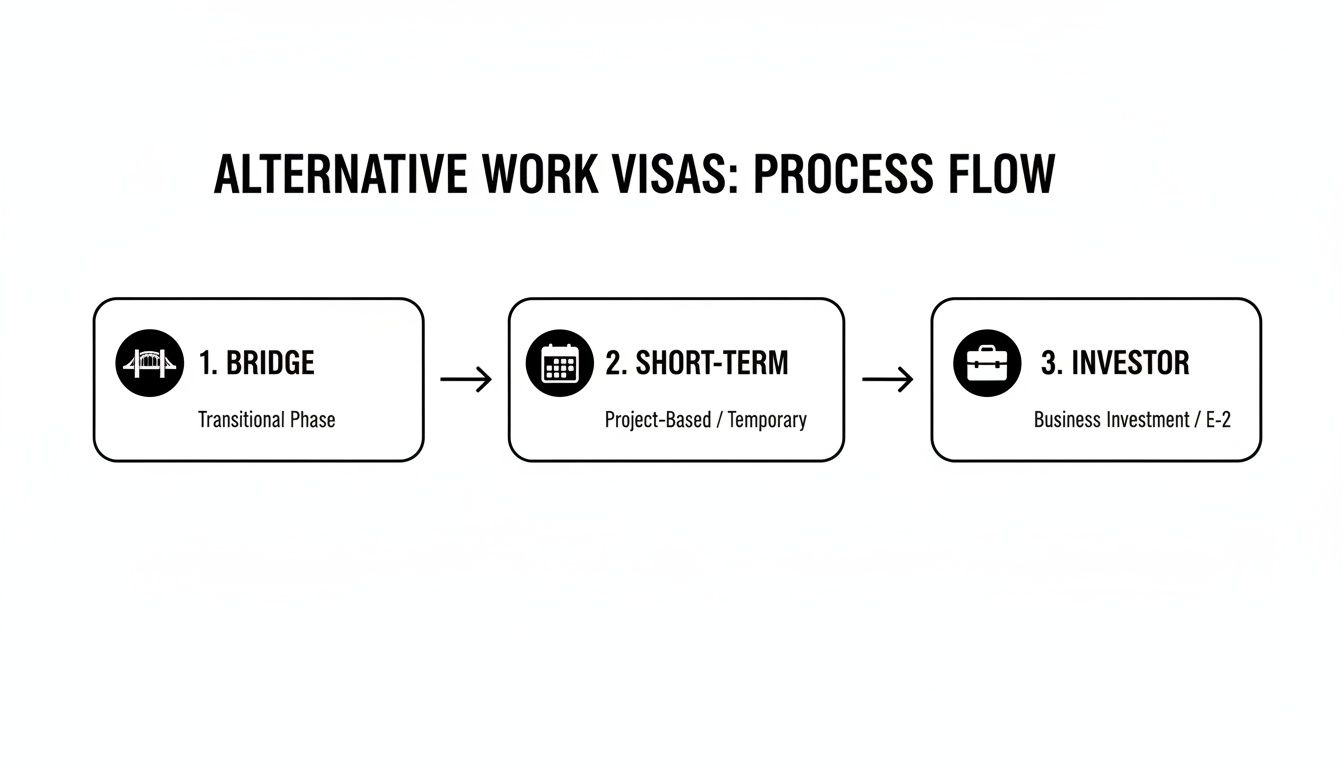
This graphic illustrates how different permits like bridge, short-term, and investor visas can offer flexibility for various hiring situations.
AEP vs. 9(g) Visa Document Checklist
To help you keep things straight, here’s a quick comparison of the primary documents needed for the two main applications: the AEP from DOLE and the 9(g) visa from the BI.
| Document | Needed for AEP (DOLE) | Needed for 9(g) Visa (BI) |
|---|---|---|
| Application Form | ✅ | ✅ |
| Passport Copy (Bio-page) | ✅ | ✅ |
| Employment Contract | ✅ | ✅ |
| Company SEC Registration | ✅ | ✅ |
| Company Articles of Incorporation | ✅ | ✅ |
| Company General Information Sheet (GIS) | ✅ | ✅ |
| Mayor's/Business Permit | ✅ | ✅ |
| Newspaper Publication Proof | ✅ | ❌ |
| Approved AEP | ❌ | ✅ |
| BI Clearance Certificate | ❌ | ✅ |
| Notarized Letter of Support (from employer) | ❌ | ✅ |
Notice how the approved AEP is a ticket to the next stage. You can't even start the 9(g) process without it, which is why getting the DOLE stage right is so critical.
Phase 4: The 9(g) Visa Petition with BI
With the approved AEP in hand, you're ready for the main event: petitioning for the 9(g) work visa at the Bureau of Immigration (BI). Here, you'll combine the employer's documents, the employee's papers, and the new AEP into a single, comprehensive submission.
This is your formal request to the government to allow your employee to live and work in the Philippines under your company's sponsorship. Be prepared for a wait—this phase can easily take 2 to 4 months. While you can manage this on your own, many businesses find that professional help from specialized Legal assistants is worth its weight in gold, especially for complex cases.
Phase 5: Post-Approval Compliance
Getting the 9(g) visa approval is a huge win, but you're not quite at the finish line. The final task is to get the Alien Certificate of Registration (ACR I-Card). This is a credit card-sized ID for foreign residents, complete with a microchip.
To get it, your employee will need to go to a BI office for a biometrics appointment to have their fingerprints and photo taken. Once that's done, the ACR I-Card is issued, and your employee is officially 100% compliant. Just be sure to set calendar reminders for the AEP and 9(g) visa renewal dates to avoid any lapses in legal status.
For more practical tips on managing HR and compliance, feel free to check out other guides on our Seat Leasing BPO blog.
Maintaining Compliance and Managing Visas

Getting that Philippines working visa for your foreign hire feels like crossing the finish line, but it’s really just the starting gun. The real work begins now, with ongoing visa management and compliance. Neglecting these responsibilities is a lot like buying a new car and skipping all the oil changes—it might run for a while, but a breakdown is inevitable.
This is especially true for agile businesses like BPOs or startups that use flexible, leased-seat workspaces. Without a big, traditional HR department, the job of tracking visa deadlines often lands on the founders or a small admin team. This is where having a simple, solid system isn't just helpful; it's your lifeline.
The Philippine government has very clear post-approval rules for foreign nationals. Missing a deadline isn't a minor slip-up. It can result in steep fines for the company, penalties for your employee, and, in the worst-case scenario, getting blacklisted by the Bureau of Immigration (BI).
Key Compliance Tasks You Cannot Ignore
Think of visa management as a continuous cycle with three non-negotiable checkpoints. Each one is essential for keeping your employee's status legal and protecting your company from risk.
The Annual Report: Every foreign national holding a valid ACR I-Card must report in person to a BI office within the first 60 days of each new year. It's a straightforward check-in to confirm they're still in the Philippines and their details are up-to-date.
Visa and AEP Renewal: The 9(g) visa and the Alien Employment Permit (AEP) both have expiration dates. You need to start the renewal process at least 60 to 90 days before they expire. If you wait until the last minute, you risk a lapse in legal status, which forces your employee to stop working immediately.
Visa Downgrading: When an employment contract ends, you are legally required to "downgrade" the 9(g) work visa back to a temporary tourist visa. This action officially concludes their employment relationship with your company in the eyes of the government.
Failing to properly downgrade a visa can cause major headaches. The former employee could face overstaying fines, and your company could remain legally responsible for them.
Practical Tips for Agile Businesses
For companies using BPO seat leasing or operating without a dedicated HR team, managing these tasks demands a proactive approach. You can't rely on memory—you need a system.
- Build a Digital Employee File: For every foreign hire, create a secure digital folder containing their passport, AEP, visa approval, and ACR I-Card. Make sure all expiration dates are clearly noted.
- Set Calendar Alerts: Use a shared calendar like Google Calendar or Outlook to set multiple reminders for key dates. I recommend alerts for 90, 60, and 30 days before the Annual Report window opens and before visas are set to expire.
- Create a Downgrading Checklist: Have a standard operating procedure ready for when an employee resigns or is terminated. This checklist should detail every step for filing the downgrading petition, ensuring a clean and compliant exit process.
Crucial Reminder: The ultimate responsibility for compliance falls on the sponsoring company. Even if you hire a visa agency to handle the paperwork, your business is the one on the hook for making sure every deadline is met and every process is followed correctly.
The Philippines is a major player in the global labor market. In 2023, there were 2,028,307 documented Overseas Filipino Workers (OFWs), a figure that has almost rebounded to pre-pandemic levels. You can dig deeper into these trends with these frequently requested immigration statistics. This global context helps explain why Philippine authorities are so thorough in regulating foreign nationals working within their own country.
Your Top Questions About Philippine Work Visas, Answered
Even with a solid plan, the details of securing a Philippines working visa can feel a bit overwhelming. I've worked with countless companies navigating this process, and the same questions pop up time and again. Getting these answers right from the start is the key to avoiding headaches and delays.
Let's walk through the most common things businesses need to know.
Can Someone on a Tourist Visa Start Working?
That’s a common question, and the answer is a hard no. Having an employee work while they only hold a tourist visa is illegal. It's a major compliance misstep that can lead to serious consequences, including fines, deportation for the employee, and even blacklisting for your company.
To get your new hire started legally while their 9(g) visa is in the pipeline, you absolutely must get them a Provisional Work Permit (PWP). This is a temporary authorization from the Bureau of Immigration that bridges the gap between filing for the main visa and its final approval.
Think of the PWP as an official, temporary green light to work. It's not a substitute for the 9(g) visa, but an essential part of the process. Skipping this step is a gamble you just can't afford to take.
What Is Visa Downgrading and When Is It Required?
When a foreign employee’s time with your company comes to an end, their 9(g) visa instantly loses its validity. This happens because the visa is directly sponsored by your business and tied to that specific employment.
Visa downgrading is the required legal process of officially changing that 9(g) work visa back to a temporary tourist visa. It’s handled by the Bureau of Immigration and serves as the final, formal step to close out the employee's work status.
This allows the person to stay in the Philippines legally as a tourist while they get their affairs in order, whether that's preparing to leave the country or exploring other options. If you fail to downgrade the visa, your former employee will start accumulating overstaying penalties, and your company could remain legally responsible for them—a messy and avoidable liability.
A Critical Offboarding Step: Think of visa downgrading as the official "sign-off" on the employment relationship. It’s just as crucial as the initial application, giving both the individual and your company a clean break in the eyes of immigration authorities and preventing legal troubles down the road.
How Long Does the Entire Work Visa Process Take in 2026?
You need to be realistic with your timelines. From start to finish, you should budget for 3 to 5 months for the entire process. This covers everything from the initial permit to the final visa stamp.
Here’s how that timeline generally breaks down in 2026:
- Alien Employment Permit (AEP) from DOLE: This first stage, handled by the Department of Labor and Employment, usually takes about 2 to 4 weeks.
- 9(g) Visa Petition with the BI: After the AEP is in hand, you'll file with the Bureau of Immigration. This is the longest part of the journey, typically taking another 2 to 4 months.
This timeline is based on a perfect application where every document is correct and complete. The smallest error—a job title that doesn't perfectly match the employment contract, for instance—can send you back to square one, adding weeks or even months to your wait. It’s critical to start well ahead of your employee’s planned start date.
Does My Company Need a Physical Office to Sponsor a Visa?
Yes, a registered business address is a non-negotiable requirement for sponsorship. But here’s the good news: you don't need to be locked into an expensive, traditional office lease.
Modern solutions like seat leasing are a perfect, and frankly, much smarter way to meet this requirement. When you lease dedicated seats in a serviced office, you get a legitimate physical address that satisfies the government's needs, but without the massive overhead of a conventional rental.
This approach is especially powerful for new or growing companies sponsoring a Philippines working visa:
- Cost-Effective: You sidestep the huge costs of setting up and maintaining your own office.
- Flexible: It's easy to add or remove team members without being stuck in a rigid multi-year lease.
- Compliance-Ready: You get a legitimate business address with all the necessary permits, making you eligible to sponsor visas from day one.
For startups, BPOs, and any business focused on growth, this makes sponsoring foreign experts much more attainable. You can establish a compliant local presence instantly and keep your capital focused on building your business, not on real estate.
At Seat Leasing BPO, we provide flexible, compliant, and cost-effective workspace solutions that empower your business to hire the talent you need. Our fully serviced offices give you a legitimate business presence to sponsor work visas without the burden of traditional leases. Learn more about how we can support your growth at Seat Leasing BPO.