You can usually spot the moment a foreign manager gets confused in a Philippine office. A team member says yes to a deadline, nods in a meeting, stays polite all week, and then the actual problem only surfaces when the work is already late. The manager reads that as avoidance, weak ownership, or poor planning.
That reading is often wrong.
In many Philippine workplaces, the issue isn't a lack of effort. It's that people are balancing task demands with social obligations, dignity, and group harmony at the same time. A direct objection can feel risky. A blunt correction can feel personal. A public disagreement can carry a cost long after the meeting ends.
That is where the philippine values system becomes operational, not theoretical. It shapes how people give feedback, ask for help, interpret authority, build trust, and decide whether to raise a problem early or solve it first without fanfare. In shared workspaces, BPO floors, startups, and hybrid teams, these patterns show up every day.
Managers who ignore them usually end up over-managing process while under-managing relationships. Managers who understand them build better teams, smoother client relationships, and more durable working norms.
Beyond the Written Rules of Business in the Philippines
A common scenario goes like this. A supervisor asks, "Can your team finish this by Friday?" The team lead says yes. No one wants to disappoint the client, challenge the room, or make a colleague lose face. By Thursday night, the blockers finally emerge.
The manager thinks the problem started on Thursday. It usually started in the first meeting.

Why good people stay silent
In the Philippine workplace, silence doesn't always mean agreement. It can mean caution. It can mean respect for hierarchy. It can mean someone is trying to avoid embarrassing a peer, a manager, or themselves.
I've seen capable staff avoid saying "that won't work" in a group setting, then stay late trying to rescue the plan privately. From a Western productivity lens, that's inefficient. From a local social lens, it's often an attempt to preserve harmony while still delivering.
Practical rule: When a Filipino employee says yes, check whether they mean "I accept the task," "I understand the instruction," or "I don't want to oppose this in public."
That difference matters more in shared office environments, where teams work close together and interpersonal friction spreads fast. A single abrasive manager can create hesitation across a whole floor. A respectful one can inspire a lot of discretionary effort.
What the unwritten rules actually govern
The philippine values system affects daily operations in ways many outsiders underestimate:
- Meetings: People may wait for the right moment, or the right relationship, before raising a concern.
- Feedback: Direct criticism in public can shut down initiative for weeks.
- Escalation: Employees may first try to solve issues through informal alignment before using formal channels.
- Partnerships: Business trust often develops through rapport, consistency, and personal credibility, not just contract terms.
This isn't a call to lower standards. It's a call to read behavior accurately.
A manager who treats every hesitation as incompetence will damage trust. A manager who understands the social logic behind hesitation can design better systems: private check-ins, clearer confirmation questions, and safer ways to disagree.
That's usually the turning point. Once leaders stop asking, "Why didn't they just say it?" and start asking, "What made it hard to say?" the workplace gets easier to run.
Understanding the Foundation of the Philippine Values System
The easiest way to understand the philippine values system is to stop treating it as a list of traits and start treating it as a social framework. At the center is kapwa, often understood as a shared inner self. It shapes how many Filipinos judge closeness, obligation, respect, and belonging.
If you manage people here, this matters because work rarely sits apart from relationship. People don't operate only as isolated job titles. They operate as members of a social world.
Kapwa as the root
Think of kapwa as the root system of a tree. The visible branches are values such as pakikisama, hiya, and utang na loob. The root underneath them is the idea that the self is connected to others, not sealed off from them.
That creates a practical divide between people who are still outside the circle and people who are already inside it. In local terms, many interactions shift depending on whether someone feels like ibang tao or hindi ibang tao. In plain language, are you still an outsider, or are you now one of us?
Managers feel this quickly:
- Outsider status: People stay formal, cautious, and less likely to volunteer uncomfortable truths.
- Insider status: People become more candid, more protective, and more willing to go the extra mile.
This is why relationship-building isn't cosmetic in the Philippines. It's part of how real cooperation starts.
For a wider view of workplace culture and operations, the Seat Leasing BPO blog offers useful context around running teams in local business environments.
Why the system feels layered
The Philippine workplace didn't develop from one influence alone. It carries indigenous social logic, then layers of Malay, Spanish, and American influence. That helps explain why you can see warmth and formality, flexibility and hierarchy, personal closeness and procedural structure all in the same office.
One part of the culture values smooth human relations. Another part is comfortable with titles, status, and formal reporting lines. Both can be active at once.
The mistake many managers make is choosing one lens only. They either treat the workplace as fully personal or fully procedural. In practice, it's both.
Family logic and workplace logic
The family-centered orientation also matters. Even when a team is professionally run, many people carry into work a strong instinct to protect relationships, avoid unnecessary confrontation, and show loyalty in ways that aren't purely transactional.
That has benefits. Teams often rally around each other. New hires are often supported informally before anyone writes a process note. Colleagues step in when someone is struggling.
It also creates management complexity:
- Boundaries can blur: Personal loyalty may affect how people handle conflict.
- Direct challenge feels heavier: Criticism can sound relational, not just technical.
- Trust takes shape socially: People often believe consistency before they believe policy.
If you understand kapwa first, the rest of the philippine values system stops looking contradictory. It starts looking coherent. People are trying to work well, but they're also trying to stay in right relationship with the people around them.
Decoding Core Filipino Values in the Workplace
Once you see the workplace through relationship rather than pure transaction, the major Filipino values become easier to read. None of them are entirely good or bad. Each one can strengthen a team or complicate it, depending on how the manager sets expectations.
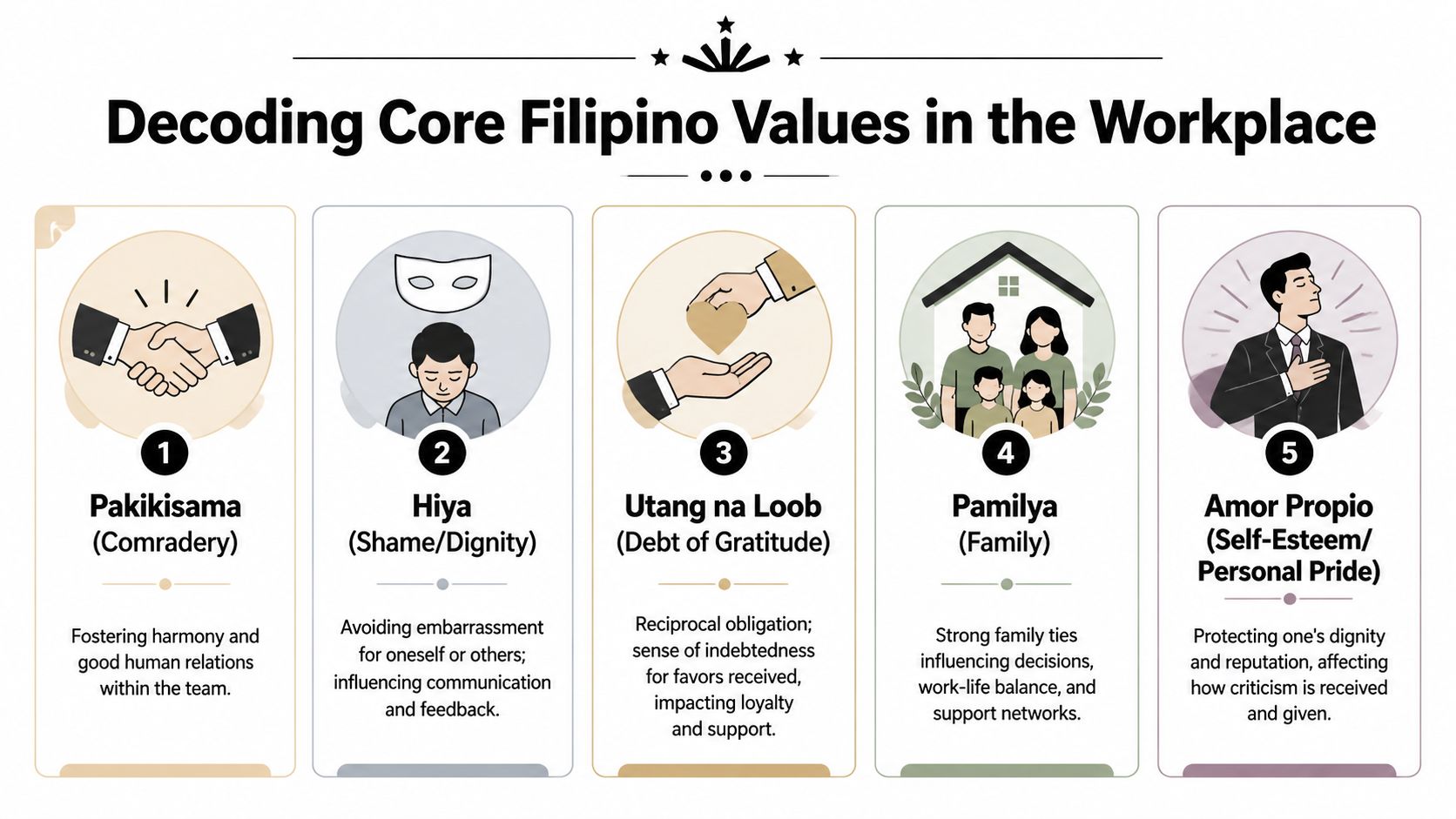
Four values every manager should learn
Pakikisama is often translated as getting along with others. In a good team, it helps people cooperate, stay approachable, and reduce unnecessary friction. In a bad setup, it can discourage someone from questioning a weak process because they don't want to appear disruptive.
Hiya is often misunderstood as simple shame. In practice, it has a lot to do with dignity, social discomfort, and avoidance of embarrassment. It can make people careful, respectful, and tactful. It can also make them reluctant to admit confusion in front of others.
Utang na loob is a debt of gratitude. At its best, it builds loyalty and deep reciprocity. Someone who was helped at a critical moment often remembers it and returns that support. At its worst, it can blur merit-based decisions if personal indebtedness starts affecting performance management.
Bayanihan is the spirit of communal support. You see it when a team rallies to save a project, onboard a struggling colleague, or cover a shift during a family emergency. The risk is that teams may overcompensate for one person's weak accountability rather than fix the root issue.
What they look like on the floor
A BPO supervisor asks for process improvements. The room is quiet. After the meeting, one analyst privately shares a strong idea. That's often hiya and pakikisama at work, not a lack of ideas.
A tenured employee helps a new hire understand systems, scripts, and unwritten rules without being asked. That's often bayanihan with a touch of utang na loob in the making. Support given now often creates loyalty later.
A manager publicly challenges an employee's mistake using a harsh tone. Output may recover quickly, but initiative usually drops. The employee becomes more careful about being wrong than about being useful.
Good managers in the Philippines don't only ask who is capable. They ask who feels safe enough to be candid.
Core Filipino Values and Their Workplace Implications
| Value (Tagalog) | English Translation/Concept | Positive Workplace Manifestation | Potential Management Challenge |
|---|---|---|---|
| Pakikisama | Getting along, social harmony | Smooth teamwork, fewer interpersonal clashes, stronger peer support | People may avoid raising hard truths or process concerns |
| Hiya | Dignity, shame, social embarrassment | Tact, respect, careful communication | Employees may hesitate to ask questions or admit problems publicly |
| Utang na Loob | Debt of gratitude | Strong loyalty, reciprocal support, long memory for help received | Favor obligations can complicate objectivity and accountability |
| Bayanihan | Communal cooperation | Teams help one another during deadlines or crises | Weak performers may be shielded instead of coached directly |
| Pamilya | Family orientation | Strong support systems, protective team culture | Personal obligations can shape availability and decision-making |
Two values that often get missed
Pamilya deserves attention because family responsibilities aren't usually treated as separate from professional life. Managers who dismiss family obligations as distractions often lose goodwill fast. Managers who set clear standards while showing reasonable flexibility usually get stronger loyalty in return.
Amor propio, or personal pride and self-respect, also matters. It shapes how criticism lands. If feedback feels insulting rather than developmental, the person may comply outwardly but disengage inwardly.
That doesn't mean you avoid hard conversations. It means you deliver them with control, privacy, and precision.
The Two Operating Systems Formal Rules vs Informal Norms
Most Philippine workplaces run on two systems at once. One is visible. The other is felt.
The visible system includes contracts, HR manuals, lease terms, KPIs, escalation paths, and compliance rules. The less visible system includes trust, alliances, personal credibility, reciprocal obligation, and the unwritten standards people use to judge one another.

Hardware and software
A useful analogy is hardware and software. Formal rules are the hardware. They give the organization structure. The cultural layer is the software. It determines how daily behavior runs.
The verified framework on Filipino values on Wikipedia describes this as a dual-model system. The indigenous model works as a non-formal, subconscious guide embedded in behavior, while the exogenous model operates through legal and formal structures. The same source notes that decision-making in Filipino business contexts may require 20 to 30% longer engagement periods to establish trust, but can produce stronger long-term partnership stability.
That point explains a lot of friction in business development and operations. A foreign firm may think, "We've sent the proposal, clarified the price, and shared the terms. Why isn't this moving?" Locally, the other side may still be assessing reliability, tone, and relationship fit.
Why policies don't always settle the issue
Many managers assume that once the handbook is clear, the behavior problem is solved. It usually isn't. People still look at how leaders behave, what gets tolerated, and what the pamantayan or standard is in practice.
If the written policy says open feedback is welcome, but the manager gets defensive every time someone disagrees, staff won't trust the policy. They'll trust the pattern.
A few consequences follow:
- Contracts matter, but rapport often opens the door first
- Standards must be modeled, not only published
- Relationship neglect creates operational drag even when process is sound
This is especially relevant in partnerships, tenant relationships, and account management. In the Philippines, a formal agreement often works best after the relationship is already credible. If you reverse that order, you may get signatures without much trust, and trust is what carries the arrangement through difficulty.
How Filipino Values Shape the Modern Workplace
A new operations manager walks into a shared office in Clark or Ortigas and sees a productive floor. Headsets are on, teams are hitting service levels, and people are polite. By the second week, the manager also notices something else. Problems are often solved through side conversations before they are raised in a meeting, junior staff wait for the right tone before disagreeing, and a team with strong camaraderie can either move very fast or avoid a hard conversation for too long.
That is the Philippine values system at work in a modern setting. In BPOs, coworking hubs, and seat leasing operations, culture shows up in daily execution. It affects escalation speed, coaching quality, shift handoffs, space usage, and whether people speak up early enough to prevent small issues from becoming client issues.
Where the values help
Teams in the Philippines usually respond well to workplaces that support connection, visibility, and practical mutual help. In a shared environment, that can translate into faster onboarding through peer guidance, smoother coordination across support functions, and better care for common areas because people treat the workplace as a shared responsibility.
I have seen this play out most clearly in multi-tenant and BPO setups where teams work near each other and rely on informal coordination throughout the day. A floor layout that allows easy access to supervisors, nearby support staff, and reliable daily amenities often improves response time and reduces minor friction that would otherwise slow operations. A workspace such as Seat Leasing BPO Building 24 reflects an environment where collaboration, accessibility, and daily support infrastructure are prioritized.
A few workplace advantages tend to show up repeatedly:
- Stronger peer onboarding: New hires often learn faster from teammates than from manuals alone.
- Better day-to-day coordination: People are more willing to help when relationships are already warm.
- Higher care for shared routines: Teams often protect systems and spaces they feel connected to.
These are practical gains, not just cultural niceties.
Where the values create friction
The same social strength can slow difficult decisions. In many Filipino teams, maintaining harmony carries real weight. That helps in customer service, account support, and cross-functional cooperation. It also means people may hold back a concern if raising it feels too blunt, too public, or too risky for the relationship.
In a BPO or shared office, that hesitation has operational consequences:
- A QA analyst spots a recurring defect pattern but delays escalating it because another team may take offense.
- A team lead senses that a target is unrealistic but phrases the concern so softly that management hears agreement.
- An agent accepts a task in a meeting, then struggles in silence rather than admit early that support is needed.
None of this means Filipino employees avoid accountability. It means accountability often works better when dignity is protected and the path for speaking up is clear.
A collaborative team still needs a safe and explicit way to disagree.
What this means for managers
Foreign managers often misread politeness as alignment. In practice, a respectful yes may mean, "I hear you," not, "I can deliver this exactly as stated." In a high-context workplace, managers have to verify understanding, surface concerns early, and make disagreement professionally acceptable.
The trade-off is real. A highly relational team often gives stronger loyalty, better peer support, and more stability during pressure periods. That same team may need more structure around escalation, feedback, and decision rights. If managers ignore the relational side, they create silent resistance. If they ignore the performance side, standards drift.
The strongest workplace cultures in the Philippines handle both. They keep the team atmosphere intact while making it easy to raise risks, clarify ownership, and correct problems before they spread across the floor.
Actionable Strategies for Managing in a Filipino Context
Most management mistakes in the Philippines come from overvaluing directness and undervaluing context. You don't need to become vague or overly soft. You need to lead in a way that keeps dignity intact while making expectations unmistakable.

What to do instead
Confirm meaning, not just agreement
Don't stop at "Can you do it?" Ask, "What risks do you see?" or "Walk me through how you'll deliver this." A verbal yes may signal politeness or acknowledgment, not true commitment.Correct in private, recognize in public
This protects dignity while still reinforcing standards. Public praise strengthens morale. Private correction keeps the person receptive.Build blameless feedback channels
Verified guidance on Filipino workplace values emphasizes the need for structured, blameless channels for feedback so ideas are separated from personal criticism. Anonymous suggestion forms, retrospective meetings with neutral facilitation, and manager one-on-ones usually work better than asking for raw criticism in a crowded meeting.Use group support without hiding individual accountability
Bayanihan is useful during surges and deadlines. It shouldn't become a permanent subsidy for one person's weak performance. Thank the team, then still address the source issue.Invest in relationship before escalation
In the Philippine context, people often respond better to a difficult conversation when some rapport already exists. A manager who only appears when there's a problem rarely gets the full truth.Give people safer ways to disagree
Ask for written input before meetings. Invite alternatives by role, not by personality. Saying, "I want one risk from each lead" makes disagreement part of the process.
A practical reference for leaders comparing workspace support features is the Seat Leasing BPO inclusions page, especially if you're thinking about how environment and service structure affect team performance.
What not to do
Avoid these habits if you want candid teams:
- Don't force public confrontation: Many employees will comply outwardly and withdraw inwardly.
- Don't mistake politeness for buy-in: Probe for obstacles early.
- Don't rely on policy alone: Daily behavior teaches the effective standard.
- Don't embarrass one person to warn the rest: That usually reduces speaking up across the team.
This short video is a useful companion if you're thinking about culture, teamwork, and communication in Filipino settings.
A manager's working checklist
If I had to reduce the philippine values system to a management checklist, it would be this:
- Read the social temperature: Is the issue technical, relational, or both?
- Protect dignity: The message lands better when the person doesn't feel cornered.
- Create repeatable trust: Consistency matters more than dramatic leadership gestures.
- Invite concern early: Don't wait for people to volunteer bad news in a public room.
- Be firm without being humiliating: Filipino teams usually respond well to calm authority.
Strong management in the Philippines isn't about being less demanding. It's about making honesty, accountability, and cooperation socially workable.
If you're looking for a flexible office setup that supports productive teams without the burden of managing facilities on your own, Seat Leasing BPO offers a practical option for businesses that want ready-to-use workspaces, reliable backend support, and room to grow.