A lot of Pennsylvania employers meet unemployment law for the first time on a hard day. Revenue dipped. A client paused work. A startup runway got shorter than expected. Or a BPO operator had to reduce headcount after a contract changed. The separation itself is difficult enough. Then the paperwork starts, and every question feels expensive.
That’s where pa unemployment law tends to feel bigger than it is. Business owners worry about saying the wrong thing, triggering avoidable claims, or creating a tax problem that lingers long after the layoff. Freelancers and mixed-workforce companies face a different version of the same stress. They’re trying to sort out who counts as an employee, who might file, and what records the state will expect.
The good news is that Pennsylvania’s UC system is structured. It’s not simple, but it is manageable if you treat it like an evidence process instead of a legal mystery.
Navigating Your First Layoff Under Pennsylvania Law
The decision is made. An employee has to be let go, or a role has to be eliminated. For most small businesses, the first instinct is to focus on the final paycheck, access removal, and how to explain the move to the rest of the team. Those things matter. But under pa unemployment law, what you document on day one often matters just as much as what you say in the room.
A common mistake is assuming that a straightforward business decision automatically translates into a straightforward unemployment outcome. It doesn’t. The state looks at facts, records, and the reason for separation. If your file is thin, your memory won’t carry the case later.
Pennsylvania has operated in a relatively stable labor market. The state’s unemployment rate reached a record low of 4.0% in May 2023, the lowest since records began in 1976, according to the Pennsylvania Department of Labor & Industry newsroom update. That stability helps employers hire, but it also means employers should treat each separation carefully because the UC system is active, mature, and rules-driven.
A useful starting point is process discipline.
- Document the reason: Was this a layoff, a performance discharge, a policy violation, or a resignation?
- Preserve the timeline: Keep the final warning, attendance notes, manager emails, and termination notice together.
- Separate fairness from eligibility: You can treat an employee respectfully and still contest a claim when the facts support it.
If you need help with the communication side before the legal side kicks in, this guide for business leaders on handling layoffs is worth reviewing. It’s practical and covers the leadership mistakes that often create downstream HR problems.
For employers building a more durable process around terminations, offboarding, and workforce transitions, it also helps to speak with an operations team familiar with employer support workflows.
Practical rule: If you can't explain the separation in two clear sentences and back both sentences with records, you're not ready for the claim that may follow.
Understanding the Core Concepts of PA Unemployment
Most employer confusion starts with vocabulary. Pennsylvania uses terms that sound technical, but the ideas are easier to manage when you translate them into payroll language.

UC means wage replacement, not severance
Unemployment Compensation, usually shortened to UC, is the state system that provides temporary wage replacement to eligible workers. Employers often confuse UC with severance or a private agreement. They’re separate. A severance package doesn’t automatically decide UC eligibility, and a polite exit doesn’t automatically make a claim chargeable or non-chargeable.
For employers, the key question is simple. If a former worker files, what facts will the state use to decide whether benefits should be paid?
The base year is the earnings lookback
Think of the base year as the state’s earnings snapshot. Pennsylvania uses the first four of the last five completed calendar quarters when reviewing financial eligibility. That matters for startups, staffing-heavy teams, and BPO environments where hours may spike during one client cycle and flatten during another.
If your employee had uneven earnings, the base year can produce a result that surprises both sides. An owner may believe the worker “didn’t work enough recently,” while the state may still find sufficient wages in the lookback period.
Here’s the simple distinction employers should keep in mind:
| Term | What it means in practice |
|---|---|
| Base year | The historical wage window used to test financial eligibility |
| Benefit year | The period tied to an approved claim once it begins |
| Weekly benefit rate | The amount the state calculates from qualifying wages |
Three ideas control most employer decisions
Pennsylvania’s UC process revolves around three recurring questions:
- Did the worker earn enough in the right period?
- Why did the employment end?
- Is the worker still meeting ongoing eligibility rules, such as work-search status?
Those are the same questions behind the forms employers receive. Once you understand that, the paperwork becomes less intimidating. A notice from the state is usually asking you to support or dispute one of those three points.
Employers get into trouble when they answer a legal question with a management opinion. “She wasn’t a good fit” is not a useful UC response. “Employee was discharged after repeated attendance violations documented in written warnings” is.
For small operators, the practical takeaway is that pa unemployment law rewards clean categories. Label the separation correctly, keep the payroll history intact, and avoid casual wording that muddies what happened.
How Employee Eligibility and Benefits Are Determined
Employers usually focus on the separation reason first. That’s understandable, but Pennsylvania looks at financial eligibility before it fully gets to fault and disqualification. If the wages don’t qualify, the claim can stop there. If they do, the separation issue becomes the main fight.
Financial eligibility depends on wage distribution
Pennsylvania changed an important financial eligibility rule in November 2016. The state requires employees to have earned a minimum of 37% of their total base-year wages across their three lowest-earning quarters, as explained in this discussion of Pennsylvania unemployment financial eligibility changes. For employers, that means workers with uneven earnings may still qualify even when one quarter carried most of their income.
That rule matters in modern businesses more than many owners realize.
A founder may hire someone heavily during a launch quarter, then reduce hours later. A BPO client may front-load project work. A small agency may have an employee whose schedule rises and falls with retainers. In those settings, you can’t assume inconsistency defeats a claim. Sometimes it does the opposite and still leaves the worker financially eligible.
The same source gives a straightforward illustration: if someone earned $40,000 annually, they would need at least $14,800 in the three lowest quarters to satisfy the 37% requirement. That example is useful because it shows how Pennsylvania looks beyond the single best quarter.
For businesses that manage distributed teams, payroll support, or shared operations, practical examples on workforce administration often appear in articles on the Seat Leasing BPO business blog, especially where operational systems intersect with employer compliance.
Separation reason decides whether benefits are likely
Once wages qualify, the separation reason becomes the live issue. Employers generally deal with three buckets.
Layoff or lack of work is usually the cleanest. If business conditions drove the separation and you can show the role ended for economic reasons, the claim is often more straightforward.
Voluntary quit cases are different. Pennsylvania expects the worker to show they made every reasonable effort to maintain the employment relationship before leaving. That’s why resignation disputes often turn on emails, accommodation requests, schedule complaints, or evidence of whether the employee raised the issue before leaving.
Discharge cases are where employers most often lose ground by being sloppy. You may believe the employee was fired for a valid reason, but UC doesn’t turn on frustration. It turns on proof. If you allege misconduct, you need records that show the rule, the employee’s awareness of it, the violation, and why the conduct justified discharge.
A short comparison helps:
| Separation type | What employers should be ready to prove |
|---|---|
| Layoff | Business reason, position elimination, reduction in work |
| Quit | Whether the employee had a compelling reason and tried to preserve employment |
| Discharge | Rule, notice, violation, and documentation supporting cause |
The weekly benefit calculation starts with wages, not emotion
Employers often ask whether a sympathetic claimant gets more favorable treatment. The benefit amount itself doesn’t work that way. Pennsylvania uses wages, and the Notice of Financial Determination Form UC-44F identifies each employer’s quarterly wage information and uses the claimant’s highest quarterly wages as the baseline for the weekly benefit calculation. That’s why payroll accuracy matters from the beginning, not just once a dispute starts.
A weak separation record can hurt you, but a weak wage record can also distort the case before you ever reach the hearing stage.
What works in practice is boring and effective. Reconcile wages quarterly. Keep position descriptions current. Save the final written notice. If compensation patterns are irregular, flag that early so whoever handles the response understands how the state may view financial eligibility.
What doesn’t work is assuming your internal labels settle the issue. Calling someone “project-based,” “seasonal-like,” or “freelance-ish” won’t carry much weight if payroll records show covered employment and the wage history meets the state’s test.
An Employer Guide to the PA Unemployment Claims Process
The first notice usually creates more panic than the claim itself. Employers see state forms, a former employee’s name, and a response deadline. Then someone in finance, HR, or operations gives a rushed summary that leaves out the one fact that mattered most.
Use a sequence instead.
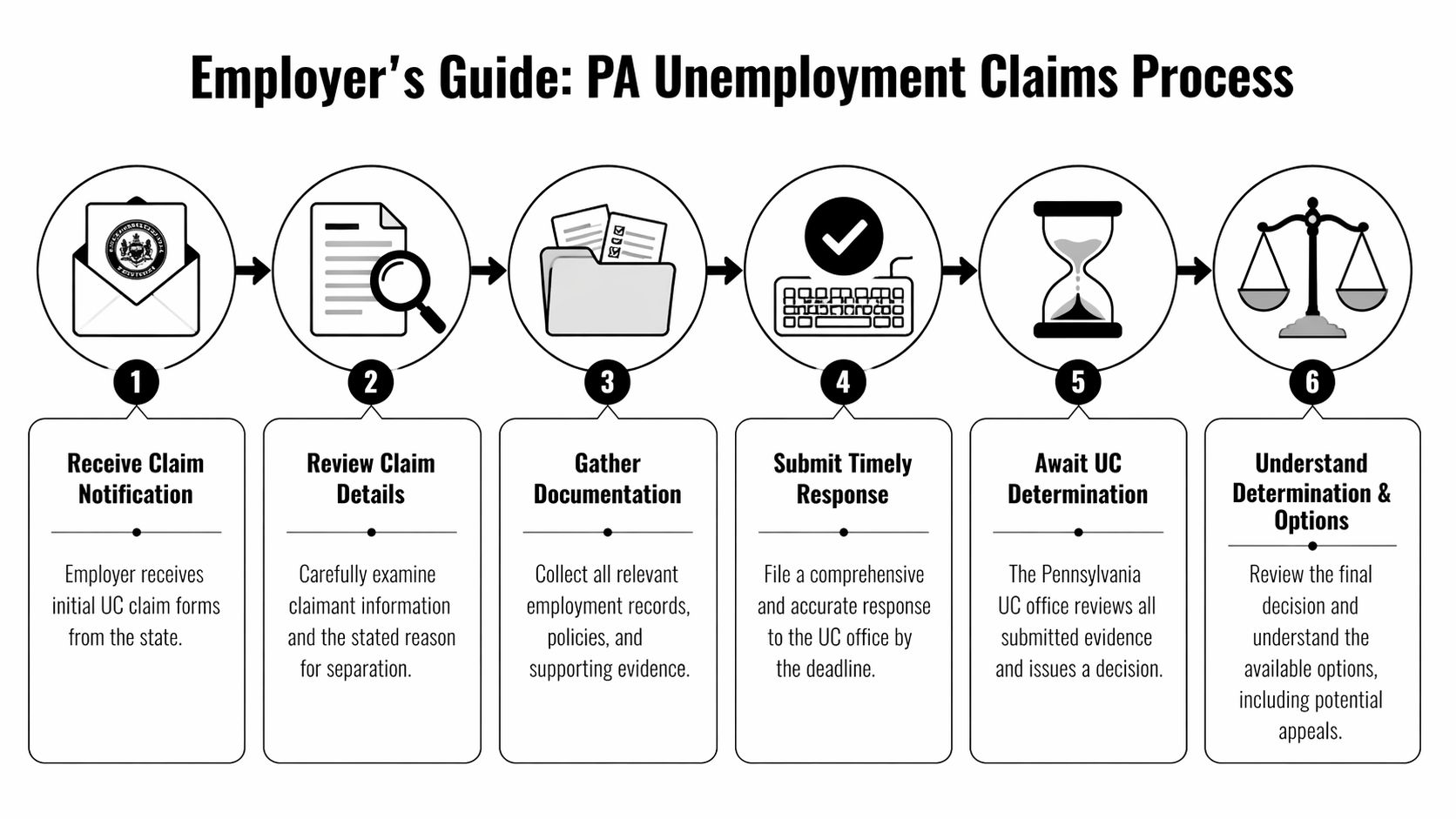
What to do when the notice arrives
Start by reading every page, not just the employee name and claimed separation. Match the notice against your personnel file. Confirm dates of hire, last day worked, final pay period, and whether the separation was initiated by the employer or the worker.
Then identify the file owner inside your company. One person should coordinate the response. When three people send fragments of information, contradictions creep in quickly.
A practical response flow looks like this:
Verify identity and dates
Confirm the claimant, payroll records, and separation date.Check the stated reason for separation
Compare what the claimant reported with your internal documentation.Pull the complete file
Gather warnings, attendance records, policy acknowledgments, resignation emails, and manager notes.Prepare a factual response
Stick to facts. Avoid loaded language and long narratives.Submit on time
A strong defense filed late can still lose force.
What the state is looking for
Pennsylvania’s process is less interested in broad opinions than in traceable facts. If the case involves misconduct, show the rule. If it involves a quit, show the communication history. If it’s a layoff, show the business decision clearly and consistently.
The strongest employer responses usually share three traits:
- They are specific: “Absent on listed dates after final warning” is stronger than “attendance problems.”
- They are consistent: The termination letter, manager statement, and state response all match.
- They include supporting records: Assertions without attachments are easy to challenge.
This overview video can help employers understand the practical flow before they prepare a response.
Common mistakes that weaken a claim response
Some errors show up constantly in small businesses and fast-moving teams.
- Overexplaining the wrong issue: Managers often write a full personality critique when the only relevant point was a final policy violation.
- Using mixed labels: “Laid off for performance” is internally contradictory and creates avoidable confusion.
- Forgetting contemporaneous records: A memo written after the claim arrives is weaker than a warning created at the time of the incident.
- Sending partial files: If you mention a handbook, final warning, or attendance system, include the relevant pages.
Your response should read like a timeline, not a rant.
The employers who handle UC claims best don’t treat them as isolated legal events. They build a repeatable internal routine. Notice received. File gathered. Narrative checked. Evidence attached. Deadline met. That routine matters even more in startups and BPO settings where managers change, projects move fast, and no one remembers details six months later.
Managing Employer UI Taxes and Responsibilities
Most employers think about unemployment law only when a claim lands. That’s backward. The expensive part often comes later, when repeated weak responses and poor records start affecting your unemployment tax experience.

Recordkeeping is a tax control tool
Pennsylvania places the burden on employers to justify a separation, and the state expects records such as daily work logs, pay stubs, and documented reasons for separation, as described in the Pennsylvania UC eligibility information guide. If you don’t produce them, you can lose cases you might otherwise have defended, and higher experience-based tax rates can follow.
That’s not an abstract compliance issue. It hits overhead.
For small businesses, the trap is usually informality. A founder knows why someone was let go, but the file contains only a Slack exchange and a final payroll record. For BPO operators, the trap is fragmentation. Operations has the schedule, payroll has the wages, IT has the login history, and no one assembles the story until a claim appears.
What records actually matter
Keep the records that answer the state’s likely questions. Not every internal note belongs in the file, but the essentials do.
Work history records
Scheduled hours, actual hours, attendance logs, and changes in assignment.Pay records
Gross pay by payment type, deductions by pay period, and final compensation details.Policy proof
Signed acknowledgments, policy versions, and any revisions in effect at the time.Separation proof
Resignation messages, warning notices, investigation notes, and termination letters.
A compact compliance stack is better than a scattered mountain of documents. If you run a multi-client environment, standardize how each supervisor records corrective action. The state won’t care that one manager likes email and another prefers verbal coaching if neither method leaves a reliable trail.
Here’s a practical comparison:
| Weak employer file | Strong employer file |
|---|---|
| Manager says worker “stopped caring” | Attendance log, warning, final incident summary |
| Payroll shows final pay only | Payroll history by period and payment type |
| Handbook exists somewhere | Specific policy page and signed acknowledgment |
| Termination reason changes in later retelling | Same reason appears across all records |
Why this matters for modern operators
Startups often postpone HR discipline because speed feels more important. That works until the first claim. Then the absence of records turns into a tax management problem.
BPO providers and shared-service businesses have an additional challenge. Their clients may expect backend support, but UC exposure still depends on the quality of employer-side documentation. If you’re building operational infrastructure for tenant or client teams, a clear support model for HR records, payroll support, and administrative workflows can make a measurable difference in claim handling. That’s one reason some operators look closely at what’s covered in managed workspace and backend support inclusions.
If your business also has household or domestic workers in the mix, classification and employer registration questions create another layer of risk. This Household Employee EIN: A Pennsylvania Employer's Guide is a useful companion read because it addresses employer setup issues that often get ignored until tax and payroll problems surface.
Good records don't just help you win a hearing. They help you avoid creating a hearing-grade problem in the first place.
What works is routine. Document incidents as they happen. Save policy acknowledgments centrally. Train managers to write factual notes. Reconcile payroll entries before they become UC evidence.
What doesn’t work is reconstructing a separation from memory after the state asks questions.
Successfully Navigating the UC Appeals Process
Sometimes you do everything right and still receive a determination you disagree with. That isn’t the end of the matter. The appeals process exists because UC decisions are made from the record the state has at that moment, and sometimes that record is incomplete, inconsistent, or interpreted poorly.

The first hearing is usually the real battleground
For most employers, the critical stage is the Referee’s hearing. That’s where testimony and documents matter most. Many employers lose not because their facts are weak, but because their presentation is disorganized.
Prepare like this:
- Choose one lead witness who knows the events.
- Bring documents in chronological order so the hearing officer can follow the timeline.
- Match testimony to records instead of adding new theories.
- Focus on the legal issue tied to the separation, not every problem the employee ever had.
If the case is about absenteeism, stay on absenteeism. If it’s about a quit, show the communication trail. Employers hurt themselves when they broaden the case into general dissatisfaction.
Credibility matters more than volume
A stack of papers won’t save a witness who waffles. The hearing officer is listening for consistency. If your manager says the employee resigned, but the termination form says discharge, you’ve created avoidable doubt.
Use a simple hearing checklist:
| Before the hearing | During the hearing |
|---|---|
| Review all notices and your prior response | Answer the question asked |
| Organize exhibits by date | Refer to documents precisely |
| Confirm who made the decision | Avoid exaggeration |
| Identify the exact policy or event at issue | Keep testimony consistent with records |
State the reason for separation in one sentence first. Then prove that sentence.
If the first result goes against you
An unfavorable Referee decision can often be appealed to the UC Board of Review. At that stage, employers need to be realistic. The strongest appeal points usually involve a clear factual or legal error, not just frustration with the outcome.
In rare situations, a case can move beyond the Board into court review. Most small businesses won’t go that far, and many shouldn’t unless the issue has broader consequences for policy, precedent, or repeated claim exposure.
The practical rule is this: appeal when the record supports you and the issue matters. Don’t appeal because the result feels unfair in the abstract. Appealing without a disciplined theory usually burns time and attention that would be better spent fixing the documentation problem that caused the loss.
Pitfalls for Modern Businesses Freelancers and Fraud
Pennsylvania unemployment law still reflects an older employment model. That creates friction for modern businesses that use mixed teams, project-based work, part-time support, and freelance talent. The hardest cases often come from the gray areas, not the obvious ones.
The freelancer problem is larger than many owners realize
Pennsylvania’s Section 402(h) often disqualifies individuals with substantial self-employment income from receiving UC benefits. Testimony cited in the Pennsylvania legislative record also notes that 38 other states use alternative base periods, while Pennsylvania has not kept pace in the same way, leaving many freelancers and contract workers without a similar safety net, as discussed in this Pennsylvania legislative testimony on UC and self-employment.
That matters in real life because modern workers rarely fit a single box. A person may have covered wages from one employer, freelance income on the side, and platform work between projects. Employers often assume that if someone “paid into the system somewhere,” benefits will sort themselves out. That assumption fails quickly under Section 402(h).
For startups and BPOs, the takeaway is practical. If your workforce model depends on a mix of employees and independent contributors, your contracts, payroll boundaries, and role definitions need to be clean. Blurred lines create confusion for everyone when a claim is filed.
Fraud and misclassification often look similar at first
Employers also need to separate two different risks.
One is claimant fraud, where a worker misstates the separation or ongoing work status.
The other is employer misclassification, where a business calls someone a contractor but manages them like an employee. In practice, both scenarios can surface during a UC dispute, and both require records to sort out.
Watch for these warning signs:
Conflicting work status
The person was invoicing as a contractor but followed fixed schedules, direct supervision, and internal policies like staff.Side work not clearly documented
The former worker had outside income, but nobody knows whether it was occasional, substantial, or disclosed.Inconsistent offboarding language
One manager says “freelancer,” payroll says “employee,” and operations treated the person like core staff.
Cross-border teams can make this even more confusing. If you manage flexible labor internationally, it helps to understand how other systems treat contingent scheduling. A good comparative read is this guide to zero-hour contract entitlements, not because Pennsylvania follows that model, but because it highlights how workforce flexibility and worker protections can pull in different directions.
What works here is precision. Define worker status correctly at engagement. Keep side business disclosures where relevant. Don’t improvise labels after a claim arrives. That’s where small businesses create problems they can’t easily unwind.
PA Unemployment Law FAQs for Startups and BPOs
How should a BPO handle a claim for an employee who worked across several client accounts
Treat it as one employment record unless the legal employer changed. Pull the full payroll history, assignment history, supervisor notes, and final separation documents across all accounts. Don’t let each client team tell a different version of the story.
We’re a startup with uneven revenue. What should we do before a layoff happens
Standardize documentation before you need it. Use one termination memo format, one warning process, and one place for policy acknowledgments. The businesses that struggle most under pa unemployment law usually don’t fail on legal theory. They fail on record discipline.
Can a former freelancer file against us
They can try. Your response should focus on the actual relationship. Show the contract, invoicing structure, supervision level, control over schedule, and whether the person was carried through payroll as an employee. Don’t rely on the label alone.
What if the worker resigned but now says they were forced out
Resignation disputes usually turn on communication history. Save the resignation email or message, any prior complaints, schedule discussions, accommodation requests, and manager responses. A clean timeline matters more than broad statements about attitude.
Should we always contest a claim if we think the employee caused problems
No. Contest claims when the facts and records support your position. If you had a legitimate business layoff, say that. If the file is weak, fix the process going forward rather than filing a reactive response built on assumptions.
Who inside the company should own UC responses
One accountable owner should coordinate the process, even if payroll, HR, and operations all provide documents. Decentralized responses create inconsistencies, and inconsistencies are expensive.
What’s the best habit to reduce avoidable UC trouble
Write the separation reason clearly on the day it happens, and back it with records created before any claim is filed.
If your company is growing and you want a more organized operating environment for workforce administration, payroll coordination, IT support, and back-office functions, Seat Leasing BPO offers flexible workspace and support infrastructure that can help modern teams stay focused on operations instead of getting buried in overhead.