The market alone should reset how leaders think about outsourcing custom software development. The global custom software development outsourcing market is valued at $43.2 billion in 2025 and projected to reach $109.5 billion by 2034, reflecting a CAGR of 22.6%, driven by demand for custom-built AI applications and complex system modernizations, according to Keyhole Software’s outsourcing statistics.
That growth isn't happening because companies want cheaper coding. It's happening because generic software breaks down at the edges. This pressure shows up in integrations, legacy systems, compliance requirements, and workflows that don't fit a boxed product.
What Is Custom Software Development Outsourcing
Custom software development outsourcing means hiring an external team to design, build, test, and maintain software that fits your business instead of forcing your business to fit a packaged tool.
A simple analogy helps. Off the shelf software is like buying a standard house in a development. It works if your needs are ordinary and your compromises are acceptable. Outsourcing custom software development is like hiring an architect and a construction firm to build around your site, your usage, your constraints, and your future plans.

What companies actually outsource
In practice, companies outsource more than coding. They bring in partners for:
- Product builds: New SaaS platforms, internal tools, customer portals, and mobile apps.
- Modernization work: Replacing fragile legacy systems, rebuilding old interfaces, or moving monoliths into cleaner service layers.
- Integration-heavy projects: Connecting ERP, CRM, billing, logistics, identity, and analytics systems through APIs and middleware.
- Specialized capability gaps: DevOps, cloud architecture, QA automation, AI feature implementation, or security hardening.
The reason this model keeps expanding is straightforward. Custom software is often the only route when the business needs are unusual, regulated, or critically operational. For leaders comparing options, these strategic outsourced development insights are useful because they frame outsourcing as a delivery model choice, not just a procurement event.
What good outsourcing looks like
The best outsourced engagements don't feel like vendor management. They feel like working with a product and engineering unit that understands trade-offs.
Practical rule: If a partner talks only about velocity and price, expect pain later in architecture, testing, and support.
A serious partner asks hard questions early. What systems must remain the source of truth. Who owns requirements. How releases will be approved. What environments exist. How the software will be supported after launch. Those questions matter more than a polished slide deck.
For companies that want a broader operating view of support environments and business execution, the Seat Leasing BPO blog is a useful reference point. Software delivery doesn't happen in a vacuum. It sits on top of people, process, connectivity, and operating discipline.
Analyzing the Business Case for Outsourcing
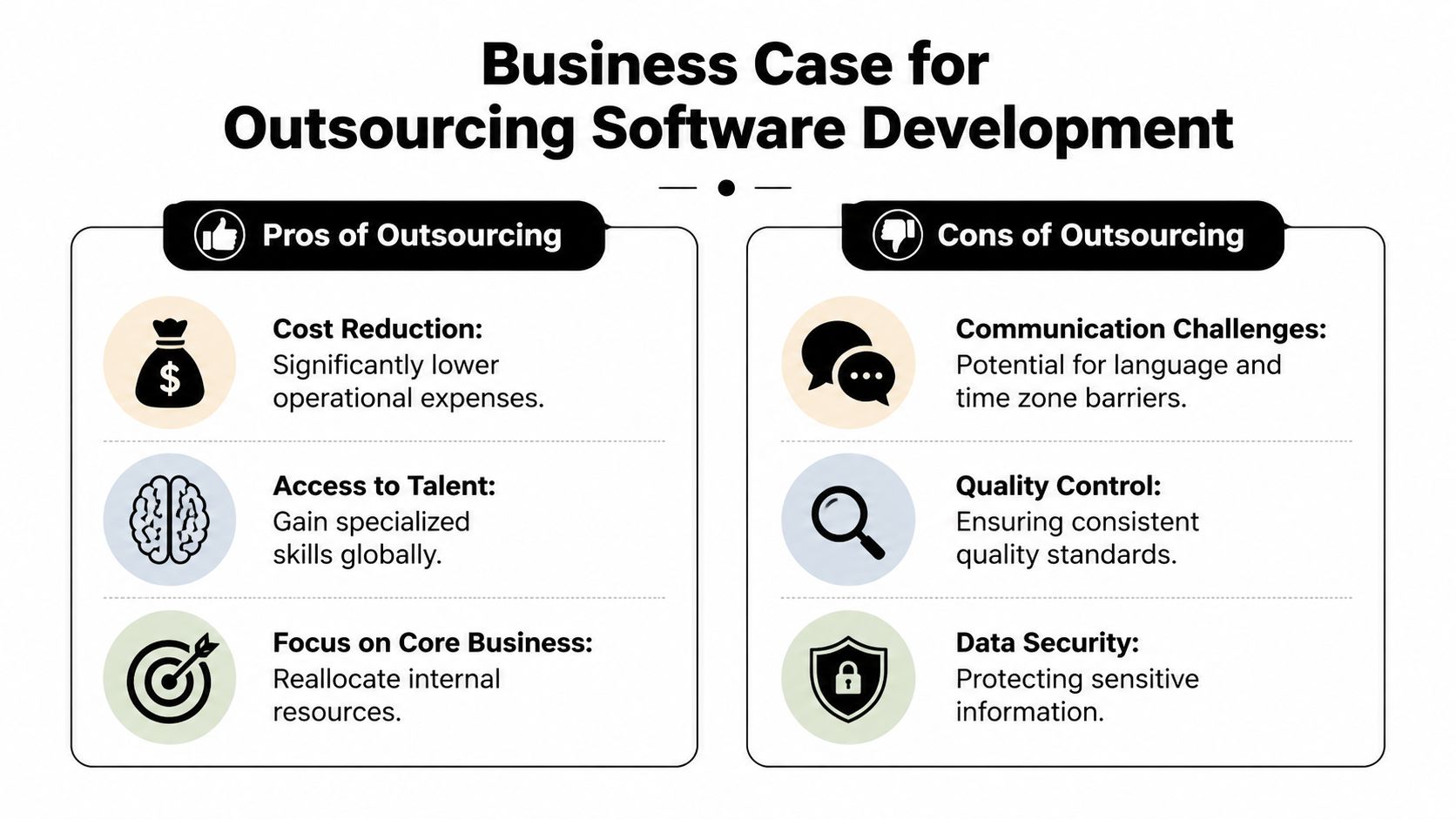
Most companies outsource for one of four reasons. Cost, speed, talent access, or focus. Smart teams evaluate all four at the same time, because a low hourly rate can be expensive if the team misses architecture decisions or creates maintenance debt.
Cost isn't just hourly rate
The raw cost case is still real. Offshore rates range from $25 to $50 per hour, compared to nearshore at $40 to $100 per hour, while median US developer salaries run from $107,090 to $210,000 annually. Also, 59% of businesses outsource for cost optimization, based on 10Pearls outsourcing statistics for 2025.
That said, hourly math is the shallow version of the business case.
A stronger calculation includes recruiting time, management overhead, QA coverage, DevOps setup, employee churn, paid tools, and the opportunity cost of waiting months to build a team internally. Many internal build plans fail because leaders compare vendor invoices to salaries and ignore the rest of the delivery system.
Speed matters when the market won't wait
An established outsourcing partner can often start faster than an internal hiring process. They already have engineers, delivery managers, QA practices, and deployment routines. If your roadmap is time-sensitive, that matters more than theoretical control.
What works is assigning your internal team to product direction and business decisions while the external team owns execution within clear boundaries. What doesn't work is treating the vendor like a backlog dumping ground. That slows everyone down.
Quality depends on specialization
The quality upside shows up when you need skills that are hard to hire locally. That can be cloud-native backend work, test automation, data engineering, mobile performance tuning, or modernization of brittle enterprise systems.
If you're weighing custom work against packaged software, this piece on optimizing operations with tailored software is worth reviewing because it highlights the operational fit question many teams miss.
Cheap code is rarely cheap software. You pay for bad architecture in rework, outages, and delayed releases.
Security is where shortcuts become expensive
Security is the area where weak outsourcing decisions become visible late and cost the most to fix. A partner that lacks disciplined access control, secure development practice, and auditability can create legal and operational risk that dwarfs the savings from lower rates.
Use a simple decision lens:
| Factor | Good reason to outsource | Warning sign |
|---|---|---|
| Cost | Lower total delivery overhead | Vendor wins only on price |
| Speed | Team can start quickly with mature delivery routines | No onboarding or release discipline |
| Quality | Deep experience in your stack or domain | Generic portfolio, shallow technical answers |
| Security | Clear controls, certifications, documented processes | Hand-wavy answers about compliance |
Choosing Your Outsourcing Engagement Model
The engagement model shapes everything. Budget control, accountability, flexibility, reporting, and how painful change requests become. Many projects struggle not because the vendor is weak, but because the commercial model fights the product reality.
Comparison of software outsourcing engagement models
| Model | Best For | Pros | Cons |
|---|---|---|---|
| Fixed Price | Small, well-defined projects with stable requirements | Clear budget, clear deliverables, easier procurement approval | Change is painful, incentives can drift toward minimum compliance |
| Time and Materials | Products with evolving scope and active stakeholder input | Flexible, transparent, supports discovery and iteration | Requires stronger client involvement and tighter backlog discipline |
| Dedicated Team | Long-term products needing continuity and domain knowledge | Team stability, strong ownership, easier roadmap execution | Ongoing commitment, value depends on active product leadership |
| Staff Augmentation | Filling specific skill gaps inside an existing internal team | Fast access to specialists, keeps management control in-house | Client must manage priorities, process, and technical integration |
Where each model works best
Fixed Price works when the requirements are stable and the acceptance criteria are unambiguous. Think internal workflow apps, narrowly scoped portals, or integrations with well-documented endpoints. If your stakeholders are still debating features, avoid it.
Time and Materials fits product development better than most buyers admit. If you're learning from users, changing priorities, or refining scope during delivery, this model is honest about uncertainty.
Dedicated Team is the strongest choice when software is becoming part of the business core. You keep strategic control, but you gain continuity that one-off projects rarely deliver.
Staff Augmentation makes sense when your architecture, processes, and internal leadership are already solid. It fails when companies expect external engineers to provide leadership while treating them as extra hands.
The selection test I use
Three questions usually make the right model obvious:
- Is scope stable or evolving
- Who will own day-to-day prioritization
- Is this a project or a product
If scope is stable, fixed price can work. If the roadmap will shift, use time and materials or a dedicated team. If your own engineering managers and tech leads are strong, staff augmentation can be effective. If they aren't, don't pretend otherwise.
The model should absorb change, not punish it.
One more point. Procurement teams often prefer fixed price because it feels safe. Engineering teams usually prefer flexible models because they deal with reality. The right answer is the model that matches how the work will unfold.
Deciding on the Right Outsourcing Location
Location decisions get oversimplified. Leaders compare rates, pick the cheapest region, and then act surprised when communication friction, weak overlap, or infrastructure gaps slow the project.
The best outsourcing location is the one that fits your operating style.
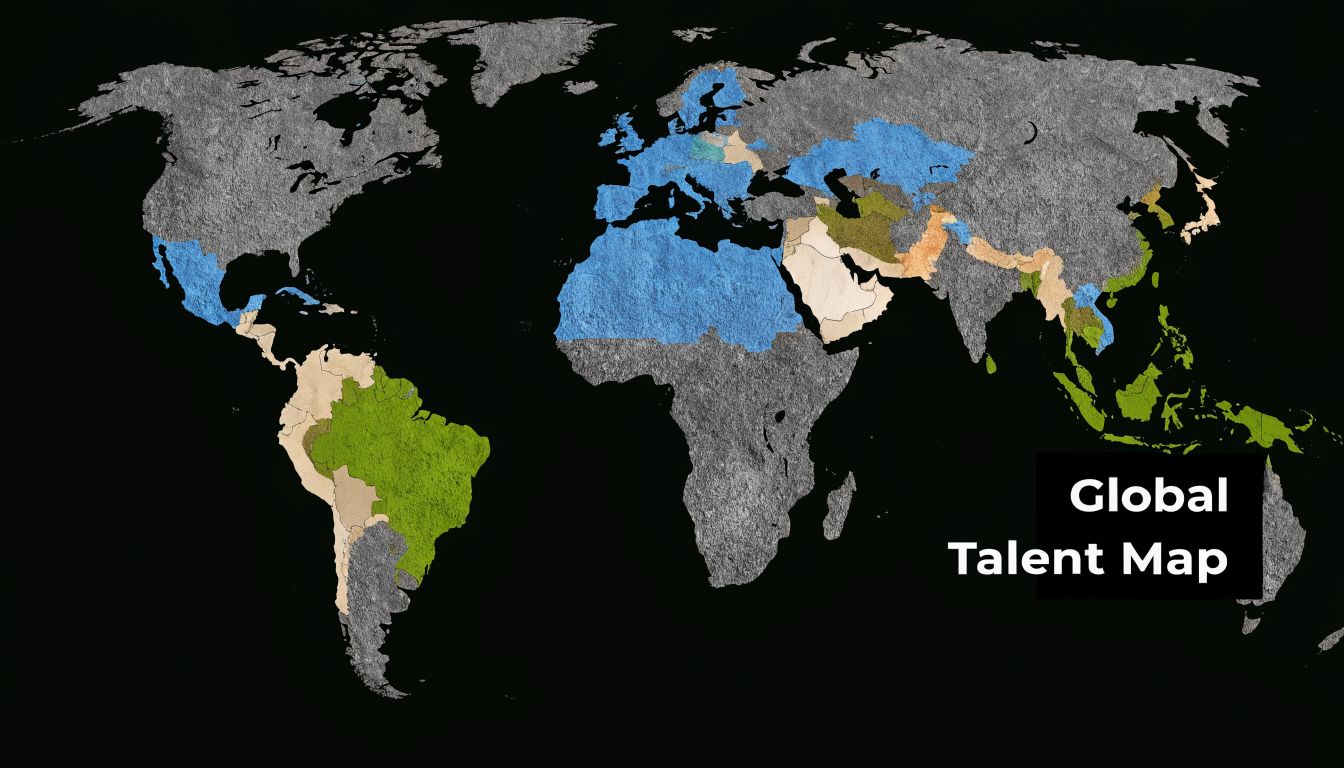
Onshore nearshore and offshore mean different management burdens
Onshore is easiest when the work is highly collaborative, regulated, or politically sensitive. You usually get cultural alignment and simpler legal coordination. You also pay for it.
Nearshore is often the practical middle ground. The biggest benefit isn't only lower cost. It's workable time-zone overlap for design reviews, sprint planning, incident response, and stakeholder access.
Offshore can be a strong choice for mature companies with clear product ownership, strong documentation, and a team that knows how to run distributed delivery. It breaks down when leaders expect constant real-time collaboration without building the process to support it.
Choose based on communication pattern
Think about the software you're building.
If you need daily access to product managers, users, and internal system owners, nearshore or onshore may reduce friction. If the work can be modularized, documented, and handed off cleanly, offshore can perform well.
A few practical questions matter more than geography labels:
- How many overlapping working hours do you need
- Will your team communicate mostly through tickets or live workshops
- Does the vendor have strong written communication
- Who handles urgent production issues
This short overview is useful if you want a visual primer on location strategy and distributed delivery realities.
Infrastructure maturity changes the answer
Location isn't only about talent and rates. It's also about operational maturity. Strong internet reliability, secure office access, endpoint management, backup power, and disciplined IT support all affect delivery consistency, especially for teams handling sensitive systems or multi-environment deployments.
I've seen offshore teams with excellent engineering talent lose momentum because the surrounding operating environment was shaky. I've also seen distributed teams perform exceptionally well because their physical and technical setup was disciplined from day one.
That difference is easy to miss in a sales process. It becomes obvious in sprint three.
How to Select and Vet Your Development Partner
Vendor selection shouldn't start with portfolio screenshots. It should start with risk reduction.
A partner can have attractive case studies and still be wrong for your project if their delivery discipline, security posture, or technical depth doesn't fit your environment. Good vetting is boring by design. That's why it works.
Start with technical fit
First, verify stack alignment. If you're building in React, Node.js, .NET, Python, Java, Kotlin, Swift, or using AWS, Azure, Docker, Kubernetes, Terraform, PostgreSQL, or Snowflake, ask who on the proposed team has shipped with those tools.
Don't accept generic claims like "our team can work with any modern stack." Ask for examples of recent architecture choices, testing strategy, deployment setup, and how they handled failure modes.
Use this shortlist during interviews:
- Ask for architecture reasoning: Why this stack, not another one.
- Review code samples carefully: Look for naming, test coverage, error handling, and consistency.
- Interview the actual team: Not only the sales engineer or account lead.
- Check who writes documentation: Strong engineering teams can explain decisions clearly.
Security and compliance are non-negotiable
Many buying teams get soft. They assume legal paperwork will cover technical weakness. It won't.
Vendors must demonstrate ISO 27001 and SOC 2 certifications. Implementing compliance-driven architecture increases initial development costs by 15% to 25% but reduces post-deployment security incidents and regulatory fines by 60% to 80%, according to Vetted OutSource on software development outsourcing.
That trade-off is usually worth it when the software handles customer data, financial records, health information, internal business operations, or regulated workflows.
Security checkpoint: Ask for security requirement documents, access control policies, audit trail capabilities, and infrastructure diagrams before contract signing.
Run a real diligence process
Reference checks should be specific. Don't ask, "Were you happy with them?" Ask what happened when scope changed, when a release slipped, when a bug escaped to production, or when a key engineer rolled off.
Then inspect delivery behavior.
| What to verify | What good looks like |
|---|---|
| Team continuity | Named team members with clear roles and backup coverage |
| Delivery process | Sprint ceremonies, demo cadence, issue tracking, release approvals |
| QA approach | Automated tests, manual regression process, defect ownership |
| DevOps practice | CI/CD ownership, environment strategy, rollback planning |
| Communication | Clear escalation path, written updates, direct access to leads |
Watch for the wrong signals
Three red flags show up often.
One is a vendor that says yes too quickly. Serious teams challenge assumptions. Another is a proposal that looks polished but doesn't identify project risks. The third is a handoff model where senior people sell the project and junior people run it without oversight.
A strong partner isn't the one that promises the smoothest journey. It's the one that exposes complexity early and still shows you how they'll manage it.
Mastering Contracts IP Protection and Project Management
A software project becomes fragile when the contract says one thing, the backlog says another, and the team communication says something else. The legal structure and the operating cadence have to support each other.
Put the contract on solid ground
Use an MSA for the overall commercial relationship and a SOW for the specific project, team, deliverables, timelines, and acceptance criteria. Keep them separate. It makes future work easier to add without renegotiating every core term.
Intellectual property language needs special attention. If you don't define ownership clearly, you can end up paying for code you can't fully control, modify, or transfer.
For a plain-English primer, this legal guide to protecting ideas is a useful starting point. Then have counsel adapt the terms to your jurisdiction and delivery model.
Your contract should explicitly cover:
- IP ownership: Client owns source code, designs, documentation, and deliverables upon payment or as otherwise agreed.
- Confidentiality: NDA language should apply to code, business logic, customer data, and operational processes.
- Subcontracting rules: Require disclosure and approval if the vendor wants to use third parties.
- Termination and transition: Define handover obligations, repository transfer, credentials handling, and documentation delivery.
Manage the project like an operating system
Once the paperwork is right, execution comes down to management rhythm. The strongest outsourced teams I've worked with had simple habits. Jira for backlog and sprint tracking. Slack or Microsoft Teams for day-to-day communication. Confluence, Notion, or Google Docs for architecture notes and decision logs. GitHub, GitLab, or Bitbucket for code review and release traceability.
What matters isn't the brand of tool. It's that everybody uses the same source of truth.
A healthy cadence usually includes regular standups for the working team, weekly stakeholder reviews, sprint demos with business feedback, and clear release approvals. For a broader sense of what production-ready workspaces and backend support can include around these operating routines, review the service inclusions at Seat Leasing BPO.
If an important decision is made in a private chat and never enters the backlog or documentation, expect confusion later.
Track the right signals
Don't drown the team in vanity KPIs. Track the indicators that reveal delivery health:
- Scope movement: What changed, who approved it, and what moved out.
- Defect trend: Are bugs clustering in one service, release stage, or team habit.
- Cycle clarity: How long work items sit blocked before someone acts.
- Demo quality: Can stakeholders see usable progress, not just technical activity.
The point of project management isn't to produce status theater. It's to surface risk before it becomes rework.
Supporting Your Team With Flexible Infrastructure
A lot of outsourcing advice assumes remote delivery is purely digital. That's incomplete. Teams still need reliable physical and operational infrastructure, especially when the software touches live business systems, compliance requirements, or shared client environments.
That matters more in outsourcing custom software development than many buyers expect.

Remote teams still depend on real-world operating conditions
Developers can work from anywhere in theory. In practice, performance depends on stable connectivity, secure access, controlled devices, dependable power, quiet collaboration space, and support staff who can solve issues fast.
The gap becomes obvious in integration-heavy projects. A key gap in outsourcing guidance is the lack of focus on smooth API integrations and data migration in multi-tenant BPO setups, where misalignments can cause 20% to 30% deployment delays and negate cost benefits by requiring expensive on-site fixes, based on TechExactly’s guide to software development outsourcing.
When a team is building software that has to fit into preconfigured office networks, identity systems, tenant controls, or shared security layers, infrastructure becomes part of delivery. It isn't background noise.
Why workspace design affects software outcomes
This is especially relevant for startups, BPO operators, and companies using plug-and-play environments. If the development team works inside a structured workspace with managed connectivity, IT support, and predictable operating conditions, fewer problems get pushed downstream into deployment.
What tends to work well:
- Controlled access environments: Better for handling client credentials, staging systems, and sensitive admin workflows.
- Shared but managed backend support: Useful when multiple teams need consistent connectivity, device policies, and troubleshooting.
- Faster setup for hybrid teams: Easier to onboard developers, QA analysts, support staff, and project managers into one operating rhythm.
- Lower distraction from non-core tasks: The engineering team spends less time dealing with facilities and support issues.
A practical example is evaluating whether the vendor's workspace can support secure calls, reliable build and test activity, and coordination with client-side infrastructure owners. If those basics are weak, integration timelines slip.
This is an execution issue not a facilities issue
Leaders often separate "workspace" from "software delivery" as if one belongs to operations and the other to engineering. In outsourced projects, they overlap.
A vendor can have strong developers and still struggle if the surrounding environment is unstable. On the other hand, a team working in a reliable, managed setting can move faster because incidents get resolved quickly and day-to-day collaboration holds together.
If you're assessing operational readiness in a physical environment, the workspace context around Building 24 helps illustrate why delivery conditions matter beyond laptops and code repositories.
Avoiding Common Pitfalls and Emerging Risks
Most failed outsourcing projects don't collapse because one big thing goes wrong. They erode through small avoidable mistakes. Vague requirements. Too much trust in verbal agreements. Weak stakeholder access. Scope changes without reset. Security treated as a late-stage concern.
The fix isn't more process for its own sake. It's disciplined decisions at the start.
The common failure points
Start with requirements. If the team doesn't know which business rules are fixed and which are negotiable, they'll build the wrong thing efficiently. Write down workflows, edge cases, integrations, and approval paths early. Then update them as the product evolves.
Scope creep is next. It's normal for ideas to change once users see the product. The problem isn't change. The problem is unmanaged change. Every material change should move through a visible request process tied to budget, timeline, and acceptance criteria.
Communication failures are usually structural, not personal. If product owners aren't available, or if business stakeholders skip demos and reviews, the outsourced team starts guessing. Guessing is expensive.
New compliance risks are changing vendor selection
The regulatory layer is getting harder, especially for AI-enabled products and cross-border data handling. Emerging risks include EU AI Act enforcement and global data sovereignty laws, which can increase compliance costs by 25% to 35% for offshore vendors, as discussed by Softura on the unseen benefits and risks of outsourcing.
That doesn't mean offshore is wrong. It means you need sharper vendor vetting.
Ask direct questions:
- Where will data be stored and processed
- How will model training or AI feature behavior be governed
- What audit records exist for access and decision paths
- Who is responsible for compliance changes after launch
Vendors that treat regulatory questions as legal fine print usually haven't embedded compliance into delivery.
A working mitigation checklist
Use a short control list before kickoff and at every major phase gate:
| Risk area | Mitigation |
|---|---|
| Ambiguous scope | Written requirements, named approvers, demo-based validation |
| Scope creep | Formal change control tied to cost and timing |
| Weak communication | Fixed meeting cadence, direct access to leads, written status updates |
| Security gaps | Certification review, access controls, documented environment rules |
| Compliance drift | Vendor questionnaire, architecture review, ongoing legal and product review |
| Integration surprises | Early system mapping, API review, data migration rehearsal |
Teams that do outsourcing custom software development well aren't lucky. They reduce ambiguity, insist on technical evidence, and treat operational details as part of engineering.
If you're building or supporting outsourced teams and want the operating side to be as reliable as the software side, Seat Leasing BPO offers flexible workspace solutions that remove much of the infrastructure burden. For companies that need ready-to-run environments with managed IT, connectivity, cybersecurity support, and lower overhead, that kind of setup can make outsourced delivery easier to scale and easier to control.