Growth usually breaks procurement before it breaks sales.
A company adds people, opens a new location, signs more software, buys more devices, and starts working with more vendors. Then the finance lead spends half the week chasing invoices, operations negotiates internet and facilities contracts on the fly, and nobody can say with confidence whether the business is buying well or just buying fast.
Outsourcing and procurement then stop being back-office topics and become management decisions. The issue is not only price. It is focus. Every hour your internal team spends fixing purchase order errors, comparing suppliers, or untangling contract terms is an hour not spent on product, customers, hiring, or expansion.
The Strategic Shift in Modern Procurement
A familiar pattern shows up in growing businesses. The founder still approves software. The office manager handles facilities. Finance pays invoices. IT negotiates hardware. Legal reviews contracts at the end. No one owns spend across the whole business, so costs spread through separate decisions.

That setup works when the company is small. It fails when supplier count rises, compliance matters more, and speed starts to compete with control. Leaders then face a blunt question: should the business keep building procurement capability internally, or should it hand part of that work to specialists?
Why companies are shifting now
The case for outsourcing often starts with labor and overhead, but that is only part of it. Cost reduction is a primary driver for outsourcing, motivating 70% of businesses, and small businesses report saving 27.2% on HR processes while achieving up to 25% efficiency gains overall according to these outsourcing statistics.
Those numbers matter because procurement touches many of the same operational pressures. Teams want lower costs, fewer delays, cleaner approvals, and less administrative drag. Outsourcing can provide that if the scope is defined well.
What changes on the ground
In practice, the shift is less dramatic than many owners expect. Good outsourcing does not remove management. It removes routine workload and adds specialist discipline.
A capable partner can take over areas that usually bog internal teams down:
- Transactional buying: purchase orders, invoice coordination, routine supplier follow-up
- Indirect spend categories: software, IT services, facilities, utilities, office operations
- Supplier administration: onboarding, documentation checks, renewals, basic compliance support
- Spend visibility: consolidated reporting that finance and operations can use
Procurement should help a business move faster with fewer mistakes. If the process slows growth, the process needs redesign.
Businesses that are still evaluating options often start by studying how operations-heavy firms have approached support functions through integrated service models. The examples collected on the Seat Leasing BPO blog are useful for that reason. They show how companies often outsource operational infrastructure first, before they outsource more strategic procurement work.
The strategic shift is simple. Companies are no longer asking only, “Can we buy this cheaper?” They are asking, “Who should own this work, and what is the best use of internal attention?”
What Is Outsourcing Procurement Really
Most owners hear the term and assume it means handing purchasing to a third party. That description is too thin to be useful.
A better way to think about it is this: an outsourcing partner acts like a Chief Spend Officer without the full-time executive overhead. The provider does not merely place orders. It structures how the company buys, which suppliers it uses, what data it tracks, and how much discipline sits behind everyday spending.
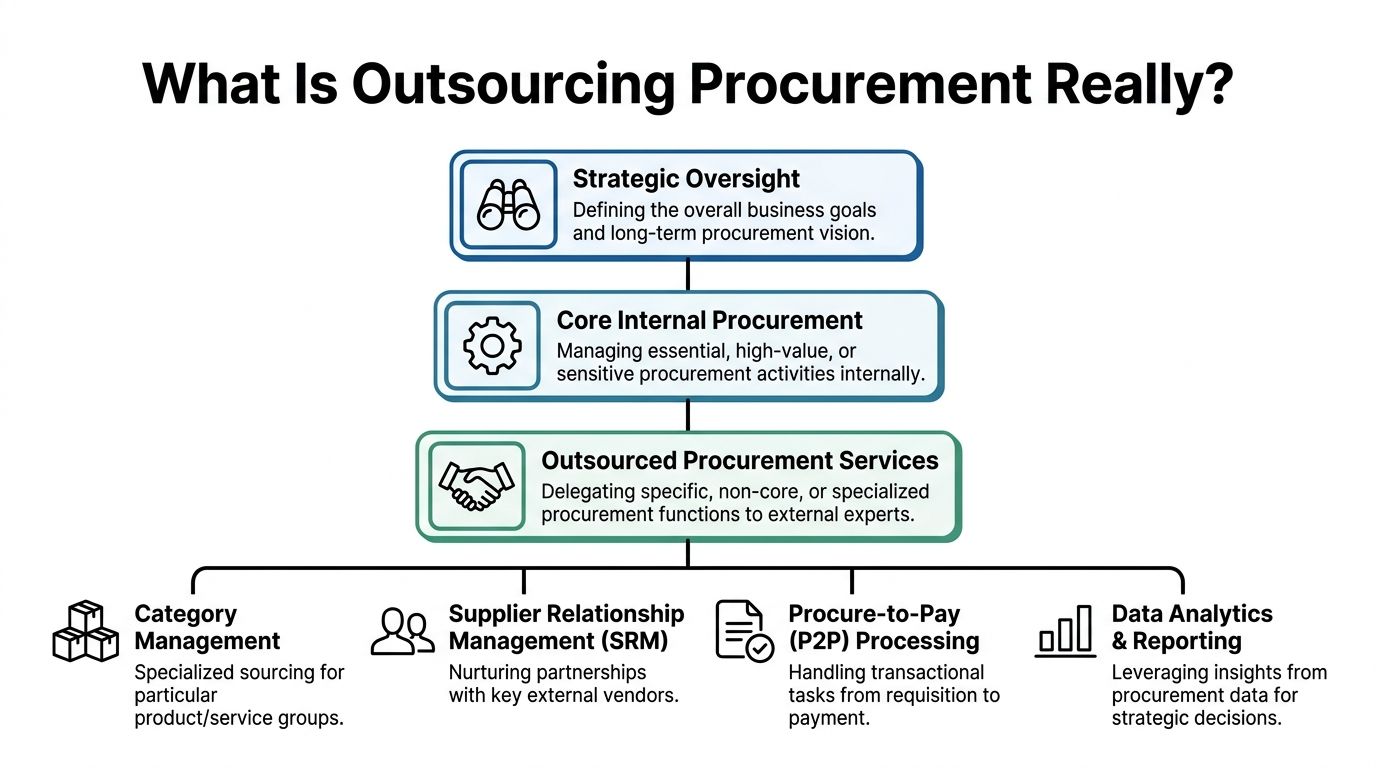
The model has become mainstream. The global procurement outsourcing market was valued at USD 6.71 billion in 2024 and is projected to reach USD 19.84 billion by 2033, growing at a 12.8% CAGR, according to SkyQuest’s procurement outsourcing market analysis.
The lifecycle companies outsource
Most procurement work falls into a few operating blocks. You do not have to outsource all of them.
Source-to-pay
Source-to-pay (S2P) covers the chain from identifying a need to selecting a supplier, negotiating terms, issuing orders, receiving goods or services, and paying invoices. This is the broadest view of procurement.
When a business outsources S2P elements, it is usually trying to standardize fragmented buying behavior across departments.
Procure-to-pay
Procure-to-pay (P2P) is narrower and more transactional. It covers requisitions, purchase orders, invoice matching, approvals, and payment coordination.
This is often the easiest entry point for outsourcing because the work is process-heavy and repeatable.
Strategic sourcing and category management
Here, value is created. Strategic sourcing looks at how you buy a category over time. Category management groups similar spend together, such as cloud software, laptops, cybersecurity, facilities, or outsourced support.
A strong provider does not ask, “Which vendor do you want?” It asks, “Why are you buying this category this way at all?”
What stays inside and what can move outside
Not every procurement activity should leave the business. High-risk categories, sensitive commercial decisions, and core product inputs often stay internal. Routine or specialized categories often move well to an external team.
A practical split looks like this:
- Keep in-house: final supplier selection for core revenue areas, budget ownership, policy setting, executive approvals
- Outsource selectively: software buying support, facilities sourcing, vendor onboarding, contract administration, spend analytics
- Hybrid ownership: negotiation support where internal leaders know the business need but outside experts know the market
If you are comparing providers, it helps to understand how a broader third-party service provider model works outside procurement too. The same lesson applies here. The best external partners do not just supply labor. They bring process control, specialist capability, and accountability that an overstretched internal team usually cannot build quickly.
Good procurement outsourcing is not abdication. It is controlled delegation with clear commercial rules.
The companies that benefit most are usually not the largest. They are the ones growing fast enough to need structure, but not large enough to justify building deep procurement capability in every spend category.
Choosing Your Model Full Selective or Managed Services
The wrong outsourcing model creates friction before any savings appear. The right one gives you control where it matters and outside help where it pays.
Most businesses choose between three setups. Full outsourcing hands over most procurement operations. Selective outsourcing targets specific categories or processes. Managed services adds external operating support while the company keeps tighter internal control.
The side-by-side comparison
| Model | Level of Control | Cost Structure | Best For |
|---|---|---|---|
| Full | Lowest day-to-day internal involvement, with governance retained internally | Broader service fees tied to end-to-end scope | Businesses that want procurement run as an outsourced function |
| Selective | High control over core decisions, with external support in chosen categories | Targeted spend by category, project, or process | Startups and SMBs with obvious pain points such as IT, SaaS, or facilities |
| Managed Services | Shared control with defined operational ownership by the provider | Ongoing support fees with internal oversight | Companies that want help operating procurement without fully handing it off |
Full outsourcing fits when complexity is already winning
This model makes sense when procurement is fragmented, internal ownership is weak, and leadership wants one accountable operator. The provider can run sourcing, supplier management, transactional buying, and reporting under one framework.
The trade-off is obvious. You gain consistency, but you lose some day-to-day closeness to the work. That is acceptable for indirect spend and standard operations. It is usually a mistake for categories tightly tied to product quality, customer delivery, or strategic intellectual property.
Selective outsourcing is usually the smartest first move
Most growing firms should start here.
If software contracts are unmanaged, hardware buying is inconsistent, and office infrastructure is distracting your operations team, outsource those categories first. Keep policy, budget, and final approvals internal.
This works especially well when the company has one or two visible procurement leaks:
- SaaS sprawl: duplicate tools, weak renewals, poor license control
- Facilities complexity: workspace, utilities, support services, security
- IT procurement drag: devices, internet, support vendors, cybersecurity services
- Supplier admin overload: onboarding, compliance documents, contract tracking
For teams exploring outsourced operational infrastructure, the inclusions list at https://seatleasingbpo.com/inclusions/ is a useful reference point because it shows how some costs and support functions can be bundled rather than sourced piece by piece.
Managed services works when the internal lead is strong
This model is underused. It suits companies that already have a capable finance or operations lead but need execution support. The provider handles workflow, reporting, supplier coordination, and day-to-day administration. Internal leadership still directs strategy.
This is often the best fit when the business wants better process discipline without changing ownership lines.
What to evaluate before choosing
Do not choose a model based on buzzwords. Choose it based on operating reality.
Ask these questions:
- Who currently owns spend? If the answer is “everyone,” full or managed support may be necessary.
- Which categories cause the most friction? That points to selective outsourcing.
- How much supplier knowledge must stay internal? The more strategic the category, the more internal control you should keep.
- How mature is your approval process? Weak approvals make any outsourcing model harder to govern.
Vendor governance matters in all three models. If your team needs a practical primer, these key vendor management best practices are worth reviewing before you sign anything. Procurement outsourcing fails more often from weak governance than from poor negotiation skill.
Start with the category that consumes management attention but does not define your competitive edge. That is usually where selective outsourcing proves itself fastest.
The Tangible Benefits and Hidden Risks of Outsourcing
Procurement outsourcing can improve margin, speed, and consistency. It can also lock a business into a bad operating model if leaders outsource the wrong scope for the wrong reason.
The strongest business case usually appears in categories where internal teams lack influence or market data. Software is a good example. Procurement outsourcing grants access to advanced price benchmarking data, enabling 10% to 20% cost savings. Expert negotiators can secure 15% better pricing on SaaS tools, which are often purchased 25% above market rates by companies without that negotiating power, according to CloudEagle’s analysis of outsourcing procurement.
What works in practice
The hard benefit is not “outsourcing.” The hard benefit is better buying discipline.
An experienced procurement partner usually improves results in four practical ways:
- Benchmarking: they know whether your current vendor pricing is normal or inflated
- Negotiation sequencing: they manage timing, term lengths, renewal clauses, and the advantage of volume
- Supplier comparison: they force side-by-side commercial review instead of one-vendor convenience buying
- Process cleanup: they reduce duplicate purchases and informal approvals
This matters even more in indirect spend. Companies often overmanage payroll and undermanage software, facilities, and operational services. That is backwards. Those categories accumulate and can damage cash flow without attracting attention.
The less visible upside
There is also an organizational benefit. Outsourcing can create a cleaner separation between demand owners and commercial owners.
The department head defines the need. Procurement tests the market, structures the competition, and protects the company’s commercial position. When one person does both jobs, convenience often beats discipline.
That split is valuable for fast-growing teams because it reduces emotional buying. Leaders stop renewing familiar tools by default and start asking whether the category still fits the business.
Savings are rarely created by a cheaper quote alone. They come from better category design, cleaner requirements, and stronger supplier terms.
What does not work
The most common mistake is outsourcing chaos and expecting the provider to decode it.
If your requirements are vague, approval rights are unclear, and contract owners are unknown, an external partner will inherit confusion. They may standardize parts of it, but they cannot fix missing internal decisions.
Another failure point is over-outsourcing. Companies sometimes hand off supplier relationships that should stay close to operations or leadership. That weakens context, slows escalation, and erodes commercial judgment inside the business.
The risks leaders underestimate
A few risks deserve blunt attention:
Vendor lock-in
If one provider controls too much spend data, too many workflows, and too many supplier relationships, the switching cost rises. That weakens your negotiating position later.
Knowledge drain
When every category decision sits outside the business, internal managers stop learning how markets work. You lose category memory, contract awareness, and supplier history.
Misaligned incentives
A provider may optimize for throughput while you need long-term value. Fast sourcing is not the same as good sourcing.
Hidden transition burden
Data cleanup, handoffs, workflow mapping, and stakeholder training take management time. Even good outsourcing requires real internal attention at the start.
The answer is not to avoid outsourcing. It is to scope it precisely, keep governance tight, and never confuse operational relief with strategic surrender.
Measuring Success KPIs and Cost Savings Calculations
Procurement outsourcing should be judged like any other operating decision. If the provider cannot show performance in measurable terms, the relationship will drift into anecdote.
The most useful scorecard balances process, compliance, and financial outcome. Key KPIs include purchase order cycle time, which can be reduced by 40% with automation, and contract compliance, which outsourcing firms can push to over 95%. High compliance helps prevent maverick spending that can inflate costs by 20% to 30%, based on Art of Procurement’s overview of procurement analytics.
The KPIs that matter first
Do not track everything. Track the few metrics that expose whether buying is becoming faster, cleaner, and more controlled.
Purchase order cycle time
Measure the elapsed time from approved request to issued order. This shows whether the operating workflow is improving.
A long cycle time usually points to approval bottlenecks, poor intake discipline, or weak system use.
Contract compliance rate
This tracks how much spend flows through approved suppliers and negotiated terms. If the rate is low, the business is leaking value through off-contract buying.
Compliance is one of the best indicators of whether procurement has influence or is just paperwork.
Procurement ROI
This compares financial benefit against the cost of the outsourcing arrangement and supporting tools. It is the metric executives care about most.
How to calculate the core figures
Keep the math simple.
Cost savings
Use the difference between the old contracted price and the new contracted price for the same requirement.Cost avoidance
Use the spend increase you prevented, such as a supplier’s proposed renewal uplift that was negotiated down.Procurement ROI
Divide net financial benefit by total procurement program cost.Compliance rate
Divide compliant spend by total addressable spend.
A practical review sheet might include:
| Metric | Simple calculation | Why it matters |
|---|---|---|
| Cost savings | Old price minus new price | Shows realized reduction |
| Cost avoidance | Supplier increase avoided | Captures prevented spend growth |
| Compliance rate | Compliant spend divided by addressable spend | Shows policy adoption |
| Cycle time | Days from approved request to order | Measures process speed |
| ROI | Net benefit divided by program cost | Tests commercial value |
What finance and operations should agree on
Teams often argue because they define savings differently. Fix that early.
Finance should agree which benefits count as budget-impacting savings and which count as cost avoidance. Procurement should document assumptions, baseline prices, and timing. Operations should confirm whether service quality held steady after the change.
If savings are not tied to a baseline, approved by finance, and visible in actual spend, they are negotiation stories, not business results.
Quarterly reviews work better than ad hoc updates. They force the provider and the client to talk about actual performance instead of isolated wins.
Implementation A Practical Roadmap for Getting Started
Most outsourcing problems begin before the contract is signed. Leaders rush into provider selection because they want relief, but they have not defined scope, owners, or the economics of the decision.

The first discipline is the make-or-buy analysis. That step gets skipped constantly. It should not. A common failure in outsourcing is neglecting a thorough pre-procurement make-or-buy analysis, which leads businesses to miss hidden long-term costs such as vendor lock-in or scalability problems in pursuit of short-term savings, as discussed in this pre-procurement analysis report.
Phase one define the scope before you shop
Start by mapping what the business is buying today.
Do not begin with vendors. Begin with categories, process pain, and ownership.
A practical internal assessment usually covers:
- Current categories: software, hardware, facilities, internet, utilities, outsourced support, office operations
- Current owners: finance, operations, IT, founders, local managers
- Current pain points: slow approvals, weak renewals, duplicate suppliers, poor visibility
- Current constraints: compliance, security, service continuity, location needs
Then ask a harder question. Which of these categories are strategic, and which need reliable execution?
Integrated service models become useful here. Many startups should not separately source workspace, connectivity, IT support, facilities management, and basic operational infrastructure if a bundled model can handle them cleanly. In practical terms, that is a form of selective procurement outsourcing. You are simplifying the category structure before trying to optimize every supplier inside it.
Phase two choose the operating model and write the brief
Once the scope is clear, write an operating brief before issuing any RFP or proposal request.
Keep it plain:
- What categories are in scope.
- Which decisions stay internal.
- What systems the provider must use or integrate with.
- Which KPIs and service levels will govern the relationship.
- What data must remain accessible and exportable.
Too many companies ask providers, “What can you do for us?” That invites generic pitches. A better question is, “Can you run this defined scope under these rules?”
Phase three vet the provider like an operator
A polished proposal is not enough. Test the provider’s operating capability.
Ask them to walk through a real scenario. For example: a software renewal, a laptop rollout, a workspace expansion, or an urgent supplier replacement. Listen for specifics. Strong providers talk about workflow, approvals, fallback plans, and data handoff. Weak ones talk mostly about account management.
Check these areas closely:
Process discipline
Can they document intake, sourcing, approvals, supplier onboarding, and reporting clearly?
Category knowledge
Have they handled your spend areas before, especially indirect categories that affect day-to-day operations?
Data ownership
Can you retrieve contract data, supplier records, and spend history without friction?
Exit practicality
If the relationship ends, how does transition work?
That matters more than most clients think.
A short explainer can help align internal stakeholders before final vendor review:
Phase four transition in waves not all at once
Do not move everything on day one.
Start with a contained area where the provider can prove process control. Indirect spend and operational infrastructure categories are often ideal because they are important, recurring, and easier to standardize than core production or revenue-critical supplier relationships.
A sensible sequence looks like this:
- Wave one: intake process, purchase orders, supplier database cleanup
- Wave two: one or two indirect categories such as software or facilities
- Wave three: broader supplier management and reporting cadence
- Wave four: only after success, consider additional categories
This staged transition gives the business time to fix internal behavior too. Outsourcing works better when managers stop bypassing the process.
Phase five govern the relationship continuously
The handoff is not the finish line. Governance is the ongoing work.
Assign one internal owner with authority. Hold regular performance reviews. Audit a sample of transactions and contracts. Check whether service levels match what the provider promised.
A practical inquiry through https://seatleasingbpo.com/contact/ can help frame what should sit inside one managed operating package versus what should remain separately sourced.
The best implementation plans reduce complexity before they chase savings. A simpler procurement environment is easier to govern and harder to waste.
Your Path to Strategic Procurement
The businesses that handle outsourcing and procurement well do not treat it as a purchasing shortcut. They treat it as a design decision about attention, control, and cost structure.
That means three things. First, know what you are outsourcing. Transaction processing, category management, supplier administration, and infrastructure support are not the same job. Second, choose a model that matches your maturity. Selective outsourcing usually beats broad handoffs for growing firms. Third, measure the relationship with disciplined KPIs, not optimistic stories.
For startups and SMBs, the most practical move is often to outsource operational infrastructure before trying to redesign every purchasing category at once. When workspace, IT support, connectivity, and related backend needs are handled through a stable external model, internal leaders regain time to focus on product, sales, hiring, and customers.
That is the central promise of strategic outsourcing. Not just lower cost. Better use of management energy.
A company does not win because it personally negotiates every service contract. It wins because leadership spends its time on the few decisions that create advantage, and builds reliable systems for everything else.
If your team wants a simpler way to reduce operational overhead while keeping focus on growth, Seat Leasing BPO offers flexible workspace and backend support solutions that can remove a large amount of infrastructure procurement from your internal workload. For startups, SMBs, and BPO operators, that can be a practical first move toward a more disciplined procurement strategy.