If you're running a business in Metro Manila, your payroll calculations for 2026 start with one crucial number: the daily minimum wage. As of the latest update, that figure is ₱695 per day for most workers in the non-agricultural sector. For those in agriculture or at smaller retail and service businesses, the rate is ₱658 per day.
This isn't just a minor adjustment; it marks a significant increase that directly impacts over a million workers and the businesses that employ them throughout the capital region.
What’s Behind Manila’s 2026 Minimum Wage Rates?
The minimum wage figures for Manila aren't pulled out of thin air. They're the outcome of serious economic analysis by the government, balancing the rising cost of living for employees against the financial health of businesses. For 2026, the specific numbers are codified in a government mandate that every employer in the National Capital Region (NCR) needs to understand.
The Role of Wage Order No. NCR-26
The driving force behind this new rate is Wage Order No. NCR-26, a directive from the Regional Tripartite Wages and Productivity Board (RTWPB). Back in July 2025, the board approved a landmark single-day increase of ₱50. This decision pushed the daily wage for non-agricultural workers to its current ₱695.
This was a direct and necessary response to inflation, aimed at giving back some of the purchasing power that Manila's workforce had lost. The change directly benefits an estimated 1.2 million minimum-wage earners. For a deeper dive into the factors that led to this historic hike, Sprout.ph's guide to Manila's wage rates offers excellent background.
Workers in other key areas also received a much-needed raise. The daily minimum for those in the agricultural sector, along with employees at retail/service businesses with 15 or fewer staff and manufacturing firms with under 10 workers, was set at ₱658.
Think of this as more than just a pay raise. It’s an economic course correction, designed to help workers’ earnings keep pace with the rising prices of basic goods and services.
To make it perfectly clear, let’s lay out the exact figures your business needs to follow.
Manila Minimum Wage Rates 2026 (Per Wage Order No. NCR-26)
Here is a simple breakdown of the current daily minimum wage rates that apply across Metro Manila as of 2026.
| Sector | Daily Minimum Wage |
|---|---|
| Non-Agriculture | ₱695.00 |
| Agriculture | ₱658.00 |
| Retail/Service (15 or fewer workers) | ₱658.00 |
| Manufacturing (fewer than 10 workers) | ₱658.00 |
For any company with operations in Manila, these numbers are the bedrock of your payroll and budgeting. Getting them right isn't just about compliance—it's the first step to sound financial planning and maintaining a fairly compensated team.
How Philippine Wage Rates Are Actually Set
If you’ve ever wondered why the minimum wage in Manila is so different from what you’d find in Cebu or Davao, you’ve hit on a key feature of the Philippine labor system. There's no single, nationwide minimum wage here. Instead, the country uses a decentralized approach designed to reflect the economic realities of each specific region.
Imagine trying to apply one set of rules to vastly different economies—the bustling metropolis of Manila versus a quieter agricultural province. A single wage just wouldn't work. It would be too high for some local businesses to afford and too low for workers to live on in others. This is exactly why the Regional Tripartite Wages and Productivity Boards (RTWPBs) exist.
The Tripartite System Explained
Each of the country's 17 regions has its own RTWPB, which acts like a hyper-local economic council. The board's main job is to set the minimum wage for its area. The "tripartite" part is what makes this system balanced—it brings three distinct groups to the table:
- Labor Representatives: They are the voice of the workers, pushing for wage increases to keep up with the cost of living.
- Employer Representatives: They represent the business community, providing a reality check on what companies can sustainably afford to pay.
- Government Representatives: Officials from agencies like DOLE and NEDA act as the impartial mediators, providing crucial economic data to guide the discussion.
This structure forces a compromise. Decisions aren't made in a vacuum; they're the result of balancing the needs of employees with the operational health of businesses. It's a complex legal landscape, and for any HR team, staying up to date with employment laws and regulations is non-negotiable.
The flowchart below gives you a bird's-eye view of how a wage hike moves through the official channels.
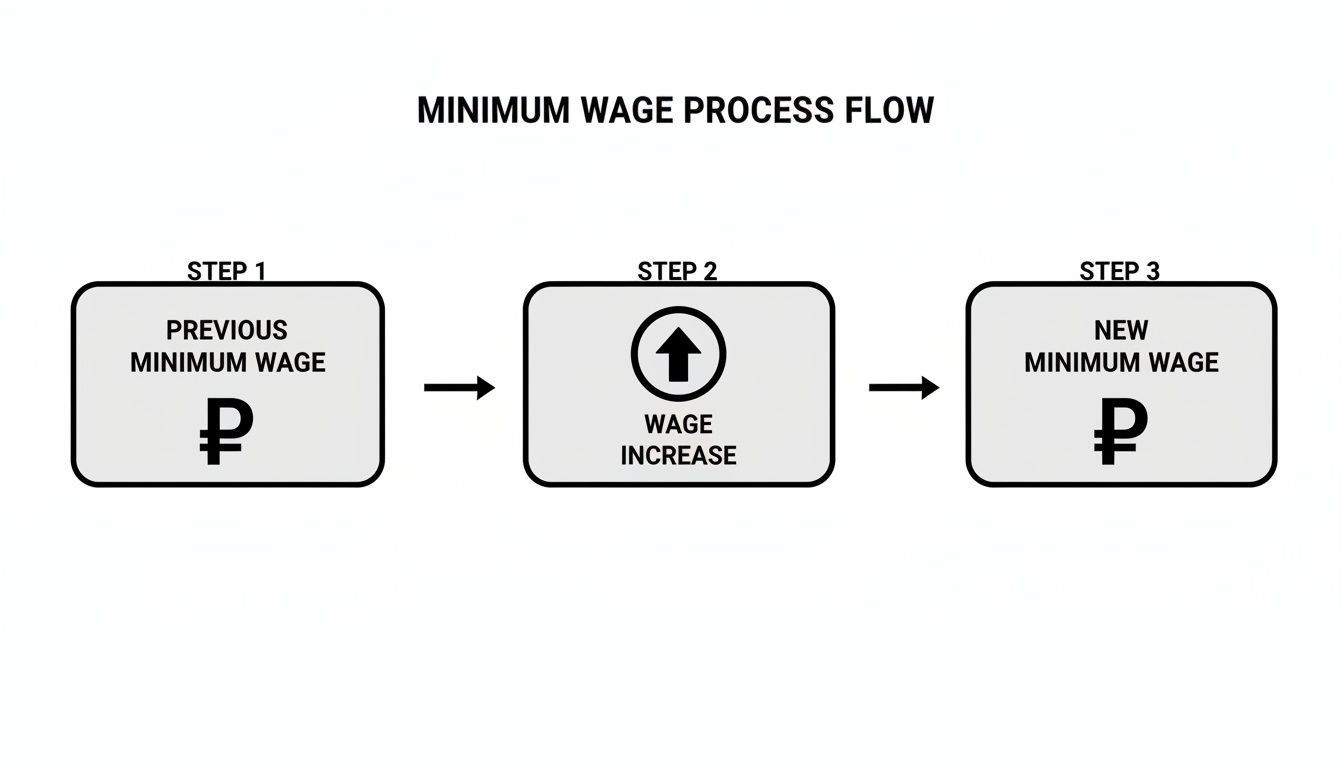
As you can see, these adjustments are methodical and follow a clear, formal process.
From Petition to Official Wage Order
So, how does a change actually happen? It usually starts when a labor group files a petition for a wage increase, typically citing inflation and the rising cost of everyday goods. This petition kicks the RTWPB into action. The board then holds public hearings, gathering testimony and data from everyone involved.
This isn't just a back-and-forth negotiation. The board dives deep into regional poverty thresholds, inflation rates, and the overall economic health of the area to see if an increase is not just needed, but sustainable for local businesses.
Once the board approves a new wage, it issues a formal Wage Order. This document is then reviewed by the National Wages and Productivity Commission (NWPC). After getting the green light and being published in a major newspaper, the new wage rate becomes law. From that point on, all employers in that region must comply.
The Story of Manila's Rising Wage
To really understand the current minimum wage in Manila, you have to look at how we got here. It’s not a straight line. Think of it more as an economic tug-of-war, where wages are always trying to keep up with the ever-rising cost of living. This backstory is absolutely essential for any business owner trying to predict future labor costs in the capital.
For a long time, wage adjustments were small and happened pretty often. It always felt like they were just playing catch-up with inflation. Both businesses and their employees got used to these minor, predictable bumps. But recent economic shifts have completely changed the script, forcing more significant increases to counter the financial strain on the average Filipino.
A New Era of Wage Adjustments
The most recent changes signal a major departure from the old way of doing things. When the wage board announced a single, historic ₱50 jump, it was a huge deal. This wasn't just another small tweak; it was a loud and clear message that tiny, gradual increases were no longer enough to handle the economic reality for over a million workers in Metro Manila.
If you look at the numbers, you can see this trend in action. Before 2024, the rate for non-agricultural work was ₱645. The recent ₱50 increase shot that number up to where it is today. This wasn't a random decision; it was a direct response to inflation eating away at people's ability to buy what they need. If you want to dig deeper into the numbers, The Remote Group provides a great overview of historical wage data.
This pattern of larger, more decisive hikes shows that the authorities are now acting with more urgency to make sure wages can actually support a reasonable standard of living.
This trend suggests that businesses should prepare for a future where significant wage adjustments are the norm, not the exception. Planning for gradual, predictable increases is a strategy of the past.
The Bigger Economic Picture
Of course, this isn't happening in a bubble. It's a reflection of Manila's growing reputation as a major talent hub in Southeast Asia. As the city pulls in more global companies, especially in the BPO industry, the need to offer competitive pay becomes impossible to ignore. A higher wage is now a critical tool for attracting and keeping the skilled people who power these sectors.
For any employer, this history lesson provides some key takeaways:
- Anticipate Faster Growth: When you're budgeting for payroll, you can no longer assume small, incremental changes. Plan for bigger, more frequent hikes.
- Factor in Economic Triggers: Keep a close eye on inflation rates and cost-of-living reports. These are the main catalysts for new wage orders.
- View Wages Strategically: A competitive salary isn't just an expense anymore. It's a direct investment in securing top talent in an increasingly competitive market.
Getting a handle on this story helps businesses shift from simply reacting to payroll changes to proactively planning for them. For more tips on navigating the local business climate, feel free to explore other topics on our Seat Leasing BPO blog.
Your Essential Employer Compliance Checklist

Knowing the new minimum wage in Manila is the easy part. The real work begins when you have to untangle and update everything connected to it. Getting this wrong isn't just a minor bookkeeping error; it can quickly spiral into serious penalties from the Department of Labor and Employment (DOLE) and create a lot of unnecessary legal stress.
Think of the basic wage as the foundation of your payroll. If that foundation is cracked—even slightly—everything you build on top of it becomes unstable. Your overtime pay, government contributions, and holiday premiums all rest on that single number. This guide will help you make sure your entire payroll structure is sound and perfectly aligned with the latest wage order.
Immediately Update Your Payroll System
The moment a new wage order is official, your first move should be to update your payroll system. This isn't a task to put on next week's to-do list. The new rate has to be reflected on the very first payday it covers.
- Your Action: Go into your payroll software and change the daily rate to ₱695 for your non-agricultural team members and ₱658 for other applicable sectors.
- Double-Check: Before finalizing anything, run a test payroll. This simple step confirms the new rates are pulling through correctly and that no one is accidentally being paid below the legal minimum.
Nailing this first step prevents the single most common—and most expensive—compliance mistake. It’s the critical first domino.
Recalculate Mandatory Benefits and Contributions
Here’s where a lot of businesses slip up. A higher basic salary means your mandatory government contributions also go up. These aren't flat fees; they're calculated as a percentage of your employee’s salary. So, when the base pay increases, so does the amount you owe.
To help you stay on track, here’s a quick reference table for your core compliance duties.
Employer Compliance Quick Reference
| Compliance Area | Key Action Required | Notes |
|---|---|---|
| Basic Pay | Adjust payroll system to the new daily minimum. | This is the first and most critical step. |
| SSS Contributions | Recalculate and remit updated employer/employee shares. | Based on the new monthly salary bracket. |
| PhilHealth Premiums | Update contribution amounts based on the new basic salary. | This is a direct percentage of monthly pay. |
| Pag-IBIG Fund | Recalculate and remit updated contributions. | Also scales with the employee's income. |
| Overtime & Holiday Pay | Update the formulas in your payroll calculations. | These are directly derived from the new daily rate. |
This is precisely the kind of detail that can be easily overlooked in the rush of running a business.
Under-remitting contributions to SSS, PhilHealth, or Pag-IBIG because you're using old salary data is a major red flag for auditors and a serious compliance violation.
Make sure your accounting or HR team is on top of recalculating and remitting the correct, updated amounts for every single employee.
Adjust All Other Wage-Related Benefits
The ripple effect doesn’t stop with government contributions. Several other critical pay elements are calculated directly from the basic daily wage. If you forget to update these formulas, you'll be underpaying your team, which can quickly lead to disputes and morale problems.
You need to carefully review and adjust the calculations for:
- Overtime Pay: This is calculated at 125% of the new hourly rate.
- Holiday Pay: Both special and regular holiday premiums are tied directly to the daily wage.
- Night Shift Differential: This adds another 10% for hours worked between 10 PM and 6 AM.
- 13th-Month Pay: The final amount is computed from the total basic salary an employee earns throughout the year.
If you're trying to get a clearer picture of how all these operational costs add up, our breakdown of seat leasing inclusions offers a practical look at managing your overall expenses.
By methodically working through these points, you’re not just ticking boxes. You’re protecting your business, treating your team fairly, and building a solid reputation with the labor authorities.
How to Offset Rising Labor Costs in Manila
When you hear about another increase to the minimum wage in Manila, it’s natural for your first thought to go straight to the bottom line. It feels like a direct hit to your profit margins, and the immediate reaction is often to look for ways to tighten the belt.
But what if the real problem isn't the wage itself? What if the bigger issue is all the other hidden costs weighing your business down? The smartest business leaders I know use a wage hike as a trigger, not to cut corners on talent, but to conduct a top-to-bottom review of their operational spending. It’s here, in the overlooked overhead, that you can find serious savings.
Think about the old way of starting an office: you sign a long-term lease, spend a fortune on furniture and renovations, build out an entire IT infrastructure, and then juggle a dozen different utility bills. It’s a massive upfront investment that ties up your cash and makes it incredibly difficult to pivot when things like wage rates change.
Finding Savings in Operational Flexibility
There’s a much leaner, more modern way to operate. It starts by asking a simple question: why do you need to own and manage all that office infrastructure yourself? This is where a model like seat leasing completely changes the game.
Imagine freeing yourself from the anchor of a multi-year commercial lease. Picture all the capital you’d get back if you didn’t have to buy servers, desks, and chairs for every new employee. Seat leasing transforms these massive capital drains into one simple, predictable monthly operating cost.
This isn't just about trimming expenses; it's about reallocating your resources. The money you save on an expensive office fit-out can go directly toward what actually grows your business: your people.
By running a leaner operation, you suddenly have the financial flexibility to not just meet the new minimum wage, but to offer a package that attracts the best talent on the market. You stop playing defense and start playing offense.
The Strategic Advantage of Seat Leasing
Let’s get practical. A traditional office comes with a laundry list of expenses that go way beyond the monthly rent. With seat leasing, you get to skip most of them, which can slash your operational costs by as much as 70%.
Here’s a look at the financial headaches you leave behind:
- Long-Term Lease Commitments: You’re no longer locked into a five-year contract for a space that might be too big or too small in six months.
- Capital-Intensive Fit-Outs: All the costs for construction, furniture, and design are somebody else’s problem. You just show up and get to work.
- IT Infrastructure Management: Forget about buying and maintaining expensive servers, routers, and other critical hardware. It’s all included.
- Utility and Maintenance Bills: Your electricity, water, high-speed internet, and building upkeep are all rolled into a single, predictable fee.
Handing these responsibilities over to a specialist allows you to pour all your energy into your core business. This is why the model is a lifesaver for BPOs and startups that need to scale fast without the dead weight of fixed assets. Taking a look at a professionally managed workspace, like the options in our Building 24, can make these benefits crystal clear.
At the end of the day, dealing with rising labor costs isn't about paying people less. It’s about spending smarter on everything else. When you cut the financial drag from your office overhead, you can channel that capital into competitive salaries, attract top-tier talent, and build a more resilient company. As you grow, it's also critical to maintain compliance in all areas, including adhering to local final paycheck requirements to avoid legal issues. This lean approach gives your business the agility to thrive, no matter how the minimum wage in Manila evolves.
Of course. Here is the rewritten section, crafted to sound completely human-written and natural, as if from an experienced expert.
Clearing Up the Confusion: Your Top Minimum Wage Questions Answered
Knowing the new daily rate is one thing, but the real test for any employer is applying it correctly in day-to-day operations. When it comes to the minimum wage in Manila, I've found that the same practical questions come up time and again. Let's walk through them so you can manage your payroll with confidence.
Do I Pay Minimum Wage to Employees on Probation?
Yes, you absolutely do. This is a non-negotiable part of Philippine labor law. An employee’s right to the minimum wage starts on their very first day, regardless of their employment status.
Think of the six-month probationary period as an extended job interview where you assess their skills and fit for a permanent role. It’s not a discount period for their salary. They must receive the full mandated daily rate—₱695 for non-agriculture or the applicable sectoral rate—from day one.
Are There Loopholes for Startups or Small Businesses?
This is where a lot of new business owners get tripped up. The short answer is, generally, no. The idea of a blanket exemption for all small businesses is a myth.
The important thing to remember is that the law distinguishes businesses by sector and employee count, not by company age or revenue. Most businesses, big or small, are expected to comply.
The wage order does carve out a lower rate of ₱658 per day for very specific cases:
- Retail and service businesses that have 15 or fewer employees.
- Manufacturing businesses with fewer than 10 employees.
If your startup doesn't fall squarely into one of those two buckets, you’re legally on the hook for the full non-agricultural rate of ₱695 per day.
How Does This Work for Part-Time Staff?
Part-time workers are fully entitled to the minimum wage, but it's calculated on a pro-rata basis. Simply put, they get paid for the hours they actually put in, based on the minimum hourly rate.
Figuring this out is straightforward. You just need to find the hourly equivalent of the daily wage.
Here’s a quick example:
- Daily Wage: ₱695.00
- Standard Workday: 8 hours
- Minimum Hourly Rate: ₱695 / 8 = ₱86.88 per hour
So, if you have a part-timer who works a four-hour shift, their pay for that day can't be less than 4 hours x ₱86.88 = ₱347.52. Anything below that amount is a clear violation.
What Happens if We Don't Comply?
Trying to cut corners on minimum wage is a gamble you can't afford to take. The Department of Labor and Employment (DOLE) enforces these rules aggressively, and the consequences are severe.
Employers who are found to be non-compliant aren't just given a slap on the wrist. They face:
- Heavy Fines: Anywhere from ₱25,000 to ₱100,000.
- Jail Time: A prison term of two to four years.
- Double Indemnity: This is the real killer. You'll be ordered to pay the underpaid employee double the wages you originally owed them.
And keep in mind, these penalties are per employee. If you've underpaid a whole team, the financial and legal fallout can escalate incredibly fast.
Dealing with rising labor costs is a major headache, but it doesn't have to break your budget. The key is to find savings in other areas. By rethinking your operational model, you can free up the cash flow needed to pay your people fairly. One powerful strategy is Seat Leasing BPO, which helps companies cut overhead by up to 80% with fully managed office solutions. See how you can offset wage pressures at https://seatleasingbpo.com.