A lot of leaders get stuck in the same loop. They want quality, speed, and accountability, so they stay close to the work. Then growth starts to punish that habit. Decisions slow down, managers become approval bottlenecks, and capable people stop using judgment because they’ve learned that every move gets checked anyway.
That tension gets sharper in flexible work setups. When teams sit across different rooms, floors, shifts, or leased locations, leaders can’t rely on hallway visibility. Some respond by increasing control. Others swing too far in the other direction and describe it as autonomy when it’s really absence.
The question in micro vs macro management isn’t which style sounds better. It’s when to tighten control, when to widen autonomy, and what operating structure has to exist before either choice works.
The Management Dilemma Every Leader Faces
A founder lands a new client and suddenly starts reviewing every email before it goes out. A BPO operations manager checks ticket updates three times a day because one service failure last month still feels fresh. A team lead who used to coach now rewrites reports, joins every call, and asks for constant status updates.
None of that starts as bad intent. It starts as risk management.
Leaders usually move toward micromanagement when the stakes feel immediate. A new account matters. Compliance matters. A fresh team might still be shaky. If delivery quality slips, the manager gets blamed first. The urge to inspect everything feels rational because, in the short term, it often prevents visible mistakes.

The problem shows up later. Once a leader becomes the center of every decision, the team stops building decision muscle. Small questions pile up. Escalations multiply. Work waits.
Why leaders drift toward the wrong extreme
Teams typically don’t fail because a manager chose “micro” or “macro” as an ideology. They struggle because the manager applies one level of control to every situation.
Common triggers include:
- Fear of inconsistency: The leader has seen quality vary across shifts or locations, so they start prescribing every step.
- Pressure from growth: More clients, more seats, and more moving parts make managers feel they need tighter grip.
- Weak systems: If reporting is messy, leaders compensate with manual follow-up.
- New or mixed-experience teams: Managers don’t trust execution yet, so they stay closely involved.
The daily leadership dilemma isn’t control versus trust. It’s deciding how much control is necessary before trust becomes responsible.
What makes this harder in flexible operations
In a traditional small office, a manager can notice drift quickly. In distributed environments, they need structure instead of proximity. That’s where many companies misread the problem. They think they have a people issue when they have a management design issue.
A growing company needs both discipline and space. Too much oversight slows execution. Too little oversight creates ambiguity. The practical answer sits in between, and it shifts as risk changes.
Understanding the Micro to Macro Management Spectrum
Micromanagement and macromanagement are best treated as two ends of a spectrum, not fixed identities. Most leaders use both. The mistake is assuming that one should dominate all situations.
Micromanagement focuses on how work gets done. It relies on close supervision, detailed instructions, narrow checkpoints, and direct intervention. This style can be useful when tasks are highly sensitive, the margin for error is tiny, or the team is still learning the basics.
Macromanagement focuses on what needs to be achieved and why it matters. The manager sets goals, defines constraints, assigns ownership, and lets people choose methods. That creates room for judgment, speed, and initiative.
The difference is bigger than personality
This isn’t just a matter of leadership preference. It changes the way a company plans, measures, and scales.
A study tied to the 2008 Economic Census in China found that macro-level aggregation supported up to 20 to 30% higher model fit in strategic forecasting than micro-level scrutiny. The same research noted that macro data was closer to normal distribution, which improves predictive accuracy in strategic planning. For leaders, the practical takeaway is simple. A broader operating view often supports better strategic decisions than constant fixation on isolated details.
That matters in growth environments, where leaders need to think beyond task compliance and into capacity, quality trends, and operational resilience.
What each end of the spectrum is trying to solve
Micromanagement tries to solve for precision. It asks:
- Did the task follow the exact process?
- Did the person execute the required step?
- Did anything drift from the standard?
Macromanagement tries to solve for alignment. It asks:
- Did the team move the business outcome forward?
- Were decisions made within the right boundaries?
- Are we still on strategy?
If you’re building stronger strategic leadership, this distinction matters. Leaders who stay trapped at task level often struggle to create a repeatable operating model because they never fully shift from doing and checking into directing and calibrating.
Why flexible environments make the spectrum visible
In a compact team, a manager can blur styles without noticing. In distributed setups, the weaknesses become obvious. If you run teams across shared offices or support functions through a flexible model such as Seat Leasing BPO, your management style becomes part of your operating system. You either create enough clarity for autonomy, or you create enough supervision to offset uncertainty.
Most companies don’t need a permanent micromanager or a permanently hands-off executive. They need a leader who knows where the work sits on the spectrum today.
Comparing Micromanagement and Macromanagement Characteristics
The cleanest way to understand micro vs macro management is to compare how each style behaves in daily operations. Not in theory. In workflows, reporting, decision rights, and team habits.
The core trade-off is straightforward. Micromanagement delivers control at the expense of adaptability. Macromanagement improves adaptability, but only if the business has enough structure to keep people aligned. Flevy’s breakdown of the styles makes that distinction clear. Micromanagement ensures tasks execute as specified, while macromanagement creates roadmaps that support innovation and long-term resilience through defined frameworks.
Micro vs. Macro Management At-a-Glance
| Characteristic | Micromanagement Approach | Macromanagement Approach |
|---|---|---|
| Team autonomy | Low discretion in execution | High discretion within clear boundaries |
| Communication flow | Frequent, directive, often manager-led | Structured, scheduled, often outcome-led |
| Decision-making authority | Centralized with the manager | Distributed to the people closest to the work |
| Performance metrics | Task completion, activity checks, process adherence | Outcomes, KPIs, trends, and business impact |
| Feedback style | Detailed correction on methods | Coaching on judgment, priorities, and results |
| Speed of response | Fast for tightly controlled tasks, slower when approvals pile up | Faster in mature teams because fewer decisions escalate |
| Innovation | Limited by strict method control | Stronger when people can test and adapt |
| Risk handling | Strong in high-risk or novice situations | Strong in stable systems with clear accountability |
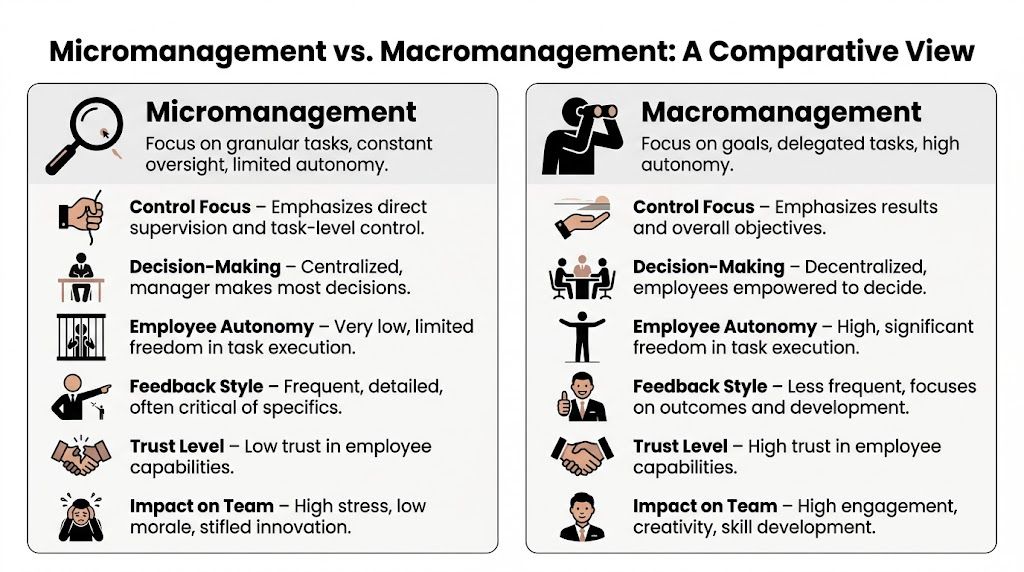
Team autonomy and ownership
Under micromanagement, autonomy is narrow. The manager defines the process, approves changes, and often wants visibility into each step. That can stabilize a shaky operation, but it teaches people to wait.
Macromanagement gives people room to solve problems. The leader defines success, constraints, and escalation triggers, then lets the team work. That doesn’t mean “do anything you want.” It means “own the result, and use judgment inside the rules.”
Practical rule: If people need approval for routine decisions, you don’t have a scaling problem. You have a decision-rights problem.
Communication flow and reporting rhythm
Micromanagers often create communication volume without creating clarity. Teams send more updates, but many of those updates exist to reassure the manager rather than move work forward.
Macromanagers still communicate often, but the rhythm is different. They rely more on dashboards, recurring reviews, exception reporting, and short decision-focused check-ins. In hybrid or seat-leased environments, that distinction matters because constant interruption doesn’t travel well across shifts and locations.
A useful reference on effective staff management reinforces the operational side of this point. Good management isn’t just frequency. It’s whether communication improves execution, accountability, and team confidence.
Decision-making authority and escalation
Micromanagement centralizes decisions. In some settings, that’s appropriate. A new quality assurance process, a compliance-sensitive workflow, or an inexperienced team may need that level of control for a period.
Macromanagement pushes decisions downward. The closer the person is to the problem, the faster they can usually resolve it, assuming the operating rules are clear.
Here’s what that looks like in practice:
- Micromanagement works better when the process is new, the risk is high, or the consequences of failure are immediate.
- Macromanagement works better when the team understands the work, the boundaries are defined, and delay is more dangerous than variation.
- Neither works well when roles are vague and reporting is inconsistent.
KPIs and what gets measured
Micromanaged teams usually get measured on visible activity. Did the task happen? Was the script followed? Was the report filed exactly on schedule?
Macromanaged teams get measured on outputs and trends. Did the team hit service levels? Did customer issues get resolved within the expected range? Did quality hold while volume increased? This is a stronger model for scale because it allows managers to focus on patterns, not isolated motion.
Innovation and adaptability
Micromanagement can suppress useful experimentation. When every method is prescribed, people stop proposing improvements because they assume the answer is already fixed.
Macromanagement creates more room for adaptation. Teams can adjust scripts, improve workflows, and solve local operational issues without waiting for a manager to notice them first.
That’s why the two styles shouldn’t be framed as moral opposites. One is not “caring” and the other “lazy.” They solve different operational problems. The question is whether your current management style matches the level of risk, maturity, and complexity in front of you.
Analyzing the Real Costs and Benefits of Each Style
The cost of a management style usually shows up long before it appears on a financial report. First, it appears in delay. Then in morale. Then in talent loss. By the time leaders call it a culture problem, the operating pattern is already established.

A Flexopus analysis reports that productivity in macro-managed teams can be up to 35% higher than in micromanaged teams. The same source links micromanagement with 71% employee disengagement, 20 to 30% turnover spikes, and an estimated $450 billion annual cost to U.S. firms by 2019 tied to turnover-related losses.
Those numbers don’t mean macromanagement is always superior. They mean prolonged overcontrol carries measurable business damage.
Where micromanagement helps, and where it gets expensive
Micromanagement has legitimate value in narrow situations. It’s useful when a process is new, heavily regulated, fragile, or high stakes. If a team is onboarding, handling a sensitive client transition, or learning a critical quality standard, close supervision can prevent errors that autonomy would magnify.
But managers often keep that level of control long after the team no longer needs it.
The hidden costs are familiar:
- Decision bottlenecks: Work slows because the manager has to approve routine actions.
- Shallow capability growth: Staff execute instructions but don’t develop judgment.
- Manager overload: Leaders spend time checking instead of solving larger operational issues.
- Talent fatigue: Strong performers leave when they can’t own outcomes.
Where macromanagement pays off, and where it can fail
Macromanagement tends to produce stronger productivity because it releases capacity across the team. People don’t wait as often. Managers spend more time on priorities, exceptions, and system improvements. Teams can adjust faster when conditions change.
That upside only holds when the environment is disciplined. A hands-off style without clear expectations is not macromanagement. It’s drift.
Macromanagement fails when leaders delegate outcomes but never build the reporting, review cadence, and accountability that make those outcomes visible.
The real financial lens
Leaders sometimes treat this debate as a soft-skills issue. It isn’t. The style you use changes throughput, escalation volume, hiring pressure, and the amount of management attention consumed by routine work.
If micromanagement increases turnover and disengagement, you pay for it in replacement effort, retraining, inconsistency, and lost momentum. If macromanagement is introduced without structure, you pay for it in rework, ambiguity, and uneven execution.
The practical financial question is this: where do you want your management effort to go?
- Into task inspection
- Into exception handling
- Into capability building
- Into strategic problem solving
The best leaders don’t eliminate oversight. They move oversight to the point where it protects the business without choking the people doing the work.
A Decision Framework for Situational Management
The most effective leaders don’t ask whether they’re micro or macro managers. They ask what level of control the current risk requires.
That shift matters because the right answer changes by task, team, and timing. A mature operations unit handling a stable process doesn’t need the same management intensity as a newly launched client program with strict quality demands.

A risk-calibrated management model makes this explicit. Effective managers adapt based on risk. When failure risk is high, managers move closer to micromanagement for quality control. When risk is lower and the team is mature, macromanagement becomes the better fit because it supports autonomy and speed.
Four variables that should drive your choice
Don’t choose your style based on instinct alone. Use four filters.
Team maturity
New hires and newly formed teams usually need tighter process guidance. Experienced teams with strong judgment usually need clearer outcomes, not more supervision.
Task criticality
If a task affects compliance, security, legal exposure, or a first impression with a high-value client, leaders should inspect more closely. If the work is routine and recoverable, they should pull back.
Process stability
A broken or changing process often needs closer oversight. A stable process with clear SOPs, known handoffs, and trusted reporting can support autonomy.
Consequence of failure
Ask the blunt question. If this goes wrong, what happens? Rework? Client escalation? Contract risk? Brand damage? The heavier the consequence, the more direct control may be justified for that moment.
A practical operating grid
Use this simple frame:
- High risk, low maturity: Lean micro. Define steps, increase review frequency, narrow decision rights.
- High risk, high maturity: Blend. Keep outcome ownership with the team, but tighten checkpoints on critical moments.
- Low risk, low maturity: Coach. Don’t overcontrol everything, but give more structure than you would to a seasoned team.
- Low risk, high maturity: Lean macro. Set goals, reporting cadence, and escalation rules. Then get out of the way.
Good managers don’t stay at one point on the spectrum. They move intentionally, and the team understands why.
What this looks like in real operations
A startup’s first enterprise onboarding probably deserves close oversight. Script approval, workflow review, and real-time escalation rules are sensible there.
A mature support team handling a familiar account shouldn’t need that same level of involvement. If the manager still approves routine responses, that’s not quality control anymore. It’s capacity waste.
For leaders trying to build this kind of adaptive operating rhythm, management resources from the broader operations blog library can help frame recurring decisions around process, team design, and growth-stage execution.
A short visual overview can also help anchor the idea before you apply it to your own team.
How to Implement Your Chosen Style in Flexible Workspaces
A lot of companies say they want to lead with autonomy. Then they place teams in hybrid or distributed environments without the systems needed to support that choice. The result is predictable. Leaders start with trust, lose visibility, and slide back into chasing updates.
That’s not a failure of philosophy. It’s a failure of operating infrastructure.
Flevy’s organizational design guidance notes that effective macromanagement requires strong systems, defined reporting structures, and transparent accountability. It also points out that teams in flexible work environments often lack the project management, KPI tracking, and communication systems needed to maintain accountability as geography adds complexity.
Build the operating spine first
If you want less micromanagement, start by making work visible without constant human follow-up.
At minimum, put these in place:
- A task system with ownership: Use tools like Asana, ClickUp, Monday.com, or Jira so every deliverable has an owner, due date, and status.
- A KPI dashboard: Track outcome measures in one place. Google Looker Studio, Power BI, and simple shared scorecards work well if they’re reviewed consistently.
- Communication rules: Define where urgent issues go, where updates live, and what belongs in meetings versus chat.
- Escalation thresholds: Teams should know when to decide independently and when to raise a flag.
Without those basics, leaders can’t macro-manage confidently because they don’t have enough signal to stay off the work.
Separate presence from control
Flexible workspaces create a subtle trap. Leaders can confuse physical presence with effective oversight. Walking a floor, joining a call, or checking online status can feel like management, but none of it guarantees accountability.
A stronger model looks like this:
For startups
Startups usually need more guidance at first because roles overlap and processes are still forming.
- Tighten onboarding: New team members need explicit SOPs, shadow periods, and named approvers.
- Keep check-ins short and scheduled: Daily standups can work early on if they focus on blockers and decisions, not performance theater.
- Review outcomes weekly: Shift attention quickly from activity to trends.
For growing BPO teams
BPO environments need consistency without freezing local judgment.
- Standardize what must be standard: Scripts, compliance steps, and escalation rules should be clear.
- Delegate what can vary: Let team leads solve staffing, queue balancing, and minor workflow adjustments within agreed limits.
- Use exception reporting: Managers should review anomalies, not every normal task.
For established corporate teams in shared setups
Mature teams often suffer when leaders reintroduce unnecessary controls after moving into flexible environments.
- Protect decision rights: Don’t centralize approvals just because the team is distributed.
- Audit reporting quality: If managers feel blind, fix the dashboard before tightening supervision.
- Set cross-site operating norms: Everyone should know the same meeting rules, handoff standards, and response expectations.
Use workspace design to support management design
The physical setup matters more than most leaders admit. Shared meeting rooms, stable connectivity, secure systems access, and support for day-to-day operations reduce the number of interruptions that drag managers back into firefighting.
That’s especially relevant when teams expand into serviced environments such as Building 24 workspace setups, where the practical backbone of operations influences how much leaders can stay focused on performance rather than facilities, technical issues, or setup problems.
If your managers spend too much time resolving avoidable operational friction, they’ll eventually manage people more tightly just to compensate.
A simple implementation checklist
Before shifting toward macromanagement, confirm these are true:
- Every core process has an owner
- KPIs are visible without asking three people for updates
- Escalation rules are written and understood
- Recurring meetings have a specific purpose
- Managers review trends, not just incidents
- Teams know which decisions they can make on their own
If most of those are missing, stay closer to the work for now. But don’t stop there. Build the structure that lets you step back safely.
Frequently Asked Questions on Management Styles
Can a micromanager change without losing control
Yes, but the shift has to be structural, not just emotional. Don't only tell the team you'll be less involved. Replace ad hoc checking with scheduled reviews, clearer decision rights, and visible KPIs. That way, you remove yourself from routine tasks without removing accountability.
Is macromanagement better for remote or hybrid teams
It’s often better suited to remote and hybrid work, but only when the team has strong systems. If reporting is weak and ownership is fuzzy, a hands-off approach creates confusion fast. Remote teams need more clarity, not necessarily more supervision.
Should one team have different management styles for different people
Yes. A new hire on a sensitive workflow may need closer direction than a senior specialist handling a stable account. The mistake is pretending that equal treatment means identical supervision. Good managers calibrate by capability and risk.
How do you know you’re overmanaging
Look for repeated patterns. People ask for approval on small decisions. Meetings are packed with status updates. Managers rewrite work that was already acceptable. Strong performers stop proposing improvements. Those are signs that control is replacing leadership.
When is micromanagement the right move
Use it deliberately and temporarily. It fits high-risk onboarding, unstable processes, critical client transitions, and situations where errors carry serious consequences. The key is to define why the tighter oversight exists and when it will be reduced.
What’s the biggest mistake leaders make in micro vs macro management
They treat the choice as personality instead of design. This isn’t about being naturally controlling or naturally enabling. It’s about matching management intensity to business risk, team maturity, and operational structure.
If your team needs room to scale without the burden of building office infrastructure from scratch, Seat Leasing BPO offers flexible workspace support that helps companies stay focused on operations, not setup. For startups, BPOs, and growing teams that want a more scalable management model, the right environment can make disciplined autonomy much easier to sustain.