You’re probably in one of two situations right now.
Either marketing keeps sliding to the bottom of the list because client work, operations, and hiring take priority. Or you are investing in marketing, but it feels scattered. One freelancer writes blogs, another runs ads, someone on your team posts on LinkedIn when they remember, and nobody can tell you what’s working.
That’s where marketing outsourcing companies come in. Not as a rescue plan for failing teams, but as a practical operating model for businesses that need skilled execution without building a full department from scratch. This matters even more if you already run lean with flexible staffing, shared workspaces, or seat leasing. When both your office setup and your marketing model are built for flexibility, you remove two of the heaviest fixed costs from growth.
Why Smart Businesses Are Outsourcing Marketing in 2026
A common pattern shows up in growing businesses. The founder or manager knows the product well, understands the customer, and can sell in a room. But marketing still drags because modern execution isn’t one job anymore. It’s strategy, content, SEO, paid media, analytics, automation, reporting, design, and tech setup.
That gap creates a daily tax on the business. Someone spends evenings reviewing ad copy. A sales manager tries to fix the website. An operations lead becomes the default project manager for campaigns they didn’t ask to own.
Businesses are responding by treating marketing as a specialist function instead of a side task. In 2024, 50% of B2B companies outsourced some marketing, a trend projected to grow, according to Full Mix Marketing’s summary of 2024 outsourcing data. That shift isn’t just about delegation. It reflects a decision to access specialist skills while controlling overhead.
For a business using a flexible operating model, that logic gets stronger. If you don’t want to lock yourself into long leases, long hiring cycles, and a full in-house marketing payroll, outsourcing gives you room to move.
What this looks like in practice
A startup might outsource its website messaging, paid search, and CRM setup while keeping product marketing internal.
A BPO provider might keep sales in-house but bring in an outside team for lead generation, landing pages, and campaign reporting.
A small professional services firm might outsource strategy and content because nobody internally has time to run an editorial calendar consistently.
Practical rule: If marketing requires skills your team only uses occasionally, outsourcing usually makes more sense than hiring full-time.
The best part is focus. Your internal team gets back to core work. The outside partner handles execution, tools, and process. If you want more context on how flexible operators think about growth systems, the Seat Leasing BPO blog is a useful reference point.
Understanding Marketing Outsourcing Companies
A lot of business owners hear “outsourced marketing” and picture a distant agency posting generic content and sending a monthly report full of vanity metrics. Good marketing outsourcing companies don’t work like that.
They’re better understood as external marketing capability. You hire them because they already have the people, workflows, tools, and experience you’d otherwise have to build yourself.

Think of it like a home renovation
If you’re renovating a house, you have choices.
You can hire a general contractor to manage the full project. That’s similar to a full-service agency handling strategy, creative, media, and reporting.
You can hire specialist trades one by one. That’s closer to using separate experts for SEO, Google Ads, copywriting, or email automation.
Or you can bring in an architect or project manager to guide decisions while your existing crew does the work. That’s similar to a fractional marketing leader.
The confusion usually comes from mixing up these roles. A freelancer is not the same as a marketing outsourcing company. A freelancer often delivers one skill. A marketing outsourcing company usually delivers a system.
What you’re really buying
You’re not just buying tasks. You’re buying judgment.
That includes things like:
- Channel selection: Knowing whether your business needs SEO, PPC, LinkedIn outreach, email nurture, or a stronger offer before any channel spend.
- Tool fluency: Using platforms like HubSpot, Salesforce, SEMrush, Google Analytics 4, Funnel.io, and ad managers properly instead of guessing.
- Process discipline: Briefs, approvals, tracking, reporting, handoffs, and campaign reviews that don’t collapse when one person gets busy.
- Cross-functional thinking: Connecting messaging, conversion paths, sales handoff, and attribution.
Outsourcing works best when the partner owns outcomes, not just output.
The main categories you’ll encounter
Not every provider looks the same. Most marketing outsourcing companies fall into one of these broad groups:
- Full-service agencies that cover many channels under one roof
- Specialist firms focused on one area like SEO, paid media, email, or content
- Fractional leadership providers who bring senior strategy without a full-time hire
- Execution teams that operate like a bolt-on department for day-to-day production
That distinction matters because many bad outsourcing decisions happen when a company hires a specialist but expects a strategist, or hires a strategist but expects hands-on production.
Choosing Your Engagement Model
How you buy outsourced marketing matters almost as much as who you hire. Two companies can work with equally strong partners and still get very different results because the engagement model doesn’t match the business.
Often, owners get stuck. They ask, “Should I hire an agency?” when the more useful question is, “What kind of arrangement fits my stage, risk tolerance, and internal capacity?”
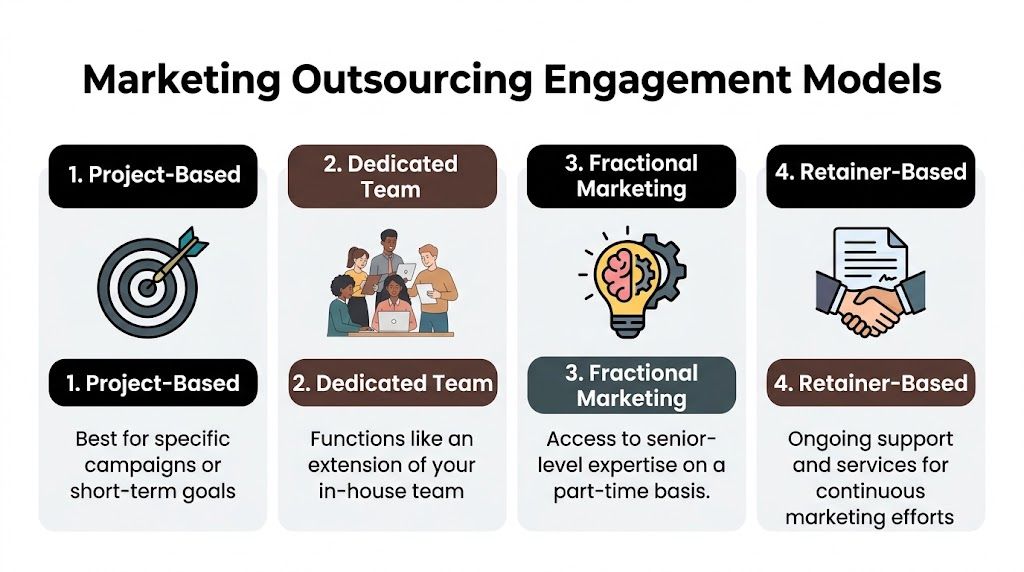
Marketing outsourcing models compared
| Model | Best For | Cost Structure | Commitment |
|---|---|---|---|
| Project-Based | Website launches, rebrands, audits, one-off campaigns | Fixed project fee or milestone-based pricing | Short-term |
| Dedicated Team | Businesses needing ongoing execution across channels | Monthly fee for a scoped team or service block | Medium to long-term |
| Fractional Marketing | Companies that need senior strategy but not a full-time leader | Monthly advisory fee or part-time leadership contract | Flexible, usually ongoing |
| Retainer-Based | Firms wanting consistent support and predictable output | Recurring monthly retainer | Ongoing |
Project-based work
This is the cleanest model when you know exactly what needs to be done. Think landing page redesign, CRM migration, campaign setup, content sprint, brand messaging overhaul, or an SEO audit.
Project work is attractive because the scope feels contained. You define the output, agree on a timeline, and review a clear deliverable.
The weakness is continuity. A project can fix a piece of the puzzle without building a repeatable marketing engine. If your team lacks follow-through after launch, a good project can still produce weak business results.
Best fit: Companies with one urgent need, limited internal complexity, or a desire to test a partner before committing further.
Dedicated team model
This setup feels closest to an external department. Instead of buying one project, you get a pod of specialists such as a strategist, writer, designer, media buyer, and analyst.
For growing firms, this often solves the “single point of failure” problem. One employee can quit. One freelancer can disappear. A dedicated team model spreads knowledge and execution across multiple people.
It also works well when campaigns need rhythm. Weekly content, ad optimization, funnel testing, reporting reviews, CRM updates, and sales alignment all benefit from a team structure.
Best fit: Businesses that already know marketing matters and need sustained execution more than one-time help.
Fractional marketing leadership
Some businesses don’t need more hands first. They need better direction.
A fractional CMO or fractional marketing lead helps shape positioning, budget allocation, channel priorities, campaign planning, team structure, and reporting standards. They usually don’t do every tactical task themselves. They set the direction and supervise the people who do.
This is especially useful for founder-led companies where marketing has grown reactively. The team may be busy, but nobody is steering.
A fractional leader is like hiring the architect before you hire more builders. The plan gets sharper, and expensive mistakes get harder to make.
Best fit: Companies with scattered activity, junior marketers who need guidance, or a leadership gap between sales and execution.
Retainer-based support
Retainers are common because marketing rarely succeeds as a one-time event. Search visibility compounds. Paid campaigns need ongoing testing. Email nurture improves through iteration. Reporting only matters if someone acts on it month after month.
Under a retainer, you pay for continuing access to the partner’s time, services, and expertise. The scope can be broad or narrow, but the relationship is designed for continuity.
A retainer isn’t automatically better than a project. It only works if both sides agree on priorities, deliverables, feedback loops, and decision rights. Otherwise, it turns into recurring activity without momentum.
Best fit: Companies that want consistency, recurring support, and a stable operating rhythm.
Hybrid arrangements
Many of the strongest setups are hybrids.
A company might hire a fractional leader for strategy, then use specialist vendors for SEO and paid media. Another business might start with a project to rebuild its site, then move the same partner into a retainer for content and reporting. A BPO operator might keep messaging and offer design in-house while outsourcing lead generation and campaign analytics.
Hybrid models require more coordination, but they let you combine precision with flexibility.
How to choose without overthinking it
Use these filters:
- Urgency: If you need one concrete asset fast, a project usually fits.
- Complexity: If multiple channels and handoffs are involved, a team or retainer makes more sense.
- Leadership gap: If nobody owns strategy, fractional support may come first.
- Internal bandwidth: If your team can’t manage several vendors, fewer partners is usually better.
- Need for white-label delivery: If you’re an agency or service firm reselling SEO, this guide to SEO white labeling explains how a behind-the-scenes delivery model can work without expanding internal headcount.
The right model should reduce management burden, not create a second job for you.
Core Marketing Services You Can Outsource
Once the engagement model is clear, the next question is practical. What should you outsource first?
The short answer is this. Start with the work that requires specialist tools, specialist judgment, or consistent execution your team can’t maintain.
Foundational services
These are the functions that make the rest of marketing easier.
SEO and content
SEO is often misunderstood as blog writing plus keywords. Good outsourced SEO work includes technical checks, search intent mapping, on-page optimization, internal linking, content briefs, and performance tracking.
Content sits right beside it. A skilled partner doesn’t just publish articles. They build topic clusters, sales-enablement assets, landing page copy, comparison pages, and conversion-focused content around the questions buyers already ask.
This is one reason outsourced teams often outperform improvised internal efforts. They use repeatable systems, editorial discipline, and tools such as SEMrush, Google Analytics 4, and content planning workflows that many small teams never fully operationalize.
Brand messaging and website copy
Many businesses try to fix lead quality with more traffic when the actual problem is weak messaging. An outside partner can often spot this faster because they aren’t too close to the product.
They can pressure-test your homepage, refine your offer, tighten service pages, and remove the vague language that erodes conversion.
Growth acceleration services
These are the channels companies use when they want demand faster or need more control over lead flow.
PPC and paid social
Paid media is easy to start and expensive to run badly. Good outsourcing here means more than ad setup. It includes audience segmentation, bid management, landing page coordination, conversion tracking, creative testing, and budget discipline.
This area has become more technical because the tools have multiplied. The marketing technology outsourcing market is projected to grow at a 10.2% CAGR through 2030, largely because of the complexity of more than 11,000 MarTech solutions and the need for AI-driven tools that optimize campaigns and predict behavior, according to Grand View Research’s marketing technology outsourcing analysis.
That matters because most businesses don’t just need ads. They need someone who can make ad platforms, analytics, CRM data, and automation tools work together.
Lead generation systems
For B2B firms, lead generation outsourcing often covers list building, outreach support, landing pages, webinar funnels, content offers, and reporting.
Some providers also manage data enrichment and attribution so you can see which channels assist conversion instead of rewarding only the last click.
Engagement and retention services
This work gets less attention, even though it often determines whether acquired leads ever become revenue.
Email marketing and automation
A strong outsourced email team can build welcome sequences, nurture campaigns, re-engagement flows, and segmented broadcasts. They also handle list hygiene, offer testing, and basic lifecycle logic inside platforms like HubSpot or Salesforce.
Email looks simple from the outside. In practice, it requires copy judgment, timing, segmentation, and a clear understanding of what sales needs next.
Social media management
This is the service many companies outsource first, and sometimes for the wrong reasons. Posting consistently is useful, but social media only creates business value when content supports positioning, demand capture, audience trust, or recruitment.
A good outsourced partner should know the difference between “activity” and “useful presence.”
What good outsourcing looks like
You don’t need every service. You need the right stack.
For most firms, a sensible starting point looks like this:
- If you have weak visibility: Start with SEO, content, and website messaging.
- If you need leads quickly: Add PPC, landing pages, and tracking.
- If leads stall after first contact: Invest in email nurture and CRM workflow.
- If your team is drowning in tools: Outsource the technical layer, not just the creative layer.
Field note: Tool access matters less than tool fluency. Owning HubSpot doesn’t help much if nobody has time to configure lifecycle stages, attribution, forms, and reporting properly.
For businesses operating in flexible work environments, backend reliability matters too. If your model depends on shared infrastructure, the workspace inclusions offered in flexible office setups shape how well distributed marketing teams can collaborate, report, and protect campaign data.
Weighing the Benefits and Potential Risks
Marketing outsourcing gets oversold when people talk only about cost or speed. The actual decision is broader. You’re trading fixed internal structure for external expertise and flexibility. That can be a smart move, but only if you understand both sides.
The upside
The clearest benefit is access to capability you don’t have in-house. Instead of hiring one marketer and expecting them to do strategy, copy, analytics, SEO, paid media, and CRM work, you tap specialists who already know their lane.
Execution often improves because outside teams work from established processes. They already have briefing templates, campaign checklists, reporting systems, and platform knowledge. Your team doesn’t have to invent everything from zero.
Performance can improve too. Outsourcing firms can achieve 43% superior lead quality over in-house teams by using AI-enhanced data profiling and proprietary analytics tools, according to Callbox’s outsourcing marketing guide. That matters because better lead quality usually creates less waste for sales and a clearer path to ROI.
The real risks
Outsourcing also creates distance.
A partner can miss the nuance of your brand. Communication can slow down when feedback loops are weak. Reports can look polished while hiding the fact that nobody is accountable for business outcomes. Security and access controls can get sloppy when too many outside people touch data and platforms.
These are not reasons to avoid outsourcing. They’re reasons to manage it properly.
How to reduce the downside
Use simple controls early:
- Define ownership clearly: Decide who approves messaging, budgets, deadlines, and final deliverables.
- Create one source of truth: Keep briefs, brand guidelines, campaign goals, and KPIs in a shared workspace everyone can access.
- Limit platform sprawl: Don’t let every partner introduce a new tool unless there’s a clear reason.
- Set reporting expectations: Ask for business-facing reporting, not just channel metrics.
- Review security access: Give the minimum access needed, then document who has what.
Outsourcing fails quietly when nobody notices the gap between completed tasks and actual progress.
A good partner will welcome this level of structure. Weak ones usually resist it.
How to Evaluate and Select the Right Partner
Choosing among marketing outsourcing companies is less like buying software and more like hiring a key operator. You’re trusting another team with your pipeline, your brand voice, and often your customer data.
That means the selection process needs more rigor than “they had a nice website.”

Start with your own brief
Before you talk to any provider, write down what success means. Not a vague goal like “more visibility.” Define the business problem.
Are you trying to generate qualified B2B leads, improve website conversion, launch in a new market, fix inconsistent content production, or support sales with better nurture?
Then clarify these points:
- Primary goal: What outcome matters most over the next planning cycle
- Internal constraints: What your team can and cannot own
- Decision speed: Who signs off, and how long approvals usually take
- Non-negotiables: Brand tone, security standards, reporting cadence, compliance needs
This gives you a filter. Without it, every proposal sounds plausible.
Ask better questions in the interview
Most business owners ask about services. Fewer ask about operating style. That’s a mistake.
Use questions that expose how the partner thinks:
- Onboarding: How do you learn our business, offer, and buyer?
- Accountability: Who owns strategy, who owns execution, and who presents results?
- Measurement: How do you connect campaign metrics to pipeline or revenue goals?
- Decision-making: What happens when performance is flat for several months?
- Collaboration: How do you work with internal sales, ops, or leadership teams?
- Data hygiene: Which tools do you use, and how do you manage access and handoff?
One issue gets overlooked far too often. Forty percent of small businesses report unclear ROI from agency contracts, which is why you should press hard on long-term measurement, not just campaign activity, as noted by Hinge Marketing’s discussion of outsourced marketing ROI.
Ask this directly: “If early campaign metrics look healthy but business results don’t improve, how will you diagnose the gap?”
That question forces a serious answer.
Review proposals like an operator
Once proposals arrive, compare them on clarity, not polish.
Look for:
- Specific scope: What exactly is included, and what is out of scope
- Named roles: Which people or functions will work on the account
- Cadence: Meeting rhythm, reporting schedule, and review process
- Dependencies: What they need from your team to move quickly
- Exit terms: Notice periods, asset ownership, and transition support
A proposal that sounds impressive but stays vague on delivery is risky.
Here’s a useful explainer to keep nearby while you vet options:
Check fit beyond capability
The best partner for your business may not be the flashiest one. It may be the one that communicates clearly, pushes back intelligently, and understands your operating reality.
If you work in a fast-moving setup with remote staff, shared workspaces, or hybrid support teams, mention that during evaluation. Ask how they run approvals, meetings, and reporting in lean environments.
If you’re preparing to speak with a workspace or operations provider as part of a broader growth plan, you can contact Seat Leasing BPO separately for the operational side. Keep the marketing selection itself focused on fit, accountability, and execution quality.
Outsourcing Strategies for Agile Business Models
Outsourcing works especially well when the business itself is built for agility.
Startups, freelancers, BPO firms, and distributed teams already understand variable capacity. They don’t want heavy fixed costs unless those costs create clear advantage. That mindset lines up naturally with outsourced marketing.
Why the combination works
A flexible workspace model reduces the drag of long leases, office setup, and back-office complexity. Marketing outsourcing reduces the drag of full-time hiring across multiple specialist roles.
Used together, they create an operating model that stays light without becoming chaotic. You can expand campaigns, launch into a new market, support a sales push, or pause underperforming work without rebuilding the company every quarter.
The catch is coordination. A key challenge is the integration between outsourced marketing teams and flexible workspaces, and businesses report productivity dips when that alignment is poor, according to Ninja Promo’s discussion of outsourcing and workspace fit. In plain terms, flexibility only helps when the pieces work together.
What different businesses should do
Startups
Keep the core story close to the founders. Outsource execution layers first. That usually means website copy refinement, paid acquisition setup, analytics, and content production.
Don’t hire five specialists before you know your message converts.
Freelancers and small firms
Use outsourcing to package yourself better. A sharper site, stronger search presence, and cleaner email nurture can make a solo operator look far more established.
You don’t need a giant agency. You need targeted support where inconsistency costs you business.
BPO providers
BPO firms often have operational strength but uneven demand generation. Outsourced marketing can support lead generation, offer positioning, landing pages, and outreach systems while internal leadership stays focused on service delivery.
If you’re sorting through providers in this space, this guide on choosing B2B marketing companies is a helpful lens for evaluating fit.
Shared workspace and hybrid teams
Your biggest risk is fragmentation. Messages get approved slowly, files live in different places, and nobody knows which version is final.
Solve that with simple operating discipline:
- Use one communication lane: One project system, one approval path
- Standardize access: Shared dashboards, shared calendars, shared file structure
- Protect data early: Align marketing tools with your workspace’s security practices
- Keep reviews short and regular: Frequent, focused meetings beat long reactive ones
The strongest agile businesses don’t just cut overhead. They turn flexibility into faster decision-making.
When marketing outsourcing and workspace strategy reinforce each other, growth becomes easier to sustain. You’re not carrying the weight of a large office footprint or a bloated internal marketing team. You’re buying capability as needed, then scaling what works.
If you’re building a lean operation and want the workspace side to be as flexible as your staffing and marketing strategy, Seat Leasing BPO offers a practical way to reduce overhead, simplify setup, and support growth without the burden of a traditional office lease.