Think of a hybrid work policy template as more than just a document. It's the blueprint for turning flexibility from a simple perk into a real strategic advantage. This isn't just about managing schedules; it's your roadmap for running a more efficient business, attracting top talent, and setting yourself up for long-term growth.
Why a Hybrid Work Policy Is a Strategic Business Tool
Let's be clear: a formal hybrid work policy is not just another piece of HR paperwork. It’s a core component of a modern, resilient business. Flying by the seat of your pants without clear guidelines is a recipe for disaster. You end up with confusion, a potential fairness gap between in-office and remote staff, and a whole host of compliance headaches.
A well-thought-out policy brings consistency, fairness, and transparency to the table. It ensures everyone, no matter where they clock in from, knows exactly what’s expected of them.
Once you have that structure in place, the real benefits start to kick in. A formalized hybrid model allows you to:
- Slash Operational Costs: A smaller office footprint means big savings. We're talking less spent on rent, utilities, and all the little things that add up.
- Expand Your Talent Pool: Why limit your hiring to a 30-mile radius? A solid hybrid policy lets you recruit the best person for the job, regardless of their zip code.
- Boost Productivity and Morale: Giving people autonomy over their work environment is a powerful motivator. You’ll often see engagement and job satisfaction shoot up as a result.
- Build a Future-Proof Organization: Life throws curveballs. A flexible operational framework means you're ready to adapt to whatever comes next, from global disruptions to shifting employee expectations.
Aligning Policy with Business Growth
Adopting a hybrid model isn't just a trend anymore; it's a mainstream business strategy. By 2026, a massive 64% of business leaders reported their companies had shifted to a hybrid work model. That’s a huge change from how things were done just a few years ago.
This shift is a game-changer for seat leasing BPO providers. It enables startups and smaller businesses to access fully-equipped, flexible office spaces without the hefty price tag. They can transition to a hybrid setup smoothly, potentially saving up to 80% on traditional office costs and scaling their teams on demand. You can dig deeper into these workplace statistics and their impact to see the full picture.
A hybrid work policy isn't just about managing where people work. It's about intentionally designing a system that fuels collaboration, protects your assets, and creates a level playing field for every single employee. It’s a formal declaration of your trust in your team to deliver results, not just show up.
For dynamic businesses like startups and BPOs, this is non-negotiable. A clear policy ensures client service never wavers, data security remains airtight, and your company culture stays connected and strong. It provides the solid foundation you need to grow while giving you the agility to innovate.
For more insights on scaling your business with smart, flexible solutions, feel free to check out the resources on the Seat Leasing BPO blog.
Now, let's get practical. This guide will give you a downloadable template and show you how to tailor it to create a work environment that’s both productive and compliant.
Building the Core Components of Your Hybrid Policy
Getting the core of your hybrid work policy right is like laying the foundation for a house. Each part has to be solid, clear, and built to hold up the entire structure. This is where you put theory into practice, defining the must-haves that will guide your new way of working. A strong policy leaves no room for confusion and sets a fair, consistent standard for everyone.
Think of this section as the essential building blocks for your hybrid work policy template. We'll dig into the practical, real-world language needed for three critical pillars: eligibility, scheduling, and communication.
Defining Who Is Eligible for Hybrid Work
Let's be realistic—not every role is a perfect fit for a hybrid model. Your first move is to set up clear, objective criteria for who can participate. This isn't about playing favorites; it's about operational needs and keeping the business running smoothly. A transparent eligibility clause heads off misunderstandings and feelings of unfairness from the start.
When figuring out who gets the green light, consider these factors:
- Job Function: Can the essential duties of the role actually be done well outside the office? Jobs that need a physical presence, specialized on-site gear, or constant face-to-face client time probably aren't good candidates.
- Performance Standards: It's completely reasonable to require employees to have a solid track record of meeting or crushing their goals. You might even specify that an employee can't be on a performance improvement plan (PIP).
- Tenure: Many companies require new hires to complete their onboarding or a probationary period entirely in-office. This helps them absorb the company culture and build those crucial early relationships. A common timeframe for this is 90 days.
Here’s a sample clause you could adapt:
"Eligibility for our hybrid work program is open to full-time employees whose job responsibilities can be effectively performed remotely. To qualify, employees must have successfully completed their introductory period and maintain a satisfactory performance rating. Continued eligibility depends on sustained performance and adherence to all company policies."
This sets a clear, performance-based standard. It sends the message that hybrid work is a benefit earned through consistent contribution, not an automatic right.
Structuring Schedules and On-Site Coordination
This is often where hybrid policies get tricky. Without a clear system, you can end up with a ghost town on Mondays and Fridays and an overflowing office mid-week. The goal is to balance the flexibility employees want with the company’s need for in-person collaboration.
A really effective approach I've seen work well is establishing "anchor days" or "core collaboration days." These are specific days when teams are required to be in the office for meetings, brainstorming, and just connecting as a team.
Here's how you could structure your scheduling:
- Set Core Days: Designate certain days, like Tuesdays and Thursdays, as mandatory in-office days for specific teams or the whole company.
- Use a Booking System: Roll out a desk booking or "hot-desking" software. This is a lifesaver for preventing overcrowding and making sure everyone who comes in has a place to work.
- Define a Ratio: Be explicit about the expected split, such as three days in-office and two days remote per week.
A clear policy doesn't just manage schedules; it directly supports key business goals like cost management, talent acquisition, and overall growth.
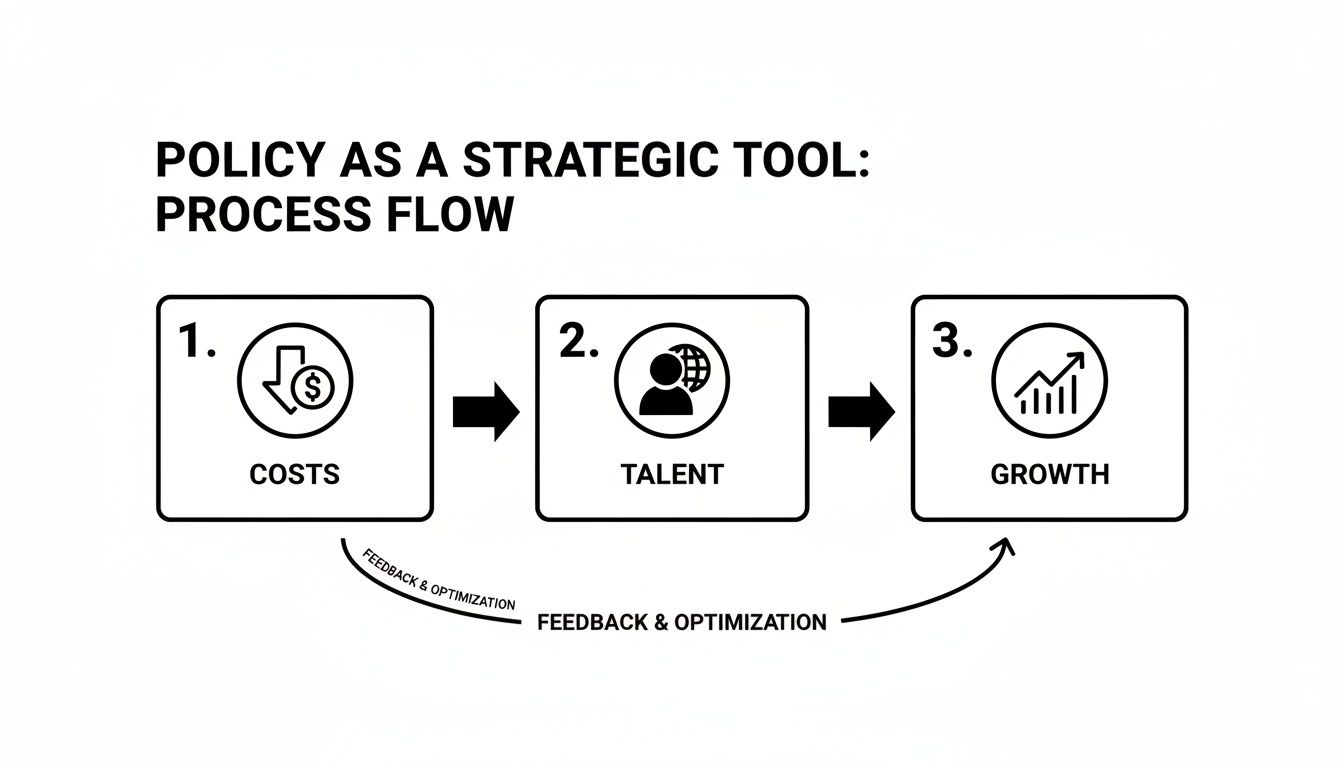
As you can see, a well-thought-out policy isn't just an HR document—it’s a strategic tool that positively impacts your bottom line.
Establishing Clear Communication Protocols
When your team is scattered, you can no longer rely on those spontaneous "water cooler" chats to keep everyone on the same page. Your policy must lay out explicit communication standards to ensure information flows smoothly and no one is left out.
This means being crystal clear about which tools are for which purpose. For instance:
- Instant Messaging (Slack, Teams): Best for quick, informal questions and real-time updates.
- Email: Reserve this for formal announcements, detailed project updates, and any external communication.
- Video Conferencing (Zoom, Google Meet): This should be the default for all team meetings to ensure remote folks are equal participants. A "cameras on" rule can really help boost engagement.
The demand for this kind of flexibility is huge. The numbers don't lie: six in 10 (60%) workers in remote-capable jobs now prefer a hybrid setup. This isn't just a preference; it's a major advantage for employers. Job postings that offer hybrid or remote options attract 2.6 times more applications than fully onsite roles. If you want a deeper dive, the Gallup research on hybrid work preferences is eye-opening.
Your policy should also set expectations around availability. Something simple like, "Employees are expected to be available online and responsive during core business hours of 10:00 AM to 4:00 PM local time," provides clarity without feeling like micromanagement. By cementing these core components—eligibility, scheduling, and communication—into your hybrid work policy template, you create a solid framework that gives employees autonomy while still hitting your business goals.
Navigating Technology Equipment and Cybersecurity
When your team is spread out, your IT infrastructure and data security suddenly face a whole new set of challenges. Think about it: your office's secure network just expanded to include dozens of individual home networks. That's a lot of new potential weak spots.
This is why hammering out clear rules around technology and cybersecurity is an absolute must for your hybrid work policy template. It's not just about locking down company data; it’s about making sure everyone has the secure, reliable setup they need to do their job well.
First thing's first: who's providing the gear? You have to make a call on this, and your policy needs to be crystal clear about which path you're taking.

Defining Equipment Provision and Use
From my experience, the Company-Provided Equipment (CPE) model is the gold standard, especially when security is a top priority. When you issue the laptops, monitors, and other hardware, you control the entire environment. Every device is pre-loaded with your security software, managed by your IT team, and strictly used for business. It keeps things clean and simple.
The alternative is a Bring Your Own Device (BYOD) policy. This gives your team more flexibility, but it throws a big wrench into your security strategy. If you go this route, you have to be incredibly strict. You'll need to mandate specific antivirus software, require device management apps, and find a way to keep company data walled off from personal files. A BYOD policy needs to be far more detailed to even begin to cover all the potential risks.
Key Takeaway: For any business handling sensitive data—especially BPOs with iron-clad client SLAs—I strongly recommend a Company-Provided Equipment model. It drastically simplifies security and cuts down the risk of a breach starting on an unsecured personal laptop.
No matter which model you choose, make it clear that all company gear is company property and must be returned when an employee leaves. You should also spell out who's on the hook for any damage or loss.
Setting Secure Home Office and Remote Work Standards
Okay, so you've got the hardware figured out. Now you need to define what a secure work environment actually looks like. An employee's home network is now, for all intents and purposes, a branch of your company’s network. You have to treat it that way.
The stakes are incredibly high. The average cost of a single data breach has ballooned to $4.45 million. Your policy needs to lay down some non-negotiable security ground rules for every remote workspace.
- Secure Wi-Fi: All home Wi-Fi networks must be password-protected with WPA2 or WPA3 encryption. Period. Using open or public Wi-Fi to connect directly to company systems is strictly forbidden.
- VPN Usage: A company-approved Virtual Private Network (VPN) must be used anytime an employee connects to the company network from outside the office. This is especially critical at places like coffee shops or coworking spaces.
- Physical Security: Company-issued devices must be kept physically secure. That means locking them when unattended and protecting them from being lost, stolen, or accessed by others, including family members.
These aren't suggestions; they're fundamental practices to protect your business. For companies using flexible workspaces or seat leasing services, this is often a huge weight off their shoulders. Quality providers handle the IT infrastructure for you, giving you an enterprise-grade secure environment without the management headache.
Enforcing Strict Data Handling and Cybersecurity Practices
Your policy needs to be explicit about how employees should handle sensitive information outside the office. This covers both digital files and any physical documents. The rules that apply in the office don't get a day off just because someone is working from their kitchen table.
Start by outlining clear protocols for accessing and moving data.
- Authorized Software Only: Make it a hard rule that employees cannot use personal cloud storage or email accounts (like their personal Dropbox or Gmail) to transfer company files. All work must stay within company-sanctioned applications.
- Data Classification: Gently remind everyone of their responsibility to handle data based on its classification (e.g., Public, Internal, Confidential). Sensitive client data should never be saved directly onto a local device unless it's absolutely necessary and fully encrypted.
- Incident Reporting: Create a simple, foolproof process for reporting suspected security incidents immediately. Whether it's a lost laptop or a sketchy-looking email, quick reporting is the key to minimizing the damage.
For a BPO, protecting data integrity is everything. We handle massive amounts of client information, and a single slip-up can have devastating consequences. It's precisely why our own data handling procedures and privacy policy are so thorough. Your hybrid work policy must echo these high standards, making sure every single person on your team knows their role in protecting information, no matter where they log in from.
Measuring Performance and Fostering Equity
So, how do you know people are actually working when you can't see them? And how do you make sure everyone gets a fair shake, whether they're at home or in the office? This is probably the trickiest part of getting a hybrid model right. If you're not careful, a subtle "out of sight, out of mind" attitude can take hold. Suddenly, the people you see in the hallway seem more productive or committed. That's proximity bias, and it's a silent killer of company culture.
The only way to solve this is to completely rethink how you measure performance. You have to stop counting hours and start focusing on actual results. A solid hybrid work policy template needs to be crystal clear about how performance is judged, ensuring a level playing field for everyone.

Shifting from Hours Worked to Results Achieved
The old-school idea that "butts in seats" equals productivity is dead. For a hybrid setup to truly work, you need to move towards a results-only work environment (ROWE). This approach builds a culture of trust and gives your team the autonomy to manage their own time, as long as they deliver high-quality work.
To get there, your policy has to spell out how progress will be tracked. That means setting up clear, results-driven Key Performance Indicators (KPIs) for every single role.
- Sales Team: Don't obsess over call times. Instead, focus on things like new leads generated, close rates, and total revenue booked.
- Marketing Team: Your key numbers are qualified leads from campaigns, growth in website traffic, and engagement on social channels.
- Development Team: Measure output with metrics like sprint completion rates, the number of features successfully deployed, and how quickly bugs are resolved.
These metrics are objective. They don't care where you're sitting. They measure what got done, not where it got done, which is the cornerstone of a fair system.
Creating an Equitable Environment for All
Equity isn't just about performance reviews. It’s about making sure remote and in-office staff have the exact same shot at career growth. Proximity bias is sneaky; managers often unconsciously tap the person they see every day for a cool new project or a promotion.
Your policy has to actively fight against this by creating formal structures for opportunities.
A truly equitable hybrid policy ties career advancement to contribution and skill, not to an employee's desk location. It forces managers to be intentional about creating visibility and opportunities for every single person on their team.
This means you have to build systems that level the playing field. For instance, make it a rule that all important team meetings are video calls by default—even if most people are in the office. It's a small change, but it stops remote employees from feeling like a disembodied voice on a speakerphone.
Here are a few more strategies I've seen work wonders:
- Formalize Mentorship Programs: Don't let mentorship happen by chance in the breakroom. Create a structured program that pairs people based on skills and goals. This guarantees your remote staff get the same access to valuable guidance.
- Standardize Project Assignments: Have a clear, transparent process for handing out those high-visibility projects. Maybe it's an application system, or maybe it's a rotation. Anything is better than a manager just grabbing the person they passed in the hallway.
- Train Your Managers: This is non-negotiable. Your managers need to be taught how to lead distributed teams, run inclusive meetings, and evaluate performance without bias. They are the ones who will make or break your policy on a daily basis.
By building these principles directly into your hybrid work policy template, you're doing more than just allowing remote work. You are intentionally designing an inclusive, high-trust culture where everyone has an equal chance to succeed based on their results, not their location.
Tailoring Your Policy for Different Business Needs
A one-size-fits-all hybrid work policy is a recipe for disaster. Let's be honest, the operational reality of a nimble tech startup is worlds apart from the ironclad security demands of a Business Process Outsourcing (BPO) firm. Your policy has to reflect your world.
Adapting your hybrid work policy template isn’t about starting from scratch. It’s about fine-tuning the key clauses so the policy becomes a powerful operational tool that works for you, not against you.
Customizing for Startups and High-Growth Companies
For startups, the name of the game is speed and attracting top talent. You're in a constant battle with established giants, and a flexible, forward-thinking culture is one of your most potent weapons. A rigid, bureaucratic policy will only slow you down and scare away the exact people you need to hire.
Your policy needs to champion:
- Agility and Flexibility: Ditch the complicated approval chains. Empower managers to make scheduling decisions directly with their teams, allowing for quick adjustments as projects pivot. The focus has to be on results, not red tape.
- Talent Attraction: Don't just have a hybrid policy; sell it as a competitive perk. Emphasize the trust and autonomy you offer in job descriptions and onboarding. A policy that trusts employees to manage their work and life attracts high-performers who will thrive.
- Intentional Culture Building: Make in-office time count. Instead of random days, think about structuring "collaboration sprints" or project kickoff days to maximize the impact of face-to-face interaction and actually strengthen team bonds.
Fortifying the Policy for BPOs
In the BPO world, security and service level agreements (SLAs) are sacred. Your clients are trusting you with their sensitive data and expect flawless, uninterrupted service. Your hybrid policy must be built on a foundation of airtight security and unwavering operational consistency.
Here's where to double down:
- Ironclad Data Security: This is non-negotiable. Mandate the use of company-provided, locked-down equipment. Prohibit personal devices for work and enforce strict VPN usage at all times. You also need to spell out the clear, immediate consequences for any security breaches.
- Maintaining SLAs: Eligibility for hybrid work has to be tied directly to roles that can meet client-mandated performance metrics from home. High-security accounts or jobs requiring specialized on-site hardware might need to be designated as fully office-based.
- Supervision and Quality Assurance: Detail exactly how remote monitoring and quality checks will happen. Being transparent about this process builds client confidence and ensures service quality never dips.
Optimizing for Seat Leasing BPO Clients
If you’re using a seat leasing service, your goal is to merge maximum flexibility with serious cost-efficiency. Your policy isn't just about managing where your employees work; it's about strategically using your physical workspace to get the most bang for your buck. You have a professional, secure environment ready to go, without the headache of a long-term lease.
Your policy should lean into the benefits your workspace provider offers.
When you're using a flexible workspace, your hybrid policy becomes a powerful tool for cost optimization. You can align in-office days with your seat leasing agreement, ensuring you only pay for the space you actively need while giving your team a premium, fully-supported work environment.
Here’s a quick-glance table showing how you might adjust your focus based on your business model. It really highlights how the same policy area requires a completely different approach depending on your operational needs.
Policy Customization by Business Type
| Policy Area | Startup Focus | BPO Focus | Seat Leasing Client Focus |
|---|---|---|---|
| Eligibility | Broad eligibility to attract talent, tied to performance. | Strict, based on role function and security clearance. | Flexible, based on team project needs and workspace capacity. |
| Scheduling | Team-led and flexible, prioritizing project needs. | Fixed, predictable schedules to ensure client coverage. | Structured around "anchor days" to maximize collaboration in the leased space. |
| Cybersecurity | Strong basics, but may allow some BYOD with controls. | Zero-tolerance for breaches; company-issued devices only. | Leverages the provider's secure network and infrastructure. |
| Equipment | Mix of company-provided and stipends for home offices. | Strictly company-provided and managed equipment. | Company-provided laptops, utilizing on-site monitors and peripherals. |
By taking the time to tailor your hybrid policy, you ensure it actively supports your core objectives. Whether you're a startup built for speed, a BPO protecting critical client data, or a business optimizing costs through seat leasing, a customized approach is the only real path to a successful hybrid future.
Executing a Smooth and Successful Policy Rollout
A brilliant hybrid work policy on paper can quickly fall apart without a thoughtful rollout plan. How you introduce this change is just as important as the policy itself. The real goal is to frame this as a positive evolution for the company, earning trust and genuine buy-in from your team from day one.
First things first, you need a realistic timeline. Rushing a launch is a sure-fire way to create confusion and anxiety. I've seen it happen. Give yourself a buffer of at least 30 to 60 days from the moment the policy is finalized to the day it officially kicks in.
This breathing room is crucial. It gives you enough time for clear communication and proper training, making sure everyone feels prepared instead of blindsided by the news.
Training Your Managers for Success
Your managers are the linchpins in this entire transition. They're on the front lines, fielding questions, navigating schedules, and making sure the policy is applied fairly every single day. Just handing them the document and hoping for the best is a recipe for disaster.
You have to invest in training that tackles the specific challenges of leading a distributed team. Don't just gloss over it. Your training should cover essential skills like:
- Combating Proximity Bias: Teach managers how to evaluate performance based on results and output, not just on who they see walking the halls most often.
- Running Inclusive Meetings: Provide practical, non-negotiable guidelines for ensuring remote team members have an equal voice and presence in every single discussion.
- Fostering Connection: Equip them with real strategies for building team cohesion and a strong culture when people aren't always in the same physical space.
When your leadership team is well-prepared, they can turn the policy from a static document into a living, breathing part of your company culture.
The success of your hybrid work policy rollout hinges on transparent communication. Frame the change not as a reaction, but as a proactive step toward a more flexible, trust-based, and effective way of working that benefits everyone.
Crafting clear, empathetic messaging is non-negotiable. Prepare a detailed announcement email and, more importantly, host an all-hands meeting to walk everyone through the new policy. This is your moment to explain the "why" behind the decisions and tackle questions head-on.
For businesses that need expert guidance in managing these kinds of operational shifts, you can always contact us for support to ensure a smooth transition. A successful rollout really does set the stage for a more engaged, productive, and happy hybrid workforce.
Answering the Tough Questions About Your Hybrid Policy
Once you launch your new hybrid work policy, you can bet the questions will start flying. It’s one thing to have a policy on paper; it's another to navigate the real-world situations that pop up.
Getting ahead of these common curveballs with clear, consistent answers is the key to making this work. If you handle these tricky spots fairly, you’ll build trust and show everyone that the policy is solid.
Let's walk through some of the questions that inevitably land on the desks of managers and HR.
What About Requests to Go Fully Remote?
Sooner or later, an employee in a hybrid role will ask to go 100% remote. This is probably one of the first and most common challenges you'll face. The absolute worst thing you can do is leave it to individual manager discretion. That's a recipe for inconsistency and resentment.
Instead, create a formal process. Evaluate these requests on a case-by-case basis, but use objective criteria. Can the core functions of this specific role truly be done without any in-office time? Does the employee have a proven track record of high performance while working independently?
Whatever your decision, be transparent. If the answer is no, explain why. Tie it back to the specific parts of your policy that emphasize the need for in-person collaboration for certain teams or projects.
How Do We Stop Everyone from Showing Up on the Same Day?
Flexible schedules are great until half the company decides Tuesday is the day to come in, and you run out of desks, parking, and coffee. This is less of a policy issue and more of a logistics puzzle, and technology is your best friend here.
- Desk Booking Software: A "hot-desking" or hoteling system is practically a must-have. Tools like this give everyone visibility into who's coming in and guarantee a workspace for those who make the commute. No more wandering the halls looking for a free spot.
- Team Coordination: Encourage managers to be strategic. They can set "anchor days" for their teams and stagger them throughout the week to help distribute the load on the office. For example, the marketing team might come in on Tuesdays, while the engineering team aims for Wednesdays.
How Do We Keep Our Company Culture Strong?
This is the big one. How do you maintain a vibrant, cohesive culture when your team isn't sharing the same physical space every day? You have to be incredibly intentional about it. Your policy should actively support activities that bridge the virtual divide.
A strong hybrid culture doesn't just happen. It's built on purpose, through deliberate actions that make remote employees feel just as seen, valued, and connected as their in-office colleagues. This means rethinking everything from all-hands meetings to happy hours for a distributed audience.
Make sure you budget for virtual team-building events. When you have major company announcements or celebrations, design them from the ground up to be engaging for everyone, whether they're in the conference room or on a Zoom call.
And as a final reminder, always keep legal considerations in mind. If you have employees working from different states or even countries, tax and employment laws can get complicated fast. It's always wise to consult with a legal expert on this front.
Ready to build a policy that drives growth and flexibility? Seat Leasing BPO provides the secure, fully-serviced workspaces you need to make your hybrid model a success, saving you up to 80% on traditional office costs. Learn more about our flexible solutions at seatleasingbpo.com.