A founder gets a message at 9:12 a.m. One team says the sales reps next door are too loud during calls. The next complaint comes from a client manager who thinks another company's staff are using shared meeting rooms without booking them. By lunch, someone is upset about fridge space, someone else is upset about headset volume, and a supervisor is trying to coach a struggling agent while three other people argue about who has authority to step in.
That's not a facilities problem alone. It's not just a personality issue either. It's hr employee relations in its most practical form.
In shared offices, seat leasing setups, and BPO floors, employee relations stops being a nice HR concept and becomes operating discipline. If people don't know how to raise concerns, how managers should respond, and what fair treatment looks like across teams, small friction turns into distraction, resentment, and turnover. The companies that handle this well don't wait for a formal complaint. They build rules, habits, and response paths early, then apply them consistently.
What Is HR Employee Relations Really About
HR employee relations is the work of keeping the relationship between people and the organization functional, fair, and productive. In plain terms, it covers how concerns are handled, how expectations are communicated, how conflict gets resolved, and how trust is protected when things go wrong.
In a traditional office, that can already be hard. In a multi-tenant workspace, it gets harder because the lines blur. One person's manager may not control the room they work in. Another team may share the same pantry, Wi-Fi, breakout space, or even shift overlap. That creates tension fast if nobody owns the process.

It's not about policing people
The mistake many leaders make is treating employee relations like a disciplinary desk. That's too narrow. Good employee relations is the infrastructure behind day-to-day work. It sets the tone for how feedback is given, how complaints are logged, how investigations stay objective, and how managers respond without making the issue worse.
A startup founder usually feels this when growth outpaces management habits. A BPO manager feels it when performance pressure, attendance issues, and team friction start colliding in the same week.
Practical rule: If your team only talks about employee relations after someone is angry, you don't have an ER approach. You have a reaction pattern.
The urgency is real. Gallup's 2025 data shows U.S. employee engagement at a historic low of 31%, with 17% of employees actively disengaged, as summarized by People Managing People's HR statistics roundup. Low connection at work is exactly the kind of condition that turns ordinary workplace friction into performance drag.
What it looks like in real life
In practice, hr employee relations often includes things like:
- Clarifying expectations: Who handles a noise complaint, a scheduling dispute, or a repeated conduct issue.
- Creating safe reporting paths: Employees need more than “talk to your manager” when the manager may be part of the problem.
- Resolving conflict early: Quick mediation beats formal escalation when the issue is still manageable.
- Protecting consistency: Similar issues should get similar responses, regardless of title or client importance.
If you're operating in a flexible office or BPO setup, the best mindset is this: employee relations is part people strategy, part risk control, and part operating system. Many teams developing that discipline start by reviewing practical workplace examples and management patterns through resources like the Seat Leasing BPO blog.
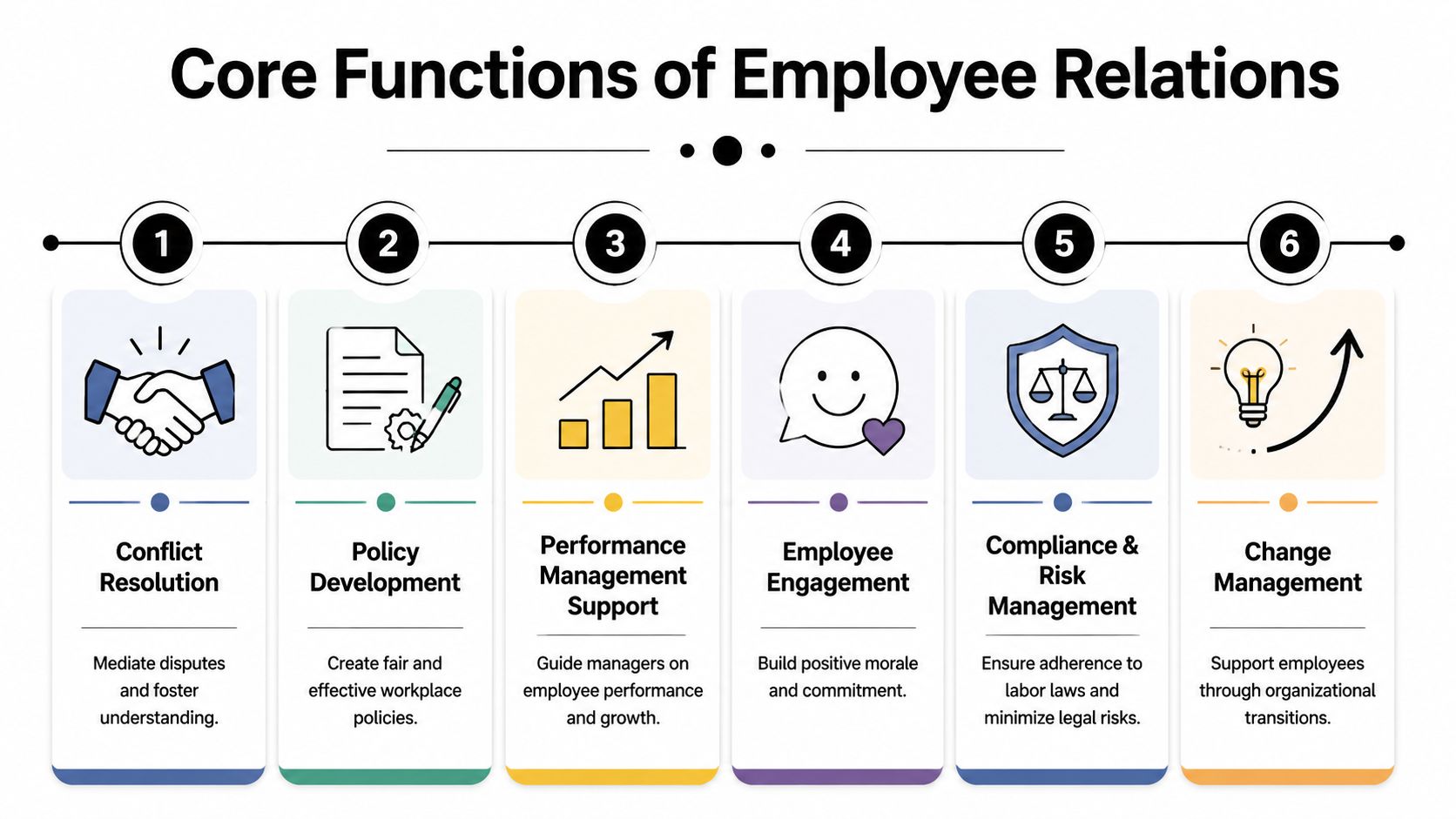
The Core Functions of Employee Relations
If payroll is about paying people correctly and recruiting is about bringing people in, employee relations is about what happens after people start working together. It's the function that keeps the workplace from drifting into confusion, inconsistency, or avoidable conflict.
Think of it as the organization's internal nervous system. It detects friction, sends signals, coordinates responses, and helps leadership act before a local issue becomes a culture problem.
Policy and culture
Policy is the written part. Culture is the lived part. You need both.
A code of conduct, grievance process, attendance rule, and shared-space etiquette policy give managers something concrete to apply. But if leaders ignore those rules when a top performer breaks them, employees stop trusting the system. In shared environments, policy also needs to cover practical issues that corporate handbooks often skip, such as meeting room use, noise standards, visitor behavior, and boundaries between client teams.
Communication and manager guidance
Most employee relations problems don't start with a formal case. They start with vague instructions, inconsistent coaching, or a manager who avoids a hard conversation until emotions are already high.
That's why communication is a core ER function. Leadership needs to explain decisions clearly. Managers need scripts, not just principles. Employees need to know where to go with questions before they become complaints.
SHRM reports that 85% of employees feel more engaged with transparent leadership communication, according to the AIHR summary on employee relations metrics. That matters because ER improves when people understand what's happening and why.
Conflict resolution and investigations
Some issues need a conversation. Some need a structured fact-finding process. Good ER teams know the difference.
Use mediation when there's tension, miscommunication, or a workable relationship to repair. Use a formal investigation when there are allegations involving harassment, discrimination, retaliation, repeated misconduct, or serious policy breaches. The key is neutrality. The manager who is emotionally invested in the outcome is rarely the best person to run the review.
Fair process matters as much as the final decision. Employees may dislike an outcome and still accept it if they can see it was handled consistently.
Engagement and recognition
Many managers underestimate employee relations. This field involves more than just resolving conflicts; it also encompasses the daily interactions that signal to staff whether a workplace is worth their long-term commitment.
That includes:
- Recognition habits: Thanking people for specific contributions, not vague praise.
- Feedback quality: Correcting performance without humiliation.
- Manager follow-through: Closing the loop after concerns are raised.
- Visible fairness: Showing that policies apply across seniority levels.
Who owns what
ER works best when responsibilities are clear.
| Role | Primary responsibility |
|---|---|
| HR or People lead | Set process, coach managers, review risk, handle serious cases |
| Line manager | Address issues early, document facts, uphold standards |
| Employee | Raise concerns promptly, participate honestly, follow policy |
| Leadership | Model consistency, support fair decisions, avoid favoritism |
When these roles blur, cases get delayed, facts get muddled, and trust drops. That's especially common in startups where one founder, one operations lead, and one team supervisor are all acting like unofficial HR.
Actionable Frameworks for a Positive Workplace
Most teams don't need a complicated employee relations playbook. They need a few repeatable frameworks that managers can actually use on a busy day. If the process is too academic, nobody follows it. If it's too loose, every manager improvises.
A workable system should fit on one page, survive pressure, and be simple enough to use in a shared office, a hybrid team, or a BPO floor.

Use the LISTEN model for low-level conflict
For everyday tension, I prefer a basic mediation structure managers can remember without opening a handbook.
Listen separately first
Hear each side alone before putting people in a room together. That lowers defensiveness and helps identify whether the issue is about conduct, communication, workload, or misunderstanding.Identify the actual issue
“They're disrespectful” is not specific enough. “They interrupt my calls by taking personal conversations beside my desk” is something you can address.Set shared expectations
Agree on observable behavior. Keep voices low during live calls. Book rooms in advance. Don't use team chat for sarcasm when frustrated.Track the follow-up
Put a check-in on the calendar. Many managers skip this part, then act surprised when the issue resurfaces.
This works well for disputes over pantry etiquette, workstation noise, Slack tone, or shift handoff friction.
Run stay interviews before people detach
Exit interviews tell you why someone left. Stay interviews help you find out what may push them out before that happens.
A manager's stay interview doesn't need to be long. It needs to be direct. Ask questions like:
- What part of your work feels heavier than it should right now
- What gets in the way of doing good work here
- Do you feel heard when you raise concerns
- What would make this a better place to stay for the next six months
In remote or chat-heavy teams, culture often weakens. Practical habits matter. If you manage distributed communication in Slack, these culture-building daily actions for Slack teams are useful because they translate culture into repeatable routines instead of slogans.
Give performance feedback without triggering defensiveness
A lot of “employee relations issues” are really clumsy performance conversations. The manager waits too long, gets frustrated, then delivers feedback as accusation.
Use this structure instead:
- State the observed pattern: “Your quality checks have had repeat errors over the last two weeks.”
- Explain the impact: “That creates rework for the next shift and delays client updates.”
- Ask for context: “What's getting in the way?”
- Set one clear next step: “For the next five shifts, log your completed checks before handoff.”
That approach is firm without being vague or personal.
Managers should document behavior, expectations, and follow-up. They shouldn't document assumptions about attitude or motive as if they were facts.
A short training clip can help supervisors tighten their approach before issues escalate:
Create a lightweight ER toolkit
Founders and small operators often delay employee relations because they assume they need enterprise software and a large HR team. They don't. Start with a small operating kit:
| Tool | Why it matters |
|---|---|
| Intake form | Captures facts consistently |
| Manager script | Reduces ad-libbed mistakes |
| Issue log | Tracks patterns over time |
| Follow-up template | Makes closure visible |
| Escalation matrix | Shows when HR or leadership steps in |
Teams using flexible offices often also need a practical space-use standard, reporting path, and conduct guide included in their workplace setup. That's why operational support details like those outlined in workspace inclusions for managed office environments matter. They reduce ambiguity before behavior problems attach themselves to it.
Key Metrics to Measure Employee Relations Success
You can't manage employee relations by instinct alone. If all you know is that “people seem unhappy,” you're already behind. ER becomes useful to leadership when it shows patterns early enough to act on them.
That doesn't mean building a giant dashboard full of vanity metrics. It means choosing a handful of indicators that tell you whether concerns are rising, whether managers are handling them well, and whether unresolved friction is spilling into retention, attendance, or performance.
Start with the metrics that reveal causes
The most useful ER metrics don't just count incidents. They help you diagnose what sits underneath them.
Data shows that 68% of companies track ER metrics to identify training needs and 54% use them to develop better policies, based on the HR Acuity analysis of employee relations metrics and KPIs. That's the right frame. Metrics should lead to action, not just reporting.
One KPI deserves special attention in BPOs and startup environments: Case Volume per 1,000 Employees. When performance-related cases rise, the lazy interpretation is “we have weak employees.” Often the better interpretation is weaker management, unclear expectations, poor onboarding, or burnout pressure.
Essential Employee Relations KPIs
| KPI | What It Measures | Why It Matters for BPOs/Startups |
|---|---|---|
| Turnover rate | How often employees leave | Shows where instability or poor management may be driving exits |
| Engagement score | How connected employees feel to work and team | Helps spot morale issues before they become conduct or retention problems |
| Satisfaction level | How employees rate their work experience | Reveals friction that may not surface in formal complaints |
| Absenteeism | Missed work patterns | Often signals stress, disengagement, or unresolved manager issues |
| Grievance incidence | Number and type of complaints | Helps identify repeat hotspots by team, manager, or site |
| Time to resolution | How long concerns stay open | Indicates whether your ER process builds trust or leaves issues hanging |
| DEIB index | Inclusion and equity signals | Highlights whether certain groups experience the workplace differently |
| Case Volume per 1,000 Employees | Rate of ER cases normalized by headcount | Makes comparisons meaningful across teams and client groups |
Read the story behind the number
A spike in complaints is not always bad news. Sometimes it means employees trust the reporting path enough to use it. The essential question is whether the same issue keeps repeating and whether response quality improves.
Look for combinations, not isolated metrics:
- High absenteeism plus performance cases often points to pressure, burnout, or poor supervision.
- Low engagement plus slow case resolution usually means employees don't believe speaking up changes anything.
- High turnover in one client team can signal a local leadership problem even if the wider site looks stable.
The goal is not to make complaint numbers look low. The goal is to make issues visible, address root causes, and reduce repeat patterns.
For startups and multi-tenant environments, segment your numbers. Don't only review site-wide totals. Break them down by team lead, shift, client account, and workspace zone if needed. That's where hidden patterns usually sit.
Navigating Employee Relations Legal and Compliance Issues
Most managers get nervous when employee relations shifts from “team issue” to “risk issue.” That's understandable, but panic creates sloppy decisions. The safer mindset is simpler: be fair, be consistent, and document what happened.
Legal and compliance trouble often starts long before a lawyer appears. It starts when one employee gets coached informally for conduct that gets another employee disciplined. It starts when a manager writes down opinions instead of facts. It starts when someone changes duties, schedule, or work conditions in a way that feels retaliatory or forces the employee into a corner.
Consistency is your strongest protection
You do not need to sound like legal counsel to handle ER responsibly. You need a process that holds up under scrutiny.
Use these practical standards:
- Apply policies the same way: Role, tenure, and client importance shouldn't determine whether conduct is addressed.
- Document facts, not character judgments: Write “arrived late three times this week,” not “seems careless.”
- Separate allegation from conclusion: A complaint is a report, not proof.
- Preserve confidentiality carefully: Share information on a need-to-know basis, not as workplace gossip.
- Close the loop: People don't need every detail of an outcome, but they should know the concern was reviewed.
What managers should do in difficult conversations
A compliant process usually looks calm from the outside. That's because the manager came prepared.
| Do | Don't |
|---|---|
| Bring notes with dates and examples | Rely on memory alone |
| Explain policy and expectations clearly | Threaten vaguely |
| Give the employee a chance to respond | Argue over every point |
| Record next steps and timeline | End the meeting without follow-up |
If your team runs heavily on Microsoft 365, practical references on HR compliance for Microsoft 365 organizations can help managers think through documentation, access, and process discipline inside the tools they already use.
The key point is simple. Compliance is not paperwork for its own sake. It is evidence that the organization acted fairly, thoughtfully, and in line with its own standards.
ER Strategies for Startups BPOs and Shared Workspaces
Generic employee relations advice assumes one employer, one culture, one chain of command, and one physical environment. That assumption breaks fast in shared offices, seat leasing operations, and client-heavy BPO setups.
In these environments, the challenge is not only employee-manager tension. It's also cross-team friction, borrowed space, overlapping norms, and different companies working side by side with different levels of maturity. A polished handbook from a traditional corporate office won't solve that on its own.

Standard policy is not enough in shared space
Many businesses are caught off guard by this challenge. Research shows that 62% of small businesses in shared environments report increased interpersonal tensions, but only 15% have protocols for inter-client disputes, as cited in SHRM's connected workforce insights. That gap matters because it can lead to 25% higher turnover in these settings.
The lesson is clear. Shared workspaces need a layer of ER design that standard office guides rarely cover.
Build a modular ER kit
For startups, the smartest move is not to overbuild. It's to create a modular ER kit addressing the most likely failure points.
That kit should include:
- Shared-space conduct rules: Noise, room bookings, pantry use, guest rules, and clean-desk expectations.
- Inter-client dispute protocol: Who receives the complaint, who investigates, and who communicates the outcome.
- Manager escalation map: Which issues stay local and which move to HR, leadership, or site operations.
- Privacy standard: How to discuss sensitive issues in open-plan offices without exposing the employee.
- Short-form documentation templates: Fast enough for operators to use, structured enough to create a real record.
In a multi-tenant workspace, ambiguity is fuel. Every unclear boundary becomes a future people problem.
Adapt your approach by business type
Different operators need different levels of structure.
For startups, focus on lightweight systems. Founders often know everyone personally, which feels efficient until they have to investigate a complaint involving someone they hired themselves. Put one neutral process in place before that happens.
For BPOs, pressure points usually come from performance monitoring, attendance, repetitive work, and supervisor quality. That means your ER strategy should sit close to operations, not in a separate silo no one trusts.
For freelancers and short-term project teams, psychological expectations need active management. If flexibility is promised, the workspace and supervision model should support that promise instead of undermining it.
A physical setup can either reduce or amplify tension. Layout, private meeting access, and support infrastructure all influence how easily concerns can be handled. Practical office planning references such as managed workspace options in Building 24 are useful because ER doesn't live only in policy. It also lives in how the workplace is arranged.
Frequently Asked Questions About Employee Relations
What's the difference between HR and employee relations
HR is the broader function. It covers hiring, payroll, benefits, onboarding, and workforce planning. Employee relations is the part focused on workplace trust, conflict handling, policy application, investigations, and fair treatment in day-to-day operations.
When should a manager escalate an issue to HR
Escalate when the issue involves harassment, discrimination, retaliation, repeated misconduct, major policy breach, or a complaint about the manager handling the matter. Escalate early if emotions are high or facts are disputed.
Can a small business handle hr employee relations without a full HR team
Yes, if it builds simple and consistent systems. A small business needs clear policies, reporting paths, documentation habits, and manager coaching. It does not need a large department to start acting professionally.
What usually goes wrong first
Usually one of three things. Managers avoid difficult conversations. Policies exist but aren't applied consistently. Or employees don't trust the reporting path enough to use it early.
How often should employee relations processes be reviewed
Review them whenever a repeated issue appears, a team grows quickly, a new client setup changes work conditions, or a shared-space conflict exposes a gap. In fast-moving environments, annual review alone usually isn't enough.
What is the simplest sign that employee relations is improving
Managers address issues earlier, employees know where to go with concerns, and the same problems stop showing up in slightly different forms. Good ER feels less dramatic because the workplace becomes more predictable.
If your team needs a flexible workspace that supports smoother operations, clearer boundaries, and less day-to-day friction, Seat Leasing BPO offers managed office solutions designed for modern teams that want to grow without the burden of building everything from scratch.