Growth is exciting until support starts breaking under the pressure.
You launch a new product, sales climb, inbound inquiries double, and suddenly your internal team spends every day triaging queues instead of solving customer problems. Response times slip. Managers jump into tickets. Sales asks why leads aren't getting called back fast enough. Customer success starts apologizing more than advising.
That's usually the point where leaders ask the wrong question. They ask, “How do we hire faster?” The better question is, “What operating model can support growth without forcing us to rebuild the company around customer service?”
Contact center outsourcing is often the right answer, but only if you treat it as an operating decision, not a staffing shortcut. This is no longer a niche move. The global contact center outsourcing market was valued at USD 102.59 billion in 2024 and is projected to reach about USD 242.80 billion by 2034, with a 9.00% CAGR according to Precedence Research's contact center outsourcing market analysis. That matters because it tells you something simple: serious companies already use outsourcing as core infrastructure.
If you're also evaluating automation, it helps to think about outsourcing and AI together rather than as competing choices. A practical resource on scaling customer support with AI can help frame where automation fits before you decide what humans, systems, and partners should own.
Is Your Growth Outpacing Your Customer Service
A growth spike sounds good until the service operation starts absorbing the shock. Monday opens with a full inbox, missed callbacks from Friday, and supervisors taking frontline chats because the queue is already behind. Sales wants faster lead follow-up. Customer success wants cleaner handoffs. Your support team is stuck reacting.
That situation is not a hiring problem first. It is an operating model problem.
If demand is getting less predictable, spread across more channels, and tied more directly to revenue, adding a few in-house agents will not fix the underlying strain. It usually adds more recruiting work, more training time, and more management overhead while service levels keep slipping.
What growth stress looks like in operations
You can usually spot the breakpoints quickly:
- Managers are covering queues instead of coaching, forecasting, and improving quality.
- Experienced staff are pulled into repetitive tickets because first-line coverage is too thin.
- Customers get different service depending on the channel across phone, chat, email, and social.
- Hiring cannot keep pace with demand because recruiting, onboarding, and ramp time are too slow.
- Revenue teams lose momentum when leads wait too long for a callback or follow-up.
Once that pattern sets in, heroics become the system. That is expensive, hard to manage, and impossible to scale for long.
The right response is to redesign capacity before service issues start dragging down retention and conversion. That is why outsourcing comes up at this stage. But the old BPO playbook is too narrow for a lot of growing companies.
The better option is often a more flexible model that lets you add trained capacity without committing to a full internal buildout. Seat leasing is a good example. It gives you faster deployment, tighter cost control, and less execution risk than building every layer yourself. For companies growing fast or testing new service coverage, that matters more than owning every seat on paper.
You should also evaluate outsourcing alongside automation, not as a separate decision. A practical resource on scaling customer support with AI can help you decide which interactions should stay with your team, which should be automated, and which should move to an outside partner.
Good outsourcing adds capacity. Smart outsourcing gives you a service model that can absorb growth without forcing the rest of the business to slow down.
What Is Contact Center Outsourcing Really
Most leaders hear “outsourcing” and picture a room full of agents answering calls from a script. That picture is outdated.
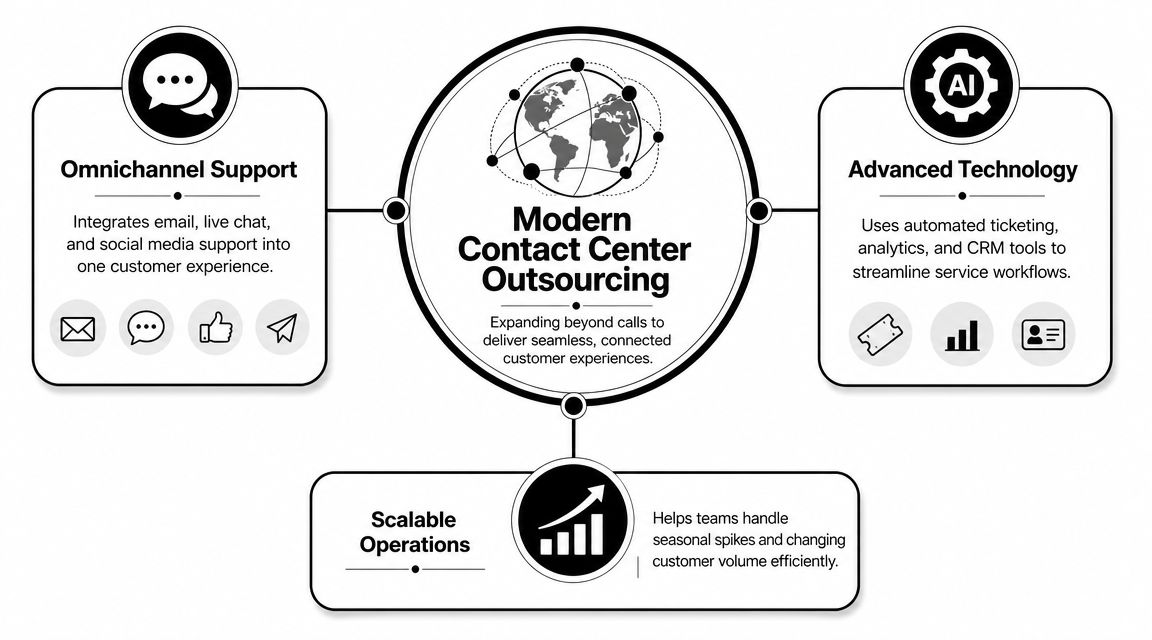
Modern contact center outsourcing is the use of an external partner to run part or all of your customer contact operation across voice and digital channels. That can include inbound support, outbound sales calls, email queues, live chat, messaging, social support, technical help desk functions, and selected back-office tasks tied to customer operations.
It's bigger than phone support
A contact center partner can take on work across the full service journey:
- Inbound service such as order support, billing questions, appointment handling, and complaint resolution
- Outbound work including follow-ups, renewal reminders, lead qualification, and collections support
- Digital channels like live chat, email management, social messaging, and SMS support
- Technical support where agents follow structured troubleshooting flows and escalation rules
- Back-office support tied to service delivery, such as case logging, data entry, and payment-related admin tasks
If customers contact you through multiple channels, your operation is already more complex than a call center. Your outsourcing strategy should reflect that reality.
What you are actually buying
You're not just buying labor. You're buying a mix of infrastructure, management, process control, and execution.
Think of it this way. Hiring internal agents gives you people. Outsourcing gives you an operating layer. Depending on the model, that layer may include workforce scheduling, QA, training, reporting, telephony, compliance processes, CRM workflows, and supervisor coverage.
That's why leaders need to look past rate cards. A vendor with strong systems can outperform a cheaper one with weak controls, even if the hourly price looks higher.
For a practical look at the systems side of handling your customer conversations efficiently, it helps to review how software, routing, and channel management shape service quality long before an agent says hello.
What it isn't
It isn't a free pass to stop managing customer experience. It isn't a cure for broken processes. And it isn't a smart move if you can't define what good service looks like.
Outsourcing works best when you already know which customer journeys matter, which standards are non-negotiable, and which outcomes you expect a partner to deliver.
Exploring the Main Outsourcing Models
Your sales team closes a strong quarter, ticket volume jumps, and customer wait times start slipping. Now you need capacity fast. The wrong move is treating outsourcing as a simple labor arbitrage decision. The smarter move is choosing a model that fits the work, the risk, and the speed your business needs.
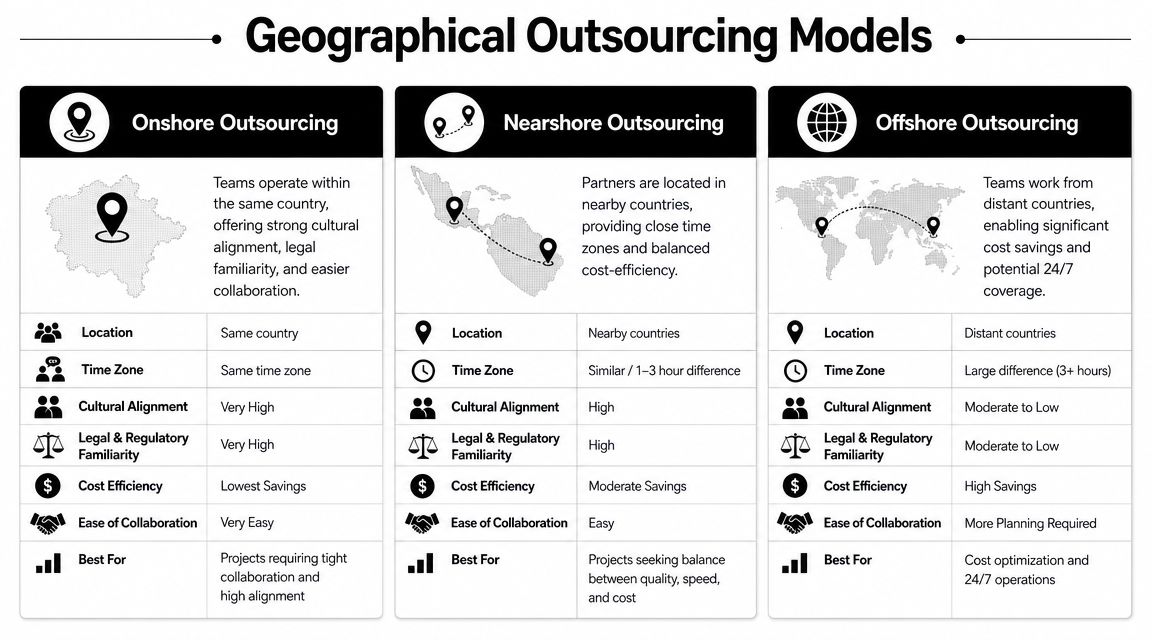
Geography matters, but it is only one part of the decision. Onshore, nearshore, and offshore models each solve a different operational problem. The right choice depends on how much customer nuance the work requires, how tightly your internal team needs to collaborate with agents, and how much execution risk you can tolerate.
Onshore outsourcing
Onshore outsourcing places your team in the same country as your customers.
Use it for work that carries high brand risk. Complaints, retention calls, regulated conversations, vulnerable customers, and premium accounts usually perform better with local language patterns, shared context, and fewer interpretation gaps. You pay more, but that premium often protects revenue and customer trust.
Analysts at Precedence Research found that onshore outsourcing held the largest share of the market in 2024, while inbound services also led service mix. That tracks with what operators see in practice. Companies still keep core customer conversations closer to home when service quality is tied directly to retention, compliance, or brand perception.
Nearshore outsourcing
Nearshore outsourcing places delivery in a nearby country with stronger time-zone overlap and usually easier day-to-day coordination.
For many growing businesses, this is the most practical starting point. It lowers cost without creating the management drag that often comes with distant teams. Nearshore works well for voice support, bilingual programs, back-office tasks linked to service, and teams that need frequent coaching or process updates.
It also gives you more room to test a flexible operating model before committing to a full managed service contract. If you want faster ramp-up with more direct control, review what is typically included in a seat leasing contact center setup and compare that structure against a traditional outsourced program. For companies still refining processes, seat leasing is often the cleaner way to add capacity without overcommitting on infrastructure or long-term overhead.
To see a simple visual breakdown before you compare vendors, this overview is useful:
Offshore outsourcing
Offshore outsourcing places the operation in a more distant market, usually to reduce cost and access larger talent pools.
Use offshore for repeatable work. Good candidates include order support, basic customer service, after-hours coverage, overflow queues, and scripted outbound programs. Offshore can also work for more complex tasks, but only if your workflows are stable, your documentation is clear, and your management discipline is strong.
Many companies fail here for a simple reason. They offshore broken processes and expect lower costs to fix them. That decision usually creates rework, escalations, QA issues, and frustrated customers.
How to compare the three
| Factor | Onshore | Nearshore | Offshore |
|---|---|---|---|
| Cost structure | Highest | Mid-range | Lowest |
| Language and cultural alignment | Strongest | Usually strong | Varies by vendor and market |
| Time-zone overlap | Full overlap | Strong overlap | Can be limited or used for round-the-clock coverage |
| Operational intensity required from your team | Lower for collaboration | Moderate | Higher |
| Best fit | Complex, high-touch, regulated support | Growth-stage teams balancing speed, cost, and control | High-volume, standardized, always-on coverage |
Choose geography based on interaction complexity and management capacity.
One more point matters. Traditional BPO is no longer the only serious option. Businesses that need speed, tighter control, or lower setup risk should also consider newer deployment models alongside geography. A nearshore or offshore seat leasing model can shorten launch time and reduce fixed investment, which makes it a strong choice for companies that are growing fast but do not want to hand over the entire operation.
Choosing Your Service Structure
A lot of outsourcing decisions go wrong before the first agent takes a call. Leadership picks a region, negotiates rate cards, and signs a deal. Six months later, they realize they bought the wrong operating model.
Choose the service structure first. It determines control, launch speed, management burden, and how fast you can correct mistakes.
Traditional managed services
This is the classic BPO arrangement. The provider handles hiring, supervision, scheduling, QA, and day-to-day execution. Your team sets targets and reviews performance.
Use this model when you want outsourcing to remove operational work from your plate. It fits stable programs with predictable volumes, clear SOPs, and leaders who care more about outcomes than daily control.
Avoid it if your product changes often, your scripts need frequent edits, or your customer experience team wants direct influence over frontline behavior. In those cases, full management by a third party usually slows decisions and creates friction.
Staff augmentation
Staff augmentation gives you extra people, not a fully outsourced operation. The partner supplies agents, while your team stays responsible for workflows, coaching direction, and often performance management.
This works well when you already run a disciplined service operation and need capacity fast. It also fits companies with specialized products, strict policy requirements, or fast-changing customer issues that demand close internal oversight.
The catch is simple. If your internal managers cannot run scheduling, QA, and real-time support well, adding outsourced headcount will magnify the problem.
Seat leasing
Seat leasing deserves more attention for a simple reason. It gives growing companies a faster, lower-risk way to expand without committing to a full managed BPO model.
You are leasing operating capacity, not just floor space. A serious setup usually includes workstations, connectivity, telephony readiness, IT support, facilities management, and security controls. You keep more control over people, process, and customer experience while avoiding the cost and delay of building your own site.
That makes seat leasing a strong choice for companies that want outsourcing flexibility without handing over the entire operation.
Where seat leasing fits best
Seat leasing is often the right structure when the business needs speed and control at the same time.
Use it for:
- Fast launches when you need production-ready capacity quickly
- Pilot programs when you want to test a market or function before making a larger commitment
- Hybrid operating models where your leaders manage the team but do not want to own facilities and technical setup
- Expansion plans when you need new capacity without tying up capital in infrastructure
It can also support revenue teams, not just service teams. If your growth plan includes outbound sales, a flexible operating footprint can help you automate sales team expansion without adding the full cost and delay of building internally.
The practical test is what is included. Review the provider's seat leasing infrastructure and support inclusions before you compare rates. That separates a real contact-center-ready environment from basic desk rental.
My recommendation
Managed services make sense for larger organizations with repeatable work and strong vendor governance.
Staff augmentation makes sense when you already have capable internal operators and only need more capacity.
Seat leasing is the smarter choice for many growing businesses. It reduces setup risk, speeds time-to-value, and keeps control closer to your team. That combination matters more than ever for companies scaling quickly.
Seat Leasing BPO is one example of this model, offering contact-center-ready workspace and operational support for businesses that want faster deployment without building their own facility footprint.
Do not buy outsourcing as a category. Choose the control model that fits the way your business actually operates.
The Business Case Benefits and Potential Drawbacks
Outsourcing can absolutely improve economics and service performance. It can also create expensive messes when leaders outsource for the wrong reasons.
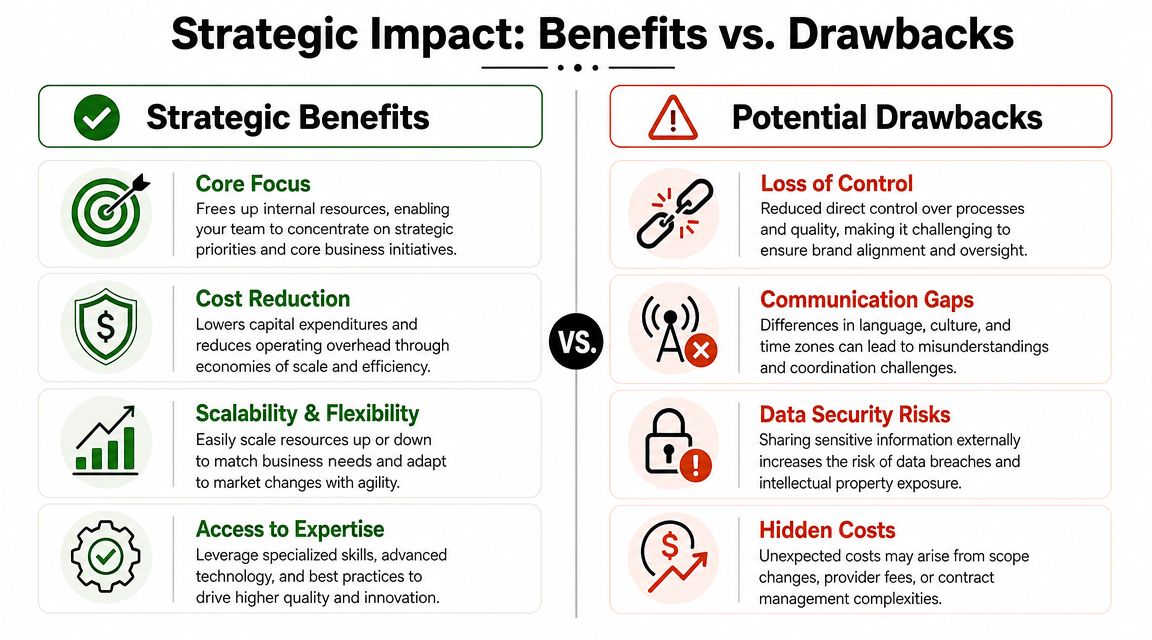
The business case is strong when you need flexibility, faster deployment, specialized operational support, or broader service coverage. It falls apart when you chase the cheapest rate and ignore governance.
Where outsourcing creates real value
The traditional argument is cost reduction, and that still matters. Industry guidance summarized by ShyftOff's 2025 contact center outsourcing guide says traditional outsourcing models can reduce operating expenses by 20% to 30%, while GigCX approaches can deliver savings up to 35%. The same source notes that top outsourced call centers can achieve customer satisfaction scores of 85% to 90% and first-call resolution around 78%, which is highly competitive with internal operations.
That's the important shift. Good outsourcing is no longer just cheaper. It can be operationally strong.
The benefits I'd actually put in a board discussion
- Variable cost structure that reduces the burden of fixed internal overhead
- Faster scaling during campaigns, seasonal spikes, or support surges
- Access to systems and management discipline that many internal teams never fully build
- Extended service windows across time zones and channels
- Leadership focus because your internal team stops getting dragged into frontline firefighting
If you're thinking beyond support and into adjacent revenue functions, this perspective on how teams automate sales team expansion is useful because the same operating logic often applies. Don't force fixed hiring onto work that needs flexible capacity.
The risks leaders underestimate
The downside isn't theoretical. Weak outsourcing decisions can hurt customers fast.
Common failure points include:
- Loss of direct control over how agents represent your brand
- Communication gaps caused by weak training or poor process handoff
- Quality drift when reporting looks fine but customer effort rises
- Security and compliance exposure if controls aren't mature
- False savings when lower rates produce more repeat contacts, escalations, and churn
A cheap vendor can become expensive in a quarter.
The wrong outsourcing partner doesn't just lower service quality. They force your internal team to spend time policing avoidable problems.
My position
Outsource when you need an advantage. Don't outsource to avoid management.
If your internal operation is chaotic, outsourcing won't magically fix that. It will export the chaos. But if you have clear service expectations, defined workflows, and disciplined oversight, outsourcing can improve both cost structure and customer experience.
Calculating the Real Cost and ROI
Most outsourcing decisions get pitched with one seductive number: the agent rate. That number is rarely enough to make a sound decision.
The fundamental question is total cost of ownership. If you don't model that properly, you'll approve a vendor that looks cheap on paper and disappoints in production.
Start with the visible costs
Visible costs are the easy part. They typically include:
- Agent fees whether priced hourly, monthly, or by usage
- Management fees for supervision, QA, training, or account oversight
- Technology charges for telephony, CRM access, ticketing, analytics, or seat licensing
- Facility-related charges if you're using a dedicated operational environment
These are the numbers every vendor wants you to compare. They matter, but they're only the first layer.
Then model the hidden costs
Financial discipline is key. Industry analysis cited by Grand View Research's contact center outsourcing market coverage notes that about 59% of businesses outsource primarily to reduce cost, but also stresses that the lowest hourly rate is not the true goal because ROI must include transition, integration, and management overhead.
Those hidden costs often include:
- Transition work such as migration planning, workflow redesign, and launch support
- Integration effort across CRM, ticketing, telephony, identity access, and reporting
- Knowledge transfer including documentation, agent certification, and QA calibration
- Vendor management time from operations leaders, trainers, IT, compliance, and finance
- Performance leakage from repeat contacts, poor handoffs, unnecessary escalations, or low first-contact resolution
Use a simple ROI framework
I advise leaders to model outsourcing in four buckets.
| Cost bucket | What to include |
|---|---|
| Current internal cost | Labor, supervision, training, software, facilities, recruiting, attrition burden |
| Vendor cost | Recurring service fees, licensing, support, management charges |
| One-time transition cost | Setup, integration, legal review, process redesign, onboarding |
| Quality impact | Rework, escalations, repeat contacts, service failures, customer retention risk |
Once you have those buckets, ask three direct questions:
- Will this lower total operating cost, not just labor cost?
- Will this improve service capacity during growth periods?
- Will this maintain or improve customer outcomes?
If the answer to the third question is unclear, your ROI model is incomplete.
What smart buyers do differently
They run a pilot, define baseline metrics first, and compare like-for-like work. They don't compare an internal senior team against a vendor's entry-level queue and call it savings. They isolate a channel, transaction type, or service segment and evaluate the full operating picture.
That's how you avoid fake ROI.
How to Select the Right Outsourcing Partner
Vendor selection is where most contact center outsourcing failures begin. Not in implementation. Not in pricing. In selection.
A slick sales process can hide weak hiring practices, poor QA discipline, shallow compliance controls, and inadequate frontline management. If you don't test those areas hard, you'll buy a promise instead of an operation.
What you should evaluate first
Weak vendor selection creates hidden performance costs. CustomerServ's guidance on outsourcing risks highlights communication barriers and poor training as drivers of lower CSAT and FCR. That's exactly right. Bad outsourcing decisions usually fail in the daily basics, not the contract language.
Your first screen should focus on five areas:
- Training quality. Ask how agents are trained, certified, refreshed, and coached after launch.
- Quality assurance discipline. Review scorecards, calibration methods, escalation handling, and coaching loops.
- Operational leadership. Meet the people who will run your account, not just the sales team.
- Security and compliance. Verify controls for data access, device policy, recordings, and regulated workflows.
- Reporting maturity. Make sure they can show channel-level, queue-level, and agent-level performance clearly.
The AI question is no longer optional
AI is now part of contact center operations. You don't need a vendor that uses flashy demos. You need one that can deploy automation without breaking customer journeys.
The practical test is simple:
- Can they route simple interactions to automation and hand off cleanly to humans?
- Can they surface useful reporting across voice and digital channels?
- Can they support omnichannel workflows without creating fragmented data?
- Can they explain how AI helps agents work better, not just how it deflects contacts?
If a partner can't answer those questions in plain language, they're not ready.
Use this due diligence checklist
| Evaluation area | What to ask |
|---|---|
| Service capability | Which channels do you run well today, and which do you outsource further? |
| People model | How do you recruit, onboard, and retain agents for this type of work? |
| Performance control | How do you monitor QA, escalation patterns, and coaching outcomes? |
| Tech stack | Which platforms do you support for telephony, CRM, chat, and analytics? |
| Compliance | Which standards can you support, and how do you enforce them operationally? |
| Business continuity | What happens if a site, system, or staffing plan is disrupted? |
| Governance | Who meets with us weekly and monthly, and what decisions happen in each review? |
Ask to see the operating rhythm. Reporting decks, QA forms, training samples, escalation trees, and supervisor workflows tell you more than a sales presentation ever will.
Don't skip the contact step
Before you shortlist anyone, test responsiveness. Reach out with specific operational questions and see how they respond. A provider that can't manage a clear pre-sales conversation usually won't manage a live support program well either. If you're evaluating a seat leasing setup, a direct contact inquiry with Seat Leasing BPO is one way to assess responsiveness, setup scope, and operating fit.
My selection rule
Choose the partner that makes performance visible. Avoid the one that makes everything sound easy.
Implementation Checklist and Measuring Success
The launch phase decides whether outsourcing becomes a performance lever or a recurring headache. Leaders often spend weeks on vendor selection and rush the handoff. That's backwards.
A solid rollout is disciplined, documented, and measurable from day one.
The rollout sequence that works
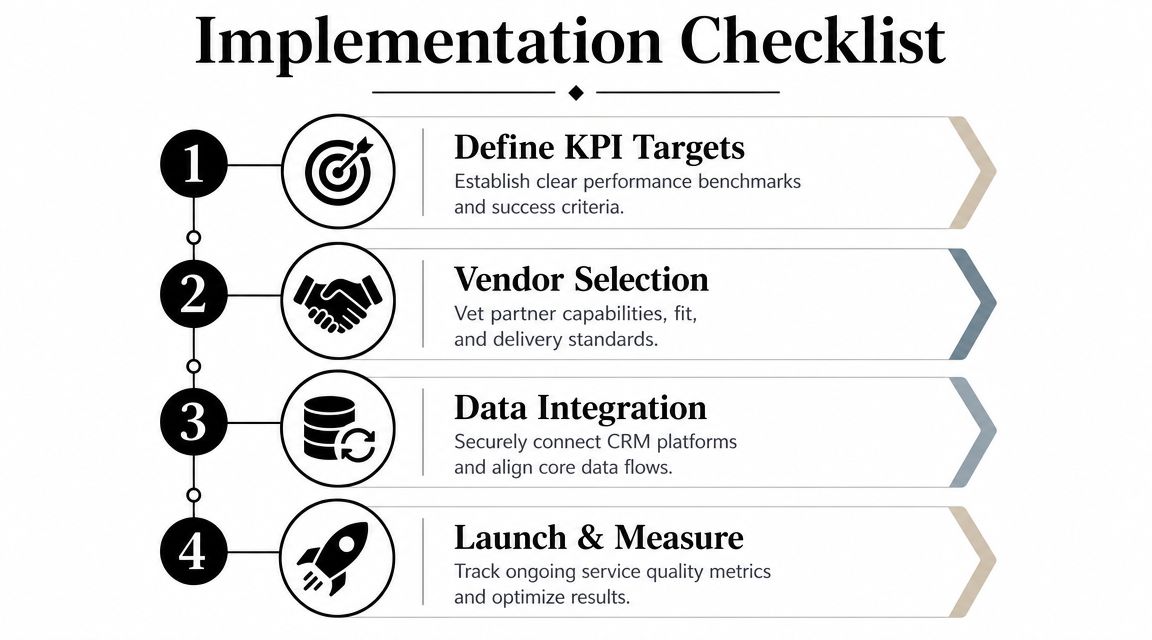
Use a phased launch instead of a hard cutover.
Define KPI baselines
Capture your current service picture before anything moves. Baseline response time, resolution behavior, transfer patterns, complaint themes, and customer satisfaction signals.
Document workflows
Write down call drivers, escalation paths, exception handling, approval rules, and brand language. If your process lives inside a manager's head, it will fail in outsourcing.
Integrate systems carefully
Connect CRM, ticketing, knowledge tools, telephony, and reporting with strict access control. If you're setting up a physical operation, facility readiness also matters. A resource like Building 24 at Seat Leasing BPO helps illustrate the kind of infrastructure environment some teams use when they need a ready-built operating site.
Run training and pilot calibration
Certify agents on product knowledge, customer scenarios, compliance rules, and escalation handling. Then run a pilot. Don't skip calibration.
Measure the right things after go-live
AI is now part of the operating baseline. According to GigaBPO's contact center outsourcing statistics summary, over 60% of outsourced call centers had deployed AI/chatbot solutions by 2024. That means you should evaluate not just agent performance, but also how automation and humans work together across channels.
The metrics that matter most are usually:
- First-call or first-contact resolution to measure whether customers get real answers
- Average handle time to monitor efficiency, but never in isolation
- Customer satisfaction to understand perceived experience
- Escalation rate to spot training or authority gaps
- Backlog and response time across every active channel
- Quality assurance scores tied to process accuracy and brand adherence
What good governance looks like
Use a simple cadence:
- Daily reviews for queue health, staffing issues, and urgent defects
- Weekly reviews for performance trends, training gaps, and workflow friction
- Monthly business reviews for service quality, cost, and improvement priorities
Launch small, inspect heavily, and expand only after the numbers hold.
Outsourcing succeeds when leaders treat it as an actively managed system. The contract starts the relationship. Governance determines whether it pays off.
If you need a faster, lower-risk way to stand up contact center capacity without building your own facility, Seat Leasing BPO is worth evaluating. Its model fits businesses that want ready-to-use infrastructure, lower upfront setup burden, and more direct control than a fully managed BPO arrangement.