Your team is growing, and the kitchen table setup has stopped being charming. Remote worked for a while, then came the missed handoffs, noisy video calls, mailing issues, and the awkward reality that clients still judge you by where and how you work. In New York, that problem gets expensive fast if you solve it the old way.
That’s why businesses keep searching for the best places to work in ny instead of signing a conventional lease right away. They want flexibility, a professional address, reliable internet, meeting rooms that function, and terms that won’t punish them if the team changes size in a quarter. They also want to avoid buying furniture, negotiating with internet vendors, and troubleshooting access control on a Monday morning.
New York gives you plenty of options, but they’re not interchangeable. Some are best for solo operators who need a polished drop-in base. Some work for startups that want recruiting appeal near high-rated employers. Others fit distributed teams that need a practical network across boroughs. And for operators thinking like a COO, the true comparison isn’t just coworking brand versus coworking brand. It’s whether coworking is the right model at all.
1. WeWork (New York City)
A COO usually reaches WeWork after the first few operating headaches show up. One manager is commuting from Brooklyn, another needs to meet clients in Midtown, and a small sales team wants a polished place to land twice a week without committing the company to a full lease. In that situation, coverage often matters more than character.
WeWork’s main advantage in New York is network breadth. A company can give employees access to multiple neighborhoods, which helps with recruiting, client meetings, and hybrid attendance patterns. That flexibility is useful in a labor market with high churn and constant movement between employers, as noted in the New York State Department of Labor job market data.
Where WeWork fits
WeWork is a practical choice for businesses that need speed, geographic spread, and a familiar operating model. It is weaker for teams that need fixed seating, tighter space control, or a cost structure that stays stable once headcount rises.
- Good fit for distributed teams: Staff can work closer to home or closer to clients without the company sourcing separate offices.
- Useful for testing demand: Shorter terms and day-use options help operations teams measure actual attendance before committing to more space.
- Less suitable for sensitive work: Shared lounges and common areas can create privacy, noise, and compliance issues for some functions.
The trade-off is this: WeWork reduces setup work, but it can also introduce policy complexity. Access rules vary by plan, meeting room availability varies by location, and the experience can differ enough from building to building that operators should verify the exact site before rolling it out across a team.
I would use WeWork as a flexible bridge solution or as a satellite network. I would not treat it as the final answer for a 20 to 50 person team that needs consistent seating, stronger oversight, and predictable monthly occupancy planning. At that stage, fully managed seat leasing often gives operations leaders more control than stacking coworking memberships. Teams comparing both models should review providers such as managed seat leasing solutions for growing teams.
Use WeWork if neighborhood access and speed matter most. Skip it if privacy, team consistency, and long-term operating discipline matter more.
Explore locations and plans on WeWork New York City.
2. Industrious (Multiple NYC locations)
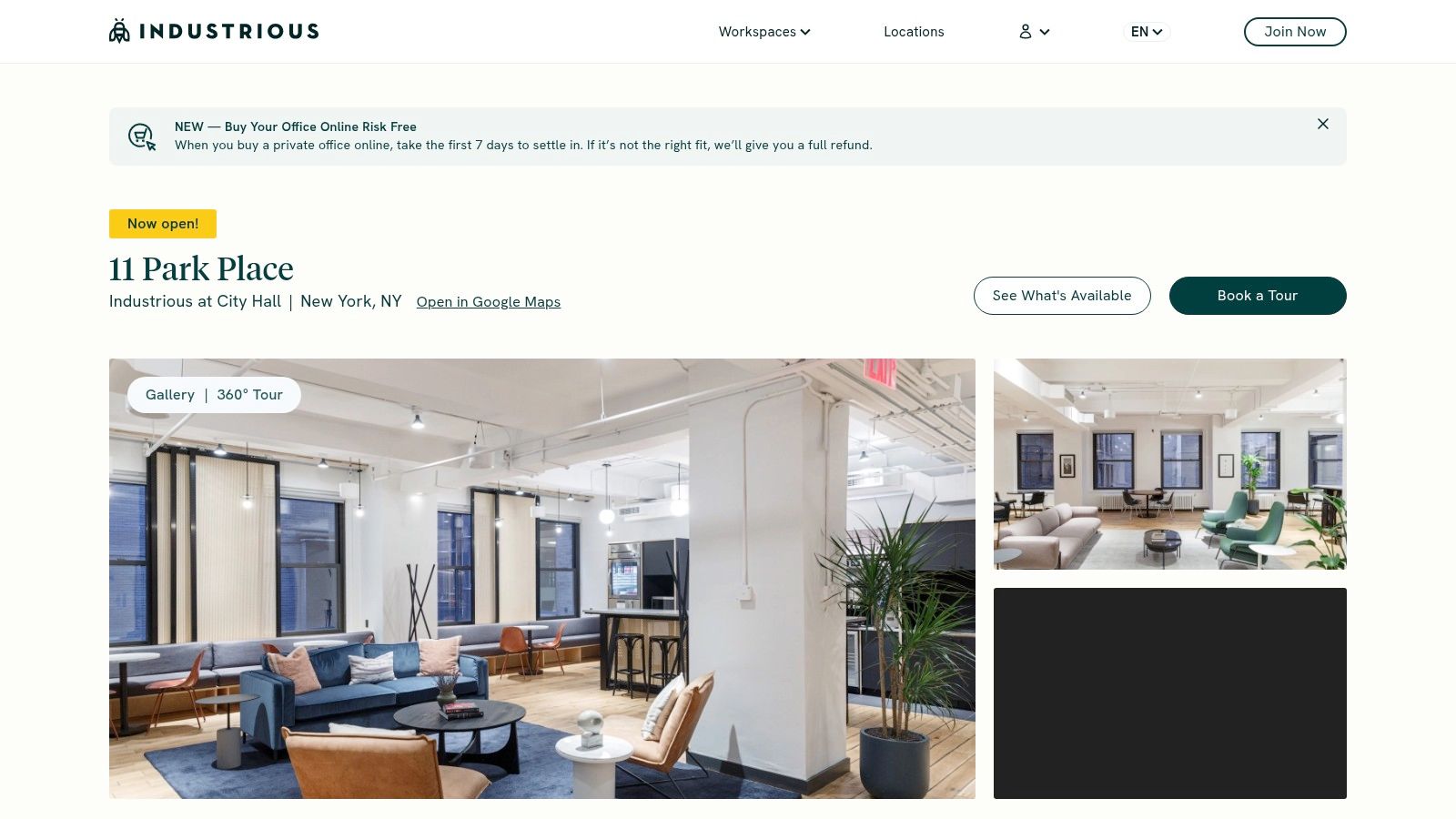
A COO usually notices the difference with Industrious in the first week, not the first tour. Fewer noise complaints. Fewer awkward client meetings in crowded lounges. Less time spent explaining to staff why one location feels polished and another feels improvised.
That operating consistency is the primary appeal. Industrious generally fits companies that want flexibility without the high-traffic feel common in larger coworking networks. In New York, that matters for recruiters, advisory firms, customer success teams, and small executive groups that spend much of the day on calls or in meetings.
Where Industrious fits best
Industrious works best for teams that value a controlled day-to-day environment and are willing to pay more for it.
- Stronger choice for client-facing work: Reception, shared areas, and overall presentation usually support a more professional visitor experience.
- Useful for pilot teams: A company opening a small NYC footprint can test a submarket before committing to a larger private office strategy.
- Better for hybrid leadership teams: Managers who only need several days a week in person often get enough structure without taking on a full lease.
The trade-off is cost discipline. Industrious can make sense for a 5 to 15 person team that needs polish, but it gets harder to justify if the business needs dedicated seats every day, strict privacy controls, or room to standardize processes across a larger headcount. At that point, operators should compare coworking against a managed setup and review what is included in fully managed seat leasing inclusions, especially support staffing, IT scope, and space control.
I also would not buy based on brand alone. Industrious locations vary by building, floorplate, meeting room supply, and how much separation your team gets from common areas. The company highlights its hospitality approach and private office options on Industrious New York locations, but the operational question is simpler. Can this specific site support your workflow without adding scheduling friction?
Quiet space helps teams execute. It also reduces the hidden cost of interruptions.
Use Industrious if your NYC office needs to feel calm, credible, and easy to manage from day one. Skip it if your priority is the lowest seat cost or a more controlled private infrastructure model for a larger team.
3. Spaces (IWG) – Manhattan portfolio
A five-person client-facing team lands in Midtown fast. They need a presentable office next month, not after six months of lease negotiation, furniture procurement, and cabling delays. Spaces fits that brief better than many operators because it gives companies a polished Manhattan address with less setup work than a conventional office and a more contemporary feel than a standard business center.
That positioning matters for a COO evaluating more than aesthetics. Spaces sits in the middle of the market. It can work for startups meeting investors, agencies bringing clients on-site, and distributed teams that need a predictable Manhattan touchdown point a few days a week. The question is not whether it looks good. The question is whether the operating model matches how your team uses space.
Best use case for Spaces
Spaces makes the most sense for companies that want flexible terms and a stronger brand presentation, but do not need heavy customization or tightly controlled infrastructure.
- Good for client-facing teams: Reception areas and shared spaces usually create a better first impression than a bare-bones serviced office.
- Useful for hybrid operations: Teams that rotate in and out can avoid paying for a full traditional footprint before they know their steady-state headcount.
- Less suitable for process-heavy functions: If you run support, recruiting, or production work that depends on fixed seating, call privacy, or standardized room access, site-level variation becomes a real issue.
The IWG network behind Spaces is still an advantage. Operators can use that footprint for short-term expansion, temporary swing space, or access in other parts of the city. I have seen that flexibility help during team growth spurts and office relocations.
The trade-off is pricing clarity and consistency. Some Spaces locations publish more detail than others, and "from" rates rarely reflect the full monthly operating cost once meeting rooms, add-ons, and term length are clear. That is where coworking often loses to a fully managed seat leasing model for larger teams. Once a company needs repeatable seat economics, stronger privacy controls, and support that is set up around one workflow, the premium for design-led coworking becomes harder to defend.
Review the current Manhattan portfolio on Spaces New York locations.
Shortlist Spaces if you need speed, presentation, and moderate flexibility in Manhattan. Push harder on due diligence if your team needs uniform operations across every seat.
4. Regus (IWG) – Citywide network
A COO trying to place 12 people across Manhattan, Downtown Brooklyn, and occasional client meetings usually is not shopping for the most photogenic office. The job is to control occupancy cost, keep commutes workable, and avoid a lease structure that breaks the moment headcount shifts. Regus fits that operating brief better than many trendier coworking brands.
Its advantage is coverage. Regus gives companies more ways to place staff near transit, clients, or recruiting pools without committing to one flagship site. For firms running hybrid schedules, satellite sales teams, interview-heavy recruiting, or temporary project groups, that network matters more than lounge design.
Where Regus makes operational sense
Regus works best for companies that need office access as a utility, not as a brand statement. I would shortlist it for practical use cases where seat flexibility and neighborhood choice carry more value than polished common areas.
- Good for budget modeling: Membership and office options are usually easier to compare against expected usage than design-led coworking packages with heavier amenity premiums.
- Good for distributed teams: A wider spread of locations can reduce commute friction and give managers more options when one neighborhood stops fitting the team.
- Weaker for culture-forward HQ plans: If leadership wants the office to impress candidates or support a strong in-person identity, some Regus sites will feel plain.
That last point matters. Regus is not especially consistent at the site level. One location may work well for focused admin and client calls, while another feels dated or thin on shared-space quality. Operators should treat each center as its own product. Check sound privacy, meeting room availability, after-hours access rules, guest handling, and how mail and front-desk support work before signing.
I also compare Regus against fully managed options when a team needs more standardization. A network membership is helpful, but it does not solve every operations problem. If you need fixed seat counts, cleaner security controls, or support built around one team workflow, a fully managed office setup in Building 24 may produce clearer monthly economics than piecing together coworking add-ons.
Field note: Regus is often the better choice when the office needs to function reliably, open quickly, and stay flexible as headcount changes.
The trade-off is straightforward. You get reach, speed, and practical business infrastructure. You give up some atmosphere, some consistency, and in certain locations, some employee appeal. Browse current options through Regus New York coworking.
5. The Farm SoHo (SoHo, Manhattan)
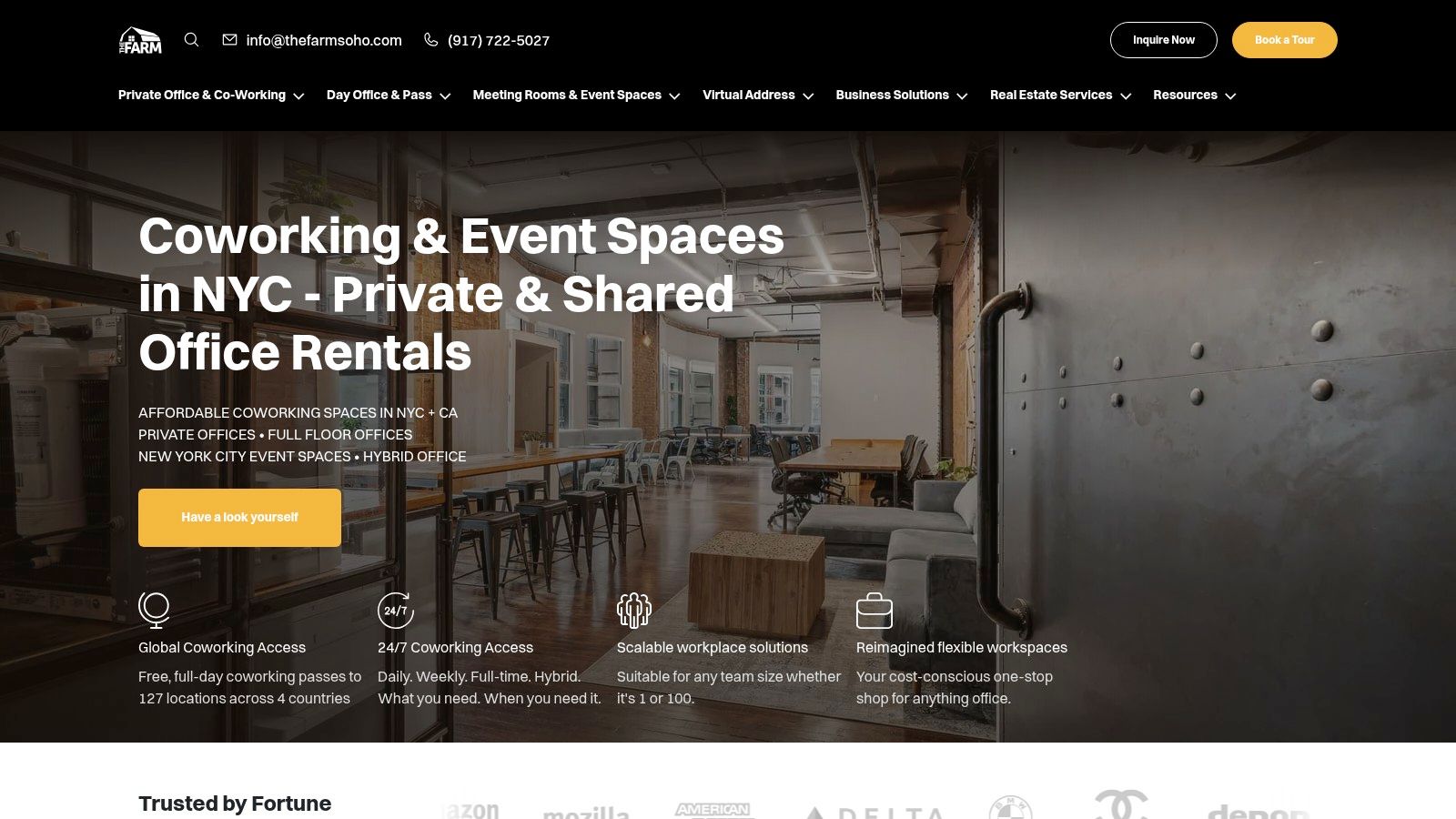
A founder signs for six seats in SoHo because the team wants energy, walkability, and a Manhattan address clients recognize. Three months later, the fundamental question is not whether the space looks good. It is whether the setup still works when hiring speeds up, call volume rises, and two private rooms are no longer enough. That is the right way to evaluate The Farm SoHo.
The Farm SoHo works best for small teams that want a distinct Manhattan location without the complexity of a large coworking network. From an operations standpoint, the appeal is clear. The product is easier to understand, the environment feels more personal, and a team that already lives downtown may not need access across the city.
Where The Farm makes sense
For early-stage companies, agencies, and project teams, The Farm can be a practical entry point into SoHo. It gives you a recognizable neighborhood, a more character-driven setting than many chain operators, and a lower-friction way to test whether regular in-person work is being used.
That matters for COOs watching office spend. Paying for one well-used site is often smarter than buying network access your team barely touches.
- Best for small downtown teams: If leadership, clients, and employees already cluster below Midtown, one SoHo location can cover the need.
- Useful for short planning horizons: Teams still testing headcount or hybrid attendance usually benefit from a simpler commitment structure.
- Less suited to larger operating teams: Once you need consistent meeting room access, heavier admin support, or room to expand quickly, boutique capacity becomes a real constraint.
The trade-off is scale. A smaller operator can deliver a better atmosphere and a more intentional member experience, but it usually gives you less overflow capacity, less policy standardization, and fewer fallback options if the team changes fast. That is manageable for a six-person product team. It is harder for a 25-seat support function or a BPO group that needs predictable utilization every day.
I usually place The Farm in the "good for now" category rather than the "build around it for three years" category. If the office is mainly for collaboration days, founder meetings, or creative work, it can be a strong fit. If the office also needs to support hiring bursts, tighter security controls, or fixed departmental seating, a fully managed office setup in Building 24 will often give operations leaders clearer control over cost and workflow.
Check current options at The Farm SoHo.
6. The Yard (Multiple NYC neighborhoods)
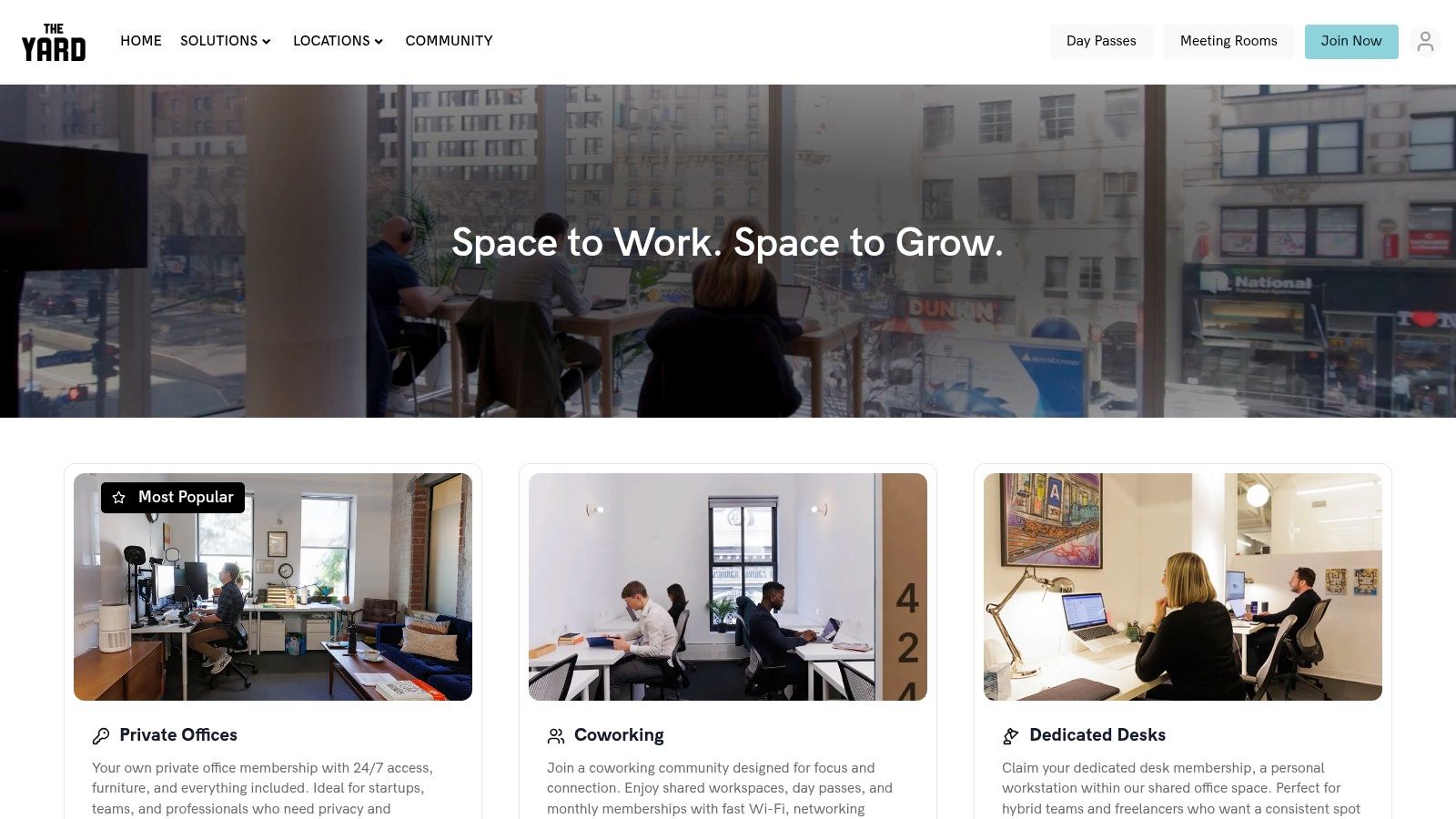
The Yard sits in a useful middle ground. It has more character than the big national chains, but it’s still structured enough for companies that need an actual workplace rather than a coffee-shop upgrade. Teams that care about neighborhood identity usually respond well to it.
That matters because New York isn’t one office market. Flatiron, Herald Square, the Lower East Side, and Brooklyn all shape workdays differently. The Yard’s model acknowledges that better than some larger operators do.
A better fit for culture-minded teams
The Yard can work well for small teams that want a space employees enjoy coming into. It’s also appealing to founders who see office choice as part of brand and hiring strategy.
A broader workplace trend supports that positioning. In the City & State 2025 Top Workplaces overview, recent reporting points to rising worker interest in community impact, with 42% of New York workers prioritizing that factor. That doesn’t make The Yard a mission-driven employer list, but it does reinforce the shift toward workplaces that feel local, intentional, and human.
Teams often tolerate bland space. They rarely feel attached to it.
The main drawback is pricing transparency. If you’re running procurement seriously, quote-based models slow down comparison work. And if your people need broad city access, a smaller network can become limiting faster than expected.
Still, for founders who want less corporate sameness and more neighborhood texture, The Yard is often one of the more compelling entries among the best places to work in ny.
See locations at The Yard coworking.
7. Carr Workplaces – Central Park (Fifth Avenue) and Westchester
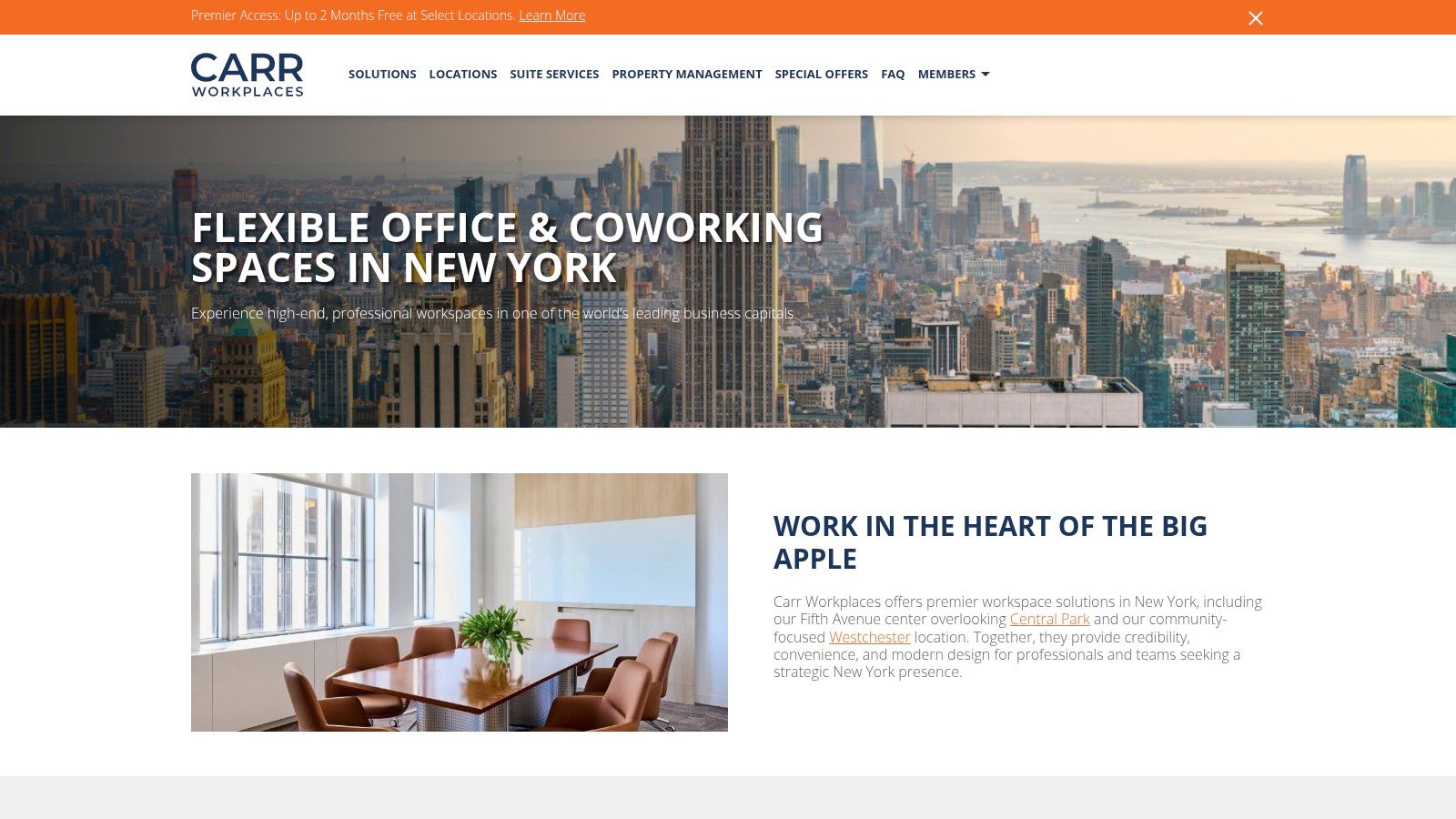
A COO usually feels the difference between coworking and business-center space in the first month, not the first tour. The question is rarely whether the lounge looks good. It is whether reception can handle guests properly, mail gets processed without errors, meeting rooms support client work, and the office projects the right signal to customers and recruits.
Carr Workplaces sits on the more traditional end of the spectrum. The Fifth Avenue location gives teams a high-credibility Manhattan address near Central Park, while Westchester offers an option for companies that want professional office infrastructure closer to suburban talent. That split is useful for firms balancing client-facing presence in the city with commute practicality for leadership, support staff, or hybrid teams.
This is usually a stronger fit for legal services, advisory firms, finance, family offices, and executive-led teams than for startup groups chasing community events or founder buzz. Carr sells reliability and business support. For some operators, that matters more than social energy.
Where Carr fits operationally
Carr is easier to justify when the office needs to function as part of service delivery, not just a place to sit.
- Good fit for client-facing teams: Staffed reception, meeting support, and a more formal atmosphere help when visitors are part of the workday.
- Useful for hybrid executive teams: Fifth Avenue can serve as the flagship address, while Westchester may reduce commute strain for part of the team.
- Stronger for structured operations: Virtual office services, mail handling, and administrative support can reduce the need to patch together vendors.
- Less suited to culture-led startups: Teams that want heavy member programming or a casual creative tone may find it too restrained.
The trade-off is straightforward. Carr often makes more sense for companies that value polish, privacy, and front-desk support than for teams optimizing purely for cost per seat. If the office is a brand asset and an operating tool, the premium can be justified. If the office is mainly touchdown space for a distributed team, broader-network coworking or fully managed seat leasing may pencil out better.
I’d shortlist Carr when leadership wants a professional address, predictable service standards, and less day-to-day office friction. I’d push it lower on the list for fast-moving startups, BPO teams that need aggressive seat economics, or companies that expect frequent scaling across multiple neighborhoods.
Review the centers at Carr Workplaces New York.
Top 7 NYC Workspaces Comparison
| Workspace | 🔄 Implementation complexity | ⚡ Resource requirements | 📊 Expected outcomes | 💡 Ideal use cases | ⭐ Key advantages |
|---|---|---|---|---|---|
| WeWork (New York City) | Low, easy sign-up, day passes & month-to-month options | Moderate, pay-per-day or membership; prices vary by site | Consistent amenities and broad city access; good for flexible drop-ins | Distributed teams, travelers, short-term trials | Wide NYC footprint; standardized amenities; global network |
| Industrious (Multiple NYC locations) | Medium, bookable day passes, site-specific policies | High, premium membership and private office pricing | Quiet, service-led environment that supports focused work | Clients needing professional, hospitality-grade spaces | Strong service, acoustics, consistent high quality |
| Spaces (IWG) – Manhattan portfolio | Medium, app bookings; membership variations by center | Moderate–High, design-forward fitouts; variable pricing | Stylish, brand-forward spaces with IWG reciprocity | Brand-conscious startups; teams wanting Midtown presence | Design aesthetic; café amenities; access to IWG network |
| Regus (IWG) – Citywide network | Low, standardized plans and transparent “from” pricing | Low–Moderate, flexible access plans (5/10/unlimited days) | Pragmatic, predictable business-grade workspace across NYC | Budget-conscious distributed teams needing predictability | Large city coverage; clear cost structure; business services |
| The Farm SoHo (SoHo, Manhattan) | Low, simple online purchase flow and pass bundles | Low, competitive day-pass and bundle pricing; 24/7 options | Affordable solo/small-team workspace with event capacity | Freelancers, small teams seeking low-cost Manhattan base | Very competitive pricing; 24/7 access; SoHo location |
| The Yard (Multiple NYC neighborhoods) | Medium, boutique onboarding; quotes per location | Moderate, location-dependent pricing; smaller network | Neighborhood-focused, curated spaces with local programming | Teams valuing community, aesthetics, and local events | Boutique feel; curated design; clear upgrade path |
| Carr Workplaces – Central Park & Westchester | Medium, business-center setup with tiered plans | Moderate–High, published plan tiers and staffed services | Traditional, service-heavy office experience with clear tiers | Businesses needing staffed reception, mail, virtual offices | Prestigious addresses; staffed support; transparent tiers |
The Smarter Alternative: Beyond Coworking
Coworking solves one problem well. It removes the burden of a long lease and gets you into space quickly. But once a company starts hiring steadily, handling client data, or coordinating a larger operations team, the cracks show up fast. Noise becomes a recurring issue, branding is limited, room access gets inconsistent, and the monthly bill can move around more than finance likes.
That’s where fully managed seat leasing becomes a different category, not just another workspace option. Seat Leasing BPO positions itself around private, ready-to-use offices with backend support already handled, and the company states businesses can achieve up to 80% cost savings compared with traditional office arrangements through its managed model. For operators, the appeal isn’t only lower cost. It’s fewer moving parts.
The practical difference is responsibility. In a standard coworking setup, your company still spends time managing internet expectations, security questions, layout compromises, onboarding logistics, and vendor coordination. In a managed seat leasing setup, one provider handles location sourcing, setup, IT infrastructure, cybersecurity, connectivity, and core backend support. That shifts the office from a side project back into an operating asset.
This matters even more in New York, where top employers attract talent with flexibility, stronger workplace standards, and better overall experience. If you’re competing for staff, your office needs to help, not create friction. Sometimes that means a coworking pass. More often, once headcount and client requirements rise, it means a private environment that your team can count on every day.
I’d look at coworking as a bridge, not the destination, unless your team is very small or highly mobile. If your operation is stabilizing, the better question isn’t which lounge has the nicest coffee bar. It’s which model gives you privacy, speed, support, and cost control without turning office management into another department.
And if you’re outfitting that private space, it’s also worth finding ergonomic office chairs early, before discomfort turns into a retention issue.
If you’re weighing coworking against a more scalable office model, Seat Leasing BPO is worth a serious look. It’s built for companies that want a professional New York base without the capital expense, setup burden, and long-term rigidity of a traditional lease.