A Manila hiring budget can swing from minimum-wage economics to premium-skill economics in one city. In Metro Manila, the daily minimum wage for non-agricultural workers is ₱695 per day, or about ₱15,290 per month, while skilled professionals in high-demand sectors such as BPO can earn ₱45,000 to ₱60,000 per month according to Playroll’s Philippines salary guide. That spread is why the average salary in manila philippines is a strategic question, not a trivia question.
International employers often make the same mistake. They grab one headline figure, convert it to their home currency, and assume they have a budget. That approach breaks down fast in Manila, where pay levels vary sharply by industry, role complexity, and the full cost of employment.
A smarter approach starts with salary bands, then layers in statutory costs, workforce planning, and operating model. For startups, SMBs, and BPO operators, the key advantage in Manila isn’t just lower payroll than Western markets. It’s the ability to match strong local talent with a lean operating setup, so more budget goes to people and less to fixed overhead.
Why Manila Is a Global Hiring Hotspot in 2026
A Manila hiring plan can span entry-level wage floors and premium knowledge-work salary bands within the same city. That range matters because it gives employers more than a low-cost destination. It gives them room to build mixed teams, place routine work and specialized work in one market, and adjust hiring pace without changing countries.

Manila combines cost discipline with talent density
Manila stands out because the labor market is already built for business services. International firms are not entering an immature hiring market. They are hiring in a city with established BPO operations, finance support teams, back-office functions, and client-facing service roles. That history lowers execution risk for employers that need repeatable hiring, supervisor-ready talent pools, and managers familiar with offshore delivery standards.
The concentration of business districts also matters. Companies that need faster launch times often choose managed environments in Metro Manila office hubs because the operating setup affects recruitment reach, attendance reliability, and how quickly a new team can start producing work.
For startups and SMBs, this creates a budgeting advantage. Salary is only one line item. The better question is how to control full operating cost while keeping access to the right labor pool.
The useful question is total employment cost
A city becomes attractive for hiring when compensation and operating structure work together. Employers that budget well in Manila usually start with role-based salary bands, then add statutory contributions, equipment, management overhead, and workspace costs. That is the practical difference between payroll planning and total employee compensation.
This is also why Manila fits flexible models better than many competing cities. A company can enter the market with a smaller upfront commitment, test a support or finance function, and scale after performance is proven. Seat leasing and other managed delivery setups are not just real-estate decisions. They are budget controls that reduce fixed overhead while preserving access to dense urban talent.
Manila rewards role-cluster planning
The city is strongest for employers hiring by function, not by one headline salary figure. Customer support, accounting support, operations, and IT-enabled service roles draw from overlapping but distinct talent pools. A hiring plan works best when those pools are budgeted separately and tied to output expectations.
Analyst view: Manila is a strong hiring market in 2026 because it combines workforce depth, operational familiarity, and flexible setup options. Employers get the best results when they treat salary as one part of a broader cost model, not the whole model.
Understanding the Average Salary in Manila
Salary figures in Manila can differ by more than twofold depending on role family, seniority, and employer type. That spread is why the phrase average salary in manila philippines has limited value for hiring decisions. It gives a rough market reference, but it does not tell an employer what it will take to recruit a finance supervisor, retain a support lead, or staff a small analytics team at acceptable margin.
A second problem is measurement. Some figures refer to national medians. Others reflect urban professional salaries. Others still capture only specific sectors. Manila compresses these into one headline number, which makes the average easy to quote and hard to use.
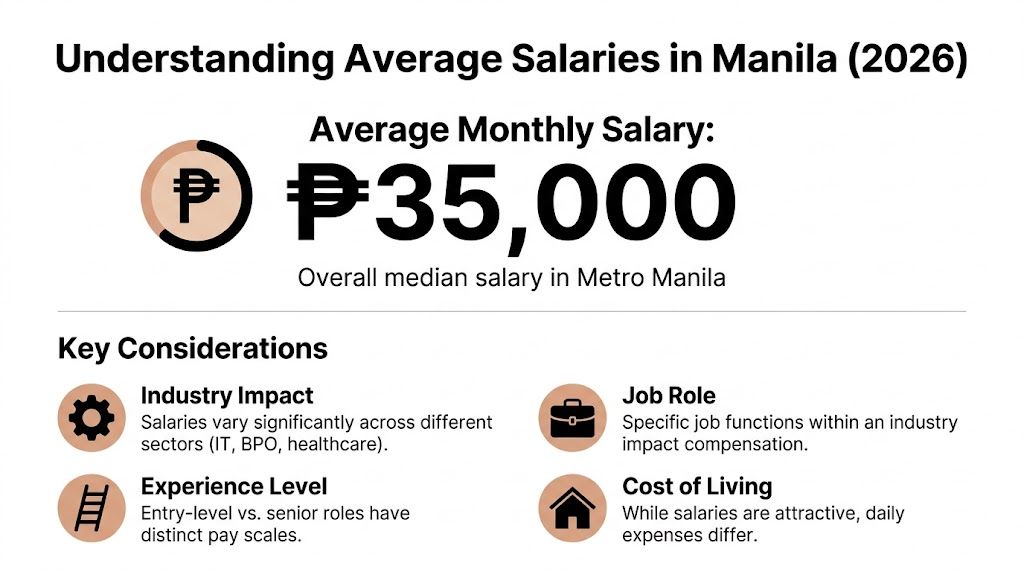
Why one average misleads employers
For budgeting, Manila functions as several labor markets at once.
Entry-level administrative roles, customer support positions, accounting staff, and software-adjacent jobs follow different pricing logic. Some are influenced heavily by local supply. Others are pushed upward by international demand, night-shift requirements, compliance exposure, or communication standards tied to client-facing work. Two candidates can sit in the same city and still command very different compensation because they reduce different business risks.
Three filters matter more than a citywide average:
- Industry demand: Compensation moves fastest where offshore demand is concentrated, especially in BPO, tech-enabled support, and finance operations.
- Role design: Broad support jobs price differently from specialist, regulated, or revenue-linked roles.
- Seniority: Experienced hires often cost more upfront but can lower training time, oversight needs, and error rates.
Average salary is only the first line in the budget model
International employers often focus too narrowly on cash salary. The more useful planning unit is total employer cost, because taxes, statutory contributions, equipment, supervision, and workspace decisions can materially change the actual monthly spend. If you need a practical reference point, Benely’s explanation of total employee compensation is a helpful starting framework.
This is also where operating model matters. A fully independent entity, a managed team setup, and a seat leasing arrangement produce very different cost structures even when base salaries are similar. Companies comparing Manila against other hiring markets should test salary bands alongside delivery setup, not in isolation. For smaller firms building first teams, the difference can determine whether expansion stays within budget. Practical examples of these operating choices are covered in seat leasing and offshore team planning resources.
What employers should do with the number
Use the city average as a reference point, then move quickly to a role-based view.
A sound budgeting sequence looks like this:
- Set a broad Manila market baseline.
- Price the specific function, not the city as a whole.
- Adjust for seniority, shift, and communication requirements.
- Convert salary into full employer cost under your planned operating model.
That approach reduces two common mistakes. One is paying premium-market rates for routine roles because the benchmark came from a high-demand talent segment. The other is underfunding business-critical hires because the budget was anchored to a broad average that ignored skill scarcity and delivery risk.
A city average provides general orientation. Effective hiring in Manila depends on role-level compensation, full employment cost, and a setup model that fits the scale of the business.
Salary Breakdowns by Top Industries and Roles
Role-level salary variance in Manila is wide enough to break a hiring budget if employers rely on a citywide average. A customer support hire, a GL accountant, and an IT-BPO specialist operate in different labor markets, compete with different employers, and require different compensation assumptions.
Published salary guides are still useful for first-pass planning. They are most useful when treated as directional inputs, then converted into total employment cost under the operating model you plan to use.
A practical salary table for hiring plans
The table below is for budget planning. It does not replace live recruiter calibration or candidate pipeline data. Where the source set supports a specific range, the number is shown. Where it does not, the table stays descriptive rather than pretending to offer precision.
| Role | Industry | Entry-Level (1-3 Yrs) | Mid-Level (4-7 Yrs) | Senior (8+ Yrs) |
|---|---|---|---|---|
| BPO Skilled Employee | BPO | Market varies within the broader BPO average | Average monthly pay sits in the upper-20k range | Can exceed the average depending on leadership scope |
| IT-BPO Hybrid Specialist | IT-BPO | Often below specialist bands for experienced hires | Commonly priced well above standard support roles | Can rise materially with systems, data, or platform specialization |
| Skilled Professional | BPO / Tech / Finance | Often below premium Manila skilled bands | ₱45,000-₱60,000 | ₱45,000-₱60,000 and above for advanced roles |
| Accountant | Finance / Accounting | ₱22,000 | Within the broader ₱22,000-₱60,000 range | Up to ₱60,000 |
| Finance Manager | Finance | Not typically an entry role | ₱80,000-₱110,000 | ₱80,000-₱110,000 |
| IT-BPO Role | IT | Can sit below specialist averages depending on skill depth | Commonly above generic support compensation | Can rise further based on technical scope |
How to read the table correctly
A salary table only helps if the reader respects the quality of the underlying evidence. Some Manila roles have well-published ranges. Others appear in broader industry averages or mixed job families, which makes exact seniority splits less reliable.
That matters for budgeting. A company that forces neat salary ladders from weak market data usually creates two problems. It overpays routine roles or underfunds hard-to-fill ones. Both errors show up later as offer declines, long time-to-fill, or margin pressure after hiring starts.
For live market checks, recruiting and finance teams often combine published salary guides with recruiter feedback and best salary benchmarking tools that compare current openings, role titles, and compensation patterns across sources.
What each industry signal means for budgeting
BPO
BPO remains the easiest entry point for international firms building a Manila team. Compensation for skilled delivery roles is typically far below equivalent hiring costs in the US, UK, or Australia, but the bigger point is operational fit. Manila offers scale in customer operations, back-office processing, and shared services, where English fluency, process discipline, and schedule coverage affect performance alongside labor cost.
For startups and SMBs, this is often the first place where salary planning should connect to setup planning. A support team that looks affordable on gross pay can become much more expensive once workspace, equipment, payroll administration, and local management are added. That is why many smaller firms use Manila seat leasing and offshore team planning resources before locking a hiring budget.
IT and IT-BPO hybrid roles
Compensation rises quickly once the job moves from standardized support into technical execution. Systems support, data operations, platform administration, reporting, and software-adjacent work draw from a tighter talent pool than voice or back-office hiring.
This has a direct budgeting implication. If the job description mixes customer support tasks with technical troubleshooting, the role should not be priced like a standard BPO seat. Employers that miss this distinction usually discover it during offer stage, when candidate expectations come in above plan.
Finance and accounting
Finance hiring in Manila is broader than AP and basic bookkeeping. The market supports transactional work, controllership support, and experienced finance management, which gives international businesses room to build layered teams instead of outsourcing only entry-level processing.
The practical takeaway is simple. Department labels are weak budgeting tools. "Operations" can mean customer support, financial processing, workforce coordination, or technical administration. Each category carries a different salary band, different hiring risk, and different total cost once benefits, compliance, and delivery setup are included.
Hiring rule: Budget around the work being done, not the department name.
Decoding the Filipino Payslip Gross vs Net Pay
Understanding the gap between gross salary, employee net pay, and total employer cost is central to hiring in Manila. A role can look competitive in the offer letter and still miss the mark if the employee focuses on take-home pay while finance budgets only for base salary.

Gross pay is the headline number
Gross pay is the contractual salary before deductions. It is the figure candidates compare across employers, and it is usually the number hiring managers use when benchmarking roles against the market.
That makes gross pay useful for offer design. It is only the first layer of the budget.
Net pay is what the employee actually feels
Net pay is the amount the employee receives after standard deductions. In the Philippines, that usually includes SSS, PhilHealth, Pag-IBIG, and withholding tax. Those deductions shape how an offer is perceived, especially when two employers advertise similar gross salaries but produce different take-home outcomes.
For international businesses, this creates a practical budgeting issue. Candidate acceptance often depends on net pay logic, while internal approval usually starts with gross pay logic. If those two views are not aligned, offer-stage friction increases.
Employer cost sits above both
The employer’s actual payroll cost is higher than the salary shown in the contract because statutory contributions and required benefits sit on top of base pay. Annual obligations such as 13th-month pay also need to be included in any realistic labor model.
This is one reason Manila hiring plans fail at the spreadsheet stage. A company prices the role correctly on salary benchmarking, then underestimates the full employment cost once compliance and recurring obligations are added. For startups and SMBs, that gap can be large enough to delay hiring or force a lower-quality role design.
Why this matters for 2026 planning
Contribution schedules, wage pressure, and compliance costs do not stay fixed. Even if your target gross salary remains within market range, your all-in cost can still rise over the life of the hire.
That has a direct implication for budgeting. Manila salary planning works better when employers model compensation as a range rather than a single static figure. The more constrained the budget, the more useful it becomes to compare direct hiring against flexible operating models such as seat leasing, where workspace, facilities, and some delivery overhead are packaged more predictably.
A practical way to model a Manila payslip budget
Use four layers:
- Base salary: The monthly gross pay attached to the role.
- Employer on-costs: Statutory contributions and other compliance-related obligations.
- Employee deductions: Amounts that reduce take-home pay and influence offer acceptance.
- Annualized compensation items: 13th-month pay and any recurring benefits that affect the true yearly cost.
Employees judge fairness through net pay. Finance teams judge sustainability through total employer cost. Sound Manila hiring plans account for both before the offer is issued, not after.
Cost of Living in Manila vs Salary Expectations
A Manila offer succeeds or fails on purchasing power. The same gross salary can feel competitive, marginal, or unsustainable depending on housing location, commute pattern, family obligations, and the employee’s after-deduction pay.
That is why citywide averages have limited value on their own. Employers need to test whether a role can support a stable local standard of living for the target talent tier. For specialist and experienced roles, candidates usually assess offers through practical budget items such as rent, transport, food, family support, healthcare, and monthly savings capacity.
A role’s appeal in Manila is determined by its ability to support a stable local lifestyle, rather than by its equivalent value in a Western currency. That framing leads to better hiring decisions, especially for overseas companies benchmarking in USD or AUD. A package that looks modest after conversion can still be competitive locally if it gives the employee predictability, shorter commute options, and room to save.
What this means for employers
Offer quality is often decided by the full employment proposition, not base pay alone. Two companies can sit close on salary and still see different hiring outcomes. The employer with clearer schedules, reliable benefits administration, and a lower-friction work arrangement will usually have the stronger position.
This has a budgeting implication. Manila’s value lies in its suitability for building effective teams, a key factor for budget planning. If your hiring model depends on employees absorbing long commutes, unstable shifts, or higher out-of-pocket costs, salary pressure rises quickly because candidates will price those tradeoffs into the offer.
For startups and SMBs, operating design affects compensation pressure more than many first-time entrants expect. A well-structured package paired with a practical workplace model can improve retention without forcing base salary to the top of the market. Companies comparing direct office setup against managed operations should review what is typically bundled in seat leasing inclusions for Manila teams before finalizing salary budgets.
Manila compared with other Southeast Asian hubs
Manila remains attractive because labor economics and operating depth work together. International employers are not only buying wage arbitrage. They are buying access to an established services ecosystem, a large English-capable talent pool, and management familiarity with offshore delivery.
Kuala Lumpur and Ho Chi Minh City remain credible alternatives. Manila tends to perform well where the role requires customer interaction, process adherence, and close coordination with overseas stakeholders. The comparison should therefore focus on role fit, ramp speed, and retention economics, not on headline salary alone.
Cost differences across regional hubs also vary by function. A company hiring support, finance, and IT coordination roles may find Manila financially efficient even if some living-cost categories are not the lowest in Southeast Asia. What matters is whether the package clears the employee’s real monthly threshold and still leaves room for employer margin.
Competitive compensation is the package that secures dependable performance and retention at a sustainable total cost.
A useful test for offer quality
Ask three questions before finalizing pay:
- Is the salary aligned to the local market for this role and experience level?
- Can the employee maintain a stable Manila lifestyle on the expected net pay?
- Does the wider operating model reduce friction enough to support retention without overpaying?
If any answer is unclear, the budget model needs revision. A salary can sit above entry-level norms and still fail to attract a specialist. It can also remain cost-efficient for the employer while staying competitive in Manila if the package reflects how people live and work in the city.
Budgeting for Your Manila Team The Seat Leasing Advantage
Most companies under-estimate office overhead and over-focus on salary. That’s understandable because salary is easy to compare. Office setup, IT infrastructure, connectivity, utilities, and business continuity costs are harder to see early. They still hit the budget.
The operating model becomes a financial decision, rather than solely a facilities decision. Verified market data notes that managed workspace models can reduce capital expenditure by up to 80% compared with traditional setups, especially when IT and connectivity are bundled into the service model, as reflected in the salary and seat-leasing context cited by Playroll.

Build the budget in the right order
A practical Manila team budget usually works better in this sequence:
Role mix first
Decide what you’re hiring. Support, finance, and IT-adjacent roles should be modeled separately.Salary bands second
Set realistic ranges based on role complexity, not a citywide average.Employment cost third
Add statutory and package-related cost on top of base salary.Workspace and operating cost last
Choose the delivery model that preserves flexibility.
This order matters because fixed overhead can distort hiring decisions. A company that commits too early to a conventional office often ends up shrinking the talent budget to make the occupancy budget work.
Why seat leasing changes the math
Seat leasing is often misunderstood as just renting desks. In practice, it’s a budget control mechanism. It shifts several setup and operations costs away from upfront capital commitments and into a more flexible operating structure.
That matters most for startups, project-based teams, and growing BPO programs. Instead of funding a full office launch, employers can move faster and keep more capital available for salaries, retention, and management.
Managed workspace arrangements are especially valuable when they include essentials such as internet, electricity, IT support, and security under one operating model. A bundled setup like the service inclusions commonly outlined in managed seat leasing packages can make labor budgeting more predictable because fewer surprise costs sit outside payroll.
Where employers usually waste money
The most common budgeting mistakes are operational, not salary-related:
- Overbuilding too early: Leasing more space than the first hiring wave needs.
- Separating payroll from facilities planning: This creates false savings on one side and overruns on the other.
- Ignoring speed-to-launch: Delayed setup can cost more than a slightly higher monthly operating rate.
- Underfunding resilience: Connectivity, IT support, and security aren’t optional for delivery teams.
A lean operating model doesn’t just cut cost. It protects hiring quality. When office infrastructure is already working, management can concentrate on recruiting and output instead of setup problems.
Practical rule: If a lower-overhead workspace model lets you raise salary quality for critical hires, that’s usually the better use of capital.
Frequently Asked Questions About Manila Salaries
Is there one reliable number for the average salary in manila philippines
No. There are useful benchmarks, but no single figure is enough for budgeting. Manila has wide variation between minimum-wage roles, mainstream professional roles, and premium skill categories. Use role-specific data instead of one citywide average.
Do employers need to budget beyond base salary
Yes. Base salary is only part of total employment cost. Employers should account for statutory contributions, payroll administration, and annual obligations such as 13th-month pay. Candidate acceptance also depends on what the package looks like after deductions, not just on the gross figure in the offer.
Is 13th-month pay mandatory in the Philippines
Yes. It’s a standard legal requirement for eligible private-sector employees and should be included in annual payroll planning. Even if you discuss pay in monthly terms, internal budgeting should treat 13th-month pay as a routine cost, not an exception.
How much extra should employers expect on top of salary
The verified Manila salary data indicates that mandatory benefits can add 15 to 30 percent to base pay in relevant hiring contexts, as noted earlier from the cited market data. The exact impact depends on salary level and package structure, so employers should model each role individually rather than apply one flat assumption to every hire.
Should salaries be paid in pesos or foreign currency
For locally employed staff in the Philippines, employers typically structure compensation in Philippine pesos for payroll clarity and local compliance. Some firms may reference foreign-currency budgets internally, but the employee-facing pay structure is generally easier to manage in local currency.
Are Manila salaries still attractive if wage levels keep rising
Yes, if you budget properly. Wage growth doesn’t erase Manila’s value. It means employers need stronger workforce planning, cleaner salary bands, and more disciplined operating models. Companies that pair market-rate hiring with flexible workspace costs usually protect margin better than companies that optimize only one side of the equation.
If you're planning a Manila team and want a faster, lower-overhead operating model, Seat Leasing BPO offers a practical way to launch without the burden of a traditional office buildout. For startups, SMBs, and BPO operators, that can free up more budget for the part that matters most: hiring and retaining the right people.