Monday starts with good intentions. By Tuesday afternoon, you're answering support emails, chasing invoices, resetting passwords, checking internet issues, reviewing applicants, and trying to remember when you last worked on sales, product, or strategy.
That pattern is common in startups, small businesses, and lean teams. The founder becomes the operator of everything. The manager becomes the backup for every broken process. A freelancer who wanted flexibility ends up running a mini company without the systems of one.
Outsourcing enters the conversation at exactly that moment. Not because the business is failing, but because the business is doing too much inside one small team.
The problem is that many people hear "outsourcing" and think only of cutting costs or handing work to a distant vendor. That's too narrow. The central question is whether a business should keep building every function itself, or whether some work is better handled by a specialist, a partner, or a flexible operating model that gives the team room to grow.
That makes the advantages and disadvantages of outsourcing worth understanding in practical terms. Not as theory. As an operating decision.
Is Your Business Drowning in 'Doing'?
A founder launches a service business with three people. At first, the setup works. Everyone pitches in. One person sells, one delivers, one handles admin, and the founder fills every gap.
Then work picks up.
Customer messages arrive faster than the team can answer them. New staff need laptops, access, and a desk. Payroll gets messy. Technical issues interrupt the day. The founder starts spending mornings solving office and IT problems, then tries to do growth work after hours.

This is the "do-it-all" trap. It doesn't look dramatic from the outside. Revenue may still be coming in. Clients may still be happy enough. But inside the company, leaders are spending their best hours on work that doesn't move the business forward.
Why smart owners look outside the business
Most companies don't outsource because they're lazy. They outsource because they hit an operational ceiling.
A useful analogy is home renovation. If your sink breaks, you could watch videos, buy tools, and spend the weekend guessing. Or you could hire a plumber who already has the tools, training, and routine to solve that problem quickly. Business works the same way. Some tasks are worth owning directly. Others are worth assigning to people who do them all day.
Practical rule: If a task is critical but not differentiating, it may be a strong outsourcing candidate.
That distinction matters. Your brand strategy, product vision, and customer relationships may belong close to home. But payroll administration, help desk support, data entry, office setup, or routine IT maintenance often don't need to live inside your core team.
The decision isn't just about saving money
New entrepreneurs often ask, "Should I outsource this because it's cheaper?" That's the wrong first question.
A better set of questions looks like this:
- What work keeps pulling my team away from growth?
- Which tasks require expertise we don't have in-house?
- Where are delays, errors, or burnout starting to show up?
- What would happen if we could deploy support faster instead of building everything from scratch?
Those questions lead to a more useful view of outsourcing. It's not a shortcut. It's a way to redesign how the business operates so leaders can spend less time managing friction and more time building momentum.
Decoding Outsourcing From A to BPO
Outsourcing means hiring an external partner to handle a function, process, or capability that your business chooses not to run fully in-house. The simplest way to understand it is through a building analogy.
If you're building a house, you don't usually hire one employee and expect that person to pour concrete, install wiring, do plumbing, and fit the roof. You bring in specialists. Business outsourcing works the same way. You keep control of the house plan, but specialists handle specific parts of the build.
What businesses usually outsource
The label matters less than the function, but the main categories are useful.
Business Process Outsourcing, or BPO, usually covers repeatable operational work. Think customer service, back-office processing, appointment setting, billing support, or administrative tasks.
IT outsourcing, often shortened to ITO, focuses on technical work. That can include help desk support, infrastructure management, cybersecurity, cloud support, software development, and system monitoring.
Knowledge Process Outsourcing, or KPO, sits higher up the complexity ladder. This is specialist work such as research, analytics, financial analysis, or domain-specific support that requires more judgment than routine processing.
A small company may use all three without calling them that. Hiring a remote team to answer tickets is BPO. Using a provider to manage Microsoft 365, endpoint security, and backups is IT outsourcing. Contracting a specialist researcher for market analysis leans toward KPO.
Geography changes the operating experience
Outsourcing also gets described by location.
| Model | What it means | Typical trade-off |
|---|---|---|
| Onshore | Partner is in your home country | Easier communication, usually higher cost |
| Nearshore | Partner is in a nearby country | Better time-zone overlap, moderate savings |
| Offshore | Partner is in a more distant country | Stronger cost advantage, more communication planning needed |
Many readers often mix up outsourcing and offshoring. They aren't the same thing. A company can outsource locally, and it can open an overseas team without outsourcing at all. If you want a clean explanation, this guide on the difference between outsourcing and offshoring is a useful companion.
Traditional outsourcing versus flexible operating models
Many people picture outsourcing as handing a process to a vendor and waiting for reports. That's one model, but it isn't the only one.
Newer approaches blend workspace, infrastructure, and support services into a more flexible arrangement. Instead of signing a long lease, buying equipment, setting up internet, and hiring internal support staff, some businesses use managed workspace models that reduce setup burden and let them stay closer to the operation. For founders comparing options, the broader scope of flexible workspace and support models is worth understanding alongside classic BPO.
Outsourcing isn't one decision. It's a menu of choices about ownership, expertise, control, and speed.
That helps remove the confusion. You're not deciding whether to "outsource the company." You're deciding which parts of the machine should stay in-house and which parts should be handled by people with better systems, lower setup friction, or deeper expertise.
The Upside Unpacked Strategic Advantages of Outsourcing
The strongest case for outsourcing isn't that it's cheap. It's that it can improve how a business allocates attention, skills, and capital.

A founder with ten urgent responsibilities doesn't need more theory. They need an operational advantage. Good outsourcing creates that advantage by moving selected work to people and systems built for it.
Cost savings are real, but the structure matters
One major reason businesses outsource is financial efficiency. According to Xometry, global outsourcing spending reached approximately $731 billion in 2023, and 59% of companies outsource primarily to cut expenses. The same source notes that 65% of respondents in Deloitte's Global Outsourcing Survey use outsourcing to focus on core functions rather than spreading internal resources too thin (Xometry on outsourcing trends and drivers).
That matters because the savings usually come from more than wages. Businesses may avoid office build-out, hardware purchases, software licensing duplication, and the ongoing cost of supporting a function that isn't central to their advantage.
Think about a small ecommerce brand that hires in-house for every support task. It doesn't just pay salaries. It also pays for desks, devices, onboarding time, supervision, utilities, and downtime when processes aren't mature yet.
Key insight: A lower monthly cost is helpful. A lighter operating model is often more valuable.
Expertise on demand changes what a small team can do
A startup with one internal IT generalist can't realistically maintain expert-level coverage in cybersecurity, networking, cloud infrastructure, and disaster recovery at the same time. Outsourcing can close that gap.
A capable provider can bring a team structure that most small businesses couldn't justify alone. Instead of one overstretched employee handling everything, the company gets access to specialists who solve narrower problems faster and design systems more thoughtfully.
That shift is operational, not cosmetic. It changes response time, problem prevention, and the quality of decisions behind the scenes.
Focus improves when routine load moves elsewhere
Internal teams produce better work when they aren't buried in repetitive tasks.
If a company keeps customer queries, data entry, account setup, and basic technical support inside a lean team, skilled employees often spend the day in fragments. They jump from a client issue to an admin request to a system hiccup. By evening, the strategic work hasn't moved.
Outsourcing can remove that drag. The internal team gets longer blocks of uninterrupted time for product, sales, hiring, partnerships, or process improvement.
Here’s a short explainer that captures the logic in visual form:
Flexibility helps companies respond without overbuilding
Hiring in-house is slow to reverse. Once you sign leases, buy equipment, and build fixed overhead around a team, the business becomes heavier.
Outsourcing can create a more adjustable structure. A company launching a new support channel, opening a new market, or handling seasonal volume can expand capacity without rebuilding its organization every time demand changes.
That agility matters most in uncertain environments. Startups don't always know what their headcount should look like six months from now. SMEs often need capability before they need permanence.
Modern workspace-linked outsourcing adds another layer
Some outsourcing models don't stop at labor. They package the environment needed to operate. In seat leasing BPO arrangements, businesses can reduce setup burden by shifting office infrastructure, IT support, cybersecurity, internet, and utilities to the provider. In that context, savings can reach up to 80% versus traditional offices, according to the verified publisher background and supporting material.
That doesn't make the model right for everyone. But it does show why the advantages and disadvantages of outsourcing should be judged by operating design, not only by headcount cost.
A good outsourcing decision gives a company more than cheaper execution. It gives the business room to think, move, and scale with less friction.
The Downsides Demystified Navigating Outsourcing Risks
Outsourcing gets oversold when people talk only about savings and speed. Every benefit comes with a management trade-off.

The biggest mistake new buyers make is assuming that outsourced work manages itself. It doesn't. You still need clarity, oversight, and a vendor relationship that fits the importance of the work.
Security and control are the first concerns for a reason
When you outsource, external teams often need access to systems, files, processes, and customer information. That creates exposure. Silver Bell Group notes that a key disadvantage of outsourcing is heightened data security risk, because sharing sensitive information with third-party vendors increases breach vulnerabilities. The same source explains that external teams may need full access to critical systems, which reduces direct control over day-to-day operations and can make rapid adjustments harder (outsourcing IT risks and controls).
Here, many business owners feel uneasy. They aren't just buying service capacity. They're granting trust.
If your customer records, internal documents, or production systems matter deeply, then outsourcing isn't only a staffing choice. It's a governance choice.
Communication problems rarely start with language alone
People often blame outsourcing issues on accents or time zones. Those can matter, but the deeper problem is usually operational ambiguity.
A vendor can't read your mind. If instructions are vague, priorities keep shifting, or quality standards live only in someone's head, outsourced teams will produce uneven outcomes.
Common failure points include:
- Undefined ownership: Nobody knows who approves, who escalates, or who closes the loop.
- Weak documentation: Processes exist in chat threads instead of SOPs, checklists, or shared dashboards.
- Mismatch in urgency: Your team treats an issue as critical. The vendor sees it as routine.
- Inconsistent feedback: Problems get mentioned informally, but not tracked or corrected systematically.
Poor outsourcing often reveals weak internal systems that were already there.
Hidden costs can eat the expected savings
The sales pitch for outsourcing is usually simple. Lower labor cost. Faster support. Less overhead.
The lived experience can be messier.
Silver Bell Group also points out that hidden costs can emerge from rework and contract reviews, offsetting initial savings. Add travel, extra management time, process correction, or tool duplication, and the business may discover that "cheap" became expensive because the relationship wasn't structured well.
A short comparison makes the point:
| Risk area | What it looks like in practice |
|---|---|
| Rework | Tasks need to be redone because standards weren't defined well |
| Oversight load | Senior staff spend too much time managing the vendor |
| Contract friction | Scope changes trigger delays, disputes, or unexpected charges |
| Dependency | Internal capability weakens because too much knowledge sits outside the business |
Quality drift happens slowly, not all at once
Most outsourcing failures don't begin with disaster. They begin with small compromises.
Response times stretch. Documentation falls behind. A few tickets get mishandled. Managers spend more time correcting than delegating. Over months, quality becomes inconsistent enough that the business loses confidence.
That doesn't mean outsourcing is flawed by default. It means vendor selection and operating discipline matter more than many first-time buyers expect.
A practical way to think about risk is this:
- Low-risk tasks are repeatable, documented, and easy to measure.
- Higher-risk tasks involve sensitive data, brand voice, compliance exposure, or judgment-heavy decisions.
The more a function touches trust, reputation, or confidential systems, the more carefully it should be scoped and governed.
Choosing Your Outsourcing Model A Practical Comparison
Once you move past the general advantages and disadvantages of outsourcing, the key question becomes operational fit. Which model gives you the right balance of cost, control, speed, and flexibility?
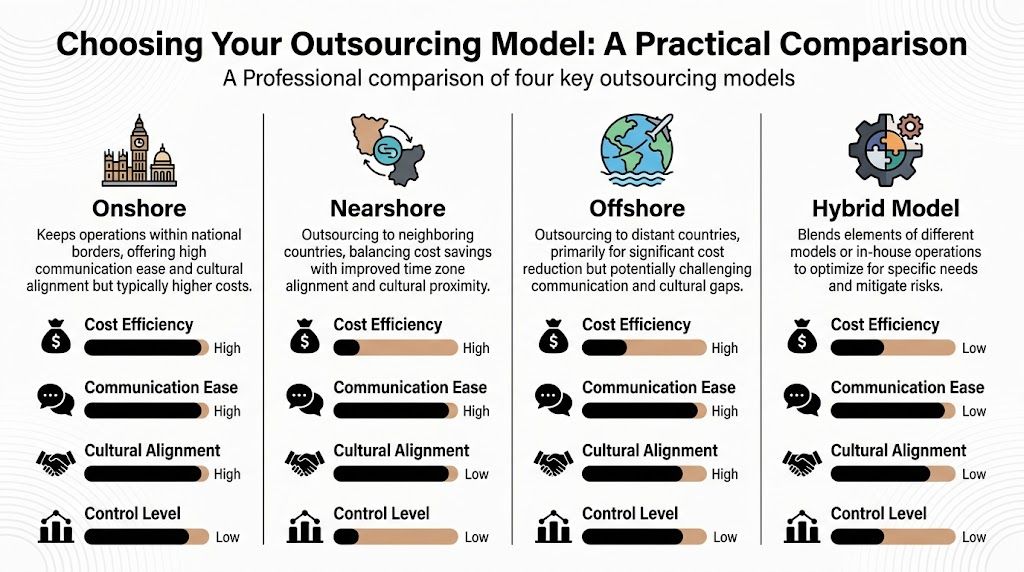
A lot of confusion disappears when you stop treating outsourcing as one thing. There are at least three practical paths most agile businesses compare:
- Build and manage everything in-house.
- Hand a function to a traditional outsourcing provider.
- Use a modern plug-and-play model such as seat leasing BPO, where workspace and operational support are bundled.
In-house versus traditional BPO versus seat leasing
Here's the simplest way to compare them.
| Model | Best for | Main strength | Main limitation |
|---|---|---|---|
| In-house team | Core functions tied closely to brand or IP | High direct control | Slowest and heaviest to build |
| Traditional BPO | Repeatable support functions | Specialized delivery at lower operating burden | Can create distance from day-to-day control |
| Seat leasing BPO | Agile teams needing space, IT, and speed | Flexible setup with managed infrastructure | Requires careful provider vetting and SLA design |
Where in-house still wins
If the work defines your competitive advantage, in-house often remains the best call.
That includes product strategy, key client relationships, proprietary methods, and leadership-heavy work that depends on company context. You usually want these functions close to decision-makers because the value isn't just in execution. It's in judgment, iteration, and cultural alignment.
In-house also works well when the process changes constantly. If your team is still inventing the playbook, a fully external partner may struggle to keep up.
Where traditional outsourcing makes sense
Traditional outsourcing is strongest when a function is important, repeatable, and measurable.
Examples include customer support queues, standardized back-office work, routine technical support, and administrative processing. In these situations, the buyer benefits from a provider's existing systems, trained staff, and operating discipline.
But the model isn't always as flexible as buyers expect. According to the verified data, 40% of SMEs face scalability issues with their providers during growth spikes, which shows that "outsourced" doesn't automatically mean "easy to scale" (Premier NX on outsourcing flexibility and seat leasing trends).
That point surprises many founders. They assume a provider can expand instantly. In reality, a vendor may still face seat limits, staffing bottlenecks, or onboarding delays.
Why modern plug-and-play models attract agile teams
Seat leasing BPO sits in a useful middle ground. The business still builds and directs its own team more closely than in a classic fully managed BPO setup, but it avoids much of the infrastructure burden of doing everything alone.
That includes workspace, internet, IT support, cybersecurity, utilities, and operational readiness. For startups, SMEs, and project-based teams, this can reduce the lag between "we need capacity" and "the team is working."
The verified data attached to this model is notable. Modern plug-and-play options show 30% faster deployment times, and vetted providers can deliver 22% higher ROI by bundling managed IT and cybersecurity. The same data set also notes that breaches in outsourced facilities rose 18% in 2025-2026, which is why provider quality matters as much as speed in this category.
If you're evaluating what bundled support should include, reviewing a detailed list of seat leasing workspace and IT inclusions helps turn a vague model into a concrete checklist.
The best outsourcing model isn't the cheapest one. It's the one your team can manage well while preserving service quality and strategic focus.
A practical lens for choosing among models
Use these questions instead of asking which model is "best" in general:
- How fast do we need to launch? If speed matters, infrastructure-heavy in-house setups can slow you down.
- How much control do we need daily? Core work often belongs closer to home.
- Is the process stable or still changing? Stable processes outsource more cleanly.
- Do we need space and systems, not just people? That points toward bundled models.
- Can the provider scale with us? Due diligence then becomes critical.
If you're comparing vendors, this guide to choosing an IT outsourcing company is helpful because it focuses on evaluation criteria rather than marketing claims.
The practical takeaway is simple. In-house gives you control. Traditional BPO gives you specialist execution. Seat leasing gives you a flexible operating base with managed support. Your choice depends on what kind of friction you need to remove first.
The Outsourcing Decision Framework When and How to Proceed
Most outsourcing mistakes happen before the contract is signed. The business picks a model before it has defined the problem.
A better approach is to treat outsourcing like an operating decision with a clear filter. Not every task should leave the company. Not every task should stay.
Step one, classify the work correctly
Start with one question: is this work part of your competitive edge, or does it support the business around the edge?
If the task directly shapes your unique value, keep a strong grip on it. If it supports delivery but doesn't define your advantage, outsourcing becomes more reasonable.
A simple screen helps:
- Keep in-house when the work involves proprietary judgment, brand-critical decisions, or sensitive leadership context.
- Consider outsourcing when the work is process-driven, repetitive, technical, or hard to staff internally.
- Use a hybrid setup when you want external execution but internal oversight.
Step two, document before you delegate
Businesses often outsource chaos and then blame the provider.
Before you hand anything over, write down how the function should work. Use basic operating tools such as SOPs, checklists, escalation rules, access permissions, ticket categories, and quality standards. If you already use platforms like Asana, Trello, Jira, Zendesk, HubSpot, or Google Workspace, those systems can become part of the handoff.
If a process can't be explained clearly, it probably isn't ready to outsource cleanly.
Write the process as if a new hire had to run it next Monday without asking ten follow-up questions.
Step three, compare true in-house cost versus outsourced cost
Many decisions quickly improve. Don't compare only salary to vendor fee.
Include the full picture:
| Cost category | In-house | Outsourced |
|---|---|---|
| Recruiting and onboarding | Internal time and hiring effort | Usually reduced or shifted to provider |
| Infrastructure | Devices, software, workspace, connectivity | Often bundled or partially included |
| Management overhead | Direct line management | Vendor management and SLA review |
| Specialized expertise | Hard to maintain in a small team | Accessed through provider capability |
The verified data on IT outsourcing is especially useful here. Outsourcing IT gives businesses access to specialized expertise in networking, cybersecurity, and cloud services that small in-house teams often can't maintain well. Providers can deploy expert teams proactively, and this can lead to up to 85% cost savings compared to in-house operations while allowing internal staff to focus on core goals (Unity Connect on IT outsourcing advantages and savings).
A concrete example makes this clearer. Say a growing company needs stronger cybersecurity coverage. Building that internally may require recruitment, tooling, training, documentation, monitoring routines, and backup capability for absences. Outsourcing that function can be logical because the company is buying a mature capability, not just a person.
Step four, test the provider before expanding scope
Don't start with your most sensitive or complex process.
Begin with a pilot. Choose a function that matters enough to test properly but won't damage the business if the first month is rough. Define success metrics, set review points, and assign one internal owner who manages the relationship.
Good pilot questions include:
- Did response times improve?
- Was communication clear and consistent?
- Did quality hold without constant correction?
- Did the provider escalate issues properly?
- Did the internal team regain time?
Step five, reduce risk through structure
The right provider still needs guardrails.
Build those guardrails through:
- Strong SLAs: Define turnaround times, quality levels, uptime expectations, reporting cadence, and security responsibilities.
- Access control: Give only the system access required for the role.
- Regular reviews: Hold scheduled operational and strategic check-ins.
- Security due diligence: For sensitive functions, ask about certifications, incident response, and controls such as ISO 27001 where relevant.
- Exit readiness: Know how data, documents, and processes will be returned if the relationship ends.
A business doesn't outsource to avoid management. It outsources to manage smarter.
That mindset changes everything. You stop asking, "How do I get this work off my plate?" and start asking, "What operating model gives this work the right level of expertise, oversight, and flexibility?"
Your Next Step Toward Smart Strategic Growth
Outsourcing isn't a magic fix, and it isn't a warning sign that your business can't cope. It's a tool. Used well, it gives lean companies room to operate with more focus, better specialist support, and less infrastructure drag.
A key takeaway regarding the advantages and disadvantages of outsourcing is that cost should never be the only filter. A low price can hide weak control, poor communication, or security gaps. A well-designed outsourcing model can improve speed, sharpen focus, and help a business scale without overbuilding too early.
For most founders and operators, the best decision sits between two extremes. Don't keep everything in-house out of habit. Don't outsource everything just because a vendor promises savings. Choose function by function. Match the model to the work. Keep strategy close, outsource support intelligently, and build clear oversight into the relationship.
If you're at the point where office setup, IT readiness, team expansion, or operational overhead is slowing growth, it helps to speak with a provider that understands flexible operating models. You can start that conversation through Seat Leasing BPO's contact page.
The businesses that benefit most from outsourcing usually aren't the ones chasing the cheapest option. They're the ones making deliberate choices about where their time, talent, and capital should go next.
If you're looking for a practical way to reduce setup burden and stay focused on growth, Seat Leasing BPO offers a flexible model that combines workspace, IT support, cybersecurity, internet, and operational essentials in one managed setup. It's a strong fit for startups, SMEs, and agile teams that want more flexibility without the weight of a traditional office build-out.