Imagine you're buying a new house. You could buy a plot of land and build from scratch—hiring architects, dealing with contractors, picking out every single fixture. Or, you could buy a model home where everything is already in place. The furniture is there, the utilities are connected, and all you have to do is turn the key and walk in.
That's the essence of a turnkey solution. It’s a complete product or service that's ready for you to use the moment you get it.
Unpacking the Meaning of a Turnkey Solution
The real magic of a turnkey model is that it takes all the complicated, time-consuming setup steps off your plate. Instead of juggling multiple vendors, buying separate components, and managing a messy installation process, you work with a single provider who hands you a finished, ready-to-go package. They've done all the heavy lifting behind the scenes.
This idea has been around for a while, originally taking root in massive industrial projects back in the 1950s. Think about building a power plant or an oil refinery. A company would be hired to handle everything from the ground up, delivering a fully functional facility. The client would literally just "turn the key" to start operations.
From Industrial Roots to Modern Business
Today, that same powerful concept has moved from factory floors to the modern office, especially in services like BPO seat leasing. It's the perfect fit for businesses that need to get up and running fast without the usual headaches. The market numbers tell the story: the global Turnkey Projects market was valued at USD 250 billion in 2024 and is expected to hit USD 400 billion by 2033, climbing at a 5.5% CAGR. You can explore more data on the turnkey projects market to see just how much this approach is taking off.
Think about what it traditionally takes to launch a new office:
- Finding a space and getting locked into a long-term lease.
- Buying servers, computers, and all the network gear.
- Hiring IT pros to set up the network, install cybersecurity, and run cables.
- Sourcing and assembling all the office furniture.
A turnkey provider bundles all of that into one simple service. You walk into a fully equipped space where the internet is blazing fast, the computers are ready, and the desks are waiting for your team.
A turnkey solution fundamentally changes the question from "How do we build this?" to "When can we start?" It shifts a company's focus from logistical burdens to immediate operational output, saving invaluable time and capital.
To make it even clearer, here’s a quick breakdown of what makes a solution "turnkey."
Turnkey Solution At a Glance
This table breaks down the essential parts of any true turnkey offering. It’s all about getting a complete, integrated package that works from day one.
| Core Component | Description |
|---|---|
| Complete Package | The solution includes all necessary hardware, software, and services needed to function. |
| Single Provider | You get everything from one source, eliminating the need to manage multiple vendors. |
| Immediate Usability | The service is pre-configured and ready for immediate operation—just "turn the key." |
| Managed Support | Ongoing maintenance, updates, and technical support are typically included. |
| Simplified Pricing | Often comes with a straightforward, all-inclusive pricing model (e.g., per seat, per month). |
Whether it's pre-configured software or a franchise that gives an owner everything they need to open their doors, the goal is always the same: bypass the complex setup and get straight to business.
How a Turnkey Solution Creates Your "Plug-and-Play" Workspace
Think about launching a new team or opening a satellite office. The traditional way is a massive headache. You're juggling real estate brokers, internet providers, IT vendors, and even furniture suppliers. A turnkey workspace completely flips that script, giving you a true plug-and-play office from the moment you get the keys.
This idea really comes to life with BPO seat leasing. Instead of building an entire operational hub from the ground up, you partner with a provider who has already done all the hard work. Once the agreement is signed, your team can literally walk in, sit down, and start working in a fully equipped office.
Getting started is surprisingly straightforward. It usually begins with a simple conversation about what you need: how many people, the kind of IT support required, and any specific security protocols you need to follow. After that, the provider takes care of the rest.
What's Inside a Ready-to-Use Office?
So, what does "fully functional" actually mean in this context? It’s not just four walls and a desk. It's a complete package designed to get rid of every common setup frustration so your team can focus on what they were hired to do.
This all-in-one model covers every essential layer of your operations:
- High-Speed, Redundant Internet: Forget negotiating with internet service providers. These offices come with enterprise-grade internet already installed, managed, and backed up.
- Complete IT Infrastructure: Workstations, servers, and secure networks are all set up, configured, and maintained by a professional IT team.
- Robust Cybersecurity: Your workspace is protected from day one with advanced firewalls, data protection measures, and constant security monitoring.
- Ergonomic Furniture and Layout: Every desk, chair, and common area is thoughtfully designed for productivity and comfort.
- All-Inclusive Utilities: Electricity, water, and building maintenance are all rolled into one predictable monthly cost.
In short, a turnkey provider absorbs the entire burden of managing the facility and the IT. Handing off these complex tasks is what turns a simple office into a real business asset, freeing you up to concentrate on things like serving clients and growing the company.
A Strategic Edge in a Fast-Paced Market
The value of a what is turnkey solution goes far beyond convenience; it gives you a serious competitive edge. Outsourcing these non-core functions is a strategy catching on across industries. For example, the global market for turnkey high-volume manufacturing hit USD 16.9 billion in 2024, as companies outsourced entire production lines to cut their time-to-market by up to 40%. This reflects the wider trend in the turnkey projects market, which is expected to leap from USD 2.39 billion in 2026 to USD 5.68 billion by 2035. You can find more details about turnkey market growth on DataIntelo.
This growth points to a fundamental business truth: you create the most value by focusing your resources on what you do best.
By taking the complexities of office logistics off your plate, a turnkey solution lets your business move with the speed of a startup but with the solid infrastructure of a much larger company.
Think about what this means in the real world. A new startup can establish a professional footprint immediately without sinking its seed money into a huge security deposit and office build-out. At the same time, an established BPO can quickly scale its team up or down based on client contracts, avoiding the trap of a rigid, long-term lease. This kind of flexibility is what makes the plug-and-play workspace so powerful for any business that needs to stay nimble and grow efficiently. The provider manages the operational backend, so you can focus on moving your business forward.
The Core Benefits: Speed, Savings, and Strategic Focus
Choosing a turnkey solution isn't just a matter of convenience; it’s a strategic move that fundamentally changes how you operate. The advantages really boil down to three powerful pillars: getting up and running with incredible speed, locking in major cost savings, and freeing your team to focus on what actually grows the business.
These benefits don't exist in a vacuum—they work together to create a far more agile and competitive way of doing business.
Launch at Incredible Speed
In business, speed is everything. A traditional office setup is the exact opposite of fast—it can easily burn months on planning, lease negotiations, and construction before a single employee can even take a seat. You're bogged down in a slow-motion process, juggling real estate agents, contractors, IT vendors, and furniture suppliers.
A turnkey solution completely flips that script. The entire operational infrastructure—the office, the tech, the network—is already built, tested, and ready to go.
This means you can go from a first phone call to having a fully functioning team in a matter of days, not months. This simple flow shows just how fast it can be.
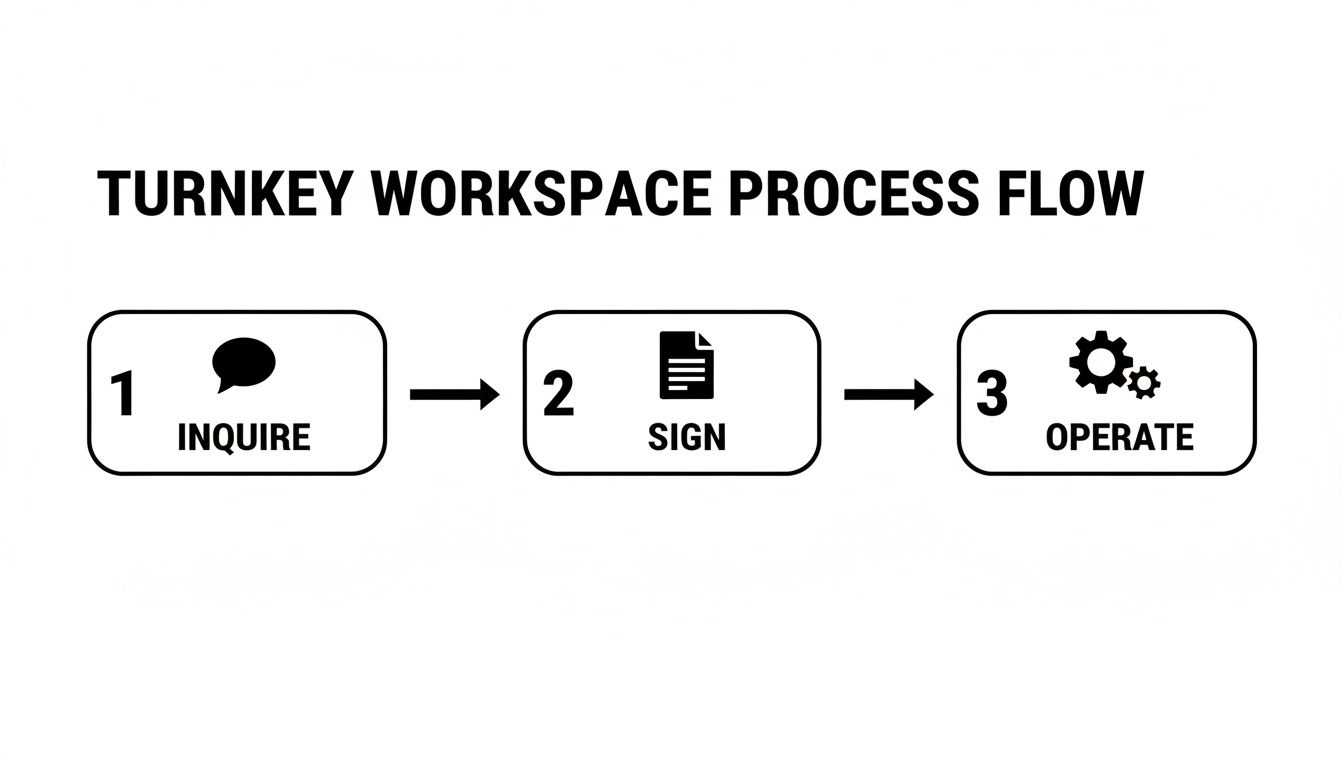
This simple, three-step journey—Inquire, Sign, Operate—cuts out nearly all the traditional friction, letting you jump on new opportunities the moment they appear.
Achieve Significant Cost Savings
One of the biggest roadblocks for any growing business is the huge upfront investment required for a physical workspace. These initial capital expenses can be staggering, tying up cash that would be much better spent on growth, marketing, or hiring great people.
A turnkey solution transforms this financial headache into a predictable, manageable operational expense.
Instead of facing a mountain of one-time bills, you get a clear, all-inclusive monthly fee. Think about what this model helps you avoid:
- Massive Security Deposits: Traditional leases often demand several months' rent upfront, locking away a huge chunk of your capital.
- Infrastructure Investment: You're not buying servers, networking gear, or pricey cybersecurity hardware. It's all included.
- Furniture and Fit-Out Costs: The steep expense of desks, chairs, and office construction is completely off your plate.
By bundling everything from IT to utilities into one predictable fee, companies often see cost reductions of up to 80% compared to a DIY traditional lease. That kind of financial efficiency is a game-changer, especially for startups and scaling BPOs.
The core financial magic of a turnkey workspace is the shift from unpredictable capital expenditure (CapEx) to a stable, predictable operational expenditure (OpEx). This allows for much smarter budgeting and frees up capital for strategic growth initiatives.
This table puts the financial and logistical differences side-by-side, and the contrast is stark.
Turnkey Workspace vs. Traditional Office Lease: A Cost and Time Comparison
| Factor | Turnkey Solution (Seat Leasing) | Traditional Office Lease |
|---|---|---|
| Time to Launch | Days to weeks | Months |
| Upfront Costs | Minimal (often just one month's fee) | High (security deposit, fit-out, furniture, IT) |
| IT & Infrastructure | Included and professionally managed | Separate, high-cost procurement and setup |
| Contract Flexibility | High (short-term, scalable options available) | Low (rigid, long-term commitments of 3-5+ years) |
| Monthly Costs | Predictable, all-inclusive operational expense | Unpredictable (rent + separate variable utilities, IT) |
As you can see, one path is built for agility and cost-efficiency, while the other is riddled with delays, high costs, and long-term risk.
Maintain Your Strategic Focus
Maybe the most valuable benefit of all is the mental and strategic bandwidth a turnkey model gives back to your leadership. Every hour your team spends dealing with a broken internet connection, managing facility maintenance, or troubleshooting IT issues is an hour they’re not spending on growing the business.
When you hand off the entire backend management of your workspace to experts, you free your key people to concentrate on the high-value activities that actually drive revenue and innovation.
Suddenly, their time is spent on things like:
- Developing business strategy and long-term goals.
- Winning new clients and nurturing key relationships.
- Innovating your products or improving service delivery.
- Recruiting, training, and retaining top-tier talent.
By letting specialists handle the operational headaches, your team can maintain a laser focus on its core mission. This strategic alignment is often what separates the companies that just get by from the ones that truly thrive.
Turnkey Solutions in Action: Real Business Scenarios
It’s one thing to talk about what a turnkey solution is, but seeing it solve real-world problems is where the concept really clicks. Let's move past the theory and look at a few practical examples of how businesses used this approach to tackle major challenges—and came out ahead.
These stories really show how a ready-to-go workspace can be a massive advantage for companies at all different stages.

The Startup Needing Credibility—Fast
Think about a tech startup that’s just landed its first round of seed funding. The team is small and remote, but they desperately need to look the part for potential investors and their first big clients. Meeting in coffee shops just isn't going to build the confidence they need, but they can't burn through their cash on a long-term lease and all the associated setup costs.
Their problem was simple: they needed a professional headquarters on a shoestring budget, without the long-term chains.
A turnkey seat leasing solution was the perfect fit. In less than a week, they moved into a modern, fully-branded office in a prime business location. Suddenly, they had access to impressive meeting rooms, a solid IT network, and a prestigious address, all bundled into one predictable monthly fee.
The outcome? The startup successfully closed its next funding round. The investors later mentioned that seeing the company's professional setup was a key factor in their decision. They avoided huge upfront expenses, which meant more capital could go directly into developing their product and marketing it.
The BPO Facing a Massive Scaling Demand
Now, picture a mid-sized Business Process Outsourcing (BPO) company on the verge of landing a huge contract. The client was ready to sign, but there was a catch: the BPO had to get 50 new customer service agents hired, trained, and operational within three weeks.
Building out a new office space would take months and a ton of capital. The BPO was staring at the possibility of losing the biggest deal in its history just because of logistics. This is a classic dilemma for growing businesses, and the traditional route is just too slow. You can dig deeper into finding the right partner in our guide on Seat Leasing BPO.
The BPO immediately turned to a turnkey workspace provider. They were able to lock down 50 fully equipped seats in a facility that was ready to go from day one. The provider took care of everything—workstations, secure internet, furniture, the works—which let the BPO focus entirely on recruiting and training their new hires.
The outcome? The BPO hit the client's tight deadline, won the multi-year contract, and gave their revenue a massive, immediate boost. The turnkey model gave them the agility to jump on a growth opportunity that would have been completely impossible otherwise.
A turnkey solution transforms a company's operational capacity from a fixed, slow-moving asset into a flexible, on-demand resource. It allows businesses to scale their physical footprint at the speed of their ambition.
The Global Corporation Entering a New Market
Finally, let's look at a large multinational corporation planning to open a satellite office in a new country. They had no local contacts, no feel for the regional real estate market, and no IT team on the ground. The logistical nightmare of setting up an office from scratch in an unfamiliar place was daunting.
Their main goal was to establish a presence quickly without getting tangled in complex local regulations, vendor contracts, and construction delays.
By partnering with a local turnkey provider, the corporation sidestepped all of these headaches. They secured a high-end office space where everything was included, from IT support to daily facility management. Their provider essentially became their on-the-ground logistics team, handling every single detail.
The outcome? The corporation launched its new office in under a month—a process that would have easily taken over six months the old-fashioned way. They massively accelerated their market entry, cut down on operational risks, and let their new team hit the ground running from day one.
How to Choose the Right Turnkey Provider
Picking the right turnkey partner isn't just about leasing an office. It's about finding a strategic partner who will be the foundation for your business's growth. With so many options out there, it’s easy to get overwhelmed. The key is to look past the glossy brochures and really dig into the things that will affect your team's day-to-day work.
Let's be real: not all providers are the same. Some are IT powerhouses, while others are all about creating a cool, collaborative vibe. You need to figure out what's a "must-have" versus a "nice-to-have" for your specific business. Once you know your priorities, you can start asking the tough questions that separate the great providers from the merely good ones.
Assess the IT Infrastructure and Security
Your workspace's tech setup is the one area you absolutely can't compromise on. A spotty internet connection or a security breach can grind your entire operation to a halt. Before you even think about signing a lease, you need to get crystal clear on their IT and cybersecurity game.
Start with their network's nuts and bolts. Ask direct questions to make sure they can handle what you'll throw at them.
- Internet Reliability: What are your actual internet speeds? Do you have backup connections from different carriers to guarantee we stay online no matter what?
- Cybersecurity Protocols: How exactly do you protect our data? Talk to me about firewalls, threat detection, and other specific security layers you have in place.
- On-Site IT Support: If my team has a tech issue, what's the process? Who do we call, and how fast can we expect a real person to help?
This isn't just a small detail anymore. The demand for rock-solid, ready-to-go IT is why the Data Center Automation market—a prime example of a high-stakes turnkey environment—is expected to jump from USD 12.32 billion in 2026 to a staggering USD 27.64 billion by 2031. Businesses are flocking to these solutions because they need reliable infrastructure without the headache of building it themselves. Find out more about data center automation trends.
Evaluate Scalability and Contract Flexibility
Let’s face it, one of the biggest draws of a turnkey setup is the freedom to pivot. Your business is going to change—you’ll grow, and you might even need to scale back for a bit. Getting locked into a rigid, multi-year contract completely defeats the purpose. You need a partner who can move at your speed.
Flexibility shouldn't be a vague promise; it should be written right into the agreement. Get straight answers on these points:
- Growth Path: How painless is it to add more seats or grab a bigger office when we hire?
- Downsizing Options: What happens if we need to reduce our footprint? Are we going to get hit with huge penalties?
- Contract Length: Do you offer month-to-month terms, or are we stuck with a long-term commitment?
The best turnkey providers don't just sell you space; they offer an operational platform that can expand or contract at the speed of your business. True flexibility is the ultimate strategic advantage.
Review Support Services and Amenities
The overall vibe and efficiency of your workspace come down to the support services and amenities. These aren't just perks; they directly impact your team's productivity, happiness, and ability to do their best work. A great provider understands this and invests in creating an environment that just works.
Look for a complete ecosystem of support, from professional receptionists who greet your clients to readily available meeting rooms and clean, inviting common areas. When a provider handles all these operational details, it frees you up to pour all your energy into what you do best. If you're weighing your options, don't hesitate to get in touch with a potential provider and grill them on the specifics of their services.
Why the Future of Work Is Turnkey
We've walked through what a turnkey solution really means, from a simple definition to how it plays out in the real world. It's clearly more than just an easy way to get an office space; it represents a genuine shift in how modern businesses get things done. This entire model is built on three incredibly powerful ideas: speed, serious cost savings, and a relentless focus on what actually matters.
In a market that can turn on a dime, being agile isn't just a nice-to-have—it’s a survival skill. The old way of doing things, like getting locked into long-term leases and then spending months building out an office, feels like a leftover from a much slower time. A turnkey approach, on the other hand, lets a company get off the ground, scale up, or even pivot in a matter of days, not months.
A New Way to Operate
The businesses that will win in the future are the ones that can put their resources exactly where they're needed most. This means pouring capital into new ideas and great people, not into office chairs and server closets. It's about freeing up your key employees from the headaches of facility management and IT troubleshooting so they can actually focus on growing the company.
A turnkey workspace makes this a reality by turning your entire operational backbone into a flexible, on-demand service. You get all the stability and professional polish of a traditional corporate office but with the nimbleness of a startup.
The promise of a turnkey future is refreshingly simple: stop building the office and start building the business. This model takes care of the operational mess, letting you focus 100% on your mission from the very first day.
It's All About Agility and Focus
This way of operating isn't just a niche solution for a few industries anymore. It's quickly becoming the go-to standard for any company that needs to be efficient and flexible. The logic is hard to argue with:
- Smarter Resource Use: It puts your money and your people’s time back into activities that actually make money.
- Lower Risk: You can say goodbye to the long-term financial burdens and massive upfront costs of traditional real estate.
- Incredible Speed: It gives companies the power to jump into new markets and grab opportunities faster than ever before.
As you think about where your own business is headed, the question isn't whether you can afford to switch to a turnkey model. It's whether you can afford not to. The sheer complexity of old-school office management is a dead weight on the speed and focus you need to compete today.
If you’re ready to drop that weight and find a new gear of operational agility, it’s time to see what a top-tier turnkey provider can do for you. By handing over the logistics, you can get back to the work that truly matters: building your business.
Frequently Asked Questions About Turnkey Solutions
Even after grasping the concept of a turnkey solution, a few practical questions always seem to pop up. Let's tackle the most common ones to clear up any lingering confusion about how these models actually play out in the real world.
Here are the specifics business leaders want to know when they're thinking about making the switch.
Is a Turnkey Solution Different From a Managed Service?
Yes, absolutely, though it's easy to see why they get mixed up. The simplest way to think about it is like buying a car versus hiring a driver.
A turnkey solution is the fully built, ready-to-go car. It comes with the engine, the seats, the tech—everything integrated and ready to drive right off the lot. You just get in, turn the key, and you’re on your way.
A managed service, however, is more like hiring a specialized mechanic or a chauffeur. They handle a specific, ongoing task—like maintenance or driving you around—but they didn't provide the car itself. Turnkey delivers the entire operational vehicle; managed services take care of one part of the journey.
Are Turnkey Options Only for Large Companies?
That’s a big misconception. In fact, turnkey solutions are often a game-changer for startups and small to medium-sized businesses (SMBs). The low barrier to entry is the main draw. Instead of sinking huge amounts of capital into building out an office, a startup can get professional, enterprise-level infrastructure for a predictable monthly cost.
A turnkey solution levels the playing field. It gives smaller companies the operational muscle and polished image of a large corporation without draining their cash reserves, letting them compete head-to-head from day one.
This model is especially powerful for businesses that need to stay agile and pour their money into growth activities like product development or marketing. To dive deeper into business strategies like this, feel free to check out our other articles on the Seat Leasing BPO blog.
How Much Can I Customize a Turnkey Office Space?
Customization in a turnkey setup is all about striking a smart balance between efficiency and your own brand identity. You won't be tearing down walls, but a good provider offers plenty of ways to make the space feel like yours.
Here’s where you can typically expect some flexibility:
- Branding: Most providers will let you add company logos, use your brand colors, and display other visual elements in your dedicated area. This helps you carve out a distinct corporate presence.
- Tech Setups: Need specific software installed or have unique network requirements? Many providers can accommodate specialized hardware or configurations for your team's workflow.
- Layout Adjustments: While the main structure is set, you can often work with the provider to arrange desk layouts and create collaborative zones that match how your team actually works.
The whole point is to get the speed and cost savings of a standardized model while still building a workspace that reflects your company culture. It’s a practical compromise that really does offer the best of both worlds.
Ready to unlock the speed, savings, and focus of a turnkey workspace? Seat Leasing BPO provides fully serviced, plug-and-play office solutions that let you concentrate on growth. Discover how we can have your team operational in days, not months.