Operational support is what keeps a business humming along in the background. Think of it like the stage crew at a rock concert. While your team—the band—is the star of the show, it's the crew handling the lights, sound, and security that makes sure the performance goes off without a hitch.
What's Really Happening in the Engine Room?
Let's try another analogy. Picture your business as a high-performance race car. Your product, sales, and marketing teams are the drivers, laser-focused on winning the race. Operational support is the entire pit crew and engineering team—everything happening off the track to make that win possible.
They're the ones refueling the car, swapping out tires in seconds, and constantly tuning the engine. Without them, even the most talented driver wouldn't complete a single lap.
In the business world, this translates to all the non-core but absolutely essential functions. We're talking about reliable Wi-Fi, a secure and ready-to-use office, computers that actually work, and all the administrative tasks that would grind productivity to a halt if they were ignored. It's the silent, steady force that lets your revenue-generating teams focus completely on what they do best.
At its heart, operational support isn’t just about putting out fires. It’s about creating an environment where fires don't start in the first place.
The 'How' vs. The 'What' of Your Business
To really get it, you have to draw a clear line between the support functions and the core business activities they empower. Knowing this difference is key to figuring out where your team should spend its time and energy.
Businesses are catching on. The global market for Operational and Business Support Systems is on a massive upward trajectory, expected to climb from US$61.07 billion in 2023 to a staggering US$146.93 billion by 2031. That's not just a trend; it's a clear signal that companies are getting serious about efficiency. You can read more about the growth of the OSS/BSS market on theinsightpartners.com.
So, what's the difference in practice?
Operational Support At a Glance
This table offers a simple breakdown of the support tasks that enable your team to focus on the work that directly drives revenue and growth.
| Operational Support Functions (The 'How') | Core Business Functions (The 'What') |
|---|---|
| Managing IT hardware and software updates | Developing a new software feature |
| Ensuring stable, high-speed internet connectivity | Closing a major sales deal with a client |
| Maintaining a clean and secure office space | Executing a marketing campaign |
| Handling payroll and administrative paperwork | Providing direct customer service or consulting |
Simply put, operational support handles the day-to-day logistics so your primary teams can stay focused on their mission-critical objectives.
The Five Pillars Of Modern Operational Support
To really get what operational support is, you need to see it as a complete system built on five distinct but deeply connected pillars. Think of it like a sturdy building—it absolutely relies on its foundation. If even one pillar is shaky, the whole structure becomes unstable. For a business, that means risk.
These aren't just abstract ideas; they're the real, tangible services that keep your business humming day in and day out. They make the difference between a team constantly bogged down by logistical headaches and one that’s free to focus completely on hitting its goals.
In short, good support enables flow and gets rid of obstacles instead of creating new ones.
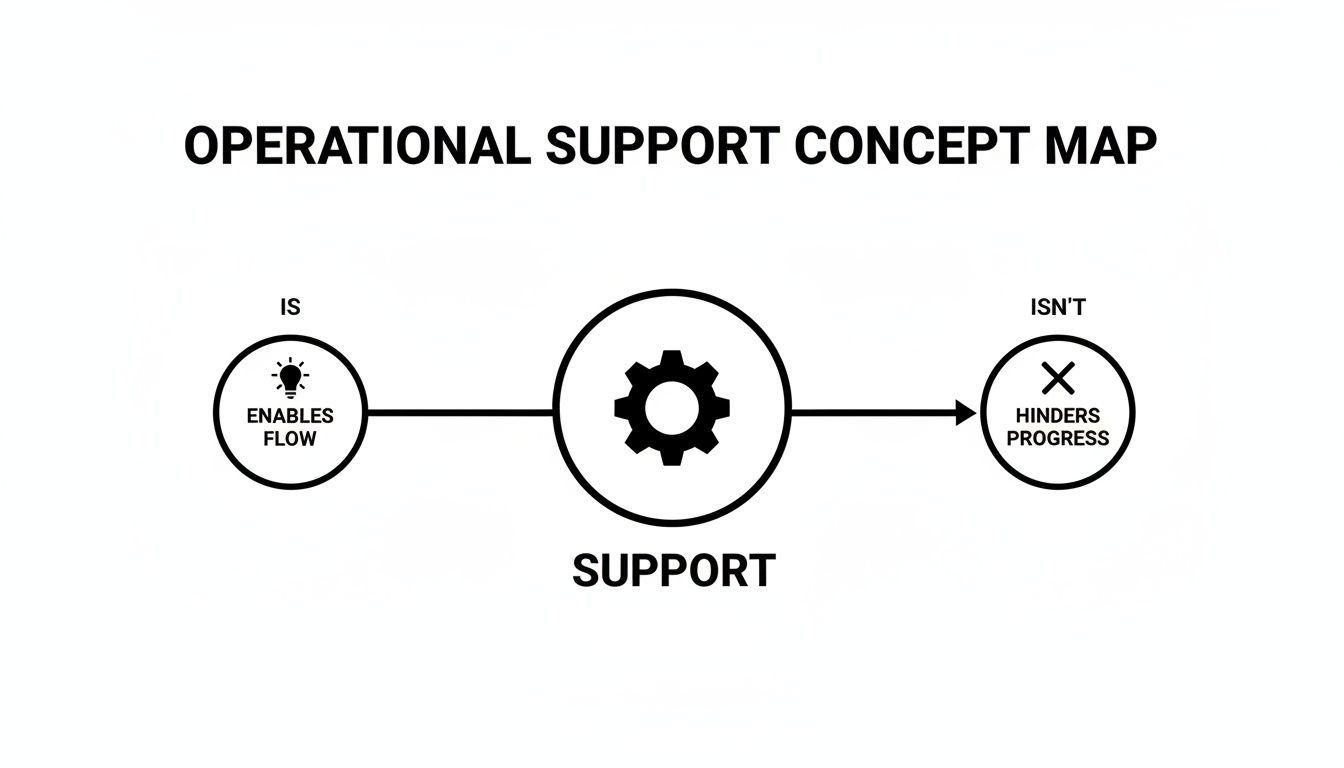
As you can see, true support empowers your business. It's the exact opposite of functions that just add layers of complexity and slow you down.
1. IT Infrastructure
This goes way beyond just having laptops and monitors. This pillar is the digital nervous system of your entire company. It covers everything from managing servers and handling software licenses to deploying cybersecurity protocols and running regular data backups. When IT support is done right, your team has the tools they need, those tools actually work, and your company's sensitive data stays locked down.
2. High-Speed Connectivity
Let’s be honest: in today’s world, a spotty internet connection isn't just a minor inconvenience. It's a direct blow to your bottom line. This pillar is all about ensuring your team has fast, stable, and redundant internet. It’s the digital highway that powers everything—from crystal-clear video calls and cloud software to every single customer interaction.
You know you have strong operational support when your internet connection is something you never even have to think about. It just works, all the time, so business can move forward without a hitch.
3. Facilities Management
This is the physical space where the magic happens. It covers the entire environment, from a professional, clean, and secure office to ergonomic chairs and dependable utilities like power and air conditioning. The goal is to create a workplace that isn’t just functional but actually helps people be productive and feel good while they're at it.
4. Comprehensive Security
Security is a two-sided coin: you have the digital side and the physical side. This pillar involves tough cybersecurity measures to defend against data breaches and malware. At the same time, it includes physical security like access control systems and surveillance to keep your people and your equipment safe. It's an absolute must-have for protecting your business from threats, both inside and out.
5. Administrative And Back-Office Support
Finally, this pillar handles all the essential but time-consuming daily logistics. Think of all the little things that can derail a productive day:
- Reception Services: Having a professional to greet clients and manage calls.
- Mail Handling: Making sure important documents get where they need to go without delay.
- Office Supplies Management: Keeping the workplace stocked so no one’s hunting for a pen.
- Payroll and HR Logistics: Taking care of the crucial background tasks that keep your staff supported.
When these five pillars are managed by experts, they create a powerful, unified foundation. This all-in-one approach is precisely what lets businesses hand off the distractions and focus on what they do best. For more insights on boosting business efficiency, check out the wide range of topics on our blog.
How Seat Leasing Perfects Operational Support
To really understand what operational support looks like in the real world, let's picture two startups on their launch day. Startup A decides to do everything themselves, building their office from scratch. Startup B, on the other hand, goes with a seat leasing model, plugging into a ready-made operational backbone from day one.
Startup A’s journey is a familiar one. It starts with a frantic hunt for office space. Then come the endless weeks of haggling with internet providers and IT vendors. Their team ends up spending precious hours putting together desks and untangling network cables instead of actually working on their product. Just when things finally seem to be running, a server crashes, and their entire operation goes dark for a day.
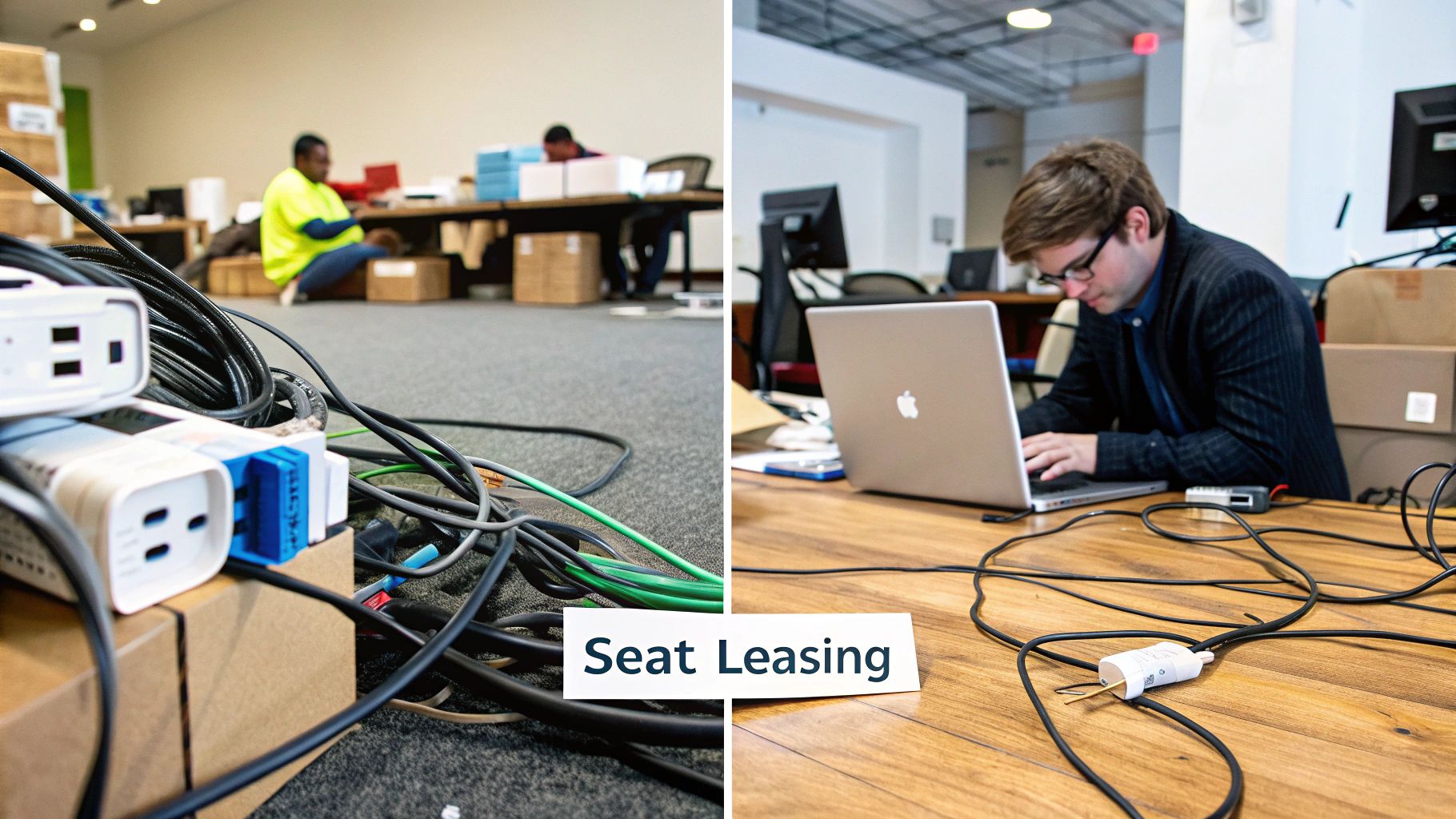
This is the classic story of hidden costs and productivity drains. When you manage all your operations in-house, you're constantly fighting fires—unexpected problems and logistical nightmares that pull you away from what matters.
The Plug-and-Play Advantage
Now, let's look at Startup B. By choosing a seat leasing solution, they were up and running on day one. Their team simply walked into a fully furnished office with fast, reliable internet, a secure IT network, and professional admin support already waiting for them. They didn't have to negotiate a single utility contract or figure out a cybersecurity plan; the experts had it covered.
While Startup A was scrambling to recover from their server crash, Startup B was already busy onboarding its first clients. This isn't just about making life easier; it's a huge strategic advantage. By plugging into a pre-built operational system, they skipped all the common growing pains that bog down new businesses.
Seat leasing transforms operational support from a massive, resource-draining headache into a simple, turnkey solution. It’s like being handed the keys to a high-performance engine instead of trying to build one from scratch.
This shift toward managed efficiency is happening everywhere. The global market for Operations Support Systems (OSS) and Business Support Systems (BSS) is expected to grow by a staggering USD 83.9 billion between 2024 and 2029. This explosive growth proves that businesses are moving away from DIY and toward managed solutions that cut costs and make them more agile. You can discover more insights about OSS/BSS software trends on technavio.com to see the full market projections.
Achieving Immediate Cost Savings
Perhaps the most powerful argument for this model is the immediate financial impact. If you build your own infrastructure, you’re looking at huge upfront capital costs for things like:
- IT Hardware: Servers, routers, workstations, and all the peripherals.
- Security Systems: Expensive firewalls, software, and physical access control.
- Office Fit-Out: Furniture, cabling, deposits, and renovation costs.
Seat leasing gets rid of all that. You pay one predictable monthly fee that bundles everything together. This turns a massive, risky capital investment into a simple, manageable operating expense. Our clients often report savings of up to 80% compared to a traditional office lease, which frees up critical cash for hiring, marketing, and growth.
To see a full breakdown of the financial benefits, you can explore the benefits of seat leasing for businesses. By tapping into a shared, professionally managed environment, you get all the perks of top-tier resources without the premium price tag.
The Hidden ROI Of Outsourced Operational Support
Most people get drawn in by the immediate cost savings, but the real return on investment with outsourced operational support is so much bigger. It’s about getting back your most precious, non-renewable resource: your team's time and focus.
When you hand off the daily grind of keeping the lights on, you’re not just cutting a line item on your budget. You're making a smart, strategic investment in what actually grows your business.
Think about it. How many hours has your leadership team lost trying to fix a spotty internet connection or wrangling with IT vendors? Every single one of those hours is a direct hit to your bottom line. That's time that could have been spent building a new product, coaching your top performers, or closing a game-changing deal. This is the opportunity cost of doing it all yourself, and trust me, it adds up faster than you'd think.
Outsourcing completely flips that script. It creates a stable, predictable environment where your core team can put 100% of their energy into the tasks that actually make money. That shift puts everything on the fast track, from getting a product to market to landing new customers, creating a powerful ripple effect that you’ll feel across the entire company.
Quantifying The Real Costs And Returns
To really get the full picture, you have to look past the monthly invoice. The hidden costs of managing everything in-house are often buried in lost productivity and distracted leaders. A seat leasing model, on the other hand, turns those unpredictable operational headaches into a fixed, manageable investment that delivers real value.
This isn't just a niche idea; it's part of a massive shift in how smart businesses operate. Companies are demanding more efficient backend systems, and operational support is the unsung hero making it happen. It’s no surprise that the Operations and Business Support System market is projected to hit USD 75 billion by 2031. This explosive growth is driven by technologies that handle everything from IT maintenance to customer relationship management, freeing up companies to do what they do best. For a deeper dive, you can learn more about how AI and the cloud are driving market growth on openpr.com.
So, let's put some real numbers to this.
ROI Comparison In-House vs Outsourced Operations
Here’s a quantitative look at the true costs and returns of managing operational support internally versus using a seat leasing provider. This table helps to show the strategic value that goes way beyond simple line items.
| Metric | In-House Management | Outsourced (Seat Leasing) |
|---|---|---|
| Initial Cost | High capital expenditure (hardware, furniture, deposits) | Zero capital expenditure; simple monthly fee |
| Team Focus | Divided between core work and operational firefighting | 100% focused on revenue-generating tasks |
| Speed to Market | Slower; delayed by setup, IT issues, and logistics | Faster; immediate plug-and-play functionality |
| Leadership Time | Significant time spent on non-core vendor management | Minimal time required; focused on strategic direction |
| Scalability | Slow and expensive; requires new leases and purchases | Fast and flexible; add or remove seats as needed |
| Predictability | Unpredictable costs (repairs, downtime, staff turnover) | Fixed, predictable monthly operational expense |
At the end of the day, the numbers tell a clear story. The value here is much more profound than just reducing overhead.
Ultimately, outsourced operational support isn’t about saving a few dollars on rent. It's about buying back time, focus, and agility—the essential ingredients for sustainable business growth and a significant competitive advantage.
Evaluating Your Business's Operational Needs

Before you can find the right operational support, you need a crystal-clear picture of your own business's pressures and pain points. It’s easy to say you need "a better office," but that’s too vague. The real work begins when you get honest about what’s holding you back.
Think of it as a diagnostic check-up for your company. A doctor doesn't just hand out a generic pill; they ask specific questions to find the root cause of the problem. You need to do the same—pinpoint the exact friction points that are dragging down your growth.
Quantifying Your Operational Gaps
The best way to start is by putting hard numbers to your challenges. This turns abstract frustrations into concrete data, making the need for solid operational support impossible to ignore. Answering these questions will give you a baseline for what you actually need.
Here’s a simple framework to guide your self-assessment:
- Downtime Costs: What does one hour of internet or power downtime actually cost your business? Tally up the lost sales, missed deadlines, and wages for staff who can't work.
- Leadership Drain: How many hours a week does your management team sink into non-revenue-generating tasks like IT fixes or managing vendors? Multiply those hours by their effective hourly rate to see the true cost.
- Onboarding Delays: How long does it take to get a new hire set up and actually productive? What's the cost of that delay in lost output and training time?
- Security Risks: What would a single security breach cost you, both financially and in reputation? Don't forget to factor in the potential loss of customer trust.
Answering these questions honestly often reveals a stark picture. The hidden costs of poor operational support are almost always higher than business owners assume, quietly eating away at profits and potential.
Pinpointing Mission-Critical Functions
Once you have a sense of the costs, you can figure out what really matters. Every business is different. A call center might put 100% internet uptime at the top of its list, while a software development team might prioritize physical security and redundant power above all else.
Your goal here is to identify which support functions are non-negotiable for your success. This self-evaluation is the first step in changing your mindset—you're not just looking for "office space" anymore. You're looking for a complete operational solution that actively fuels your growth.
By understanding your specific needs, you can make a much smarter decision. If you're ready to see how a solution can be built around your unique challenges, you can get in touch with our team to discuss your operational requirements.
Have Questions About Operational Support? We Have Answers.
It's completely normal to have a few questions—and maybe even a little skepticism—when you first hear about outsourced operational support. Many business owners I talk to wonder if it's the right move for them or worry about losing control over key parts of their company. Let's clear the air and tackle these common concerns head-on.
Getting these questions answered is crucial. It helps you look past the buzzwords and see the real strategic value a fully supported operational model can bring to your business.
"Isn't this kind of support just for big corporations?"
That's probably the biggest myth out there. While it's true that large companies have massive operational teams, the concept is arguably more important for startups and small to medium-sized businesses (SMBs). For a smaller company, the fallout from a single operational hiccup—a day of internet downtime, a server failure—can be catastrophic.
A massive enterprise can absorb a lost day of productivity. An SMB can't. Outsourced operational support is the great equalizer. It gives smaller businesses access to the kind of enterprise-grade IT, security, and facilities that used to be reserved for the big players. Think of it as de-risking your entire operation without the crippling upfront cost.
Many people mistakenly see robust operational support as a luxury. The reality? For a growing business, it’s a non-negotiable insurance policy against the daily disruptions that kill momentum.
"How much control will I have to give up?"
This is a perfectly valid concern for any entrepreneur or manager. No one wants to feel like they're handing over the keys to the kingdom. But here's the thing: a good operational support partner doesn't take control; they take on responsibility. You aren't giving up your authority, you're just delegating the hands-on execution of tasks that aren't your main focus.
You're still the one setting the direction. You decide on the security protocols, the performance benchmarks, and the overall goals. Your provider’s job is simply to meet those standards and handle the day-to-day grind. This actually frees you up to have more strategic control, shifting your focus from putting out fires to planning your next big move.
"So, this is just a fancy coworking space, right?"
Not at all. While both offer a place to work, they solve fundamentally different problems. A typical coworking space is essentially a real estate play—they sell you access to a desk and a Wi-Fi password in a shared environment.
Operational support, particularly in a seat leasing model, is a complete business solution. It’s far more than just a physical office.
- Coworking Space: Gives you a desk, internet, and some shared amenities. The main value is flexible real estate and a sense of community.
- Seat Leasing: Gives you a fully managed operational engine. This includes dedicated IT support, cybersecurity, redundant power and internet, and back-office admin services. The value is business continuity and uninterrupted productivity.
To put it simply, a coworking space gives you a place to plug in your laptop. A seat leasing provider with strong operational support ensures that when you do, everything just works—securely, seamlessly, and without fail—so your team can focus 100% on their actual jobs.
Ready to stop worrying about operational headaches and start focusing on growth? At Seat Leasing BPO, we provide a complete, plug-and-play operational backbone that empowers your team to perform at its best from day one. Discover how our managed solutions can save you time, reduce costs, and give you a powerful competitive edge. Explore our flexible seat leasing options today!