Think of flexible office space less as a place and more as a service. It's the simple idea of getting access to a professional workspace when you need it, without being locked into a long-term, high-stakes commitment. It's essentially a workspace-as-a-service model.
What is a Flexible Workspace, Really?
Imagine needing a professional office and getting one just as easily as you subscribe to a new software app. You pay for what you use, for as long as you need it, and everything is ready to go from day one. That's the real magic behind the flexible office model.
This isn't just about renting a desk for a month. It’s a complete, bundled solution built for businesses that need to stay light on their feet. It completely sidesteps the old way of doing things—no more rigid, multi-year leases or the massive upfront capital needed for fit-outs and furniture.
Instead, you and your team can walk right into a professional environment where all the essentials are already taken care of.
That usually includes things like:
- Blazing-fast, reliable internet
- Serious IT infrastructure and cybersecurity
- All utilities (electricity, water, etc.) handled
- Front-desk reception and administrative support
- Fully furnished common areas, kitchens, and meeting rooms
This setup lets companies pour all their energy into what they do best, leaving the headaches of office management to a dedicated provider.
Built for How We Work Now
The true value of a flexible office is how well it matches the fast-paced, unpredictable nature of modern business. You can scale your team up after a big win or down during a quiet period without facing harsh penalties. This kind of agility isn't just a convenience; it's a powerful competitive edge.
The worldwide shift to hybrid work has thrown gasoline on the fire. Flexible spaces aren't just for freelancers and startups anymore. They've become a go-to strategic tool for companies of all sizes looking to be more efficient and resilient.
This shift has kicked off some incredible growth. Flexible offices, including coworking spaces, are perfect for agile operations like BPO providers who rely on seat leasing models. The proof is in the numbers: the global flexible office market was valued at USD 39.57 billion in 2024.
It’s expected to explode to USD 136.46 billion by 2032, growing at a staggering 17.08% CAGR from 2025 on. You can dig into the full research on the future of flexible office markets. This isn't just a trend; it's a fundamental change in how businesses think about their physical footprint.
Exploring the Different Types of Flexible Workspaces
"Flexible office space" isn't a one-size-fits-all term. It's more of an umbrella that covers a few different ways of working, each built to solve specific business problems. Figuring out which one is right for you is the first step toward creating the perfect environment for your team.
Think of it like choosing a vehicle. A solo freelancer might just need a scooter to zip around town (that's your hot desk). A growing startup? They probably need a versatile SUV that can handle a growing team and client meetings (a serviced office). And a large corporation setting up a satellite team might need a custom-outfitted bus (a managed office). They all get you where you need to go, but the ride, capacity, and features are completely different.
Let's break down the main options you'll come across.
Coworking Spaces: The Community Hub
When most people think of flexible offices, coworking spaces are what come to mind. These are energetic, open-plan environments where freelancers, small startups, and remote workers from all sorts of companies work in the same space. The biggest draw is the built-in community and the networking that happens naturally over a cup of coffee.
This setup is fantastic for individuals or small teams who feed off social energy and enjoy collaborating. You'll typically find a mix of hot desks (grab any open seat) and dedicated desks (your own reserved spot), plus access to shared perks like meeting rooms, phone booths, and networking events.
This is where the core ideas of agility and all-inclusive service really shine.
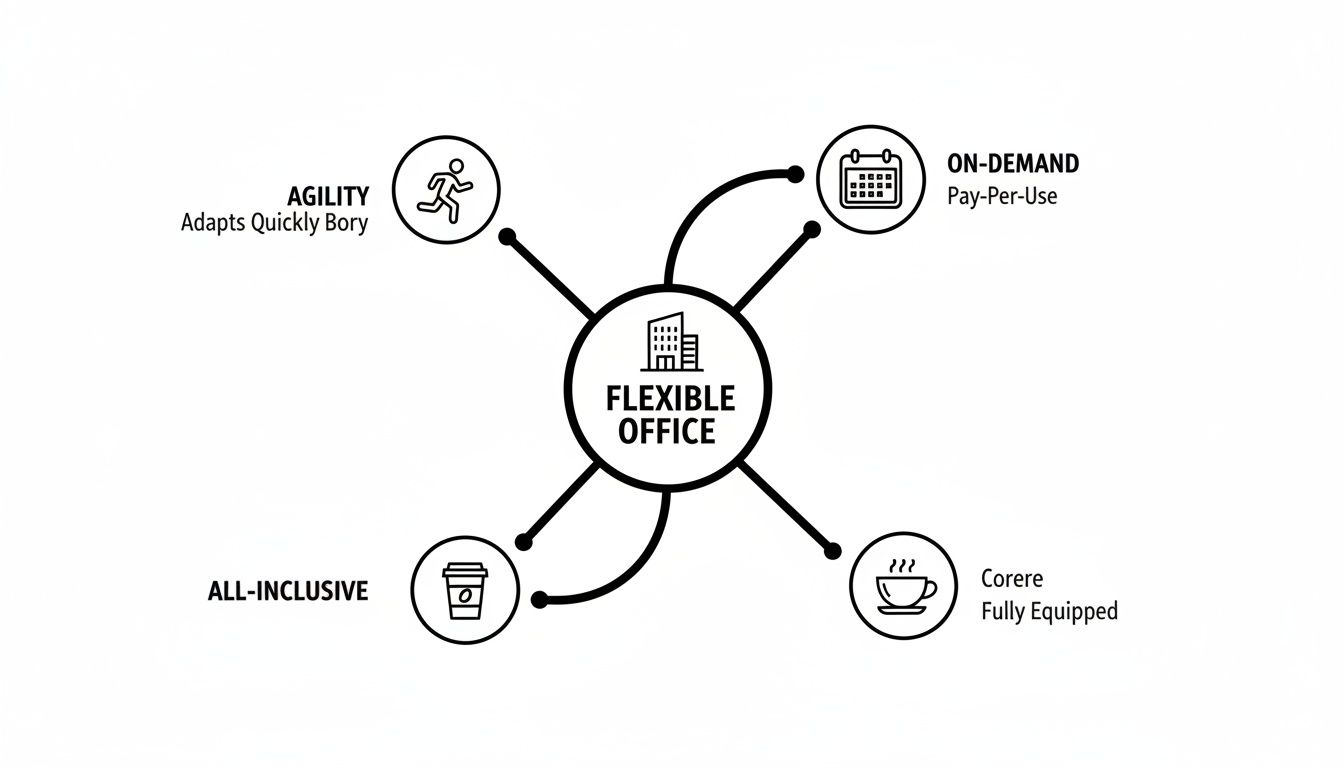
As you can see, the entire model is designed around providing a fully-equipped workspace on demand, freeing you from the headaches of traditional office management.
Serviced Offices: The Turnkey Solution
A serviced office gives you a more private, classic office experience but wraps it in all the benefits of flexibility. You get your own fully furnished, secure office that can be branded for your company, but you skip the long-term lease and the hassle of managing utilities, internet, and cleaning services. The provider takes care of everything, right down to the front-desk reception.
This model is a perfect match for:
- Established businesses that need a professional, private workspace.
- Small to medium-sized enterprises (SMEs) that want a top-tier business address without the massive overhead.
- Teams handling sensitive data that require more privacy and security than a typical coworking space can provide.
A serviced office hits that sweet spot. It offers the independence and professional image of a traditional office but with the agility and all-in-one simplicity of a flexible arrangement. It's no wonder it's such a popular choice for companies on the rise.
Managed Offices and Virtual Offices
Beyond those two mainstays, a couple of other models cater to more specific needs.
A managed or 'plug-and-play' office is a tailored solution for larger companies. Here, the provider does all the legwork—finding the space, designing it to your exact specifications, and managing it for you, all under one simple, flexible contract. It's your office, on your terms, without the property management nightmare.
On the other end of the spectrum is the virtual office. This gives your business a professional mailing address, mail handling, and phone answering services without any physical office space. It’s a super low-cost way for remote-first companies or freelancers to project a professional image from a prime location.
To dive deeper into strategies for optimizing your business operations, check out the great resources on the Seat Leasing BPO blog.
Flexible Workspace Models at a Glance
With several options on the table, it can be tough to see the differences at first glance. This table breaks down the four main models to help you quickly compare them and find the best fit for your business needs.
| Workspace Type | Best For | Privacy Level | Included Services | Typical Contract Length |
|---|---|---|---|---|
| Coworking Space | Freelancers, startups, remote workers seeking community | Low (shared spaces) | WiFi, coffee/tea, printing, community events | Monthly, daily |
| Serviced Office | SMEs, established businesses, teams needing privacy | High (private, enclosed offices) | All coworking perks + reception, mail handling, IT support | 3-12 months |
| Managed Office | Larger companies (20+ people) needing a custom space | Very High (private, branded, self-contained) | Fully bespoke, including design, fit-out, and ongoing management | 1-3+ years |
| Virtual Office | Remote businesses, solopreneurs needing a professional address | N/A (no physical space) | Business address, mail forwarding, phone answering service | Monthly, annually |
Each model provides a unique set of benefits. The key is to match the workspace type to your company's size, culture, and operational requirements.
The True Benefits of a Flexible Office Strategy
So, why are so many businesses ditching the traditional, long-term lease? It’s not just about a shorter contract. The real value comes down to three game-changing advantages that tackle the biggest headaches modern companies face: tight finances, rigid operations, and slow-moving market entry.

This whole approach reframes the office from a fixed, heavy liability into a dynamic tool for growth. It helps businesses stay nimble, efficient, and smart in a world where you never quite know what’s coming next.
Unlock Financial Agility
The first and most obvious win is how it transforms your finances. A traditional office lease is a cash-flow killer right from the start. You're hit with massive upfront costs for security deposits, furniture, IT infrastructure, and renovations before you’ve even turned the lights on.
Flexible offices wipe out almost all of that initial pain. Instead of juggling separate, fluctuating bills for utilities, internet, and maintenance, you get one predictable, all-inclusive monthly fee. Budgeting becomes incredibly straightforward, freeing up your capital for what actually grows the business—your people, your products, and your market share.
Achieve Effortless Operational Scalability
Business needs are never set in stone. One month, a BPO provider might have to bring on 50 new agents for a big client project with just a week’s notice. The next, a startup might need to scale back its team after a funding round. With a traditional lease, you’re stuck, either paying huge penalties to break the contract or bleeding money on empty desks.
Flexible office space gives you an elastic footprint. You can add or remove desks, private offices, or even entire floors on a monthly basis, aligning your workspace costs directly with your real-time business needs and revenue.
This on-demand scalability is a massive competitive edge. It takes the gamble out of long-term real estate commitments and lets your workspace breathe in and out right along with your business. It's no wonder this model is a perfect fit for cost-conscious operations like startups and BPO seat leasers.
The market data backs this up. In 2024, dedicated private spaces make up the largest share at 47%, as bigger companies look for scalable spaces they can still make their own. The global flexible office market is also set to explode, projected to leap from USD 47.02 billion in 2025 to USD 196.17 billion by 2034. You can dig into more stats on the growth of the flexible office market.
Capitalize on Strategic Speed
In business, speed wins. The old-school process of finding, leasing, and fitting out an office can easily drag on for six to twelve months. In today’s world, that’s an eternity—long enough to miss a critical window of opportunity, like being the first to launch in a new city.
A flexible office strategy puts you in the fast lane. You can get a professional, fully functional office up and running in a new market in just a few days. This speed allows you to:
- Test new markets with minimal risk and financial commitment.
- Spin up temporary project teams for specific, time-sensitive jobs.
- Set up regional hubs to support a distributed workforce without the usual delays.
By getting rid of the real estate bottleneck, companies can jump on opportunities the moment they appear, leaving competitors stuck in the slow lane, tangled up in their outdated property deals.
Flexible Leases vs. Traditional Leases: A Head-to-Head Comparison
Choosing an office used to be a straightforward—if monumental—decision. The only real option was a traditional lease, which felt a lot like buying a house. It demanded a huge financial commitment upfront, locked you into a long-term relationship, and left you on the hook for every single detail, from buying furniture to fixing the Wi-Fi.
That old model is rigid and slow, built for a business world that’s long gone. A flexible office space, by comparison, is more like renting a fully-serviced, all-inclusive apartment. You can decide you need it today, move in tomorrow with zero hassle, and leave with relatively short notice if your plans change.
This fundamental difference in approach creates a clear divide. Let's break down exactly how these two models stack up against each other.
Flexible Leases vs Traditional Leases a Head-to-Head Comparison
When you dig into the details, the differences between flexible and traditional office leases become stark. It's not just about the length of the contract; it's about cost, responsibility, and the freedom to adapt. This table lays out the core distinctions side-by-side.
| Feature | Flexible Office Space | Traditional Office Lease |
|---|---|---|
| Lease Term | Short-term; typically month-to-month or 1-2 years. | Long-term; usually 5-10 years or more. |
| Upfront Cost | Low; often just a one-month security deposit. | Extremely high; includes a large deposit, fit-out, furniture, and IT setup. |
| Monthly Payments | One all-inclusive fee covering rent, utilities, internet, etc. | Multiple separate bills for rent, utilities, cleaning, internet, and maintenance. |
| Speed to Occupy | Fast; can move in within days or even hours. | Slow; can take 6-12 months from signing to move-in. |
| Management | Professionally managed by the provider's on-site team. | Self-managed; you are responsible for all operations. |
| Scalability | Easy to scale up or down as your team size changes. | Very difficult and expensive to change your space mid-lease. |
| IT & Security | Managed by the provider with enterprise-grade infrastructure. | Tenant's responsibility to set up, manage, and secure. |
Ultimately, the choice comes down to what you value most: the total control (and total responsibility) of a traditional space, or the agility and cost-efficiency of a flexible one.
Commitment and Contract Terms
The biggest difference comes down to the lease itself. Traditional leases are long-term commitments, typically demanding you sign on for 5 to 10 years. Trying to break that contract early triggers massive financial penalties, making it a high-stakes decision that can hamstring a company’s ability to adapt.
On the other hand, flexible office space is built on short-term agreements. Contracts often run on a monthly or yearly basis, giving you the freedom to scale up, downsize, or relocate as the market dictates. This agility is a core advantage, turning your office from a fixed anchor into a dynamic asset.
Upfront Costs and Ongoing Expenses
Securing a traditional office is an incredibly capital-intensive process. You are on the hook for:
- A substantial security deposit, often several months' rent.
- The entire cost of fitting out the space—construction, wiring, and design.
- Purchasing all furniture, from desks and chairs to kitchen appliances.
- Setting up IT infrastructure, phone lines, and internet contracts.
This can easily add up to tens or even hundreds of thousands of dollars before you even open your doors.
A flexible workspace wipes out nearly all of these upfront costs. You walk into a fully furnished and equipped office from day one. Instead of juggling dozens of separate bills for rent, utilities, internet, cleaning, and security, you pay one simple, all-inclusive monthly fee.
This bundled approach provides total cost certainty. It transforms unpredictable capital expenditures into a predictable operational expense, making budgeting far simpler and freeing up cash for core business activities like hiring and marketing.
Management and Operational Burden
With a traditional lease, you’re not just a tenant; you’re an office manager. You or your staff are responsible for everything: dealing with internet outages, managing cleaning crews, restocking supplies, and handling building maintenance issues. This administrative burden is a constant distraction from your real business goals.
Flexible office providers take on this entire operational load. A dedicated on-site team handles all day-to-day management, reception services, mail handling, and tech support. This "workspace-as-a-service" model allows your team to focus 100% on their work, boosting productivity and removing hidden operational headaches.
The choice becomes clear: do you want to be in the business of managing an office, or do you want to focus on growing your company?
How Different Industries Win with Flexible Offices
The real magic of flexible office space isn't just the concept; it's seeing how different businesses put it to work to solve real-world problems. This isn't a one-size-fits-all solution. Think of it as a versatile toolkit that helps turn operational headaches into a genuine competitive edge.

For a startup on the rise, a flexible office delivers a prestigious business address and professional infrastructure without burning through venture capital on a long-term lease. It lets them project a polished image to investors and clients while staying financially nimble.
BPOs and Seat Leasing
Business Process Outsourcing (BPO) companies live and breathe adaptability. When a new client contract suddenly demands you onboard 50 new agents in two weeks, a traditional office lease simply isn't an option. It's a non-starter.
This is exactly where the seat leasing model becomes a game-changer. BPOs can rent fully-equipped workstations on a per-seat, per-month basis, which perfectly matches their real estate costs to their project revenue. No more paying for empty desks during lulls. This turns a massive fixed cost into a manageable variable one—a critical advantage in the fast-paced BPO world.
Corporations Testing New Markets
Even large corporations use flexible offices as a low-risk strategic tool. A global company can set up a small regional hub in a serviced office to test a new market, all without the monumental commitment of a ten-year lease.
If the market takes off, they can easily scale up their team and space. If it doesn't pan out, they can pack up and exit cleanly, avoiding a costly real estate disaster. This kind of agility makes market expansion faster and far more financially sound.
This approach is part of a much bigger trend. Companies of all sizes are now building flexible options into their property portfolios to gain better cost control and agility. The global flexible workspace market was already valued at USD 33.23 billion in 2020 and is projected to hit USD 73.03 billion by 2026. You can find more details on this incredible growth from research on the flexible workspace market.
The message is loud and clear: flexibility is no longer just a nice-to-have perk. It’s a core business strategy.
Choosing the Right Flexible Office Partner
Once you’ve decided that a flexible office is the way to go, the real work begins: picking the right provider. This isn't a decision to take lightly. The right partner becomes a silent, powerful extension of your business operations. The wrong one? It can be a constant source of friction and headaches.
It’s tempting to just look at the monthly price, but that’s a rookie mistake. A truly great partner supports your long-term goals, and that value goes far beyond the rent.
Your first stop should be their IT infrastructure. Get specific. Ask them about their internet redundancy—what happens if the primary connection goes down? Dig into their data security and cybersecurity protocols. In a shared space, this is non-negotiable. Having on-site tech support available can also be a lifesaver.
The right flexible office isn't just a space; it's a service ecosystem. Your provider's reliability in technology, support, and community management directly impacts your team's productivity and your business's professional image.
After you're confident in their tech, it's time to weigh the community against the contract terms. You need a balance that works for your team.
Evaluating Key Provider Differentiators
Think about the professional environment. Walk through the space. Do the other companies there seem like potential collaborators or clients? A vibrant, professional community can spark unexpected partnerships and ideas, adding a layer of value that you just can't put a price on.
Finally, get into the nitty-gritty of the contract. How "flexible" is their flexibility, really? A good partner has a crystal-clear process for adding or removing desks as your team changes, without slapping you with hidden fees. Check online reviews or ask for references to gauge their reputation for responsive support—this is often the best predictor of your future experience.
For businesses in the BPO world, finding a provider who gets the specific demands of seat leasing is absolutely essential. You need a partner who understands your operational needs inside and out. To see what a specialized provider can offer, check out the solutions at Seat Leasing BPO.
By carefully vetting these key areas—IT, community, contract terms, and support—you'll be able to confidently choose a flexible office partner who is genuinely invested in your success.
Common Questions About Flexible Offices
Even with all the clear advantages, I find that business leaders still have some very practical questions before they’re ready to jump into a flexible office. Moving away from something as established as a traditional lease can feel like a big step, so let's tackle the most common concerns I hear all the time.
The first question is almost always about the money. People look at a monthly rate for a flexible desk and think it seems high compared to a square-foot lease rate. But that’s not an apples-to-apples comparison. You have to look at the total cost of ownership, which is often drastically lower in a flexible space.
Think about it: one predictable monthly fee covers everything. Your rent, utilities, high-speed WiFi, furniture, security, and even cleaning services are all bundled together. This completely sidesteps the huge upfront costs and the never-ending surprise bills that come with running a traditional office, saving most businesses a significant amount of cash.
Can I Customize a Flexible Office to Match My Brand?
You absolutely can. While the open coworking areas are communal by design, most providers offer private offices, suites, and even entire floors that are yours to customize. You can bring in your company logos, paint the walls in your brand colors, and set up the furniture to fit exactly how your team works.
This is where "managed" or "plug-and-play" solutions really shine. They give you a fully bespoke, branded headquarters without the financial headache and long-term chains of a traditional lease. You get a space that truly feels like it’s yours, but with the freedom to change and grow.
How Secure Is My Data in a Shared Office Environment?
This is a big one, and rightly so. Any reputable provider puts security at the very top of their list. They invest heavily in enterprise-grade security measures to keep your business safe.
We’re talking about secure firewalls, private networks (VLANs) for each company to isolate their traffic, and serious physical security like 24/7 surveillance and keycard-only access. It’s their business to protect your business.
Still, it's smart to do your homework. Always ask a potential provider for the specific details of their security protocols to make sure they meet your company's compliance standards. If you have any more questions about security or getting your team set up, our experts can find the answers you need.
At Seat Leasing BPO, we provide secure, scalable, and cost-effective flexible office solutions that let you focus on what you do best. Explore our options at https://seatleasingbpo.com.