So, what exactly is a shared service provider?
Think of it as a central hub inside a business that handles essential, everyday tasks for everyone. Instead of each department—say, marketing, sales, and operations—having its own separate IT person, HR coordinator, or finance clerk, a shared service provider bundles these functions into one specialized team. This single unit then serves the entire organization.
The whole point is to stop duplicating effort, create consistent processes, and give every department access to top-tier support without the massive overhead. It frees up your core teams to focus on what they do best: driving the business forward.
Understanding the Shared Service Provider Model
Here’s a simple analogy: imagine a modern apartment building. It wouldn’t make sense for every single resident to buy, install, and maintain their own industrial-sized water heater, backup generator, or security system. That would be wildly expensive and inefficient. Instead, the building management provides these as centralized, shared utilities. Everyone gets reliable, professional-grade services without the individual cost and hassle.
A shared service provider does the exact same thing, but for a business.

It’s a strategic shift away from having siloed support roles scattered across the company. That consolidated team becomes highly efficient, developing deep expertise that benefits everyone.
To make this crystal clear, here’s a quick breakdown of what a shared service provider is all about.
Shared Service Provider At a Glance
| Core Concept | Primary Goal | Common Services | Key Benefit |
|---|---|---|---|
| A central, internal unit that provides specific business functions to multiple parts of the same organization. | To improve efficiency, reduce costs, and standardize processes by eliminating redundant work. | IT Support, Human Resources, Finance & Accounting, Cybersecurity, Facilities Management. | Achieving economies of scale and accessing specialized expertise without each department bearing the full cost. |
Ultimately, this model is designed to streamline the necessary but non-core parts of a business.
The Core Idea: Centralization for Efficiency
At its heart, the shared services model is about achieving economies of scale and operational excellence. When you centralize common business processes, a few powerful things happen:
- Standardize Workflows: You get consistency. Whether it's how an IT ticket is resolved or how a new employee is onboarded, best practices are applied uniformly across the entire company.
- Reduce Redundancy: You stop paying for the same job to be done by multiple people in different departments. This directly cuts down on staffing, software licenses, and other operational costs.
- Increase Expertise: The centralized team becomes a center of excellence. These professionals handle these specific tasks all day, every day, allowing them to develop deep knowledge and provide a much higher level of service.
The thinking behind adopting a shared services model is refreshingly simple: do more with less. It's about turning background operational functions from cost centers into genuine strategic assets that add real value and help the company grow.
This isn’t just some internal shuffle; it’s a fundamental move toward smarter, more agile operations. The market reflects this. The global shared services market was valued at a huge $58.98 billion in 2024 and is on track to hit an incredible $473 billion by 2035. That kind of explosive growth signals a massive worldwide shift away from isolated, departmental functions and toward this more collaborative, efficient model.
By pooling resources, companies gain access to capabilities that might have otherwise been too expensive or complex. For a business looking to scale, this model provides the perfect foundation. You can grow your operations without the usual pains of hiring dozens of new support staff and building out new infrastructure. It’s exactly this principle that we at Seat Leasing BPO embody by providing fully managed workspaces that handle all the operational heavy lifting for you.
The Core Services Shared Providers Offer
So, what exactly can you hand off to a shared service provider? While the menu of options is broad, the services usually fall into a few key categories that represent the operational engine of any business. By centralizing these tasks, an SSP gives you immediate access to a deep bench of specialists—the kind of talent that's often too expensive or difficult to build from scratch.
Think about it this way: instead of hiring one IT generalist who's a jack-of-all-trades but a master of none, an SSP delivers a full team with dedicated experts in networking, security, and hardware support. This creates a level of operational strength and resilience that's typically out of reach for most small and medium-sized businesses.
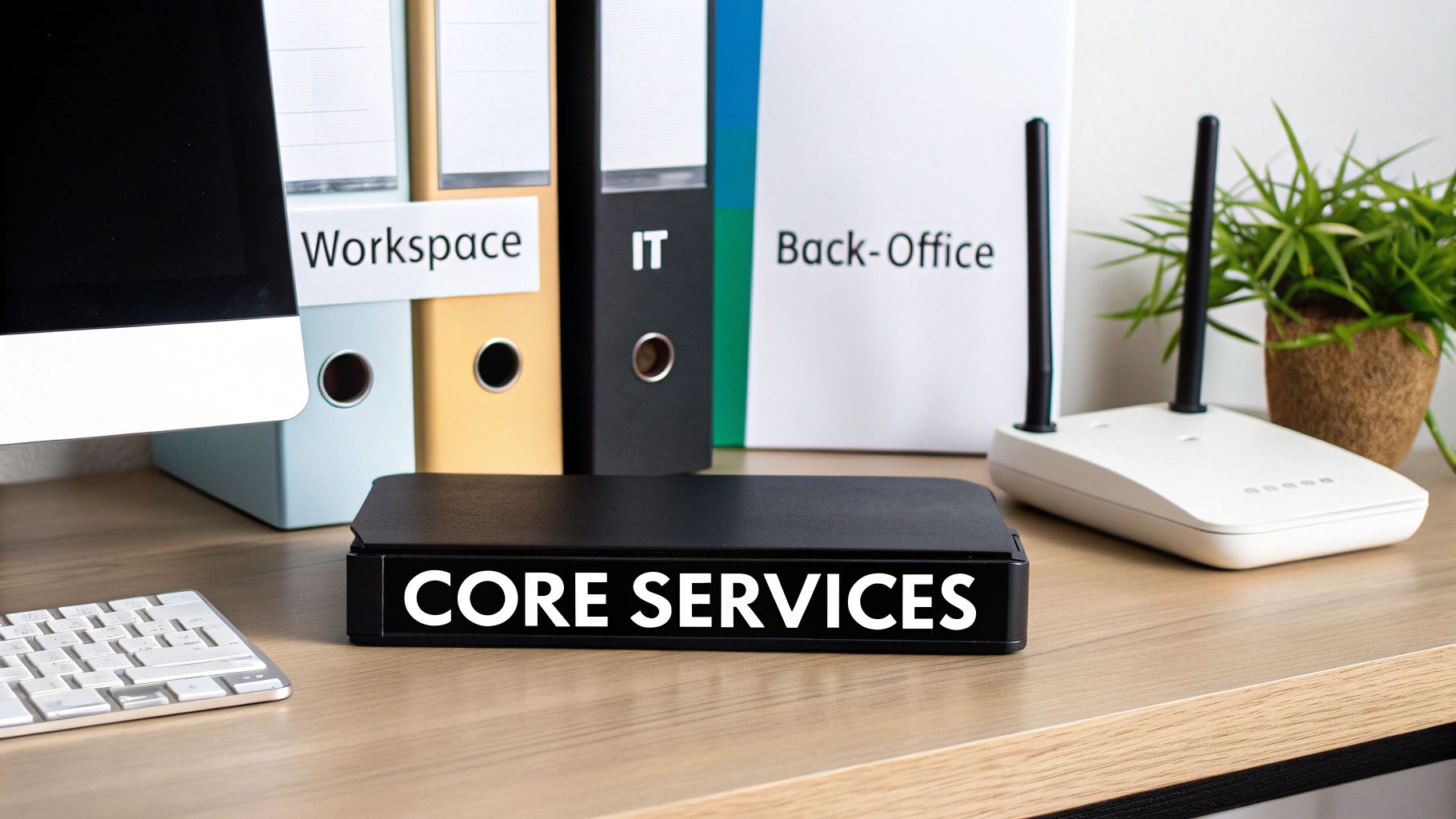
This centralized expertise doesn't just fix problems faster; it proactively manages your systems to stop issues from ever happening.
Workspace and Facilities Management
One of the most obvious and tangible services is the physical office itself. This isn't just about renting a desk and a chair. It's about providing a fully managed, ready-to-go workspace where your team can walk in and be productive on day one.
Core services in this area typically include:
- Fully Furnished Office Space: This covers everything from ergonomic chairs and desks to meeting rooms and lounge areas, saving you from the massive capital expense of a traditional office fit-out.
- Utilities and Maintenance: All the essentials like power, water, and HVAC are handled by the provider, along with daily cleaning and general building upkeep.
- Physical Security: Expect access control systems, on-site security personnel, and surveillance to keep your team and company assets safe.
By bundling these physical infrastructure costs, a shared service provider can slash a company's operational overhead by as much as 50% compared to leasing and managing a traditional office space on your own.
This "plug-and-play" model is a game-changer for any company that needs to get up and running quickly without getting tangled up in real estate deals and logistical nightmares.
IT and Technology Infrastructure
In any business today, technology is the lifeblood. A shared service provider acts as the guardian of that technology, ensuring your systems are powerful, reliable, and secure. They take care of the complex technical infrastructure that's absolutely critical for operations but isn't part of your core business.
This usually involves a whole host of technical functions:
- Network Management: Delivering stable, high-speed internet with built-in redundancies to prevent the kind of downtime that costs you money.
- Hardware and Software Support: Managing workstations, servers, and software licenses, while also providing an expert help desk for your employees.
- Cybersecurity: Deploying enterprise-grade security measures like firewalls, data encryption, and constant monitoring to shield your sensitive information from threats.
Essential Back-Office Support
Beyond the physical space and the digital backbone, many SSPs also offer support for crucial administrative and financial tasks. These are the repetitive, process-heavy functions that are vital for keeping the lights on but can easily distract your team from revenue-generating activities.
Common back-office services include:
- Human Resources (HR): Handling payroll, benefits administration, and employee onboarding.
- Finance and Accounting: Managing accounts payable, accounts receivable, and financial reporting.
- Procurement: Centralizing the purchasing of supplies and equipment to get better prices through bulk buying.
By consolidating these functions, the shared service provider model brings consistency and efficiency, turning operational chores into a genuine strategic advantage.
The Real-World Payoffs: What You Actually Get
Switching to a shared services model isn't just about shuffling boxes on an org chart. It's a strategic move that delivers some serious, compounding advantages. Businesses that embrace this approach typically see three core benefits that hit the bottom line and sharpen their competitive edge. These aren't just fluffy concepts—they're real outcomes that change how you operate and grow.
The first and most obvious win is a major cut in your expenses. It really comes down to two things. First, you get to sidestep massive capital expenditures (CapEx). Forget about shelling out cash for servers, office furniture, or complex security hardware. You’re essentially renting access to top-tier infrastructure, turning a huge upfront investment into a predictable monthly bill.
Second, your day-to-day operational expenditures (OpEx) also drop. Because you're sharing resources like expert IT teams, administrative staff, and even the electric bill with other companies, you get the benefit of economies of scale. Your provider buys software licenses and office supplies in bulk, and those savings get passed right along to you.
To see how this stacks up against running everything yourself, let's break it down.
Shared Services vs Traditional Operations
This table gives a clear, side-by-side look at how the shared service model compares to the old-school, siloed way of doing things.
| Factor | Traditional In-House Model | Shared Service Provider Model |
|---|---|---|
| Cost Structure | High upfront CapEx, fixed OpEx. | Low/no CapEx, predictable, scalable OpEx. |
| Resource Allocation | Often redundant; each department has its own staff. | Centralized and efficient; experts serve multiple teams. |
| Scalability | Slow and expensive; requires new hires and long-term leases. | Fast and flexible; scale up or down on demand. |
| Expertise | Limited to the talent you can afford to hire full-time. | Access to specialized, high-cost talent is included. |
| Speed | Bureaucratic and slow; long setup times for new projects. | Plug-and-play; new teams can be operational in days. |
| Focus | Management is bogged down with operational details. | Leadership can focus on core business strategy and growth. |
As you can see, the shift is pretty dramatic. It’s less about just saving money and more about building a smarter, more resilient operational foundation.
Gaining True Operational Flexibility
Beyond the savings, a shared service provider gives you a level of flexibility that’s almost impossible to achieve on your own. Let’s say you need to spin up a new project team. Traditionally, that means a painful hunt for office space, getting locked into a multi-year lease, buying a truckload of equipment, and going through a long hiring process. It can take months.
With a shared services partner, you can add or subtract people almost instantly. This agility lets you jump on market opportunities or scale back during slow periods without the usual friction and financial headaches.
A business's ability to pivot quickly is its greatest asset. The shared service model removes the operational anchors that slow companies down, allowing them to scale resources in precise alignment with their current needs, not a five-year real estate forecast.
This kind of adaptability transforms your operations from a rigid cost center into a flexible asset that actually fuels your growth.
Getting to Market Faster Than Your Competition
When you combine lower costs with incredible flexibility, you get the ultimate prize: a dramatic increase in your speed to market. Think about it. When you can get a new team or a new project up and running in a new location in a few days instead of a few months, you can seize opportunities your competitors are still planning for.
This is possible because the entire infrastructure is already built and waiting for you. The office is set up, the IT network is secure, and the support staff knows what they’re doing. You just plug your people in and they can start working immediately.
This isn’t just a minor improvement; it fundamentally rewrites the timeline for expansion. It's a key reason why the shared services market is projected to grow by an astounding USD 492.6 billion between 2024 and 2029. And with 77% of providers planning to expand their service offerings, this model is only getting more powerful. You can read more about these market projections and trends on Technavio.com.
Shared Services, Outsourcing, and Managed Services: What's the Difference?
When you start looking for ways to run your business more efficiently, you’ll hear a lot of terms thrown around: shared services, outsourcing, and managed services. They sound similar, and people often use them interchangeably, but they represent very different ways of getting things done.
Picking the right model isn't just a matter of semantics—it's a strategic decision that affects your costs, your control, and how well the service aligns with your long-term goals.
Let's break it down with a simple analogy. Imagine your company needs cars for its employees.
- In-House: This is the old-school way. You buy the cars, you insure them, you handle all the maintenance, and you manage the entire fleet yourself. You have total control, but it's also the most expensive and time-consuming option.
- Outsourcing: This is like calling an Uber or a taxi every time someone needs a ride. It’s a purely transactional service focused on a single task: getting from point A to B. The main driver is usually immediate cost savings, not a long-term partnership.
- Managed Services: Think of this as leasing a fleet. A separate company provides the cars and takes care of everything—insurance, maintenance, repairs—for a fixed monthly fee. You get all the benefits of having cars available without the day-to-day headaches of owning them.
- Shared Services: This is like creating a corporate motor pool. A dedicated department within your own organization manages a fleet of vehicles that different teams can use. The focus is on standardization, sharing costs, and making the entire company more efficient.
The real distinction comes down to the relationship and the goal. Outsourcing is tactical and external. A shared service provider, on the other hand, is more like a strategic partner—often an internal one—dedicated to optimizing how the whole organization works.
Which Model Is Right for Your Business?
The best choice hinges on what you want to achieve. Outsourcing is great for one-off tasks, while a managed service offers a deeper partnership focused on specific outcomes. A shared service provider, however, is woven into the fabric of the organization, motivated by the company's overall success rather than a typical client-vendor relationship.
This is where the power of the shared service model really shines.
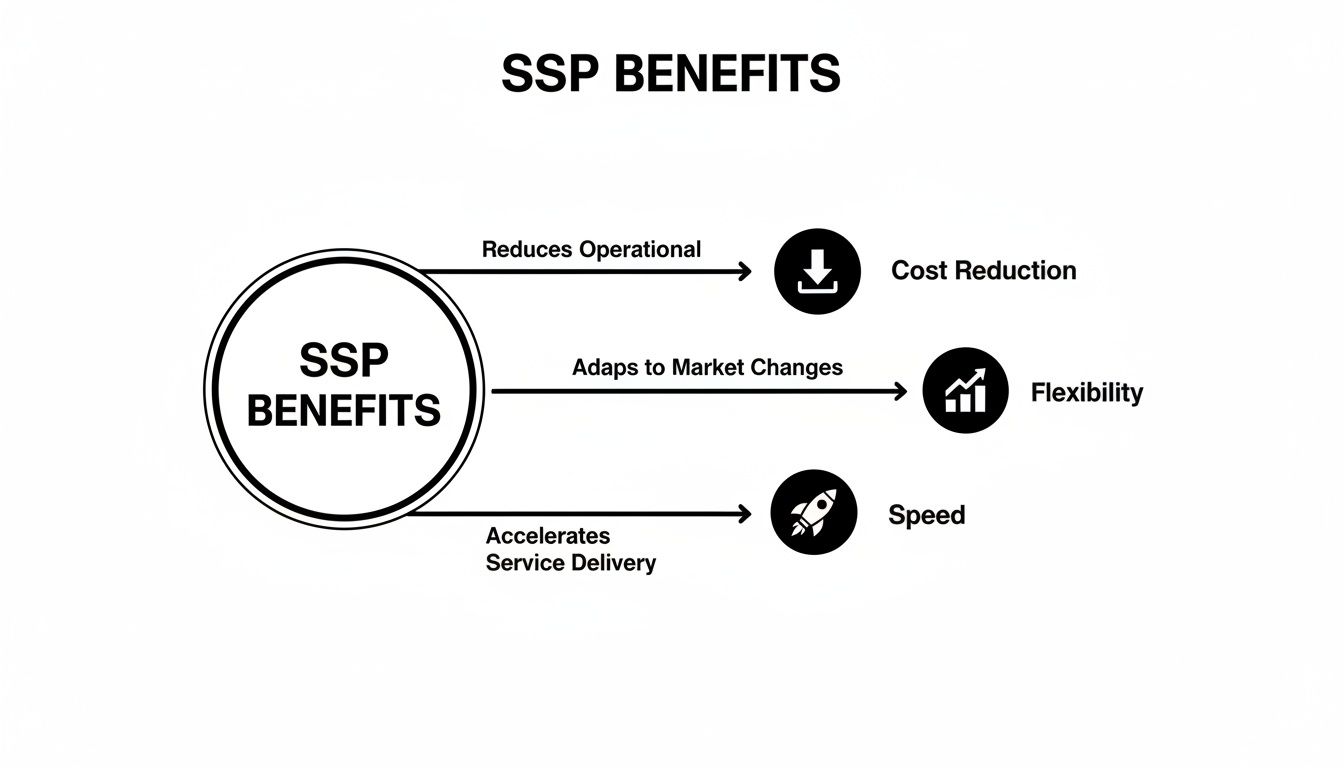
As you can see, it’s all about delivering tangible results: serious cost reduction, greater flexibility to adapt, and the speed to get things done faster.
And this isn't just a niche strategy for corporate giants anymore. The shared services market is booming, especially for small and medium-sized businesses. The market was valued at USD 31.8 billion in 2022 and is expected to grow at a blistering 24.1% CAGR through 2030. What's driving this? The universal need for smarter, more agile operations. This trend is making high-level efficiency accessible to companies of all sizes.
Ultimately, choosing your model depends on your strategic priorities. If you're looking to build long-term internal efficiency and standardize your processes for a stronger foundation, the shared service provider model is definitely worth a closer look.
You can explore more strategies and expert insights over on the Seat Leasing BPO blog.
How Seat Leasing Puts the Shared Service Model into Practice
So, how does the idea of a shared service provider play out in the real world? This is where a model like seat leasing truly shines. It takes the abstract benefits of shared services and turns them into a practical, powerful solution for any business needing a physical workspace and the operational support that comes with it.
The seat leasing model is a perfect real-world example of shared services in action. All those theoretical advantages we talked about—cost savings, flexibility, and speed—suddenly become very real.
The promise of cost savings isn't just a line item on a spreadsheet; it's a real, immediate drop in your overhead. Flexibility means you can genuinely scale your team up or down without getting trapped in long-term leases or pouring money into an office build-out. And rapid deployment? That’s having a fully-equipped, 'plug-and-play' office ready for your team in days, not months.

At its core, this model bundles everything you need—from IT support and facilities management to security and utilities—into one straightforward, predictable cost per seat.
Real-World Scenarios Where This Just Works
The true value of this approach clicks when you see how it helps different businesses sidestep common growing pains. Seat leasing removes the operational headaches so companies can get back to doing what they do best.
Let’s look at a few examples of this shared service model in action:
- The Startup Launchpad: Imagine a brand-new tech startup. They need a professional office to attract talent but can’t stomach the sky-high costs of a traditional lease. Seat leasing gives them access to an enterprise-level workspace and IT setup from day one, so their precious capital can go toward building their product, not buying desks.
- The BPO Scaling at Speed: A business process outsourcing (BPO) company just landed a huge client and needs to onboard 50 new agents—fast. The old way meant months of searching for real estate and setting up a new site. With seat leasing, they can have those 50 agents in fully-equipped seats and ready to work in under a week.
- The Market-Testing Enterprise: A large, established company wants to dip its toes into a new city. Instead of committing to a risky, long-term commercial lease, they can use seat leasing to launch a small, agile team. It’s the perfect low-risk way to test the waters and see if the expansion makes sense.
For any growing business, the ability to eliminate operational drag is a massive competitive advantage. Seat leasing turns the office from a fixed liability into a flexible, on-demand asset.
This is what makes the shared service provider concept so compelling. It’s not just theory; it’s a practical tool for smart, sustainable growth.
How to Choose the Right Shared Service Partner
Picking the right shared service provider is more like choosing a business partner than hiring a simple vendor. This isn't just a transaction; it's a long-term relationship. The success of the whole venture depends on finding a partner whose culture, capabilities, and vision truly line up with your own. Rushing this decision without doing your homework is a recipe for service gaps and a lot of operational headaches down the road.
That’s why a careful, structured evaluation is so important. Don’t let the price tag be your only guide. You need to dig deep into the provider's operational muscle, their security setup, and how committed they are to helping you grow. The best partners feel like a natural extension of your own team, always one step ahead of your needs.
Evaluating Service Level Agreements and Scalability
Your first stop should be a deep dive into the Service Level Agreement (SLA). Think of this document as the constitution of your partnership—it needs to be airtight and crystal clear. Vague promises are a major red flag.
Look for specific, measurable guarantees that you can hold them to. Pay close attention to:
- Performance Metrics: What are the exact uptime percentages they guarantee for IT systems and internet connectivity? What are the promised response and resolution times for any support tickets you raise?
- Scalability Terms: How fast can you add or even remove seats? Are there penalties for scaling down your team? What’s the process for a sudden, short-notice expansion?
- Reporting and Transparency: Will you get access to a dashboard or regular reports that track key performance indicators (KPIs)? You need to see the data for yourself.
A rock-solid SLA protects your business and keeps everyone on the same page. But the contract's flexibility is just as crucial. The right partner will give you terms that let you pivot and adapt to market changes without being stuck in a rigid, unforgiving agreement.
The best shared service providers are not just vendors; they are growth partners. They invest in their technology and processes because they understand that their success is directly tied to yours. Look for a team that is genuinely interested in your long-term objectives.
Assessing Security and Technology Infrastructure
When you’re sharing resources, security isn't just a feature—it's everything. Your provider absolutely must show a serious, provable commitment to protecting your company’s sensitive information. Don’t hesitate to ask the tough questions about their security protocols.
Here are a few key areas to investigate:
- Compliance and Certifications: Do they hold important industry certifications like ISO 27001? This shows they meet global security standards.
- Data Protection: How do they manage data encryption, both in transit and at rest? What do their access controls look like? How secure are their physical facilities?
- Technology Stack: Is their network infrastructure modern and reliable? Do they have redundancy built in to prevent outages?
A provider running on an outdated or poorly managed tech stack is a huge risk to your business. If you need help creating a checklist for your business, get in touch with our team of experts for a personalized consultation.
Got Questions About Shared Services? We've Got Answers.
Here are some of the most common questions we hear when people are figuring out if a shared service provider is the right move for their business. Let's clear things up.
How Is a Shared Service Provider Different From a Coworking Space?
It's a great question because, on the surface, they can look similar. But think of it this way: a coworking space is like a landlord, while a shared service provider is more like an operational partner.
Coworking is all about flexible real estate. You get a desk, a chair, and a Wi-Fi password. It's a fantastic solution if you just need a place to work. A shared service provider, however, goes much, much deeper. They don't just give you a desk; they deliver the entire business engine that runs on top of it—fully managed IT support, cybersecurity, HR functions, and building management. You're not just renting space; you're plugging into a complete, ready-made operational framework.
Aren't Shared Services Just for Big Corporations?
That's a myth we're happy to bust. While it's true that huge corporations first developed this model to streamline their internal departments, today's shared service providers offer incredibly scalable solutions that are a perfect fit for startups and small-to-medium businesses (SMBs).
In fact, the benefits of cost savings and agility are often more critical for a smaller company. Working with an SSP gives you immediate access to enterprise-level technology, security, and talent without the crippling upfront investment. It’s a way to level the playing field and compete with the big guys.
A shared service provider lets a small business punch way above its weight. It’s about gaining the same operational muscle that used to be reserved only for massive enterprises—a huge advantage for scaling up.
What About Data Security in a Shared Environment?
Security is everything, and any SSP worth its salt knows this. Reputable providers invest heavily in enterprise-grade security infrastructure—often far more than a single small or medium-sized business could afford on its own. It's a core pillar of their business, not an add-on.
When you're vetting a provider, you need to dig into their security posture. Look for tangible proof of their commitment:
- Industry Certifications: Is the provider certified with globally recognized standards like ISO 27001? This is a strong indicator they adhere to best practices for managing information security.
- Robust Protocols: Don't be shy about asking the tough questions. What are their data encryption methods? How do they handle access control? What about physical security at their facilities?
- Dedicated Teams: The best providers have a team of security professionals whose only job is to monitor for threats and keep everything locked down.
Make sure all these security promises are clearly spelled out in your Service Level Agreement (SLA). It’s non-negotiable.
Ready to see how a shared service model can slash your operational costs and accelerate your growth? Seat Leasing BPO provides a plug-and-play workspace solution that handles all your backend needs so you can focus on what matters most. Discover how our model works.