At its core, VoIP in call centers is about one simple, powerful change: making and taking calls over the internet instead of old-fashioned phone lines. It’s the single biggest reason today's contact centers are so agile, affordable, and packed with features. Think of it like the jump from mailing a letter to sending an email—VoIP is just a faster, smarter, and cheaper way to communicate.
Why VoIP Is The Engine Of The Modern Call Center

Picture a call center from about ten years ago. You’d see rows of desks, each one physically tethered to a clunky phone system by a mess of wires. In the back, a server room would be humming with expensive, specialized hardware. If you wanted to add a new agent, you had to call a technician, wait for them to install a new line, and pay a hefty installation fee. Scaling down? Tough luck—you were stuck paying for lines you weren't even using.
Now, contrast that with a modern call center running on VoIP. Agents can work from literally anywhere with a decent internet connection, needing only a laptop and a headset. A manager can add or remove 50 agents from the system with just a few clicks in a software dashboard. This isn't just a small improvement; it's a complete reimagining of how call center operations work.
The Core Differences at a Glance
VoIP works by converting your voice into digital data and sending it over the internet, completely bypassing the physical limitations of traditional copper wires. This is what unlocks its massive potential for efficiency and growth. To really see what's possible, it’s worth looking at the capabilities offered by the best business VoIP providers on the market today.
This shift isn't just a niche trend; it's driving huge market growth. The global VoIP services market hit an impressive USD 172.49 billion in 2025 and is projected to climb to USD 308.41 billion by 2030. Much of this explosion is fueled by cloud-based contact centers, where businesses have reported cutting their Average Handle Time (AHT) by up to 40% by using advanced VoIP analytics. The numbers don't lie: moving to VoIP isn't just about saving a few bucks—it's about fundamentally working smarter.
From Clunky Hardware to Agile Software
The contrast between old and new phone systems is stark and shows why holding onto outdated technology is a serious competitive risk. Traditional phone systems lock you into a rigid, expensive model. VoIP, on the other hand, gives you the flexibility you need to adapt and succeed.
The core advantage of using VoIP in call centers is transforming your communication system from a fixed cost center into a flexible, scalable asset. It gives you the power to adapt to business demands in real-time.
To make this crystal clear, here’s a quick breakdown of how the two systems stack up.
Traditional Phone Lines vs VoIP in Call Centers
This table quickly highlights the core differences between outdated telephony and modern VoIP solutions for call center operations.
| Feature | Traditional Phone System (PSTN) | VoIP System |
|---|---|---|
| Infrastructure | Requires physical copper wires, on-premise PBX hardware | Runs over the internet; can be cloud-hosted or on-premise software |
| Scalability | Slow and expensive; requires technician visits | Instant and easy; add/remove users through a software dashboard |
| Cost Model | High upfront CAPEX, ongoing maintenance contracts | Low OPEX, predictable monthly subscription (per user) |
| Geographic Mobility | Tied to a physical address; high costs for long-distance calls | Location-independent; agents can work from anywhere with internet access |
| Advanced Features | Basic calling; advanced features are expensive, complex add-ons | Features like IVR, ACD, and call recording are often built-in and standard |
As you can see, VoIP isn't just a different way to make calls—it’s a completely different operational philosophy that prioritizes flexibility and efficiency over rigid, physical hardware.
The Real-World Wins of VoIP in a Call Center
Moving your call center from an old-school phone system to VoIP in call centers isn't just about swapping out hardware. It’s about completely rethinking how your operation runs, spends money, and serves customers. The advantages aren't just technical novelties; they deliver real, measurable results to your bottom line and your team's agility.
Think about a growing e-commerce business stuck with a traditional phone system. Their monthly bill is a nightmare of line rentals, per-minute charges, and shocking international rates. Adding a new agent means buying a pricey, proprietary phone and calling in a technician. It’s a model that drains capital (CapEx) and is full of unpredictable costs.
Now, let's flip the script with VoIP. That same business now has a simple, predictable per-user monthly fee. International calls are suddenly a fraction of the cost, sometimes as low as $0.0040 per minute on certain VoIP-to-VoIP connections. There's no expensive hardware to buy or maintain. This move from heavy upfront investment to a manageable operating expense (OpEx) is huge, especially for businesses using a Seat Leasing BPO model where keeping initial costs down is everything.
Scale on a Dime, Work from Anywhere
One of the biggest headaches for any call center manager is handling fluctuating demand. With a traditional setup, preparing for a seasonal rush—like the holidays for a retail brand—is a slow and expensive ordeal. You’re ordering new phone lines weeks ahead of time, and when things quiet down, you're stuck paying for that extra capacity until the contract is up.
VoIP in call centers makes this problem disappear. The whole system is software-driven, so you can add or remove agent seats with just a few clicks in a web portal.
With a VoIP system, you finally have the power to scale your team on demand. Need to bring on 20 temporary agents for a Black Friday sale? They can be set up and taking calls in minutes, not weeks. Once the rush is over, you can scale back down just as fast, only paying for what you used.
This flexibility also untethers your team from the office. Before VoIP, your agents were chained to their desks. Now, they can log in and work from anywhere with a decent internet connection—a different office, their home, or even a coworking space halfway around the world. This doesn't just open up a global talent pool; it provides a level of business continuity that was once impossible.
Powerful Features That Were Once Expensive Add-Ons
Old phone systems gave you the basics: caller ID and voicemail. Anything more advanced was a complicated and costly add-on. VoIP in call centers flips this on its head, bundling incredibly powerful features as standard and changing the way you can interact with customers.
- Interactive Voice Response (IVR): Instead of making a customer wait on hold just to ask for business hours, an IVR can handle that automatically. It lets callers get answers to simple questions on their own, which frees up your agents to focus on more complex problems.
- Automatic Call Distribution (ACD): Think of this as an intelligent traffic controller for your calls. It doesn't just ring a random phone; it routes callers to the best available agent based on skill, language, or other rules you set. The result is a sharp drop in customer wait times.
- Call Recording and Analytics: With VoIP, every call becomes a source of valuable insight. You can record and analyze conversations for agent training, quality control, and to better understand what your customers are really saying. Tracking metrics like call duration and first-call resolution gives you the hard data you need to constantly improve.
These aren't just bells and whistles. They are tools that drive efficiency and create a far better customer experience. For example, when your VoIP system is connected to your CRM, an agent can see a caller's entire history the second the phone rings, allowing for a conversation that feels truly personal and informed.
Building Your VoIP Infrastructure for Peak Performance
Making the jump to VoIP isn't just about picking new software. You have to lay the right groundwork first. Think of it like the plumbing in a new high-rise building—you wouldn't hook up state-of-the-art fixtures to old, rusty pipes and expect great water pressure. The same principle applies to your call center's network.
Before you do anything else, you need to confirm your network is actually ready for the job. This means having enough bandwidth and a rock-solid internet connection to handle dozens, or even hundreds, of simultaneous calls without sputtering. A weak network is the number one cause of bad call quality, which leads directly to frustrated agents and even angrier customers.
Creating a VIP Lane for Your Voice Data
Once you've got a robust network, the next critical step is to make sure your voice traffic always gets top priority. Picture your network as a busy multi-lane highway. All the usual data—emails, web browsing, file downloads—are the everyday cars and trucks. Your VoIP data packets, on the other hand, are the ambulances that need a clear, fast lane to get where they’re going, no exceptions.
This is where Quality of Service (QoS) becomes your best friend. QoS is a simple network setting that essentially creates a dedicated "VIP lane" just for your voice data.
By configuring QoS, you’re telling your network to always let VoIP packets cut to the front of the line, ahead of all other data. It’s the single most effective thing you can do to kill common VoIP headaches like jitter (choppy audio) and latency (that awkward delay), ensuring your call quality stays consistently high.
Getting this foundation right is what unlocks all the game-changing benefits of VoIP.
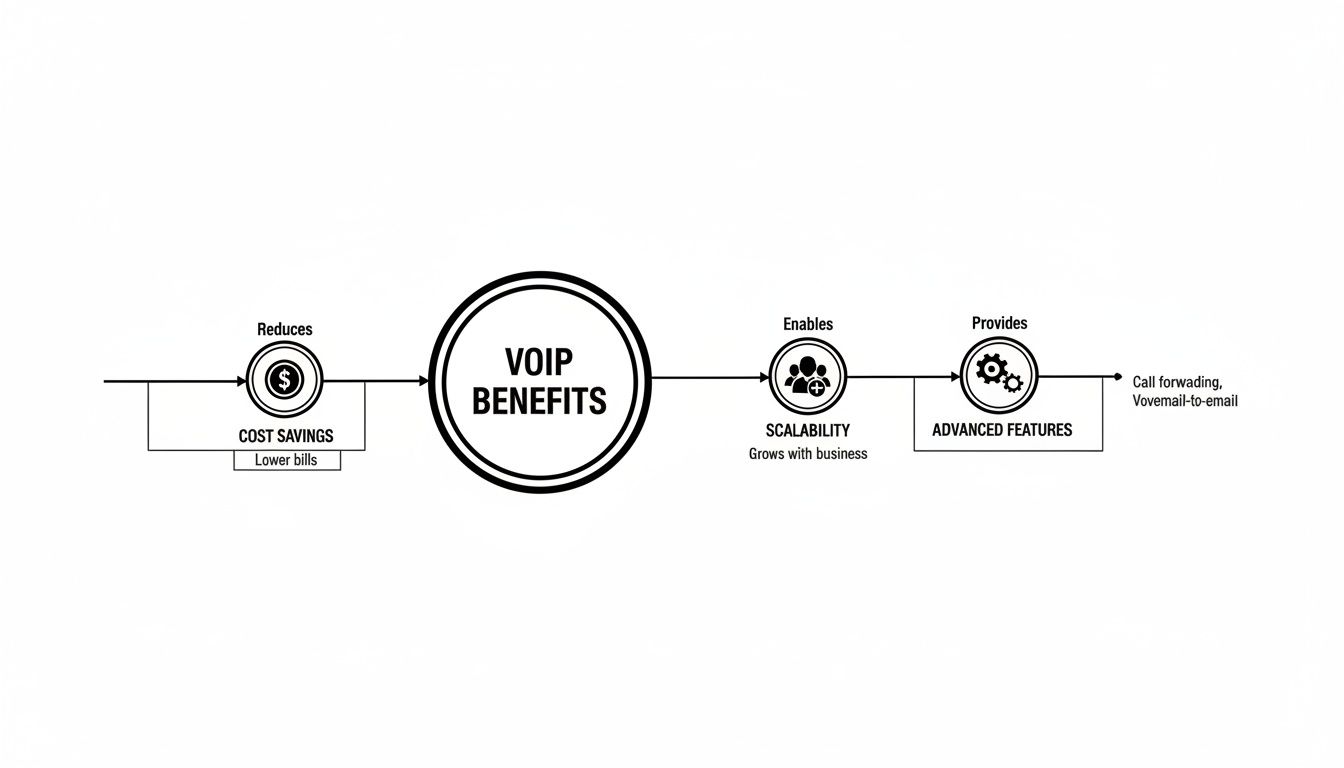
As you can see, a solid infrastructure is the launchpad for slashing costs, scaling on a dime, and accessing the advanced features that truly define a modern contact center.
Understanding Your Digital Phone Lines
With your network optimized, you still need a way to connect to the outside world—the global telephone network. In the old days, this meant ordering expensive bundles of physical phone lines from the phone company. Today, we have a much smarter, digital solution: SIP Trunking.
Think of a SIP (Session Initiation Protocol) Trunk as a virtual bundle of phone lines delivered right over your internet connection. It’s what lets your internal VoIP system make and receive calls to and from any regular landline or mobile number on the planet. It completely replaces clunky, outdated hardware with a flexible, scalable, and far more cost-effective alternative.
For companies looking to get up and running quickly, this technology fits perfectly within pre-built, professional environments. You can see how this all comes together by exploring our turnkey office solutions.
Choosing the Right Tools for Your Agents
Finally, your agents need the right gear to talk to your customers. You've got three main choices here, and the best one really depends on your operational style. The flexibility of these options is a major reason for VoIP's rapid growth. By 2026, it's projected that 35% of all businesses will be on VoIP, with computer-to-computer communication leading the charge at 44%, thanks almost entirely to the rise of softphones.
Picking the right endpoint is a serious decision that directly impacts agent efficiency and comfort, especially in a fast-paced seat-leasing environment.
Agent Hardware Options: A Comparison
| Hardware Type | Pros | Cons | Best For |
|---|---|---|---|
| IP Phones | Familiar desk phone feel, extremely reliable, dedicated to calls. | Less portable, can have a higher upfront cost. | Traditional office setups with fixed workstations. |
| Softphones | Incredibly flexible, no extra hardware needed, perfect for remote agents. | Depends on PC performance; can be a source of distraction. | Agile teams, work-from-home agents, and flexible seat-leasing models. |
| Headsets | Hands-free operation, superior audio, and noise cancellation. | Quality varies widely; needs a PC or IP phone to connect. | Essentially every call center agent. A good headset is non-negotiable. |
In my experience, the winning combination for most modern call centers is a softphone paired with a high-quality, noise-canceling headset. This setup delivers the ideal mix of flexibility, professional-grade audio, and cost-effectiveness that today's competitive environment demands.
Securing Your Communications And Ensuring Compliance
Let's be honest—moving your call center's voice traffic to the internet can feel a little risky, especially when you're handling sensitive customer data. While the flexibility of VoIP in call centers is a massive benefit, it’s only natural to worry about security.
But here’s the thing: with the right strategy, a VoIP system isn't just as secure as your old landlines; it can actually be far more secure. You're probably worried about things like call interception (eavesdropping) or a Denial-of-Service (DoS) attack that could cripple your operations. Those are valid concerns, but the good news is that modern VoIP platforms were designed from the ground up to fight these very threats.
Fortifying Your VoIP System
Securing your VoIP traffic isn’t something you bolt on at the end. It has to be a core part of your setup from day one. I like to use an analogy: you wouldn't ship a diamond in a clear plastic bag. You’d use a locked, armored box. That’s exactly what call encryption does for your voice data.
Call encryption is the process of scrambling your voice data so that even if someone managed to intercept it, all they would get is useless, unintelligible noise. For any call center that's serious about security, this is absolutely non-negotiable.
But encryption is just one piece of the puzzle. A truly secure system uses several layers of defense that work together:
- Secure Network Configurations: Think of your firewall and access controls as digital bouncers at the door of your network. They check every piece of data trying to get in and only allow authorized traffic to pass.
- Regular Security Audits: You can't just set it and forget it. Proactively hunting for vulnerabilities in your system is how you stay one step ahead of anyone trying to find a way in.
- Managed Security Services: When you partner with a provider like a Seat Leasing BPO, you often get a dedicated team of IT pros. Their entire job is to monitor, manage, and defend your communications network 24/7.
This layered approach turns a potential weak point into a fortress, giving you the confidence to focus on your operations.
Meeting Strict Compliance Standards
For most call centers, security isn't just about best practices—it's about the law. A single data breach can lead to staggering fines and completely erode the trust you've built with your customers. This is where VoIP's advanced capabilities become powerful tools for compliance.
Regulations like the General Data Protection Regulation (GDPR) in Europe or the Health Insurance Portability and Accountability Act (HIPAA) in the U.S. have incredibly strict rules for handling personal data. VoIP helps you tick all the right boxes with features like:
- Secure Call Recording: Recordings are stored in an encrypted format, and strict controls ensure only the right people can access them.
- Detailed Access Logs: Need to prove who listened to a call and when? VoIP systems create a clear audit trail, which is crucial for demonstrating compliance.
- Role-Based Access Controls: You can give specific permissions to team members, limiting access to sensitive data only to those who absolutely need it.
If your agents handle credit card numbers, achieving and maintaining strong PCI DSS compliance is essential. A good VoIP setup gives you the granular control you need to meet these tough requirements, making sure every transaction is secure. At the end of the day, a well-planned VoIP system doesn't just improve communication; it actively protects it.
Your Implementation Checklist From Planning To Launch
Moving your contact center to a new communication platform is a big project, but it doesn't have to be a headache. A successful switch to VoIP in call centers all comes down to smart planning and taking it one step at a time. Don't think of it as flipping a single, giant switch; see it as a series of manageable phases that take you from the drawing board to a fully operational system.
This checklist breaks down the entire process into a clear roadmap. Follow it, and you'll sidestep the common pitfalls, ensuring a smooth launch that empowers your team from day one.
Phase 1: Assess Your Current Needs
Before you even start looking at providers, you need to get brutally honest about what your call center actually needs. The biggest mistake you can make is paying for a bunch of flashy features you'll never touch. So, start by gathering some hard data.
How many calls do your agents handle on an average day? What about during your busiest hours? Documenting your call volume is the first step. This tells you exactly what kind of bandwidth you’ll need and how many simultaneous call channels are required.
Next, draw a line in the sand between "must-have" features and "nice-to-have" ones. Do you absolutely need a complex IVR to route callers, or will basic call forwarding do the trick for now? Be realistic about features like call recording, CRM integrations, and real-time analytics.
A thorough needs assessment is your blueprint for success. It prevents you from overspending and guarantees the solution you pick actually fits your business goals, rather than just being a collection of impressive but irrelevant tools.
Phase 2: Choose The Right VoIP Provider
With your requirements list ready, it's time to start sizing up potential providers. This is about more than just comparing prices—you're looking for a long-term partner. Look past the monthly per-user fee and find out what you're really getting.
Here are the key things to put under a microscope:
- Feature Set: Does the provider check all your "must-have" boxes? Do they have a clear plan for adding new features in the future?
- Support and SLAs: What kind of technical support do they offer, and when is it available? Look for a Service Level Agreement (SLA) that guarantees a specific uptime percentage. This is your insurance policy against costly downtime.
- Scalability: How quickly and easily can you add or remove users? The process should be simple, letting you scale up or down with business demand without any friction.
- Pricing Structure: Get a complete picture of the cost. Are there hidden fees for porting your numbers or unlocking advanced features? Transparent, all-inclusive pricing is always the safer bet.
For more insights into running a modern call center, our other articles can offer some valuable perspective. You can learn more about effective strategies on the Seat Leasing BPO blog.
Phase 3: Prepare Your Network
You can sign up for the best VoIP system on the market, but it will be a complete flop if your network isn't ready for it. As we've covered, having enough bandwidth and properly configured Quality of Service (QoS) is non-negotiable. Get your IT team or your new provider to run tests and validate your network's readiness long before you plan to go live.
This is also the phase where you'll handle porting your existing business numbers. Your new provider will manage this process, which essentially transfers your phone numbers from your old carrier to them. Kick this off early, as it can sometimes take a few weeks to complete.
Phase 4: Train Your Team And Go Live
Finally, it’s time to get your agents on board. New technology can be intimidating, so good training is essential for getting everyone to actually use the system. Your agents need to feel confident with the new softphone or IP phone and understand how the features will make their jobs easier, not harder.
Once your team is trained and your numbers are ported over, you can schedule your go-live date. A smart move is to start with a small pilot group for a day or two. This lets you iron out any last-minute wrinkles in a controlled environment.
After a successful pilot, you can roll out the new VoIP system to everyone. But the work doesn't stop there. Keep a close eye on call quality and system performance, and make sure to gather feedback from your agents to make continuous improvements.
How Seat Leasing Makes VoIP Simple and Affordable
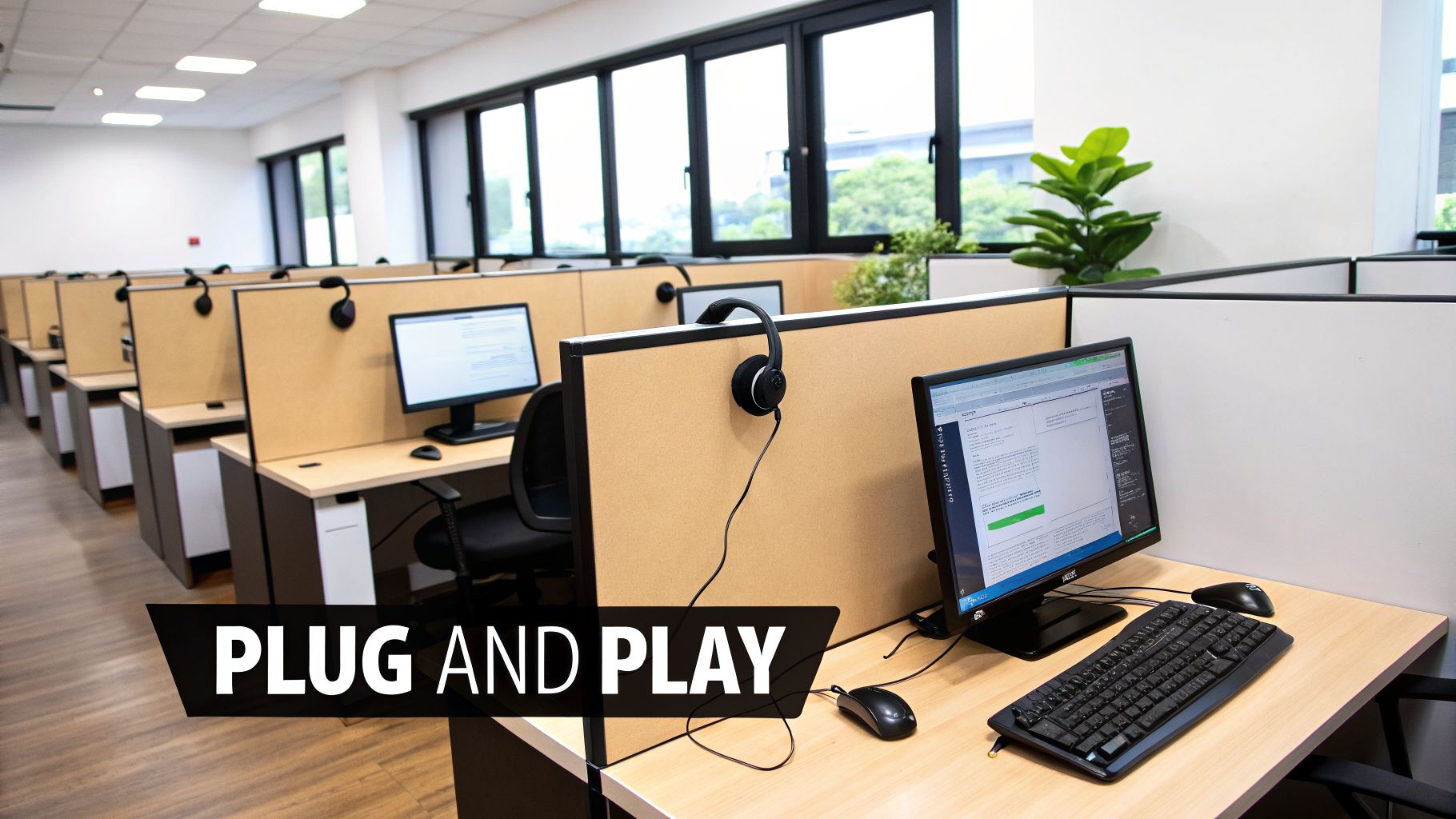
Let's be honest: setting up a professional VoIP in call centers solution from the ground up is a huge undertaking. You have to evaluate your network, configure Quality of Service, vet providers, and lock down your security. For most startups and growing businesses, the technical complexity and upfront costs can feel overwhelming.
But what if you could sidestep that entire implementation process? This is exactly the problem a Seat Leasing BPO model solves. It takes a complex, expensive project and turns it into a simple, ready-to-go solution.
The Plug-and-Play VoIP Environment
Imagine walking into a fully equipped office where your call center’s entire communication system is already built, fine-tuned, and waiting for your team. That’s the reality of a good seat leasing arrangement. You get a professional, enterprise-grade environment from day one, without spending months on planning and setup.
This "plug-and-play" approach is a game-changer for VoIP. All the difficult parts of network management are simply handled for you.
With a seat leasing provider, you’re not just renting a desk. You're stepping into an ecosystem where high-speed internet, a QoS-optimized network, and a secure IT framework are already in place and professionally managed.
You don't have to spend your time negotiating with internet providers or hiring IT specialists to get your network right. It’s all taken care of, so you can focus on training your agents and getting your campaigns off the ground.
Bundle the Infrastructure, Maximize the Savings
One of the biggest draws of the seat leasing model is the incredible cost savings, which can be as high as 80% compared to building out your own office. A huge portion of that comes from bundling all the VoIP-ready infrastructure into one simple package.
Think about all the expenses you'd have to cover yourself:
- High-Speed Business Internet: Sourcing and paying for a fiber connection with guaranteed uptime.
- IT Staff: Hiring people to manage your network, handle security, and troubleshoot the VoIP system.
- Cybersecurity Tools: Paying for firewalls, monitoring software, and threat detection services.
- Hardware: The upfront cost of routers, switches, and other essential networking gear.
With seat leasing, all these separate capital and operational costs are rolled into a single, predictable monthly fee. The model inherently includes the critical backend support needed for a perfect VoIP experience. You can see how this works by exploring our comprehensive service inclusions.
The Fast Track to Growth
For any business trying to grow quickly—whether you’re a startup, a small business, or expanding into a new market—speed is everything. The old way of building a call center from scratch is just too slow and expensive.
Seat leasing flips that entire dynamic. It gives you instant access to the same sophisticated VoIP in call centers technology that massive corporations use, but without the eye-watering price tag or long implementation timeline. It levels the playing field, empowering smaller companies to compete on a global scale. Your team can be taking calls and driving revenue in a matter of days, not months.
Ultimately, this model frees you from the burden of IT management. It lets you pour all your energy and resources into what you actually do best: serving your customers and growing your business. It’s not just about leasing a space; it’s about leasing a complete, growth-ready operational platform.
Your VoIP Questions, Answered
Making the switch to a new phone system is a big decision, and it’s natural to have a few questions. We’ve put together answers to some of the most common concerns we hear from call center leaders considering VoIP.
Is VoIP Reliable Enough For a Busy Call Center?
This is probably the number one concern for any call center, and it's a fair one. The short answer is yes, modern VoIP is absolutely reliable enough for even the most demanding operations, but with one important condition: it all hinges on your internet connection.
A solid, high-speed connection with Quality of Service (QoS) is non-negotiable. QoS essentially creates a VIP lane on your network exclusively for voice traffic. This prevents your calls from getting stuck in "traffic" behind emails or web browsing, which is what causes common issues like jitter and dropped calls.
Top-tier providers will also back their service with uptime guarantees in their service level agreements (SLAs). If you're working with a Seat Leasing BPO, this rock-solid reliability is already part of the package, as they manage the entire enterprise-grade network for you.
Can I Keep My Business Phone Numbers?
The good news is, yes, you almost always can. The process is known as "number porting," and it's a standard part of any professional VoIP migration.
Your new VoIP provider will coordinate with your old carrier to transfer your existing numbers over. This means your customers experience zero disruption and can keep calling the numbers they’ve trusted for years. It’s a smooth, behind-the-scenes process.
How Much Technical Knowledge Do I Need?
For your agents, the learning curve is practically flat. Modern softphone apps and VoIP desk phones are designed to be incredibly intuitive, often more so than the clunky old systems they replace.
When it comes to managing the system, the complexity really depends on your setup. This is where partnering with a managed service or a Seat Leasing BPO really shines. They handle all the heavy lifting—from security and updates to network performance—so you don't have to.
You get all the powerful features of a modern VoIP system in your call center without needing a dedicated IT team to run it. It’s all the capability without the complexity.
Ready to get enterprise-grade VoIP without the setup headaches and management costs? Seat Leasing BPO offers a fully managed, plug-and-play environment so you can focus on what you do best: growing your business. Find out more at https://seatleasingbpo.com.