Let's be honest, the old way of getting an office is a headache. It's like needing a car but being told you have to build the entire factory first. That's what a traditional office lease feels like—a huge, long-term commitment that drains your capital on renovations, IT infrastructure, and furniture before your team can even sit down.
A shared office space flips that entire idea on its head. It’s a fully managed, equipped, and professional workspace where different companies lease their own private areas. Think of it as a serviced apartment for your business: you show up, plug in, and get straight to work from day one.
So, What Is a Shared Office Space Really?
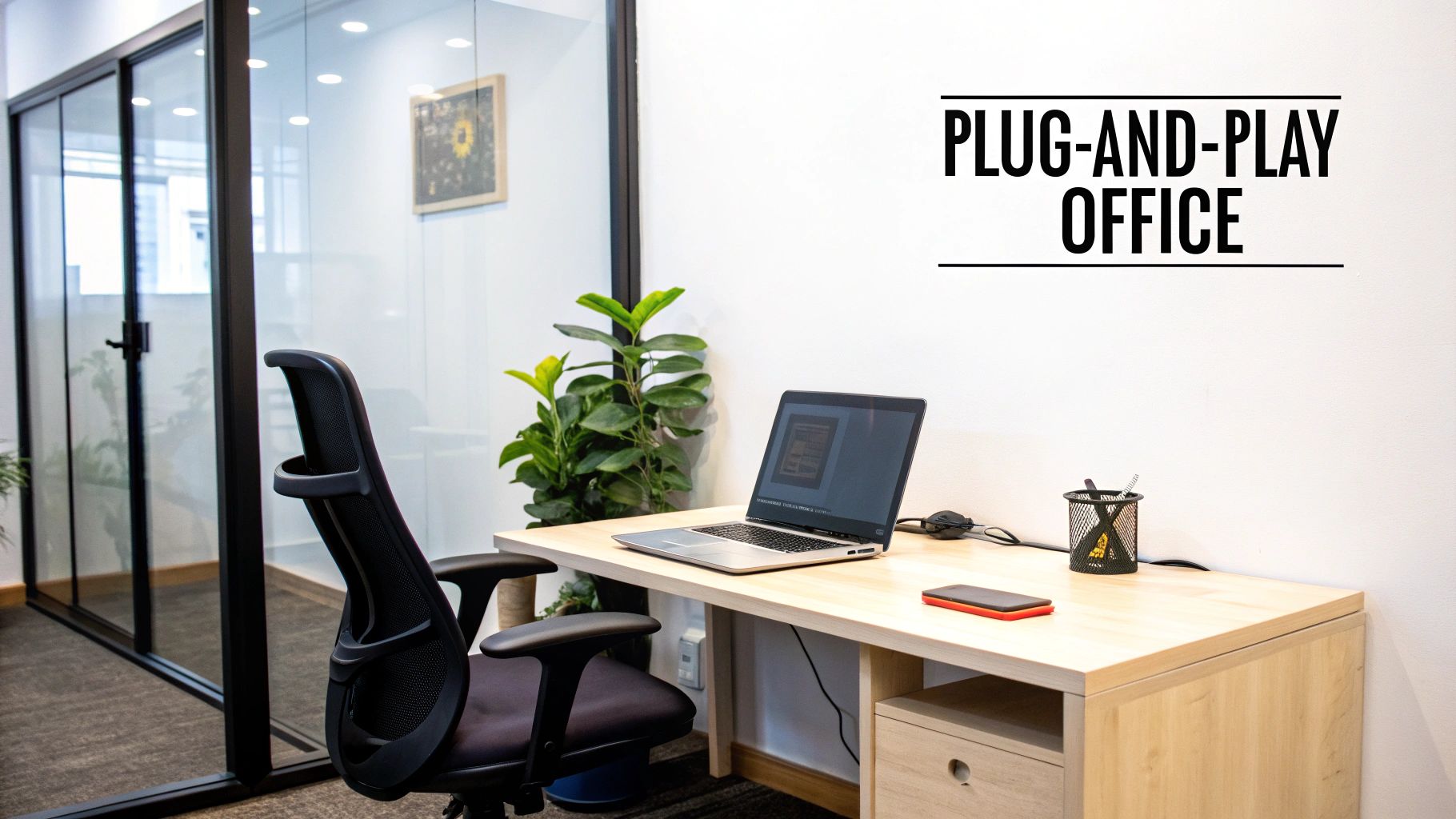
Forget the old model. A shared office space provides a modern, practical solution where you get a completely private and secure environment but only pay for the exact space you use. The provider handles everything else.
The Power of Seat Leasing
The engine that makes this model so effective is seat leasing. Instead of renting an entire floor by the square foot—much of which you might not even use—you lease individual workstations, or "seats," for your team. This simple shift has some powerful benefits:
- Operational Agility: Need to grow your team or scale back? You can do it almost overnight without the penalties of a restrictive multi-year lease.
- Zero Capital Expenditure: You completely sidestep the massive upfront costs of office fit-outs, network cabling, and buying equipment. It’s all included.
- Focus on Your Core Business: The provider manages everything from IT support and network uptime to daily cleaning, freeing you up to concentrate on what you do best—running your business.
This is a fundamental change in how companies think about their physical presence. It’s less about managing real estate and more about empowering your team with a ready-made, professional infrastructure.
The shared office space market isn't a small niche anymore; it's a global powerhouse. Valued at a massive $41.4 billion, the market is expected to skyrocket to $62.75 billion by 2029, all thanks to the worldwide move toward more flexible ways of working. You can dig into the numbers yourself with Statista's research.
It's More Than Just a Desk
A great shared office is an entire ecosystem built for productivity. It gives you access to enterprise-level amenities that would be incredibly expensive to set up on your own. We're talking about things like redundant power supplies to prevent outages, high-speed fiber internet, and a professional, on-site IT team ready to help.
At the end of the day, a shared office space removes all the friction and financial hurdles that come with securing a professional workspace. It’s the smart, asset-light choice for startups, BPOs, and SMEs who want to operate efficiently and scale without limits. You can explore more strategies for business growth in our blog.
Unlocking Your Financial and Operational Edge
The phrase “cost savings” gets thrown around a lot, but when it comes to shared office space, the financial upside is real and immediate. This isn't just about saving a few dollars; it’s about a complete shift in how you think about your workspace—moving from being a part-time property manager to focusing 100% on your actual business.
Think about the old way of doing things with a traditional office lease. The process often starts with a massive, sometimes paralyzing, upfront investment. You're not just signing a lease; you're funding a small construction project before a single employee can even turn on their computer. That old-school model siphons away cash that should be fueling your growth.
The Hidden Costs of a Traditional Lease
A conventional lease is a bit like an iceberg. The monthly rent you see on paper is just the tip. Lurking beneath the surface is a whole mess of hidden expenses that can quietly drain your budget month after month. These aren't just one-off costs; they're recurring operational headaches that demand constant money and attention.
Just look at the long list of things you’re suddenly on the hook for:
- Massive Security Deposits: Landlords often demand several months' rent upfront, tying up a huge chunk of your working capital.
- Office Fit-Out and Renovation: The cost of construction, design, painting, and flooring can easily soar into the tens of thousands.
- Furniture and Equipment: You have to buy every single desk, chair, conference table, and coffee maker. It adds up fast.
- IT Infrastructure Setup: This means paying for all the cabling, server racks, firewalls, and the experts to install it all.
- Monthly Utility Bills: Electricity, water, and heating are unpredictable expenses that land on your desk every month.
- Maintenance and Cleaning Services: You’re now in charge of hiring and managing janitorial staff and repair services.
This financial drain is bad enough, but it also comes with a serious time tax. Instead of driving strategy, your leaders find themselves haggling with contractors, dealing with utility companies, and troubleshooting Wi-Fi problems.
The Simplicity of an All-Inclusive Fee
Now, let's contrast that tangled mess of expenses with the beautifully simple model of a shared office space. Here, everything is neatly bundled into a single, predictable monthly fee per person. This all-in-one approach takes all the financial guesswork and administrative pain off your plate.
A shared office model completely changes your cost structure. Your office stops being a capital-intensive liability (CapEx) and becomes a flexible operational expense (OpEx). This is a strategic move that frees up cash, strengthens your balance sheet, and makes financial planning far more agile.
The fee for your seat covers everything you need to hit the ground running. You walk into a fully furnished, professionally managed office where the lights are already on, the internet is fast and reliable, and a support team is on standby to help.
To really see the difference, let’s break down the numbers side-by-side.
Cost Comparison Traditional Lease vs Shared Office Space
The table below gives you a clearer picture of just how many separate expenses are eliminated when you choose a managed shared office model over a standard commercial lease.
| Expense Category | Traditional Office Lease (Monthly Estimate) | Shared Office Seat Leasing (Included in Fee) |
|---|---|---|
| Base Rent & CAM Fees | $5,000 – $15,000+ | Included |
| Office Fit-Out (Amortized) | $1,500 – $5,000 | Included (Move-in ready) |
| Furniture (Amortized) | $500 – $2,000 | Included |
| Utilities (Electric, Water, HVAC) | $800 – $2,500 | Included |
| High-Speed Internet | $300 – $1,000 | Included (Enterprise-grade) |
| Cleaning & Maintenance | $500 – $1,500 | Included |
| Reception & Admin Staff | $3,000 – $5,000 | Included |
| Security & Alarm System | $100 – $300 | Included (24/7 security) |
| IT Support & Infrastructure | $500 – $2,000 | Included (On-site support) |
| Coffee, Snacks & Supplies | $200 – $600 | Included |
| Estimated Monthly Total | $12,400 – $35,400+ | One predictable fee per seat |
Note: Estimates are illustrative and can vary significantly based on location, size, and quality.
As you can see, the traditional path involves juggling at least ten separate, often unpredictable, invoices. With a shared office, all of that complexity vanishes into a single line item.
Operational Agility as a Competitive Weapon
Beyond the hard-dollar savings, the operational advantages give you a serious competitive advantage. In today's market, speed and flexibility are everything, and this model delivers both.
Launch at Lightning Speed
Need to spin up a new project team or open a branch in a new city? With a traditional lease, you’re realistically looking at a 3-6 month timeline for finding a space, negotiating the lease, and managing the build-out. In a shared office, you can have a team fully up and running in a few days. That kind of speed lets you jump on opportunities while your competitors are still reading lease agreements.
Business Continuity Built-In
Unexpected downtime can kill a business. A good shared office provider has already invested in redundancies that most small or medium-sized companies couldn't afford on their own. This often includes:
- Enterprise-Grade Internet: They don’t just have one internet provider; they have multiple fiber connections to ensure you’re always online.
- Power Redundancy: Backup generators and uninterruptible power supplies (UPS) mean a city-wide power outage won't shut down your operations.
- 24/7 IT Support: An on-site tech team is there to handle any issues right away, so you’re not stuck waiting for a third-party contractor.
At the end of the day, these financial and operational benefits aren't just nice-to-haves. They are strategic tools. They let you redirect your two most valuable resources—your money and your leadership’s focus—away from managing real estate and back to where they belong: on innovation, serving your clients, and growing your business.
Choosing Your Workspace Model
Diving into commercial real estate can feel a lot like car shopping when you don't know the difference between a sports car, an SUV, and a moving truck. Each one gets you from A to B, but picking the wrong one for your needs can turn into a very expensive mistake. Let's break down the three main workspace models to figure out which one is the right fit for your business.
Think of it like finding a place to live. A traditional lease is like building your own house from scratch. You have complete control over every single detail, from the floor plan to the paint on the walls. But it also means a huge upfront investment, a long-term commitment, and being on the hook for every single bit of maintenance and upkeep.
The Open-Plan Coffee Shop Vibe
Coworking spaces are the buzzing, open-plan coffee shops of the office world. They're fantastic for freelancers, solopreneurs, and tiny teams who feed off networking and a social buzz. The atmosphere is all about collaboration, designed for those "chance encounters" that can spark new ideas.
But that open-door policy has its downsides. The lack of private, secure space can be a dealbreaker for any business that handles sensitive client information or simply needs a quiet, focused environment to get work done. It’s a great option for community, but not so much for confidentiality and control.
Your High-End Serviced Apartment
This is where a managed shared office space comes in, and it's best described as a high-end serviced apartment. You get your very own private, secure, and dedicated office—an exclusive space just for your team—but all the building amenities and services are completely managed for you.
This model gives you the privacy and security of a traditional office lease combined with the convenience and flexibility of coworking. You aren't just renting a few desks in a room; you're getting a fully operational business environment from day one.
The core difference is strategic. A shared office isn't just a real estate decision; it’s an operational one. It allows you to maintain your company's unique culture and security protocols within a private suite while offloading all the backend facility management to experts.
This infographic paints a really clear picture of how the costs break down between the traditional and shared models.
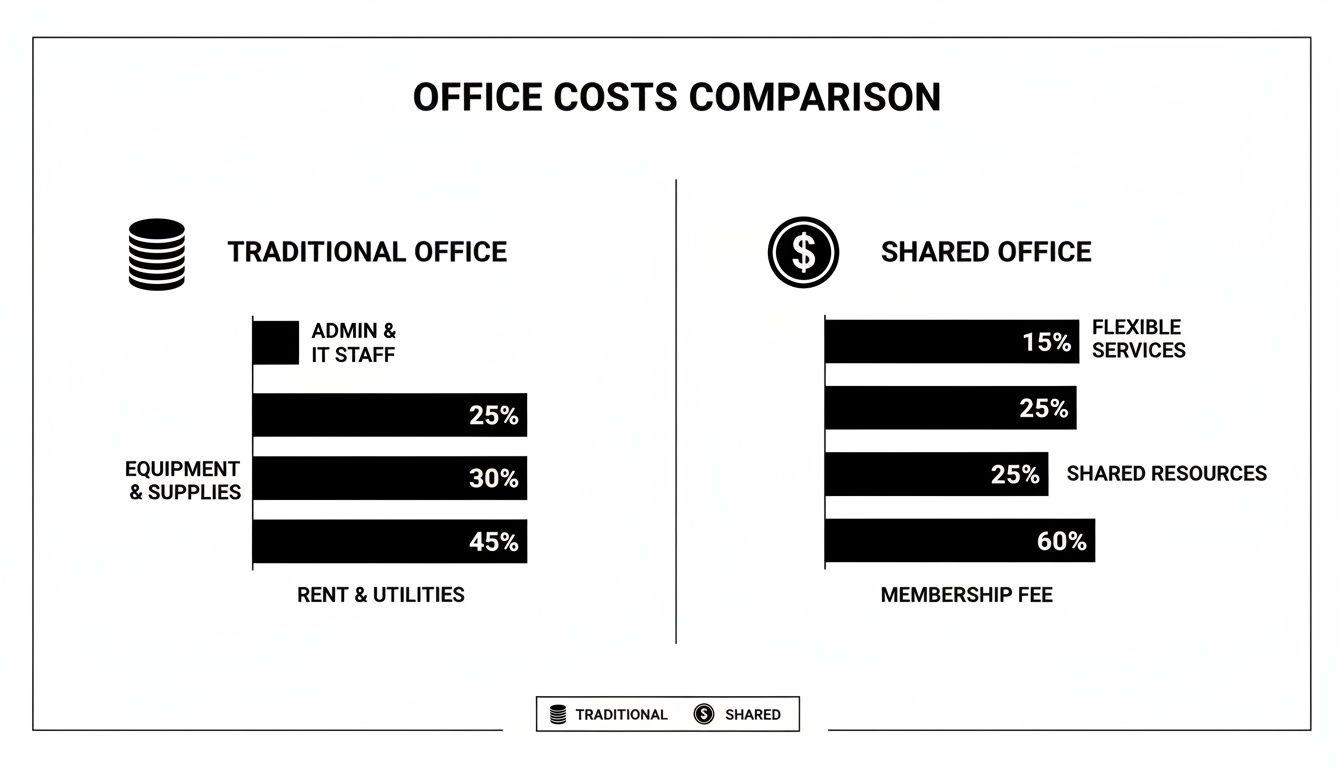
As you can see, the single, predictable fee in a shared model rolls up all the numerous—and often hidden—costs that come with a traditional lease.
Making the Right Strategic Choice
So, which path is yours? It really boils down to where your business is right now and where it's headed.
- Team Size and Growth Stage: Are you a fast-growing startup that might need to add ten people next quarter? A shared office gives you the scalability a long-term lease just can't match.
- Security and Confidentiality: Do you handle sensitive client data, like a BPO or a law firm? Having a private, lockable office in a shared facility is non-negotiable.
- Speed to Market: Need to get a new team or project up and running yesterday? The plug-and-play setup of a managed office is the fastest way to get operational.
Ultimately, the right choice hinges on your priorities. If you need absolute control and have the deep pockets for a long-term build-out, a traditional lease might be the answer. If your main goal is networking, coworking is a great fit. But for most growing businesses—startups, BPOs, and SMEs—a managed shared office strikes the perfect balance of privacy, flexibility, and professional infrastructure, all without the financial headache and administrative burden of managing your own property.
Who Wins with a Shared Office Model?
The real magic of a shared office isn't just about saving a few bucks or getting free coffee; it’s about how it can be wielded as a powerful tool for growth. This model isn't the right fit for everyone, of course. But for certain kinds of businesses, it’s a total game-changer.
When you look at the unique hurdles different companies face, you start to see exactly who thrives in this kind of flexible environment. "Flexibility" and "scalability" are more than just buzzwords these days—they're essential for any company that wants to pivot, expand, and jump on opportunities without being anchored by a rigid, long-term lease.
Let's break down three types of businesses that consistently come out on top by going with a shared office.
The Agile Startup
Picture a tech startup that just closed its Series A funding. Fantastic news, right? But now, that plan to hire ten new developers in the next six months is a real, immediate problem. Signing a traditional five-year lease is a massive gamble. What if they outgrow the space in a year? Or worse, what if they need to downsize? That’s precious capital down the drain.
For a fast-moving startup, a shared office is the perfect answer. They can get a private, branded space for their core team and simply add more seats as they hire. It’s that simple.
- Preserve Cash: They sidestep the huge upfront costs of fit-outs and furniture, plowing that money directly into what matters—building their product and hiring great people.
- Scale On-Demand: They can expand their office footprint in a matter of days, not months, perfectly matching their space to their headcount.
- Attract Talent: Let's be honest, top talent isn't always keen on joining a company working out of a garage. A professional, fully-equipped office in a great location makes a huge difference in recruiting.
The startup gets the infrastructure of a major company without the financial deadweight, making it a clear win.
The Global Enterprise
Now, think about a big multinational corporation wanting to dip its toes into a new market. The old way was painfully slow and expensive: fly out an executive team, hire local brokers, and sign a long-term lease in a place where they have zero track record. It’s a high-risk, high-cost, and sluggish process.
A shared office lets this global giant launch a satellite office with almost no risk and incredible speed. They can establish a legitimate, professional presence overnight, giving a small local team a secure and productive home base.
This isn't just for small fry anymore. Big companies are jumping on this model, with 55% of corporations now weaving flexible workspaces into their real estate portfolios. The entire industry is valued at $20.96 billion and is expected to blow past $58 billion by 2033, largely because enterprises are using these spaces for regional hubs and special project teams. You can discover more insights about this shift toward flexible work models.
This strategy allows the enterprise to test the waters, build local relationships, and see if the market has potential before making any heavy capital commitments. If the venture takes off, they scale up. If not, they can pull out cleanly without being stuck with an expensive, empty building.
The Strategic BPO
Finally, consider a Business Process Outsourcing (BPO) company that just landed a huge new client. The contract demands a fully operational, 50-person team ready to go in just four weeks to handle customer support. They need a secure, compliant workspace with rock-solid, redundant IT from day one.
Trying to do this with a traditional lease is a non-starter. The timeline is just impossible.
A managed office provider can deliver a turnkey solution that hits all the BPO’s critical needs:
- Rapid Deployment: They can have a fully configured office ready for the team to walk into, easily meeting the client’s aggressive deadline.
- IT and Compliance: The provider takes care of the enterprise-grade internet, network security, and backup power needed to meet tough Service Level Agreements (SLAs).
- Flexible Contracts: The lease can be structured to align with the client contract, which means no risk of paying for empty seats if the project wraps up.
For a BPO, the shared office model is the secret weapon for winning and servicing big contracts with speed and confidence.
Your Checklist for Selecting the Right Partner
Choosing a shared office provider is a big deal. It's not like picking a coffee shop for the afternoon; it’s a strategic partnership that can make or break your team's productivity and your ability to grow. You have to look past the slick marketing and tempting price tags to find a partner that genuinely supports your business.
Think of it this way: you aren't just renting desks. You're handing over the keys to your entire office infrastructure. That means you need to vet a potential provider with the same level of care you'd use for any other critical vendor. A great partner becomes an invisible extension of your operations team, while a bad one creates daily headaches and operational bottlenecks.
This checklist will help you cut through the noise, guiding you on what really matters so you can assess the true reliability and value of any shared office space.
Dig Into the Technical Infrastructure
Your business lives and breathes on technology. Any hiccup in your provider's IT infrastructure immediately becomes your problem, so their tech backbone is non-negotiable. Don't be shy about asking tough, specific questions.
Here's what you need to probe:
- Internet Redundancy: Do they have backups? Specifically, you want to hear that they use multiple, independent fiber internet providers. A single point of failure is a massive red flag that spells costly downtime.
- Cybersecurity Protocols: How exactly is your private network firewalled off from other tenants? Ask them to walk you through their security measures, from firewall configurations to the physical security of their server rooms.
- IT Support Responsiveness: What happens when something breaks at 2 AM? Find out their guaranteed response times, whether support is available 24/7, and if the IT team is actually on-site for faster fixes.
A top-tier shared office provider invests heavily in enterprise-grade infrastructure. Their entire value proposition hinges on guaranteeing uptime and security. If they get defensive or can't give you clear answers here, walk away.
Scrutinize the Contract and Scalability Clauses
The whole point of a shared office is flexibility, but that flexibility is only as real as the contract you sign. The fine print is where you'll discover how easily you can adapt to the unpredictable nature of business. A rigid contract can trap you, completely defeating the purpose of avoiding a traditional lease.
Before you even think about signing, get crystal-clear answers on these points:
- Scaling Up: How fast can you add more seats or grab a larger private office when you land that big new client? Is the process simple, or is it buried in penalties and paperwork?
- Scaling Down: What happens if you need to downsize? You need to know the exact terms for reducing your seat count, including the notice period and any associated costs.
- Term Length and Renewals: Does the contract align with your business cycles? A provider who actually gets it will offer more than a rigid, one-size-fits-all 12-month lock-in.
A true partner works with you, building a contract that supports your growth instead of penalizing you for it. This is what separates a genuine workspace provider from a simple landlord.
Evaluate the Operational Quality and Environment
At the end of the day, it's the day-to-day experience that matters most to your team. The quality of the facility—from the front desk to the breakroom—is a direct reflection of the provider's professionalism and commitment. You need to spend time in the space and look at it with a critical eye.
Pay close attention to these details:
- Staff Professionalism: Are the people on-site—reception, IT, management—helpful and knowledgeable? They're your first line of support and the face of the facility.
- Amenity Condition: Take a hard look at the shared spaces. Are the kitchens, lounges, and meeting rooms consistently clean and well-maintained? Worn-out furniture or dirty common areas are a bad sign.
- Building Accessibility and Security: Can your team get in securely 24/7? Also, consider the basics: the building's location, parking situation, and how close it is to public transport.
Finding the right provider means finding a space that matches your company's standards and can keep up with your ambitions. For companies in fast-moving industries, exploring models like those in our guides on seat leasing solutions can give you a solid framework for making this critical decision.
Making a Seamless Transition to a Shared Office
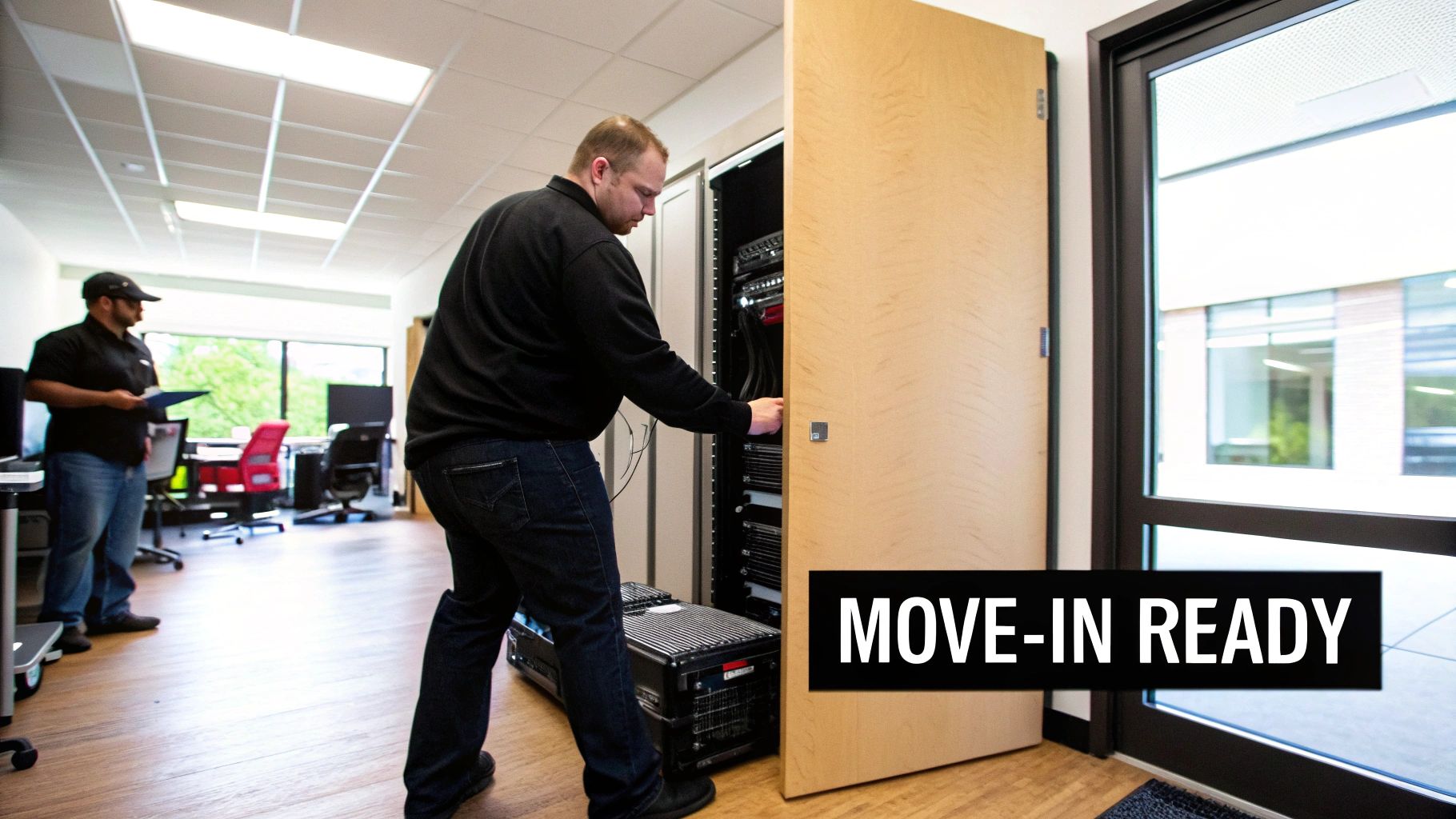
The very idea of moving your office can bring on a headache. You start thinking about downtime, logistical nightmares, and coordinating a dozen different vendors. But moving into a shared office space isn't like a traditional relocation at all—it’s more like a strategic business upgrade. When you work with a quality provider, the whole process is designed to be incredibly smooth, getting you up and running with almost zero disruption.
So, forget the stress of managing contractors or waiting on furniture deliveries. The journey is really a simple, three-stage path where the provider does all the heavy lifting. This proves that making the switch is one of the easiest, smartest moves you can make for your company.
Stage One: Discovery and Exploration
The first step is all about getting clear on what you need. This is where you'll sit down with a provider and map out your exact requirements—not just how many seats you need, but also your specific technical specs, the layout you prefer, and any security protocols you have. It's the perfect chance to tour different facilities and find a space that genuinely fits your team’s culture and workflow.
Think of this phase as a deep-dive consultation, not a sales pitch. A good partner will ask smart questions to really understand your business goals. They want to make sure the environment they're providing will actually help you succeed. This initial stage sets the foundation for a strong, effective partnership.
Stage Two: Agreement and Configuration
Once you've picked out the perfect space, the next stage is to finalize the agreement and hand over your technical specifications. This is where the provider’s expertise really makes a difference. You simply outline your network requirements, software needs, and any custom setups you have, and their team gets right to work.
While you're busy running your business, their IT specialists are handling everything in the background:
- Configuring your private, firewalled network to keep your data completely secure.
- Setting up every workstation with all the hardware and software your team needs.
- Preparing server racks and making sure every system is tested and ready to go.
Stage Three: Activation and Operation
The final stage is the best part: activation day. This is when your team walks into a fully functional office that's ready for business from the moment they arrive. The desks are set up, the internet is blazing fast, and the coffee is already brewing. There's no downtime and no last-minute scrambling to get things working.
The entire point of a managed transition is to achieve zero operational interruption. From day one, your team is productive, connected, and has an on-site support team ready to handle any technical or facility issues that pop up.
This seamless process really highlights the core value of a shared office space. It completely removes the massive administrative headache of a traditional office move, letting you focus on what actually grows your business. Instead of a month of chaos, you get a powerful, ready-made infrastructure in just a matter of days.
If you're ready to see what a simple, effective transition looks like for your team, you can get in touch with our team to talk about your specific needs.
Got Questions About Shared Office Spaces? We've Got Answers.
Making the leap to a shared office is a big decision, and it’s smart to have questions. It’s a different way of working, and you need to know exactly what you’re getting into. We’ve rounded up some of the most common questions we hear to help you get a clear picture.
Let's dive into the practical stuff—from security and branding to what happens when your team suddenly grows or shrinks.
"How Secure Is My Company's Data in a Shared Building?"
This is one of the first things business owners ask, and for good reason. A professional shared office provider knows that security is non-negotiable. Your team will operate on its own private, firewalled network, completely separate and invisible to other companies in the building. Think of it as your own secure data bubble, even though you're sharing the same address.
It's not just about digital protection, either. Physical security is just as tight. Expect 24/7 building monitoring, controlled entrances, and keycard access that ensures only your team can get into your specific office suite. This layered security means your data and equipment are just as safe as they would be in your own building.
"Can We Brand and Customize Our Private Office?"
Of course! While you’re sharing amenities like the lobby and pantries, your own office space is your private territory. The whole point is to make it feel like your company's home base.
Go ahead and put your logo on the wall, bring in your own furniture, or set up the desks in a way that fits your team's workflow. This isn’t just a temporary desk—it’s your headquarters, and you should be able to shape it to reflect your company's culture and identity.
"What Happens if Our Team Size Changes Suddenly?"
This is where the shared office model really shines. Traditional leases can be an anchor, weighing you down when you need to be agile. These agreements are built for change. If you land a huge project and need to double your team, you can typically add more seats or move into a larger suite in the same building almost overnight.
The real magic of a shared office is its flexibility. It gives you an escape hatch if you need to scale down, saving you from the nightmare of being locked into a lease for empty space you're not even using.
And if you need to scale back? The flexible terms give you a practical way out without financial penalty. Your office space can finally keep pace with the real-time needs of your business.
"Are There Hidden Costs I Should Be Worried About?"
A reputable provider prides itself on transparency. Your agreement should spell out a clear, all-inclusive price per seat that bundles everything—rent, utilities, high-speed internet, cleaning, and maintenance. But it never hurts to ask a few direct questions to make sure there are no surprises.
Before you sign, get clarity on what’s included and what might count as an extra. Good things to ask about include:
- Charges for high-volume printing and scanning.
- Costs for booking conference rooms beyond your included hours.
- Fees for any custom IT support or special projects.
A good service agreement will outline every potential cost, so you have one predictable, easy-to-manage bill each month.
Ready to find a workspace that scales with you? Seat Leasing BPO offers fully managed, secure, and flexible office solutions that eliminate the headaches of a traditional lease. Discover how we can get your team operational in days, not months. Learn more about our flexible office solutions.