Office space utilization is simply a measure of how well you're actually using the workspace you're paying for. Think of it as the difference between having a vibrant, productive hub and a costly, empty ghost office. Getting a real handle on this is the first step to unlocking huge savings and creating a more flexible work environment.
The True Cost of Unused Workspace
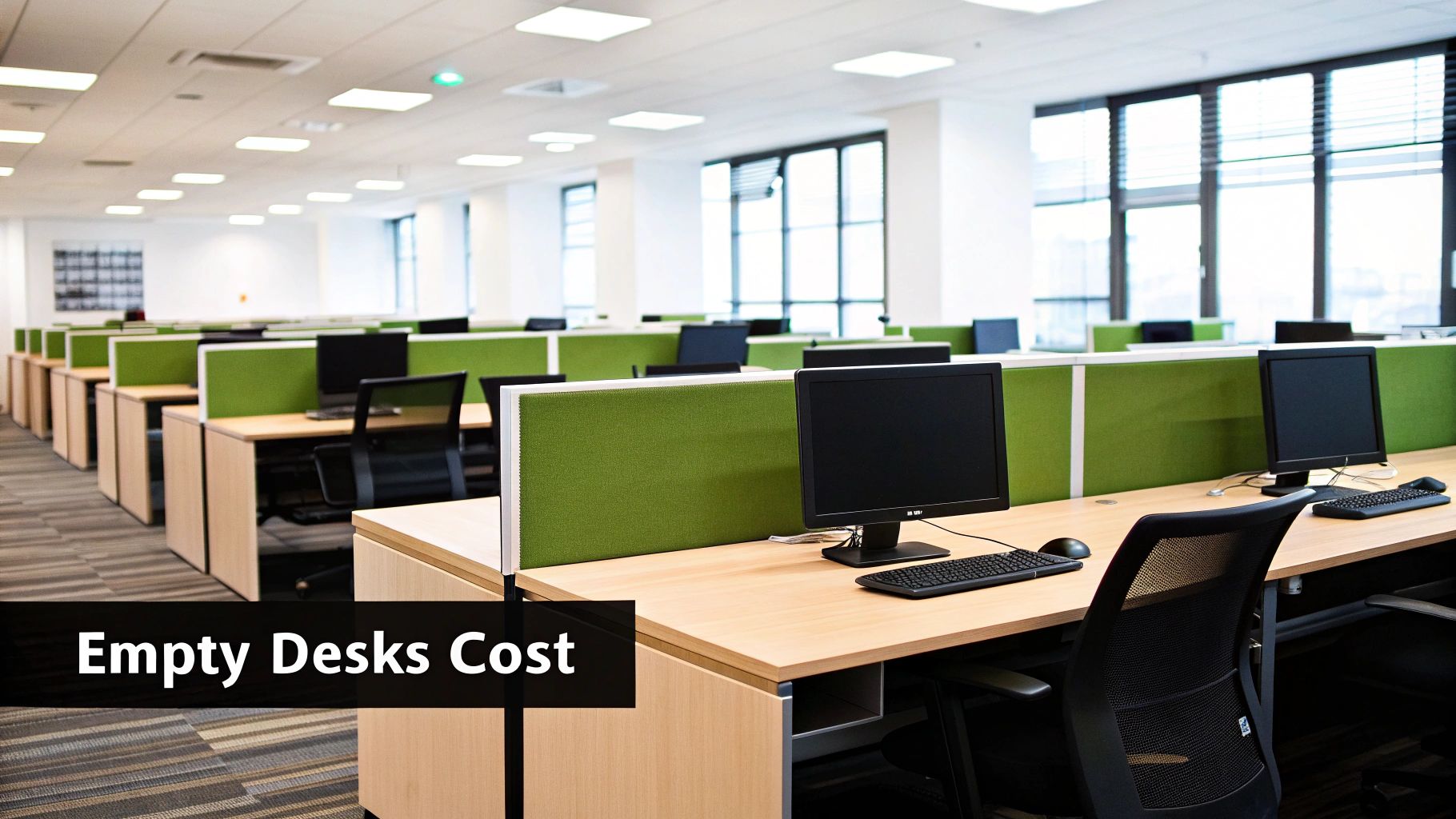
Imagine running a restaurant where half the tables stay empty every night, but you’re still footing the full bill for rent, staff, and utilities. That’s exactly what’s happening when your office space sits underused. Every empty desk and unoccupied meeting room is a constant financial leak—a major missed opportunity.
Not long ago, a packed office was just the norm. But with hybrid work now a permanent fixture, that picture has changed completely. Businesses everywhere are finding themselves stuck in long-term leases for spaces that are half-empty most days. This gap turns a company's second-biggest expense, real estate, into a serious financial burden.
Why Utilization Is a Sign of Your Company's Health
Tracking office space utilization isn't just a chore for the facilities manager; it's a direct reflection of your company's financial and operational fitness. It makes you ask tough questions about how your team really works and whether your office actually supports them. Low utilization isn't just about empty chairs—it points to bigger problems.
- Wasted Money: Every square foot has a price tag. Unused space means you're paying to light, heat, and cool areas that give you zero return on your investment.
- Operational Drag: An office that doesn’t fit how people work can kill productivity. Not enough meeting rooms or too many empty private offices creates unnecessary friction.
- Lost Agility: Being chained to an oversized, underused office prevents you from pivoting quickly, whether you need to scale up or down to meet market demands.
For startups, BPOs, and any growing business, paying for a ghost office just isn't an option anymore. The financial pressure is too high, and the need to be nimble is everything.
Poor office space utilization is like having a powerful engine that's only firing on half its cylinders. You're paying for the full machine but only getting a fraction of the performance. Optimizing your space is the tune-up your business needs to run efficiently.
Ultimately, getting a grip on your office utilization is about more than just trimming the budget. It’s the groundwork for designing a smarter, more deliberate workplace. When you align your physical space with your team's actual work habits, you create an environment that’s not just cheaper to run but also one that boosts productivity, collaboration, and morale. This pivot from a rigid, old-school office to an agile, optimized workspace is crucial for thriving today.
How to Measure Your Current Workspace Efficiency
To improve how you use your office, you have to stop guessing and start measuring. You can't fix what you don't understand, and getting a real handle on your space utilization is the first, most critical step. The good news is you don't need a crystal ball—just the right approach.
Think of it like a checkup for your office. First, you gather data to get a baseline diagnosis. Only then can you figure out the right treatment. There are a few ways to do this, from simple walk-throughs to sophisticated, automated systems. The goal is to turn raw data into smart decisions that actually save you money.
Technology-Driven Measurement Methods
If you're after pinpoint accuracy and real-time data, technology is your best bet. These tools act as the eyes and ears of your office, giving you a clear picture that manual methods just can't match.
-
IoT Sensors: These are small, discreet devices you can place under desks or in meeting rooms. They anonymously detect when someone is present, giving you a precise, minute-by-minute view of which spaces are actually being used. They are the gold standard for accurate office space utilization data.
-
Occupancy Analytics Software: This is the brain that crunches all the numbers from the sensors. Platforms like Density or VergeSense turn raw data into easy-to-read heat maps, charts, and reports. This software can instantly show you peak usage times, point out ghost town zones, and help you spot long-term trends.
-
Reservation System Data: Already using an app for booking desks or meeting rooms? You're sitting on a goldmine of data. Analyzing booking information from tools like Robin reveals which spaces are constantly in demand and which ones are always available. It’s a straightforward way to see what your team actually values.
These tech solutions provide a constant, unbiased stream of information, taking all the guesswork out of how your real estate is performing.
Low-Cost Alternatives for Startups and Small Businesses
Not every company is ready to invest in a full suite of sensors and software. If you're a startup or a small business, you can still get valuable insights using methods that are practically free.
It’s all about using what you already have. Simple observations and existing data can paint a surprisingly clear picture.
Gaining insight into your office space utilization is about being resourceful. Even without a big budget, you can uncover significant opportunities for improvement by analyzing the digital and physical footprints your team leaves every day.
For example, your building's badge swipe data can tell you how many people come into the office each day. A quick review of your meeting room calendars might show that your biggest conference room sits empty 90% of the time. You can even do a few "visual audits"—just walk the floor a couple of times a day and count heads. It's a simple, yet effective, snapshot.
This data is more important than ever, especially with how much work has changed. Before the pandemic, the average office utilization rate was around 64%. By early 2023, that number had plummeted to just 29%, a staggering 45% drop. This massive shift shows just how much our workspaces have been turned upside down. You can learn more about these workplace utilization findings and see how your business stacks up.
There are several ways to get the data you need, and the right method depends on your goals and budget. Here’s a quick comparison to help you decide.
Methods for Measuring Office Utilization
| Method | How It Works | Pros | Cons | Best For |
|---|---|---|---|---|
| IoT Sensors | Small sensors under desks or in rooms detect physical presence. | Highly accurate, real-time, anonymous data. | Higher upfront cost for hardware and software. | Businesses needing precise, continuous data for major real estate decisions. |
| Reservation Data | Analyzing booking data from desk and room scheduling software. | Leverages existing systems; great for tracking demand. | Only measures intent (bookings), not actual use. | Companies that have already adopted desk hoteling or flexible seating. |
| Badge Swipes | Tracking entry/exit data from employee ID cards. | Easy to access; provides a good headcount of who is on-site. | Doesn't show where in the office people are working. | Getting a basic, high-level understanding of daily office attendance. |
| Visual Audits | Manually counting people in different zones at set times. | No cost; easy to implement immediately. | Time-consuming; provides only a snapshot, not a trend. | Startups and small businesses needing a quick, low-cost baseline. |
Ultimately, choosing the right approach comes down to your needs, budget, and company size. The most important thing is just to start somewhere. Once you have this data, you're armed with the knowledge to make strategic decisions, trim unnecessary costs, and build a workspace that truly supports how your team works today.
Why Your Office Is Not Being Fully Utilized
So, you've noticed the office is a bit of a ghost town. Figuring that out is the easy part; the real challenge is digging into why. An empty office isn't just about people preferring their home setup. It’s often a sign of a fundamental mismatch between the space you provide, the rules you set, and what your team actually needs to get their work done.
It's tempting to blame it all on the rise of remote work, but that’s only scratching the surface. The problem is often baked right into the office design itself or rooted in company policies that haven't kept pace with how people work today. Let's break down the common culprits.
The Hybrid Work Mismatch
The most obvious reason for empty desks is the hybrid model. If you're still assigning a permanent desk to every single employee, you're operating on a pre-hybrid playbook. When people are only coming in a few days a week, that one-to-one desk ratio is a recipe for wasted space.
Think about it: if an employee is in the office just two days a week, their desk sits vacant and costs you money for the other three. This isn't just inefficient; it's a deep-seated disconnect.
The core issue is trying to fit a flexible, hybrid work model into a rigid, traditional office layout. It's like trying to run modern software on a ten-year-old computer—it technically works, but it's slow, clunky, and misses the entire point of the upgrade.
The fix starts with a mental shift. Stop thinking about employees "owning" a desk and start thinking about them "accessing" a workspace when they need one. That change in perspective is the first real step toward a smarter, more cost-effective office.
This map shows how different measurement tactics—from high-tech to low-cost—can help you get a handle on efficiency.
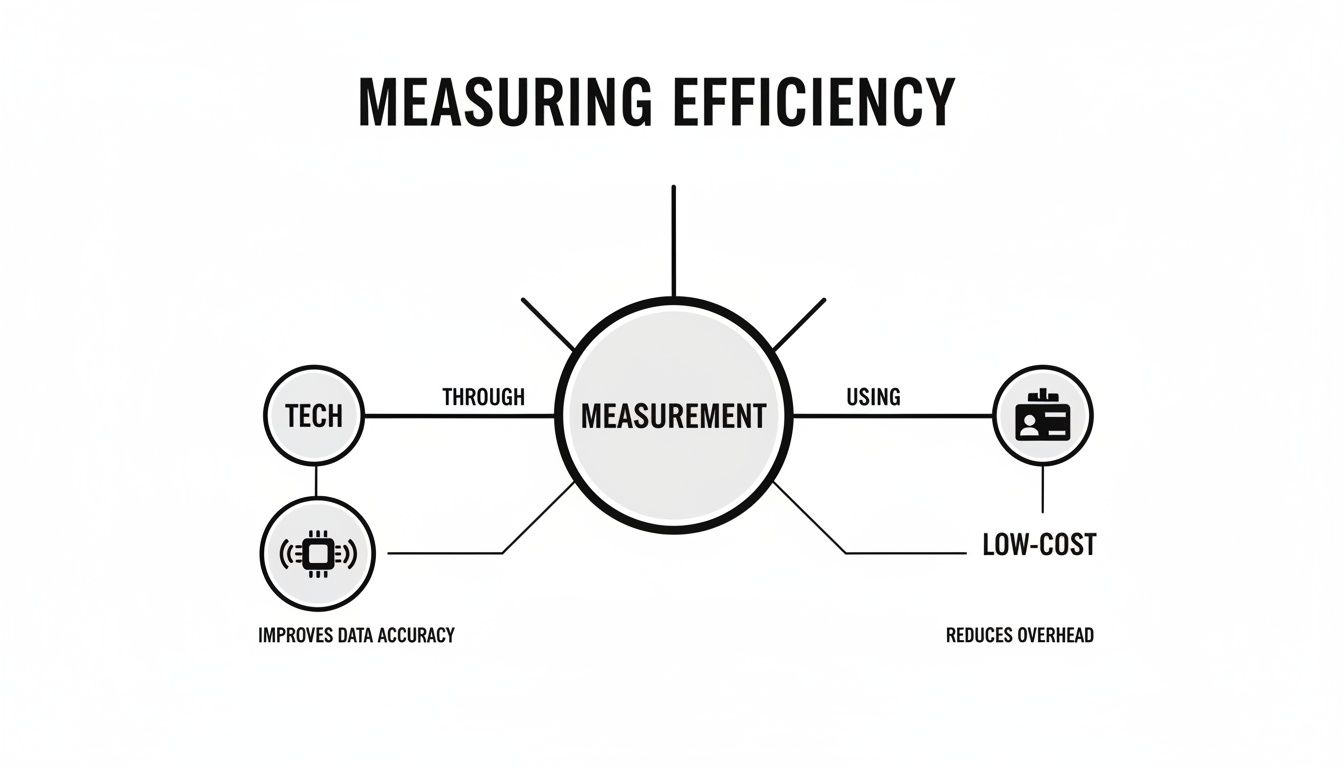
As the visual suggests, you don't need a massive budget to start understanding how your workspace is performing. There’s a path for everyone.
Inefficient Layouts and Dead Space
Sometimes, the floor plan itself is the problem. An office that wasn't designed for how teams work now will naturally feel empty. Common design flaws include:
- Too Many Private Offices: In a world that runs on collaboration, a floor plan dominated by closed-door offices creates silos. These areas are often the first to become underused, especially if senior leaders work flexibly.
- Not Enough Collaborative Zones: On the flip side, if your team comes in specifically to work together but can never find a meeting room or a whiteboard, they’ll quickly give up. Frustration is a powerful repellent.
- Lack of Variety: A monotonous sea of cubicles doesn't work anymore. People need different kinds of spaces for different kinds of work—like quiet pods for deep focus, comfy nooks for casual catch-ups, and formal rooms for important meetings.
If the office doesn't support the very reason your team is commuting in, they’ll simply stop making the trip. Your layout needs to be a productivity tool, not a hurdle.
The Policy and Employee Needs Disconnect
Finally, you might have a gap between company policy and what your employees truly need. Forcing people to come in on certain days without a clear purpose is a classic recipe for empty chairs. If the "in-office experience" means commuting for an hour just to sit on Zoom calls they could have taken from home, you’ve lost them.
The office has to offer something more. It needs to provide value that home can’t, whether that's better tech, easier collaboration, or just the energy of being around colleagues. When policies are handed down without a compelling "why," they don't drive real engagement. You end up with a space that's occupied on paper but isn't actually being used.
Actionable Strategies to Optimize Your Workspace
So, you've realized your office isn't being used to its full potential. That's the first step. Now, it's time to do something about it.
Transforming an underutilized space into a vibrant, efficient asset doesn't mean you need to tear down walls or start from scratch. With a few smart strategies, you can get your workspace in sync with how your team actually works, which is a win for both your bottom line and their productivity.
These methods are all about injecting flexibility and purpose into your office. Instead of trying to fit a modern, hybrid team into a rigid, old-school floor plan, you adapt the space to them. This shift is the key to improving your office space utilization.
Implement Flexible Seating Models
For most hybrid companies, the days of assigning one permanent desk to every single employee are long gone. That one-to-one ratio is one of the biggest reasons for poor utilization rates. The most direct way to fix this is to embrace flexible seating.
Think of desk hoteling or hot desking like making a reservation at a restaurant. Employees book a workspace only for the days they plan to be in the office, often through a simple app. This simple change ensures that desks are used with intention, and you stop paying to keep empty workstations running day after day.
This approach immediately breaks the link between your headcount and your real estate needs. You can easily support a larger, more flexible team with a much smaller office footprint, unlocking some serious cost savings. It’s a powerful move toward a more agile way of operating.
By shifting from assigned seating to a reservation-based system, companies can often support their entire workforce with 50-70% fewer desks. This isn't just about saving space; it's about creating a more dynamic and intentional workplace.
Design Activity-Based Work Zones
A modern office shouldn't be a monotonous sea of cubicles. People commute for different reasons—to collaborate with their team, to find a quiet space to focus, or just to connect with colleagues. Your office layout should support all of these needs.
This is where the concept of activity-based working (ABW) comes into play. It’s about designing your office a bit like a home, with different rooms serving different purposes.
- Focus Zones: Quiet areas with individual pods or separated desks for deep, concentrated work.
- Collaboration Hubs: Open spaces with whiteboards, big screens, and comfy seating perfect for team brainstorming sessions.
- Social Spaces: Café-style lounges and casual areas that encourage those spontaneous conversations that build company culture.
- Private Enclaves: Small, soundproof booths for taking confidential calls or hopping on a video meeting without distractions.
When you offer a variety of environments, you empower your team to choose the space that best fits what they need to do at that moment. This doesn't just make them more productive and happier; it also ensures every part of your office has a clear purpose and gets used more effectively. A well-designed ABW layout naturally boosts office space utilization because every square foot is optimized for a specific, valuable function.
Leverage Smart Scheduling and Policies
Technology and policy have to work together to make a flexible workspace successful. The right tools and guidelines can smooth out the process and encourage the kind of behavior you want to see.
Start with a user-friendly desk and room booking platform. The easier it is for people to see who’s coming in and to reserve a spot, the more likely they are to actually use the office. These tools also give you a goldmine of data on peak usage days and popular work areas, helping you make even smarter decisions down the road.
Next, take a hard look at your workplace policies. Instead of mandating arbitrary in-office days, encourage teams to coordinate their schedules for specific, collaborative tasks. For example, setting a "project day" where a whole team comes in to brainstorm makes the commute feel worthwhile. Aligning your policies with purpose makes the office a destination, not an obligation. For more ideas on managing a flexible team, you might be interested in exploring our other guides on the Seat Leasing BPO blog. This ensures your office becomes a hub of meaningful activity, not just a collection of sporadically occupied desks.
How Seat Leasing Solves Utilization Challenges
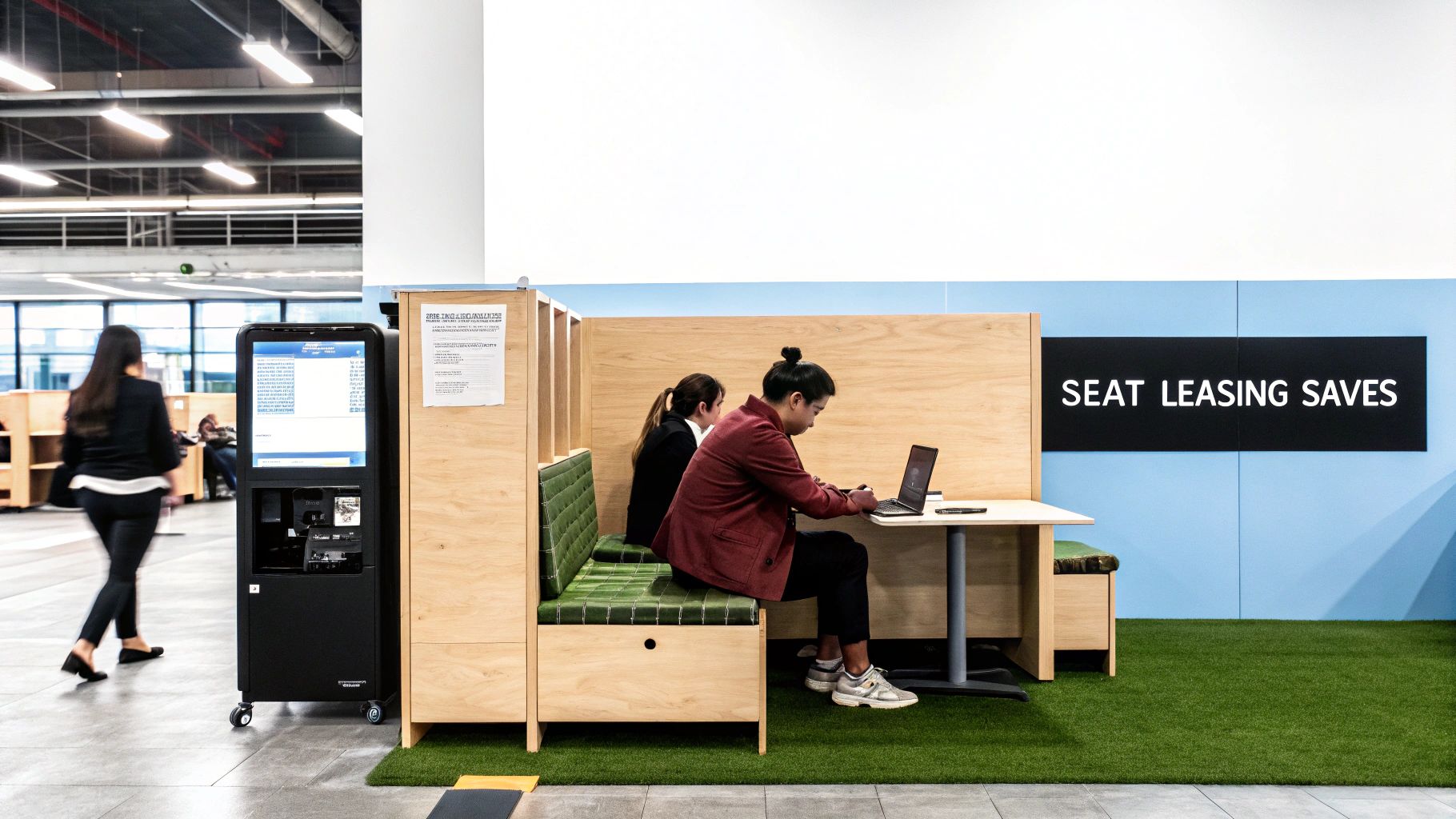
While you can certainly optimize a traditional office lease to improve your office space utilization, what if you could bypass the problem altogether? For businesses that need maximum flexibility and cost control, seat leasing offers a powerful alternative. It completely rewrites the rules of commercial real estate, shifting from a risky, long-term commitment to a nimble, pay-as-you-go model.
Think of it like this: your office space becomes less like a hefty hardware purchase and more like a cloud service subscription. You only pay for the exact resources—the seats—your team needs right now. This approach strikes at the very heart of underutilization by cutting out the dead weight of empty desks and wasted square footage.
The Power of On-Demand Scaling
A traditional office lease locks you into a fixed amount of space, forcing you to pay for real estate you might not need next month or next year. This is a huge gamble for startups, BPOs, and small businesses whose team sizes can change at a moment's notice. Seat leasing flips this script entirely, letting you scale your physical presence up or down almost instantly.
Need to bring on ten new agents for a big project? Just add ten seats. When that project wraps up, you can scale back down without being stuck paying for a ghost town. This agility ensures your real estate expenses are always in lockstep with your actual headcount, guaranteeing 100% utilization of every dollar you spend on office space.
Seat leasing transforms real estate from a fixed, capital-intensive liability into a flexible, operational expense. It’s the ultimate strategy for businesses that prioritize growth and adaptability over being tied down to a long-term lease.
This model is a game-changer for businesses in fast-moving industries. By opting for a flexible workspace, you sidestep the massive upfront costs and long-term chains that drain cash better spent on your core operations and growth.
Slashing Costs Beyond Just Rent
The savings with seat leasing go much deeper than just the rent on empty desks. A conventional lease saddles you with a mountain of other expenses—both obvious and hidden—that can easily hamstring a growing company.
A quality seat leasing arrangement is typically all-inclusive. Just look at what's covered:
- Zero Capital Expenditure: Forget about buying desks, ergonomic chairs, or any other office furniture. Everything is set up and waiting for your team.
- No IT Setup Hassles: You get access to enterprise-grade IT infrastructure, from high-speed internet to robust cybersecurity, all managed for you. This benefit alone can save thousands of dollars and countless headaches.
- Bundled Utilities and Maintenance: All the operational costs—electricity, water, daily cleaning, and building maintenance—are rolled into one predictable monthly payment.
For BPOs and startups, these bundled savings are huge. Companies often report cutting their total real estate and operational expenses by up to 80% compared to a traditional office lease. That’s a massive amount of capital freed up to reinvest in talent, technology, and winning new business.
A Strategic Move for Agile Businesses
At the end of the day, seat leasing is more than just a different kind of office—it's a strategic business decision. It gives you the power to run a lean, agile operation that can pivot quickly to grab market opportunities without being anchored by a rigid property contract.
By taking the headaches of office management and the financial risks of poor office space utilization off your plate, you can focus on what you do best: running your business. If you want to grow without the traditional burdens of real estate, exploring what a provider like Seat Leasing BPO has to offer is one of the smartest moves you can make. It’s the definitive solution for any forward-thinking company focused on efficiency and scalable growth.
Frequently Asked Questions About Office Space Utilization
Diving into office space utilization often brings up a ton of questions. As you start moving from theory to practice, you'll probably wonder what a good benchmark looks like, how to start without a huge budget, and, most importantly, how to get your team on board.
Let's clear up some of the most common questions. Think of this as a quick guide to help you get past those initial hurdles and confidently build a smarter, more efficient workspace.
What Is a Good Office Space Utilization Rate?
This is the big one, and the answer isn't what it used to be. Before the hybrid work boom, a 65% utilization rate was pretty standard. Today, a healthy, active office often lands somewhere between 40% and 60%.
What's "good" really comes down to your company's goals. While aiming high seems great for the bottom line, getting close to 100% can actually be a problem. It usually means the office is packed, and people are scrambling to find a spot to work, which kills productivity and morale. The sweet spot is an office that feels alive and well-used but never so crowded that your team can't find the space they need.
How Can a Small Business Measure Utilization Without Expensive Tech?
You don't need to install a bunch of high-tech sensors to get a handle on how your space is being used. Small businesses can get surprisingly useful insights with some simple, low-cost approaches.
- Walk the Floor: Seriously, just do a few walkthroughs. Take a lap at different times of the day and on different days of the week. A simple headcount gives you a solid snapshot of your peak and slow times.
- Ask Your Team: Use a free survey tool to ask employees how they work, what spaces they need, and what would make their time in the office better. This kind of direct feedback is gold.
- Check Your Calendars: You're probably already sitting on a treasure trove of data. Look at your meeting room booking calendars. You'll quickly see which rooms are always booked and which ones are collecting dust.
How Do We Encourage Employees to Adopt Desk Hoteling?
Shifting to a flexible model like desk hoteling is all about people. It's a change in culture, not just logistics. To make it work, you have to frame it as an improvement for everyone, not a loss of personal space.
Start by explaining the why. Focus on the benefits for your team—more freedom to choose where they work, a better mix of collaboration and quiet zones, and a more dynamic atmosphere. Then, make it easy. A simple, intuitive app for booking desks is non-negotiable. Leadership also needs to buy in and use the system themselves.
Finally, little things make a big difference. Provide personal lockers and make sure every workstation has the same great tech setup. The goal is to make any desk feel like home for the day. If you need a little help navigating this shift, you can always get in touch with our workspace strategy experts for some practical advice.