Knowing how to scale your business starts with a brutally honest look in the mirror. It's not just about more sales. Real readiness comes from having a stable, profitable foundation, a steady stream of customers, and a playbook that lets you handle more work without everything falling apart.
Are You Genuinely Ready to Scale Your Business?
Every entrepreneur wants to grow, but jumping the gun is a classic, and often fatal, mistake. Pushing for growth too soon can wreck a business faster than staying small. Scaling is about amplifying what already works, not just getting bigger for the sake of it.
So many founders mistake a good quarter for a permanent trend. They rush to hire and lease bigger spaces, only to find the demand wasn't as deep as they thought. Now they're saddled with costs their revenue can't support. This is the moment to get real and look at the data, not just your gut feeling. Is your recent success a solid launchpad, or is it a temporary peak you need to reinforce first?

Unpacking the Real Signals of Readiness
Before you even think about drafting a growth plan or talking to investors, you need to make sure the core of your business is rock-solid. Think of it like a pre-race inspection for a car—you check the engine, the chassis, and the tires before you hit the accelerator.
First up: profitability. I'm not talking about revenue; I mean actual, consistent profit. Is your cash flow healthy and predictable? That’s the fuel for expansion. If you’re just scraping by or your profits swing wildly from month to month, throwing money at the problem will only make the financial cracks bigger. A business that’s ready to grow isn't just surviving; it's thriving.
Next, what does your customer demand look like? Are you constantly telling potential customers, "Sorry, we're booked solid"? Does your sales team hit its numbers without having to perform miracles? That's a huge sign you’ve found product-market fit and there’s a bigger audience out there waiting for you. But if every sale is a bare-knuckle fight and your customer list isn't growing, you need to fix the core product before you even dream of scaling.
"Premature scaling is the leading cause of death for startups. It's the result of putting the cart before the horse, spending money on scaling before you've actually figured out who your customers are and what your product is."
— Eric Ries, Author of The Lean Startup
Is Your Operational House in Order?
Finally, take a hard look at your internal operations. If you hired someone new tomorrow, could they follow a checklist to do a key task? Or is all that crucial information locked inside the heads of your top two employees? Scalable businesses run on systems, not on the heroic, last-minute efforts of a few people.
Use this quick-reference table to gauge where you stand. It lays out the foundational elements that absolutely must be in place before you take the leap.
Key Indicators of Scaling Readiness
| Indicator | What to Look For | Why It Matters for Growth |
|---|---|---|
| Consistent Profitability | Predictable, healthy profit margins and positive cash flow. | Growth costs money. You need stable profits to fund expansion without taking on dangerous levels of debt. |
| Strong Customer Demand | You're turning away work or have a long waiting list; sales targets are met consistently. | This proves you have product-market fit. Scaling allows you to meet existing demand, not create it from scratch. |
| Documented Processes | Core workflows for sales, service, and operations are written down and standardized. | Systems make growth repeatable and predictable. They ensure quality doesn't slip as you add new people and customers. |
| High Customer Satisfaction | Low churn rates, positive reviews, and strong word-of-mouth referrals. | Happy customers are the bedrock of sustainable growth. Unhappy ones will churn faster as you scale, creating a leaky bucket. |
| Team Capacity | Your team is performing well but isn't constantly burned out. There's some bandwidth for new projects. | An overworked team has no room to manage the chaos of growth. You need a team that can absorb new responsibilities. |
If you check all these boxes, you have a strong foundation. If not, your priority isn't scaling—it's shoring up these weak spots first.
Think about it this way. I once saw a marketing agency hire five new people after landing one huge client. Six months later, the client pulled out, and they were stuck with a massive payroll they couldn't afford. Painful layoffs followed.
Contrast that with a software company I know. They waited until their support tickets outpaced their team's capacity for three straight quarters. They had undeniable proof of sustained demand and a documented process for training new support reps. When they finally hired, the expansion was seamless and profitable from day one. That's the difference between gambling and scaling smart.
Building Your Strategic Growth Blueprint
Let's get one thing straight: real, sustainable growth doesn't just happen. It's designed. Once you've confirmed you're truly ready to scale, it's time to draft a detailed, actionable plan. This isn't just about dreaming big; it's about turning the abstract idea of ‘scaling’ into a concrete project with clear milestones and ways to measure success. Think of it as your roadmap for the challenging journey ahead.
Simply wanting to grow isn’t a strategy. You have to get specific about what growth actually looks like for your business. That means picking a scaling model that plays to your strengths, fits the market opportunities you see, and lines up with where you want to be in the long run. Without that clarity, you'll just end up spreading your resources thin or chasing shiny objects that pull you off course.

Choosing Your Path to Growth
There are several well-worn paths to scaling a business, and the right one for you depends entirely on your situation. You don't need to reinvent the wheel, but you do need to pick the right vehicle for your journey.
Here are the most common strategic moves I've seen work:
- Market Penetration: This is the most direct approach. The goal is simple: sell more of what you already have to the market you're already in. Think of a local coffee shop opening a second location across town or a software company launching a referral program to grab a bigger slice of its current user base.
- Product or Service Diversification: Here, you're creating new things to sell to your existing customers. A great example is a web design agency that starts offering SEO and content marketing services. They're capitalizing on the trust they've already built to cross-sell.
- Market Development: This strategy is all about taking your current products to new audiences. This could mean geographic expansion, like an e-commerce brand finally shipping internationally, or it could mean targeting an entirely new customer demographic you hadn't focused on before.
- Business Model Innovation: Sometimes, scaling means rethinking how you do business from the ground up. This might involve shifting from one-off sales to a subscription model. Or, as many are discovering, it could mean exploring flexible operational models like outsourcing to slash overhead and move faster. For a deeper dive, you can learn more about business growth strategies in our blog.
Setting Objectives That Actually Work
Once you've picked a direction, you need to set clear, measurable goals. Vague ambitions like "increase sales" are useless. This is where the SMART framework is an absolute lifesaver for anyone figuring out how to scale a small business.
Your objectives have to be:
- Specific: "Increase monthly recurring revenue by 20%," not "Grow the business."
- Measurable: "Acquire 500 new paying customers," not "Get more users."
- Achievable: Push yourself, but set targets that are realistic based on your data and resources.
- Relevant: Does the goal actually push your chosen growth strategy forward?
- Time-bound: "Achieve this by the end of Q4," not "Sometime this year."
For example, a business focused on market penetration might set a goal like this: "Increase our market share in the Midwest region from 10% to 15% within the next 12 months by securing 30 new enterprise clients." Now that's a goal. It’s specific, you can measure it, and it has a deadline.
Identifying the KPIs That Truly Matter
You can't manage what you don't measure. As you scale, your Key Performance Indicators (KPIs) have to get more sophisticated than just revenue and profit. You need to be tracking the metrics that tell you if your growth is healthy and sustainable.
A common mistake I see is a singular focus on top-line revenue. True scalability is measured by how efficient and profitable your growth is, not just how fast it is.
Zero in on these critical growth KPIs:
- Customer Acquisition Cost (CAC): How much do you spend on sales and marketing to land one new customer? If this number starts climbing as you grow, it's a sign your growth engine is sputtering.
- Customer Lifetime Value (CLV): What's the total revenue you can realistically expect from a customer over their entire relationship with you? For a healthy business model, your CLV needs to be significantly higher than your CAC—a 3:1 ratio is a common benchmark.
- Churn Rate: What percentage of your customers are leaving over a given period? High churn is a massive red flag. It signals a problem with your product or service that scaling will only make worse.
By building your blueprint around a clear strategy, SMART goals, and the right KPIs, you're creating a disciplined framework for growth. This plan becomes your north star for making decisions, allocating resources, and knowing if you're actually on the right track.
Designing Operations That Can Actually Scale
That scrappy, "all-hands-on-deck" approach that got you here? It’s about to become your biggest bottleneck. The very things that worked for a team of five will absolutely crumble under the weight of fifty. Scaling isn’t just about doing more of the same—it’s about completely re-architecting the engine of your business to handle more volume, more speed, and more complexity without everything falling apart.
You have to get away from work that depends on what’s in one key person's head. The goal is to build standardized, system-dependent workflows. When your operations run on documented systems, anyone with the right training can step in and get the job done right. That’s how you build a resilient, truly scalable company.
From Manual Effort to Systemized Success
First thing's first: you need to get brutally honest and document everything. Map out every single core process in your business, from how you onboard a new client to how you fulfill an order or handle a customer complaint. I know, it sounds tedious, but this is the blueprint for your future growth. Once you see it all laid out, the inefficiencies and opportunities for improvement will jump right out at you.
Next, it's time to be ruthless about automation. Repetitive, manual tasks are the sworn enemies of scale. They eat up your team's precious time and are a breeding ground for human error.
Here's where to start:
- Customer Relationship Management (CRM): A good CRM is non-negotiable. It becomes the single source of truth for all customer data, tracks every interaction, and automates your sales and marketing follow-ups so no lead ever falls through the cracks.
- Project Management Tools: Platforms like Asana, Trello, or Monday.com bring much-needed clarity to complex projects. They help you standardize how work gets done, assign clear ownership, and keep everyone on the same page.
- Workflow Automation Software: Think of tools like Zapier as the glue holding your tech stack together. For instance, you could set it up so that a new lead in your CRM automatically creates a project folder in Google Drive and a new task in Asana. No human intervention required.
By systematizing and automating, you're building an operational framework that actually supports growth instead of getting in its way. You free up your people to focus on the high-value work that really requires human creativity and critical thinking.
Building a Flexible Infrastructure for Agile Growth
As you tighten up your internal processes, you also have to think about your physical and technical infrastructure. One of the biggest mistakes I see founders make is locking themselves into expensive, long-term commitments for things like office space and IT equipment. That old-school, capital-intensive approach just drains your cash and kills your ability to pivot.
Scalable operations are lean and flexible. The goal is to build a business that can expand or contract with market demand without being crushed by fixed overhead costs.
This is exactly why flexible infrastructure solutions have become such a game-changer. Instead of sinking a huge chunk of your capital into a five-year office lease, you can use models that let you pay for only what you need, right when you need it. This mindset shift is a critical piece of learning how to scale a small business the smart way.
This isn't just a niche idea; it’s a massive global trend. Just look at the Business Process Outsourcing (BPO) market. Projections show it growing from USD 328.37 billion in 2025 to an incredible USD 695.77 billion by 2033. This explosion is being driven by businesses just like yours that need agile ways to scale their teams and adopt new tech without the heavy upfront costs.
Solutions like seat leasing let you tap into a ready-made operational infrastructure. You get the office space, the IT setup, and the back-office support without the massive investment and management headaches of building it all yourself. You can see the specific inclusions that make this model so powerful. It’s simply a smarter way to grow, letting you pour your capital into things that actually move the needle—like product development and marketing—instead of tying it up in real estate and IT hardware.
A Smarter Way to Reduce Overhead with Seat Leasing
One of the biggest roadblocks to scaling a business is the massive, upfront cost of physical infrastructure. I’ve seen so many founders get bogged down by this. Long-term office leases, expensive IT hardware, furniture, and all the facility management headaches can drain your capital before you’ve even made your next key hire.
It forces a really tough choice: Do you tie up precious cash in real estate, or do you pump the brakes on your growth?
Thankfully, there’s a much more agile way to handle this. Instead of leasing an empty shell and building it out from scratch, you can tap into a "plug-and-play" operational hub. This model gives you immediate access to a fully-equipped workspace without the crippling capital expenditure.
What Is Seat Leasing and How Does It Actually Work?
At its core, seat leasing is a straightforward and incredibly flexible workspace solution. You're not renting an entire office; you're renting individual, fully-equipped workstations—or 'seats'—on a simple monthly basis. Forget getting locked into a multi-year contract for an empty room. Seat leasing gives your team everything they need to be productive from day one.
The real beauty is that it bundles all the essential services into one predictable monthly cost.
- Fully Furnished Workstations: Every team member gets a proper desk, an ergonomic chair, and lockable storage.
- High-Speed Internet: You get reliable, enterprise-grade connectivity that's already set up and managed for you. No calling the internet company.
- Complete IT Infrastructure: This is a big one. It includes PCs, necessary software, and ongoing IT support to handle any tech glitches that pop up.
- Utilities and Maintenance: All the annoying bills—electricity, water, cleaning, and building security—are rolled into the price.
You just decide how many seats you need, and the provider handles everything else. This instantly transforms what would have been a huge capital expense into a manageable operational expense, freeing up your money for what really matters: marketing, product development, and winning new customers.
The whole point of seat leasing is to let you focus 100% on your business, not on playing landlord or part-time IT manager. It removes the operational friction that so often stalls ambitious companies.
Think about it in the context of building truly scalable operations. The game is all about documenting, automating, and outsourcing.
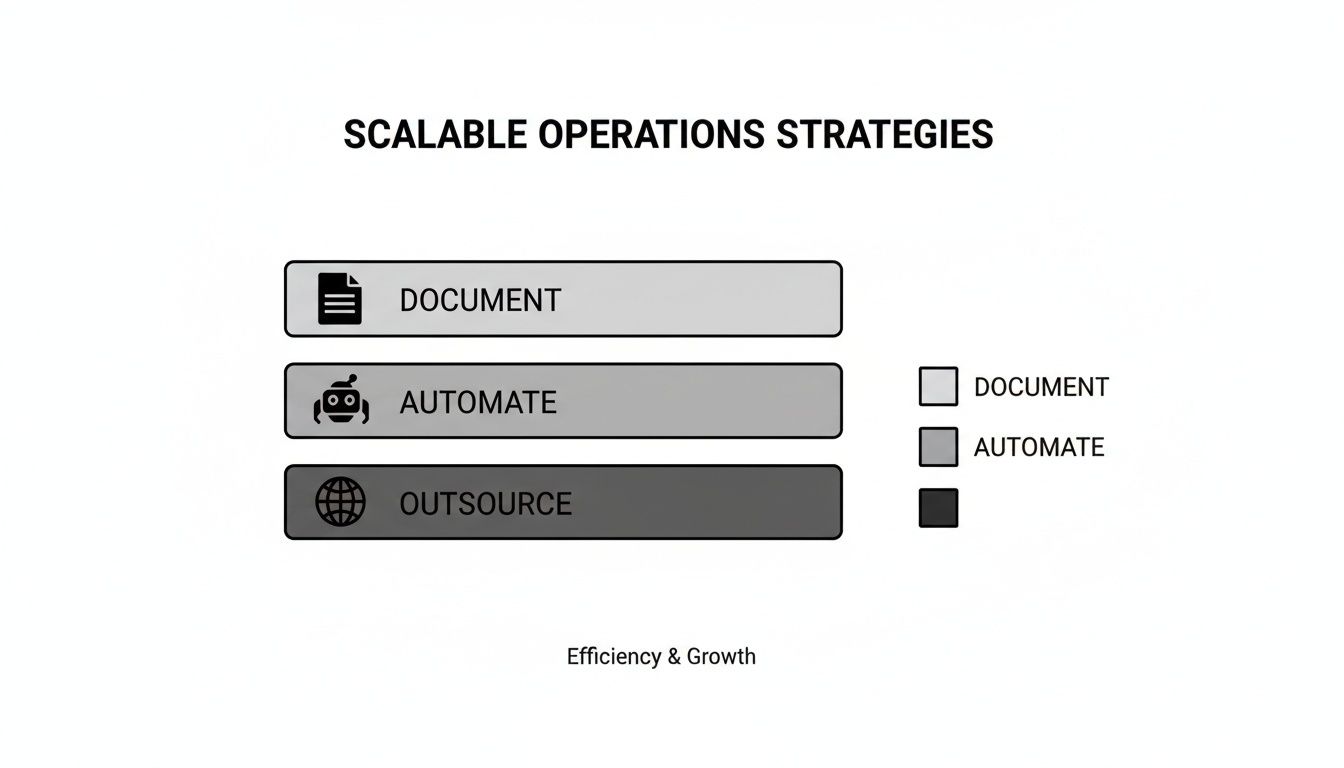
Outsourcing your physical infrastructure is a powerful move that fits perfectly into this framework, letting you create a lean, mean engine for growth.
The Clear Financial Advantage Over a Traditional Lease
Let's make this real with a quick example. Say you need to hire 10 new support agents to handle a surge in business.
If you go the traditional lease route, your upfront costs are going to be painful:
- A hefty security deposit (often several months' rent).
- Office furniture for 10 people.
- All the computers, monitors, and networking gear.
- Installation fees for your internet and phone systems.
This can easily run into tens of thousands of dollars before a single person has started their first day.
Now, contrast that with seat leasing. Your upfront capital cost is virtually zero. You just pay the first month's fee, and your team is ready to go. This isn't just a minor tweak; it’s a fundamental shift in how you deploy capital.
By bundling space, equipment, and support, this model can lead to cost savings of up to 80% compared to a conventional office setup. The flexibility is also a massive win for a growing company. You can add or subtract seats as your needs change, avoiding the crippling penalties that come with trying to break a traditional lease early.
Agility Is the Ultimate Competitive Edge
Beyond the obvious cost savings, the greatest benefit of this model is pure agility. Learning how to scale a small business is really about how fast you can react to opportunities and challenges.
Need to double your team in 30 days to land a huge new client? A good seat leasing provider can make that happen. Is a project wrapping up, meaning you need to scale back? You aren't stuck paying for empty desks for the next three years.
This nimbleness allows you to align your operational costs directly with your revenue, which creates a much healthier and more resilient business. By using a solution like Seat Leasing BPO, you aren't just renting a desk. You're grabbing a strategic lever that enables faster, leaner, and smarter growth.
Building a Team and Culture That Can Keep Up
If your processes and systems are the skeleton of your business, then your people are its heart and soul. Let's be honest: when you're scaling, the biggest hurdles aren't usually operational—they're human. Knowing how to grow a small business is really about mastering the art of building a team and a culture that can handle the pressure of expansion. In fact, they should thrive on it.
Your hiring strategy has to change. You can't just hire for the job you need filled today. You need to start hiring for the company you want to be in 12 to 18 months. That means finding adaptable problem-solvers who get excited by change, not scared of it.
Hire for Where You're Going, Not Where You Are
When you’re a team of five, everyone pitches in on everything. But when you hit 20, 50, or more people, you need specialists. That marketing generalist who was a superstar in the beginning might not have the deep SEO or paid media skills required for your next big push.
It's time to shift your focus to hiring "T-shaped" people. These are individuals with deep expertise in one specific area (the vertical part of the T) but also a broad ability to work with and understand other departments (the horizontal part). They can execute their core job flawlessly while still contributing to the bigger picture.
When you're interviewing, look for these traits:
- Adaptability: Ask them about a time a project went completely sideways. You want to hear how they reacted and what they did next, not just that they survived it.
- Ownership Mentality: You need people who see a problem and feel compelled to solve it, even if it's not "their job." They don't just point out fires; they grab an extinguisher.
- A Hunger for Learning: The skills you need today will be different a year from now. Find people who are genuinely curious and always looking to sharpen their skills.
Don't Let Your Culture Get Watered Down
Company culture is easy when you can all fit around one table for lunch. But as you add people, departments, and maybe even offices, that unspoken "vibe" can get diluted fast. If you don't define your culture, growth will define it for you—and you probably won't like what it comes up with.
Your culture is the invisible operating system that guides how your team makes decisions and works together when you're not in the room. To scale it, you have to make it visible.
Start by writing down your core values. And I don't mean just putting some nice words on the wall. Translate them into actual, observable behaviors. For example, if "Customer Obsession" is a value, a behavior might be, "Every team member spends at least two hours a month listening to customer support calls."
Weave these values into everything you do:
- Hiring: Ask interview questions that test for value alignment.
- Onboarding: Spend real time teaching new hires how you work, not just what they'll be doing.
- Performance Reviews: Measure people on both their results and how well they live the company values.
- Promotions: Promote the people who are not just top performers, but also your biggest culture champions.
Get Smart with a Flexible Workforce
Growing your team doesn't always have to mean hiring full-time employees in your city. This is where a flexible workforce gives you a huge advantage, letting you access a global talent pool without the usual headaches and costs.
The explosive growth of global BPO markets proves this model works. India's BPO service market, valued at USD 49.87 billion in 2024, is expected to reach USD 139.35 billion by 2033. The Philippines isn't far behind, reporting USD 38 billion in IT-BPM revenue in 2024. These hubs allow companies to scale efficiently.
By using options like seat leasing in these markets, you can access skilled talent and slash operational costs without getting tied up in real estate. To get a better sense of the trend, you can dig deeper into the growth of the global BPO market.
This approach lets you bring on specialized skills when you need them—like a team of data analysts for a three-month project—without the long-term overhead. It gives you the power to ramp your workforce up or down based on what the business actually needs, making your entire organization more agile and resilient.
Your Top Scaling Questions, Answered
Growing a business is exciting, but it's also a journey filled with tough questions. Founders are constantly trying to look around the corner and anticipate the next challenge. Let's tackle some of the most common concerns that come up on the path to scaling.
What’s the Single Biggest Mistake to Avoid When Scaling?
Hands down, the most catastrophic error is scaling prematurely. This happens when you start pouring money into hiring and marketing before you've actually locked in a predictable, repeatable way to win and keep customers. So many entrepreneurs get caught up in the vanity of growth, chasing bigger numbers for the sake of it.
This is a surefire way to burn through your cash reserves at a terrifying pace. It creates internal chaos where no one is quite sure what they're supposed to be doing, and it can completely wreck the company culture that got you this far. Think of it this way: scaling is about amplifying a system that’s already proven to work, not trying to fix a broken engine by adding more fuel.
Before you pour gasoline on the fire, make sure it's a controlled burn. You need undeniable product-market fit and a documented, repeatable system for acquiring and delighting customers. Anything less is just a high-stakes gamble.
How Do I Figure Out How Much Funding I Actually Need?
Calculating your funding needs is far more science than art. It's not about raising the most money you can get; it's about securing just enough capital to hit specific, measurable milestones that will get you to the next level and increase your company's value.
Start by mapping out your major expenses for the next 18-24 months. Don't guess—dig into the details. Your forecast should realistically cover:
- People: New salaries, benefits, and the costs of finding and hiring them.
- Marketing & Sales: Ramping up ad spend, creating new content, or expanding your sales team.
- Tech & Tools: New software subscriptions, better hardware, or necessary infrastructure upgrades.
Once you have your expenses projected, forecast your revenue based on your scalable growth model. The difference between what you'll spend and what you'll earn is your funding target. And whatever you do, build in a safety net of at least 20-30%. Trust me, unexpected challenges always come up.
Is It Possible to Scale Without Losing Our Company Culture?
Yes, it’s absolutely possible—but it won't happen on its own. Preserving your culture during a period of intense growth takes deliberate, consistent effort. Your culture is going to change as you add more people, but the goal is to guide that evolution intentionally.
The first, most crucial step is to write down your core values. And I don't mean just listing vague words on a poster. Define the specific behaviors that bring each value to life. Then, weave those values into everything you do: how you hire, how you promote, and how you make decisions day-to-day. As the founder, you have to transition from being the primary source of culture to empowering your leaders to be its biggest champions.
Radical transparency also becomes non-negotiable. As your team gets bigger, it's easy for people to feel disconnected. Regular, honest communication keeps everyone aligned and feeling like they are all pulling in the same direction.
What’s the Real Difference Between Seat Leasing and a Traditional Office Lease?
Understanding this distinction can save you a massive amount of money and headaches. A traditional office lease is a rigid, long-term commitment for an empty shell. Once you sign on the dotted line, you're on the hook for everything: desks, chairs, IT setup, internet contracts, utilities, cleaning—you name it. It's a huge upfront cash drain.
Seat leasing, on the other hand, is a flexible, all-in-one service built for speed and agility. You pay a simple, predictable monthly fee for each employee, and that fee includes a fully furnished and operational workspace.
Here’s how they stack up:
| Feature | Traditional Office Lease | Seat Leasing BPO |
|---|---|---|
| Commitment | Long-term (3-10 years) | Flexible (monthly/yearly) |
| Upfront Cost | Very high (deposit, fit-out) | Minimal to none |
| Inclusions | Just the empty space | Everything (furniture, IT, net) |
| Flexibility | Very low | High (scale up or down easily) |
| Management | You manage everything | The provider manages it all |
With seat leasing, you sidestep the huge capital outlay and gain the ability to add or remove team members on short notice. More importantly, it lets you and your team focus 100% on growing the business, not on managing an office.
Ready to scale your operations without the massive upfront costs and management headaches of a traditional office? Seat Leasing BPO offers a plug-and-play solution that lets you focus on growth. Discover our flexible, all-inclusive workspaces by visiting https://seatleasingbpo.com today.