Have you ever noticed how the price of a cup of coffee can be wildly different from one city to the next? Labor arbitrage is built on that same idea, but instead of coffee, it applies to professional skills. It's a business strategy that involves finding skilled professionals in parts of the world with a lower cost of living to get work done more affordably, without compromising on quality.
This isn't about finding the cheapest option possible. It's about finding the best value. You get the same expertise—whether it's a software developer, a graphic designer, or a customer support specialist—from a market where that talent is more accessible from a cost perspective.
What Is Labor Arbitrage and How Does It Work

At its core, labor arbitrage is about turning a simple economic imbalance into a strategic advantage. Let's stick with the shopping analogy. If you could buy the exact same high-quality product for $100 in New York or for $30 in a smaller town, where would you buy it? You'd obviously choose the smaller town to save a significant amount of money.
That’s precisely how labor arbitrage works for businesses. The salary for a specific job can differ dramatically between countries, driven by local economies and cost of living. A company based in a high-wage country, like the United States or Switzerland, can hire talented people in a country with lower wage standards, pay them a very competitive local salary, and still come out far ahead financially. It’s about being smart with your resources.
The Core Mechanism: Wage Disparities
The engine that makes this all possible is the huge gap in salary expectations across the globe. Labor arbitrage functions by strategically tapping into these wage differences to lower operating expenses while keeping productivity high.
For example, a senior software developer in Silicon Valley might expect an annual salary of around $150,000. A developer in a tech hub like Bangalore, India, or Manila, Philippines, with the same skill set and experience, might earn between $30,000 to $50,000. That's a staggering 3-5x cost difference that savvy companies have been using for years to gain a competitive edge. If you're curious to learn more about how these wage gaps are shaping global business, Qandle.com offers some great insights.
This economic reality allows a business to:
- Slash operational costs: Lowering salary expenses is the most direct way to improve your bottom line.
- Tap into a global talent pool: You’re no longer restricted to hiring people who live within a 30-mile radius of your office.
- Scale your team with agility: You can grow or shrink your teams much more easily in response to business needs.
By taking advantage of these global wage differences, companies can free up cash to reinvest in other vital parts of the business—like R&D, marketing, or improving the customer experience. What starts as a simple cost-saving move quickly becomes a powerful tool for growth.
Exploring the Different Flavors of Labor Arbitrage
Once you get past the textbook definition, you quickly realize labor arbitrage isn't a one-size-fits-all strategy. It’s more like a toolkit, with different approaches for solving different business problems. Knowing the variations is key to figuring out which one will actually work for your company.
The most familiar form is geographic arbitrage. This is the classic model: a business in a high-cost country like the United States moves work to a location with much lower wages, such as the Philippines or India. The main goal here is straightforward cost-cutting.
But the strategy gets much more interesting when you look beyond just the price tag.
More Than Just Cost: Timezone and Skill Arbitrage
The smartest companies use labor arbitrage for more than just saving money; they use it to gain a real competitive advantage. This is where the strategy evolves from a simple cost-play into a way to build a stronger, more resilient business.
Two powerful variations stand out:
- Timezone Arbitrage: This is about building teams across the globe to create a "follow-the-sun" workflow. Imagine a company in New York handing off tasks to a team in Eastern Europe just as the US workday ends. This ensures work never stops, enabling true 24/7 productivity and round-the-clock customer support.
- Skill Arbitrage: This approach focuses on finding top-tier expertise that’s either too expensive, hard to find, or completely unavailable in your home market. A tech startup, for instance, might hire a team of AI specialists in a country known for its excellent STEM education, getting access to world-class talent without the Silicon Valley price tag.
The real power of labor arbitrage isn't just in the dollars you save. It's in turning global economic differences into your strategic advantage—solving multiple problems at once, from operational bottlenecks to talent shortages.
This global mindset also helps spread out your operational risk. Consider the significant 40% IT wage gap between Eastern and Western Europe, which is projected to push the regional outsourcing market to €50 billion by 2026. This isn't just about finding cheaper developers; it's a perfect storm of geographic and skill arbitrage, creating a hotbed for agile and cost-effective tech teams.
Strategic Geographical Models
Choosing where to go is just as important as deciding to go. Your choice of location defines the type of geographic arbitrage you’re practicing, and each option comes with its own pros and cons related to culture, communication, and cost.
The primary models are offshoring (far-flung countries), nearshoring (neighboring countries), and onshoring (lower-cost regions within your own country). Each serves a very different strategic purpose. To get a better handle on these models, it’s worth exploring the key differences between nearshoring, offshoring, and onshoring. This will help you decide which approach best fits your need for control, collaboration, and cost-effectiveness, moving you from a basic idea to a practical plan.
Real-World Models of Labor Arbitrage in Action

So, what does labor arbitrage actually look like on the ground? The theory is simple enough, but seeing how businesses turn global wage differences into real-world advantages is where it gets interesting. These aren't just abstract concepts; they are concrete strategies that thousands of companies use every single day to grow smarter and more efficiently.
The most widely known approach is offshoring. This is the classic model where a business moves an entire function—like its customer support center or a software development division—to a different country. The goal is to find a location where the cost of skilled labor is significantly lower, maximizing savings. Think of a US-based tech company setting up a massive engineering hub in Southeast Asia to build its core product.
Moving Beyond Traditional Offshoring
While offshoring can slash costs, it’s a heavyweight strategy. It demands huge capital investments, requires navigating complex foreign legal systems, and comes with a heavy operational burden. It’s a big commitment.
Because of this, more agile and accessible models have emerged. Each one strikes a different balance between cost, control, and convenience, opening up the global talent pool to a much wider range of businesses.
Here are a couple of the most popular alternatives:
- Nearshoring: This strategy involves moving business processes to a neighboring country, often one that shares a similar time zone and cultural overlap. For a company in the United States, that might mean building a team in Mexico or Costa Rica. The biggest win here is easier communication and travel, which helps keep the home office and the remote team in sync.
- Seat Leasing: This is a modern, incredibly flexible model where you rent fully equipped workstations—or 'seats'—in an existing, professionally managed office. It's a plug-and-play solution that gives you immediate access to a global talent hub without the headaches and massive upfront costs of building your own facility.
For startups and small-to-medium-sized businesses, seat leasing is a total game-changer. It provides a low-risk entry point to test the waters of labor arbitrage, allowing them to scale up or down on demand without getting locked into long-term commercial leases or sinking cash into capital expenses.
The Rise of Agile and Accessible Models
This shift toward more flexible models is part of a larger story. The offshoring boom, which really took off with India's economic liberalization in the 1990s, turned its IT-BPO sector into what's projected to be a $200 billion juggernaut by 2025. Today, models like seat leasing are building on that foundation by making global talent accessible to everyone, not just multinational corporations. If you want to dive deeper into the history and impact of labor arbitrage, you can explore more data on the subject.
For a startup, this means you can tap into a ready-made, professional workspace in a prime BPO hub through a provider like Seat Leasing BPO. Doing so helps you sidestep the sky-high expenses of a traditional office setup, which can be up to 80% higher in Western countries.
You can explore more strategies for smart business growth on our blog.
The Strategic Benefits of Smart Labor Arbitrage
Everyone knows labor arbitrage is about saving money. But focusing only on cost-cutting is like buying a high-end camera just to use the automatic setting—you're missing out on all the best features. The real advantages go far deeper than just trimming the budget.
Of course, the financial impact is what gets everyone's attention first, and for good reason. A well-executed strategy can slash labor expenses by a staggering 40% to 70%. That’s not just a line-item adjustment; it's a massive cash injection you can pour back into product development, marketing, or simply strengthening your bottom line.
Tapping Into a World of Talent
Beyond the savings, one of the most powerful benefits is breaking free from the limitations of your local hiring market. Suddenly, you're not just recruiting from your city or state; you're tapping into a global reservoir of skilled, educated, and motivated professionals.
This opens the door to finding niche expertise that might be incredibly scarce or expensive back home. Even better, building a team across different continents gives you a huge operational advantage: true 24/7 productivity. Work gets done while your home office sleeps, letting your business solve problems and serve customers around the clock.
Gaining Unmatched Flexibility and Focus
Another huge win is agility. Modern labor arbitrage models, particularly seat leasing, allow you to scale your workforce up or down almost instantly. Need to add ten customer service reps for the holiday rush? Done. Need a specialized development team for a six-month project? You can do that without the burden of long-term hiring and overhead. You can see how this flexibility is built-in by exploring our list of inclusions.
This isn't just about adding headcount. It’s about liberating your most valuable domestic employees from routine, time-consuming work. When they can focus on high-impact, strategic initiatives, your entire business shifts from just running to actively growing.
The numbers tell the story. The global BPO industry, which is built on this very principle, was valued at $280 billion in 2023 and is on track to hit $500 billion by 2030. This growth is fueled by companies moving work from high-wage countries to more affordable locations. For instance, a skilled agent in the Philippines might earn around $450 USD per month, while a similar role in the US could cost $4,500—that's a potential 90% savings on salary alone. You can find more data about BPO and global labor arbitrage here.
How to Implement Labor Arbitrage the Right Way
Dipping your toes into labor arbitrage can feel like a huge undertaking, but it doesn't have to be. A smart, structured approach is your best friend here. True success isn't about a blind race to the bottom on price; it's about making strategic decisions that actually support your core business goals.
First things first, you need to figure out which roles are a good fit for this model. Look for functions that are repeatable and can be managed from a distance. We often see this with customer support, certain software development tasks, data entry, and other back-office administration.
Once you know what you're moving, you have to decide where. This is a crucial balancing act. You're weighing cost savings against the stability of the local infrastructure, the depth of the skilled talent pool, and whether the time zone will help or hinder your operations.
Choosing Your Engagement Model
With the 'what' and 'where' sorted, it's time to tackle the 'how'. You generally have three paths to choose from, and each comes with its own set of pros and cons.
- The DIY Route: This means setting up your own legal entity in another country. You get total control, but it demands a massive investment in time, capital, and navigating foreign legal systems. It’s a high-risk, high-reward play usually reserved for large corporations with deep pockets.
- Traditional BPO: Here, you hand off the entire operation to a Business Process Outsourcing partner. They take care of everything—hiring, HR, facilities, and IT. The trade-off? You often give up direct control over your team's culture and day-to-day work.
- Seat Leasing: This model offers a fantastic middle ground. You rent fully equipped workstations in a modern, managed office. It gives you the freedom to hire and manage your own team directly while the provider handles all the headaches of facilities and IT infrastructure.
This decision tree helps visualize how the drive for growth can lead you to the key benefits of labor arbitrage.
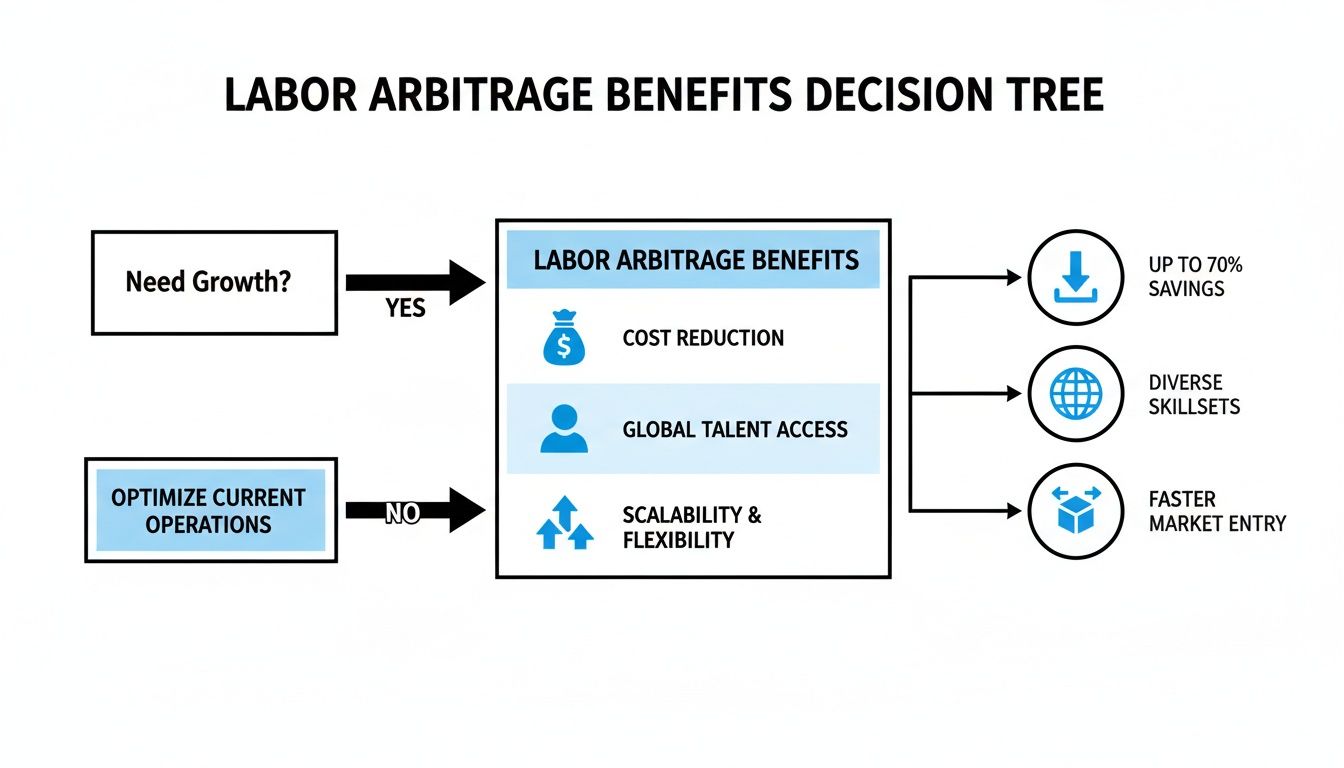
As you can see, the path forks into three main advantages: cutting operational costs, tapping into a global talent pool, and gaining the flexibility to scale on your terms.
To help you decide, here’s a quick breakdown of how these models stack up against each other.
Labor Arbitrage Model Comparison
| Model | Initial Cost | Control Level | Best For |
|---|---|---|---|
| DIY (Foreign Entity) | Very High | Full | Large enterprises with long-term plans and significant capital. |
| Traditional BPO | Low to Medium | Low | Companies looking to offload entire non-core functions quickly. |
| Seat Leasing | Low | High | Startups, SMBs, and BPOs wanting control without the overhead. |
Ultimately, the best model depends entirely on your company's resources, risk tolerance, and how much direct oversight you want to maintain.
Setting Up for Success
No matter which model you land on, clear communication and solid performance metrics are the bedrock of success. You must establish Key Performance Indicators (KPIs) from day one to keep a close eye on quality, efficiency, and productivity. When working with an external company, success often comes down to the careful selection of an outsourcing partner.
For startups and small to mid-sized businesses, seat leasing is almost always the most practical starting point. It clears the biggest hurdles—infrastructure investment and legal complexity—letting you focus on what you do best: managing your team and growing your business.
This model lets you move fast. You can see how our move-in-ready facilities work by checking out the details of our Building 24 location. It's about getting your strategy off the ground without the weight of a massive upfront investment.
Navigating the Risks and Ethical Questions
It’s easy to get excited about the cost savings of labor arbitrage, but let's be real—it’s not a magic bullet. To do it right, you have to go in with your eyes wide open to the potential pitfalls.
Ignoring these risks won't just cause a few headaches; it can completely derail your efforts before they even get off the ground. The biggest hurdles are usually operational. You start asking yourself the tough questions: How do we guarantee the quality of work when our team is on the other side of the world? How do we bridge language and cultural gaps to build a team that actually feels like a team?
And what about keeping our data safe while complying with all the different international laws? These aren't reasons to back away from the strategy, but you absolutely need solid answers before you dive in.
Managing Operational and Financial Risks
Even with the best talent, you can't control everything. While saving money is the primary driver, financial risks are always part of the equation. For instance, some companies were caught off guard when currency fluctuations in 2022 wiped out 10-15% of the savings they had budgeted for.
The good news is that these risks are entirely manageable. Having strong governance and a modern tech stack doesn't just reduce risk; it can help you build a 24/7 operation that spreads risk across different regions. It’s this kind of strategic diversification that has experts predicting Eastern Europe's 40% IT wage gap will help drive €50 billion in regional outsourcing by 2026. If you want a deeper look at these trends, you can learn more about BPO and global labor arbitrage.
To protect your business, you need to be proactive in a few key areas:
- Quality Control: Don’t just "set it and forget it." Implement strict KPIs, conduct regular performance reviews, and stay engaged to ensure the work consistently meets your standards.
- Communication: Misunderstandings can kill productivity. Invest in good project management software like Asana or Monday.com and establish clear, regular communication cadences.
- Data Security: This is non-negotiable. Only work with providers who are transparent about their security measures and hold certifications like ISO or SOC 2 to protect your company’s (and your customers’) sensitive information.
Addressing the Ethical Dimension
Beyond the spreadsheets and operational plans, there's a serious ethical conversation to be had. The first question that always comes up is about displacing jobs in your home country. But it’s just as important to think about your impact on the country where you're hiring.
This can’t be about exploitation.
The ethical application of labor arbitrage is about creating opportunity, not just cutting costs. It means paying fair, competitive local wages, providing excellent working conditions, and contributing positively to the communities where you operate.
This is precisely why choosing a reputable partner is so critical. An ethical provider doesn't just find you cheap labor; they prioritize their employees' well-being, ensuring your global team is treated with the same dignity and respect as your team at home.
They create a stable, professional environment that turns a simple cost-saving tactic into a sustainable, responsible, and frankly, more successful business practice. When you focus on creating real value for everyone involved, you end up with a much stronger and more resilient global team.
Frequently Asked Questions About Labor Arbitrage
Even after breaking down the details of labor arbitrage, you probably still have a few practical questions. That's good. It means you’re thinking about how this could actually work for your business.
Let’s go through some of the most common questions I hear from business owners who are considering this strategy.
Is Labor Arbitrage Only for Huge Corporations?
That’s a common misconception, but the game has completely changed. It’s true that giant corporations were the first to build massive offshore operations, but you no longer need a multi-million dollar budget to do the same.
The barriers have come crashing down, especially for startups and small businesses. Models like seat leasing give you direct access to global talent without the enormous upfront costs or logistical headaches of setting up your own foreign office. It’s a powerful way to grow, no matter your size.
How Can I Ensure High-Quality Work?
This is probably the most important question you can ask. The secret isn’t just about watching over someone’s shoulder from a distance; it's about actively managing for great performance. Remember, this isn’t about finding the cheapest person possible. It’s about finding incredible talent that just happens to live in a more affordable part of the world.
To get the quality you need, you have to be intentional:
- Establish Clear KPIs: Your team needs to know exactly what success looks like. Define specific, measurable goals right from the start.
- Invest in Communication: Use good project management software and set up a consistent rhythm for check-ins. A team that’s aligned is a team that performs.
- Hire Carefully: Apply the same rigor to your international hiring as you would at home. Screen every candidate for the right skills, proven experience, and a personality that fits your company culture.
Smart labor arbitrage is not a race to the bottom on price. It is a strategic talent acquisition strategy. The goal is to build a skilled, motivated, and integrated team that delivers outstanding results, regardless of their physical location.
Ultimately, your results depend on the environment your team works in. Partnering with a company that provides a professional, supportive workplace is a direct investment in the quality of work you’ll receive.
Ready to see how your business could cut costs by up to 80% while tapping into a world-class talent pool? At Seat Leasing BPO, we offer flexible, move-in-ready office solutions that eliminate the operational burdens, freeing you to focus on growing your company. Discover more about our plug-and-play model by visiting our website at https://seatleasingbpo.com.