Let's be honest, "data processing services" sounds a bit dry, doesn't it? But what it really means is taking a massive, jumbled mess of raw data and turning it into something genuinely useful—something that can actually help you make smart business decisions.
Imagine you have a giant pile of puzzle pieces. On their own, they're just random shapes and colors. Data processing is the act of sorting those pieces, finding the edges, and putting them all together until a clear, coherent picture emerges. That picture is the insight you need.
Why Data Processing Services Are Your Secret Weapon
Every single day, your business is swamped with data. It comes from everywhere: every customer purchase, every click on your website, every social media comment, every internal report. In its raw form, this data is just noise. It’s like a warehouse packed to the ceiling with unmarked boxes—you know there's valuable stuff in there, but you have no idea where to start looking.
This is where data processing services come into play. They’re the system you need to unbox, sort, and organize everything, turning that chaotic mess into a clear inventory. It's the engine that powers smart, informed decisions instead of just guessing.
The Core Data Processing Cycle
At its core, data processing isn't magic; it's a logical cycle. Each step builds on the last to make sure the final information you get is accurate, reliable, and something you can actually act on. The tools can get complicated, but the workflow itself is pretty straightforward.
Think of it as refining raw materials into a finished product. The process breaks down into four key stages:
- Collection: First, you have to gather the raw data. This could be anything from sales numbers and customer feedback forms to data from internet-connected sensors. The quality of what you collect here directly impacts the quality of your final results.
- Preparation: Next comes the cleanup. This stage is all about tidying up the data by removing duplicate entries, fixing errors, and getting everything into a consistent format. It's the digital equivalent of prepping your ingredients before you start cooking.
- Processing: This is where the real transformation happens. Using specialized software or even manual review, the clean data is converted into meaningful information. The "puzzle pieces" start getting connected, revealing patterns, trends, and connections you couldn't see before.
- Storage & Output: Finally, the processed information is stored somewhere safe and easy to access. It’s then presented in a way people can actually understand—like reports, charts, or interactive dashboards.
When you get this cycle right, you stop relying on gut feelings. Suddenly, your strategies are built on solid evidence, and every major decision is backed by real, reliable data.
In the end, effective data processing isn't just an IT task; it’s a core business strategy. It helps you understand what your customers really want, find ways to make your operations more efficient, spot new market opportunities, and stay ahead of the competition. Without it, even a company swimming in data is essentially flying blind, unable to tap into the value sitting right in front of them.
Understanding The Core Data Processing Methods
Think of a chef in a busy kitchen. They wouldn't use the same cooking method for every dish, right? A slow-cooked stew requires a different approach than a flash-fried stir-fry. In the world of business, data is your main ingredient, and you need the right "cooking" method to turn it into something valuable.
Not all data needs to be analyzed the second it arrives. By understanding the core processing methods, you can choose the most efficient and budget-friendly way to transform raw information into a real strategic advantage. The goal is to take all those disconnected data points and piece them together into a clear picture that informs your business intelligence.
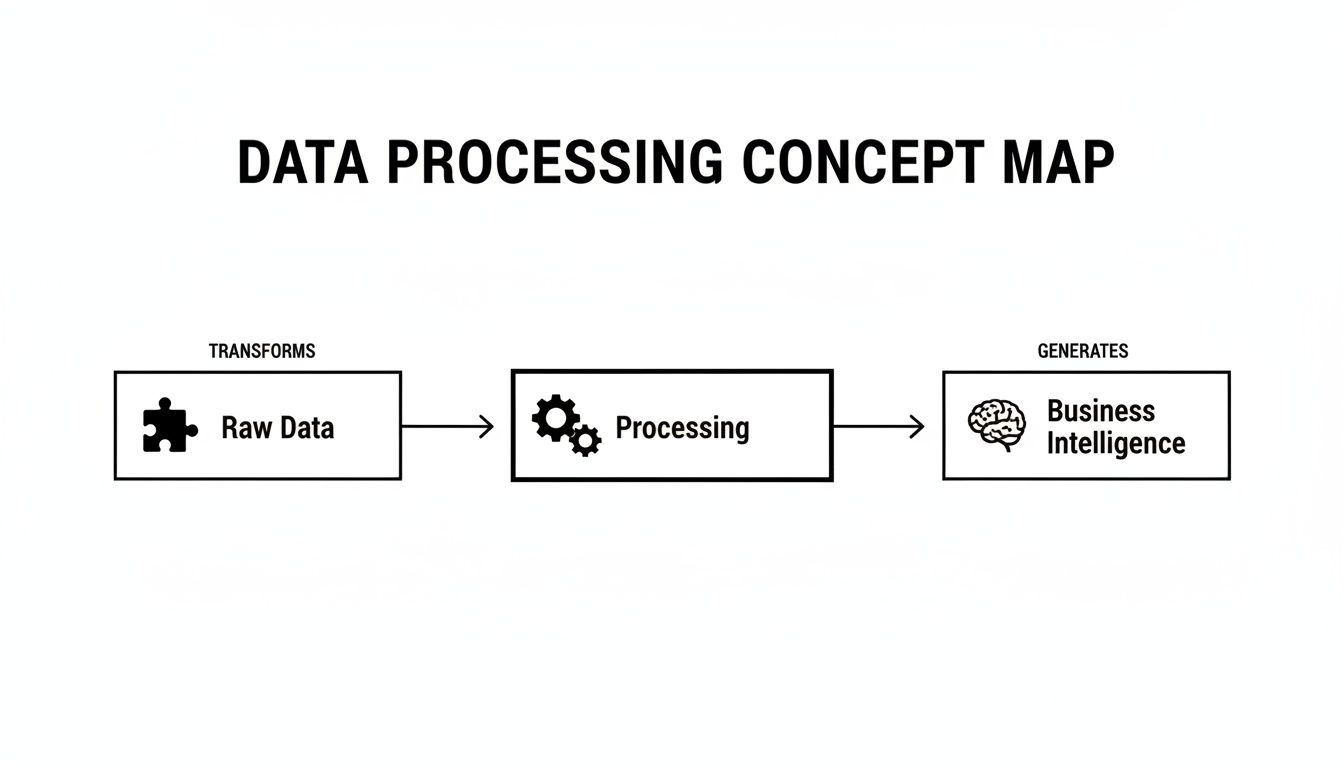
As you can see, without that crucial middle step—processing—raw data just sits there. It's inert, disconnected, and offers zero insight. Let's break down the main methods that bring this data to life.
Batch Processing: The Heavy Lifter
Batch processing is the marathon runner of the data world. It's built for endurance, not speed. This method works by collecting and grouping huge amounts of data over a set period—maybe a day, a week, or a month—and then processing it all in one massive "batch."
Imagine a bank that waits until the end of the day to process all of its check transactions overnight. That's batch processing in action.
It’s the perfect fit for tasks that aren’t time-sensitive but involve enormous datasets. Because these jobs usually run during off-peak hours, this method is incredibly efficient and doesn't hog system resources when your business needs them most.
Real-Time Processing: The Sprinter
If batch processing is a marathon, real-time processing is a full-out sprint. This method analyzes data the very instant it's created or received, with response times often measured in milliseconds. It’s designed for mission-critical situations where an immediate outcome is the only option.
A classic example is credit card fraud detection. When you swipe your card, the system instantly analyzes the transaction against your location, spending patterns, and other risk factors to approve or deny the purchase. A delay of even a few seconds would be completely unacceptable.
The relentless demand for these instant insights is fueling massive industry growth. In the US alone, revenue for data processing and hosting services is projected to hit $383.8 billion by 2025. This explosion is driven by the need to handle ever-growing data volumes at lightning speed, a challenge being met by over 69,532 businesses in the space. You can read more about the data processing industry's growth on ibisworld.com.
Real-time processing is non-negotiable for systems where immediate feedback is critical, like stock market trading platforms, online gaming servers, and air traffic control.
Online Processing: The Interactive Middle Ground
Online processing, sometimes called interactive processing, strikes a balance between the other two. It handles transactions as they arrive, but not necessarily with the hair-trigger speed of a true real-time system. Here, data is sent to the system for immediate handling, and the user waits for a direct response.
Think about booking a flight. You select your seats, and the system instantly checks their availability and confirms your reservation. This requires a live, interactive connection to a central database to make sure two people don't book the same seat. It's fast and responsive, but not at the microsecond level of real-time fraud detection.
These kinds of crucial but resource-intensive tasks are often ideal candidates for outsourcing. Learning more about how a comprehensive BPO setup can support these functions can reveal smart ways to manage them without overwhelming your in-house team.
Comparing Data Processing Methods
Choosing the right approach depends entirely on your specific needs—from the type of data you have to how quickly you need the results. This table breaks down the key differences to help you decide.
| Processing Type | How It Works | Best For | Example |
|---|---|---|---|
| Batch Processing | Data is collected over time and processed in large, scheduled groups. | Non-urgent, high-volume tasks that can run during off-peak hours. | Monthly payroll processing, end-of-day sales reporting, utility billing. |
| Real-Time Processing | Data is processed instantly upon arrival with near-zero delay. | Mission-critical functions where immediate action or feedback is essential. | Credit card fraud detection, stock market trading, air traffic control. |
| Online Processing | Data is processed as soon as it's submitted by a user, providing a direct response. | Interactive tasks requiring immediate confirmation or updates. | Booking a flight, making an online purchase, ATM transactions. |
Ultimately, many businesses use a mix of all three. They might use batch processing for their end-of-month financial reports, online processing for their e-commerce store, and real-time processing for website security. The key is matching the method to the mission.
The Strategic Edge of Outsourcing Data Processing
Deciding how to handle your company's data processing is a big deal. It’s a major strategic choice, not just another item on the operational to-do list. While keeping things in-house gives you direct control, outsourcing often delivers a serious competitive advantage that’s about much more than just saving a few bucks.
Think of it this way: you’re turning a necessary, but often complicated, business function into a source of genuine strength.
For a lot of companies, especially BPOs and startups, the idea of building a data processing department from scratch is daunting. You’re looking at a huge upfront investment in technology, software, and—most critically—the right people with very specific skills. This is where outsourcing completely changes the equation.
When you partner with an outside provider, you're not just hiring a vendor; you're plugging into a ready-made team of experts and their top-tier infrastructure, all without the massive capital expense. It’s a strategic shortcut that lets you skip the long and costly process of hiring, training, and equipping your own team. That frees up your resources to be poured back into what you do best: growing your core business.
Unlocking Expertise and Advanced Technology
One of the first things you’ll notice when you use professional data processing services is the instant access to specialized talent. Fields like data science, analytics, and compliance are incredibly complex and are always changing. Outsourcing partners live and breathe this stuff every day, bringing a depth of expertise that’s tough and expensive to build on your own.
They’re already up to speed on the latest tools and security protocols, making sure your data is handled efficiently and safely from day one. You’re not just getting tasks checked off a list; you're getting them done by specialists at the top of their game.
This isn’t just a niche strategy anymore—it's a global shift. The market for data processing and hosting is booming, valued at USD 118.83 billion in 2025 and expected to jump to an incredible USD 213.74 billion by 2031. This kind of growth shows just how many businesses are realizing the power of handing off complex work to specialists. You can explore the full market projections on mordorintelligence.com to see the full scale of this trend.
Outsourcing data processing isn't just about offloading work. It's about onboarding a team of specialists whose core competency is turning your raw data into a refined, secure, and actionable asset.
This approach effectively gives you the power of a large corporate data department without the crippling overhead, leveling the playing field so you can compete more effectively.
Gaining Scalability and Cost Efficiency
Business demands are never a flat line. You have seasonal peaks, periods of rapid growth, and unexpected quiet spells. An in-house team has a fixed capacity, which makes it hard to scale up for a rush or scale down during a lull without wasting money on overtime or idle staff.
Outsourcing offers the ultimate flexibility. A good partner can dial their resources up or down to match your exact workload. This means you only pay for what you need, right when you need it. This kind of agility is a massive advantage, letting you react to market changes on a dime without being slowed down by internal constraints.
Here’s a quick rundown of the benefits:
- Reduced Operational Costs: You can say goodbye to expenses for salaries, benefits, office space, and technology for a dedicated data team.
- Predictable Budgeting: Service agreements usually have clear, fixed pricing, which makes your financial planning much simpler and more reliable.
- Focus on Core Competencies: With data management in the hands of experts, your team is free to focus on what really drives your business forward—innovation, customer service, and strategic growth.
By delegating these essential but non-core tasks, you empower your organization to put its energy and money where they’ll make the biggest difference. That strategic shift is often the very thing that unlocks the next level of growth.
Data Processing Services in Action Across Industries
The real impact of data processing isn't just a technical theory; it’s a practical force that fundamentally changes how industries work. Think about it. From the moment you click "buy now" on an e-commerce site to the way a hospital pulls up patient records, these services are the invisible engines running in the background. They take raw, often chaotic, information and turn it into something smooth, intelligent, and useful.
Let's dive into how different sectors are actually using data processing—not just as a back-office chore, but as a core piece of their strategy for success and innovation. These examples bring the concept to life, showing how turning data into insight creates real, tangible value.
E-commerce and Retail Personalization
For anyone in online retail, knowing your customer is the name of the game. Every click, every search, and every purchase adds to a massive pile of data. Data processing services are what sift through this digital mountain to create highly personalized shopping experiences that keep customers coming back.
Picture a major online store analyzing your browsing history, what you've bought before, and even the items you've left in your cart. This data is processed to do a few key things:
- Recommend Products: Suggest items you'll actually find interesting, not just random junk.
- Optimize Supply Chains: Figure out which products will be popular in certain areas, making sure they don't run out of stock.
- Personalize Marketing: Send you promotions and discounts that are genuinely relevant to what you like.
This is the shift from generic, hopeful marketing to precise, data-backed engagement. It makes customers feel like the brand actually gets them.
Fintech and Real-Time Security
In the world of financial technology (fintech), speed and security are everything. Billions of transactions fly around the globe every single day, and each one is a potential target for fraud. Real-time data processing acts as the first line of defense, analyzing transactions the instant they happen to spot anything fishy.
When you swipe your credit card, services instantly process dozens of data points—your location, the purchase amount, your typical spending patterns. If something looks off, the system flags the transaction in milliseconds. This protects both you and the bank, and it's what makes modern digital finance work so seamlessly.
Healthcare Data Management
The healthcare industry juggles some of the most sensitive data there is, from patient histories to lab results. Good data processing is non-negotiable for both patient care and running a clinic efficiently. Hospitals use it to manage electronic health records (EHR), ensuring doctors have accurate, up-to-the-minute information when they need it most.
By organizing huge volumes of clinical and patient data, healthcare providers can spot trends, improve treatment plans, and stay compliant with strict privacy laws like HIPAA. It’s a critical tool for pushing patient care forward.
As markets evolve, new hotspots emerge. The Asia-Pacific region is now the fastest-growing hub for data processing, thanks to widespread digitalization. With a projected 14.2% CAGR in big data processing, this area offers a huge opportunity for businesses seeking high-growth environments. For more on this, you can check out insights on dataintelo.com. Staying on top of these shifts is key, and you can explore more on our blog.
By putting these services to work, companies in every sector aren't just managing data anymore. They're unlocking its power to innovate, protect their customers, and drive real growth.
How to Choose the Right Data Processing Partner
Picking a provider for your data processing services is a major decision. It’s not just another vendor contract; you’re entrusting a partner with one of your company's most critical assets. The right choice can be a catalyst for growth and give you a serious competitive advantage. The wrong one? It can open you up to security nightmares, operational headaches, and unexpected costs.
Think of it like hiring a key executive. You wouldn't just glance at a resume. You'd dig into their background, check references, and make sure they're a perfect fit for your team's culture. Finding a data processing partner requires that same level of careful, structured evaluation, looking far beyond the initial price tag.
Scrutinize Security and Compliance Credentials
In an era where data breaches are front-page news, security has to be your top priority. It's simply non-negotiable. Your very first step should be to confirm a potential partner's commitment to protecting your information. Don't just take their word for it—ask for hard proof of their security credentials and compliance with all relevant regulations.
You want to see certifications that are globally recognized, as they prove a provider has a solid, systematic approach to information security. Be sure to ask about:
- ISO 27001: This is the gold standard for information security management. It shows they have a formal system for managing sensitive company and customer data.
- GDPR Compliance: If you deal with any data from EU citizens, your partner absolutely must be compliant with the General Data Protection Regulation. No exceptions.
- HIPAA Compliance: For anyone in the healthcare space, strict adherence to the Health Insurance Portability and Accountability Act is a legal must-have.
A partner who is transparent and willing to share their security audits and certificates is a partner who takes this responsibility as seriously as you do.
Choosing a partner with proven security credentials isn't just about avoiding fines; it's about building trust with your customers. A data breach can do irreparable damage to your brand's reputation.
Evaluate Technical Infrastructure and Scalability
Your business isn't static, and your needs are going to change. You'll hit growth spurts, manage seasonal demand, and take on new projects. Your data processing partner has to have the technical muscle and operational flexibility to keep up. If they can’t scale, they’ll quickly turn from an asset into a bottleneck.
Get specific when you talk to them. Ask pointed questions about their infrastructure. How do they handle a sudden spike in data volume? What's their process for scaling up resources for your account? A partner built for scale can fluidly adjust their support to match your workload, so you only pay for what you use without ever compromising performance when it matters most.
Assess Industry Experience and Case Studies
General data processing skills are a dime a dozen. What you really need is expertise in your industry. A partner who deeply understands the nuances of your world—whether that's e-commerce, finance, or healthcare—will provide exponentially more value. They'll already be familiar with your data types, regulatory challenges, and business goals.
Ask for case studies and client testimonials from companies in your field. This is your chance to see their track record in the real world and confirm that their solutions have produced real, measurable results for businesses facing the same challenges you are. This step ensures you're not just hiring a service provider, but bringing on a strategic ally who can offer valuable, industry-specific insights.
Finding the right partner is a foundational business decision. If you're ready to see how a dedicated provider can strengthen your operations, get in touch with our team today to talk about what you need.
Common Questions About Data Processing
Diving into data processing for the first time? It’s natural to have a few questions. Getting straight answers is the best way to cut through the jargon and see how these services can really help your business.
We’ve gathered some of the most common questions we hear to give you the clarity you need to make a smart decision.
What Is the First Step in the Data Processing Cycle?
Everything starts with data collection. This is the foundational step where raw data is gathered from all your different sources—think customer forms, website clicks, survey responses, or even social media interactions.
The quality of this initial collection sets the tone for everything that follows. If you start with messy, inaccurate data, you’ll end up with unreliable insights. It's like cooking: if you begin with bad ingredients, the final dish is never going to taste right, no matter how skilled the chef is.
How Do Data Processing Services Keep My Data Safe?
Any provider worth their salt will have a multi-layered security plan in place. It's not just a single firewall; it's a comprehensive system designed to protect your information from every angle.
Here’s what you should expect to see:
- End-to-end encryption, which scrambles data so it's unreadable while it's being sent and while it's stored.
- Strict access controls, ensuring that only pre-approved team members can ever touch your sensitive information.
- Routine security audits to proactively find and fix any potential weak spots in their systems.
- Compliance with major standards like GDPR, HIPAA, or ISO 27001, proving they adhere to global best practices for data security.
A provider's approach to security tells you a lot about their professionalism. They should also have solid disaster recovery plans ready, just in case, to make sure your data is never lost or compromised by an unexpected event.
Can a Small Business Really Benefit from Data Processing Services?
Absolutely. In many ways, small businesses stand to gain the most. Outsourcing data processing services gives you access to the same kind of powerful insights that large corporations use, but without the crippling cost of building an in-house data team from scratch.
Instead of hiring data scientists and investing in expensive software, you can partner with an expert to:
- Pinpoint customer trends to make your marketing more effective.
- Fine-tune your inventory to avoid overstocking and free up cash.
- Guide your business strategy with real evidence instead of just gut feelings.
It’s a game-changer. You get enterprise-level expertise for a predictable, manageable cost, which helps you compete on a much bigger stage and grow your business the right way.
Ready to turn your data into your biggest advantage? Seat Leasing BPO provides the managed backend support you need to make data processing a seamless part of your operation. Find out how our flexible solutions can cut your operational costs by up to 80%. Visit us at https://seatleasingbpo.com to learn more.