Getting a startup off the ground is a race against the clock and the budget. A coworking space gives you a head start, providing a fully-equipped, professional office from day one so you can focus on what really matters: building your business.
Launching Your Startup Without Breaking the Bank

For most founders, cash is king, and every spending decision is critical. A traditional office lease is one of the biggest cash drains a new company can face, tying up precious capital in long-term commitments, hefty security deposits, and the endless costs of furniture and utilities.
Think about it. Signing a multi-year lease means locking your startup into a fixed cost and space. What happens in six months when your team doubles? Or if you need to downsize to weather a slow period? That lease quickly turns from a home base into a financial anchor.
Shifting from Capital Expense to Smart Operations
This is where coworking completely changes the game. It moves your office costs from a massive, upfront capital expense (CapEx) to a predictable monthly operating expense (OpEx). It’s not just about renting a desk—it’s a fundamentally smarter way to run your business.
This simple accounting shift has a huge impact on your startup’s health:
- Keep Your Cash Flowing: Instead of sinking money into deposits and furniture, you can invest it in product development, marketing, or hiring your next key employee.
- No More Surprise Bills: Utilities, high-speed internet, cleaning, and even coffee are all rolled into one straightforward monthly fee. Budgeting just got a lot easier.
- Plug-and-Play Infrastructure: You walk in the door on day one with everything you need to be productive, from printers and meeting rooms to a professional mailing address.
The bottom line is that your workspace becomes a flexible resource, not a fixed burden. You scale your space up or down as your needs change, allowing you to stay nimble and ready for any challenge or opportunity.
The Growing Appeal of Flexible Workspaces
This move toward flexibility isn't just a small trend; it's a massive shift in how businesses operate. The global coworking market is booming, and it’s expected to hit $30.36 billion by 2026. What’s driving this growth? Startups. Founders are overwhelmingly choosing agile, cost-effective solutions over the rigid and expensive traditional model.
By choosing a coworking space, you’re doing more than just saving money. You’re gaining an instant professional image and plugging into an environment built for innovation and growth. It’s an immediate competitive advantage, and providers like Seat Leasing BPO make this strategy incredibly simple to implement.
The Real-World Advantages of a Flexible Workspace
Choosing where your team works is one of the most critical decisions a startup founder makes. It’s not just about finding a place with desks and Wi-Fi; it’s a strategic choice that directly affects how fast you can move and grow. Going with a flexible workspace isn't simply a way to cut costs—it's about sidestepping the massive headaches and financial anchors that can easily sink an early-stage company.
This flexibility gives you immediate breathing room, both financially and operationally. It lets you build your business on a foundation of agility instead of being locked into a rigid, long-term commitment that your startup may not be ready for.
The Freedom from Financial Handcuffs
For any new business, a traditional office lease is a financial minefield. It starts with a huge security deposit, often tying up several months' worth of rent in cash you desperately need. Then, you have to spend a fortune on furniture, IT equipment, and the entire office setup—a bill that can easily hit tens of thousands of dollars before you’ve even landed your first client.
A coworking space for startups completely flips that script. Instead of a massive upfront cash burn, you have a single, predictable monthly fee. This shifts your office from a capital-draining investment to a simple operating expense, freeing up your cash for what actually grows the business:
- Building a better product: Pouring money into development and refinement.
- Getting the word out: Funding marketing and sales to win those first critical customers.
- Hiring the right people: Bringing on the talent that will make your vision a reality.
This model also lets you avoid the crippling penalties for breaking a lease if your plans change. A huge part of the appeal is the built-in flexibility, with favorable short-term leasing options that are often a perfect match for a startup's unpredictable journey.
Your 'Plug-and-Play' Command Center
Think about what happens after you sign a traditional lease. The real work begins. You’re suddenly spending weeks—or even months—haggling with internet providers, setting up secure networks, buying printers, and furnishing meeting rooms. All that time, your team’s focus is split, and productivity grinds to a halt.
A flexible workspace is the 'plug-and-play' solution to that nightmare. From the moment you walk in, everything you need is ready to go.
You show up with your laptop and you're in business. That isn't just a small convenience; it’s a massive strategic advantage that helps you get to market faster.
This instant infrastructure means you don't have to worry about:
- Enterprise-Grade Wi-Fi: Fast, secure, and reliable internet is already sorted.
- Professional Meeting Rooms: You have fully equipped spaces ready to impress clients and investors.
- Business Amenities: Printers, mail services, and kitchens are all handled for you.
The Power to Scale on a Dime
Here’s where flexible spaces really shine: the ability to scale your team in real time. Imagine your startup lands a huge project and you need to grow from five people to 25, practically overnight. In a traditional office, that’s a logistical disaster. You're either cramming people into a space that's too small or starting a long, expensive hunt for a new office.
In a coworking environment, you just ask for more desks or a larger private office. It’s that simple. This elasticity means your physical space can grow or shrink exactly in line with your business needs, so you’re only ever paying for what you actually use. This on-demand scalability is a core feature of the modern coworking space for startups.
This isn't a niche trend anymore. Big companies are all in, with 55% of corporations now using flexible workspaces. This influx of established players creates a richer, more diverse environment that startups can tap into. With global occupancy rates now averaging 68% and climbing past 70% in major cities, these hubs are buzzing with over 5.5 million users—creating unmatched opportunities to connect. You can find more details about these coworking trends and what they mean for the industry. Discover more insights about coworking trends on allwork.space.
Community: The Intangible Asset with Real ROI
"Community" might sound like a fluffy buzzword, but in a good coworking space, its value is real and tangible. It’s about the unplanned conversations and chance encounters that lead to genuine breakthroughs. That quick chat by the coffee machine can easily turn into a game-changing partnership.
For instance, a founder wrestling with a marketing problem might run into a seasoned consultant from another company. A developer on a tight deadline could find a freelance designer just two desks away to help nail a UI project. These organic connections, often helped along by curated events and a collaborative vibe, are the true lifeblood of a healthy startup ecosystem.
Coworking Versus Traditional Office Leases
Choosing an office space for your startup isn’t just about picking a location; it's a decision that pits two completely different ways of thinking against each other. Do you want to own and maintain everything yourself, or simply access what you need, when you need it? This isn’t a simple pros-and-cons list. It’s about matching your workspace strategy to your plan for growth—and survival.
A traditional office lease is a major, long-term commitment. It’s a trap for a young company. You’re on the hook for a huge upfront security deposit, not to mention the cost of furniture, internet setup, and office design. The entire process, from finding a broker to negotiating the lease and finally moving in, can easily eat up months of your time.
On the other hand, a coworking space for startups functions more like a subscription service. You get a fully furnished office, ready to go from day one, all for a single, predictable monthly fee. This fundamental difference gives you incredible financial and operational agility. To truly get it, you need to understand the gap between a locked-in lease and a flexible shared workspace model.
Comparing Commitments and Costs
The biggest split between these two paths comes down to money and time. One demands a massive upfront investment and locks you in for years, while the other is built for speed and lets you keep your cash in the bank.
A simple flowchart can help you visualize which path makes sense based on your startup's need to scale and keep your budget under control.
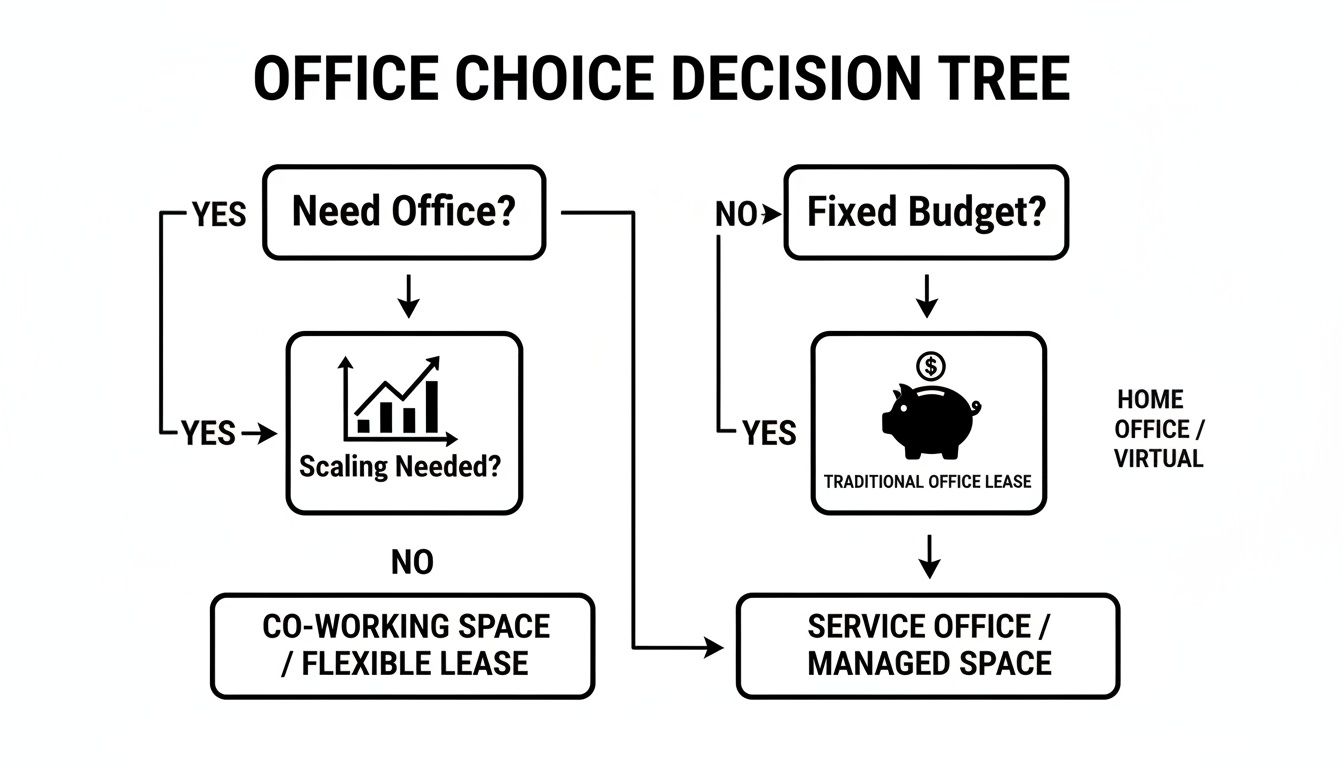
As the chart shows, if you expect your team to grow or need the freedom to adjust your spending, all signs point toward a more flexible workspace.
Let's break down the practical differences:
- Financial Model: A traditional lease is a Capital Expenditure (CapEx). It ties up your precious cash in a long-term liability. Coworking is an Operational Expenditure (OpEx)—a manageable monthly bill that leaves your capital free for what really matters, like hiring engineers or running marketing campaigns.
- Time to Occupancy: Getting a traditional office ready can take 6-12 weeks, sometimes longer. A coworking space is truly ‘plug-and-play,’ letting your team get to work the very next day.
- Commitment Term: Leases almost always require multi-year commitments of 3, 5, or even 10 years. Coworking operates on flexible monthly agreements, so you can adapt your space as your company changes.
This table puts the stark contrast between the two models side-by-side, making the financial and operational trade-offs crystal clear.
Coworking Flexibility vs. Traditional Lease Rigidity
| Factor | Coworking Space (e.g., Seat Leasing BPO) | Traditional Office Lease |
|---|---|---|
| Initial Cost | Low (first month's fee + small deposit) | High (large deposit, furniture, fit-out) |
| Commitment | Flexible (monthly or short-term) | Rigid (multi-year, typically 3-10 years) |
| Scalability | High (add or remove seats on demand) | Low (stuck with fixed space, expensive to change) |
| Setup Time | Instant (move-in ready) | Weeks or months of coordination |
| Included Services | All-inclusive (internet, utilities, cleaning) | Separate contracts and bills for everything |
The choice is about more than just cost; it's about building resilience into your business model. Coworking provides the agility startups need, while traditional leases can become a significant liability.
Resilience in Practice: A Tale of Two Startups
The strategic power of this choice really comes to life when you imagine it playing out. Picture two startups, both hit by a sudden, unexpected downturn in the market.
The first startup is stuck in a five-year traditional lease. To conserve cash, they need to downsize their team, but their office becomes a massive financial anchor. They’re burning money paying for empty desks, and the lease itself prevents them from making the nimble moves needed to survive.
Now, consider the second startup. Operating from a coworking space, they face the exact same market pressure but have a completely different set of options. They simply notify their space provider and reduce their seat count for the next month.
Their workspace is a flexible tool, not a fixed liability. This agility allows them to navigate the lean period, preserve capital, and position themselves to seize the next opportunity without being dragged down by legacy costs.
This is the core reason why a coworking space for startups is such a powerful advantage. It ensures your overhead costs are directly tied to your operational reality, making your office a supporter of your journey, not a roadblock.
How to Choose the Right Coworking Space
Alright, so you see the value in a flexible workspace. Fantastic. But now comes the tricky part: finding the right one. The thing is, not all coworking spaces are built the same. Choosing the wrong one can be just as painful as getting stuck in a bad traditional lease.
Don't let the glossy brochures and free coffee tours fool you—they only show you what the provider wants you to see. To find a coworking space for startups that will actually help you grow, you need to dig deeper. Think of it less like shopping and more like an investigation. You're not just renting a desk; you're choosing a home base and a partner for your startup's journey.
This means you have to get hands-on. When you take a tour, don't just be a passive observer. Your job is to audit the space, pressure-test their claims, and see if the reality lives up to the marketing hype.
Evaluate Location and Accessibility
The old real estate saying—location, location, location—is still gospel, but for a startup, it means something different. It’s not just about a fancy address; it’s about how the location impacts your team and your business operations day-in and day-out.
Think about these critical access points:
- The Team Commute: How easy is it to get there? Look for good public transport links and affordable parking. A brutal commute is a surefire way to burn out your team and makes it much harder to attract great talent.
- Client and Investor Access: Can important visitors find you easily? A central, well-known spot not only makes meetings simpler but also sends a signal of professionalism from the moment they walk in.
- Neighborhood Vibe: What’s actually around the office? Being close to good lunch spots, cafes for a quick coffee run, or a bank can make a huge difference in everyone's workday.
At the end of the day, a great location has to serve your team first. A happy team that isn't stressed about their commute is a productive team.
Kick the Tires on the Infrastructure
An office’s infrastructure is its engine. It’s easy to get distracted by cool furniture and modern design during a tour, but you have to check under the hood to make sure the essentials are solid. I've seen too many startups get burned by this, signing a contract only to discover the Wi-Fi is flaky and the meeting rooms are perpetually booked.
Don't just take their word for it—test everything yourself. A provider who is truly confident in their setup won't mind you running a few tests. Their infrastructure should be a launchpad for your ambition, not a roadblock.
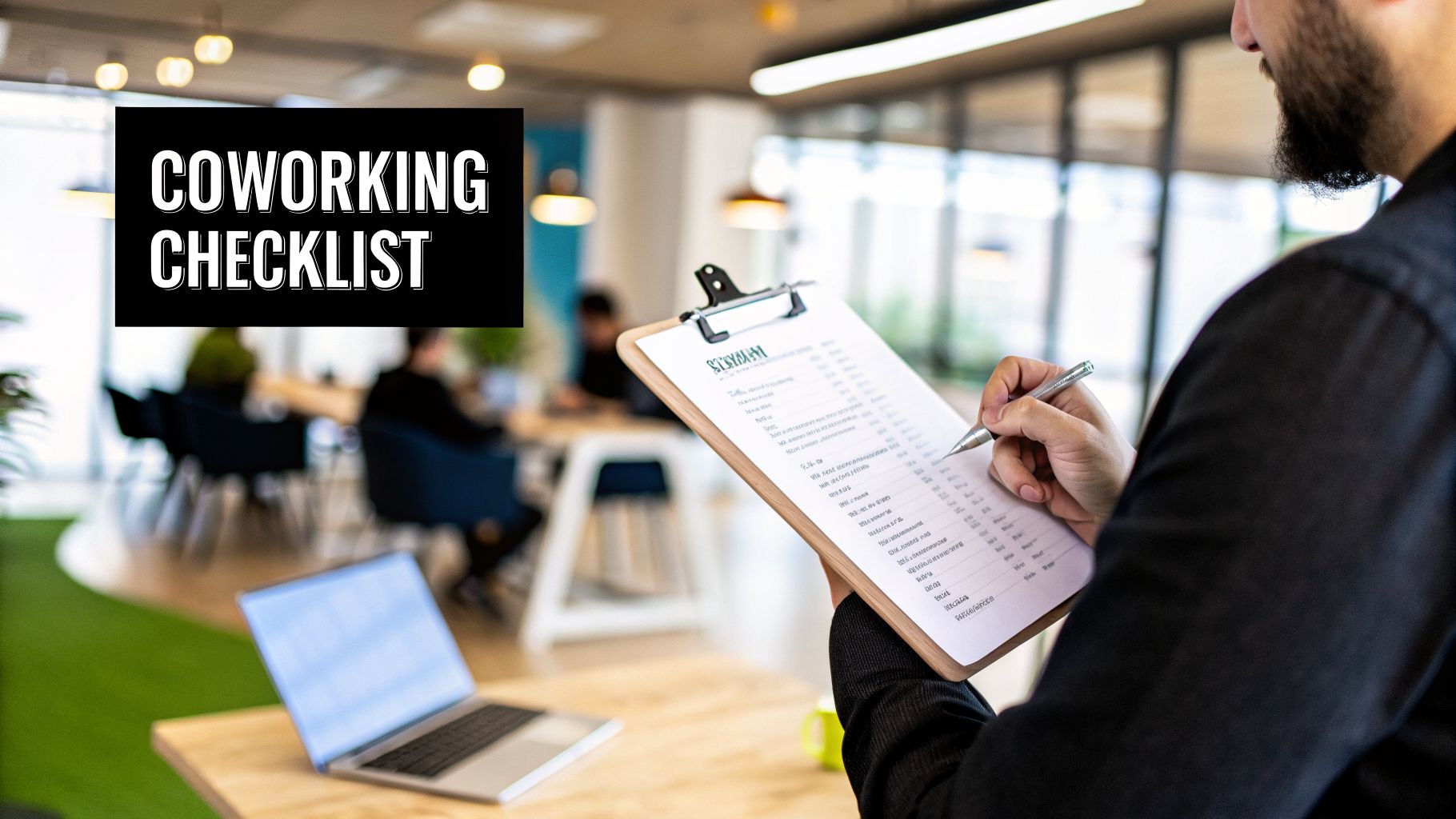
Here’s a quick checklist to run through on your tour:
- Run a Wi-Fi Speed Test: Seriously, pull out your phone or laptop and run a speed test. Is it fast enough for your whole team to be on video calls and moving large files without a hiccup?
- Check Meeting Room Availability: Ask to see the live booking system. Is it a ghost town, or is it booked solid for the next three weeks? If you can't get a room when you need one, it can stall everything from client pitches to internal strategy sessions.
- Inspect the Little Things: Is the coffee actually drinkable? Are the common areas and restrooms clean? Small details like these tell you a lot about the management's attention to detail and how they treat the space.
It’s also crucial to understand exactly what you’re paying for. Digging into the specifics, like the office inclusions from a provider like Seat Leasing BPO, shows you the true value you get, which often goes far beyond just a desk and a chair.
Assess the Community and Culture
Finally, every coworking space has its own unique personality. Some are dead silent, like a library, which is perfect for deep, focused work. Others are buzzing social hubs built for constant chatter and collaboration. Neither is right or wrong, but one is definitely a better fit for your team's culture.
The right community can be a massive advantage, opening doors to new partnerships and learning opportunities. But a culture clash can be a daily drain on your team's energy and morale.
The best way to get a real feel for the vibe is to ask if you can work there for a trial day or attend one of their community events. There's no substitute for firsthand experience. Watch how people interact. Are they engaged and open, or does everyone have their headphones on, locked in their own world? Finding a place where your team feels like they belong is one of the most critical, yet often overlooked, keys to success.
Finding a Strategic Partner, Not Just a Landlord
When you're searching for a coworking space for your startup, it’s easy to think you're just renting desks. But the smartest founders know they're looking for something much more valuable. The best providers aren't just landlords collecting a check; they act as strategic partners who are genuinely invested in your growth.
Think of them less like a property manager and more like an extension of your own operations team. They're the ones handling all the tedious backend work so you can stay focused on the front lines of your business. This partnership is all about offloading the operational drag that grinds so many promising startups to a halt.
Instead of you getting bogged down by internet contracts, looming cybersecurity threats, or surprise utility bills, your provider simply handles it. This frees up your single most valuable asset—your own focus—to be spent on what really matters: building a great product, finding customers, and scaling your company. When this happens, your workspace stops being a cost center and becomes a true growth engine.
The Ideal Partner in Action
So, what does this kind of partnership look like in the real world? A great case study is the model used by Seat Leasing BPO. They’ve built their entire process around removing friction for founders, making everything from signing the contract to moving in feel completely seamless.
The whole approach rests on a simple but powerful idea: handle everything else so the startup can just get to work. This means things like:
- Comprehensive IT Support: You get an enterprise-grade network, solid cybersecurity, and on-call tech help as standard, not as pricey add-ons.
- All-Inclusive Utilities: Electricity, water, and building expenses are all rolled into one clear monthly fee. No more guesswork or surprise bills.
- Full Backend Management: They manage facility maintenance, cleaning, and security, ensuring you have a professional, productive environment 24/7.
When your workspace provider takes on these responsibilities, you're not just saving time; you're buying back mental energy. You can channel that focus into building your product and winning customers, which is the only work that truly matters for an early-stage company.
This model is especially potent in markets that are expanding quickly. The Asia-Pacific region, for example, is the fastest-growing hub for coworking. It's projected to explode from a $3.09 billion market in 2023 to $11.82 billion by 2030. That boom is being fueled by startups that need plug-and-play solutions to cut overhead and grow faster. You can dig into the numbers on this incredible APAC coworking market expansion.
The Financial Impact of a True Partnership
Ultimately, though, the biggest win of having a strategic workspace partner is the direct impact on your bottom line. When a provider bundles all the essential services into a single, all-inclusive package, the savings are hard to ignore. Compared to a traditional lease where you’re nickel-and-dimed for every separate service, this approach can slash your overhead by as much as 80%.
These aren't just numbers on a spreadsheet. This is real cash you can put right back into your growth strategy. You could use it to hire another engineer, launch a new marketing campaign, or just give yourself a few more months of runway. Every dollar saved on rent and utilities is a dollar you can use to build a stronger, more resilient business.
This is exactly why choosing the right provider is such a critical strategic decision. By picking a partner who handles the non-essential functions of your business, you're making a calculated bet on your own speed and agility. You can see what these kinds of environments look like by exploring examples such as Seat Leasing BPO's innovative Building 24. The right partner doesn't just give you a place to work; they help fuel your growth, making them an indispensable part of your startup journey.
Answering Your Questions About Coworking Spaces
The benefits of coworking sound great on paper, but as a founder, you’re wired to be skeptical. And you should be. Choosing your company’s home is a huge decision, and you need to be sure before you sign anything.
Let's dig into the tough questions—the "what ifs" that pop up right before you commit. We'll tackle the common worries we hear from startups about security, sudden growth, and justifying the cost to people holding the purse strings.
Is My Startup's Intellectual Property Secure?
This is usually the first question out of the gate, especially for any tech-focused startup. Your code, your data, your entire business strategy—that’s the crown jewel. The idea of working in a shared building can feel unnerving. It’s a completely fair concern, but any coworking space for startups worth its salt builds its entire operation on security. It’s not an add-on; it’s the foundation.
Top-tier providers know security is a deal-breaker. They offer a layered approach that’s often more robust than what a startup could affordably build from scratch. This isn't about working in a big open room where anyone can glance at your screen.
It’s about creating a fortress with multiple lines of defense:
- Private, Enclosed Offices: This is your team's sanctuary. A fully enclosed, lockable office gives you the same level of confidentiality you’d expect from a traditional space, just without the long-term headaches.
- Enterprise-Grade Cybersecurity: Providers manage powerful, secure networks complete with firewalls and access controls. Many use dedicated VLANs (Virtual Local Area Networks) to completely isolate your team's digital traffic from everyone else. This is the kind of IT muscle that’s expensive and complicated for a new company to set up on its own.
- Strict Access Controls and NDAs: From keycard access and on-site security staff to visitor management systems, every entry point is controlled. Member agreements and community guidelines almost always include confidentiality clauses, fostering a professional environment where privacy is respected.
Think of it like a bank. You have your own private safe deposit box (your office) inside a building with vaults, guards, and cameras (the coworking space). It’s a whole lot safer than keeping your valuables at home.
What If Our Team Grows Faster Than Expected?
For a founder, hyper-growth is the dream. For a company locked into a traditional lease, it's an operational nightmare. Suddenly your office is bursting at the seams, and you're stuck. Breaking a lease is costly, subletting is a hassle, and cramming new hires into makeshift spaces kills productivity.
This is where the flexibility of coworking isn’t just a convenience—it’s a strategic weapon. The entire model is designed to expand and contract right alongside your team.
The most valuable asset for a scaling startup is agility. A flexible workspace contract ensures your office is a catalyst for growth, not a constraint on it. Your workspace should bend to fit your needs, not the other way around.
Good providers plan for your success. Their contracts and operations are built for this exact scenario. Let's say you start with a 5-person office but need to hire ten more people next quarter. The process is remarkably simple:
- Notify Your Provider: Give them a heads-up that your team is expanding.
- Move to a Larger Office: They’ll help you move into a bigger private office, often in the same building and with just a few days' notice.
- Add Desks on Demand: If you just need a few extra seats for a short-term project, you can typically add individual "hot desks" or dedicated desks to your plan without having to move offices at all.
This on-demand approach completely removes the financial penalties and logistical chaos of traditional real estate. You only pay for what you use, when you use it, keeping your costs perfectly in sync with your company's real-time needs.
How Do I Justify This Cost to Investors?
Investors are obsessed with one thing: capital efficiency. They want to see their money fueling growth—building product, acquiring customers, and hiring talent—not tied up in office furniture or a massive security deposit.
When you pitch a coworking space, you're not just justifying a "rent" line item. You're explaining a deliberate strategy to stay agile and preserve capital. An investor questioning the cost is really asking, "Is this the absolute smartest way to spend my money?"
A traditional lease is a huge liability on your balance sheet. It’s a multi-year fixed commitment that locks up cash.
In sharp contrast, a coworking membership is an Operational Expense (OpEx), which is far more attractive to investors for a few key reasons:
- It Preserves Your Runway: You completely sidestep the huge upfront costs of a security deposit, furniture, and IT infrastructure. That cash stays in the bank, giving you more time to hit your milestones.
- It Demonstrates Fiscal Discipline: This choice signals that you're a sharp operator focused on staying lean. You're prioritizing investment in what actually grows the business, not in fixed assets that don't.
- It Mitigates Risk: Every investor wants to reduce risk. A flexible workspace de-risks the entire operational side of your business. If the market shifts and you need to pivot or downsize, you aren't chained to an empty office for years.
Frame it this way, and the choice is obvious. You’re not just renting desks; you’re adopting a capital-efficient strategy that keeps your startup nimble and focused. That’s a playbook any smart investor will be thrilled to see.
Ready to make the smart, agile choice for your startup? With Seat Leasing BPO, you get more than just an office—you get a strategic partner dedicated to your growth. We handle the backend so you can focus on building your empire. Discover how our all-inclusive, plug-and-play solutions can save you up to 80% on overhead and get you operational in days, not months. Start building your future with Seat Leasing BPO today.