For decades, the Philippines has been quietly building a reputation, transforming itself into the world's go-to destination for customer experience. It’s no longer just a player in the outsourcing game; it has become a strategic hub where global businesses find top-tier talent and achieve remarkable operational savings.
The Philippine Call Center Industry: A Global Force
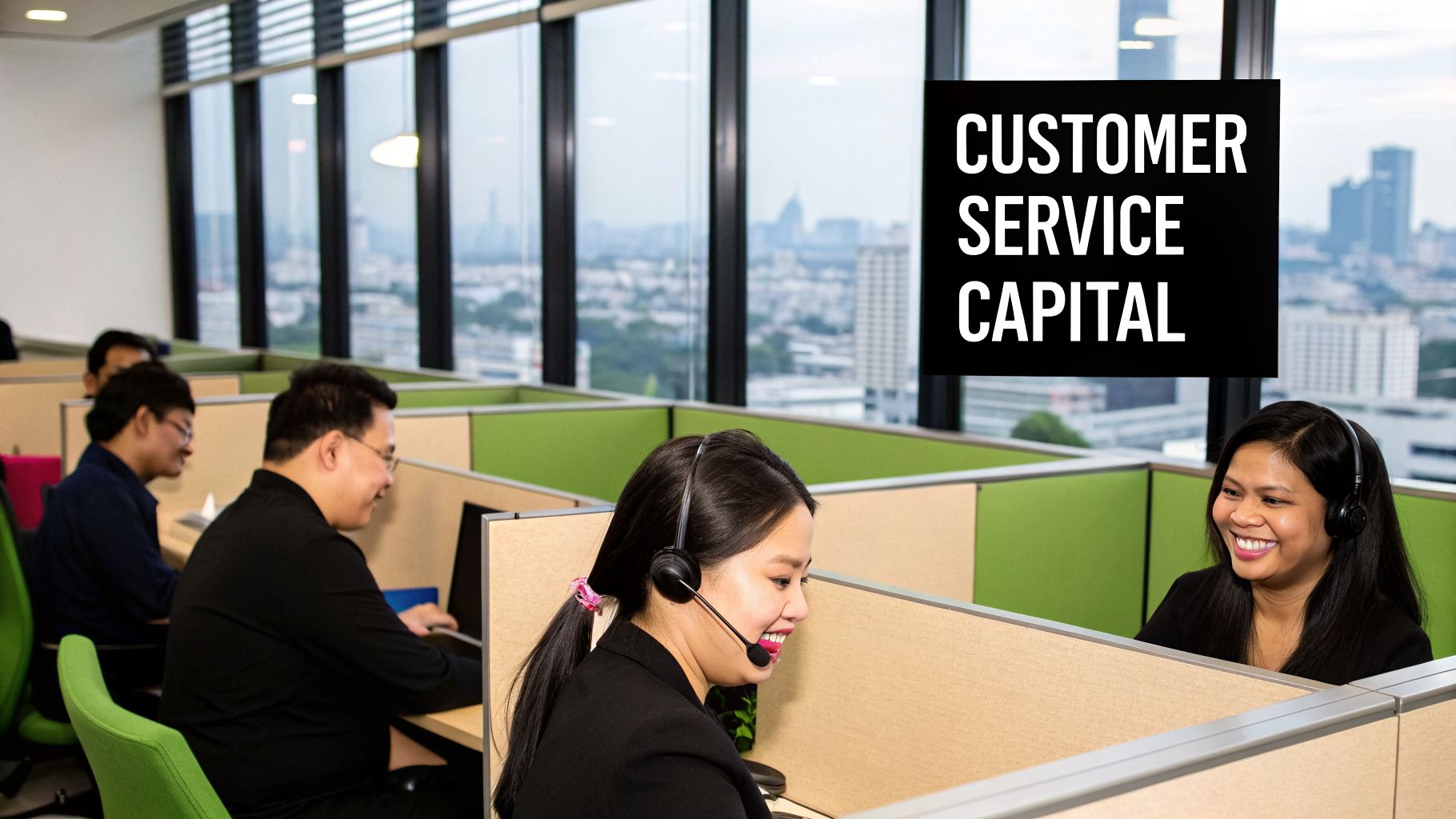
When companies from startups to Fortune 500 giants need world-class customer support, their search often leads directly to the Philippines. This isn't by accident. The country has deliberately cultivated an ecosystem that serves as the backbone for global customer relations.
The sheer scale is hard to overstate. Industry forecasts predict that by 2026, the sector will employ close to 1.97 million professionals and pull in roughly $42 billion in annual revenue. These aren't just abstract figures; they represent a massive, well-trained workforce handling countless customer interactions around the clock.
More Than Just Answering Calls
The industry's story is one of incredible growth and sophistication. It started out as a place for basic voice support—simple call handling and routine inquiries. Now, it has evolved into a center for complex, high-value business functions. The call center industry in philippines today is about so much more than just phone calls.
The big shift is in perception. Companies used to see the Philippines as a way to cut costs. Now, they see it as a source of competitive advantage. It's not just about finding a cheaper alternative anymore; it's about finding a strategic partner that can drive growth and keep customers happy.
This change was fueled by a powerful combination of factors that created the ideal environment for business process outsourcing (BPO).
- A Deep Talent Pool: The workforce is not just fluent in English; they have a strong cultural affinity with Western markets. This allows them to manage sensitive conversations with genuine empathy and skill.
- Serious Cost Advantages: The economics just make sense. Lower operational costs can lead to savings of up to 80% compared to running an equivalent office in North America or Europe. You can see how flexible office options help keep these costs manageable at https://seatleasingbpo.com/building-24/.
- Quick to Adopt New Tech: Philippine BPOs are leaders in adopting AI, cloud platforms, and omnichannel tools. They use this tech to provide smarter, faster, and more personalized customer service.
Smarter Ways to Enter the Market
For any business looking to tap into this opportunity, getting started has never been easier. Traditional outsourcing partnerships are still a great option, but flexible models like seat leasing are changing the game.
Think about it: you get a fully-furnished, modern office with all the IT infrastructure, high-speed internet, and support staff ready to go, all for a straightforward monthly fee. Seat leasing gives you direct control over your team and operations without the huge upfront investment and long-term lock-in of a traditional lease. It’s a perfect fit for companies that need to be agile and ready to grow.
Why Do So Many Global Businesses Outsource to the Philippines?
When companies decide to outsource, they have a world of options. Yet, for decades, one country has consistently come out on top: the Philippines. It’s a choice that goes far beyond a simple cost-saving exercise. It’s a strategic move built on an incredible combination of people, cultural connection, and a rock-solid business environment.
The secret sauce is, without a doubt, the Filipino workforce. We're not just talking about a large population; we're talking about a massive pool of talent with exceptional English proficiency. English isn't just a second language here; it's an official language and the primary language used in schools, business, and government. This creates a level of fluency and a neutral accent that's hard to find anywhere else.
But speaking the language is just the start. The real magic lies in the soft skills. The Filipino culture is known for its hospitality, genuine empathy, and an incredibly positive attitude. In a call center, this translates directly into better customer conversations. Agents aren't just following a script—they're building real connections, understanding subtle cues, and solving problems with a personal touch.
More Than Just Language: A Natural Cultural Fit
Imagine your customer support team not only speaks your customers' language but also gets their jokes and cultural references. Thanks to a long history of Western influence, Filipinos have a strong familiarity with the cultures of North America, the UK, and Australia. This shared context smooths over a lot of the usual friction you might find in cross-cultural communication.
This cultural familiarity makes for a more natural, effective style of communication. It lets agents navigate tricky or sensitive customer problems with a degree of understanding that builds real trust and strengthens your brand's reputation.
It's like having a remote team that feels like an extension of your local office. They understand the humor, the expressions, and the customer expectations, which makes every interaction smoother and more impactful.
When you put it all together—the language, the empathy, the cultural fit—you have what is essentially a ready-made, world-class customer experience team, prepared to represent your brand on the front lines.
Backed by a Pro-Business Government
Of course, a great workforce needs a stable environment to thrive. The Philippine government has long understood how vital the Business Process Outsourcing (BPO) sector is to the economy and actively works to support its growth through smart policies and attractive incentives.
This government support shows up in a few key areas:
- A Talent Pipeline for the Industry: The national education system and many vocational schools focus on developing the exact skills needed for the call center industry in philippines.
- Financial Incentives: Government bodies offer real perks, like tax holidays and easier business registration, making it a financially smart place to operate.
- Modern Infrastructure: There's ongoing investment in the country's telecommunications and IT infrastructure, ensuring it can handle the demands of modern, high-tech call centers.
This level of national commitment gives companies confidence that they aren’t just setting up shop in a new market; they’re partnering with a country that is invested in their success. The numbers tell the story. The Philippine call center industry now employs over 1.8 million professionals. It’s projected to grow to nearly 1.97 million employees by 2026 and generate around $42 billion in revenue that year alone. You can find more details about this workforce's massive scale and why it remains a top choice for major global markets. This is why the Philippines isn't just an outsourcing option; for many, it's the only one that makes sense.
Comparing Costs and Commercial Models
The financial argument for setting up shop in the Philippines is powerful, but unlocking those savings means picking the right game plan. The core advantage comes down to a few key things: much lower labor costs, a friendly currency exchange rate, and dramatically reduced overheads for real estate and utilities. When you add it all up, you could be looking at savings of up to 80% compared to what you’d spend in North America or Europe.
But getting to that number isn’t just about paying less for salaries. The operational model you choose will make or break your budget, your level of control, and how quickly you can get your team up and running.
The sheer scale of the opportunity here is hard to overstate. The numbers speak for themselves.
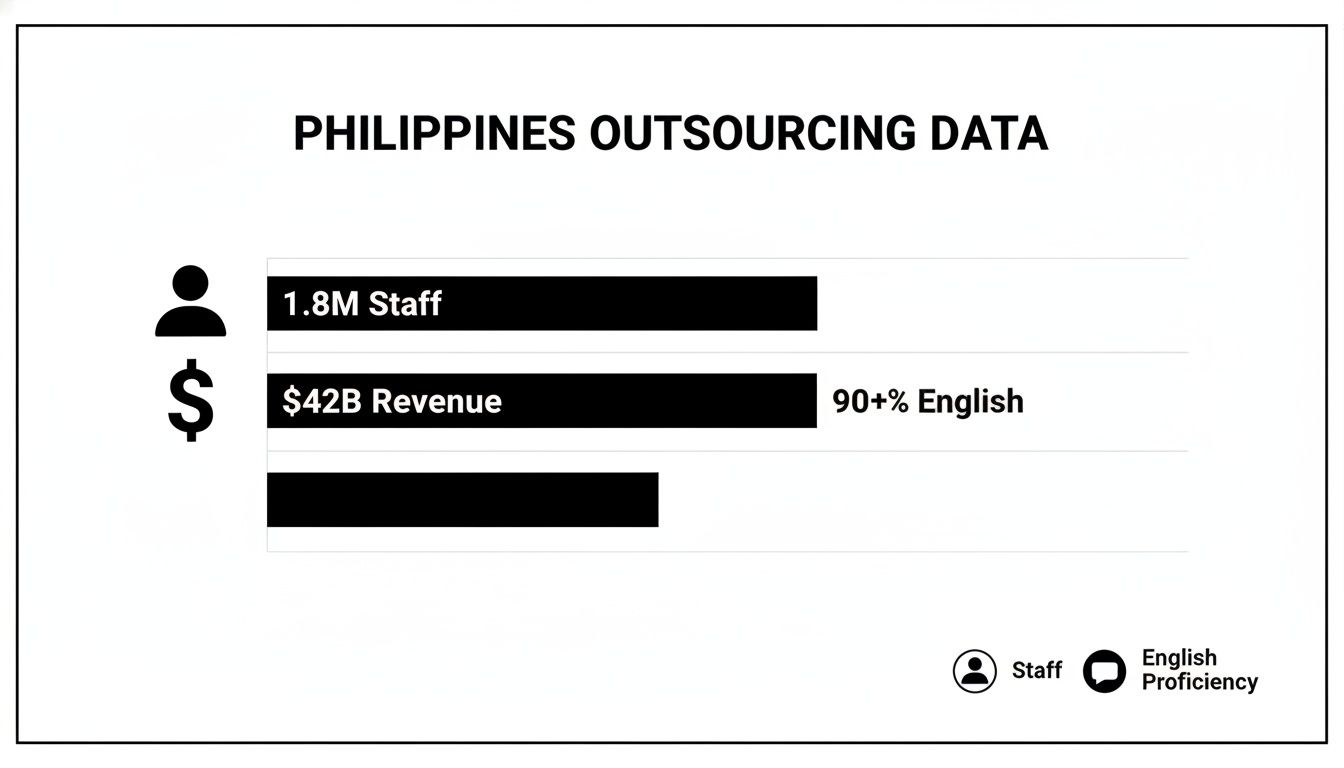
With a talent pool of 1.8 million professionals driving $42 billion in revenue, and with over 90% English proficiency, the resources are not just vast—they're world-class.
The Traditional BPO Partnership Model
The classic approach is to sign on with a large, traditional Business Process Outsourcing (BPO) company. This is the "full-service" or "all-inclusive" route. You essentially hand over an entire business function, like your customer support desk, and the BPO partner handles absolutely everything.
This typically includes:
- Recruiting, hiring, and training every agent
- Running the day-to-day operations and quality assurance
- Providing the office space, technology, and infrastructure
This model works well for huge corporations that want a completely hands-off solution and are fine with paying a premium for it. The BPO provider shoulders the entire operational burden, but you pay for that convenience. The trade-off is that you often lose direct control over your team, the work culture, and even the software they use. It’s a proven model, but it can feel rigid and is almost always the most expensive option.
The Agile Seat Leasing Model
For businesses that want more direct control and better cost-efficiency, a more modern approach has become the go-to solution: seat leasing. This is especially popular with startups, small to medium-sized businesses, and even larger companies looking to test the waters in the Philippines.
Seat leasing is like having an office on demand. It strips away all the complexities of setting up a physical presence, allowing you to focus purely on your people and your performance from day one.
Instead of outsourcing your entire operation, you simply lease the "seats" your team needs. Each seat comes in a plug-and-play package, giving you a fully equipped workstation in a professional office. This bundle includes everything you need to operate:
- IT Hardware: A ready-to-use PC, monitors, and network connections.
- Internet: High-speed, redundant fiber connectivity so you're always online.
- Utilities: Power with full backup generator support.
- Support Teams: 24/7 IT and administrative staff on-site.
- Amenities: Access to conference rooms, pantries, and building security.
This model completely changes the financial picture. You avoid the huge upfront cost of building out an office and the ongoing headache of managing a facility. Most importantly, you keep 100% control over who you hire, how you train them, and how you manage your operations. They are your employees, following your processes, just in an office managed by a specialist. You can explore the specifics of what's included in these packages to see just how turn-key this solution is.
A Head-to-Head Comparison
Choosing between a traditional office and a seat leasing provider comes down to balancing cost, control, and convenience. The table below breaks down the key differences to help you see which model aligns best with your business goals.
| Factor | Traditional Office Setup | Seat Leasing Model |
|---|---|---|
| Control | Low to medium; you manage outcomes, not process. | High; you manage your team, culture, and operations directly. |
| Cost | Higher; you pay a premium for a fully managed service. | Significantly lower; up to 80% savings by unbundling services. |
| Setup Time | Weeks to months; involves contract negotiations and process integration. | Days to weeks; sign the contract and your team can start. |
| Flexibility | Lower; often involves long-term contracts and fixed team sizes. | High; easily scale your team up or down based on need. |
| Best For | Large enterprises wanting a hands-off, fully outsourced solution. | Startups, SMBs, and enterprises seeking control, agility, and maximum cost savings. |
For a growing number of businesses, seat leasing hits that perfect sweet spot. It delivers all the financial perks of the Philippine market without forcing you to hand over control of your brand's voice and the customer experience you've worked so hard to build.
Moving Beyond Voice to High-Value Services
When most people picture the call center industry in the Philippines, they still imagine rows of agents answering phones. That picture isn't wrong, but it's woefully incomplete. While the country certainly earned its stripes with world-class voice support, clinging to that old image means you're missing the real story.
The industry has moved on. This wasn't some happy accident; it was a deliberate, strategic pivot. As global business demands became more intricate, Filipino BPOs didn't just keep up—they evolved. They've grown from being simple call-handling vendors into sophisticated partners managing critical, knowledge-heavy functions for companies all over the world.
The New Landscape of Expertise
Today, the work getting done in the Philippines requires a much sharper set of skills. It's less like a traditional contact center and more like a distributed headquarters for specialized operational teams. This is where businesses now turn for support that demands deep, subject-matter knowledge.
Instead of just answering basic customer questions, Filipino professionals are now at the heart of core business operations. The range of services is impressive and getting wider every day.
- Financial Services: Teams aren't just taking payment calls. They’re handling complex financial analysis, accounting, and even investment research for global financial institutions.
- Healthcare Information Management: Highly trained specialists manage sensitive patient records, medical billing, and clinical data, all while navigating strict international privacy laws like HIPAA.
- Legal Process Outsourcing (LPO): You’ll find paralegals and legal experts here assisting with contract reviews, legal research, and document management for major law firms and corporate legal departments.
This climb up the value chain is the clearest sign of the market's maturity. They're delivering a lot more than just good customer service.
The modern Philippine BPO is an extension of a client's core team, not just their support desk. They’re trusted with processes that directly impact revenue and compliance—a level of partnership that goes miles beyond traditional outsourcing.
The industry's push into these non-voice, knowledge-based roles is what’s powering its continued growth. This transition is critical for staying competitive. The global BPO market, with the Philippine workforce as a major engine, is on track to blow past $400 billion by 2026. More and more of that growth is coming from demand for specialized finance, healthcare, and data analytics work from companies in the U.S., UK, and Australia. You can dig into more on these projections about the BPO industry's future.
Cultivating the Next Generation of Talent
Naturally, shifting to high-value services means you need a more advanced workforce. The standard customer service skillset, while still important, just doesn't cut it anymore. The industry now needs data analysts, cybersecurity experts, certified medical coders, and even creative professionals.
Recognizing this, the industry and government have been smart about investing in serious upskilling and training programs. These aren't just token workshops; they're targeted initiatives designed to build the exact talent pools needed for the future. They're developing deep expertise in high-demand fields such as:
- AI and Machine Learning
- Cybersecurity and Data Privacy
- Digital Marketing and Creative Services
- Advanced Data Analytics
This forward-thinking approach ensures a steady pipeline of qualified professionals who can handle genuinely complex work. It shows that the call center industry in the Philippines isn't just reacting to change. It's actively building its own future and solidifying its place as a go-to partner for businesses that need sophisticated and reliable support.
How Technology Is Shaping the Future
The conversation about the call center industry in the Philippines has shifted. It’s no longer just about the massive, talented workforce; it’s about how that workforce is being supercharged by technology. This isn't some sci-fi story of humans versus machines. It’s a practical partnership where tech handles the grunt work, freeing up human agents to deliver faster, smarter, and more empathetic customer support.
And when we talk about technology in this space, one thing dominates the conversation: Artificial Intelligence (AI). The common fear is that AI is here to replace agents, but on the ground, that’s not what’s happening. Instead, AI is working as a co-pilot, empowering agents by taking repetitive tasks off their plates and feeding them real-time insights so they can focus on what people do best—solving complex problems and building real connections.

The Rise of AI-Powered Interactions
You can see this shift most clearly in the move away from basic voice-only services. Modern contact centers in the Philippines are embracing sophisticated tools, especially advanced chatbots, to add more value. These aren’t the clunky bots of a few years ago; they’re powerful systems designed for efficiency. If you want a deep dive into how these work, this guide to an AI Chatbot for Customer Support is a great starting point.
In a typical modern setup, these AI systems are already handling key functions:
- Figuring out the 'why': The best AI can instantly grasp why a customer is getting in touch. This means no more frustrating transfers—the customer gets routed to the right agent on the first try.
- Smarter call routing: AI uses customer data to predict their needs, connecting them to an agent with the exact skills to solve their problem, often before the agent even says "hello."
- 24/7 global support: Multilingual bots can handle basic queries around the clock and in different languages, letting human agents focus on the more complex, high-touch conversations.
The result is a better experience for everyone. Customers get quick resolutions, and agents start every call with the context they need to be effective from the first second. This drive for efficiency is a huge part of the industry’s growth. It’s a key factor in projections that see the sector employing 1.97 million people and generating $42 billion by 2026.
Cloud Platforms and Cybersecurity
None of this tech-driven progress would be possible without two behind-the-scenes pillars: cloud platforms and rock-solid cybersecurity. The pandemic threw the remote and hybrid work model into overdrive, and it was cloud infrastructure that allowed Philippine BPOs to adapt without missing a beat.
Cloud platforms give teams the incredible flexibility to work from anywhere, all while accessing the same secure tools and data they would in a physical office. It makes scaling a breeze. Need to add 50 agents for a seasonal rush? It's done in days, not months, without worrying about buying new hardware or leasing more office space.
Technology is the great equalizer. It gives businesses using models like seat leasing access to enterprise-grade infrastructure—redundant internet, advanced security, and cloud platforms—without the enterprise-level price tag.
This is where operational models like seat leasing really shine. A quality provider isn’t just renting you a desk and a computer. They're handing you the keys to a complete, pre-built technology ecosystem.
- Plug-and-Play IT Infrastructure: You gain immediate access to powerful, professionally managed systems without spending a dime on capital investment.
- Unbreakable Internet: Providers use multiple, redundant fiber optic lines. For a 24/7 operation, this means an internet outage simply isn't a concern.
- Built-In Security and Compliance: Top-tier providers manage cybersecurity for you, ensuring compliance with global standards like GDPR and keeping sensitive customer data locked down.
By bundling this powerful tech stack into a straightforward monthly fee, seat leasing removes one of the biggest hurdles for companies looking to establish a presence in the Philippines. It’s the fastest way to tap into the kind of robust, secure, and scalable infrastructure that used to be reserved for only the largest multinational corporations.
Your Practical Guide to Getting Started
Alright, let's translate all this market potential into a real, working operation. Having a clear plan is what separates a good idea from a successful launch. This roadmap will walk you through the big decisions you need to make to get started on the right foot.
First things first: where will you set up shop? While Metro Manila is still the heavyweight champion of the call center industry in philippines, it's not your only option. Cebu has long been a fantastic alternative, with a deep and experienced talent pool. You can also look toward "Next Wave Cities" like Davao and Iloilo, where you’ll find fresh labor markets with a lot less competition.
Your choice of city directly impacts everything from who you can hire to what you'll pay in rent and salaries. It's a foundational decision, so take the time to weigh your options against what your business truly needs.
Building Your Due Diligence Checklist
Once you've got a location in mind, it's time to choose your operational model and, potentially, a partner. Whether you're eyeing a traditional BPO or a more flexible approach like seat leasing, you absolutely cannot skip thorough due diligence. This isn't just about finding the cheapest price—it's about making sure your partner has the chops to deliver and won't expose you to unnecessary risk.
Think of your checklist as being built on a few core pillars. Getting these right ensures your partner can meet global standards and won't stumble when you need to grow.
The goal of due diligence is simple: to find a partner whose infrastructure, security, and legal footing are as strong as their operational promises. A great price means nothing if the fundamentals are weak.
A deep dive here gives you the peace of mind that your entire operation is built on solid ground.
Key Areas for Vetting a Partner
When you start talking to potential providers, your questions should be pointed and specific. How they answer these will tell you far more about their real capabilities than any slick sales presentation ever could.
Legal and Regulatory Compliance: Are they fully registered and on the right side of all local labor laws? Ask them to walk you through their compliance processes and their experience working with other international clients.
Data Security and Privacy: This is non-negotiable. Get specific and ask how they handle standards like GDPR and CCPA. A partner worth their salt will be completely transparent about their security measures, from data encryption and access controls to how often they run security audits.
Infrastructure Reliability: Don't just accept "we have great internet." Ask for details. Do they have redundant fiber lines from different providers? What’s their power backup situation—do they have generators, and are they tested regularly? What kind of IT hardware are your agents actually going to be using?
Scalability and Flexibility: How painful is it to grow? You need to know exactly what the process is for adding more seats or even scaling down if needed. A good partner will have straightforward terms for adjusting your team size without locking you into a rigid, punishing contract.
This is where models like seat leasing really shine. They provide a transparent, "plug-and-play" solution that lets you get into the market fast. All the headaches of setting up an office are handled for you, so you can pour your energy into what you do best: hiring a great team and running your business.
If you’re ready to turn these insights into a concrete plan, get in touch with our team to discuss your specific business needs.
Frequently Asked Questions
If you’re considering the Philippines for your business operations, you probably have a few questions. We get it. Here are some straight answers to the most common queries we hear from businesses just like yours.
What Makes Filipino Agents So Effective?
It really comes down to a powerful combination of language skill and a natural knack for customer service.
First off, English is an official language here and is woven into the education system from day one. This means you get a workforce with a high degree of fluency and, often, a very neutral accent that's easy for Western customers to understand.
But it goes beyond just language. There's a deep-seated cultural emphasis on hospitality and service. This translates into agents who are genuinely empathetic and skilled at building a real connection with customers—a world of difference from someone just reading off a script.
How Much Can My Business Realistically Save?
The savings are dramatic—it’s one of the main reasons so many businesses look here in the first place. It's not uncommon for companies to see cost reductions of up to 80% compared to running the same operation in North America or Europe.
So, where does all that savings come from?
- Lower Labor Costs: Competitive local salaries mean you can build a team of top-tier talent for a fraction of what you'd pay at home.
- Reduced Overhead: Everything from commercial real estate and utilities to general administrative expenses is significantly lower.
- Flexible Operating Models: Solutions like seat leasing let you bypass the huge upfront capital investment required for office fit-outs and IT infrastructure.
What Are The Main Differences Between BPO And Seat Leasing?
This is a big one. Your choice really boils down to how much control you want versus how much you want handled for you.
Think of it this way: a traditional BPO is like hiring a full-service catering company. You tell them what you want, and they manage everything from the menu to the staff. Seat leasing is like renting a fully-equipped professional kitchen—you get the space and all the best tools, but you bring your own chefs and run the show yourself.
A traditional BPO partner takes the entire operation off your hands, from hiring and training to daily management. It’s a hands-off approach but comes at a higher price and gives you less direct oversight. With seat leasing, you get the office, the IT, and the facilities, but you hire and manage your own team. This gives you complete control over your company culture and processes for a much lower cost.
How Secure Is My Data With A Philippine Partner?
Any reputable provider in the Philippines knows that data security isn't just a feature; it's the foundation of their business. Top-tier BPOs and seat leasing firms invest heavily in both physical and digital security to meet tough global standards.
You'll find that they are well-versed in and compliant with international privacy laws like GDPR and CCPA. Standard practice includes robust measures like end-to-end data encryption, multi-factor authentication, and 24/7 security monitoring to ensure your business and customer data stays protected.
Ready to see how a flexible, cost-effective office solution can work for your business? Seat Leasing BPO offers plug-and-play workstations that give you full control of your operations with up to 80% cost savings. Learn more and get started at Seat Leasing BPO.