If you want to get a real handle on your business's financial health, you need to know how to calculate overhead costs. The basic idea is simple: add up all your indirect expenses for a given period—think rent, utilities, admin salaries—and then divide that by a key business metric, like labor hours or total sales. This gives you your overhead rate, a number that's absolutely critical for smart pricing and solid budgeting.
Why Understanding Overhead Costs Is Crucial for Growth

Ignoring your overhead is one of the fastest ways to run a growing business into the ground. I saw this happen firsthand with a mid-sized BPO. They were bringing in new clients left and right but their profitability was bafflingly low.
It wasn't until they dug into their numbers that they found the culprit. Their "hidden" costs—things like half-empty office floors, redundant software subscriptions, and sky-high utility bills—were quietly eating up nearly 40% of their gross profit. Once they identified and slashed these expenses, they nearly doubled their net profit in six months without signing a single new client.
This story drives home a core business truth. Growth isn't just about making more sales; it's about mastering the cost of staying in business.
Defining Your True Cost of Operations
So, what exactly are overhead costs? Think of them as any expense that isn’t directly tied to producing your product or delivering your service. You can't run the business without them, but they support the whole operation, not a specific sale. They're the cost of keeping the lights on.
To get this right, you have to separate them from direct costs. Direct costs are the expenses you can trace directly to a single product or client project. For a furniture maker, the wood and the carpenter’s wages are direct costs. For a BPO, an agent's salary is a direct cost.
Overhead, on the other hand, covers all the indirect expenses that benefit the entire company. This usually includes:
- Rent and utilities for your office.
- Salaries for admin, marketing, and management staff.
- Insurance policies that protect the business.
- Software subscriptions for accounting, project management, and communication tools.
- Office supplies and general maintenance.
Accurately tracking these numbers isn't just an accounting chore—it's the key to smarter pricing, realistic budgeting, and building a truly resilient company. When you know your overhead, you know your break-even point.
The Strategic Advantage of Knowing Your Numbers
When you calculate overhead costs with precision, you gain a massive strategic advantage. You can set prices that actually guarantee a profit on every sale, instead of just guessing at a margin and hoping for the best. You can also build budgets that reflect reality, which helps prevent those nasty cash flow surprises from unexpected expenses.
Ultimately, mastering your overhead gives you control over your financial destiny. It shifts you from being a reactive owner who's surprised by month-end statements to a proactive leader who makes decisions based on hard data. This financial clarity is the foundation for sustainable growth, making your success a matter of strategy, not luck.
Categorizing Your Expenses: Direct vs. Indirect Costs
Before you can even think about calculating overhead, you have to get your expenses in order. Every dollar your business spends needs to be put into the right bucket. If you get this wrong, all your calculations down the road will be skewed. The most critical distinction to make is between direct costs and indirect costs—and those indirect costs are what we call overhead.
Think of a direct cost as anything you can directly trace to a single, specific product or service you sell. It’s the classic "cost of goods sold" (COGS). If you can't produce one more unit of your product without incurring that specific expense, it's almost certainly a direct cost.
Indirect costs, on the other hand, are your overhead. These are the expenses that keep the lights on and the entire operation running, but they aren't tied to a single item. It's the cost of being in business, not just the cost of making something. This is where things like office rent, administrative salaries, and your marketing budget live.
Diving Deeper: Fixed, Variable, and Semi-Variable Overhead
Once you’ve separated your indirect costs from your direct ones, there's another layer to peel back. Not all overhead behaves the same way. Some costs are predictable month after month, while others will fluctuate with your business activity. Getting a handle on this is key if you want to calculate overhead costs that are actually useful for forecasting.
Your overhead expenses will generally fall into one of three buckets:
- Fixed Overhead: These are the costs that stay the same every single month, no matter how busy you are. Your office rent or annual insurance premiums are perfect examples. They give you a stable, predictable baseline for your budget.
- Variable Overhead: These costs move in direct proportion to your business activity. For a manufacturing plant, the electricity bill is a classic example—it's going to be much higher during a month of heavy production.
- Semi-Variable Overhead: This is a hybrid. These costs have a fixed base amount but will also increase as your activity ramps up. A salesperson's compensation is a great example—they might have a fixed base salary plus a variable commission that depends on how much they sell.
Getting these categories right is more than just an accounting exercise. It shows you where your costs are locked in and where they might spike unexpectedly, giving you the insight you need to actually control them.
Real-World Examples Across Different Industries
The line between a direct cost and an indirect cost can look completely different depending on your business model. What’s considered overhead for one company could easily be a direct cost for another. Seeing a few examples side-by-side usually makes it much easier to categorize your own expenses with confidence.
Direct vs Indirect (Overhead) Costs Across Business Models
To see this in action, let’s look at how common expenses are classified in a few different sectors. This table should help clarify where your own costs fit.
| Expense Type | Manufacturing Example | Software Startup Example | BPO Example |
|---|---|---|---|
| Direct Costs | Raw materials (steel, wood), factory worker wages, production-line electricity. | Salaries for software developers working on a specific product, server costs for a live application. | Call center agent salaries, specific software licenses used per client account. |
| Indirect (Overhead) | Factory rent, maintenance on equipment, salaries of plant supervisors. | Office rent, marketing team salaries, accounting software subscriptions (like QuickBooks). | Office lease, HR and admin staff salaries, general IT infrastructure costs, utility bills. |
As you can see, the context is everything.
This distinction is crucial in every industry. Take construction, for example. The raw materials and the labor to assemble a building are clearly direct costs. But what about site preparation, permits, and temporary facilities? Those are all part of the project's overhead. In fact, global averages show these preliminary costs can represent 10-11% of a project's total value, which shows just how quickly overhead can eat into margins. You can find more details on these trends in a report from Turner & Townsend.
By diligently sorting every single expense into its proper category, you’re building a reliable financial foundation. This detailed map makes the next step—actually calculating your overhead rate—both accurate and deeply insightful. It gives you a true picture of how efficiently your business is running.
A Practical Guide to Calculating Your Overhead Rate
Okay, you've done the hard work of sorting your expenses into direct and indirect piles. Now it's time to make that data useful. We're going to transform that list of indirect costs into one of the most powerful numbers in your financial toolkit—your overhead rate.
This single metric tells you exactly how much it costs to support the people and activities that actually make you money. It's the key to pricing your services for real profit, not just revenue.
The Core Formula for Your Overhead Rate
At the end of the day, calculating your overhead rate is just simple division. Don't let the accounting terms make it seem more complicated than it is.
Total Indirect Costs / Allocation Measure = Overhead Rate
Let's quickly unpack what that means in plain English.
- Total Indirect Costs: This is just the sum of all those overhead expenses you identified for a specific period—usually a month or a quarter. Add up the rent, utilities, admin salaries, software subscriptions, and everything else on that list.
- Allocation Measure: This is the key business activity you'll divide those costs by. Choosing the right one is the most important part of this whole process because it’s what makes the final number meaningful.
- Overhead Rate: This is your answer. Depending on the allocation measure you choose, it might be a percentage, a dollar amount per hour, or a cost per unit.
The real skill here isn't the math; it's picking the right allocation measure for your business.
Choosing the Right Allocation Measure
Think of your allocation measure as the bridge connecting your overhead costs to your actual operations. You need to pick something that has a direct, logical relationship with how your business racks up those indirect costs. If you choose poorly, you'll get a skewed rate and make bad pricing decisions.
Here are the most common options and when I've seen them work best:
- Direct Labor Hours: This is the gold standard for service businesses like BPOs, consulting firms, or creative agencies. If your team's time is your main "product," this is almost certainly your best bet. It gives you a clear dollar amount of overhead per hour of billable work.
- Direct Labor Costs: This is similar to hours but uses the total payroll cost of your direct labor instead. It's really useful if you have team members with wildly different pay rates. The result is a percentage, like "our overhead is 40% of our direct labor cost."
- Machine Hours: This is the go-to for manufacturers. If your business depends on heavy equipment, this tells you the overhead cost for every single hour a machine is up and running.
- Total Sales: A simple, high-level option where you just divide total overhead by total sales revenue. It's easy, but it can be misleading if you have different products or services with very different profit margins.
For most modern service companies, especially in the BPO world, direct labor hours is the most insightful choice. It creates a direct line between the cost of your infrastructure and the productive hours of the employees who bring in the revenue.
A Worked Example for a Small BPO
Let's make this real. Picture a small BPO with 30 agents. We're going to calculate their monthly overhead rate using direct labor hours.
First, Sum Up Monthly Indirect Costs
They add up all their overhead for one month:
- Office Rent: $8,000
- Utilities (Electricity, Internet): $2,500
- Admin Salaries (HR, IT, Supervisor): $15,000
- Software Subscriptions (CRM, HR Tools): $1,200
- Insurance: $800
- Office Supplies & Maintenance: $500
Total Monthly Indirect Costs = $28,000
Next, Calculate the Allocation Measure
Now for the direct labor hours. With 30 agents each working a standard 160 hours a month:
30 agents * 160 hours/agent = 4,800 direct labor hours
Finally, Calculate the Overhead Rate
We just plug those numbers into the formula:
$28,000 (Total Indirect Costs) / 4,800 (Direct Labor Hours) = $5.83 per hour
This result is pure gold. The BPO owner now knows that for every single hour an agent works on a client's project, the business has to tack on an extra $5.83 just to cover the lights, management, and software. That insight is absolutely critical for setting profitable service rates and knowing the true cost of every contract you sign.
Keeping a close eye on this number is more important than ever. Operational costs can get out of hand quickly. For example, spiking energy and equipment prices have put a serious squeeze on businesses. Data shows that U.S. wholesale power prices jumped over 12% this past summer, while industrial machinery costs have skyrocketed 85% since the mid-90s. These trends hit everyone from manufacturers to office-based BPOs. You can get a deeper look at these cost trends in manufacturing on mie-solutions.com.
By running this calculation regularly, you give yourself the data to navigate these kinds of economic shifts and protect your bottom line. For more tips on keeping your operations lean and profitable, feel free to explore other articles on our blog.
A Smarter Metric for Modern Businesses: Per-Seat Overhead
While a company-wide overhead rate gives you a decent bird's-eye view, it doesn't always tell the whole story. For service-based businesses like BPOs, tech startups, and design agencies, getting more granular is key. That's where calculating your per-seat overhead cost comes in.
This figure strips away the complexity and gives you a single, powerful number: the exact cost to keep one employee productive in their workspace.
Total Office-Related Overhead / Total Number of Seats = Cost Per Seat
Think of it as moving from a macro to a micro perspective. Instead of just looking at the cost of the entire building, you're focusing on the cost of each individual unit of productivity—the person at their desk. This shift in thinking is especially critical if you're weighing the pros and cons of a traditional office lease versus more flexible workspace options. It helps you calculate overhead costs in a way that allows for a true apples-to-apples comparison.
This diagram helps visualize how we get to that number. You're essentially taking all those indirect costs and allocating them across a specific measure to create a practical rate.
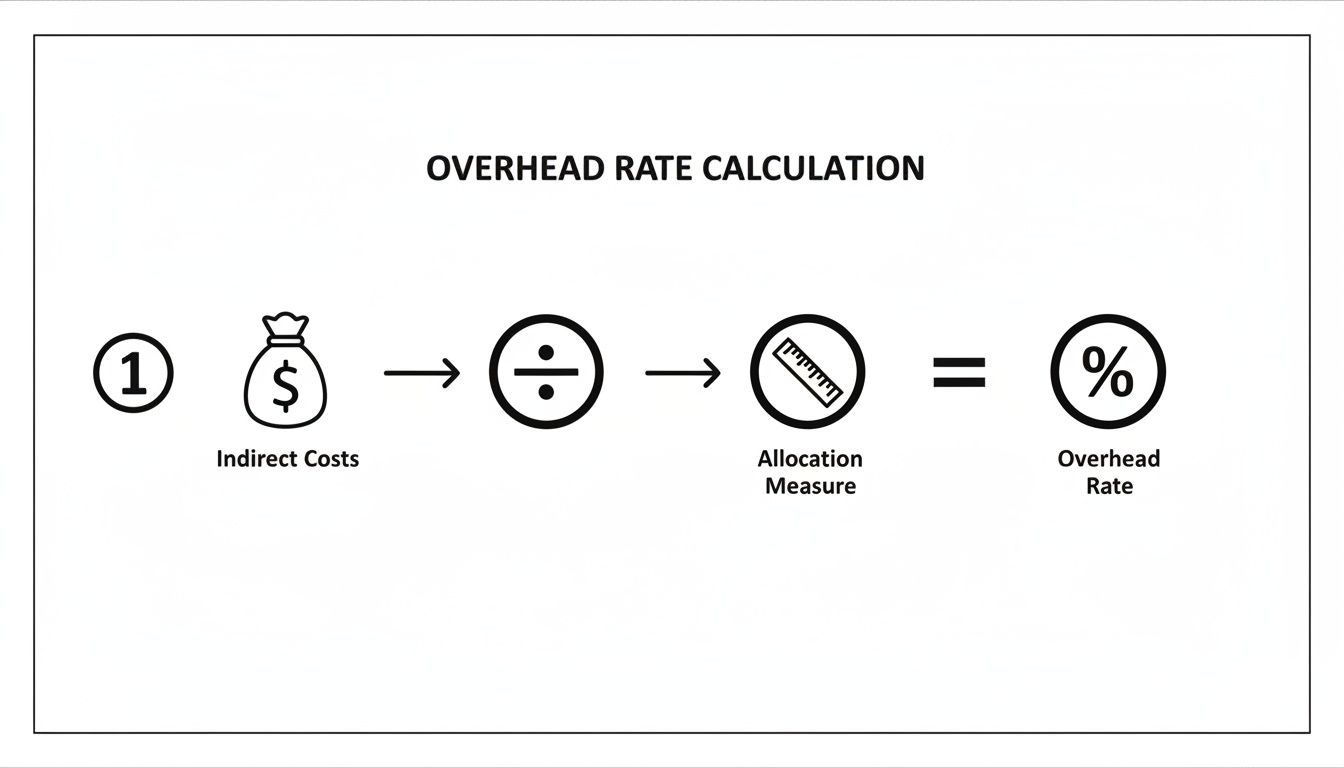
By breaking down your total indirect expenses this way, you create a much clearer benchmark for making smart financial decisions.
The Hidden Costs Lurking in a Traditional Office Lease
The real eye-opener comes when you apply this per-seat calculation to a conventional office lease. On the surface, the monthly rent seems straightforward. But in my experience, that's just the tip of the iceberg. A traditional lease is packed with hidden expenses and administrative burdens that can dramatically inflate your actual cost per employee.
These are the "invisible" overheads that never appear on the lease agreement but relentlessly chip away at your bottom line:
- IT Infrastructure: This isn't just about paying for internet. It’s the server setup, network cabling, ongoing maintenance, software licenses, and the salaries of the IT staff needed to keep it all running.
- Security: You're responsible for everything from hiring security personnel to installing and monitoring alarm systems and access control.
- Utilities and Maintenance: This goes far beyond electricity. Think daily cleaning services, HVAC repairs, plumbing issues, and general building upkeep.
- Office Fit-Out: That empty shell of an office needs to be turned into a functional workspace. That means a significant upfront investment in furniture, partitions, wiring, and equipment.
These aren't just minor extras; they are substantial costs that turn a predictable rent payment into a volatile and often surprisingly high total occupancy cost.
Per-Seat Cost Breakdown: Traditional Office vs. Seat Leasing
Let's run the numbers with a practical example. Imagine a 50-person company deciding between leasing a traditional office space and opting for a BPO seat leasing arrangement.
The table below breaks down the typical monthly expenses. In a traditional lease, you pay for everything separately. With seat leasing, most of these costs are bundled into a single per-seat price.
| Overhead Cost Item | Traditional Lease (Monthly Cost) | Seat Leasing BPO (Included) |
|---|---|---|
| Office Rent (5,000 sq ft @ $3/sq ft) | $15,000 | ✅ |
| Utilities (Electricity, Water, HVAC) | $1,500 | ✅ |
| High-Speed Internet | $500 | ✅ |
| Daily Cleaning & Maintenance | $1,000 | ✅ |
| IT Infrastructure & Support | $3,000 | ✅ |
| Security (Personnel & Systems) | $2,000 | ✅ |
| Reception & Admin Support | $3,500 | ✅ |
| Office Supplies & Kitchen Stock | $500 | ✅ |
| Total Monthly Cost | $27,000 | $12,500 |
| Cost Per Seat (50 employees) | $540 | $250 |
The difference is staggering. The traditional lease racks up a per-seat cost of $540. The all-inclusive seat leasing model? Just $250.
By choosing a model that bundles these unpredictable overheads into one transparent price, the company saves $14,500 every month. That's an annual saving of $174,000. If you're curious, you can explore how these flexible workspace solutions work to see if this model makes sense for your operations.
This idea of per-capita costs isn't unique to real estate. We see a similar dynamic in the corporate events industry. For example, forecasts show the average cost-per-attendee for meetings is expected to climb from $162 to $172 per day. Much like an office with empty desks drives up the per-person cost, fixed event costs spread across fewer attendees become more expensive for everyone.
Ultimately, by focusing on a per-seat cost, you can transform a dozen variable, hard-to-manage expenses into a single, predictable operational line item. This doesn't just save money—it frees up capital and, just as importantly, leadership's time to focus on growing the business instead of managing the office.
How to Strategically Reduce Your Overhead
Knowing how to calculate overhead costs is only half the battle. The real power comes from using that knowledge to take decisive action. Once you have a firm grasp on your numbers, you can start strategically trimming them down, freeing up capital to reinvest where it truly matters—in growing your business.
This isn't about blind cost-slashing. It’s about making smart, targeted decisions to boost efficiency without hurting quality or your team's morale. We're aiming to trim the fat, not the muscle.
For many businesses I've worked with, the largest and most volatile overhead expenses are almost always tied to physical office space. This is often where you'll find the biggest opportunity for savings, especially if you've outgrown your current setup or feel trapped by an inflexible long-term lease.
Transforming Costs with Flexible Solutions
One of the most powerful strategies for getting these expenses under control is to ditch the traditional lease model for a more flexible workspace, like seat leasing. This move completely changes your cost structure. Instead of juggling a dozen separate, unpredictable bills—rent, utilities, IT, security, maintenance—you consolidate everything into a single, predictable operating expense.
This approach turns a chaotic mix of fixed and variable costs into one straightforward monthly payment. You’re no longer guessing what your electricity bill will be or bracing for an unexpected HVAC repair. That stability is a game-changer for budgeting and financial forecasting.
This shift isn't just a cost-saving tactic; it's a strategic move toward operational agility. It allows you to scale your team up or down on demand without the crippling financial penalties tied to breaking a long-term lease.
This kind of flexibility is priceless. If you land a new project and need to add ten agents, you can do it almost overnight. When the project winds down, you can scale back just as quickly. This agility ensures you’re never paying for empty desks—a common and expensive problem for businesses with fluctuating headcounts.
A Startup Case Study in Smart Savings
Let's walk through a real-world scenario. A tech startup with 40 employees was ready to move out of its incubator space. The founders ran the numbers for a traditional office lease and were floored by the upfront investment and ongoing expenses.
Here's what their projected initial spend looked like:
- Security Deposit: $30,000 (often three months' rent)
- Office Fit-Out: $50,000 (for furniture, wiring, and partitions)
- IT Infrastructure Setup: $15,000 (covering servers, cabling, and initial support)
That’s a $95,000 capital outlay before they could even open the doors. On top of that, their monthly overhead was projected at around $22,000, covering everything from rent and utilities to IT staff and maintenance.
Instead, they looked into seat leasing. The provider offered a fully-equipped, "plug-and-play" office. There was no massive security deposit and zero cost for furniture or IT setup. Their all-inclusive monthly cost for 40 seats came to just $12,000.
By choosing this route, they cut their initial operational spending by a staggering 60%. That capital, which would have been locked up in office assets, was instead reinvested directly into product development and marketing—the very things that fueled their growth.
The True ROI Beyond the Bottom Line
The financial savings are clear, but the strategic advantages are just as powerful. By offloading the administrative nightmare of managing an office, the startup’s leadership team freed up hundreds of hours.
They were no longer dealing with internet outages, haggling with cleaning services, or overseeing repairs. They could focus entirely on their business. This is a critical, often-overlooked benefit. The time and mental energy of your key people are your most valuable resources.
This model delivers several key strategic benefits:
- Greater Business Agility: Scale your operational footprint in real-time to match business needs without being locked into long-term commitments.
- Capital Preservation: Avoid huge upfront costs and put that cash toward growth activities like hiring top talent or launching new marketing campaigns.
- Reduced Administrative Load: Outsource the headaches of office management to a dedicated provider, keeping your team focused on what they do best.
Ultimately, strategically reducing overhead is about more than just saving money. It's about building a leaner, more resilient, and more focused organization. By converting unpredictable capital expenditures into manageable operating expenses, you gain the financial freedom and operational flexibility to thrive. If you’re ready to see how this model could reshape your company’s finances, you can connect with our team to discuss your specific needs.
Got Questions About Overhead Costs? We've Got Answers.
As you start crunching the numbers, you're bound to run into a few tricky spots. It's completely normal. Getting these details right is crucial for accurate financial planning, so let's clear up some of the most common questions I hear from business owners.
How Often Should I Be Calculating My Overhead Rate?
For most businesses, calculating your overhead rate monthly is the gold standard. Think of it as a regular financial health check-up. This frequency lets you catch rising costs early, see how operational changes are affecting your bottom line, and adjust your pricing or budget before small issues become big problems.
If monthly feels like too much right now, a quarterly review is the bare minimum you should be doing. Anything less frequent, like an annual calculation, is just too slow. The business world moves fast, and making decisions based on year-old data is a recipe for trouble.
Are Employee Salaries a Direct or an Overhead Cost?
This is probably the most common point of confusion, and the answer is: it depends entirely on what the employee does. The real question to ask is, "Does this person's work directly generate revenue?"
- Direct Cost: If an employee is hands-on with creating your product or delivering your service, their salary is a direct labor cost. Think of a BPO agent taking calls for a specific client or a software developer building the product you sell.
- Overhead Cost: If an employee supports the business as a whole, their salary is overhead. This bucket includes your administrative team, marketing staff, HR, and executives. Their work is vital, but it isn't tied to a single, billable unit of service.
The biggest mistake businesses make when they first calculate overhead costs is misclassifying expenses. Accidentally labeling an indirect cost as direct (or vice versa) can significantly distort your overhead rate and lead to poor business decisions, like underpricing your services.
What's the Biggest Mistake People Make When Calculating Overhead?
Aside from mixing up direct and indirect labor, the most frequent error is overlooking the small stuff. It’s easy to remember the big monthly check for rent, but the dozens of smaller, recurring costs are what sneak up on you and quietly inflate your overhead.
Be on the lookout for these commonly missed expenses:
- Monthly software subscriptions (CRM, project management tools, accounting software)
- Bank fees and credit card processing charges
- Professional association dues and memberships
- Business insurance premiums
- Small office supplies or kitchen restocks
The best way to avoid this is to work from a detailed checklist. Go through your bank and credit card statements line by line to make sure every single business expense is accounted for.
Can a Business Really Have Zero Overhead?
In practice, no. A legally registered business will always have some level of overhead. Even a freelancer working from their spare bedroom has indirect costs—internet service, software licenses, a portion of their utility bills. These are all necessary expenses to keep the operation running.
The goal isn't to hit zero overhead, because that's impossible. The goal is to control and optimize it. This is precisely why concepts like seat leasing have become so popular. They don't magically eliminate costs; they bundle them. Instead of juggling a dozen variable expenses, you get one predictable, manageable monthly payment, which simplifies everything.
Ready to stop guessing and start controlling your overhead? Seat Leasing BPO offers plug-and-play office solutions that bundle rent, IT, utilities, and security into one predictable monthly cost, helping businesses like yours save up to 80% on operational expenses. Discover a smarter way to manage your workspace by visiting https://seatleasingbpo.com.