For years, the conversation around accounting outsourcing to the Philippines has been dominated by one thing: cost. And while the savings are certainly compelling, smart businesses in 2026 are realizing that’s only a small part of a much bigger strategic picture.
It’s about moving beyond simply offloading routine bookkeeping. It’s about building a high-caliber finance team that frees up your key people to focus on growth, without the headaches and high costs of local hiring. This isn't just a cost-cutting measure; it's a low-risk way to gain a serious competitive advantage.
Why the Philippines for Accounting?
When you start looking at moving financial operations offshore, you quickly realize it’s not just about finding the cheapest option. It’s about finding a stable, mature environment that can support your business long-term. This is where the Philippines truly stands out.
The country has a well-established BPO industry, especially in finance and accounting. This means the infrastructure, talent, and processes are already in place, making it a reliable choice for businesses that can't afford to take a gamble on their financial operations. The real value is in turning your finance department from a necessary expense into a powerhouse for strategic decision-making.
The benefits of this approach are clear and tangible. Here's a quick look at the core advantages businesses gain.
Key Advantages of Philippine Accounting Outsourcing
| Advantage | Description | Impact on Business |
|---|---|---|
| Significant Cost Reduction | Reduce labor-related expenses by up to 70% by tapping into a lower-cost market without sacrificing quality. | Frees up capital to reinvest in growth areas like marketing, R&D, and product development. |
| Access to Top Talent | Gain access to a large pool of English-speaking, certified accountants proficient in global standards and software. | Build a skilled team quickly without facing local talent shortages or high salary competition. |
| Increased Efficiency | Dedicated teams handle time-consuming tasks like bookkeeping, payroll, and AP/AR, following proven processes. | Your in-house team can shift its focus from transactional work to high-value strategic analysis. |
| Cultural Alignment | Filipino professionals are known for their strong work ethic, loyalty, and service-oriented mindset. | Ensures smoother communication and a remote team that functions as a true extension of your company. |
These advantages work together to create a powerful operational model that drives both savings and strategic growth.
A Deep Bench of Qualified Talent
One of the biggest frustrations for finance leaders in the West is the shrinking pool of available accountants. It's a real struggle. In contrast, the Philippines has a constant stream of highly qualified finance graduates and Certified Public Accountants (CPAs).
You aren't just hiring bookkeepers. You're getting access to professionals trained in international accounting standards (like IFRS and GAAP) and who are already experts in the software you use every day, whether it's QuickBooks, Xero, or NetSuite. This means you can build a specialized team without getting into a bidding war for local talent.
For a more detailed breakdown from a financial leader's perspective, this CFO's guide to outsourcing accounts payable offers some excellent insights.
Unlocking Significant Cost Advantages
Let's be clear: the cost savings are substantial. We're talking about reducing your labor-related costs by up to 70%. That’s a number that gets anyone’s attention.
This isn't just about a lower salary. It's the total, "fully loaded" cost of an employee you're saving on:
- Hefty recruitment and onboarding fees
- Benefits, payroll taxes, and insurance
- Office rent, new equipment, and IT support
That freed-up capital can be put to work immediately. Imagine what you could do by reinvesting those savings into product development, a bigger marketing budget, or better customer support. It directly fuels growth.
You can learn more about how different outsourcing models help achieve these savings on our blog.
The numbers speak for themselves. The Philippine BPO industry is on track to generate $38 billion in revenue in 2026, with a workforce of 1.82 million people. The finance and accounting sector alone is projected to more than double from $1,762.4 million in 2026 to $3,632.4 million by 2030, showing just how much global trust is being placed here.
A Culture That Just Clicks
Beyond the numbers and credentials, there’s a cultural component that’s hard to overstate. Filipino professionals are widely recognized for a strong work ethic, a deep sense of loyalty, and a genuinely service-oriented mindset.
This isn't just a "nice-to-have." It’s critical for building a remote team that feels connected and invested in your success. High English proficiency and a deep familiarity with Western business culture mean communication is smooth and effective. You end up with a true partner—a stable, scalable team that’s committed to helping your business thrive.
Understanding Costs and Ensuring Compliance
Let's get straight to the numbers. The promise of slashing labor costs by up to 70% is what puts accounting outsourcing to the Philippines on the map for most businesses. But to see the whole picture, you have to look past the headline salary figures.
When you hire an accountant in a place like the US or the UK, that base salary is just the tip of the iceberg. You’ve got recruitment fees, health insurance, payroll taxes, office rent, new hardware, and software licenses. All those overheads can easily tack on another 30-50% to your total cost, turning a seemingly manageable salary into a much larger financial commitment.
This is where the outsourcing model really shines. A single, transparent fee from your BPO partner typically bundles all of these expenses together.
A Realistic Financial Breakdown
So, what does this look like in practice? Imagine you need a solid mid-level accountant. In a major Western city, you might budget $70,000 for their salary. After factoring in all the overhead, the actual cost to your company could easily push $100,000 per year.
Now, let's look at the alternative. An outsourced professional in the Philippines with the same qualifications—often a CPA—might cost you a total of $25,000 to $35,000 annually. That’s an all-in figure covering their compensation, the provider's management fee, IT support, and infrastructure. The savings aren't just a theory on a spreadsheet; they represent real capital you can reinvest into growing your business.
And if you really want to maximize those savings, technology is your best friend. To "slash costs and errors" that bog down manual processes, integrating tools like Invoice Processing Automation into your outsourced workflow is a game-changer. It’s a simple way to boost accuracy and free up your team for more strategic work.
The growth of the Philippine BPO sector is a testament to its value, with both revenue and its skilled workforce projected to climb steadily.
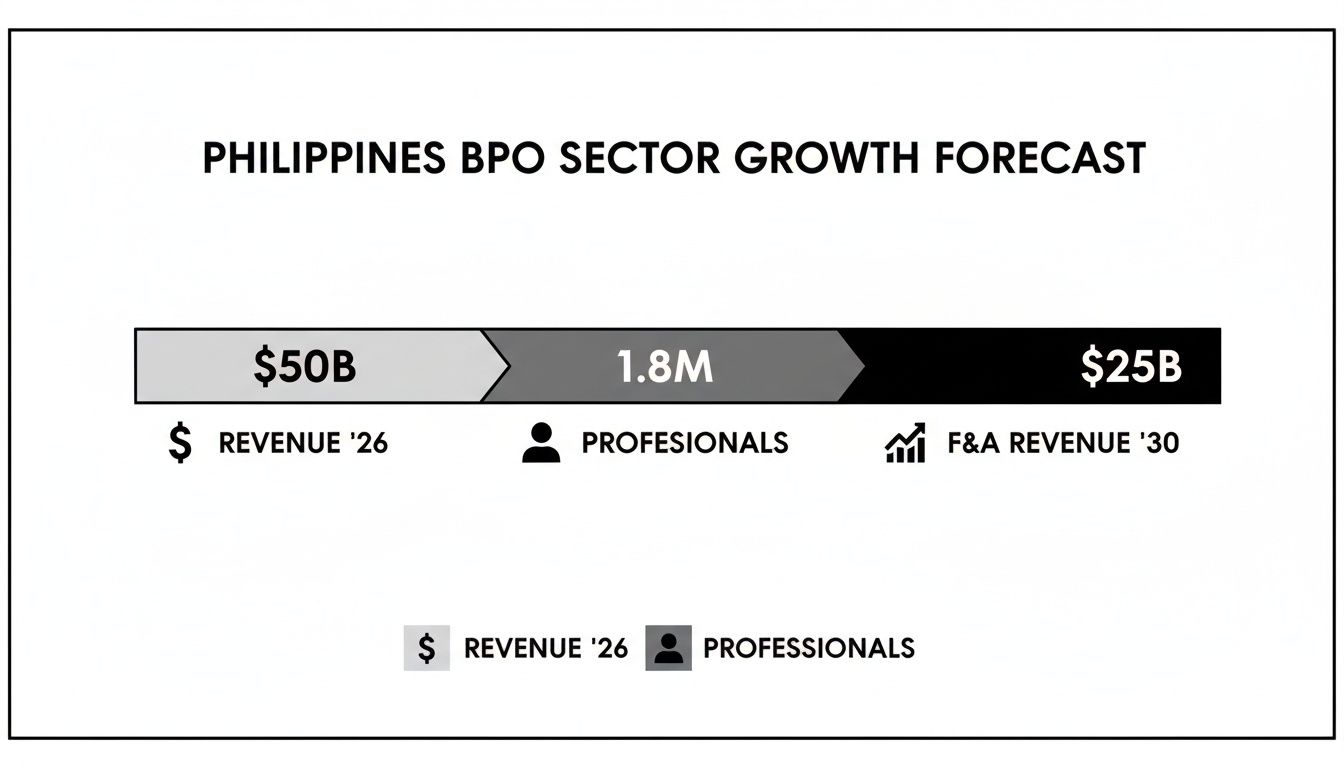
This data shows a healthy expansion across the board, especially in the Finance & Accounting space, reflecting growing global confidence in the industry.
Prioritizing Security and Compliance
Saving money is great, but it means nothing if your company’s financial data isn't secure. The good news is that the Philippines has a well-established legal framework for data protection, and any BPO worth its salt makes compliance a core part of its operations.
The country’s cornerstone legislation is the Data Privacy Act of 2012 (Republic Act No. 10173). It’s a robust law designed to align with international standards like GDPR, setting strict rules for how companies collect, handle, and store sensitive information.
A provider's commitment to security isn't just a feature; it's a non-negotiable. Never trade robust compliance for a slightly lower price tag. Your financial integrity is on the line.
If you do business in Europe, you also need to ensure your partner is fully compliant with the General Data Protection Regulation (GDPR). The best providers have dedicated compliance officers and airtight protocols to meet these demands, making them a safe bet for global companies.
Verifying a Partner’s Security Posture
So, how do you verify a potential partner's security claims? You need to dig deeper and ask for proof.
Here’s what I always look for:
- Certifications: An ISO 27001 certification is the global benchmark for information security. It shows they have a documented, systematic process for protecting sensitive data. Ask to see it.
- Physical Security: What happens on-site? I want to hear about biometric scanners, 24/7 security guards, and comprehensive CCTV coverage. Access should be tightly controlled.
- IT Security Protocols: Get into the weeds on their network security. Discuss firewalls, intrusion detection systems, and encryption standards for data both at rest and in transit.
- Employee Training: Human error is still the weakest link in security. Ask how they train their staff on data privacy and security protocols. Is it a one-time thing or a continuous process?
Asking these pointed questions will help you see past the marketing brochures and understand how seriously they take security. Finding a partner who invests heavily in compliance ensures your move to accounting outsourcing to the Philippines is both smart and secure.
Choosing the Right Outsourcing Partner

This is it. Selecting your partner is hands-down the most important decision you'll make in your accounting outsourcing Philippines journey. Get it right, and you’ve got a seamless extension of your team. Get it wrong, and you've just signed up for months of headaches.
I’ve seen it go both ways. A great partner doesn’t just process transactions; they spot trends, suggest improvements, and truly care about your success. A bad one? They create more work than they take on, with endless corrections, missed deadlines, and frustrating communication gaps. It's crucial to look beyond the slick sales pitch and figure out who can actually deliver.
Vetting Technical Expertise and Industry Fit
First things first: you need to vet their actual skills. Before you even schedule a call, dig into their industry specialization and software proficiency. Don't fall for a "we do it all" provider. A firm that genuinely understands your world—be it SaaS, e-commerce, or construction—is worth its weight in gold.
They'll already know the specific compliance rules, revenue recognition models, and key metrics that matter to you. Just as important, they must be masters of your accounting software.
Here’s a quick checklist to screen potential partners:
- Software Proficiency: Can they prove they have certified experts in your tech stack (like QuickBooks, Xero, or NetSuite)? Ask to see the certifications, not just a line item on a proposal.
- Industry Experience: Do they have case studies or client references from your specific niche? An e-commerce specialist will understand inventory and payment gateway fees far better than a generalist.
- Team Credentials: What are the qualifications of the accountants who will be doing the work? You're looking for Certified Public Accountants (CPAs) and staff with solid accounting degrees.
This simple screening process will quickly weed out the firms that aren't a good technical fit, saving you countless hours.
Asking the Right Questions
Once you have a shortlist, the discovery call is where you separate the contenders from the pretenders. Your job is to go beyond their prepared script and uncover how they actually operate and solve problems.
Forget basic questions like, "What services do you offer?" Instead, get specific.
Try asking something like this: "Walk me through a time you handled a complex, multi-level invoice approval workflow. What were the biggest hurdles, and how did you get past them?"
A few other powerful questions I always recommend:
- "What’s your process for finding and fixing errors in a new client's books from their previous accountant?" This shows you their diagnostic and cleanup skills.
- "How do you guarantee continuity if our main point of contact resigns or takes a long vacation?" This tests their operational depth and planning.
- "Describe your standard month-end close process. How often, and in what format, do you communicate with clients during that period?" This reveals their project management and commitment to transparency.
Their answers to these questions will tell you far more than any marketing brochure ever could.
The Philippines has a phenomenal talent pool, with over 200,000 certified public accountants (CPAs)—a stark contrast to markets like the US, where a huge portion of CPAs are nearing retirement. Filipino professionals bring incredible expertise in roles like accounts payable, general ledger management, and reconciliations, offering a lifeline for growing companies. You can find more insights on the talent landscape in the Philippines vs. India on connextglobal.com.
Assessing Cultural Fit and Communication
This is the part everyone underestimates. Cultural alignment is the glue that makes the partnership work. You want your outsourced team to feel like your team, not a disconnected vendor.
Pay close attention to how they communicate on your calls. Are they clear and direct? Do they listen intently before responding? A good partner is proactive. They’ll flag a potential issue before it spirals and suggest ways to make your processes better.
Be crystal clear about your communication expectations from day one. If you need daily updates on Slack and a weekly video sync, state that upfront. A partner who can adapt to your preferred tools and cadence will integrate seamlessly.
If you’re ready to find a partner that truly fits your business, get in touch with us today.
A Smooth Onboarding and Transition Plan

From my experience, the first 90 days will make or break your accounting outsourcing Philippines partnership. If you just throw your new team in the deep end, you’re asking for confusion, mistakes, and a whole lot of frustration on both sides. But with a solid onboarding plan, you can get them delivering real value from day one.
This is about more than just handing over a software login and hoping for the best. It's a deliberate process that starts well before your new accountants even begin. The mission is to create a crystal-clear roadmap that removes any guesswork and paves the way for a productive, long-term relationship. A great transition is a team sport—it takes preparation from you and a real commitment to learning from your new partner.
Laying the Groundwork for Success
Before you even begin the handoff, you have to get your own financial house in order. I've seen it happen time and again: a company hands over a tangled mess of books and expects miracles. It’s like hiring a master chef and giving them a dirty kitchen—it’s inefficient and guarantees problems.
The first, most crucial task is to document your existing financial workflows. And I mean everything. Don't assume any part of your process is "common sense." You need to map out every single step. How does an invoice move from arrival to approval to payment? What's the protocol for expense reimbursements? Create simple flowcharts or written guides for each task.
Once that’s done, it's time for a deep clean. Have your current accountant reconcile every account, track down and fix any lingering discrepancies, and make sure your books are absolutely pristine. This gives your new outsourced team a reliable starting point, letting them focus on today's work instead of cleaning up yesterday's messes.
Building Your Knowledge Transfer Toolkit
With your books cleaned up, you can now shift your focus to the actual knowledge transfer. The goal here is to create a set of resources that gives your new team the power to work accurately and without constant hand-holding. The heart of this entire effort is creating your Standard Operating Procedures (SOPs).
These SOPs need to be incredibly detailed, step-by-step guides for every key accounting function. They shouldn't just explain what to do, but also why it's done that particular way, which helps them make smarter decisions.
For example, a solid SOP for "Accounts Payable Processing" would cover:
- Receiving Invoices: Specify how invoices arrive (e.g., a dedicated email inbox) and who is responsible for checking it.
- Verification: List the exact steps for confirming an invoice is legitimate, like matching it to a purchase order number.
- Approval Workflow: Include a clear chart or list showing who needs to approve invoices based on the dollar amount.
- Data Entry: Provide specific instructions for coding the invoice in your accounting software, including which general ledger codes to use.
- Payment Run Schedule: State the exact days payments are processed (e.g., every Tuesday and Friday morning).
A well-documented process is the single best investment you can make in a successful outsourcing relationship. It reduces training time, minimizes errors, and creates a single source of truth that both teams can rely on. Ambiguity is the enemy of efficiency.
Establishing Technical and Communication Channels
The final piece of the onboarding puzzle is the infrastructure—both technical and human. You need to ensure your new team has secure access to the right tools and that you have a clear rhythm for communication.
First, establish secure system access. Work with your IT department or provider to create dedicated user accounts with role-based permissions for your accounting software, banking portals, and any other platforms they’ll need. This is a crucial security step, as it limits their access to only what's necessary to do their job.
Next, get your communication channels set up. Email works for formal announcements, but you need real-time tools to make them feel like part of the team.
- Daily Communication: A platform like Slack or Microsoft Teams is perfect for quick questions, daily check-ins, and building rapport.
- Weekly Syncs: Schedule a non-negotiable weekly video call. Use this time to review progress, talk through challenges, and set priorities for the week ahead.
- Project Management: Tools like Asana or Trello are fantastic for tracking bigger tasks like the month-end close, giving everyone on both teams total visibility into where things stand.
By carefully planning your pre-transition cleanup, knowledge transfer, and technical setup, you replace uncertainty with a clear, actionable strategy. This doesn’t just guarantee a smooth start—it builds the strong foundation you need for a successful and lasting partnership.
Managing Your Remote Team for Peak Performance
Getting your new accountants onboarded is a huge milestone, but the real work has just begun. The long-term success of your **accounting outsourcing Philippines** strategy truly depends on how you manage, integrate, and empower this new part of your team. This is where you shift from seeing them as a vendor to embracing them as a genuine extension of your company.Effective management isn’t about watching their every move. It’s about building a solid framework of clear expectations, open communication, and mutual respect. If you treat your outsourced team with the same professionalism as your in-house staff, you’ll earn the kind of loyalty and drive that delivers real, measurable results.
Setting Key Performance Indicators That Matter
You can't manage what you don't measure. Vague goals only ever lead to vague outcomes. It's time to move beyond simple task completion and set concrete Key Performance Indicators (KPIs) that tie directly to the financial health of your business.
Think of KPIs as the shared language of success. They give both your local and remote teams objective benchmarks to aim for, making it easy to track progress and spot areas that need a little more attention.
Here are a few powerful accounting KPIs we see clients use effectively:
Days to Close Books: This is simply the number of days it takes your team to close the books at the end of a month or quarter. A consistently low number is a great sign of an efficient, well-oiled process.
Invoice Accuracy Rate: What percentage of invoices are processed perfectly the first time? Aiming for a high rate, like 99.5%, dramatically cuts down on costly rework and keeps your supplier relationships strong.
Time to Produce Financial Reports: After the books are closed, how quickly can your team generate essential reports like the P&L or cash flow statement? The faster this happens, the faster you can make informed strategic decisions.
Accounts Payable Turnover: This ratio reveals how efficiently you're paying your suppliers. It’s a key indicator of your company's liquidity and cash management skills.
Tracking metrics like these changes the conversation from "Did you finish the task?" to "How well was the work done and what impact did it have?" That shift is fundamental to managing a truly high-performing team.
Building a Collaborative Remote Culture
Your outsourced team in the Philippines should never feel like they're stuck on a remote island. Integrating them into your company culture is absolutely essential for long-term success and retention. When they feel like they're part of the core mission, their engagement and personal investment in your company’s success will go through the roof.
This starts with fostering genuine, open communication that goes beyond a single weekly check-in call. Encourage daily interactions on platforms like Slack or Microsoft Teams. We recommend setting up a dedicated channel where everyone—in-house and remote—can ask questions, share updates, and celebrate wins together.
A strong partnership thrives on a continuous feedback loop. Don't wait for an annual review to talk about performance. Nurture a culture where constructive feedback is a regular, two-way conversation that makes everyone better.
Regular performance reviews are another pillar of a healthy partnership. Set up quarterly video calls to go over their progress against KPIs, celebrate their big wins, and set new goals together. Frame these talks around professional development, not just judgment. Always ask, "What support do you need from us to hit these goals?"
Troubleshooting Challenges Constructively
Even in the best-run operations, things can go wrong. A minor error might slip past, or a miscommunication could cause a delay. How you respond in these moments is what truly defines the strength of your partnership.
Resist the urge to play the blame game. Instead, tackle every issue with a problem-solving mindset. If an error is made, the first step is to dig into the root cause together. Was it an unclear process document? A limitation in the software? Or just a simple human mistake?
Once you know the why, you can work as a team to find the how—how to fix it and prevent it from happening again. This could mean updating an SOP, scheduling a quick training session, or adding a new review step to the process.
By treating challenges as opportunities to get better, you build incredible trust and reinforce that you're all one team. This constructive approach fortifies your accounting outsourcing Philippines strategy, turning small bumps in the road into a stronger, more resilient operation.
Gaining More Control with Seat Leasing
For a lot of business owners, traditional accounting outsourcing in the Philippines feels like a compromise. You get incredible talent and major cost savings, but you give up direct control over your team. It's a valid concern. But what if you could have both?
There's a hybrid model that’s become a game-changer for companies that want to stay hands-on: seat leasing. Think of it as getting all the benefits of an offshore team without the headaches of setting up an entire foreign office from scratch.
With seat leasing, you aren't just handing off tasks to a faceless firm. You hire your own dedicated accountant. They are your employee, part of your team. You direct their work, set their KPIs, and bring them into your company culture, just like you would with someone in your home office.
You Manage the Person, We Manage the Place
So, where does the BPO provider fit in? Their role is to handle all the background logistics so you don't have to. It's a simple, powerful division of labor.
Your accountant works out of a fully-serviced, modern office, but you’re completely removed from the operational drag. A good seat leasing partner takes care of everything that makes an office run smoothly:
- A-Grade Office Space: A professional workstation in a secure, well-located building.
- Plug-and-Play IT: High-speed, redundant internet, enterprise-grade hardware, and the IT support to keep it all running.
- Total Security: This covers everything from 24/7 building security and biometric access to the latest cybersecurity measures protecting your sensitive financial data.
- Utilities & Maintenance: All the overhead—electricity, air conditioning, daily cleaning—is included.
This setup lets you focus entirely on managing your accountant and their output. You get the control of a direct employee with the cost efficiency of a managed service.
The real shift with seat leasing is in where you apply your management. Instead of trying to manage a vendor's process from thousands of miles away, you're directly managing your own person. The provider's job is simply to give them the best possible environment to excel.
The Cost-Benefit Without the Complexity
Let's be frank: setting up a legal business entity in another country is a massive undertaking. It’s a maze of foreign regulations, steep legal fees, and long-term commitments that can be a huge risk, especially for a growing business.
Seat leasing sidesteps all of that. There's no need to incorporate, no navigating complex local labor laws on your own, and no long-term, binding contracts for office space. You get a ready-to-go solution that lets you build your team in the Philippines fast and with minimal exposure.
Think about the capital you don't have to spend:
- No Massive Upfront Investment: You skip the tens of thousands of dollars on office fit-outs, furniture, and buying IT equipment.
- No Long-Term Leases: You aren't locked into a multi-year commercial real estate contract that you can't easily exit.
- No Administrative Overload: The provider typically assists with recruitment and handles local payroll, HR, and benefits administration.
This approach puts accounting outsourcing to the Philippines squarely within reach for small and medium-sized businesses. It’s a scalable path to growth—you can add team members one seat at a time as you expand, without any new capital investment. To see what a comprehensive package looks like, you can review our complete list of service inclusions. It's the most flexible, low-risk way to build a world-class accounting team on your own terms.