Figuring out your true labor cost isn't as simple as looking at an employee's hourly wage. The real calculation must include gross wages, overtime, payroll taxes, benefits, and insurance costs. If you ignore these, you’re flying blind and working with a dangerously incomplete picture of your company's finances.
Your Guide to Truly Understanding Labour Costs

For nearly every business, labor is the single largest expense. Yet, I've seen countless owners track only the hourly pay, leaving them exposed to a host of hidden costs that inevitably pop up later. This is your quick-start guide to getting a firm grasp on the core formulas you need.
Let’s get one thing straight: calculating labor cost correctly means looking far beyond the paycheck. We'll walk through the essentials so you can see your real financial standing, complete with a handy table to help you spot what you might be missing.
The True Cost of an Employee
At the end of the day, your total labor cost is the sum of every single dollar you spend on an employee. It starts with their wage, but that’s just the beginning. The real number includes all the other mandatory and voluntary expenses that come with having someone on your payroll.
The most common mistake I see, especially with new entrepreneurs, is budgeting based solely on the wage offered. This almost always leads to a cash flow crunch when the fully-loaded cost comes due. A $20 per hour employee doesn't cost your business $20; they might actually cost you closer to $25 or even $30 per hour once you factor everything in.
Key Insight: The difference between an employee's base wage and their total labour cost is often referred to as the "labour burden." A typical labour burden can be 25% to 40% above an employee's salary.
Unpacking the Components of Labour Cost
Before you can plug numbers into any formula, you have to know what all the components are. These are the non-negotiable building blocks for an accurate calculation.
Here’s a breakdown of the essential variables you need to track:
- Gross Wages: This one’s the most obvious. It’s the total amount paid to an employee before any deductions are taken out. For hourly staff, it’s their rate multiplied by the hours they worked.
- Overtime Pay: Don't let this sneak up on you. Any hours worked beyond the standard 40-hour week typically require premium pay, usually 1.5 times the regular rate.
- Payroll Taxes: As an employer, you have mandatory contributions to make. This includes Social Security, Medicare (FICA), and federal and state unemployment taxes (FUTA/SUTA).
- Benefits and Insurance: This bucket can be surprisingly large. It covers everything from health insurance premiums and retirement plan contributions (like a 401(k) match) to paid time off (PTO), sick leave, and holiday pay.
- Other Associated Costs: Think about expenses like workers' compensation insurance, funds for training and development, uniforms, or any other job-specific costs you cover for your team.
To truly get a handle on your labor expenses, it's worth understanding the full cycle of payroll processing, as this is the engine that governs how and when these costs are actually paid out.
The Total Labour Cost Formula Breakdown
To help you get started, this table outlines the essential variables you'll need to calculate the total labor cost for any employee. Think of it as your checklist for ensuring nothing gets missed.
Components of the Total Labour Cost Formula
| Cost Component | Description | Example Calculation Element |
|---|---|---|
| Gross Pay | The base salary or hourly wage paid to an employee. | $20/hour x 40 hours/week |
| Payroll Taxes | Employer-paid taxes like FICA and unemployment. | ~7.65% of gross pay in the U.S. |
| Benefits | Costs for health insurance, retirement plans, etc. | $500/month for health insurance |
| Insurance | Workers' compensation and other liability insurance. | Varies by state and risk level |
| Overhead | Indirect costs like HR staff or IT support. | Often bundled in seat leasing models |
This breakdown shows just how many puzzle pieces there are. Once you have a clear picture of these individual costs, you can confidently add them up to find your true total labor cost.
In the competitive world of Business Process Outsourcing (BPO), a recent Deloitte report highlighted that firms were overspending by 15-20% on untracked labor costs, which directly erodes profits. For startups or freelancers using a seat leasing BPO model, this formula is a powerful tool. It lets you benchmark your costs against a traditional office setup, where labor can easily eat up 30-40% of total revenue.
For businesses leveraging modern staffing solutions, knowing what's included in a seat lease is a game-changer. It simplifies this calculation immensely, as many of the overhead items are bundled neatly into a single, predictable fee. That kind of clarity is a massive advantage when you’re trying to nail down your real expenses.
How to Calculate Direct Labour Cost

Alright, let's get practical. To really nail down your labour expenses, you need a reliable formula. I've seen countless businesses trip up by just looking at the hourly wage, but the real cost is so much more.
Here’s the formula that should be your starting point:
Direct Labour Cost = (Hourly Wage × Hours Worked) + Payroll Taxes + Employee Benefits
This simple equation is your key to looking past the surface-level wage and understanding what each employee truly costs your business.
Let's walk through a common scenario. Say you hire a new BPO agent at a competitive $20 per hour. It's tempting to stop the math right there, but doing so will wreck your budget projections.
We'll use a standard 160-hour work month to see how that $20 hourly rate balloons into a much larger number.
Start With the Base Wage… But Don't Stop There
First, you calculate the gross wages. This is the easy part, but it's only the tip of the iceberg.
- Calculation: $20/hour × 160 hours
- Monthly Gross Wage: $3,200
This $3,200 is what most people focus on, but it's far from the full picture. What about overtime? Even a few extra hours a month can throw off your numbers.
For example, if that agent works just 10 hours of overtime at 1.5 times their regular pay ($30/hour), you've just added $300 to your payroll. Their gross pay for the month is now $3,500.
Don't Forget Mandatory Payroll Taxes
Payroll taxes are a non-negotiable part of the cost. In the U.S., employers are on the hook for FICA taxes (Social Security and Medicare), a direct and mandatory addition to your labour expenses.
The employer's share of FICA is typically 7.65% of gross wages. Based on our agent's updated pay:
- Calculation: $3,500 × 0.0765
- Monthly Payroll Tax Cost: $267.75
And just like that, your cost for this employee has jumped from the initial $3,200 to $3,767.75. We haven't even gotten to benefits yet. If you want to get deeper into this specific part of the calculation, it's worth reading a guide on how to calculate direct labor cost in more detail.
The Real Cost-Multiplier: Employee Benefits
This is where the numbers can really climb. Benefits are one of the most significant—and most variable—parts of your total labour cost. These are the perks you offer to attract and keep great people.
Let’s layer on a few common benefits for our BPO agent:
- Health Insurance: A company contribution of $400/month is a pretty standard figure.
- Retirement Plan: A 3% company match on their $3,200 base salary adds another $96/month.
- Paid Time Off (PTO): If they earn 8 hours of PTO each month, that's another $160 in paid time when they aren't actively working ($20/hour × 8 hours).
Adding these up reveals the true cost of that "$20-an-hour" employee.
Total Monthly Cost Breakdown
| Cost Component | Monthly Amount |
|---|---|
| Gross Wages (with OT) | $3,500.00 |
| Payroll Taxes (FICA) | $267.75 |
| Health Insurance | $400.00 |
| Retirement Match | $96.00 |
| PTO Accrual | $160.00 |
| True Monthly Cost | $4,423.75 |
Suddenly, that $20/hour agent is actually costing your business $4,423.75 per month.
If you divide that true cost by the 160 standard hours they work, their effective hourly rate is $27.65. That's nearly 40% higher than their base wage. Understanding this difference is absolutely critical—it prevents you from underpricing your services and watching your profit margins disappear.
Measuring Productivity with Labour Cost Per Unit

Knowing your total labour cost is a great start, but it only tells you what you're spending—not what you're getting for it. To really understand your operational efficiency, you have to connect your spending to performance. That’s where the labour cost per unit formula comes in.
This metric is how you shift from simply tracking hours to measuring actual, tangible results. For any service-based business, whether you're a BPO provider, a team of freelancers, or a creative agency, this is the key to figuring out if your pricing is profitable and your workflows are actually working.
The formula itself looks simple, but the insight it provides is incredibly powerful:
Labour Cost Per Unit = Total Labour Cost / Total Units of Output
This one calculation tells you the true cost behind every productive action your team completes. Think of it as the cost to resolve a support ticket, write a block of code, or finalize a design.
Putting the Labour Cost Per Unit Formula into Action
Let's walk through a real-world scenario. Take a customer support agent working in a BPO. Their main output is, of course, resolving customer service tickets.
First, you'll need that agent's total labour cost. In our previous example, we figured out that an agent earning a $20/hour wage actually costs the business around $4,423.75 per month once you add in taxes, benefits, and paid time off.
Next, you track their total units of output for that same period. Let's say the agent successfully resolved 800 customer tickets in one month. Now you have both sides of the equation.
- Total Labour Cost: $4,423.75
- Total Units of Output: 800 tickets
From here, you just plug the numbers into the formula:
- Calculation: $4,423.75 / 800 tickets
- Labour Cost Per Unit: $5.53 per ticket
That $5.53 isn't just a number; it's a critical piece of business intelligence. It represents the fully loaded, real-world cost to solve a single customer problem. With this figure, you can set your service prices with confidence, forecast profitability, and evaluate team performance with incredible accuracy.
Why This Metric Is Crucial for Competitiveness
Getting this number wrong can be more damaging than you'd think. One 2022 analysis revealed that a staggering 60% of small businesses miscalculate this, often overestimating their per-unit costs by up to 18%. That's a mistake that directly eats into their ability to compete on price. For more details on these findings, you can explore the labour cost per unit research on American Express.
I saw a perfect example of this with a plug-and-play BPO firm. They used this exact calculation and discovered their cost per support ticket was a shocking $28. By making some smart adjustments to shift schedules and workflows, they got it down to $22. That change saved them over $200,000 a year across just 50 seats.
By consistently tracking this metric, you can easily spot inefficiencies. If one agent’s cost per ticket is always higher than their colleagues', it might not be a performance issue. It could mean they’re getting stuck with the most complex cases, which naturally take more time. This is the kind of insight that lets you make smart, data-driven decisions that directly impact your bottom line.
Practical Applications for Your Business
| Application | Description | Impact |
|---|---|---|
| Service Pricing | Set prices for your services (e.g., per ticket, per hour, per project) that guarantee a profit margin above your true costs. | You stop guessing and start ensuring sustainable profitability on every project. |
| Performance Reviews | Use objective data to evaluate employee efficiency, identify your top performers, and spot who might need more training. | It helps foster a culture of accountability and data-backed management. |
| Process Optimization | Pinpoint bottlenecks or clunky workflows that are driving up the cost of getting work done. | Leads directly to streamlined operations, less waste, and lower costs. |
This approach turns your labour line item from a simple expense into a measurable driver of value. For anyone in a service-based field, from a solo freelancer to a growing BPO, it's an essential tool for building a smarter, more sustainable business.
For more strategies and operational insights, check out our other posts on the Seat Leasing BPO blog.
Using the Labour Cost Percentage Formula
Once you have a handle on your direct labour costs and team productivity, it's time to pull back and look at the bigger picture. I like to think of the labour cost percentage formula as a quick financial health check for your entire business. It answers a crucial question: how much of every dollar you make is spent on your people?
This number is so important because it adds context to your spending. A $100,000 monthly labour bill might seem high on its own, but if you're bringing in $400,000 in sales, it's actually quite reasonable. The formula itself is simple, but what it reveals is powerful.
Labour Cost Percentage = (Total Labour Costs / Total Revenue) × 100
This percentage is easily one of the most important key performance indicators (KPIs) you can track. It gives you a clear, honest benchmark for your company's financial sustainability.
The "Magic Number" for Labour Costs
So, what should you be aiming for? For most businesses, a healthy and sustainable labour cost percentage lands somewhere between 25% and 35% of total revenue. This range is a fantastic starting point for gauging your financial stability.
But what happens if your number is outside that sweet spot?
- If your percentage is too high (say, over 40%), that’s a red flag. It often means your payroll is eating up too much revenue, leaving very little room for other expenses, never mind profit. Frankly, it’s a direct threat to your business's long-term survival.
- If your percentage is too low (maybe below 20%), it might look good on paper, but it can signal other problems. Are you underpaying your staff, creating a revolving door of turnover? Is your team stretched too thin, causing burnout and a drop in service quality?
This "sweet spot" isn't a rigid rule, of course. A restaurant might need to be on the lower end to account for high food costs, while a service-based business like a consulting firm could naturally sit at the higher end. It’s a guideline, but a powerful one.
Putting the Formula into Practice
Let's walk through a real-world example. Imagine you run a small but growing business that generated $1,000,000 in total sales last year. After you’ve tallied up all your gross wages, payroll taxes, benefits, and other staff-related expenses, you find your total labour cost for the year was $380,000.
Now, let's plug those numbers into our formula:
- Calculation: ($380,000 / $1,000,000) × 100
- Labour Cost Percentage: 38%
At 38%, your labour cost is a bit higher than the ideal range. This isn't cause for panic, but it is a clear signal that you need to dig a little deeper. Is this happening because of excessive overtime? A recent wage increase? Or maybe a temporary dip in sales? Knowing this number is the critical first step toward taking corrective action.
Interpreting and Acting on Your Results
The real magic happens when you track your labour cost percentage regularly. A single snapshot is useful, but a trend tells a story. If you see that percentage creep up from 33% to 38% over six months, you can get ahead of it before it spirals into a major problem.
This metric is also your best friend when dealing with external market forces. If minimum wage goes up or the market rate for your industry suddenly jumps, you can use the formula to model the financial impact. It helps you make strategic decisions, like adjusting your pricing or finding new operational efficiencies, to keep that percentage in a healthy range.
The data backs this up. While a healthy percentage is 25-35%, a 2023 Gartner study revealed that a staggering 45% of small businesses operate above the 35% mark, contributing to higher failure rates. On the flip side, businesses that actively manage this metric have been shown to cut their labour percentage by as much as 8%. To see how different industries approach this, you can learn more about estimating labour costs on Nomitech.com.
How Seat Leasing Optimizes Your Labour Spend
Knowing your labour cost formulas is one thing. Actually doing something to control those costs is where the real magic happens. This is exactly where a Business Process Outsourcing (BPO) model like seat leasing can be a game-changer, particularly when it comes to the often-ignored "overhead" part of your labour budget.
When you run a traditional office, you're on the hook for a whole host of indirect labour costs that can easily spiral out of control. These are the salaries for the support team—the people who aren't directly bringing in revenue but are absolutely essential to keep the lights on. Think IT support, office admins, facilities managers, and security staff. Every one of them adds to your total labour spend through their wages, taxes, and benefits.
Seat leasing flips this model on its head by bundling all those indirect costs into one, predictable monthly fee. Instead of juggling multiple support hires, you get a fully-serviced office with all the necessary infrastructure and support staff included. This immediately slashes the overhead portion of your labour cost equation, leading to a much leaner, more predictable financial picture.
Traditional Office vs. Seat Leasing: A Cost Comparison
Let's put this into perspective with a real-world scenario. Imagine you're a startup looking to build a customer support team of 10 agents.
In a traditional office, you’re not just budgeting for those 10 agents. You also have to account for all the "hidden" labour costs that make an office function. That means you’re also paying for:
- A part-time IT specialist to keep your network running and fix tech headaches.
- An office administrator to manage supplies, handle mail, and keep things organized.
- A slice of the building's security and maintenance staff costs, usually baked into your CAM (Common Area Maintenance) fees.
These indirect roles can easily add thousands to your monthly payroll, pulling capital away from the core activities that actually grow your business. It's a significant financial drain and a massive distraction for management.
The Bottom Line: The seat leasing model converts dozens of variable, hard-to-predict indirect labour costs into a single, fixed operational expense. This makes your budgeting simpler and your labour cost calculations far more accurate.
Now, picture that same startup in a seat leasing facility. You still hire and manage your 10 core agents, but the entire support ecosystem is already built and waiting for you. That one monthly fee covers their workspace and all the crucial support services.
- IT Support: Included.
- Admin and Reception: Included.
- Security and Maintenance: Included.
- Utilities and Internet: Included.
This side-by-side comparison shows just how stark the difference is. You're shifting from a model loaded with overhead to a streamlined, efficient approach.
| Expense Category | Traditional Office (Hiring 10) | Seat Leasing (Hiring 10) |
|---|---|---|
| Direct Labour | 10 Agents' Salaries & Benefits | 10 Agents' Salaries & Benefits |
| Indirect Labour | Salary for IT, Admin, etc. | $0 (Included in seat fee) |
| Office Rent & CAM | High and Variable | $0 (Included in seat fee) |
| Utilities/Internet | Separate, Variable Bills | $0 (Included in seat fee) |
| Financial Model | High Overhead, Low Predictability | Low Overhead, High Predictability |
Your labour cost as a percentage of revenue is a key indicator of your company's health. Getting it wrong can put your entire operation at risk.
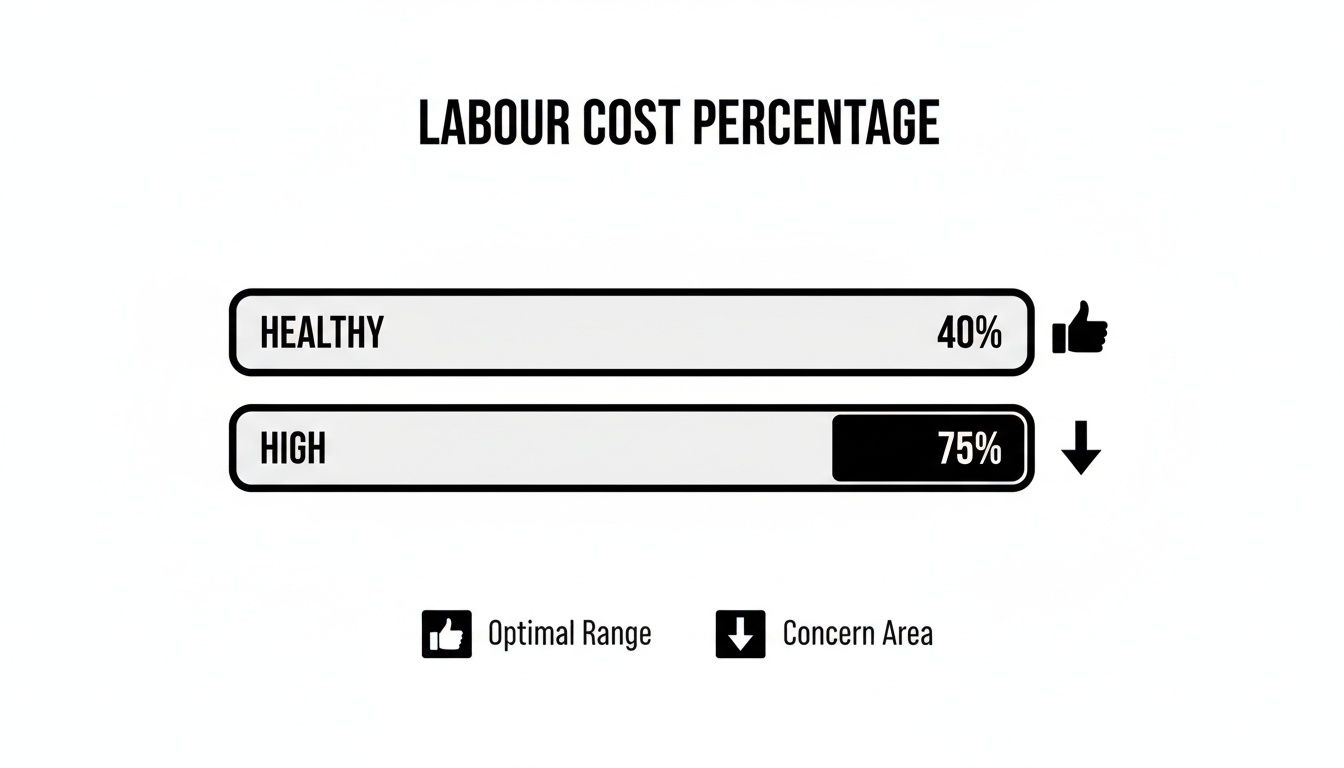
As you can see, the goal is to keep your labour costs in that healthy sweet spot. High percentages are a major red flag for profitability and stability down the road.
Freeing Up Capital for Growth
By effectively removing these indirect labour costs from your payroll, the financial relief is immediate. All that saved capital can be funneled back into what really matters: growing the business.
Instead of paying for support staff, that money can now be used to:
- Hire more revenue-generating employees, like top-tier sales reps or highly skilled agents.
- Invest in marketing and sales campaigns to bring in new customers.
- Boost compensation and benefits for your core team, which helps with retention and morale.
For startups and small businesses where every dollar is critical, this strategic shift is a powerful advantage. If you're serious about scaling efficiently, learning more about the Seat Leasing BPO model is a smart next move. It strips away the most complex and unpredictable variables, making your labour cost management infinitely simpler.
Your Top Labour Cost Questions, Answered
Even with the right formulas, digging into your labour costs can feel overwhelming. It’s a common experience—once you start tracking the numbers closely, a lot of new questions tend to pop up.
Let's clear up some of the most frequent questions I hear from business owners so you can move forward with total confidence.
What Is a Good Labour Cost Percentage?
For most businesses, a labour cost percentage between 25% and 35% of total revenue is a healthy target. Think of this range as a financial guardrail.
Of course, the "right" number really depends on your industry. A restaurant, for instance, has to account for high food costs, so they often need to keep labour closer to that 25% mark to stay profitable. On the other hand, a service business like a marketing agency, where your people are the product, can comfortably operate closer to 35% or even a little higher.
The key is to figure out what’s sustainable for your specific business. Use the 25-35% range as a starting point, but track your own numbers to find the baseline that works for you.
How Can I Reduce High Labour Costs?
If your labour percentage is climbing higher than you'd like, it's time to focus on efficiency, not just arbitrarily cutting shifts. Slashing hours without a plan can hurt morale and customer service, which only creates bigger problems down the road.
Instead, try these more strategic approaches:
- Fine-Tune Your Schedules: Use your sales data to match staffing to your busiest and slowest times. You want to avoid having idle staff during lulls and being short-handed during a rush.
- Double Down on Training: A well-trained employee works faster, makes fewer costly mistakes, and needs less supervision. Good training is an investment that pays for itself in productivity.
- Automate the Grunt Work: Look for repetitive, time-consuming tasks that software could handle. This frees up your team to focus on work that truly requires their expertise and a human touch.
- Rethink Your Staffing Model: Solutions like seat leasing can significantly lower your indirect labour costs. They bundle overhead expenses—like IT, admin, and facilities—into one predictable fee, stripping out a lot of the financial guesswork.
What Is the Difference Between Direct and Indirect Labour Costs?
Getting this right is crucial for an accurate calculation. The main difference comes down to one simple question: does the employee directly create the product or service you sell?
Direct Labour Costs
These are the costs for employees whose work is directly billable or tied to the creation of your product. They are the people on the front lines, making or delivering what your customers pay for.
- For example: An assembly line worker building a product, a graphic designer creating a logo for a client, or a call center agent actively resolving a customer's issue.
Indirect Labour Costs
This bucket includes everyone who is essential to keeping the business running but isn't directly involved in production. They support the people who do the direct work.
- For example: The HR manager who processes payroll, the janitorial staff who clean the office, or the IT team that keeps your network online.
Distinguishing between these two shows you exactly where your money is going—how much is invested in creating your product versus how much is spent on the infrastructure that supports it.
Managing labour costs effectively is all about having the right data and the right operational model. Seat Leasing BPO offers a streamlined solution that simplifies your labour calculations by minimizing overhead, so you can focus on growing your core business. Learn how our flexible workspace solutions can help you reduce costs and improve efficiency.