It’s easy to get the terms mixed up, but the core difference between outsourcing and offshore comes down to one simple question: are you focused on who does the work, or where they do it?
Outsourcing is about the "who"—handing a task over to a third-party specialist. Offshoring is about the "where"—moving a business function to another country. You can do one without the other, or you can do both at the same time.
Outsourcing vs Offshore Unpacked
People often use these words interchangeably, but in reality, they represent two very different strategic moves. Getting this distinction right is the first step toward building a business that's more efficient and ready to scale.
Outsourcing is simply the act of hiring an outside company to handle specific projects or ongoing business functions. That partner could be right down the street or on the other side of the world. The main reason companies do this is to tap into specialized skills, free up their internal teams, and get rid of operational headaches.
Offshoring, on the other hand, is a purely geographic strategy. It’s all about relocating a part of your business to another country. This can mean hiring a foreign vendor (which is called offshore outsourcing) or setting up your own office abroad (often called a "captive center"). The number one driver for offshoring is almost always a dramatic reduction in costs, especially for labor.
Key Conceptual Differences
Your choice really boils down to your priorities. Are you trying to delegate a task to an expert who can do it better? That's an outsourcing problem. Or are you trying to slash operational costs by moving a whole department to a more affordable location? That's an offshoring goal.
Here’s a practical example. A tech startup might hire a local accounting firm to manage its books and stay compliant with complex tax laws. That’s outsourcing, but it isn’t offshoring.
Now, imagine that same startup decides to build its own customer support team in the Philippines to offer 24/7 coverage at a fraction of the cost. That's a classic case of offshoring. For many small companies, looking into options like outsourced IT for small businesses is a perfect real-world example of using outsourcing to improve security and control costs without needing a huge in-house team.
For a quick reference, here’s how the two concepts stack up.
Outsourcing vs Offshore At a Glance
| Attribute | Outsourcing | Offshoring |
|---|---|---|
| Definition | Delegating business tasks to a third-party company. | Relocating business operations to another country. |
| Primary Goal | Access specialized skills and focus on core functions. | Reduce labor and operational costs. |
| Location | Can be anywhere: local (onshore) or foreign (offshore). | Always in a foreign country. |
| Workforce | Employees of the third-party vendor, not your own. | Can be your own employees or a vendor's employees. |
As you can see, the key difference lies in control and location. With outsourcing, you're paying for a service. With offshoring, you're fundamentally changing where your business operates.
To really get a handle on the difference between outsourcing and offshoring, it helps to understand where these ideas came from. They weren't just invented in a boardroom one day. Instead, they grew out of huge economic and tech shifts in the back half of the 20th century, and their separate origins are key to understanding why they solve different problems.
Outsourcing really started to take shape when companies began to obsess over one simple question: What are we truly good at? The answer led to a focus on core competencies. Everything else—the necessary but non-essential tasks—was now on the table to be delegated. Functions like payroll, IT support, or even the cleaning crew were handed off to specialized third-party firms who could do it better and more efficiently.
This wasn't just about passing off work. It was a savvy financial play. Contracting out these tasks turned fixed costs, like salaries and equipment, into flexible variable expenses. It gave businesses access to top-tier expertise without the heavy price tag and long-term baggage of hiring full-time staff for every single role.
The Rise of Offshoring for Cost Arbitrage
While outsourcing was all about finding specialized help, offshoring was driven by a completely different, and far more powerful, motivator: labor arbitrage. As the world became more connected, companies saw a golden opportunity. Why pay a premium for labor at home when you could move entire operations to countries where costs were dramatically lower? This wasn't about hiring an outside vendor; it was about physically relocating a part of your own company.
At first, it was all about manufacturing. Factories packed up and moved from North America and Europe to Asia. But it didn't take long for services to follow. Call centers, software development teams, and back-office processors began popping up in places like India and the Philippines, where a massive, educated, and English-speaking talent pool was available for a fraction of the price.
A Deloitte report noted that around 70% of companies outsource to cut costs on things like benefits and training, freeing them up to focus on growth. Offshoring, on the other hand, is purely about moving internal operations to a cheaper country. By 2010, some firms were reporting incredible 60-70% reductions in operational costs from offshoring alone, though it came with new headaches like managing across time zones and cultures. For more on these financial strategies, you can see the full analysis at Preferred CFO.
Key Takeaway: Think of it this way: Outsourcing started as a quest for expertise and focus. Offshoring was born from a pure and simple chase for cost savings on a global scale.
From Separate Paths to a Combined Strategy
For a while, these two strategies moved on parallel tracks. A company might outsource its accounting to a local firm down the street while, at the same time, offshoring its manufacturing to a company-owned factory in another country.
But then, things got more interesting. As global business became more tangled and complex, the lines started to blur. Companies realized they could get the best of both worlds by combining the two, which gave rise to the model we now call offshore outsourcing. This hybrid approach is simple: you hire a third-party expert that just so happens to be located in another country.
This combined strategy was a game-changer. Suddenly, you could get the massive cost reductions of offshoring plus the specialized management and expertise of outsourcing. For instance, a US-based tech startup could hire a firm in Eastern Europe to handle all its software testing. This one move leverages the lower wages of the region (offshoring) and the specific testing skills of the vendor (outsourcing). Understanding this evolution is vital, as it shows how modern businesses now have a flexible toolkit to build the exact operational model they need.
Comparing Outsourcing and Offshoring Across Key Criteria

Alright, let's move past the dictionary definitions. To really choose between outsourcing and offshoring, you have to get practical and compare what each model actually means for your day-to-day business. The right decision always comes down to a balancing act between core factors like cost, control, risk, and the kind of talent you need.
When you look at outsourcing versus offshoring through this lens, you realize they don't solve the same problem. One gives you managed expertise wrapped in a service, while the other provides a platform to build your own operation, just somewhere cheaper.
Cost Implications
The financial logic behind each strategy is worlds apart. Both can save you money, but they take completely different routes to get there.
- Outsourcing is all about cost predictability. You hire a vendor for a fixed project fee or a clear, output-based rate. This is great for budgeting because it turns a bundle of operational headaches—salaries, benefits, IT—into a single, predictable expense. No surprises.
- Offshoring, on the other hand, delivers deep labor arbitrage. The main financial win comes from setting up shop in a country where wages are significantly lower. This can lead to massive, sustainable cost reductions, especially if you’re scaling a large team.
For example, outsourcing a software development project might have a clean, flat-rate cost of $50,000. Building your own offshore team to do the same work might slash your annual salary costs by 60%, but you’ll also have to invest upfront in setting up the local office and management.
Operational Control and Ownership
This is where the two models diverge the most. The central question is: how much control do you really need over the people and processes doing the work?
Control is the starkest dividing line. When you outsource, you hand over a process to a third-party vendor. They own the deliverables, and your day-to-day oversight is limited. In contrast, offshoring—especially with a captive center—gives you full control over the infrastructure and staff, making the team a true extension of your company.
According to a Deloitte report, 70% of companies that outsource feel it helps them focus on their core business, as they offload functions like accounting. Offshoring is the opposite play. A giant like Microsoft has maintained 100% control over its India-based centers, where it has employed over 10,000 people since its expansions began in 1998. This ensures total cultural alignment and quality control, which often translates to higher commitment and better output.
The Central Trade-Off: Outsourcing buys you an outcome, managed by someone else. Offshoring buys you capacity, managed directly by you.
This choice has a real impact on your agility. If you need to pivot with an outsourced partner, you're looking at a contract renegotiation. With your own offshore team, you can reassign tasks and shift priorities instantly, just like you would with the team sitting down the hall.
Access to Expertise and Talent
Both models are fantastic for tapping into global talent, but they cater to very different skill requirements.
Outsourcing is perfect for getting specialized, hard-to-find skills on a temporary basis. Think of it as expertise on demand. A company can hire a world-class cybersecurity firm for a one-off audit or a top-tier marketing agency for a specific campaign, all without the long-term commitment of hiring.
Offshoring, in contrast, is about building a dedicated talent pipeline for the long haul. It shines when you need a large, scalable workforce for functions like customer support, data entry, or other back-office processes. You aren't just buying a skill; you're building a team from the ground up in a new labor market.
Communication and Cultural Alignment
Geography and ownership change the entire communication dynamic. An outsourced relationship is fundamentally a vendor-client conversation, while an offshore one is an employer-employee relationship.
- Outsourcing Communication: Interactions are usually formal, structured, and focused on results. You're talking about project milestones, deadlines, and service-level agreements (SLAs), not micromanaging the daily workflow.
- Offshoring Communication: Here, you have to actively integrate a remote team into your company culture. This means daily stand-ups, direct collaboration tools, and team-building events are critical for making everyone feel like part of one cohesive unit.
A company that offshores its support team has to do the heavy lifting of bridging cultural and time zone gaps. When you outsource, that responsibility shifts to the vendor, who is contractually on the hook to meet your performance standards.
Risk Management and Security
Finally, each approach comes with its own unique risk profile, especially when it comes to your intellectual property (IP) and data security.
With outsourcing, you're handing sensitive data to an external partner. The biggest risk is a data breach on their end or their failure to comply with regulations. You manage this through ironclad contracts, NDAs, and rigorous vendor background checks.
When you offshore to your own captive team, your IP and data stay within your company's control, just in a different country. The risk shifts to your own shoulders—you have to ensure your international IT infrastructure is secure and compliant with all relevant laws, both local and international.
For companies that want the control of offshoring without the headache of building it all from scratch, managed infrastructure solutions are a game-changer. You can check out our breakdown of seat leasing inclusions to see how a managed IT and security setup can seriously de-risk an offshore operation.
Exploring the Global Sourcing Spectrum
When people talk about the difference between outsourcing and offshore, they’re often missing the bigger picture. The conversation usually gets stuck on a simple either/or comparison, but modern businesses have a much wider and more interesting range of options to work with.
It's not just about who does the work versus where they do it. The real strategic question is about finding the perfect mix of cost, control, collaboration, and talent for your specific needs. A sourcing strategy that’s a game-changer for a massive corporation could be a total disaster for a fast-moving startup.
To make a smart decision, you have to understand the whole playing field—from keeping work local to building your own team on the other side of the world.
Breaking Down the Four Core Sourcing Models
Each approach to sourcing comes with its own set of trade-offs. Let's walk through the main models and see where each one really shines.
Onshore Outsourcing: Think of this as hiring an expert in your own backyard. You’re delegating work to a third-party company located in the same country. You get access to specialized skills and avoid the headache of managing a new department, all without crossing time zones or cultural divides.
- Real-World Example: A US-based fintech company needs to lock down its data security. Instead of building an internal team from scratch, it hires a local cybersecurity firm. This is perfect because the vendor already has an expert-level understanding of domestic regulations like SOX, a huge advantage over an overseas partner.
Nearshore Outsourcing: This is where you outsource to a company in a neighboring country, usually one that shares a similar time zone. For businesses in the US, that often means working with partners in Canada, Mexico, or other parts of Latin America.
- Real-World Example: Imagine a California software company needing to scale its customer support. By partnering with a team in Guadalajara, Mexico, they get the talent they need with minimal time difference. This allows their support and engineering teams to collaborate in real-time, crushing complex technical bugs much faster.
Offshore Outsourcing: This is the classic model most people picture when they hear "outsourcing." It means you're hiring a third-party vendor in a distant country—think the Philippines or India—primarily to capitalize on significant labor cost advantages.
- Real-World Example: A growing European e-commerce brand wants to offer 24/7 customer support but can't afford the local cost. They hire a BPO in the Philippines to manage customer service and back-office tasks around the clock. The cost savings make a 24/7 operation financially possible.
The In-House Alternative: Captive Centers
What if you want the cost benefits of going global but aren't comfortable handing over the reins to a third party? There's a powerful model for that, too.
A captive center is a wholly-owned subsidiary you set up in another country. You aren't hiring a vendor; you're building your own office and hiring your own employees, just in a different location. It’s a strategy that blends the cost savings of offshoring with the complete control of keeping things in-house.
Key Distinction: A captive center is your company, your people, and your culture—just located offshore. It’s the go-to choice for large-scale operations where process control, data security, and brand identity are absolutely non-negotiable.
For example, a major global bank might establish a captive center in India to handle complex financial modeling. This gives them direct access to a huge pool of skilled analysts while ensuring all their proprietary algorithms and sensitive client data remain securely under their own roof. It’s a serious investment, but it offers a level of control and scale that outsourcing just can't match.
By understanding this full spectrum, you can move beyond a simple "either/or" debate. The smartest companies often use a hybrid approach, picking the right model for the right job to build a truly optimized global operation.
A Decision Framework for Choosing Your Model
Deciding between all the different global sourcing models can feel like you're staring at a map without a compass. The real difference between outsourcing and offshore isn't just about who does the work versus where they do it. It's about finding the perfect match for your company's goals, budget, and the way you actually operate.
There’s no magic bullet here. The "best" model doesn't exist—only the one that’s right for your business right now. To find it, you need a clear way to think through the problem. By asking a few tough questions, you can filter out the noise and pinpoint the approach that gives you the biggest strategic advantage. Think of this less as a test and more as a practical roadmap.
Key Questions to Guide Your Strategy
Start by taking a hard look at your business needs across five critical areas. Your answers will naturally point you toward the most logical and effective sourcing model.
Core Function vs. Support Task?
Is this work a part of your secret sauce—the thing that makes your company special? If it’s your proprietary code or a high-level business strategy, you’ll want to keep it close to home. But if it's a necessary task that supports the main event, like data entry or routine customer service, it becomes a perfect candidate to hand off.How Critical Is Direct Control?
Be honest: do you need to micromanage the daily workflow? If your processes are constantly changing or demand moment-to-moment oversight, a model that gives you more direct control, like a captive offshore team, is probably the better bet. On the other hand, if you care more about the final result and would rather let an expert handle the "how," traditional outsourcing will serve you well.What Is Your Budget and Risk Tolerance?
Let's talk about money. A startup running on fumes will get more mileage from the predictable, low-investment model of project-based outsourcing. A larger, more established company might have the capital to build its own captive offshore center, unlocking deeper, long-term cost savings.How Important Is Real-Time Collaboration?
Do your teams absolutely need to talk back and forth throughout the workday? If the answer is yes, then time zone alignment becomes a deal-breaker. This immediately makes onshore or nearshore models far more practical than offshoring to a country with a 12-hour time difference.Is Your Primary Goal Cost Reduction or Access to Skills?
While you often get both, you have to know what your top priority is. If cutting labor costs is the number one objective, nothing beats offshoring. But if you’re chasing specialized expertise that you can’t find or afford in your local market, outsourcing to a best-in-class provider is the smarter move.
Situational Recommendations
Let's see how this framework plays out in the real world. Once you’ve answered those questions, certain models become the obvious choice for different types of businesses.
Scenario 1: The Lean Startup
A new tech startup needs a professional marketing campaign but is working with a shoestring budget and has no marketing experts on the payroll.
- Recommendation: Onshore or Nearshore Outsourcing.
- Why: This lets them tap into a specialized agency for a fixed project cost, completely sidestepping the huge overhead of a full-time team. Keeping it onshore or nearshore also makes it much easier to collaborate closely on brand messaging, which is critical in the early days.
Scenario 2: The Scaling SMB
An e-commerce business is taking off, but its customer support team is getting swamped. They need to expand to 24/7 coverage without blowing up their budget.
- Recommendation: Offshore Outsourcing.
- Why: Partnering with a BPO in a hub like the Philippines is a proven, cost-effective way to scale support and offer round-the-clock service. The BPO partner takes care of all the hiring, training, and management headaches. To get a better handle on this, learning about the mechanics of contact center outsourcing can offer some really practical insights.
Key Insight: Your business model dictates your sourcing strategy. A startup prioritizes flexibility and expertise on demand, while a scaling business focuses on repeatable, cost-effective processes.
Scenario 3: The Enterprise Corporation
A large financial institution needs to process massive volumes of highly sensitive data. For them, security, process control, and a large, dedicated workforce are non-negotiable.
- Recommendation: Captive Offshore Center.
- Why: Building their own facility offshore means all proprietary data and internal processes stay in-house, which virtually eliminates third-party risk. It’s the ultimate combination: you get the huge labor cost savings of offshoring and maintain complete control over your operations.
By working through these questions and seeing how they apply to real-world scenarios, you can build a strategy that truly supports your long-term vision. For more practical tips on business strategy, feel free to explore our other articles on the Seat Leasing BPO blog.
The Seat Leasing Model: A Modern Hybrid Solution
The discussion around outsourcing versus offshoring often forces a difficult choice: save money or maintain control. For years, businesses thought they had to pick one. But what if you didn't have to? A flexible, modern approach called seat leasing has gained traction by offering a practical middle ground.
Seat leasing is essentially a "workspace-as-a-service" model. It allows you to build your own dedicated team in an offshore location but without the colossal capital expense and administrative headaches. It’s a smart hybrid, borrowing the cost efficiency of offshoring and the operational ease of outsourcing.
Achieving Control Without The Capital Burn
Imagine having your own private, branded office, but it's located inside a fully managed, state-of-the-art facility. Instead of sinking months and a huge budget into real estate, legal setup, and IT infrastructure, you simply lease the "seats" you need in a ready-to-go workspace. This gives you the direct oversight of a captive center with the speed and lean cost structure of an outsourced partnership.
This model is perfect for companies that want full control over their own offshore team but want to sidestep the risks and high costs of establishing a foreign entity. The seat leasing provider takes care of all the background logistics.
- IT and Infrastructure: Your team gets fully equipped workstations, high-speed, redundant internet, and reliable backup power.
- Administrative and Facility Support: The provider handles building maintenance, physical security, and daily operational tasks.
- Rapid Deployment: You can have a team on the ground and productive in weeks, not the typical six to twelve months.
The real value is getting to focus 100% on your people and their performance. You manage the team, the work, and the culture; the provider handles the rest. It’s the control of a captive center for a predictable, operational cost.
This decision tree can help you visualize where different sourcing models land on the spectrum of control versus operational focus.
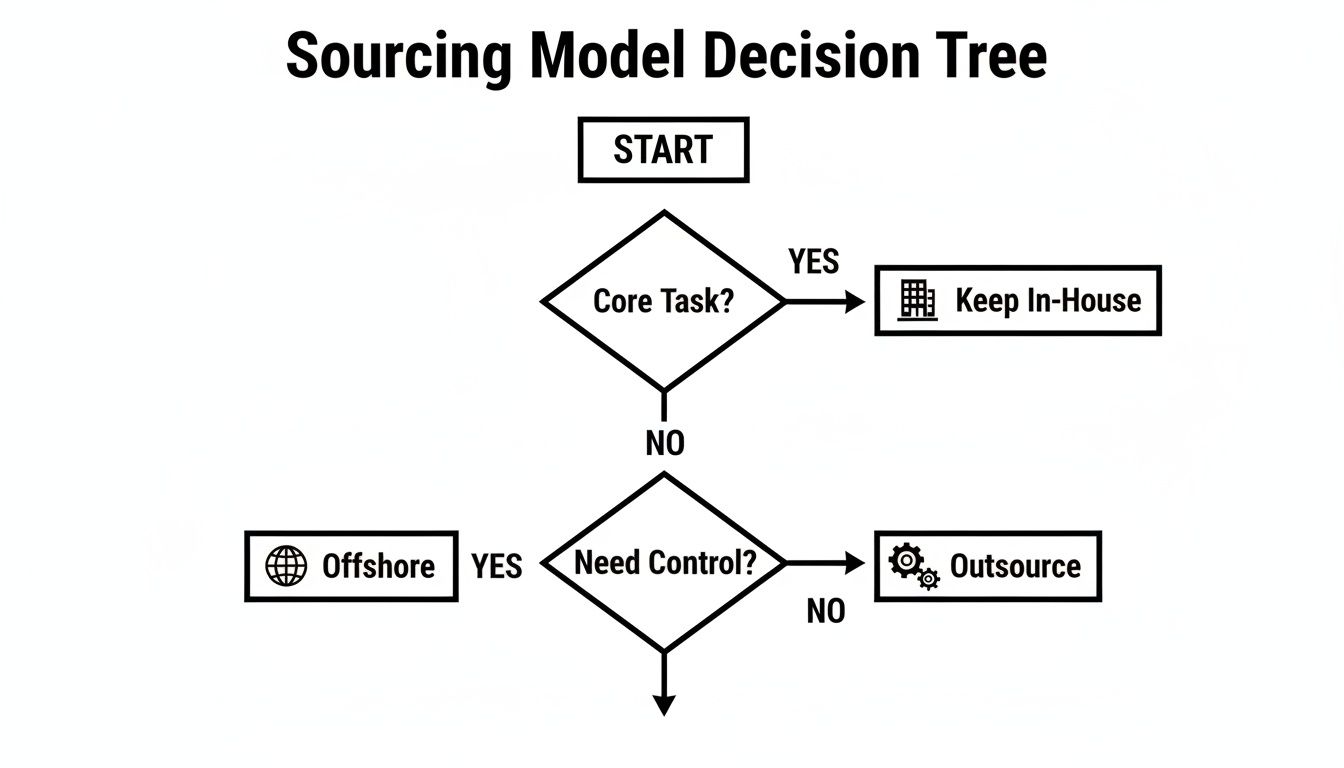
As the flowchart shows, when a task isn't core to your business and direct control isn't a priority, outsourcing makes sense. But if having that control is non-negotiable, an offshore model is the clear winner. Seat leasing makes that offshore path far more accessible.
The Ideal Balance For Modern Business
The seat leasing model has been a game-changer for small and medium-sized businesses (SMBs) and startups. These companies absolutely need the labor cost advantages of offshoring to stay competitive, but they rarely have the millions in capital or the internal resources to build an office from scratch overseas.
A great example is a growing tech startup that needs to scale its software development. Using seat leasing, they can hire their own full-time developers in a location like the Philippines. They manage them directly, integrating them into their existing sprints and company culture, and retaining full control over their intellectual property. The seat leasing partner simply provides the office, the hardware, and the support staff that keep the lights on.
This approach often slashes operational costs by 70-80% compared to setting up a traditional office in a Western country. It turns a massive capital expenditure (CAPEX) into a simple, predictable operating expense (OPEX).
To see how this creates a complete, turnkey operational environment, you can explore the benefits of seat leasing and understand how it helps businesses scale smartly. It’s a forward-thinking strategy that makes offshoring practical, manageable, and incredibly effective for companies of any size.
Frequently Asked Questions
Even after you've weighed the pros and cons, a few questions are bound to pop up. It's completely normal. Let's dig into some of the most common ones we hear from businesses trying to decide between outsourcing and offshoring.
Can a Small Business Truly Benefit from Offshoring?
It’s a common misconception that offshoring is a strategy just for large corporations. Thanks to modern BPO partners, it’s more accessible than ever for small and medium-sized businesses (SMBs). You don't have to build a giant "captive center" from scratch.
The smart way to start is by offloading specific, high-volume tasks—think data entry, tier-1 customer support, or even social media management. An SMB can start with a dedicated team of just a few people through a provider, getting a major win on labor costs without a massive upfront investment. That freed-up cash can then be poured right back into sales or product development.
What Is the Biggest Hidden Cost of Outsourcing?
Hands down, the most overlooked cost is vendor management. The sticker price or hourly rate is just one piece of the puzzle. You also have to account for the time and energy your own team will spend finding the right partner, handling contracts, and managing that ongoing relationship.
If you choose a partner based on the lowest bid and their performance falters, your managers can easily spend more time fixing mistakes and chasing deliverables than doing their own jobs. Suddenly, those "cost savings" vanish.
Key Insight: The success of outsourcing hinges on the quality of your vendor partnership. A slightly more expensive but reliable partner is almost always cheaper in the long run than a low-cost provider who requires constant oversight.
How Do I Maintain Company Culture with an Offshore Team?
Building a unified culture across continents takes real, intentional effort—it won’t just happen on its own. The goal is integration, not isolation.
- Treat them like your own: Include your offshore staff in all-hands meetings, virtual coffee breaks, and team celebrations via video. Don't let them become an afterthought.
- Communicate constantly: Use tools like Slack for more than just project updates. Create channels for casual chatter and daily check-ins to build rapport.
- Unify around a mission: Make sure everyone, no matter their location, understands the company's vision and sees exactly how their work pushes it forward.
- Force collaboration: Design projects that require your local and offshore teams to work together. Shared challenges build the strongest bonds.
What Is the First Step to Starting an Outsourcing Partnership?
Before you even think about researching vendors, your very first step is to clearly define the function you want to outsource. Seriously, get granular.
Create a detailed document that spells out the exact tasks, workflows, key performance indicators (KPIs), and what success looks like. You can't find the right partner if you can't give them a precise blueprint of what you need. This document becomes the bedrock for your request for proposals (RFPs) and the final service level agreement (SLA). So many partnerships fail simply because this crucial groundwork was skipped.
Ready to explore a more flexible and cost-effective way to build your team? Seat Leasing BPO offers a modern hybrid solution that gives you the control of an in-house team with the cost benefits of offshoring. Learn more at https://seatleasingbpo.com.