When you hear "business outsourcing in the Philippines," your mind might jump to cost savings. And you're not wrong—companies regularly see operational costs drop by up to 70%. But that's just the beginning of the story. The real value lies in using the Philippines as a launchpad for strategic growth, tapping into world-class talent to do more than just save money.
Your Strategic Gateway to Global Growth

Think about it this way: you wouldn't try to build a skyscraper all by yourself. You'd bring in expert architects, engineers, and a skilled construction crew to turn your vision into reality. That's exactly what outsourcing to the Philippines offers—a way to bring in dedicated experts who can build and scale your operations while you focus on the big picture.
This guide is your blueprint for doing just that. We'll cut through the noise and show you why everyone from hungry startups to Fortune 500 giants are building teams in the Philippines. It’s a journey that goes far beyond basic call centers and into high-value, integrated business functions.
Unlocking a World of Opportunity
The outsourcing landscape here has matured dramatically. It's no longer about just delegating simple tasks. Today, it’s about building dedicated, high-performing remote teams that become a genuine extension of your company—driven by the country’s unique blend of professional talent and a service-first mindset.
One of the biggest game-changers has been the rise of flexible solutions like seat leasing. This model gives you incredible agility, letting you scale a team almost overnight without the headaches and massive capital investment of setting up a traditional office. It’s essentially a "plug-and-play" approach to global expansion.
We’re going to unpack the real reasons behind the Philippines’ success and give you a practical playbook for building your own global team. To get there, you need to understand:
- The Talent Ecosystem: It’s more than just excellent English. It's about a highly educated workforce with a deep-seated cultural emphasis on service and professionalism.
- Operational Models: From full-service BPO partnerships to flexible seat leasing that puts you squarely in the driver's seat.
- Strategic Functions: We're moving past admin work. Think finance, IT development, digital marketing, and even creative services.
The core idea is simple: You hand off essential but non-core functions to a dedicated team of experts. This frees up your key people at home to focus on innovation, strategy, and the critical work of growing your business. It's not just delegation; it's strategic leverage.
To get a head start on what this looks like in practice, this detailed Founder's Playbook for Hiring a Virtual Assistant in the Philippines is a great resource for building and scaling your initial team. And for more expert tips on this journey, feel free to explore other articles right here on our https://seatleasingbpo.com/blog/.
Why the Philippine BPO Market Is on Fire
The rise of the Philippines as a global BPO powerhouse is no accident. It’s the result of decades of deliberate effort, transforming the nation into a stable, world-class hub for international businesses. This isn't just about impressive growth charts; it’s a story of a country that has systematically built an ecosystem that global companies can count on.
Think of it like building a solid foundation for a skyscraper. You don't just pour concrete and hope for the best. You need meticulous planning, the right materials (a deep talent pool), solid engineering (government support), and the right infrastructure. The Philippines has put all these pieces in place, creating an environment where businesses can build and scale with confidence.
The Numbers Tell the Story
The sheer scale and momentum of the Philippine BPO industry are staggering. It's become a critical pillar of the national economy, consistently outpacing global averages and providing a secure, thriving environment for any company’s outsourced teams.
The growth trajectory alone speaks volumes about global trust in business outsourcing in the philippines. The industry's revenue jumped from $26.7 billion in 2020 to $32.5 billion in 2022, and then accelerated to $38 billion in 2024. That's not just growth; that's compounding momentum.
The Philippine BPO market was valued at USD 41.0 billion in 2025 and is projected to hit USD 83.34 billion by 2034, growing at a steady clip of 8.2% annually.
Let's put that into perspective. In 2024, the sector expanded by a remarkable 7%. That's double the global average of just 3.5%. This isn't a small lead; it's a clear signal of the Philippines' powerful competitive edge. You can dig deeper into this trend by exploring more detailed market analysis.
The Pillars of This Explosive Growth
So, what’s the fuel behind this fire? It’s not one single thing but a powerful combination of strategic advantages that have been nurtured over many years.
- Rock-Solid Government and Industry Partnership: The Philippine government, through agencies like the Board of Investments, has been a key player. They don't just sit on the sidelines; they actively promote the BPO sector with incentives, ensure a favorable business climate, and work hand-in-glove with industry groups to uphold world-class standards.
- Serious Infrastructure Investment: We're talking about massive investments in fiber optic networks, modern and secure business parks, and a reliable power grid. This has created an operational backbone that ensures BPO providers can deliver the seamless, 24/7 service their global clients demand.
- A Deeply Ingrained Culture of Service: Beyond the policies and the hardware, there's a powerful cultural element at play. The Filipino workforce is celebrated for its strong work ethic, impressive adaptability, and a genuine drive to deliver high-quality work. It’s a culture built on hospitality and service excellence.
This trifecta of support, infrastructure, and culture explains why the Philippines has graduated from being just another outsourcing option to a premier, go-to destination. Businesses come here not just to cut costs, but to scale their operations, tap into incredible talent, and build a foundation for real, long-term growth. The market's explosive expansion is a direct reflection of the incredible value it consistently delivers.
Why Companies Are Going All-In on the Philippines

So, what’s the real reason business outsourcing in the philippines has become such a dominant global strategy? It’s not just one thing. It's the powerful convergence of cost, talent, and operational agility that creates an environment where businesses don't just save money—they build a powerful engine for growth.
Sure, the conversation almost always starts with cost. And for good reason. It’s not uncommon for a company to slash its operational expenses by up to 70% compared to what they’d spend back home. But this isn't just about paying less for salaries. It’s about offloading the crushing weight of overhead that suffocates so many businesses.
Think about it. Building a team in-house means you’re on the hook for everything: recruiting, leasing office space, buying equipment, managing payroll, and handling the day-to-day admin. By partnering with an outsourcing provider, you sidestep all of that. It’s the difference between building your own factory from the ground up and plugging into a state-of-the-art facility that’s already humming with activity.
Massive Cost Efficiency and Reduced Overhead
The financial relief comes from turning a huge, unpredictable capital expense into a simple, predictable operational cost. Instead of burning through cash to set up a new office, you can funnel that money directly into what grows your business—like product development, sales, and marketing.
Your outsourcing partner handles the entire back-end infrastructure. This gives you incredible clarity and control over your budget. You get a clear, all-in cost per employee that covers everything, making financial forecasting a whole lot easier.
You’re not just hiring staff; you’re acquiring an entire operational ecosystem. The real savings come from this bundled efficiency, which liberates capital you can then reinvest in strategic growth instead of tying it up in administration.
Access to a World-Class Talent Pool
But the story doesn't end with cost. The reason companies stay—and scale—in the Philippines is the people. The country has spent decades cultivating an incredible pool of highly educated, motivated, and skilled professionals who are tailor-made for the global business world.
This goes well beyond simple English proficiency. The Filipino workforce is known for its deep cultural affinity with the West, a natural service-oriented mindset, and a work ethic that is second to none. This makes for a team that doesn't just follow instructions but actively contributes to your success.
Need to grow your customer service team from five people to fifty in a month for a new product launch? In most places, that’s a logistical nightmare. In the Philippines, it’s just another Tuesday. The sheer depth of the talent pool makes rapid scaling a reality.
The numbers back this up. The BPO industry already employed 1.57 million people in 2022 after adding 121,000 new jobs that year alone. With projections aiming for nearly 1.97 million professionals by 2026 and an ambitious goal of 3 million by 2028, you're tapping into a sustainable and growing talent pipeline. You can dive into more statistics on the Philippine BPO workforce to grasp the true scale of this incredible resource.
The Follow-the-Sun Operational Advantage
Then there's the operational magic of the time zone. What looks like a challenge on paper is, in practice, a massive strategic weapon. The 12-hour time difference from the U.S. allows you to build a "follow-the-sun" model that creates a nonstop, 24/7 business cycle.
Here's how it plays out in the real world:
- Round-the-Clock Support: Your team in the Philippines is online and handling customer tickets while your home office sleeps. Customers get help instantly, at any time of day, which transforms their experience.
- Overnight Productivity: Your U.S. or European team ends their day by assigning tasks. They wake up the next morning to find the work completed, reviewed, and waiting for them. This literally doubles your company's daily output.
- Continuous Business Operations: For critical functions like server monitoring, data entry, or content moderation, you can achieve true 24/7 coverage with no gaps. Your business is always on, always productive, and always serving customers.
Managed correctly, this 24-hour cycle turns a logistical detail into a core competitive advantage, creating a seamless global operation that never stops working for you.
What Services You Can Outsource to the Philippines
First things first: let's get rid of the old idea that outsourcing to the Philippines is just about call centers. That's a picture from 20 years ago. Today, the range of available services is less like a single-item menu and more like an extensive catalog covering nearly every department in a modern business.
The country has matured into a global hub for complex, high-value work. This shift means you can now hand off a huge variety of tasks, freeing your core team from operational drag so they can focus on what truly drives growth.
Let's break down the most common services businesses are successfully outsourcing.
Popular Outsourced Services in the Philippines
The breadth of talent is impressive, covering everything from routine administrative tasks to highly specialized professional roles. This table gives you a snapshot of what’s possible.
| Service Category | Specific Functions | Typical Business Need |
|---|---|---|
| Customer & Technical Support | Phone, Email, Live Chat, Social Media Support, Help Desk | Providing 24/7 customer service and resolving technical issues without hiring in-house around the clock. |
| IT & Development | Web/App Development, QA Testing, Cloud Management, Cybersecurity | Accessing specialized tech skills for projects or ongoing maintenance without the high cost of local developers. |
| Finance & Accounting | Bookkeeping, Payroll, Accounts Payable/Receivable, Financial Reporting | Managing daily financial operations accurately and efficiently, improving cash flow and compliance. |
| Digital Marketing | SEO, PPC Management, Social Media Marketing, Content Creation | Building an online presence and running marketing campaigns with a dedicated team of digital experts. |
| Creative Services | Graphic Design, Video Editing, Copywriting, UI/UX Design | Producing professional marketing assets and creative content consistently and affordably. |
| Data & Administrative | Data Entry, Transcription, Research, Virtual Assistance | Handling time-consuming back-office tasks to improve overall operational efficiency. |
As you can see, the question isn't "what can I outsource?" but rather "what shouldn't I outsource?" The possibilities extend far beyond this list, but these categories represent the most popular and impactful starting points for most companies.
IT and Development Services
Information technology is a huge piece of the outsourcing puzzle. In fact, recent data shows IT services represent the most outsourced function at 54%, as businesses look to tap into top-tier tech talent without the staggering costs of hiring locally. This goes way beyond a simple "help desk."
You can build entire teams for core functions like software development, information security, and network administration. Read more about these outsourcing trends and statistics on kdci.co.
Instead of just general IT support, you can hire for highly specialized roles:
- Cloud Infrastructure Management: Experts who live and breathe AWS, Azure, or Google Cloud.
- Cybersecurity Analysis: Professionals dedicated to hunting for threats and protecting your data.
- Quality Assurance (QA) Testing: Meticulous testers who find bugs before your customers do.
- Web and App Development: Skilled developers to build, maintain, and scale your digital platforms.
Finance and Accounting Support
Finance and accounting is the second-largest category, and for good reason. It’s about more than just data entry; you can build an entire remote finance department to handle critical back-office functions with incredible precision.
Think of it as gaining a world-class finance team without the world-class price tag. Your Philippine team can manage day-to-day financial operations, freeing your domestic finance leaders to focus on high-level strategy and investment decisions.
Popular outsourced finance roles include:
- Bookkeeping and Payroll: Keeping your books clean and ensuring everyone gets paid on time, every time.
- Accounts Payable and Receivable: Managing cash flow by staying on top of invoices and collections.
- Financial Reporting: Preparing the statements you need to make smart, data-driven decisions.
For businesses needing deeper strategic insights, you can even Hire Financial Analysts to support financial planning and modeling.
Customer and Technical Support
This is the classic BPO service, but it has evolved dramatically. Today’s customer experience (CX) teams are savvy, multi-channel specialists who provide support across phone, email, live chat, and social media. They become true brand ambassadors trained to solve problems and build real customer loyalty.
A well-run outsourced team can offer 24/7 coverage, meaning your customers always have a human to connect with. To see how this comes together, it’s worth looking into the inclusions of a full-service outsourcing partner to understand what a seamless setup looks like.
Knowledge Process Outsourcing (KPO)
This is where the real magic happens. KPO involves work that requires advanced degrees, specialized knowledge, and sharp analytical skills. It’s the clearest signal that outsourcing has shifted from a cost-cutting play to a strategic talent advantage.
These aren't just administrative tasks; they are brain-powered functions that directly create value for your company.
Common KPO Services Include:
- Creative Services: Graphic designers, video editors, and content writers who can become your outsourced creative agency.
- Digital Marketing: SEO specialists, social media managers, and paid ad experts to run your entire growth engine.
- Data Analytics: Data scientists who can dive into your numbers and surface the insights you've been missing.
- Research and Analysis: Teams dedicated to market research, competitor analysis, and even product development support.
When you tap into these advanced KPO services, you’re no longer just saving money. You’re actively getting smarter and more competitive.
Navigating Local Labor Laws and Compliance
Diving into a new country to set up operations can feel overwhelming, especially when you hit the wall of local regulations. When it comes to business outsourcing in the philippines, the legal side has its own unique quirks, but they’re not as complicated as they first appear. Once you understand the landscape, you can navigate it with confidence.
Right off the bat, you have a fundamental choice to make about your operational structure. You could go through the lengthy and expensive process of establishing your own legal entity in the Philippines, which involves significant capital and a ton of red tape. Or, you could do what most savvy companies do: partner with a local expert who handles all of this for you. For most businesses, the second path is a no-brainer.
Think of it this way: partnering with a BPO provider or an Employer of Record (EOR) is like taking the express lane. They act as the official, legal employer for your team, which means all the payroll, HR, and compliance headaches land on their desk, not yours. You get to focus on what actually matters—managing your team and hitting your targets.
Key Mandatory Employee Benefits
One thing you absolutely must get right is employee benefits. The Philippines has a very pro-employee labor code, and a number of benefits are not just expected, but legally required. Any good partner will manage these for you, but as a leader, you should know what they are.
- 13th-Month Pay: This is a standard, legally required annual bonus. It’s equal to one month of an employee's basic salary and must be paid out by December 24th. It's a core part of the compensation package here.
- Social Security System (SSS): Just like social security programs in other countries, this is a shared contribution between you and your employee. It covers retirement, sickness, disability, maternity leave, and death benefits.
- Philippine Health Insurance Corporation (PhilHealth): This is the country's national health insurance. Both employer and employee contribute to the fund, which provides coverage for medical care and hospitalization.
- Home Development Mutual Fund (Pag-IBIG Fund): A national savings program, this fund primarily helps employees secure affordable housing loans. It's another mandatory, shared contribution.
Getting these wrong isn't an option. Failing to comply can result in serious legal trouble and heavy financial penalties. This is exactly why working with an established local provider isn't just about convenience—it's a critical strategy for managing your risk.
The Role of Your Outsourcing Partner
Your BPO or EOR partner is essentially your compliance shield. They absorb the full complexity of Philippine labor law so you don't have to become an expert overnight. Their job is to make sure every government contribution is calculated correctly and paid on time, that payroll is processed flawlessly, and that your operation stays 100% compliant.
This partnership lets you sidestep the steep learning curve and the costly mistakes that can come from navigating a foreign legal system. For instance, they'll handle all the specific rules around paid leave, holiday pay calculations, and proper termination processes—all areas that can easily trip up a foreign company. By delegating these responsibilities, you get all the upside of a global team without the administrative drag, ensuring your expansion is both safe and smooth.
The Seat Leasing Advantage: A Smarter Way to Start
If you're looking to build a team in the Philippines, the traditional path can feel overwhelming. You picture your team working productively, but the reality of setting up a physical office—finding real estate, signing long-term leases, overseeing construction, and buying equipment—can be a huge drain on time and money. It's like being told you need to build an entire airport just to land a single plane.
There’s a much more agile and efficient way to get started. It’s called seat leasing, and for many businesses, it’s a game-changer for launching their business outsourcing in the philippines.
Think of it as the ultimate "office-in-a-box" solution. Instead of building everything from scratch, you rent a fully-equipped workstation in a professional, managed office on a simple per-seat, per-month basis. This plug-and-play approach means you can get your team up and running in a matter of weeks, not months.
What’s Included in a Seat Leasing Package?
The real beauty of seat leasing lies in its all-inclusive simplicity. You're not just renting a desk and a chair; you're getting access to a complete operational infrastructure. This lets you skip the logistical headaches and focus on what truly matters: managing your team and growing your business.
A standard seat leasing package bundles all the essentials into one predictable monthly cost:
- Fully-Equipped Workstations: Each team member gets a modern desk, an ergonomic chair, and a business-grade computer ready to go.
- High-Speed, Redundant Internet: You get access to enterprise-level fiber internet with built-in backup connections, ensuring downtime is never an issue.
- 24/7 IT Support: On-site IT professionals are on call around the clock to handle everything from software glitches to network support.
- Secure, Professional Office Space: Your team works in a modern, secure facility with badge access, CCTV, and on-site security guards.
- Utilities and Maintenance: All costs for electricity, water, air conditioning, and building upkeep are covered. No surprise bills.
- Shared Amenities: Staff get to enjoy shared spaces like conference rooms, training areas, pantries, and lounges.
This model effectively transforms a massive upfront capital expense into a simple, predictable operating expense. You receive one monthly invoice that covers your entire physical and IT infrastructure, giving you total control and clarity over your budget.
The Financial Power of Seat Leasing
The cost savings aren't just a talking point—they are substantial and immediate. To set up a traditional office for a small team of 10 people, you'd have to pour significant cash into security deposits, renovations, furniture, and IT hardware. This can easily cost tens of thousands of dollars before a single employee is even hired.
Seat leasing eliminates nearly all of this initial cash outlay. You bypass the restrictive long-term leases and the financial risks that come with them. Let’s look at a quick comparison to see just how stark the difference is.
Cost Savings Scenario: Traditional Office vs. Seat Leasing
Here’s a hypothetical breakdown of the costs for a 10-person team over a 12-month period. This illustrates just how quickly the savings from seat leasing add up.
| Expense Item | Traditional Office Lease (Annual Cost) | Seat Leasing (Annual Cost) | Annual Savings |
|---|---|---|---|
| Office Rent & Deposits | $25,000 | $0 | $25,000 |
| Office Fit-Out & Furniture | $15,000 | $0 | $15,000 |
| IT Equipment & Setup | $12,000 | $0 | $12,000 |
| Utilities & Internet | $7,200 | Included | $7,200 |
| IT & Admin Staff | $30,000 | Included | $30,000 |
| Seat Lease Fees | $0 | $36,000 | -$36,000 |
| Total Annual Cost | $89,200 | $36,000 | $53,200 |
As you can see, the numbers speak for themselves. By opting for seat leasing, a business can save over $53,000 in the first year alone on a small team—a cost reduction of nearly 60%. That's capital you can pour back into what matters: hiring more people, boosting marketing efforts, or accelerating product development. You can learn more about how this model provides flexibility and affordability by visiting our homepage at Seat Leasing BPO.
Of course, setting up your team is about more than just physical space. You also have to navigate local labor laws and payroll. This is where having a knowledgeable partner is crucial.
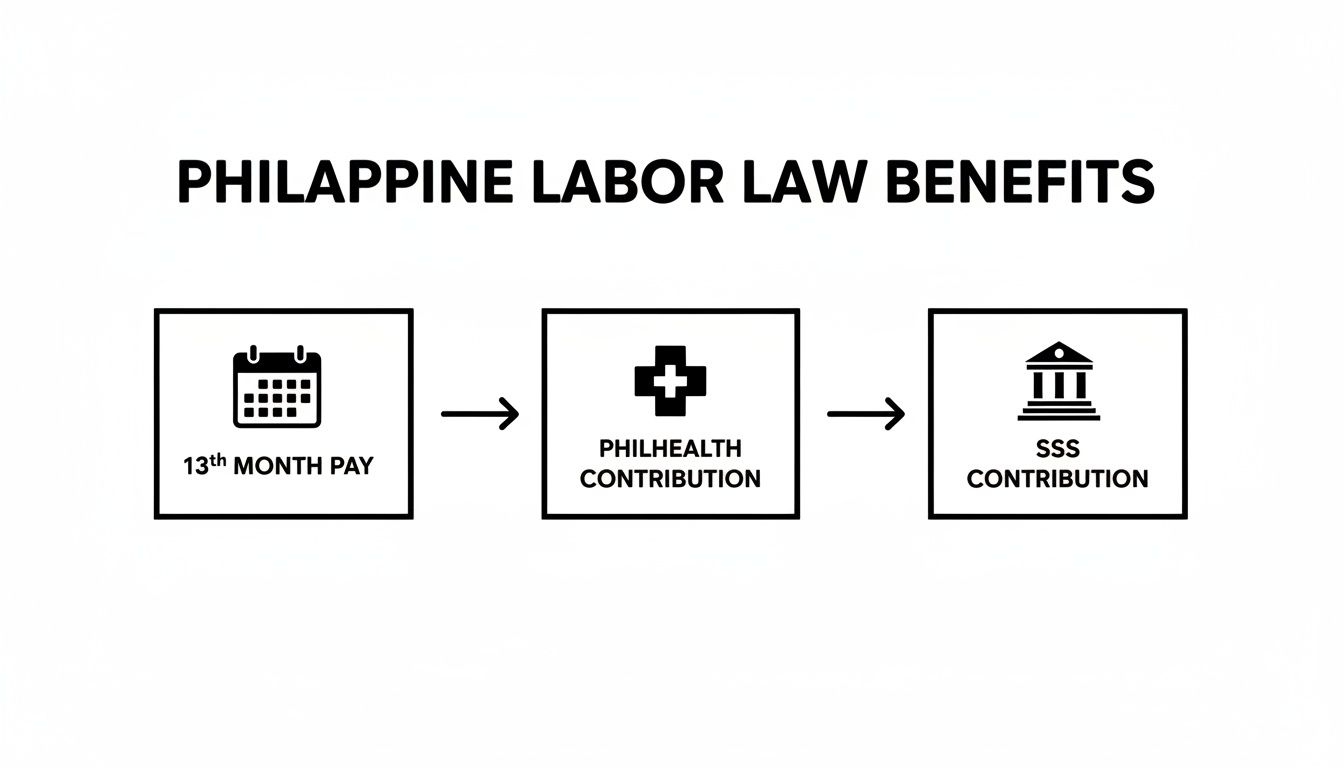
The image above highlights some of the mandatory employee benefits—like 13th Month Pay, PhilHealth, and SSS contributions—that are a core part of Philippine labor compliance. A good seat leasing partner doesn't just provide a desk; they often help you navigate these complexities as well.
Answering Your Questions About Outsourcing to the Philippines
Even after seeing all the benefits, it's completely normal to have a few nagging questions before you jump in. In fact, it's smart to be skeptical. Taking your business global is a big move.
Let's tackle the big three concerns I hear most often from business leaders who are considering the Philippines for the first time. Think of this as the final conversation to clear up any lingering doubts so you can move forward with total confidence.
How Can I Ensure Data Security with an Offshore Team?
This is, without a doubt, the number one question—and it should be. The good news is that any BPO partner worth their salt is obsessed with security. They're not just renting office space; they're operating from secure, modern facilities with biometrics, controlled access, and 24/7 CCTV monitoring. On the floor, you'll find strict "clean desk" policies, meaning no personal phones or devices are allowed in operational areas.
On the tech side, the security stack is just as robust:
- Secure Networks: All data travels through encrypted Virtual Private Networks (VPNs) and is protected by enterprise-grade firewalls.
- Access Control: Your team members are given role-based access. This simply means they can only see and interact with the information absolutely necessary to do their job—nothing more.
- Compliance: Look for providers who are compliant with international standards like ISO 27001 for information security. They should also be ready and willing to sign a detailed Non-Disclosure Agreement (NDA).
It's also worth noting that the Philippines has its own comprehensive data privacy law, the Data Privacy Act of 2012, which legally holds companies accountable for protecting your sensitive information.
Will There Be a Language or Cultural Barrier?
This is one of the biggest reasons businesses choose the Philippines over other locations. English is an official language here, and the country has an incredible 92% English proficiency rate. This isn't just textbook English; it's a fluent, conversational style that leads to crystal-clear communication right from day one.
Culturally, the Philippines has deep historical ties to the West, which translates to a natural alignment with Western business etiquette. Filipino professionals are widely known for their warm, customer-first attitude, a powerful work ethic, and a remarkable ability to adapt. While any team with members from different backgrounds needs good leadership, the learning curve here is refreshingly flat.
The goal isn't to erase cultural differences but to build a shared company culture. With open communication and clear expectations, your Philippine team will quickly feel like a natural extension of your own.
How Do I Maintain Quality Control from Afar?
This is a valid concern, but managing for quality isn't about geography—it's about systems. You can't just "set it and forget it," whether your team is across the ocean or down the hall. The trick is to establish clear, measurable systems from the very beginning.
Effective Quality Control Strategies:
- Define Key Performance Indicators (KPIs): Don't be vague. Set concrete, measurable goals for everything from productivity and accuracy to customer satisfaction scores.
- Implement Regular Reporting: Get into a rhythm of daily or weekly reports. This dashboard view lets you track progress against your KPIs and spot issues before they become problems.
- Conduct Quality Audits: Regularly listen to call recordings, review support tickets, or check completed tasks. This hands-on review is crucial for ensuring your standards are being met.
- Schedule Consistent Communication: Daily video huddles and weekly one-on-ones are non-negotiable. They build connection, foster a team atmosphere, and give you a real-time pulse on your operations.
By setting clear expectations and using the right tools, you’ll find that maintaining high standards is entirely achievable. In fact, the focused structure often leads to even better quality than you have now.
Ready to explore how you can build a high-performing team while dramatically reducing overhead? Seat Leasing BPO offers flexible, plug-and-play office solutions that get you operational in weeks, not months. Visit us at https://seatleasingbpo.com to see how we can help you scale.