When North American companies start seriously looking at outsourcing, their first thought used to be about finding the absolute lowest labor cost, even if it meant looking halfway around the world. That mindset is changing, and fast. Today, the smartest businesses aren't just chasing savings; they're looking for a genuine competitive edge, and many are finding it right next door in Mexico.
It’s about more than just trimming the budget. Outsourcing to Mexico has become a strategic way to build a more efficient, resilient, and integrated team that feels like a direct extension of your home office.
Why Smart Businesses Are Outsourcing to Mexico

For years, the outsourcing conversation was dominated by far-flung destinations in Asia. The problem? Companies often had to sacrifice convenience, communication, and operational agility for those rock-bottom prices. The game has changed. We're now in the era of nearshoring, and Mexico is leading the charge for US and Canadian businesses.
This isn't just a trend. It's a fundamental shift in how companies build their global teams. Instead of wrestling with 12-hour time differences and deep cultural divides, leaders are discovering the incredible value of having a partner just a short flight away.
More Than Just Cost Savings
While you will certainly see cost benefits, the real magic of outsourcing to Mexico lies in operational alignment. Mexico’s proximity means your teams are working on the same clock. A software developer in Guadalajara can jump on your 9 AM daily stand-up just as easily as a colleague in Chicago.
This completely eliminates the frustrating communication lags and late-night calls that come with traditional offshoring. On top of that, there's a strong cultural familiarity between Mexico and its North American neighbors, which leads to much smoother team integration and a better grasp of business norms right from day one.
The Big Picture: The conversation around outsourcing to Mexico has matured. It's less about pure cost-cutting and more about strategic wins like real-time collaboration and cultural synergy. The result is a workforce that's truly integrated, not just tacked on.
To give you a quick snapshot, here are the core advantages that are pulling businesses south of the border.
At a Glance: Why Mexico Makes Sense
| Benefit | Strategic Advantage |
|---|---|
| Time Zone Alignment | Enables real-time collaboration and standard business hours across teams. |
| Skilled Talent Pool | Access to a large, well-educated workforce, especially in tech and engineering. |
| Cost-Effectiveness | Significant operational and labor cost savings without sacrificing quality. |
| Cultural Proximity | Smoother team integration and a better understanding of North American business practices. |
| Stable Trade Relations | The USMCA provides a secure and predictable framework for business operations. |
These benefits create a powerful, low-risk environment for companies looking to expand their operational footprint effectively.
A Powerhouse of Skilled Talent
Mexico isn't just close; it's a hotbed of talent. The country is making serious investments in education and producing over 130,000 engineers and technicians every single year. This creates a deep, sustainable talent pool for companies in high-demand sectors.
You can see the depth of this talent firsthand. A quick search for remote jobs in Mexico reveals a market full of highly proficient professionals and experienced executives ready to contribute.
The numbers back this up. In 2026, the Mexican outsourcing market brought in USD 25,622.7 million, and it's on track to explode to USD 42,149.8 million by 2030. That’s driven by a powerful compound annual growth rate (CAGR) of 8.9%.
This growth is anchored by strong economic foundations, especially the United States-Mexico-Canada Agreement (USMCA), which ensures a stable and predictable environment for doing business across borders. When you combine these factors, you get a high-reward, low-risk destination for growing your company. If you're curious about how this stacks up against other models, you can explore more outsourcing strategies on our blog: https://seatleasingbpo.com/blog/.
Finding Your Ideal Outsourcing Model
Deciding how you’ll operate in Mexico is the most critical choice you'll make. This isn't just a logistical detail; it defines your control, upfront costs, and how much time you'll spend managing the operation day-to-day.
Think of it as choosing how to get across the country. You could hire a professional moving company (a BPO), buy your own RV and drive yourself (a captive center), or just rent a powerful truck to tow your own gear (staff augmentation). Each works, but the right one for you depends entirely on your budget, timeline, and how much you want to be in the driver's seat.
Let's walk through the main options so you can find the perfect fit.
The Classic BPO Approach
The most straightforward path is partnering with a Business Process Outsourcing (BPO) provider. This is the "turnkey" solution. You hand over an entire function—like your customer service queue, back-office accounting, or data processing—to a third-party expert in Mexico.
The BPO handles everything: hiring, training, day-to-day management, and quality control. Your job is to manage the contract and make sure they hit the agreed-upon performance metrics.
This is a great fit for companies that need to:
- Focus on what they do best: You don't want the distraction of running a support center.
- Get up and running fast: A good BPO already has the infrastructure and talent pool to launch a team much quicker than you could yourself.
- Keep management lean: You manage the relationship, not the individual agents and their daily schedules.
A BPO is a fantastic way to offload high-volume, standardized work. The trade-off, of course, is that you give up direct control over your team's culture and how they operate moment to moment.
Building Your Own Captive Center
On the complete opposite end of the spectrum is the captive center. This is where you go all-in, establishing your own legal entity in Mexico, leasing an office, and hiring your own team directly. You're essentially building a mini version of your company, just in a different country.
This model gives you 100% control. Everything from the brand posters on the wall and the specific security software on the computers to the hiring process is yours to command. Large companies with very specific needs—especially around protecting intellectual property—often go this route. For instance, a fintech firm with strict compliance and data security requirements would likely build a captive center to perfectly mirror their home-office protocols.
The big catch with a captive center is the immense upfront investment in time, money, and complexity. You're suddenly in the business of navigating Mexican labor law, corporate tax, real estate, and IT infrastructure. It can easily take months, if not years, and a significant capital investment to get off the ground.
The Flexible Staff Augmentation Model
Staff augmentation offers a smart middle ground that’s all about talent, not process. Instead of outsourcing a whole department, you hire individual professionals in Mexico who become extensions of your existing teams. They report to your managers and follow your workflows, just like any other remote employee.
Tech companies and agile businesses love this model. Imagine a growing SaaS startup that needs two more senior developers. Through staff augmentation, they can quickly bring on two engineers from Guadalajara to join their existing sprint teams. It gives you incredible flexibility to add specific skills exactly when you need them, without the overhead of building a whole new department.
A Hybrid Solution: Seat Leasing
A newer model has emerged that perfectly blends the control of a captive center with the low upfront cost of a BPO: seat leasing. It’s an incredibly effective hybrid.
Here’s how it works: A provider gives you a fully-managed, modern workspace—the "seat." This includes the desk, ergonomic chair, high-end computer, secure internet, and all the facility services. You simply bring your own team, which you hire directly (often with the provider's recruiting help).
This approach brilliantly sidesteps the biggest hurdles to entry:
- No massive capital outlay for an office build-out and furniture.
- No getting locked into a long-term commercial real estate lease.
- No headaches managing janitorial services, security, or IT infrastructure.
Seat leasing lets you maintain total control over your people, training, and company culture, while your partner handles all the background operational noise. It truly gives you the best of both worlds and has become a go-to strategy for companies looking to get started in Mexico without breaking the bank.
Your Playbook for Launching in Mexico
You’ve decided on an outsourcing model—great. Now comes the real work: getting your operation up and running on the ground in Mexico. This isn't just about finding a few desks. It's a deliberate process of building a secure, compliant, and productive extension of your business. Let's walk through how to do it right.
This flow chart maps out the typical journey, showing how companies often move from a simple, flexible setup to a fully committed operation as they grow.
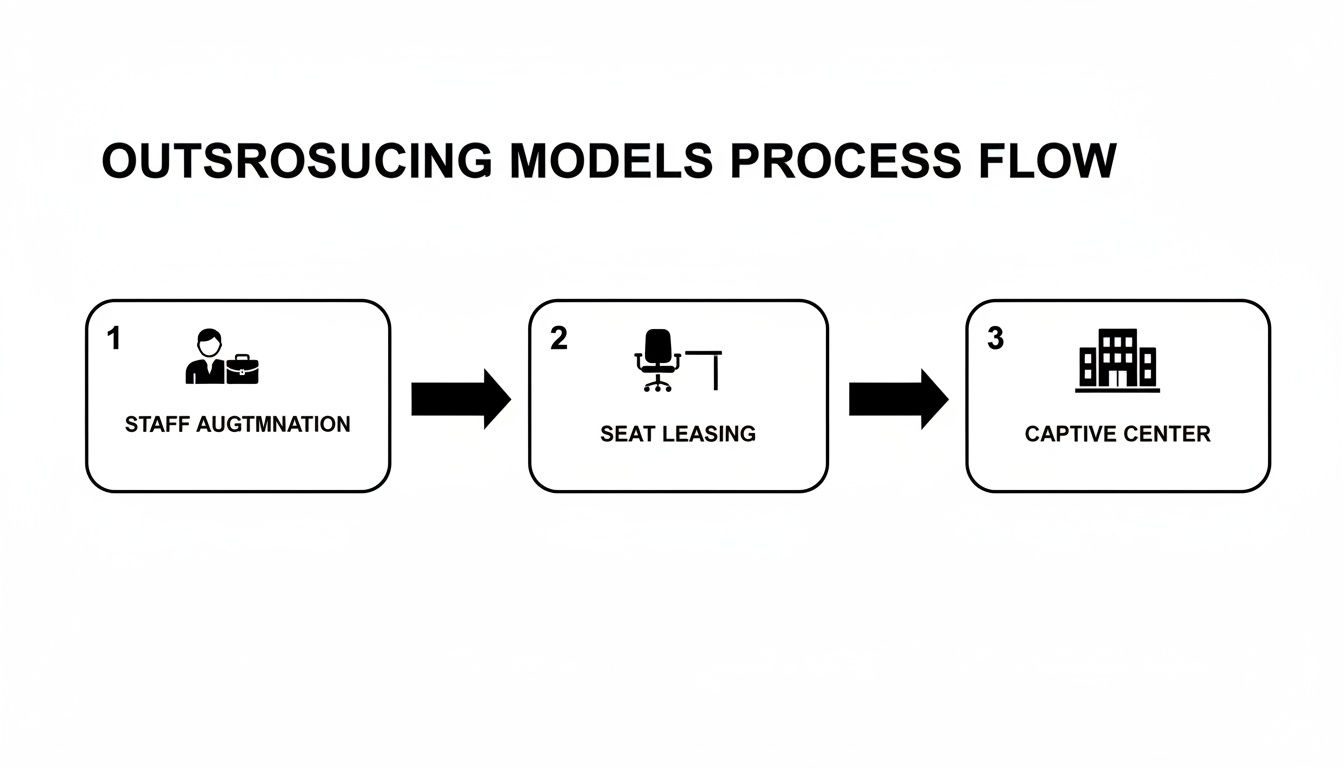
As you can see, most businesses test the waters with staff augmentation or seat leasing. The low risk and high speed are a huge advantage. Only when scale and a desire for total control become the main drivers do they consider graduating to a full captive center.
Navigating Legal and Tax Setup
First things first: you absolutely must establish a legal presence in Mexico. You can't just hire people directly as a foreign company; it doesn't work that way. For most, the go-to structure is the S. de R.L. (Sociedad de Responsabilidad Limitada), which functions much like an LLC in the United States.
Setting up an S. de R.L. means hiring a local law firm, registering with the Public Registry of Commerce, and getting a federal taxpayer number (known as an RFC). It might seem like a lot of red tape, but this is what protects your parent company by limiting liability and gives you the legal foundation to hire staff, pay taxes, and operate without issue.
Key Takeaway: Don't try to save a few bucks on legal and accounting. Partnering with a reputable local firm from the very start is the single best investment you can make. Going it alone is a proven recipe for costly delays and compliance nightmares down the road.
Getting your tax strategy right is just as crucial. You'll be dealing with a few key areas:
- Income Tax (ISR): This is Mexico's corporate income tax.
- Value-Added Tax (IVA): A consumption tax that applies to most goods and services you'll purchase.
- Payroll Taxes: This is a big one, covering contributions to social security (IMSS), employee housing funds (INFONAVIT), and retirement funds (AFORE).
Insider Tips for Hiring and Payroll
With your legal entity in place, the fun part begins: building your team. The nearshoring boom is fundamentally reshaping supply chains, and it’s no secret why. A remarkable 49% of U.S. companies are now outsourcing their IT and software development to Mexico and Canada.
This "tech-shoring" wave is powered by Mexico’s deep talent pool and impressive digital infrastructure. By 2024, the country was already home to over 15,000 foreign-owned operations, with tech hubs like Guadalajara and manufacturing powerhouses like Monterrey leading the way across more than 14,000 industrial parks.
When you start hiring, it's vital to understand that Mexican labor law is strongly pro-employee. Employment contracts are indefinite by default, and statutory benefits make up a significant portion of an employee's total compensation.
Key benefits include:
- Aguinaldo: A mandatory annual bonus that must be at least 15 days' pay.
- Vacation & Prima Vacacional: Employees are entitled to at least 12 vacation days after their first year, plus a "vacation premium" of 25% of their vacation salary.
- Social Security (IMSS): This comprehensive system covers healthcare, disability, and more for your team.
Payroll needs to be flawless. We strongly recommend using a local payroll provider. They live and breathe the specific deductions, reporting timelines, and payment rules mandated by Mexican law, which will save you an enormous amount of time and risk.
IT, Cybersecurity, and Connectivity
In 2026, data security is not optional. Your Mexico office has to be a fortress, seamlessly integrated with your corporate security standards. That foundation is built on reliable, high-speed internet. Fortunately, major cities like Mexico City, Guadalajara, and Monterrey offer robust fiber-optic networks that are on par with any major North American metro area.
Your IT setup checklist must include:
- Secure Network Architecture: Implement firewalls, VPNs, and access controls that perfectly mirror your standards back home.
- Endpoint Security: Every laptop and workstation needs up-to-date antivirus, anti-malware, and data encryption software.
- Physical Security: The office itself needs controlled badge access, surveillance systems, and a secure, locked space for any on-site servers.
This is another area where a model like seat leasing shines. A good provider handles all the enterprise-grade IT infrastructure, cybersecurity protocols, and redundant internet connections for you. You can see the level of infrastructure we provide by looking at spaces like Building 24.
Real Estate Strategy: Seat Leasing vs. Traditional Leases
Finally, your team needs a place to work. You could go the traditional route and sign a multi-year commercial lease. But that means a massive upfront capital expense for construction, furniture, and equipment, not to mention a long-term commitment that's hard to get out of. This process can take months and lock you into a fixed amount of space you might outgrow—or underuse.
Seat leasing completely flips that script. It’s a flexible, operating-expense model where you pay a simple monthly fee for each employee. That fee includes a fully furnished and IT-ready workstation, plus all the overhead: utilities, security, and maintenance.
With seat leasing, you can launch in weeks, not months. Better yet, you can scale your team up or down as needed with incredible agility. For most companies just entering the Mexican market, it’s simply the fastest and most cost-effective way to get started.
Calculating Your True Costs and ROI

While the strategic advantages of a team in Mexico are compelling, let's be honest: the decision always comes down to the numbers. A positive return on investment isn't just a nice-to-have; it's the entire point.
To get a real picture of your ROI, you have to look far beyond a simple salary comparison. I’ve seen too many companies get tripped up by underestimating the total cost of an operation, which can quickly turn a great plan into a financial headache.
The Full Spectrum of Expenses
When you're building out your financial model for Mexico, wages are just the starting line. A truly accurate budget accounts for all the investments needed to run a compliant, productive, and stable operation.
Your major cost buckets will break down like this:
- Employee Compensation: This isn't just base pay. It absolutely must include mandatory benefits like aguinaldo (the annual bonus), social security (IMSS), and vacation premiums. These can easily add another 30-40% on top of an employee's salary.
- Infrastructure Costs: This is where a traditional setup can become a money pit. You're on the hook for commercial office rent, utilities, furniture, high-speed internet contracts, and all the IT hardware for your team.
- Administrative Overhead: These are the ongoing costs of just keeping the doors open. Think legal and accounting retainers, payroll processing fees, office managers, and cleaning crews.
- One-Time Setup Costs: If you go the captive route, get ready for significant capital outlay. This includes everything from office construction and security deposits to legal entity formation fees, which can run into the tens of thousands.
For businesses new to operating in Mexico, these bundled costs can be a real shock. The path to a strong ROI is found by choosing a model that sidesteps the heaviest of these expenses.
The secret to maximizing your ROI in Mexico isn't just about lower salaries. It's about choosing an operational model that vaporizes your capital expenses and administrative burden. This is where seat leasing provides a nearly unbeatable financial edge.
Traditional Office vs. Seat Leasing: A Cost Showdown
Let's make this real. Imagine you're building a 10-person customer support team in Tijuana. Here’s a side-by-side look at what the annual costs might be if you set up a traditional office versus using a seat leasing model.
This comparison clearly shows how seat leasing converts what would be massive capital investments and unpredictable operating costs into a single, predictable monthly fee. The model absorbs the financial weight and logistical nightmare of setting up and managing an office, so you can focus on what actually matters: your people and your business goals. You can see a detailed breakdown of what's typically included in our seat leasing packages here.
Cost Breakdown: Traditional Office vs. Seat Leasing
| Expense Category | Traditional Office (Annual Est.) | Seat Leasing Model (Annual Est.) |
|---|---|---|
| Salaries & Benefits | $150,000 | $150,000 |
| Office Rent & Utilities | $48,000 | $0 (Included) |
| IT & Internet | $12,000 | $0 (Included) |
| Furniture & Equipment (Amortized) | $15,000 | $0 (Included) |
| Admin & Mgt. Overhead | $25,000 | $0 (Included) |
| One-Time Setup (Amortized) | $20,000 | $0 (Included) |
| Total Estimated Annual Cost | $270,000 | $150,000 |
The talent costs the same in both scenarios. The game-changing difference—a staggering $120,000 per year in this example—comes from completely eliminating the need to build, furnish, and run your own office space.
By using a seat leasing partner, you skip the biggest financial hurdles of international expansion. There's no five-year lease to sign, no huge upfront check for construction, and no need to hire a separate admin team just to keep the lights on. This approach not only generates operational savings that can reach up to 80% but also slashes your time-to-market, getting you up and running in a few weeks instead of many months.
How to Ensure a Seamless Transition and Measure Success
Getting your Mexico operation launched is a huge milestone, but the celebration is short-lived. Now the real work begins. The make-or-break moment is how you manage the transition and prove the team's long-term value. A shaky handover can poison the well from day one, so a thoughtful, structured transition plan isn't just a good idea—it’s everything.
The foundation of that plan is solid knowledge transfer. I’ve seen too many companies just dump files into a shared drive and expect their new team to figure it out. That's a recipe for failure. To get the smooth handoff and consistent quality you’re after, you absolutely must create thorough process documentation. This becomes your new team's playbook, giving them a clear, repeatable guide for every single task.
Crafting a Winning Transition Plan
A successful transition is built on much more than just processes; it's about people. You're not just moving tasks, you're integrating a new group of professionals into your company's DNA. They need to feel like part of the team from their very first day.
Your plan needs a few key ingredients:
- A Phased Rollout: Don't try to boil the ocean. I always advise starting with a small pilot group or a handful of well-defined responsibilities. This creates a low-pressure environment for your new team to learn and gives you a chance to work out the kinks on a much smaller, manageable scale.
- Shadowing and Mentorship: This is where the magic happens. Pair your new hires in Mexico with seasoned employees back home. This creates a direct lifeline for all those little questions that never make it into a manual and helps them absorb the unwritten rules of your company culture.
- Clear Communication Cadence: Establish the rhythm of communication early. Will you have daily stand-ups? Weekly check-ins? Define the purpose of each channel—maybe Slack for quick questions and informal chats, and email for formal reports and updates.
Don't forget the human element. Fostering a real connection is critical. Simple things like celebrating both U.S. and Mexican holidays, or having a shared "virtual water cooler" channel for non-work chat, can go a long way in building a single, cohesive team.
Measuring Performance with the Right Metrics
Once your team is humming along, you have to prove it's working with cold, hard data. This isn't about micromanaging—it's about demonstrating the ROI of your decision and pinpointing where you can get even better. This is where Service Level Agreements (SLAs) become your best friend.
Key Insight: Your SLAs should be specific, measurable, and directly tied to your business goals. Vague metrics lead to vague results. Be precise about what success looks like for each role on your team.
The Business Process Outsourcing (BPO) boom in Mexico is no secret. American and Canadian companies are flocking to the region, drawn by the incredible talent and cost-efficiency. In fact, North American firms have boosted their remote hiring in nearshore locations by a staggering 70%. This trend is why models like seat leasing, which can deliver up to 80% cost savings with ready-to-go workspaces, are so compelling.
This rapid growth makes having precise performance metrics more important than ever. The KPIs you track will naturally change depending on the team's function.
Examples of Role-Specific SLAs:
| Team Function | Key Performance Indicator (KPI) | What It Measures |
|---|---|---|
| Customer Support | First Call Resolution (FCR) | The percentage of issues solved on the first contact. |
| Software Development | Cycle Time | The time it takes to move a task from "in progress" to "done." |
| Back-Office/Data Entry | Accuracy Rate | The percentage of entries completed without errors. |
| Sales Development | Meetings Booked | The number of qualified appointments set for the sales team. |
By tracking these KPIs consistently, you build a transparent system of accountability. This data is your management toolkit—it helps you coach your team in Mexico effectively, celebrate wins, and clearly show the immense value they're bringing to the entire organization.
Common Questions About Outsourcing to Mexico
Even with a solid plan, taking the leap into a new country always comes with a few lingering "what ifs." It's completely normal. Before you fully commit to launching an operation in Mexico, you need clear, straightforward answers to those final questions.
These aren't just hypotheticals; they're the real-world concerns we hear from business leaders every single day. Let's get them answered so you can move forward with total confidence.
How Hard Is It to Find Skilled Bilingual Talent?
This is probably the first question on everyone's mind, and the answer is better than most expect. Mexico has an incredibly deep well of bilingual professionals, especially in the major business hubs like Guadalajara, Mexico City, and Monterrey. Thanks to the country's strong emphasis on STEM education and its close cultural ties to the U.S., you have millions of people who grew up with English-language media.
What you get is a workforce that isn’t just fluent on paper—they understand the subtle cues and cultural context of North American business. For most customer service, sales, and IT support roles, finding top-notch, fluent English speakers is not the major challenge you might think it is.
Of course, it all depends on what you're looking for. Finding a senior AI engineer with 10 years of experience who is also perfectly bilingual is going to be a tough search anywhere in the world. But for the vast majority of roles that companies nearshore, the talent is ready and waiting.
What Are the Real Legal Hurdles for a U.S. Company?
Stepping into a new legal system feels daunting, but thousands of U.S. companies have already paved this road. The main thing to understand is that you can't just hire Mexican citizens directly as a foreign corporation; you need to establish a legal entity in Mexico first.
For almost every company, this means setting up a Sociedad de Responsabilidad Limitada (S. de R.L.), which is Mexico’s version of a U.S. LLC. It involves some paperwork and registration with the right authorities, but it's a standard and well-defined process.
The biggest mistake we see is companies trying to find shortcuts on the legal side. Don't do it. Partnering with a good Mexican law firm is non-negotiable. They will handle the S. de R.L. formation from start to finish and ensure you're fully compliant with Mexico's Federal Labor Law—which is very pro-employee—from day one.
How Do We Manage Cultural Differences?
While the U.S. and Mexico are neighbors, small cultural differences can definitely affect the workplace. For instance, building personal relationships is often a key part of business in Mexico, and communication can be more indirect compared to the blunt, to-the-point style common in many American offices.
The secret to making this work is proactive cultural training—for everyone.
- For your new Mexican team: Hold an orientation that covers your company's specific way of communicating, how you run meetings, and your approach to giving and receiving feedback.
- For your U.S. team: Teach them about Mexican cultural norms. Simple things, like the importance of a little small talk before diving into business or being aware of different national holidays, go a long way.
Building a true "one team" culture isn't about erasing these differences; it's about respecting them. Small gestures, like celebrating both U.S. and Mexican holidays, can have a massive positive impact on building a cohesive, global team.
Is Our Intellectual Property Truly Secure?
A critical question, particularly for software, tech, and R&D companies. The great news is that Mexico’s intellectual property (IP) laws are robust and closely aligned with international standards, thanks in large part to trade agreements like the USMCA.
But a legal framework is just one part of the equation. Practical, on-the-ground security measures are what will actually protect your IP day-to-day. This is where your choice of operating model and local partners is absolutely crucial.
Your IP Protection Checklist:
- Ironclad NDAs: Make sure every employee and partner signs a strong Non-Disclosure Agreement. It must be drafted by your Mexican legal team to be enforceable locally.
- Physical & Digital Security: Your office needs controlled access, camera surveillance, and secure, firewalled networks. This is a huge benefit of working with a quality seat leasing provider—they already have enterprise-grade security built in.
- Data Access Controls: Use the "least privilege" principle. Employees should only be able to access the specific data and systems they absolutely need to do their jobs.
When you combine strong legal protections with strict, multi-layered security protocols, you can operate in Mexico with a high degree of confidence that your most sensitive information is safe.
At Seat Leasing BPO, we handle the operational complexities so you can focus on what matters: building a great team. Our fully managed, secure facilities are the perfect launchpad for your Mexico operations, helping you save up to 80% on overhead and get started in weeks, not months. Learn more about how we make it simple.