In a hyper-competitive global market, gaining a sustainable edge is no longer a luxury, it's a necessity for survival and growth. Businesses are constantly seeking strategies to optimize costs, accelerate innovation, and scale with agility. While many avenues exist, one powerful approach consistently delivers significant results: offshore outsourcing.
This strategy is far more than a simple cost-cutting measure. It acts as a strategic lever for accessing global talent pools, achieving round-the-clock operational efficiency, and freeing your core team to focus on what truly drives business growth. A key to success, however, is a clear understanding of its multifaceted advantages and how to apply them effectively to your specific business model. The many benefits of offshore outsourcing can completely reshape your operational framework and financial health.
This guide provides a detailed roundup of the 10 most impactful benefits, moving beyond theory to offer actionable insights and real-world examples. We will explore how this model can create a path to greater profitability and stronger market positioning. You will learn not just what the advantages are, but how to implement them, mitigate potential risks, and ultimately use offshoring to secure a durable competitive advantage. This article breaks down how to gain access to a global workforce, improve service quality, and reduce capital expenditure, providing a clear roadmap for small and large businesses alike.
1. Significant Cost Reduction and Budget Optimization
One of the most compelling benefits of offshore outsourcing is the direct and substantial impact it has on your company's bottom line. By strategically moving specific business functions to countries with lower operational expenses, companies can achieve cost savings ranging from 40% to as high as 80% compared to maintaining those roles in-house in Western markets. This isn't just about lower salaries; it's a holistic reduction that includes costs associated with recruitment, office space, utilities, and local employee benefits.
The savings are particularly noticeable for startups and small-to-medium-sized enterprises (SMEs) that need to maximize every dollar. For instance, a startup can extend its financial runway significantly by building its development team offshore, allowing it to perfect its product without the immediate pressure of high domestic payroll costs. This dual cost advantage makes premium business environments and talent pools accessible to organizations that might otherwise be resource-constrained.
How to Implement Cost Reduction Effectively
To realize these savings, a structured approach is crucial. Don't just look at salary differences; consider the full financial picture.
- Conduct a Total Cost of Ownership (TCO) Analysis: Before committing, map out all potential expenses. This includes one-time transition costs, management overhead, travel, and any necessary technology upgrades. A thorough TCO analysis prevents unexpected expenses from eroding your projected savings.
- Manage International Payments Wisely: A significant part of budget optimization in offshore outsourcing comes from intelligently managing financial flows. Understanding how to avoid currency conversion fees and other cross-border transaction costs can preserve your savings.
- Negotiate Smart Contracts: Opt for fixed-pricing models where possible, but include clear escalation clauses tied to predictable metrics like the partner country's inflation rate. This protects you from sudden, arbitrary price hikes.
- Phase Your Transition: Instead of moving an entire department offshore at once, start with a smaller, well-defined function. This gradual approach allows you to manage transition risks, refine processes, and build a strong working relationship with your BPO partner before scaling up.
2. Access to Global Talent Pool and Specialized Expertise
Beyond cost savings, one of the most powerful benefits of offshore outsourcing is gaining immediate entry to a worldwide talent pool. Geographic limitations vanish, allowing your company to recruit professionals with specialized expertise from regions celebrated for specific competencies. This approach lets you tap into a rich vein of skills without enduring long and expensive domestic recruitment cycles.

For example, a tech startup can partner with developers in Eastern Europe for their strong AI and machine learning capabilities, or a growing e-commerce brand can source top-tier customer service agents from the Philippines. Major corporations like Microsoft and Google have long demonstrated this model's success by establishing development and research centers in India, China, and Europe to accelerate innovation. This strategic staffing enables businesses to build world-class teams and scale capabilities on demand.
How to Access Specialized Talent Effectively
To properly connect with the right global professionals, a clear strategy is essential. It's about finding the right skills, not just filling a seat.
- Define Competency Requirements First: Before searching for a vendor, create a detailed profile of the exact skills, experience, and certifications you need. This clarity ensures your partner understands your requirements and can source the most qualified candidates.
- Request and Review Credentials: Don't take a vendor's claims at face value. Ask for team credentials, certifications, and a portfolio of past work relevant to your project. This due diligence confirms their expertise and ability to deliver results.
- Establish Strong Knowledge Management: Implement a centralized system for documentation, process guides, and training materials. This ensures business continuity and makes it easier to integrate new offshore team members smoothly.
- Use Collaborative Workspace Models: For companies wanting closer integration, solutions like those from Seat Leasing BPO offer managed office environments where your offshore team can work together. This fosters a stronger team culture and improves collaboration between your in-house and remote staff.
3. Enhanced Business Focus and Core Competency Concentration
Among the key benefits of offshore outsourcing is the ability it gives your company to sharpen its strategic focus. By delegating non-essential operational tasks to a specialized offshore partner, you free up your internal teams to concentrate on what truly drives your business forward: innovation, customer relationships, and product development. This strategic shift moves your best minds away from managing administrative minutiae and directs their energy toward activities that create genuine competitive advantages.
This redirection of internal resources is not just about efficiency; it's about accelerating growth. For example, a tech company can double down on creating exceptional software, like Basecamp did by outsourcing its HR and accounting, allowing its core team to perfect its project management tools. Similarly, Apple’s legendary focus on design and user experience is made possible by outsourcing its large-scale manufacturing to partners like Foxconn. This allows leadership to dedicate its time to strategic planning and market expansion rather than overseeing factory operations.
How to Implement Strategic Refocusing Effectively
To achieve a true concentration on core competencies, you must be methodical in how you delegate. This ensures that outsourcing adds strategic value instead of just cutting costs.
- Categorize All Business Functions: Start by conducting a thorough audit of every process within your company. Clearly separate them into two categories: core (activities that directly create your unique value) and non-core (essential but routine functions like payroll, IT support, or data entry).
- Document Standard Operating Procedures (SOPs): Before handing over any task, create detailed SOPs. Clear documentation ensures your offshore team can execute functions consistently and to your standards from day one, minimizing disruption and training overhead.
- Establish Clear Performance Metrics: Define specific Key Performance Indicators (KPIs) for your outsourced functions. Schedule regular performance reviews with your vendor to track progress, address issues, and ensure their work remains aligned with your strategic goals.
- Reassess Alignment Quarterly: Your business strategy will evolve. Hold quarterly sessions to review your outsourcing arrangements. This ensures that the functions you have delegated remain non-core and that the partnership continues to support your primary business objectives effectively.
4. 24/7 Business Operations and Round-the-Clock Productivity
One of the most powerful benefits of offshore outsourcing is the ability to create a perpetual work cycle, transforming your business into a 24/7 operation. By distributing teams across different time zones, your company can maintain momentum long after domestic employees have logged off. When teams in countries like India or the Philippines are starting their day, it perfectly aligns with the evening or night in North America and Europe. This creates a "follow-the-sun" model that accelerates project timelines, dramatically improves customer support responsiveness, and ensures continuous progress on key business goals without the high costs of local night-shift premiums.
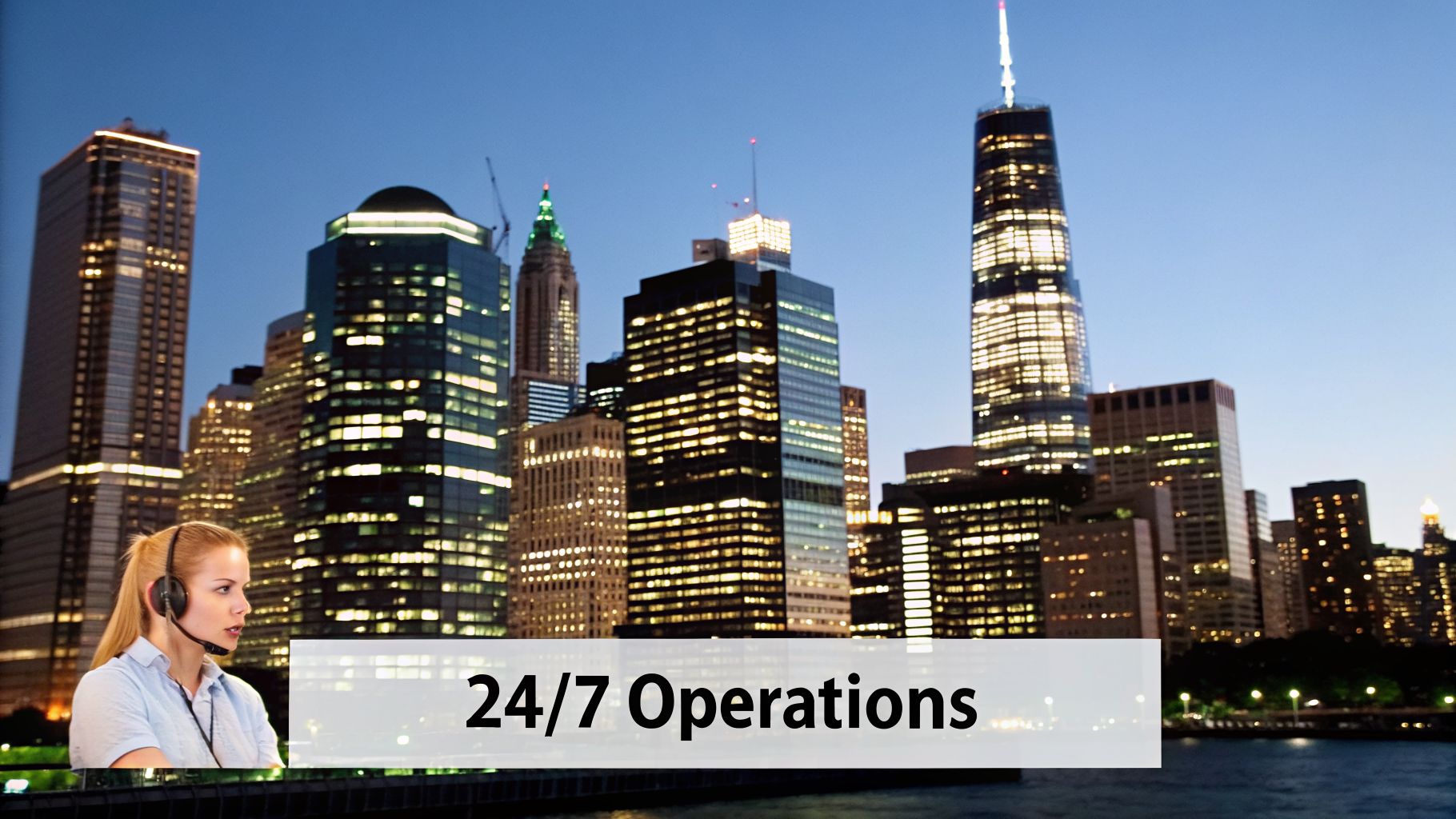
This around-the-clock productivity is particularly impactful for service-oriented and mission-critical functions. For example, SaaS companies can have their offshore support centers resolve customer tickets overnight, meaning users in the U.S. or U.K. wake up to solutions rather than waiting another business day. Similarly, financial services firms use offshore teams for continuous trading, settlement operations, and market monitoring, while global giants like Amazon use their distributed workforce for 24/7 infrastructure monitoring and support, ensuring uptime and security.
How to Implement 24/7 Operations Effectively
Achieving a seamless global workflow requires clear processes and the right tools. Simply having teams in different time zones isn't enough; you must enable them to collaborate efficiently.
- Establish Clear Handoff Protocols: Your most critical process is the daily handoff. Create detailed documentation standards and checklists that one team completes at the end of their day to brief the next team. This ensures nothing is lost in translation and work continues without interruption.
- Embrace Asynchronous-First Communication: Rely on tools that don't require immediate responses. Platforms like Slack, Loom (for video messages), and Notion (for shared documentation) allow teams to communicate effectively across time zones. Schedule 1-2 hours of daily overlap for urgent sync-ups and critical decisions only.
- Implement Robust Project Management Tools: Use software like Jira, Asana, or Trello with rigorous standards for status updates. Every team member, regardless of location, should be able to see the exact status of a project at a glance, eliminating ambiguity and dependency on real-time check-ins.
- Invest in Global Collaboration Training: Don't assume teams will know how to work together across cultures and time zones. Provide specific training on communication best practices, cultural nuances, and the tools you've implemented to support the 24/7 model.
5. Rapid Scalability and Flexible Resource Management
One of the most powerful benefits of offshore outsourcing is the operational agility it provides. Businesses can expand or contract their workforce with remarkable speed, sidestepping the prolonged and expensive cycles of domestic hiring, onboarding, and office space acquisition. This elasticity allows companies to react instantly to market demands, seasonal peaks, or unexpected growth opportunities by adding dozens of skilled professionals to their team in weeks, not months.

This flexibility is a game-changer for businesses with fluctuating needs. For example, e-commerce platforms can triple their customer support staff to handle the holiday rush and then scale back down just as easily. Similarly, a fintech startup can grow its development team from five to fifty engineers to meet aggressive product launch deadlines without committing to long-term payroll and infrastructure costs. During downturns or lulls, companies can reduce their offshore team size without facing the complexities of domestic layoffs and severance obligations, preserving capital and maintaining a lean operational core.
How to Implement Scalability Effectively
Achieving true operational flexibility requires a proactive and strategic approach to managing your offshore partnership.
- Establish Tiered Staffing Agreements: Work with your BPO provider to create contracts that explicitly support both growth and contraction. Define clear terms for adding team members at different tiers (e.g., 10, 25, 50+ staff) and include pre-agreed-upon conditions for scaling down, giving you predictable control over your workforce size.
- Document Scalable Process Frameworks: Your internal processes must be designed to accommodate team size changes. Create modular, well-documented workflows that new members can adopt quickly and that can function efficiently whether you have a team of 10 or 100.
- Use Predictive Analytics for Forecasting: Don't wait for a demand spike to hit. Use sales data, market trends, and customer behavior analytics to forecast your staffing needs at least 4-6 weeks in advance. This gives your offshore partner ample time to recruit and train qualified candidates, ensuring a seamless expansion.
- Build a Relationship with a Flexible Vendor: Partner with a BPO that has a proven track record of flexible "bench" management. These providers maintain a pool of trained, ready-to-deploy professionals, allowing them to staff your projects almost immediately when you give the green light.
6. Improved Service Quality and Process Excellence
A common misconception is that offshore outsourcing means sacrificing quality for cost. The reality is often the opposite. Professional offshore service providers operate in a highly competitive, reputation-driven market where process excellence is a key differentiator. They are incentivized to maintain strict quality standards, adhere to service-level agreements (SLAs), and secure industry certifications like ISO, SOC 2, or CMMI to attract and retain global clients.
Organizations benefit directly from this focus on quality. Established BPOs bring structured methodologies, rigorous quality assurance frameworks, and detailed procedural documentation that may be more advanced than what a company, particularly a startup or SME, can develop internally. For instance, top-tier providers like TCS and Infosys consistently deliver industry-leading quality metrics for Fortune 500 companies, while specialized healthcare BPOs manage HIPAA compliance with zero breaches across thousands of accounts.
How to Implement and Verify Quality Excellence
Ensuring your offshore partner delivers on its promise of quality requires a proactive and structured approach. You must set clear expectations and continuously monitor performance against them.
- Establish a Baseline Before Engagement: Before handing over any process, measure your current performance metrics. This baseline is essential for accurately tracking the improvement and demonstrating the ROI of your outsourcing initiative.
- Verify Certifications Independently: Don’t just take a provider's word for their certifications. Independently verify claims with the issuing bodies. This due diligence confirms their commitment to established quality and security standards.
- Demand Detailed SLA Agreements: Your contract must include specific, measurable SLAs with clearly defined penalties for non-compliance. Metrics could include response times, resolution rates, error percentages, or system uptime guarantees.
- Conduct Regular Quality Audits: Implement a schedule for monthly or quarterly quality review meetings with vendor leadership. You can also perform on-site visits or hire a third-party to audit their processes. For managed services, you can explore facilities with certified infrastructure to ensure the physical environment supports your quality goals.
7. Reduced Capital Expenditure and Improved Cash Flow
A major financial benefit of offshore outsourcing lies in its ability to convert large, fixed capital expenditures (CapEx) into predictable, variable operational expenses (OpEx). Instead of purchasing buildings, furniture, and expensive tech infrastructure, you pay a manageable, recurring fee to a partner who has already made these investments. This preserves your company's working capital and greatly improves financial flexibility.
This model is especially effective for startups and growing businesses that need to protect their cash flow for strategic purposes like product development, marketing, or market expansion. It allows them to access world-class facilities and operational capabilities without the upfront financial burden. Think of how companies like Slack or Zoom grew rapidly; they built on cloud infrastructure, avoiding massive server farm investments and converting their costs to a subscription model.
How to Implement This Financial Strategy
Transforming CapEx into OpEx requires a clear financial plan to maximize the benefits.
- Conduct a Total Cost of Ownership (TCO) Analysis: Before committing, compare the long-term costs of both models. Calculate the full expense of buying and maintaining your own infrastructure versus the operational cost of outsourcing over a 3-5 year period. This clarifies the true financial advantage.
- Negotiate Fixed-Rate Contracts: To maintain cost predictability, secure contracts with fixed monthly rates. Ensure any escalation clauses are tied to transparent metrics, like the partner country’s official inflation rate, to prevent unexpected cost increases.
- Model the Impact of Freed-Up Capital: Use financial modeling to project how the preserved cash can be reinvested into core business activities. Quantify the potential return on investment from putting that capital toward sales, marketing, or research instead of office chairs.
- Explore Seat Leasing Models: For maximum cash flow benefit, consider a seat leasing arrangement. This approach bundles all necessary infrastructure, IT support, and facilities into a single OpEx fee, eliminating almost all capital outlay. You can explore what a seat leasing solution includes to see how it removes infrastructure burdens.
8. Risk Mitigation and Business Continuity Advantages
One of the most strategic benefits of offshore outsourcing is its ability to build resilience and ensure business continuity. By distributing key operations across different geographic locations, a company significantly reduces its vulnerability to localized disruptions. Events like regional economic downturns, political instability, natural disasters, or even public health crises can cripple a business that operates from a single location. Geographic diversification acts as an insurance policy, ensuring that if one site goes down, another can maintain critical functions.
This distribution of risk is not just about having a backup location; it's about creating a robust, decentralized operational framework. For example, many global financial institutions maintain redundant processing centers in multiple countries to guarantee uninterrupted service. Similarly, insurance companies often use offshore disaster recovery centers to continue claims processing during regional events like hurricanes or floods, maintaining customer trust when it's needed most. During the COVID-19 pandemic, companies with distributed offshore teams were able to maintain nearly 100% uptime by shifting workloads between regions as local conditions changed.
How to Implement Risk Mitigation Effectively
Building a resilient offshore operation requires proactive planning rather than a reactive scramble during a crisis.
- Develop a Comprehensive Disaster Recovery Plan (DRP): Work closely with your offshore partner to create a detailed DRP. This plan should outline specific procedures, roles, and responsibilities for various crisis scenarios, from power outages to major geopolitical events.
- Test Failover Procedures Regularly: A plan is only effective if it works. Conduct quarterly or semi-annual tests of your failover procedures to ensure a seamless transition between your primary and backup sites. These drills help identify and fix weaknesses before a real crisis occurs.
- Ensure Data Redundancy and Security: Implement robust data backup and replication protocols across different geographic locations. Verify that your offshore provider has strong cybersecurity measures and its own business continuity plans, including adequate insurance coverage.
- Establish Clear Crisis Communication Protocols: Define how, when, and by whom information will be shared between your domestic and offshore teams during a disruption. A clear communication chain prevents confusion and enables quick, coordinated responses.
9. Innovation Acceleration Through Diverse Perspectives and Global Best Practices
Beyond direct cost and efficiency gains, one of the most powerful benefits of offshore outsourcing is its capacity to act as a catalyst for innovation. Integrating offshore teams introduces a wealth of diverse cultural backgrounds, work methodologies, and problem-solving techniques into your organization. This cognitive diversity challenges internal assumptions and sparks creative friction, leading to breakthrough ideas that might not emerge from a more uniform domestic team.
This exposure to global best practices and different industry standards can help your company advance its competitive standing. For instance, an offshore team in a region known for mobile-first development can bring invaluable insights to a US-based company looking to improve its mobile user experience. Similarly, tech giants like Google and IBM credit their global innovation centers, which blend Eastern and Western approaches, for major advancements in AI and cloud computing.
How to Foster Innovation with Your Offshore Team
To turn this potential into a tangible advantage, you must actively cultivate an environment where diverse ideas are shared and valued.
- Create Structured Innovation Forums: Don't leave creativity to chance. Schedule regular brainstorming sessions, hackathons, or "innovation days" that bring together both your onshore and offshore teams. The goal is to create a dedicated space for cross-pollination of ideas.
- Document and Share Best Practices: Establish a central knowledge base or internal wiki where successful processes, new techniques, and market insights from all locations are documented. This ensures that valuable learning from one part of the organization benefits the whole.
- Encourage Methodological Experimentation: If your offshore team proposes a different project management approach or a new software testing framework, encourage them to pilot it on a small scale. This fosters a culture of continuous improvement and shows that their expertise is respected.
- Hire for Diverse Perspectives: When building your offshore team, look beyond pure technical qualifications. Actively seek out candidates with different educational backgrounds, industry experiences, and problem-solving styles to maximize cognitive diversity.
10. Competitive Market Advantage and Improved Profitability
The culmination of all the benefits of offshore outsourcing creates a powerful, sustainable competitive advantage. When you combine lower costs, faster delivery, expanded capacity, and access to specialized talent, you fundamentally change your position in the market. This allows your company to offer more aggressive pricing, deliver services faster, and provide a broader range of capabilities than competitors who are restricted to local resources.
This strategic positioning directly fuels growth. For example, a software company can use its offshore development team to release new features twice as fast as its rivals, capturing early adopters and market share. Similarly, an e-commerce brand can afford to offer 24/7 customer support, a key differentiator that builds loyalty and attracts new buyers. This market strength translates directly into increased customer acquisition and, most importantly, improved profitability, creating a virtuous cycle of reinvestment and growth.
How to Implement for a Competitive Edge
To turn outsourcing benefits into a true market advantage, a strategic approach is essential. Don't just pocket the savings; reinvest them to build a stronger business.
- Allocate Savings Strategically: A great rule of thumb is the 30-30-40 split. Invest 30% of your cost savings back into quality improvements and innovation, use 30% to create a pricing advantage, and allocate the remaining 40% to your profit margin.
- Differentiate Beyond Price: While cost advantages are significant, true market leadership comes from quality and speed. Use your offshore team to build a brand reputation based on superior service, reliability, and faster turnaround times.
- Monitor Your Competitive Landscape: Always aim to maintain a 15-20% cost advantage over your closest competitors to ensure your position is sustainable. Track their moves and adjust your strategy to stay ahead.
- Track Customer Satisfaction (CSAT): It is critical to ensure that quality is not sacrificed for cost. Continuously monitor CSAT scores and other customer feedback metrics to validate that your offshore operations are enhancing, not diminishing, your customer experience. This ensures your competitive advantage is built on solid ground.
Top 10 Offshore Outsourcing Benefits Compared
| Item | Implementation Complexity 🔄 | Resource Requirements ⚡ | Expected Outcomes ⭐📊 | Ideal Use Cases 💡 | Key Advantages ⭐ |
|---|---|---|---|---|---|
| Significant Cost Reduction and Budget Optimization | Moderate 🔄 — initial setup and transition required | Low-to-Moderate ⚡ — vendor management, contract negotiation, facility use | High ⭐📊 — 40–80% OPEX reduction, improved cash flow | Startups, SMEs, cost-sensitive scaling | Large cost savings, predictable scalable costs ⭐ |
| Access to Global Talent Pool and Specialized Expertise | Moderate 🔄 — vendor selection and knowledge transfer | Moderate ⚡ — vetting, credential checks, collaboration tools | High ⭐📊 — rapid access to niche skills and multilingual teams | Specialized projects, fast capability scaling, 24/7 support | Wide talent access, rapid ramp-up, domain expertise ⭐ |
| Enhanced Business Focus and Core Competency Concentration | Low-to-Moderate 🔄 — audit and process handoff planning | Low ⚡ — KPI tracking and vendor oversight | Moderate-High ⭐📊 — improved innovation and customer focus | Firms aiming to free leadership for strategic work | Increased innovation velocity and employee engagement ⭐ |
| 24/7 Business Operations and Round-the-Clock Productivity | High 🔄 — complex handoffs and time-zone coordination | Moderate-High ⚡ — overlapping hours, robust connectivity | High ⭐📊 — faster delivery, improved SLA compliance | Global support centers, time-sensitive services | Continuous operations, faster response times ⭐ |
| Rapid Scalability and Flexible Resource Management | Moderate 🔄 — staffing agreements and modular team design | Variable ⚡ — vendor bench, onboarding capacity | High ⭐📊 — quick expansion/contraction in weeks | Seasonal businesses, high-growth startups, pilots | Elastic capacity without long-term facility commitments ⭐ |
| Improved Service Quality and Process Excellence | Moderate-High 🔄 — maintain SLAs, certifications, audits | Moderate ⚡ — QA teams, compliance and certification costs | High ⭐📊 — standardized processes, higher reliability | Regulated industries, mission-critical operations | Certifications, formal SLAs, continuous improvement ⭐ |
| Reduced Capital Expenditure and Improved Cash Flow | Low 🔄 — shift from CapEx to OpEx via contracts | Low ⚡ — fewer upfront investments, predictable billing | High ⭐📊 — better liquidity, preserved capital for growth | Cash-constrained startups, scaling companies | Improved cash flow and financial flexibility ⭐ |
| Risk Mitigation and Business Continuity Advantages | High 🔄 — manage distributed operations and compliance | Moderate-High ⚡ — redundant systems, DR planning | High ⭐📊 — greater resilience and lower disruption risk | Financial services, critical infrastructure, disaster-prone regions | Geographic diversification and robust continuity guarantees ⭐ |
| Innovation Acceleration Through Diverse Perspectives and Global Best Practices | Moderate 🔄 — structured forums and diversity management | Moderate ⚡ — collaboration spaces, knowledge-sharing programs | Moderate-High ⭐📊 — increased creativity and faster best-practice adoption | R&D, product design, global market expansion | Cognitive diversity, global insights, faster learning ⭐ |
| Competitive Market Advantage and Improved Profitability | Moderate 🔄 — balance cost, quality, and strategic reinvestment | Moderate ⚡ — cost management, marketing and quality programs | High ⭐📊 — higher market share and improved margins | Price-sensitive markets, firms seeking scale-led differentiation | Stronger positioning, higher profitability and reinvestment capacity ⭐ |
From Strategy to Execution: Maximizing Your Offshore Advantage with the Right Partner
The journey through the benefits of offshore outsourcing reveals a clear and powerful roadmap for modern businesses. From significant cost reductions and access to a global talent pool to achieving 24/7 operational capacity and accelerating innovation, the case for looking beyond domestic borders is stronger than ever. These advantages are not merely theoretical; they represent tangible, strategic levers that startups, SMBs, and established enterprises can pull to gain a decisive competitive edge.
We’ve explored how offshoring allows you to concentrate on your core competencies, letting dedicated experts handle specialized functions. This strategic reallocation of resources sharpens your business focus, leading to improved service quality and faster product development cycles. It’s a direct path to operating more efficiently and profitably.
From Theory to Tangible Results
The real challenge, however, isn't just understanding these benefits, it's implementing a strategy that fully captures them without introducing new complexities. The difference between a successful offshore engagement and a frustrating one often comes down to one critical factor: the operational model. Traditional outsourcing can still saddle your business with the burdens of managing facilities, IT infrastructure, and backend support, which can erode the very focus you sought to gain.
This is where the distinction between simple delegation and smart partnership becomes crucial. To truly maximize your offshore advantage, it's crucial to understand how to effectively select a partner for your outsource software development or customer support needs. The right partner doesn’t just provide labor; they provide a complete, frictionless operational framework.
Key Takeaway: The greatest benefits of offshore outsourcing are unlocked when you move beyond just hiring remote talent and adopt a model that eliminates operational friction, allowing you to focus 100% on growth and core business functions.
The Next Step: A Smarter Outsourcing Model
For startups and small to medium-sized businesses, the ideal solution minimizes capital expenditure and maximizes flexibility. This is precisely where models like seat leasing come into play, offering a practical evolution of traditional BPO. Instead of building an entire offshore operation from scratch, you can plug directly into an existing, fully managed infrastructure.
Consider the implications:
- Zero Capital Expenditure: You avoid the immense upfront costs associated with securing office space, purchasing equipment, and setting up IT networks.
- Operational Agility: You can scale your team up or down with minimal notice, aligning your resources perfectly with business demand.
- Reduced Management Overhead: The provider handles facility management, IT support, security, and utilities, freeing your leadership to focus on strategy and team performance.
This approach effectively combines the cost-saving benefits of offshoring with the operational ease of a serviced office, creating a powerful dual advantage. You get access to top-tier global talent at a fraction of the cost, all while running on a lean, capital-light infrastructure. By choosing a partner that manages the backend, you're not just outsourcing tasks; you are adopting a smarter, more agile business strategy built for modern market dynamics. It's the final piece of the puzzle that turns the promise of offshore outsourcing into a practical and highly effective reality.
Ready to unlock the full benefits of offshore outsourcing without the operational headaches? Seat Leasing BPO provides fully managed, plug-and-play solutions that handle your IT, facilities, and backend support, so you can focus on what you do best. Discover how our model can help you build your dedicated offshore team and achieve significant cost savings by visiting Seat Leasing BPO today.