Trying to make sense of the paperwork for a work permit Philippines application can be overwhelming. Let’s be honest, it looks like a mountain of bureaucracy. But this guide will serve as your experienced sherpa, guiding you through the process step-by-step. Securing the right permit isn't just a legal formality; it's your official welcome to one of Southeast Asia's most exciting economies.
Your Gateway to Working Legally in the Philippines
Don't think of your work permit as a roadblock. It's the key that unlocks your ability to work legally and build a career here. This applies to everyone, whether you're an executive at a multinational, a technical expert at a startup, or a manager in the massive BPO industry. Without the proper documentation, you simply can't be employed.
The entire system hinges on the cooperation of two distinct government agencies. You can't deal with one without the other; it’s a sequential process.
The Key Government Agencies
First up is the Department of Labor and Employment (DOLE). Their job is to protect the local workforce. This means before any company can hire a foreign national, they have to prove to DOLE that no Filipino is "able, willing, and competent" to do that specific job. This is the logic behind the Alien Employment Permit (AEP), which is the very first document you must secure.
Once DOLE gives the green light, the Bureau of Immigration (BI) steps in. With the AEP in hand, the BI is responsible for granting you the legal right to live and work in the Philippines. They are the ones who issue the work visa that gets affixed to your passport.
Think of it this way: DOLE vets your job to ensure it doesn't take away from local talent, while the BI vets you as a person to ensure you can legally reside in the country while you perform that job.
Understanding how these two agencies work together is the secret to a smooth application. This guide will walk you through each stage, from getting DOLE’s approval to securing your visa from the BI, so you can start your professional life in the Philippines with total confidence.
Work Permit vs. Work Visa: What's the Difference?
If you’re planning to work in the Philippines, one of the first hurdles is understanding the local bureaucracy. And here’s a crucial distinction that trips up almost everyone new to the process: a work permit and a work visa are not the same thing.
They are two completely separate documents, issued by two different government agencies. For any long-term employment, you will absolutely need both. Getting this right from the start will save you from headaches, delays, and serious legal snags down the road.
Think of it this way: the work permit is the approved architectural plan for your house, while the work visa is the key that lets you move in. You can't have one without the other, and they serve very different, sequential purposes.
The AEP Is Your Authorization to Be Hired
The first piece of the puzzle you'll need is the Alien Employment Permit (AEP), which comes from the Department of Labor and Employment (DOLE).
The AEP itself doesn't give you any right to live or enter the Philippines. Its real job is to pass the labor market test. Essentially, DOLE’s primary role is to protect the local Filipino workforce. Before a company can hire a foreigner, it must prove to DOLE that no qualified Filipino is available or willing to take the job.
The Alien Employment Permit (AEP) is DOLE’s official stamp of approval, certifying that a specific job has been cleared for a foreign national to fill. It's the government confirming, "We agree, this role requires skills that justify hiring from abroad."
To get this, your employer usually has to publish the job opening and demonstrate why you are uniquely suited for the position. Once that’s done and the AEP is issued, you’re ready for the next step.
The 9(g) Visa Is Your Right to Live and Work
With your approved AEP in hand, you and your employer can now apply for the 9(g) Pre-arranged Employee Visa. This is the actual visa, and it’s issued by the Bureau of Immigration (BI).
If the AEP was the blueprint, the 9(g) visa is the key that unlocks the front door. This is the document that gets stamped in your passport, legally permitting you to live in the Philippines and perform the exact job described in your AEP.
You simply cannot get a 9(g) work visa without first securing an AEP. The process is strictly sequential: the AEP authorizes the job, and the 9(g) visa authorizes you to be in the country to do that job. The demand for these legal pathways is on the rise.
In 2024, the Bureau of Immigration reported that over 153,000 foreign nationals completed their annual reporting requirements, marking a 13% increase from the previous year. This points to a growing number of foreign professionals choosing the Philippines for work, and you can explore more of the BI's data on foreign nationals on their official site.
Work Permit vs Work Visa at a Glance
To put it all together, it helps to see the two documents side-by-side. This table breaks down the core differences in a straightforward way.
| Aspect | Alien Employment Permit (AEP) | 9(g) Work Visa |
|---|---|---|
| Purpose | To authorize the employment of a foreign national for a specific job. | To grant a foreign national the legal right to reside and work in the Philippines. |
| Issuing Body | Department of Labor and Employment (DOLE) | Bureau of Immigration (BI) |
| Analogy | The approved blueprint for a house. | The key to the front door of the house. |
| Prerequisite | The first step for long-term work. | Requires an approved AEP before application. |
Ultimately, remember that the AEP is about the job, and the 9(g) visa is about the person. Understanding this sequence is the foundation of a smooth and successful application process.
What About Short-Term Work? The SWP
So, what happens if you’re only in the Philippines for a short project? For temporary assignments, there’s the Special Work Permit (SWP).
An SWP is designed for short-term work, typically lasting six months or less. It's issued by the Bureau of Immigration and is a great fit for professionals on brief assignments, like consultants, visiting artists, or athletes.
The key advantage here is speed and simplicity. An SWP does not require a prior AEP from DOLE, making it a much faster process. However, it's strictly temporary—it can't be extended past six months and doesn't lead to residency. If your work continues beyond that period, you'll need to go through the full AEP and 9(g) visa process from the beginning.
The AEP Application: A Step-by-Step Walkthrough
So, you have a job offer in the Philippines. Congratulations! The next big step is securing your Alien Employment Permit (AEP). Think of the AEP as your official green light from the Department of Labor and Employment (DOLE). It’s the government’s way of confirming that a foreign national is needed for a specific role because a qualified Filipino isn't available to take it.
Without an AEP, your journey stops before it even begins. It's the foundational document you absolutely must have before you can even think about applying for a work visa.
While the process can feel like a mountain of paperwork, it's really just a series of logical steps. Once you understand the "why" behind each requirement, the path becomes much clearer. The basic sequence is straightforward: get the job, get the AEP permit from DOLE, and then get the work visa from the Bureau of Immigration.
This flowchart paints a simple but accurate picture of the journey ahead.
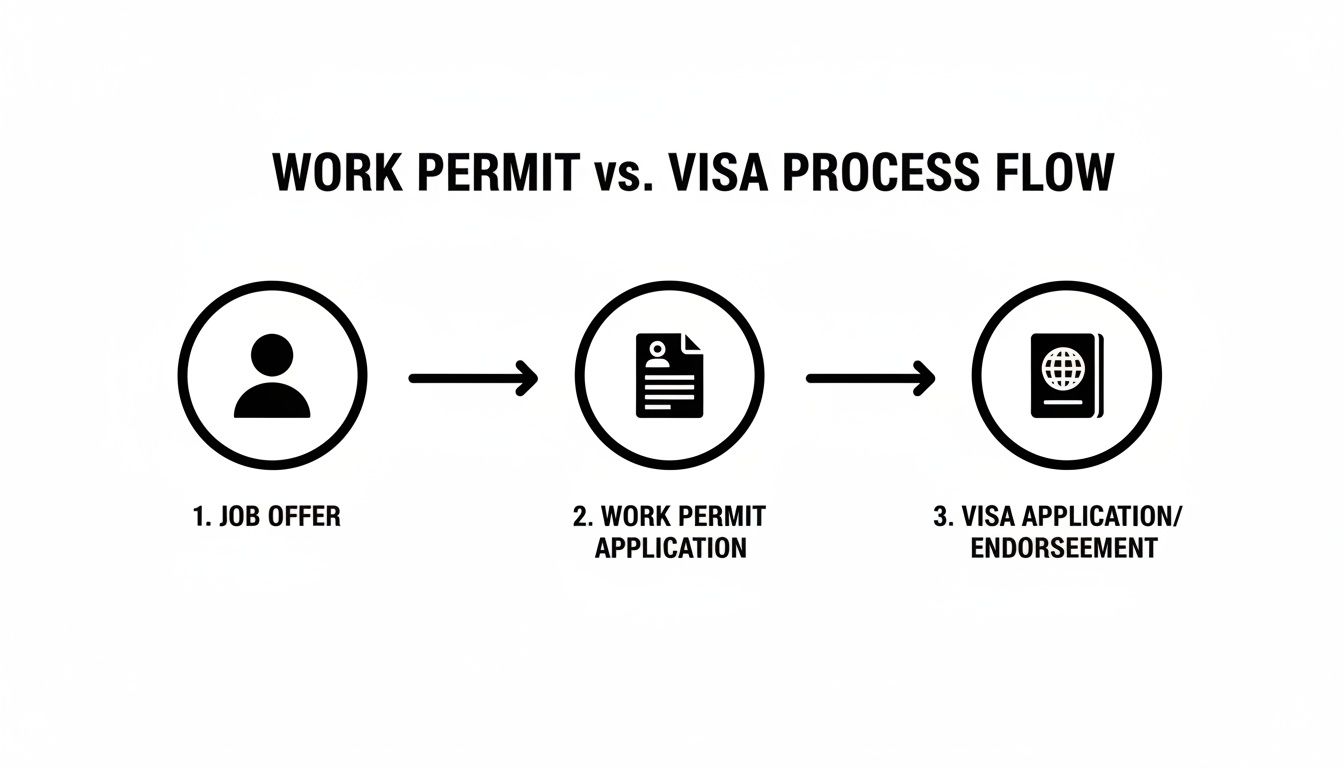
As you can see, the AEP acts as the critical bridge connecting your employment offer to your legal right to work and live in the country. Let's break down exactly how you cross that bridge.
Step 1: Gather Your Essential Documents
Before you fill out a single form, your first job is to get all your paperwork in order. This is where most applications hit a snag—a missing document can bring everything to a halt. While your employer will drive the process, they'll need key documents from you, so having them ready is crucial.
Here’s the core checklist for your AEP application:
- Completed Application Form: Make sure it's filled out perfectly. No empty fields, no mistakes.
- Passport: You'll need a clear copy of your passport's main page (the one with your photo) and the page showing your most recent entry stamp into the Philippines.
- Employment Contract: A copy of the contract you signed, or an official appointment letter. It must clearly outline your role, salary, and responsibilities.
- Company Permits: Your employer will handle this part, providing copies of their legal documents like SEC registration and Mayor's Permit.
- Recent ID Photos: Two recent passport-sized pictures taken against a plain white background.
Getting these items organized from the very beginning will save you and your employer a massive headache later on.
Step 2: The Labor Market Test Publication
This is, without a doubt, the most critical—and often most confusing—part of the AEP process. DOLE has a mandate to protect the local workforce, so they need to verify that your job was offered to Filipinos first. This is done through a formal labor market test.
To satisfy this, your employer is required to publish the job vacancy in a major national newspaper. This advertisement must include your name, the position you've been hired for, and a summary of your qualifications. The ad has to run for at least 15 calendar days before the AEP application is even submitted.
The entire point of the labor market test is to ensure fairness. DOLE is essentially asking the public, "Is there really no Filipino citizen available who can do this job?" The newspaper publication is the tangible proof that an effort was made to hire locally.
This principle of testing the local market is a common feature in work permit systems worldwide. For a bit of perspective on how other countries handle this, this guide on the China work permit visa process provides an interesting comparison.
Step 3: Filing the Application and Paying Fees
Once your documents are ready and the newspaper publication period is complete, it's time to make it official. Your employer, or a representative they authorize, will file the application at the DOLE Regional Office that covers your place of work.
When the application is submitted, the government fees must be paid.
AEP Fee Breakdown:
- Application Fee: PHP 10,000 for a permit valid for one year.
- Annual Renewal Fee: An extra PHP 4,000 for each additional year you need the permit.
For example, if you're getting a permit for three years, the total cost would be PHP 10,000 + (2 x PHP 4,000) = PHP 18,000. After filing and payment, you'll be given a claim stub—hold onto this, as it's your official receipt and proof of application.
Step 4: Await Approval and Claim Your AEP Card
Now comes the waiting game. DOLE will review your entire application package. Assuming everything is in order and the labor market test is satisfied, your AEP will be approved. The typical processing time is about 2 to 3 weeks, but this can change depending on how busy that particular DOLE office is.
Once approved, DOLE issues the actual AEP card. This isn't just another piece of plastic; it's your official proof of authorization to work in that specific role for that specific company. Your employer will usually claim the card for you.
With your AEP card finally in hand, you're officially cleared to start the next major phase of your journey: applying for your 9(g) work visa.
Securing Your 9(g) Work Visa and Other Permits
Getting your Alien Employment Permit (AEP) approved is a huge milestone, but it's only half the battle. You’ve successfully gotten the green light from the Department of Labor and Employment (DOLE) to perform a specific job. Now, you need permission from the Bureau of Immigration (BI) to actually live in the Philippines while you do that job.
This is where the 9(g) Pre-arranged Employee Visa comes into play.
A good way to think about it is that your AEP is your confirmed job offer, and the 9(g) visa is the entry pass that lets you stay in the country to fulfill it. You can't get one without the other, and the AEP is always the first piece of the puzzle. This next stage is very much a team effort; your sponsoring company drives the application, but they'll need you to be responsive in providing documents and showing up for appointments.
The 9(g) Visa and Your ACR I-Card
The 9(g) visa is the standard work visa for most foreign professionals taking on long-term roles in the Philippines. It’s usually granted for one to three years, and its validity is tied directly to your employment contract and AEP. Be prepared, though—this process is more complex and takes significantly longer than the AEP application.
Key Documents Your Employer Will Need:
- Your original passport, which must be valid for at least another six months.
- Your brand new AEP card issued by DOLE.
- A stack of company legal documents, like its SEC registration and Mayor's Permit.
- The BI’s official application form, completed and notarized.
Once everything is submitted, it becomes a waiting game. The official processing time at the Bureau of Immigration can be anywhere from two to three months, but honestly, it can sometimes stretch longer if they're dealing with backlogs. A little patience goes a long way here.
Upon approval of your 9(g) visa, you will also be issued an Alien Certificate of Registration Identity Card (ACR I-Card). Do not underestimate the importance of this card. It's a credit card-sized ID that contains your personal details, visa status, and a security microchip. You are legally required to have it with you at all times.
The ACR I-Card is your day-to-day proof of legal residency. It's what you'll use to open a local bank account, sign a lease on an apartment, and handle any official business. It truly solidifies your status as a legal resident worker.
The Provisional Work Permit for a Fast Start
So what happens if your company needs you on the job tomorrow, but the 9(g) visa is still months away? This is a common dilemma. Thankfully, the system has a solution: the Provisional Work Permit (PWP).
The PWP is a temporary pass issued by the Bureau of Immigration that acts as a bridge. It allows you to start working legally for your employer while the full 9(g) visa is being processed. It's an essential tool for businesses that can't afford to have their new talent sitting on the sidelines.
Getting a PWP is straightforward, provided you meet two key criteria:
- You have already been issued an Alien Employment Permit (AEP).
- Your employer has formally filed your 9(g) visa application with the Bureau of Immigration.
A PWP is generally valid for three months and can be renewed as needed until your 9(g) visa is finally approved and stamped into your passport. It's the proper, legal way to get started quickly without violating immigration laws.
For Short-Term Gigs: The Special Work Permit
The 9(g) visa is built for long-term employment. But what if you're a consultant, artist, or specialist coming in for a project that will only last a few months? Going through the entire 9(g) process would be unnecessary and impractical.
For these exact scenarios, there's the Special Work Permit (SWP).
The SWP is also issued by the Bureau of Immigration, but it's a completely different animal from the 9(g) visa. The distinction is critical.
SWP vs. 9(g) Visa
| Feature | Special Work Permit (SWP) | 9(g) Pre-arranged Employee Visa |
|---|---|---|
| Duration | For work up to 6 months. | For long-term employment (1-3 years). |
| Prerequisite | Does not require a prior AEP. | Requires an approved AEP. |
| Nature | A temporary permit for non-resident work. | A formal visa for legal residents. |
| Best For | Consultants, artists, short-term project staff. | Full-time employees, executives, managers. |
The SWP is a fantastic, fast-track solution for temporary assignments. The most important thing to remember is its hard limit: an SWP cannot be extended beyond six months. It doesn't grant you residency, and if a short-term project unexpectedly turns into a long-term role, you can't just keep renewing it. You would have to begin the formal long-term work permit Philippines process from scratch, starting with an AEP.
Employer Responsibilities and Compliance
If you're hiring a foreign national in the Philippines, one thing needs to be crystal clear: sponsoring their work permit is a serious legal commitment, not just a mountain of paperwork. As the employer, the buck stops with you. Getting this wrong can lead to some genuinely painful consequences.
Think of it this way: you are legally guaranteeing that your foreign employee is working above board. This means absolutely no work—not a single task—can start until their AEP and the appropriate visa, like a PWP or 9(g), are approved and in hand.
The Core Duties of a Sponsoring Employer
Your job as a sponsor doesn't end once the initial application is submitted. It's an ongoing responsibility that involves keeping a close eye on deadlines, reporting changes, and making sure everything stays aligned with DOLE and BI rules. The government sees you as the first and most important gatekeeper.
Here’s what that looks like in practice:
- Staying on Top of Renewals: Expiration dates for AEPs and 9(g) visas can sneak up on you. It's your job to track these dates and kick off the renewal process with plenty of time to spare, ensuring there's no gap in their legal status.
- Reporting Any Changes: Did your employee get a promotion or move to a different project site? You must notify both DOLE and the BI. A major change in job duties might even mean you have to apply for a brand-new AEP.
- Managing Departures: When a foreign employee’s contract ends, your obligations aren’t over. You're required to inform the authorities so they can officially cancel the work permit and visa.
A big part of staying compliant is Mastering Right to Work Checks from the very beginning. Verifying that every foreign team member is legally cleared to work is a non-negotiable step that protects everyone involved.
The High Cost of Non-Compliance
Let me be blunt: Philippine authorities have little patience for violations. Having a foreign national work without the correct permits is a major offense, and the penalties can do more than just sting—they can put a real dent in your business.
Non-compliance isn't just a slap on the wrist. Fines can range from PHP 50,000 to PHP 100,000 for each instance of a foreign national found working without a valid permit.
And it doesn't stop with fines. If you’re caught multiple times, you could be blacklisted from hiring foreign talent altogether. In the most serious scenarios, company executives could even face criminal charges. It’s a powerful reminder to treat every work permit Philippines application with the attention it deserves.
Compliance in Modern Work Models
These responsibilities are the same no matter what your office setup looks like. Whether you're in a traditional office tower or using a more flexible solution, the legal burden remains entirely yours. The Philippines has an incredibly deep talent pool, with the domestic workforce hitting 50.09 million as of August 2025, which gives you plenty of options.
Even if you’re using a BPO or seat leasing service that provides the desks and the internet, you are still the direct employer. That means you are the one accountable for immigration compliance. It’s crucial to understand the full scope of seat leasing inclusions so you know exactly where their services end and your legal duties begin. At the end of the day, building a compliant, global team starts with you.
Making a Place for Global Talent in Your Local Office
So you’ve done the hard work. You’ve successfully navigated the requirements for a work permit Philippines and your new foreign expert is ready to start. But what if you don't have—or need—a massive, traditionally leased office for them?
This is a common crossroads for modern businesses. Let's say you've just hired a brilliant project manager from Germany to lead your local team of 20 developers. You've sorted out their AEP and 9(g) visa with DOLE and the BI. Now, you just need a practical, professional space for them to work alongside their new colleagues without the headache of a five-year commercial lease.
That’s where flexible workspace solutions, like seat leasing, have become a game-changer.
The Plug-and-Play Office Solution
Seat leasing bridges the gap between getting a work permit and getting to work. It allows you to place your new hire in a fully-serviced office from day one. They can walk in and find everything they need: a desk, reliable high-speed internet, meeting rooms, and even IT support.
This setup is particularly effective in the Business Process Outsourcing (BPO) world, which often blends specialized leadership from abroad with large, skilled Filipino teams. A foreign manager with a valid work permit can step right in and start collaborating immediately, with zero operational delays.
Think of it as separating the people from the place. The employer is fully responsible for all legal and compliance aspects of the work permit, while the seat leasing provider handles the physical infrastructure. It’s a clear division of duties that enables operational agility.
This model mirrors the flexibility inherent in global talent movement. The Philippines has a long history of sending skilled workers abroad, and a closer look at the Filipino diaspora shows that employers often prefer rehired, experienced talent. You can explore this dynamic evolution of overseas employment in more detail through extensive research on the topic. That same global experience often informs how businesses can best integrate foreign experts coming into the country.
A Blueprint for BPO Success
The BPO industry's rapid growth is a perfect example of this model in action. Success in this sector depends on razor-sharp operational efficiency, and that's exactly what seat leasing delivers. By outsourcing the management of the physical office, companies can pour their time and money into what really drives the business: serving clients, ensuring quality, and building a strong team.
Key Factors for Integrating Teams in a BPO Setting:
- Strategic Location: Choose a facility that’s easy for your local employees to get to. Most top-tier serviced offices are in central business districts with great access to public transport.
- On-Demand Scalability: Seat leasing lets you grow your team at your own pace. You can add or remove desks as projects demand, without being locked into a rigid contract.
- Clear Compliance: It's crucial to remember that the legal responsibility for the work permit Philippines application and ongoing compliance rests 100% with you, the employer.
Ultimately, flexible workspaces are what make a modern, global workforce strategy possible on the ground. They provide the agility to bring in top talent from anywhere and get them productive right away, as you can see in a fully-equipped BPO office building designed for exactly this purpose. This allows you to combine the best of both worlds: specialized foreign expertise and the Philippines' deep pool of skilled local professionals.
Common Work Permit Questions Answered
When you're dealing with the work permit Philippines process, a lot of practical questions pop up. It’s completely normal. As you go from submitting documents to waiting for that final approval, the same uncertainties tend to cause the most stress.
Let's cut through the confusion. Here are some straightforward answers to the questions we hear all the time from both employers and foreign talent. Getting these details right from the start can save you from some serious headaches and delays down the road.
Can I Start Working While My 9(g) Visa Is Being Processed?
This is easily the most common question we get, and the answer isn't a simple yes or no. You can't legally start your job while only waiting for your 9(g) visa, but there’s a crucial workaround: the Provisional Work Permit (PWP).
Once your Alien Employment Permit (AEP) from DOLE is approved and your 9(g) visa application is officially on file with the Bureau of Immigration, you can apply for a PWP. This permit is your legal green light to begin working while the government processes the much lengthier 9(g) visa. A PWP is usually valid for three months and can be renewed if the 9(g) takes longer than expected.
What Happens if I Change Employers?
Here’s the deal: your work permits are tied directly to the company that sponsored you. They are not portable. If you get a new job offer, you can't just carry your existing AEP and 9(g) visa over to the new company.
The entire process has to start from scratch. Your old employer is legally obligated to cancel your current permits. Then, your new employer must apply for a brand-new AEP and, subsequently, a new 9(g) visa. It is illegal to work for the new company using the permits from your previous job. You can find more practical advice for employers and employees on our Seat Leasing BPO blog.
How Long Does the Entire Process Really Take?
Patience is more than a virtue here; it's a necessity. Being realistic, you should plan for the whole process to take anywhere from two to four months.
The AEP application with DOLE is the quicker part, typically wrapping up in about 2-3 weeks. It’s the next step—the 9(g) visa application with the Bureau of Immigration—that really tests your patience, often taking another 2-3 months.
Keep in mind that these are just estimates. Government holidays, application backlogs, or even a single missing document can tack on extra weeks to your timeline. The best strategy is always to start as early as you possibly can.
At Seat Leasing BPO, we provide the agile office infrastructure to support your global team from day one. We handle the complexities of IT, internet, and office management, freeing you to focus on your people and your business growth. Discover how our flexible workspace solutions can power your operations by exploring our Seat Leasing BPO services.