If you're looking for the most inexpensive business phone line today, your search will almost certainly lead you to one place: VoIP (Voice over Internet Protocol). This isn't your traditional phone line. Instead of relying on the old copper-wire network, VoIP routes your calls straight over the internet connection you're already paying for.
The result? Drastically lower costs and a surprising number of powerful features that level the playing field for small businesses.
Why VoIP Is the Go-To for Modern Businesses
Let's be honest, nobody misses dealing with the phone company. The days of expensive hardware, rigid contracts, and paying for physical lines that collect dust are over. For lean, modern businesses—from a solo freelancer to a growing BPO team using a seat leasing model—VoIP just makes sense.
The biggest win is the immediate cost savings. You stop paying for a separate telephone service and simply use your existing internet. But the real magic happens when you see what else comes with it.
More Than Just a Cheaper Phone Bill
Switching to VoIP gives you access to a toolkit of professional features that, not long ago, were only available to massive corporations with equally massive budgets. These tools help you sound bigger and operate smarter.
Here’s a taste of what you get:
- A Virtual Receptionist: You can easily set up an auto-attendant ("Press 1 for Sales, Press 2 for Support") with custom greetings and smart call routing. Calls find the right person, whether they're at a desk or working from home.
- Scale Up (or Down) Instantly: Need to add a new team member? It takes a few clicks in a software dashboard. No waiting for a technician or installing new lines. This is a lifesaver for businesses with seasonal needs or rapid growth.
- Know Your Numbers: Get real data on call volumes, average wait times, and your busiest hours. This kind of insight is gold for figuring out staffing and making sure your customer service is top-notch.
- All-in-One Communication: Many VoIP providers bundle everything—voice calls, video meetings, and business texting—into one clean app. It simplifies your workflow and your budget.
The Bottom Line: Financial and Operational Wins
For startups and BPOs, particularly those in shared or flexible workspaces, moving to a VoIP system isn't just a small upgrade; it's a strategic financial decision. We've seen businesses slash their communication costs by up to 50-70% compared to what they were paying for traditional landlines.
This impact is shaking up the entire industry. The global VoIP market is expected to balloon from USD 66.02 billion in 2026 to a staggering USD 132.33 billion by 2034.
The move to VoIP is more than a trend—it’s a fundamental shift. It allows smaller, agile operations to project a professional image and use enterprise-grade tools without the enterprise-grade price tag. That frees up cash and focus for what really matters: growing the business.
To see how this technology can specifically benefit your operations, it's worth learning more about a professional VoIP telephone service.
Ultimately, finding an "inexpensive" business phone line isn't just about the lowest monthly price. It’s about getting the smartest, most flexible communication system that gives you a real competitive advantage.
Comparing Your Phone Line Options
Picking the right phone service isn’t about navigating a maze of technical jargon. It’s about finding the tool that actually fits what you do every day. The "best" inexpensive business phone line is simply the one that matches your team's size, workflow, and budget.
Think of it this way: a freelance graphic designer probably just needs a professional-looking number that rings their cell phone. It keeps business and personal calls separate without any fuss. But a growing 10-person BPO team? They'll need a full-blown VoIP system with call routing, analytics, and an auto-attendant to manage their call volume effectively.
This flowchart is a great starting point. It helps you quickly narrow down the options based on what you really need.
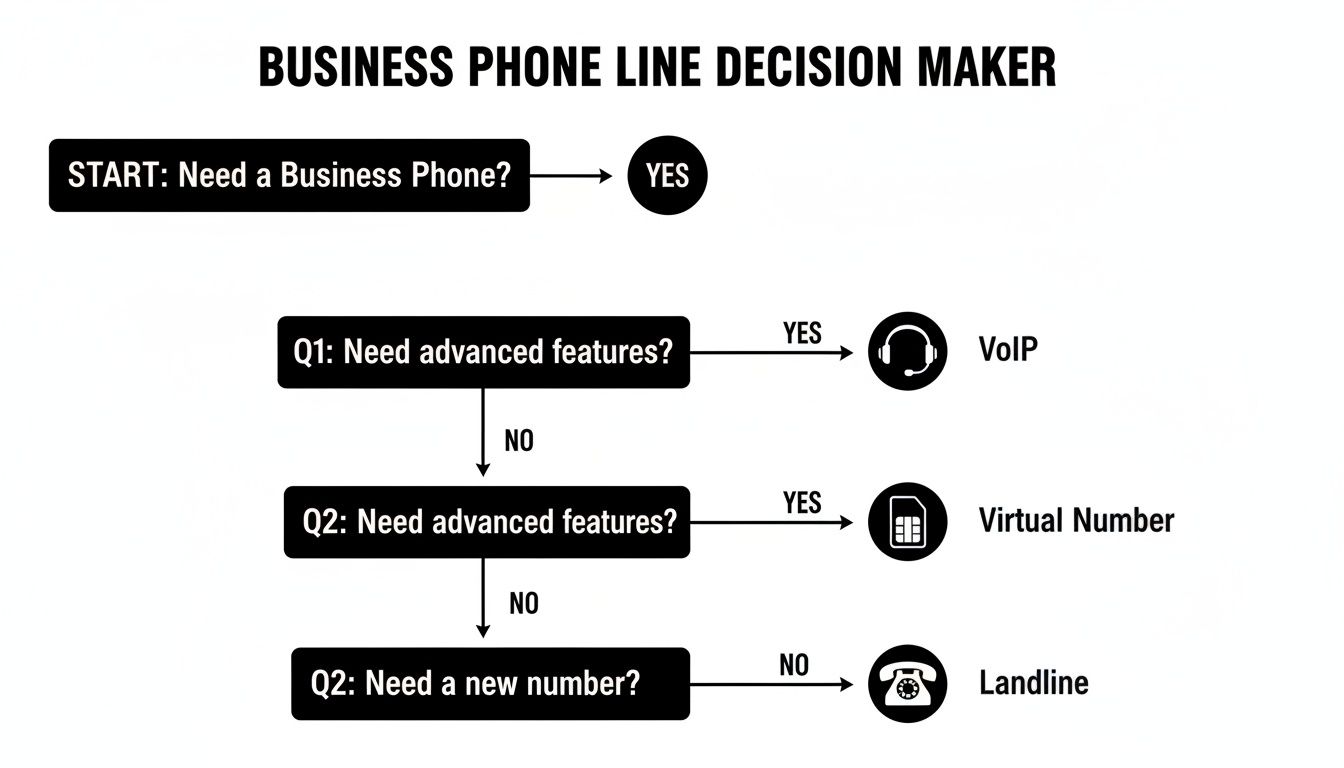
As you can see, if you need features like call routing or performance analytics, VoIP is almost always the answer. If your needs are simpler, it’s a choice between getting a new virtual number or sticking with a physical phone line.
Voice over IP (VoIP): The All-in-One Solution
For most modern businesses, VoIP is the go-to choice. It's flexible, scalable, and packs a ton of features into one package. It essentially turns your internet connection into a complete communications hub for voice, video, and messaging.
- Best For: Startups, BPO teams, remote companies, and any business with plans to scale.
- Pros: Loaded with features (auto-attendant, call recording, analytics), easy to scale up or down, and very cost-effective. Plans typically start around $20-$30 per user, per month.
- Cons: Your call quality is completely dependent on your internet connection. No internet means no phone service.
VoIP acts like a command center for your communications. From a single dashboard, you can add new employees in minutes, set up rules to forward calls to the right department, and even track call volume to make sure you're staffed properly during peak hours.
Virtual Phone Numbers: The Simple and Professional Choice
A virtual number is exactly what it sounds like: a real phone number that isn't tied to a physical phone line. You can get a local or toll-free number and have it forward calls to any phone you want—most commonly, your personal mobile.
This is the perfect middle ground for solopreneurs or micro-businesses. It gives you a legitimate business number to put on your website and business cards, creating a professional image and separating work from personal life without any new hardware.
Most providers also give you a mobile app. This lets you make calls and send texts that show your business number as the caller ID, keeping your personal number completely private. It's the ideal inexpensive business phone line for anyone just getting started.
Traditional Landlines: The Old Guard
We all know what a landline is. It’s the classic phone service that runs through physical copper wires installed by the phone company. It’s incredibly reliable but feels dated compared to the other options. When you're looking at phone systems, it's worth knowing how a traditional 2-Line Telephone System compares to modern alternatives.
- Best For: Businesses in areas with spotty internet or those that need a physical line for specific hardware like a credit card machine, fax, or alarm system.
- Pros: Rock-solid reliability. It works even when the power or internet is out (as long as you have a basic, non-powered phone).
- Cons: It's expensive, often costing $40 or more per line. You're also tied to a physical location and miss out on modern features like call analytics or a mobile app.
For most businesses looking to grow, the high cost and lack of flexibility make landlines a tough sell. The world has largely moved to more dynamic, internet-based solutions for a reason.
Your VoIP System Setup Checklist
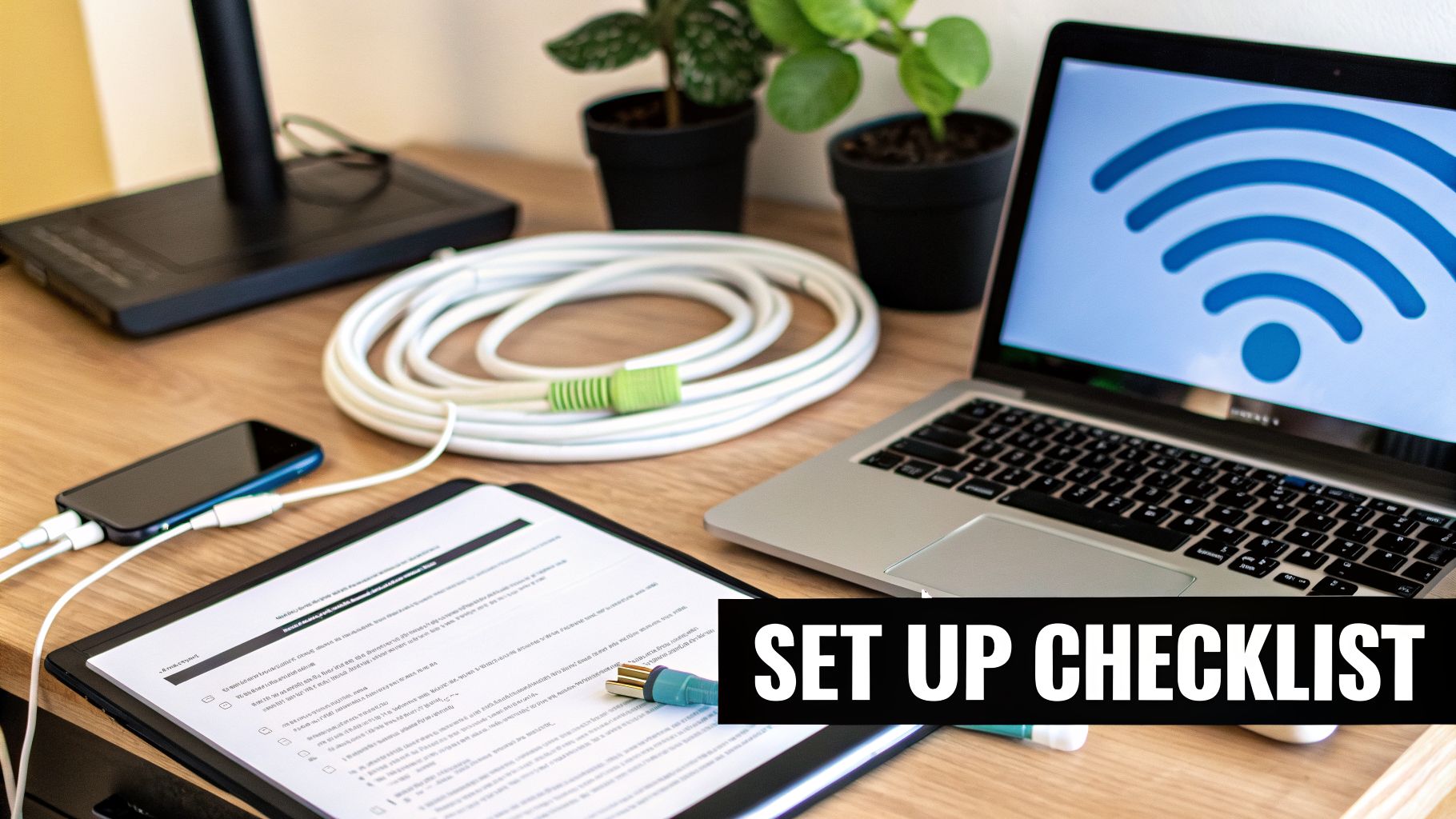
You've decided on a budget-friendly business phone line—great call. But the real win is getting it set up without any hiccups. This isn't about diving into complex technical manuals; it's about following a practical game plan to ensure your new VoIP system just works from the moment you switch it on.
Let's walk through the key steps I've seen make or break a new phone system launch.
First, Check Your Internet's Pulse
Before you even start comparing VoIP providers, you need to know if your internet connection is up to the task. This is the single most common point of failure.
- Look for stability, not just speed. Run several speed tests at different times of the day. You’re looking for consistency. While each call only needs about 100 kbps of upload and download bandwidth, unstable connections with high jitter will lead to dropped calls and garbled audio.
- Spot any network bottlenecks. Are you on a crowded Wi-Fi network with dozens of other devices competing for bandwidth? If you’re in a shared office or a BPO seat leasing setup, this is usually a non-issue. They provide business-grade internet designed for this exact purpose, which is a massive advantage.
Choosing Your Provider and Phone Number
Once you're sure your internet can handle the load, you can confidently start shopping for a provider. The goal here is to find a plan that gives you the features you actually need without paying for extras you'll never touch.
Think about your daily operations. Do you need call recording for quality assurance? How important is an auto-attendant for directing callers? List your must-haves first.
Next up is your phone number, which is a core part of your business identity. You have two main paths:
- Grab a new number. Providers make it easy to get a local, toll-free, or even a catchy "vanity" number. This is the fastest way to get up and running with a professional presence.
- Port your existing number. If clients already know and use your current number, you’ll want to bring it with you. This process is called number porting. Just be aware, it can take a few weeks. Start the process early and, whatever you do, don't cancel your old phone service until the port is 100% complete.
This move to software-based phones is a major industry shift. We're seeing a huge drop in demand for traditional hardware, with enterprise desk phone revenue falling 9.2% to $2.21 billion in 2024. Meanwhile, the mobile VoIP market is exploding, which tells you everything you need to know about where things are headed. To get a broader view of these trends, you can find more detail in the business phone system market report on datainsightsmarket.com.
Configuring Your System for Success
With your provider selected and your number sorted out, it’s time to actually configure the system. This is where you bring your inexpensive business phone line to life and make it work for you, not the other way around.
Pro-Tip: Don't just "set it and forget it." Take 30 minutes to configure your auto-attendant and call forwarding. A professional greeting ("Thank you for calling [Your Company]. Press 1 for Sales…") instantly makes your business sound bigger and more credible. It also ensures calls always reach the right person, even if your team is remote.
Get your basic call flows mapped out, create user accounts for everyone on the team, and record your main voicemail message.
Honestly, this is where a seat leasing model can be a real lifesaver. The on-site IT support can handle all this for you or walk you through it, troubleshooting any snags on the spot. It turns what could be a frustrating task into a simple, plug-and-play experience that gets your lines live in no time.
For more hands-on advice for optimizing your operations, feel free to check out our guide on the Seat Leasing BPO blog.
How to Budget for Your Business Phone Line
An "inexpensive" business phone line is only truly affordable if you know how to budget for it. The advertised monthly price tag is just the beginning. To really understand the cost and avoid any nasty surprises down the road, you have to look at the total cost of ownership. This includes one-time setup fees, any hardware you might need, and extra charges for premium features you’ll eventually want.
Before you even think about signing a contract, get a handle on your expenses by splitting them into two simple categories: one-time costs and recurring costs. This is the easiest way to see the full financial picture.
-
One-Time Costs: Think of these as your upfront investment. This bucket includes things like number porting fees (if you’re bringing your current number with you), activation charges, and the cost of physical gear like IP phones or quality headsets.
-
Recurring Costs: This is your predictable monthly bill. It’s made up of the base per-user fee plus any extras you bolt on, such as additional phone numbers, call recording services, or advanced analytics dashboards.
Sample Budget Scenarios
To put this into perspective, let's look at how a budget can shift dramatically depending on who you are. A solo freelancer has completely different needs than a growing BPO team, and their spending should reflect that.
A freelancer, for example, might just need a virtual number that forwards calls straight to their cell phone. Their budget is refreshingly simple:
- Monthly Cost: $15-$25 for a basic virtual number service.
- Hardware Cost: $0, since they're using their existing smartphone.
- Total First-Year Cost: Somewhere in the ballpark of $180 – $300.
A 5-person startup needs more tools for collaboration. A basic VoIP plan is usually the perfect fit.
- Monthly Cost: $25/user x 5 users = $125.
- Hardware Cost: 5 decent headsets at $50 each = $250 (one-time).
- Total First-Year Cost: Around $1,750.
Now, consider a 20-agent BPO team. They depend on reliability and powerful features to do their job effectively.
- Monthly Cost: $30/user x 20 users = $600.
- Hardware Cost: 20 professional-grade headsets at $75 each = $1,500 (one-time).
- Total First-Year Cost: Approximately $8,700.
Did you notice how hardware can be a major initial hurdle? That's a key detail. At the same time, the rise of affordable, VoIP-powered phone lines is what's fueling the explosive growth of the global BPO industry. With the industry valued at a staggering $352.4 billion in 2024 and still climbing, the low cost of VoIP is critical. It delivers powerful features for a fraction of the $40+ per month you’d pay for a traditional line.
The Seat Leasing Advantage
Here's an insider tip that can completely change your budgeting: your office setup matters. A lot. If you go the traditional route and rent your own office, you're on the hook for everything—the business-grade internet, all the hardware, and the IT staff needed to keep it all running.
A seat leasing model flips the entire cost equation on its head. Because things like enterprise-grade internet, IT support, and secure infrastructure are already baked into the service, your phone system setup becomes incredibly simple. You really only need to budget for your VoIP provider’s monthly fee and any headsets your team wants.
This approach strips away the big capital investments and hidden operational headaches, making that "inexpensive" phone line even more affordable. Your budget simplifies down to a predictable, per-user monthly expense. If this streamlined model sounds like the right fit for your team, we'd be happy to provide a custom quote based on your team's needs.
How Seat Leasing Simplifies Your Communication Setup
Choosing an inexpensive business phone line is just the first step. The real challenge? Making sure it actually works reliably, especially when you're setting up a new team in a shared workspace or starting a BPO. Your physical office environment can either be your biggest headache or your greatest asset.
Instead of trying to piece everything together—office lease, internet contracts, IT support—a seat leasing model rolls it all into one. This creates the perfect, hassle-free foundation for a modern VoIP system to thrive.
Think about the traditional route for a moment. You'd have to find and sign a lease, then hunt down an internet provider that can guarantee business-level stability. After that, you're on the hook for hiring an IT team to run cables and configure the network. I've seen startups burn weeks and thousands of dollars on this process before a single call is ever made.
The Power of Managed Infrastructure
Seat leasing flips that entire script on its head. You walk into a fully-functional office where all the critical tech infrastructure is already in place and professionally managed. We’re not talking about basic coffee-shop Wi-Fi. This is enterprise-grade, high-speed internet built to handle dozens, if not hundreds, of simultaneous VoIP calls without a single dropped connection or choppy conversation.
For your phone system, this managed approach gives you some serious advantages right out of the gate:
- Rock-Solid Reliability: The network is constantly monitored for performance and stability. That’s the secret to crystal-clear voice quality that never falters.
- Built-in Cybersecurity: You’re operating on a secure network from day one. This protects your calls and sensitive customer data without you having to become a security expert overnight.
- On-Site IT Support: Run into a technical glitch or a setup question? Expert help is right there in the building to get you back up and running fast.
The beauty of this is how the physical space and the digital tools work together. You're no longer responsible for building—or maintaining—the technical bedrock your entire communication system depends on.
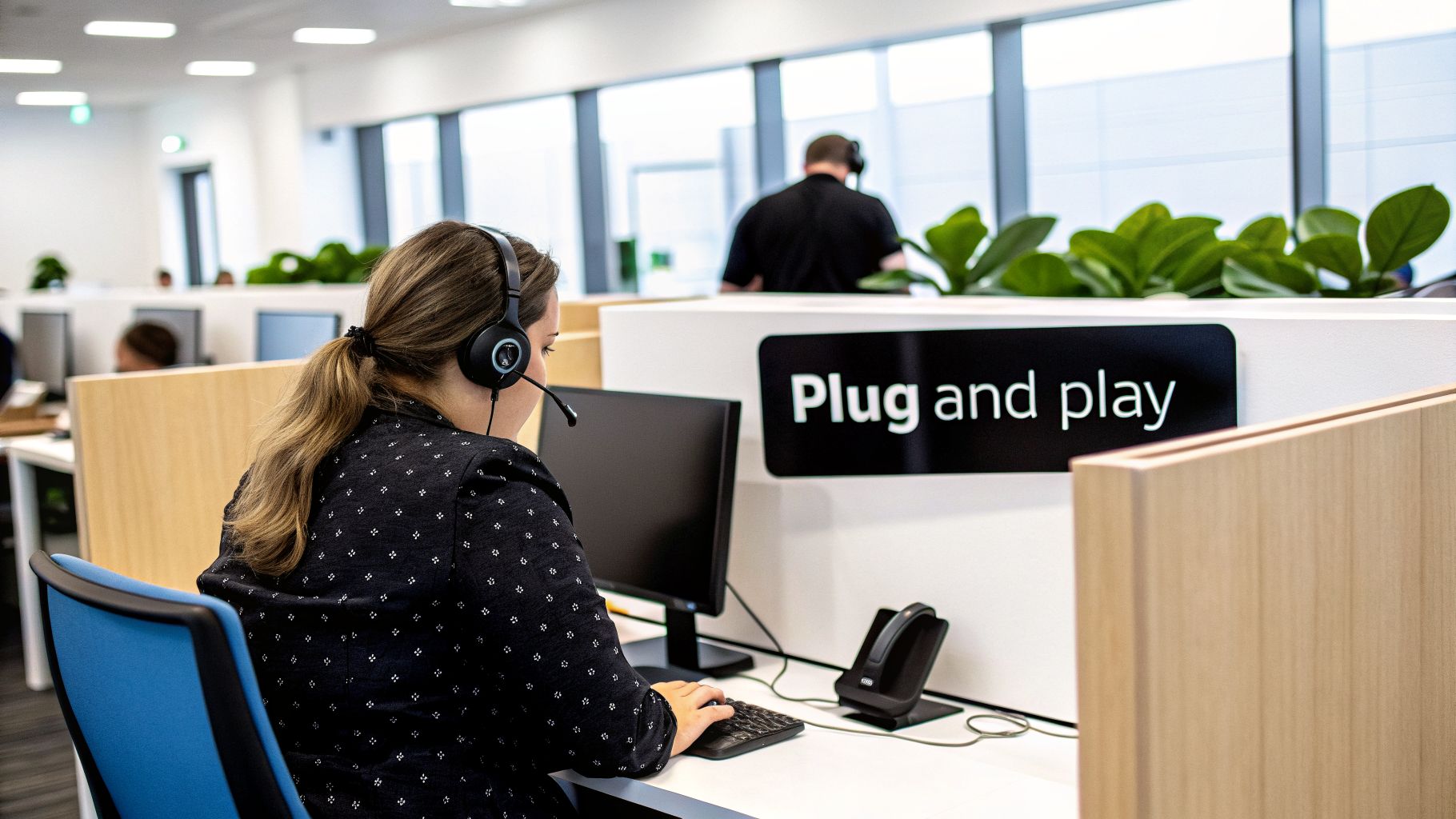
When you remove the burden of managing IT infrastructure, you get true plug-and-play capability. You can deploy a professional, secure call center almost overnight. All that capital and mental energy you would have spent on setup can go directly into growing your business.
Accelerate Your Launch and Focus on Growth
The most immediate benefit is pure speed. A new BPO or startup can be fully operational in a tiny fraction of the time it takes in a conventional office. Your team just shows up, plugs in their headsets, and logs into your VoIP provider's softphone app. It's that simple. The network is already optimized and waiting.
This approach is a lifesaver for any business that needs to be agile and manage its cash flow carefully. By bundling the office space with all the essential IT services, the model drastically cuts down the upfront investment needed to get started. You can launch faster, with fewer headaches, and with the confidence that your inexpensive phone line is backed by a professional-grade network.
If you want to see how this model can fast-track your own launch, you can explore seat leasing solutions on seatleasingbpo.com.
Answering Your Top Questions About Low-Cost Business Phone Lines
When you're trying to find an affordable phone line for your business, a few questions always seem to pop up. Getting these sorted out upfront is key to making a choice you won't regret later. Let's walk through the most common things people ask.
Can I Keep My Existing Business Number?
Yes, you can—and you absolutely should. Your customers already know that number, so keeping it is crucial for a smooth transition. The process is called number porting, and pretty much any modern VoIP provider will handle it for you. It’s a standard procedure for moving your existing local or toll-free number to a new service.
Just keep a couple of things in mind:
- It takes time. Porting isn't instant. You should expect it to take anywhere from one to four weeks, depending on the carriers involved.
- Don't cancel your old service yet! This is a big one. Wait until your new provider gives you the official confirmation that the port is 100% complete. If you cancel too early, you could lose your number for good.
There's often a small, one-time fee for porting, but it's well worth it to maintain continuity and avoid confusing your clients.
What Internet Speed Do I Really Need for VoIP?
This is a place where a lot of people get tripped up. You don't need a blazing-fast connection, but you do need a stable one. Call quality suffers more from an unstable connection (high "jitter" or "packet loss") than from a slow one. A choppy, unreliable connection will lead to garbled audio, no matter how much bandwidth you have.
As a rule of thumb, a single VoIP call uses about 100 kbps of both upload and download speed. So, if you have a small team and expect up to 10 calls happening at once, you'd want at least 1 Mbps of dedicated, stable bandwidth set aside just for your phones.
This is one of the hidden perks of working in a seat leasing environment. The office comes with professionally managed, business-grade internet that’s already built to handle the demands of dozens of VoIP calls at once. Call quality is simply never a worry.
Are VoIP Business Phone Lines Secure?
Modern VoIP systems are built with security at their core. When you're using a reputable provider, your calls aren't just broadcast openly over the internet. They're protected using powerful encryption to prevent eavesdropping and keep your data safe.
They typically use a two-pronged approach to security:
- Transport Layer Security (TLS): This encrypts the call signaling—all the behind-the-scenes data used to set up and manage the call.
- Secure Real-Time Transport Protocol (SRTP): This encrypts the actual audio of your conversation, ensuring it stays private.
Working in a shared space, like one from a seat leasing company, adds another layer of security. The entire network is managed with enterprise-grade firewalls and cybersecurity protocols, protecting not just your calls, but all of your business activity online.
Do I Have to Buy Special Phones for a VoIP System?
No, not at all. This is actually one of the biggest ways you can save money when setting up an inexpensive business phone line. You have a few great options that don't involve buying a new set of desk phones:
- Use Softphones: A softphone is just a software application you install on your computer or smartphone. Pair it with a good headset, and you're ready to make and receive calls from your existing devices.
- Use an ATA Adapter: Have some old analog phones you like? An Analog Telephone Adapter (ATA) is a small box that plugs into your router and lets you connect those traditional phones to your new VoIP service.
- Purchase IP Phones: Of course, if you want that classic desk phone experience, you can always buy IP-enabled phones designed specifically for VoIP.
This flexibility means you can get your phone system up and running with almost no upfront hardware cost, and then add physical phones later if you find you need them.
Are you ready to stop worrying about IT infrastructure and focus on what you do best? Seat Leasing BPO provides a plug-and-play office environment with managed, high-speed internet perfect for any business phone system. Learn more at seatleasingbpo.com.