The Philippines has long been a go-to for outsourcing, but the strategy is evolving far beyond simple cost reduction. Today, it’s about accessing a unique combination of highly skilled talent, strong cultural alignment with Western markets, and sophisticated operational setups. The old guard of BPO giants remains, but newer, flexible models like seat leasing are opening the door for businesses of all sizes to build teams here without the massive initial investment.
This guide moves past generic success stories to offer a strategic breakdown of companies that outsource to the Philippines. We will examine seven distinct players, from global enterprise leaders to agile BPO providers and seat leasing enablers. For each example, you will get a clear analysis of:
- What functions they outsource and how they structure their teams.
- Why their specific model works and the strategic advantages it offers.
- Actionable lessons you can apply to your own business, whether you need a full-service BPO or a more direct seat leasing arrangement.
This isn’t just a list; it’s a playbook. We'll dissect the real-world strategies that make the Philippines a smart bet for growth, helping you decide on the right approach for your operational needs.
1. Seat Leasing BPO
For companies ready to establish a physical presence in the Philippines but want to bypass the immense costs and logistical hurdles of traditional office build-outs, Seat Leasing BPO presents a compelling, infrastructure-first solution. This platform is not a BPO itself; instead, it provides the secure, fully managed, and production-ready workspace that BPOs, startups, and remote teams need to operate efficiently from day one. It is a standout choice for businesses that prioritize speed, security, and operational continuity without the burden of heavy capital expenditure.
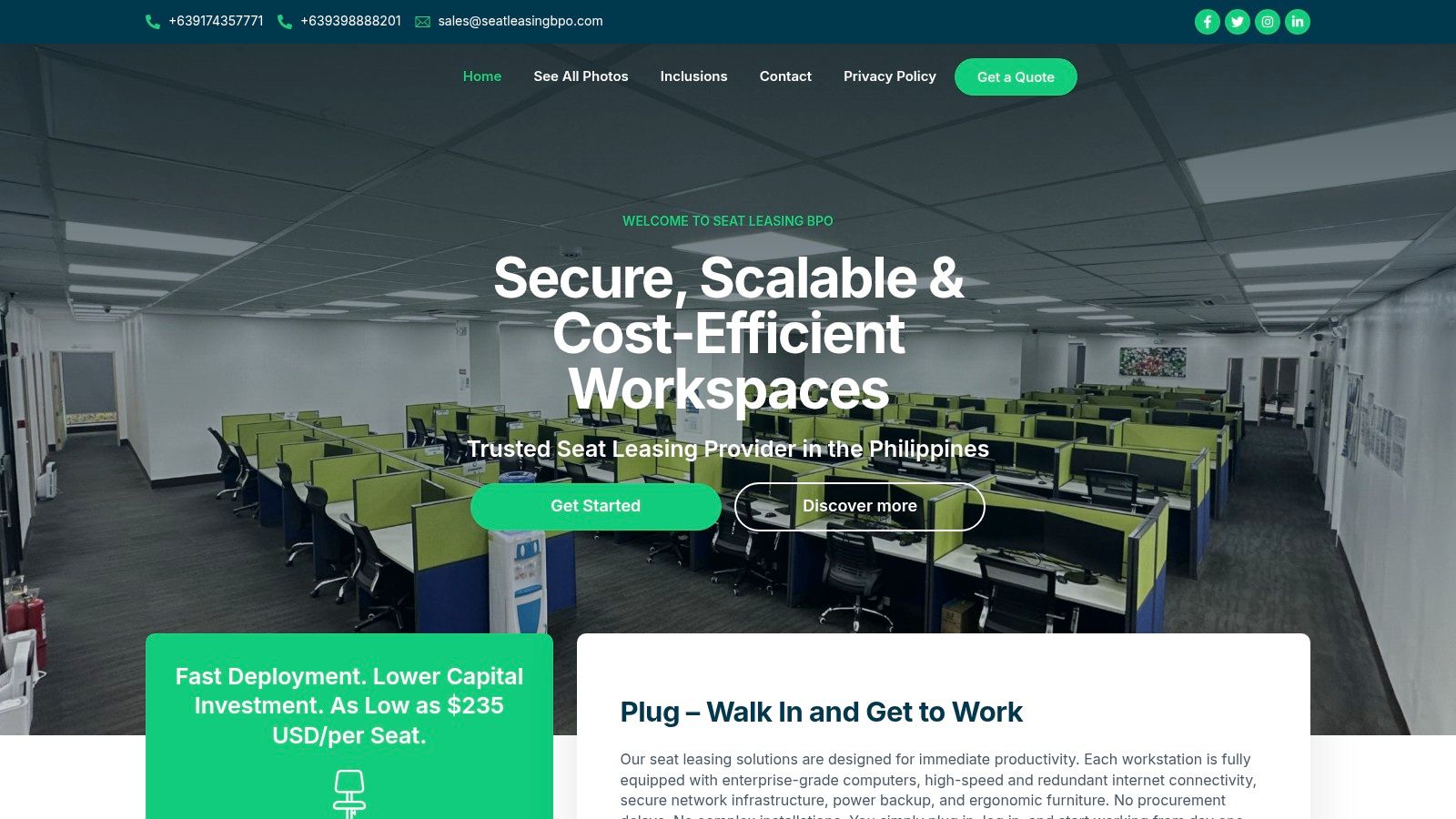
The core value is its "plug-and-play" model. Instead of spending months on procurement, renovation, and IT setup, a business can secure workstations that are already equipped with enterprise-grade computers, ergonomic dual-monitor desks, and a robust network infrastructure. This model is particularly effective for companies that outsource to the Philippines and need to scale their teams quickly in response to client demands or market growth, as it removes the typical delays associated with infrastructure deployment.
Strategic Analysis: The Turnkey Infrastructure Advantage
Seat Leasing BPO’s strategy centers on removing operational friction. By handling the entire backend stack, from IT management and cybersecurity to utilities and physical security, it allows its clients to focus exclusively on their core business: managing their people and delivering services. This is a critical distinction from both traditional office leases and many co-working spaces.
The company's deep focus on security and compliance makes it a prime candidate for businesses in regulated industries like finance, healthcare, and technology. Certifications such as ISO 27001:2022, SOC 2 (Type 1 & 2), and ISO 9001:2015 are not just badges; they represent a commitment to maintaining a secure and reliable operational environment, a non-negotiable for handling sensitive data.
Key Strategic Point: The business model effectively de-risks market entry and expansion in the Philippines. By converting a large, unpredictable capital expense (office build-out) into a predictable monthly operational expense (seat leasing), companies can test the market, scale flexibly, and protect their capital.
Actionable Takeaways for Your Business
Prioritize for Speed-to-Market: If your business plan requires getting a team operational in weeks, not months, a seat leasing model is an excellent path. You can bypass lease negotiations, construction permits, and IT vendor management entirely.
Mitigate Compliance and Security Risks: For operations involving sensitive customer data (e.g., financial services, healthcare records, intellectual property), partnering with a provider that has verifiable compliance credentials like ISO 27001 and SOC 2 is essential. This shifts a significant portion of the security burden to a specialized third party.
Calculate the True Cost of an Office: Before committing to a traditional lease, calculate the total cost of ownership. Factor in not just rent but also IT hardware, security systems, internet redundancy, generator backup, and the salaries of the IT and facilities staff needed to manage it all. Compare this to the all-inclusive per-seat cost offered by a provider like Seat Leasing BPO. You can explore their plug-and-play model to understand the potential savings.
Use Seat Leasing for Flexible Scaling: This model is ideal for project-based work or for companies experiencing rapid growth. You can add or remove seats based on operational needs without being locked into a long-term, fixed-space lease.
Platform Breakdown
| Feature | Analysis |
|---|---|
| Pricing & Access | Starts at a competitive $235 USD per seat, but final pricing requires a consultation. This model ensures you only pay for what you need, though it adds a step to the procurement process. |
| Infrastructure | A-Grade. Features a 1G network backbone, redundant high-speed ISPs, centralized UPS, and diesel generator backup. This built-in redundancy is a major differentiator, guaranteeing uptime. |
| Security & Compliance | Exceptional. ISO 27001, SOC 2, and ISO 9001 certifications, supported by a dedicated cybersecurity team. This makes it suitable for high-stakes, data-sensitive operations. |
| Location | Philippines-focused. While this is a strength for targeting the Filipino talent pool, it is not a solution for businesses requiring a multi-country or global physical footprint. |
2. Concentrix
Concentrix represents the enterprise-scale BPO partner for global brands needing robust, secure, and geographically diverse operations. As one of the largest companies that outsource to the Philippines, this US-headquartered firm provides a complete suite of customer experience (CX) services, including technical support, sales, content moderation, and extensive back-office processing. Their key differentiator is their massive physical footprint across the Philippines.
Unlike smaller agencies, Concentrix offers built-in business continuity with sites in over 18 cities, including Manila, Cebu, and Davao. This geographic redundancy minimizes operational risk from local disruptions, a critical factor for corporations that require 24/7 uptime. Their services are designed for businesses in regulated industries like finance and healthcare, where data security and compliance are non-negotiable.
Strategic Analysis & Actionable Takeaways
Concentrix excels at large-scale, complex projects where governance and security are paramount. Their pricing is bespoke and typically requires significant contract minimums, making them a better fit for established enterprises than for startups. For businesses evaluating this level of partnership, it's a reminder of the importance of aligning operational scale with provider capability. While their model is not direct seat leasing, understanding the components of their all-inclusive service can provide valuable insights into what a premium BPO setup includes. You can discover what typical seat leasing inclusions cover to compare against a fully managed solution.
Key Strategic Insights:
- Geographic Redundancy: Operating from multiple, geographically distinct locations within the Philippines is a core strategy for risk mitigation.
- Compliance as a Service: For regulated industries, choosing a partner with pre-existing compliance frameworks (e.g., PCI, HIPAA) is more efficient than building them from scratch.
- Scale Enables Specialization: Their size allows them to build deep expertise and dedicated teams for specific industries and complex tasks, such as multilingual support or high-level technical troubleshooting.
For businesses that require enterprise-grade security, proven scalability, and multi-site operational continuity, Concentrix offers a mature and reliable solution.
Website: https://www.concentrix.com
3. Teleperformance Philippines
Teleperformance stands as a testament to process maturity and stability in the outsourcing sector. Operating in the Philippines since 1996, it is one of the pioneering companies that outsource to the Philippines, offering a deep history of operational excellence. This France-headquartered giant provides a wide array of services, including customer care, technical support, sales, and advanced digital business services for major global brands. Their key differentiator is their longevity and deep-rooted procedural maturity, making them a go-to for enterprises that prioritize predictable outcomes and proven methodologies over experimental approaches.
With a massive nationwide footprint, Teleperformance offers multi-site capabilities that assure clients of business continuity and access to a diverse talent pool. Their services are built for high-volume, enterprise-grade programs where robust quality assurance and strict compliance are critical. Unlike boutique agencies, Teleperformance applies its global best practices and established tooling at the local level, ensuring a consistent standard of delivery for large US and European accounts.
Strategic Analysis & Actionable Takeaways
Teleperformance is the choice for large corporations seeking a reliable, "safe pair of hands" for mission-critical functions. Their pricing structure is designed for significant, long-term contracts and is typically revealed through a formal Request for Proposal (RFP) process, making them less accessible for small businesses or startups looking for quick, flexible pilots. For businesses considering this type of partnership, it highlights the value of having mature, documented processes. Examining the infrastructure of a top-tier provider like Teleperformance can offer insights into what a premium operation entails; for example, you can see the kind of modern facilities available in Cebu's IT Park to understand the physical environment that supports these large teams.
Key Strategic Insights:
- Process Maturity as a Product: Decades of experience have refined their operational playbooks, reducing the risk and ramp-up time for complex, large-scale projects.
- Global Standards, Local Execution: They successfully apply globally standardized tools and quality metrics within the Philippine context, creating predictable and measurable outcomes for clients.
- Bench Strength for Scalability: Their immense talent pool and recruitment engine allow them to rapidly scale teams up or down to meet fluctuating client demand, a capability smaller providers cannot match.
For enterprises where stability, proven performance, and the ability to handle massive volume are the primary decision drivers, Teleperformance offers one of the most established and reliable solutions in the Philippine BPO industry.
Website: https://www.tp.com/en-ph/locations/philippines/
4. Foundever (formerly Sitel + SYKES)
Foundever, the new entity formed from the merger of Sitel and SYKES, is a global customer experience (CX) powerhouse with deep roots in the Philippines. For US companies seeking a partner with significant scale and a proven track record, Foundever is one of the top-tier companies that outsource to the Philippines. They serve over 120 clients in-country with a massive workforce of more than 40,000 associates, offering a full spectrum of services from customer care and technical support to sales, collections, and trust and safety.
Their distinction lies in the combination of immense scale and industry-specific expertise, particularly in regulated sectors like banking, financial services (BFSI), and healthcare, as well as high-touch industries like retail and travel. With 19 locations spread across the country, Foundever provides strong business continuity and access to a diverse national talent pool. This wide footprint is a key advantage for large enterprises that cannot afford downtime.
Strategic Analysis & Actionable Takeaways
Foundever is built for businesses that need to deploy large, specialized teams quickly and reliably. Their model is geared toward long-term, ongoing programs rather than small, short-term projects, with pricing structured accordingly. For companies considering this level of engagement, evaluating their well-documented HR programs and employee retention awards can be a good proxy for service quality and workforce stability. These elements directly impact the consistency and skill of the agents handling your customer interactions.
Key Strategic Insights:
- Merger-Driven Scale: The combination of Sitel and SYKES creates a partner with extensive resources, a broader service portfolio, and a larger talent pool than either company had alone.
- Industry Depth as a Moat: Their focus on regulated and high-touch sectors means they have pre-built compliance frameworks and agent training programs, reducing ramp-up time and risk for clients.
- Talent Retention as a Quality Indicator: A provider’s investment in employee experience and retention (evidenced by awards and programs) often translates to higher-quality service and lower attrition on client accounts.
For businesses that require a partner with a vast operational footprint, deep industry specialization, and the ability to manage complex, large-scale CX programs, Foundever offers a compelling and mature solution.
Website: https://foundever.com/locations/philippines/
5. TaskUs
TaskUs represents the high-growth, digitally native outsourcing partner for modern technology companies. While many traditional BPOs focus on legacy customer service, TaskUs has built its reputation by providing specialized services for fast-scaling startups and tech giants. As one of the most prominent companies that outsource to the Philippines, they offer a suite of services designed for the digital economy, including trust and safety, content moderation, AI services (like data annotation and model evaluation), and financial crime compliance.
Their key differentiator is a deep specialization in complex, sensitive workflows that go beyond standard support. For social media platforms, marketplaces, and fintech companies, TaskUs provides the critical operational backbone for ensuring platform integrity and user safety. Their strong employer brand and investment in "ridiculously good" office spaces help them attract and retain the skilled talent needed for these demanding roles, a crucial advantage in the competitive Philippine labor market.
Strategic Analysis & Actionable Takeaways
TaskUs is an ideal fit for US tech, SaaS, and marketplace platforms that need an agile partner capable of handling more than just basic customer inquiries. Their pricing for advanced services like AI operations and trust & safety will naturally be higher than for commodity call center work, reflecting the specialized skills and intensive training required. For businesses evaluating this type of partnership, TaskUs demonstrates the value of aligning with a provider whose service lines match your industry's specific challenges.
Key Strategic Insights:
- Specialization as a Moat: Focusing on high-value niches like trust & safety and AI services creates a strong competitive advantage and attracts clients with complex, non-commoditized needs.
- Employer Branding as a Talent Magnet: Investing in a positive workplace culture and modern facilities is a direct strategy to secure top-tier talent, which in turn delivers higher-quality service to clients.
- Agility for Scale-Ups: Unlike more rigid enterprise BPOs, their operational model is built to support the rapid pivots and scaling demands of high-growth technology companies.
For businesses operating at the forefront of technology, TaskUs offers a forward-looking partnership that addresses the unique operational risks and opportunities of the digital economy.
Website: https://www.taskus.com/locations/philippines/
6. SupportNinja
SupportNinja is a modern outsourcing partner built for the pace of high-growth technology companies, especially startups and scale-ups. Among the companies that outsource to the Philippines, it distinguishes itself with flexible engagement models designed for agility and tech-forward operations. The firm offers a broad range of services, including customer experience (CX), technical support, content moderation, data processing, and back-office functions like finance and accounting.
Unlike traditional BPOs with rigid, long-term contracts, SupportNinja provides distinct delivery frameworks: Talent-as-a-Service (TaaS) and Management-as-a-Service (MaaS). This allows clients to choose their level of operational control, from simply hiring vetted talent to a fully managed solution. This approach is ideal for businesses that need to scale or iterate their support teams quickly without the heavy overhead associated with enterprise-level providers. Their focus on AI tools to improve agent productivity and compliance makes them a practical choice for tech-centric companies.
Strategic Analysis & Actionable Takeaways
SupportNinja's value proposition is its blend of startup agility with professional BPO infrastructure. Their pricing is customized based on the service model and team size, making it accessible for companies that are not yet at an enterprise scale but require more than just freelancers. For businesses evaluating this partner, the key is to determine how much management and control you want to retain versus delegate. Their model offers a clear path from a more hands-on setup to a fully outsourced function as your company matures.
Key Strategic Insights:
- Flexible Engagement Models: Offering TaaS and MaaS allows clients to align outsourcing with their internal management capacity and operational maturity. It’s a hybrid approach that bridges the gap between direct hiring and full BPO.
- Tech-Enablement for SMEs: By integrating AI and productivity tools, SupportNinja provides smaller businesses access to operational efficiencies that were once only available to large enterprises.
- Scalability for Growth: The model is built for companies expecting rapid change, allowing them to pilot small teams and scale resources up or down without the friction of traditional BPO contracts.
For startups and SMEs needing a nimble, tech-forward partner that can adapt to their growth trajectory, SupportNinja offers a compelling and flexible solution.
Website: https://www.supportninja.com
7. Cloudstaff
Cloudstaff offers a streamlined model for small and medium-sized enterprises (SMEs) wanting to build dedicated offshore teams. It stands out among companies that outsource to the Philippines by bundling recruitment, modern office space, IT infrastructure, and HR management into a transparent, fixed monthly fee per employee. This approach removes the complexities of establishing a local business entity, allowing foreign companies to gain a direct extension of their team without the associated administrative burden.
Their key differentiator is this all-in-one, dedicated-staff model. Unlike project-based outsourcing, clients work with specific, named individuals who function as full-time remote employees. Cloudstaff handles all the backend logistics, including payroll, compliance, and providing a secure, high-spec workspace (ISO 27001-aligned), which is a major advantage for businesses that need operational control and strong security but lack the scale for a fully-managed BPO contract.
Strategic Analysis & Actionable Takeaways
Cloudstaff’s model is purpose-built for businesses that want the cost benefits of offshoring combined with the control of having their own staff. The transparent pricing structure simplifies budgeting and provides clear ROI calculations, a critical factor for SMEs. While pricing requires a direct quote based on the specific role, this approach allows businesses to start with a small team of one or two people and scale incrementally. This makes it an ideal entry point into Philippine outsourcing.
For businesses considering this path, the Cloudstaff model is a valuable case study in de-risking offshore operations. It demonstrates how bundling essential services like HR, IT, and facilities creates a predictable operational framework. By reviewing what’s typically included in a seat lease, a business can better appreciate the value of Cloudstaff’s comprehensive package, which goes beyond just a desk and a chair to cover the entire employee lifecycle.
Key Strategic Insights:
- Dedicated-Staff Model: Prioritizes team integration and control over the transactional nature of project outsourcing, fostering better cultural alignment.
- Transparent Bundling: A fixed monthly cost covering salary, workspace, and support services simplifies financial planning and reduces hidden operational expenses.
- Scalability for SMEs: The ability to start small and add staff one by one provides a low-risk pathway for growth, avoiding the large minimum commitments of enterprise BPOs.
For SMEs seeking to build a loyal, long-term offshore team without the headache of foreign entity setup, Cloudstaff presents a clear, secure, and scalable solution.
Website: https://www.cloudstaff.com
Top 7 Philippine Outsourcing Providers Comparison
| Service | Implementation Complexity 🔄 | Resource Requirements ⚡ | Expected Outcomes 📊 | Ideal Use Cases 💡 | Key Advantages ⭐ |
|---|---|---|---|---|---|
| Seat Leasing BPO | Low — turnkey, plug‑and‑play setup | Low — provider supplies seats, IT, power redundancy | High uptime and compliance; major OPEX savings (up to ~80%) | Regulated CX/BPO and rapid scale-ups in the Philippines | Cost‑effective, compliance-driven, fast deployment |
| Concentrix | Medium–High — bespoke onboarding and longer timelines | High — enterprise integration, RFPs, minimum volumes | Scalable, mature CX with multi-site continuity | Large enterprises needing 24/7 US operations and regulated programs | Extensive PH footprint, strong governance and industry expertise |
| Teleperformance Philippines | Medium–High — process‑mature, formal implementation | High — formal RFPs, enterprise governance and QA | Predictable, stable delivery and rapid ramp capability | High‑volume, predictable US accounts and global brands | Long tenure in PH, global best practices and tooling |
| Foundever (Sitel+SYKES) | Medium — large provider with structured change management | High — large workforce coordination and program governance | Large capacity, multilingual delivery, strong retention programs | Companies needing nationwide coverage and industry depth | Wide PH presence, documented HR programs, multilingual capability |
| TaskUs | Low–Medium — agile onboarding but some minimums | Medium — AI/trust & safety capabilities require specialists | Agile, tech‑forward CX and AI/data workflows | Tech, SaaS, fintech, marketplaces and AI/data ops | Strong AI/trust & safety capabilities and employer brand |
| SupportNinja | Low — flexible pilots and iterative rollouts | Low–Medium — customizable engagement models (TaaS/MaaS) | Fast pilots, iterative improvements, scalable SMB delivery | Startups and SMEs needing quick pilots and flexible control | Flexible engagement models and tech enablement focus |
| Cloudstaff | Low–Medium — straightforward dedicated‑staff model | Medium — recruitment, HR/payroll, secure offices included | Dedicated offshore teams with predictable monthly costs | SMEs seeking dedicated offshore staff without local entities | Transparent inclusions, simple monthly pricing and governance |
Your Next Move: Choosing the Right Philippine Outsourcing Model
The journey through the strategies of companies that outsource to the Philippines reveals a clear and powerful truth: there is no single, perfect blueprint for success. From tech giants like Google leveraging giants like Concentrix for massive-scale support, to agile startups like SupportNinja building specialized teams, the common thread is strategic alignment. Each company we've examined matched its outsourcing model to its specific operational goals, budget constraints, and desired level of control.
The major takeaway is that your business must first look inward before it looks outward. A thorough self-assessment is the critical first step. Are you a large enterprise that needs to offload high-volume, standardized tasks with minimal direct management? A traditional BPO partnership with a leader like Teleperformance or Foundever might be the most direct path. Their established infrastructure and management hierarchies are built for this exact purpose, offering a turnkey solution for corporations focused on core activities.
However, for startups, small to medium-sized businesses, and firms that want to maintain their unique company culture and direct process oversight, the equation is different. Modern, flexible models have emerged to serve this growing need.
Finding the Right Fit: Control vs. Convenience
The choice often boils down to a trade-off between hands-off convenience and hands-on control.
- Maximum Convenience (Traditional BPO): You delegate almost everything, including recruitment, training, and day-to-day team management. This is fast to set up but can lead to a disconnect from your offshore team and less operational agility.
- Maximum Control (Direct Incorporation): You set up your own legal entity in the Philippines, lease an office, and handle all HR, payroll, and IT. This offers complete control but involves significant capital investment, legal complexity, and administrative burden.
- The Strategic Middle Ground (Seat Leasing): This model offers a compelling balance. You get a fully equipped, secure, and compliant office space without the massive upfront cost or long-term lease commitments. It separates the facility management from the people management.
This third option allows you to focus your energy and resources where they matter most: hiring your own team and managing your core business operations. By partnering with a provider like Seat Leasing BPO, you gain access to enterprise-grade infrastructure and IT support while retaining full authority over your staff, their training, and your company culture. It’s a model that provides the cost benefits of the Philippines without sacrificing the control that is vital for innovation and quality.
Your Actionable Next Steps
Before you engage with any provider, define your non-negotiables.
- Define Your Primary Goal: Is it pure cost reduction, accessing specialized talent, achieving 24/7 operations, or increasing operational flexibility? Your main objective will dictate the best model.
- Assess Your Need for Control: How critical is it for you to directly manage your team's daily tasks, performance, and cultural integration?
- Evaluate Your Internal Resources: Do you have the time and expertise to manage an offshore team directly, or do you need a partner to handle HR and operational management? As you evaluate options, understanding the different service models, like the differences between an ASO and a PEO, is crucial for choosing your best HR outsourcing partner and ensuring the relationship structure aligns with your management style.
By answering these questions, you can confidently determine whether a full-service BPO, a direct incorporation, or a flexible seat leasing arrangement is the right move. The success stories of the many companies that outsource to the Philippines prove that with the right strategy, this move can be a powerful engine for growth, efficiency, and competitive advantage.
Ready to build your dedicated team in the Philippines with maximum control and minimal overhead? Seat Leasing BPO provides secure, state-of-the-art office spaces and infrastructure, allowing you to focus solely on hiring and managing your talent. Explore how our flexible solutions can be the launchpad for your success by visiting Seat Leasing BPO today.