Ever tried setting up a new office from scratch? It's a huge undertaking. You're not just renting four walls; you're taking on a second job as a project manager. There are contractors to hire, furniture to buy, internet to install, and a mountain of bills to manage before your team can even think about doing their actual work.
That entire headache is what serviced offices were designed to eliminate.
What Are Serviced Offices and Why Are They So Popular
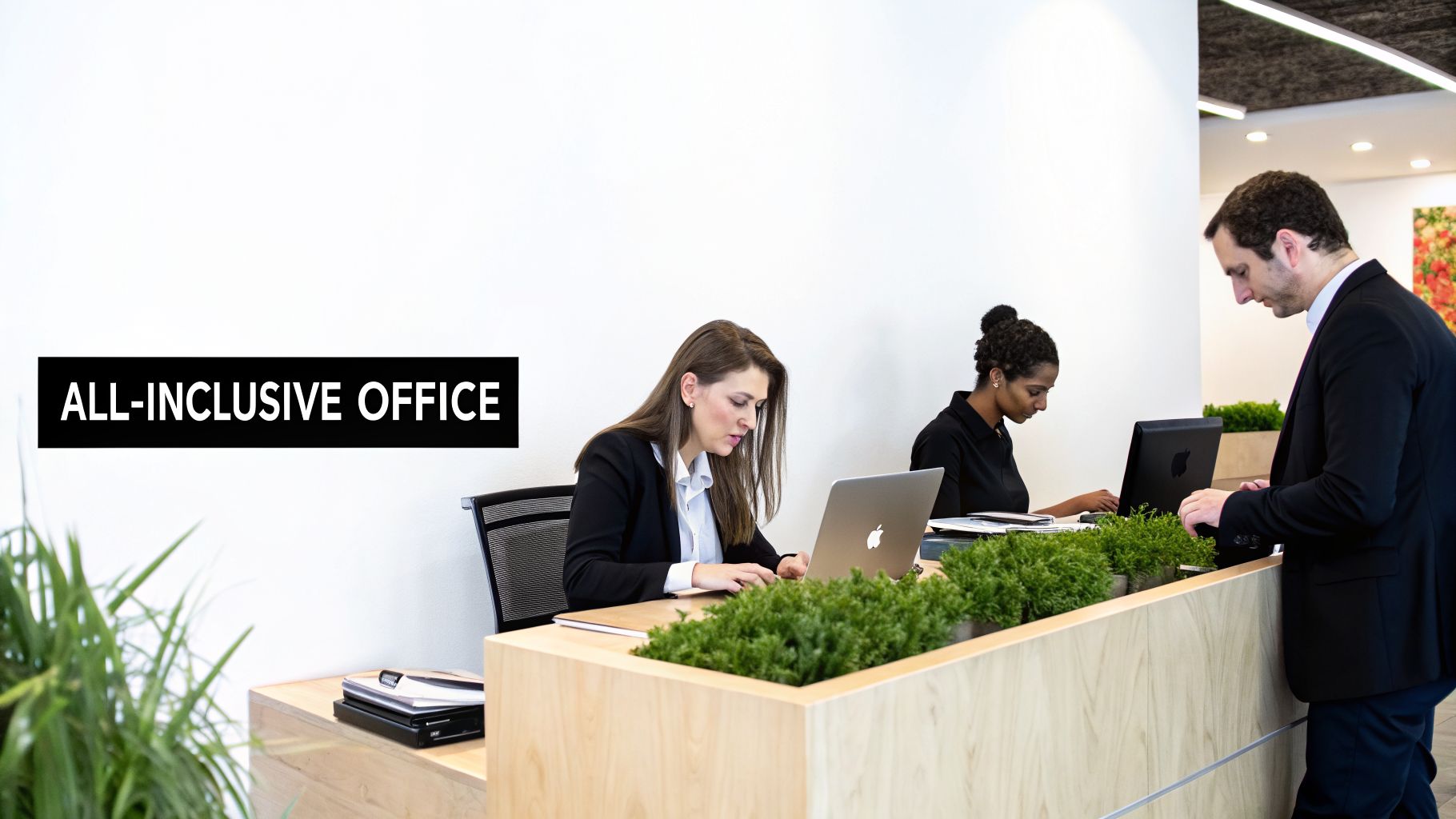
Think of a traditional office lease as buying an empty house—you get the keys, but the real work and expense have just begun. A serviced office, on the other hand, is like walking into a fully-staged home where everything is ready for you. The internet is on, the coffee is brewing, and the desks are waiting. You can literally sign the papers and get to work the very next day.
This "plug-and-play" model is precisely why the concept has taken off. Businesses are tired of the massive upfront costs and long-term commitments of old-school leases. This shift is clear in the market's growth, which is projected to climb from USD 52.19 billion in 2026 to an incredible USD 91.83 billion by 2030. If you're interested in the data, you can dive into the full research report, but the trend is undeniable: companies want flexibility.
The All-Inclusive Office Model
When you see a provider advertising serviced offices for rent as "all-inclusive," what does that actually get you? It’s more than just a room with furniture; it’s your entire office operation wrapped into one predictable monthly fee.
A good serviced office provider bundles all the necessities, so you don't have to think about them. This typically includes:
- Fully Furnished Space: Professional desks, ergonomic chairs, and lockable storage are all set up and ready.
- Utilities and Bills: All the essentials like electricity, water, and climate control are covered.
- High-Speed Internet: You get a reliable, business-grade connection without the setup hassle.
- Support Staff: A receptionist to greet your guests and manage mail, plus an on-site IT team for any tech issues.
- Maintenance and Cleaning: The space is kept clean and professional-looking every single day.
With this model, you avoid the huge capital outlay on things like office fit-outs and equipment, which keeps more cash in your business for what really matters—growth.
A serviced office is a strategic tool for business agility. It gives companies the power to scale their physical footprint up or down in response to market demands, without the restrictive chains of a multi-year lease.
Instead of spending months juggling vendors, you can have a team fully operational in a new city within days. This speed is a game-changer for a startup racing to launch, a BPO firm onboarding a new client, or a corporation testing a new market with a satellite office. It’s about subscribing to a service, not getting locked into a liability.
The True Cost Savings of a Serviced Office
When you’re hunting for office space, it’s easy to get fixated on the monthly rent. But with a traditional lease, that number is just the tip of the iceberg. The real story is in the mountain of hidden costs and massive upfront cash outlays that can cripple a business before it even gets going.
Think about setting up a standard office for a 20-person team. Before a single employee can log in, you’re on the hook for major capital expenses. We're talking about tens of thousands of dollars for the office fit-out, not to mention the cost of buying every desk, chair, and computer. It’s a huge financial drain.
And that's just to get the doors open. Then the operational bills start rolling in. You're suddenly responsible for everything: negotiating internet contracts, paying for utilities, hiring reception staff, and managing daily cleaning services. These costs are often unpredictable, making it a nightmare to budget accurately.
Head-to-Head: The Real Financial Picture
This is where the serviced office model completely changes the game. It takes that chaotic mess of high upfront investment and unpredictable monthly bills and consolidates it all into a single, flat monthly fee. This isn't just a minor accounting trick; it’s a strategic shift that frees up your cash and your focus for what actually matters—growing your business.
To really see the difference, let’s run the numbers and compare the two options over five years for that same 20-person team.
Serviced Office vs Traditional Lease: A Five-Year Cost Projection
The table below breaks down the typical expenses you'd face with a traditional lease versus the all-inclusive model of a serviced office. The difference is staggering.
| Expense Category | Traditional Office Lease (5-Year Est.) | Serviced Office (5-Year Est.) |
|---|---|---|
| Upfront Costs | ||
| Office Fit-Out & Design | $40,000 | $0 |
| Furniture & Equipment | $25,000 | $0 |
| Security Deposit (3 months) | $30,000 | $10,000 |
| Total Upfront Costs | $95,000 | $10,000 |
| Recurring Monthly Costs | ||
| Rent & Utilities | $10,000 | Included |
| Internet & IT Support | $1,000 | Included |
| Admin & Reception Staff | $4,500 | Included |
| Cleaning & Maintenance | $800 | Included |
| Total Monthly Costs | $16,300 | $10,000 (All-inclusive fee) |
| Total 5-Year Cost | $1,073,000 | $610,000 |
The numbers don't lie. You're looking at an initial cash outlay that's over 89% lower with a serviced office. Over the long haul, the total savings can approach 43%. This is how our promise of saving up to 80%, especially in the setup phase, becomes a concrete financial reality for our clients.
Unlocking Your Capital for Growth
This isn't just about saving money; it’s about gaining incredible business agility. Imagine what you could do with the nearly $100,000 you didn't have to sink into an office setup. That capital could go directly into hiring top engineers, funding a game-changing marketing campaign, or accelerating your product roadmap.
By converting massive, one-time capital expenditures into a manageable operational expense, a serviced office fundamentally de-risks expansion and growth. It allows you to invest in your business, not just your building.
This shift toward flexible workspaces is a global phenomenon. Market research from firms like Technavio predicts the market will grow by an additional USD 34.21 billion between 2026 and 2030. A massive chunk of that growth—nearly 40%—is happening right here in the APAC region, as IT and financial companies scramble for smarter, more cost-effective ways to operate.
For any company, but particularly for startups and BPOs, this kind of flexibility is a massive competitive advantage. You can scale your team up instantly after landing a big contract or trim down if market conditions change—all without the crushing weight of a long-term lease. It gives you a level of control a traditional landlord simply can't offer.
If you want to see exactly what's covered in our packages, check out our guide on what's included with a Seat Leasing BPO package. This is the new standard for smart, growth-focused businesses.
Which Businesses Benefit Most from Serviced Offices
The real magic of a serviced office isn’t just about saving money—it's about giving certain types of businesses the speed and agility they need to succeed. While just about any company can appreciate flexibility, some business models are a perfect match for this kind of plug-and-play environment. These are the companies that truly shine when they can trade operational headaches for a laser focus on their core mission.
From high-growth startups to established global players, the all-inclusive model solves very different problems for each. Let's dig into who stands to gain the most.
The Ambitious Startup
Picture a tech startup that just landed its first round of funding. Their number one goal is to hire a team of ten developers and launch their product yesterday. Locking into a traditional five-year lease would be a disaster. They'd drain precious capital on a huge security deposit and office fit-out, all for a space they’ll likely outgrow in six months.
A serviced office is the ideal launchpad. They can be up and running in a professional, fully-equipped space in days, not months. This gives them a massive advantage:
- Conserve Capital: Instead of dropping tens of thousands on furniture, IT infrastructure, and deposits, they can pour that cash directly into hiring top talent and marketing their product.
- Scale on Demand: When the team grows from ten to thirty people, they can simply move to a larger office down the hall without the nightmare of breaking a lease.
- Focus on the Product: The founders get to spend their time building a great company, not wrestling with internet providers, managing cleaning contracts, or fixing the air conditioning.
This kind of agility is exactly why startups flock to serviced offices. It removes all the friction standing between a great idea and the team needed to make it happen.
The Expanding BPO Provider
Business Process Outsourcing (BPO) companies live and die by their projects. One day they might need to rapidly onboard a 50-person team for a new client contract. Building a new facility from the ground up for every project is slow, expensive, and incredibly risky.
This is where serviced offices become a game-changer for BPOs. They can secure a fully compliant, high-security office that's ready to go almost instantly. It’s a solution that allows them to meet client demands with incredible speed. Plus, the built-in infrastructure, like redundant internet and backup power, is non-negotiable for ensuring the business continuity their clients expect.
For BPO providers, "time-to-operation" is a critical performance metric. Serviced offices cut setup time from several months down to just a few days, giving them a huge competitive edge when bidding on new contracts.
This approach transforms a BPO's real estate from a fixed, long-term liability into a flexible asset that directly supports winning new business and keeping clients happy.
The International Corporation
Now, think about a large European corporation looking to test a new market, say, in Southeast Asia. Committing to a multi-year lease in an unproven region is a massive gamble. What they really need is a low-risk way to dip their toes in the water, hire a small local team, and start building a presence.
Serviced offices are the perfect tool for market entry. They provide a prestigious business address and a professional workspace without the long-term financial handcuffs of a traditional lease. This lets the corporation enter—and, if necessary, exit—new markets with minimal financial damage, making global expansion a far more manageable strategy.
This chart drives the point home, showing the stark financial difference between the old way and the new way.
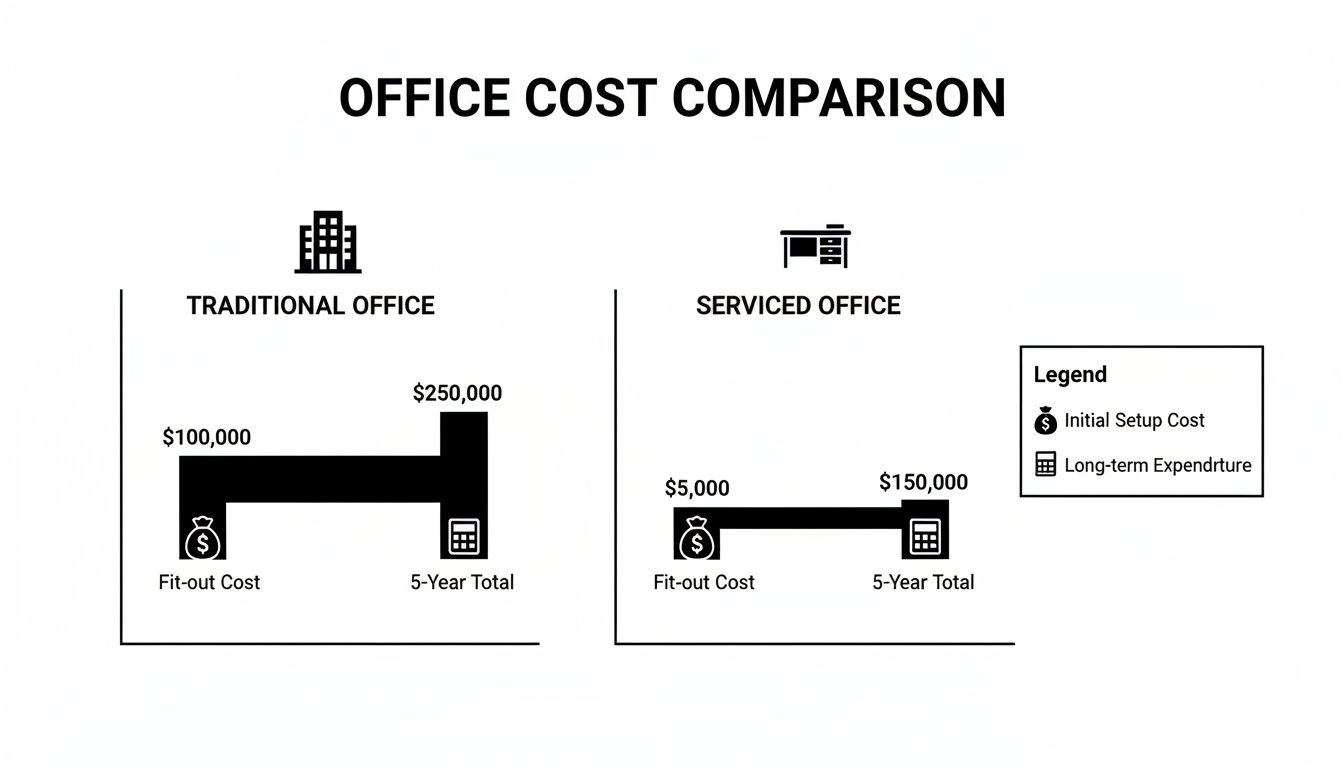
As you can see, the huge upfront fit-out cost completely disappears, which drastically lowers the initial investment and the overall financial risk. This isn't just a niche trend; it's a fundamental shift in how businesses view real estate. Market projections show the managed and serviced office sector growing from USD 53.94 billion in 2026 to an incredible USD 201.27 billion by 2035. You can read more about these market projections to see how this global movement toward flexible workspaces is reshaping the industry.
Your Step-by-Step Checklist for Choosing the Right Office
Finding the right serviced office isn't just about picking a space that looks good. It’s a strategic move, one that needs to support your actual business goals. It's easy to get distracted by flashy perks, but a methodical approach will keep you focused on what truly matters for your team and your bottom line.
Think of this as your field guide. It’s designed to help you look past the sales pitch and compare different serviced offices for rent with a critical eye. With the right questions in hand, you’ll find a space that acts less like a landlord and more like a genuine partner in your operations.
Evaluate the Location and Accessibility
The old real estate mantra "location, location, location" is still absolutely true, but what it means for a modern business has changed. It's no longer just about having a prestigious zip code; it's about practical, real-world accessibility for the people who matter most: your team and your clients.
A brutal commute is a surefire way to lose great talent, and if clients can't find you or park easily, it creates friction before you've even shaken hands. Before you even book a tour, do some recon on the location.
- Commute and Transportation: How will your team actually get to work? Check the office’s proximity to major highways, bus or train stations, and the residential areas where your employees live.
- Client and Visitor Experience: Is the building a pain to find? Is there plenty of reasonably priced parking nearby? A frustrating arrival immediately sets a negative tone for a big meeting.
- Local Amenities: What’s in the neighborhood? Having great lunch spots, coffee shops, banks, and other conveniences just a short walk away makes a huge difference in your team's day-to-day morale.
Scrutinize the IT Infrastructure and Security
Let’s be honest—for nearly every business today, a solid internet connection is as non-negotiable as electricity. Downtime isn’t just an inconvenience; it’s lost revenue. This is where you have to dig deep and get real answers about a provider’s technical backbone.
A serviced office’s IT setup is its most critical feature, but it's also the one most often overlooked. Promises of "fast internet" are worthless without verifiable proof of performance and support.
When you're running through your checklist, the overall security in the office—both physical and digital—should be a top priority. Don’t be afraid to ask direct, specific questions:
- Guaranteed Internet Uptime: What is your official Service Level Agreement (SLA) for uptime? A serious provider should be able to contractually guarantee at least 99.9% uptime.
- Bandwidth and Redundancy: How much bandwidth is truly dedicated to us? Crucially, do you have redundant fiber lines from different ISPs? This is what prevents a single provider outage from taking your entire operation offline.
- On-Site IT Support: Who do we call when something breaks? What are the hours for your on-site IT team, and what’s their average response time for a critical issue?
- Security Measures: What’s in place to protect our people and data? Ask about physical security like CCTV, 24/7 guards, and keycard access. Then, ask about their cybersecurity protocols for protecting the shared network.
Understand the Contract and Scalability
Flexibility is probably one of the main reasons you’re considering a serviced office in the first place. But that flexibility is only real if the contract backs it up. The fine print can easily trap you, undermining the very agility you’re paying a premium for.
You're looking for a provider who can grow and shrink along with you. For example, our clients can add or remove seats with simple terms, ensuring their workspace always matches their real-time needs. To see what a truly scalable and well-equipped environment looks like, check out our fully-equipped Building 24 facility.
Here are the key things to clarify before you sign anything:
- Scaling Terms: What is the exact process for adding or removing seats? How much notice do you need, and are there penalties for scaling down?
- Hidden Fees: Does "all-inclusive" really mean all-inclusive? Ask them to itemize potential extra costs, like printing overages, fair use policies for meeting rooms, or after-hours HVAC charges.
- Termination Clause: What does it take to end the agreement early if things don't work out? Your exit strategy is just as important as your move-in plan.
By digging in with this checklist, you shift from simply touring an office to conducting a proper investigation. This is how you find a space that’s not only a great fit for today but a solid foundation for whatever comes next.
The Seat Leasing BPO Advantage in Office Rental

While the market for serviced offices for rent is a huge step up from a traditional lease, not all providers are created equal. Many will just hand you a key to a furnished room and a Wi-Fi password, leaving the rest to you. This is where the Seat Leasing BPO model is fundamentally different. We don't just rent you space; we deliver a fully managed operational ecosystem.
Our whole approach goes far beyond basic amenities. We essentially become an extension of your business, taking on all the complex, mission-critical backend support so you can focus 100% on your actual work. Imagine running your business without ever having to think about cybersecurity, IT meltdowns, or dealing with utility providers. That’s the peace of mind we offer.
The ‘Select, Sign, Setup, Succeed’ Process
We’ve spent years refining our process to be as frictionless as possible, getting you from decision to operation in record time. It’s a straightforward four-step journey that gets you up and running in days—not the months you’d burn with a traditional office setup.
- Select: First, we sit down with you to find the perfect location and office layout that fits your team size, workflow, and budget.
- Sign: Our contracts are clear and flexible. No hidden clauses or confusing legal jargon, just simple terms that make sense.
- Setup: Here's where we really shine. Our team handles everything. We build out your entire IT infrastructure, configure every workstation, and make sure your space is 100% ready for your team to walk in and get to work.
- Succeed: With all the operational headaches gone, your team can hit the ground running from day one, focusing entirely on productivity, serving clients, and hitting your business goals.
This isn’t just about getting an office faster; it’s about launching your operation smarter.
More Than an Office—A Complete Operational Package
What truly defines our model is the depth of our all-inclusive service. While other providers stop at furniture and a receptionist, we’re just getting started. Our packages are designed to handle the tough realities of modern business, especially for industries like BPO and tech where security and uptime are everything.
Here’s a good way to think about it: a standard serviced office gives you a car with a full tank of gas. Seat Leasing BPO gives you the car, a professional chauffeur, a full-time mechanic on standby, and a complete insurance and security detail.
Our value isn't just in the office space we provide, but in the operational problems we solve. We manage the complex backend—IT, cybersecurity, and infrastructure—so you can manage your business.
This level of comprehensive support turns a simple office rental into a powerful strategic asset. You can explore how our unique business model supports growth and efficiency by learning more about the Seat Leasing BPO approach to workspace solutions.
A Real-World ROI Example
Let's make this tangible. Imagine a BPO company needing to quickly launch a 50-person team for a new client.
With a traditional lease, they’re looking at a huge uphill battle. It could take them 4-6 months just to find a space, negotiate the lease, manage construction and fit-out, and buy all the IT equipment. The upfront capital required could easily top $120,000 for deposits, construction, furniture, and servers—all before a single agent takes a call.
With a Seat Leasing BPO solution, the picture changes dramatically.
- Launch Timeline: They're fully operational in under a week.
- Upfront Costs: They only need a manageable security deposit, often less than $15,000.
- Result: The company instantly saves over $100,000 in initial cash outlay and starts billing their client at least three months ahead of schedule.
This is about more than just cost savings; it's about speed. That three-month head start translates directly into revenue, happier clients, and a massive competitive edge.
Your Strategic Partner for Growth
Ultimately, choosing Seat Leasing BPO isn't just about finding serviced offices for rent. It’s about gaining a partner who is genuinely invested in your operational success. We take on the headaches of running an office so you can pour your time, money, and energy into what you do best. From our robust IT infrastructure and enterprise-grade cybersecurity to managing every last facility detail, our entire purpose is to build an environment where your business can thrive without distraction.
Frequently Asked Questions About Serviced Offices
It's natural to have a few questions before you commit. Choosing an office is a big decision, and it’s smart to cover all your bases. To help you make a final, confident choice, we've gathered some of the most common queries we hear from businesses just like yours.
Let's clear up any remaining uncertainties so you have everything you need to move forward.
Is a Serviced Office the Same as Coworking?
This is a common point of confusion, but the distinction is actually quite simple. A serviced office gives you a private, secure, and fully enclosed space that's dedicated solely to your company. It’s your own headquarters, just without the headaches of a long-term lease.
A coworking space, on the other hand, is typically a large, open-plan area where you share the floor with individuals and teams from many different companies. While it’s great for networking, it lacks privacy. Many modern providers, however, now offer hybrid models that give you a private office but with access to shared lounges, giving you the best of both worlds.
What Does the Monthly Fee Usually Include?
The "all-inclusive" nature of the fee is one of the biggest perks. Instead of juggling a dozen different bills, you get one predictable monthly payment that bundles everything together.
This single fee almost always covers:
- Core Costs: Your rent, business rates, and all utilities (electricity, water, heating).
- Essential Services: Business-grade high-speed internet, daily cleaning, and building maintenance.
- Infrastructure and Staff: All office furniture, a professional reception team, and on-site security.
- Shared Amenities: Use of communal kitchens, breakout lounges, and often complimentary coffee and tea.
This model brings total predictability to your operational costs, which is a massive win for budgeting and financial planning.
How Flexible Are the Rental Agreements?
Flexibility is the name of the game here. Forget the traditional commercial leases that lock you down for 5–10 years. Serviced office agreements are built for agility.
Contracts can be as short as one month, although terms of six months to a year are pretty standard. This setup lets your business pivot on a dime. You can easily scale up your space after landing a big contract or downsize during a slower period—all without the punishing financial penalties tied to breaking a traditional lease.
This contractual freedom is what transforms your office from a fixed liability into a flexible asset. It empowers you to make strategic decisions based on your business needs, not your real estate commitments.
That kind of operational agility is a game-changer, especially for project-based teams or companies in fast-moving industries.
Can I Customize and Brand My Office Space?
Absolutely. There's a common myth that serviced offices are generic, cookie-cutter boxes, but that’s rarely the case. While the essential infrastructure is ready for you, any good provider will encourage you to make the space your own.
You can bring in your company branding, from logos on the walls to incorporating your brand colors in the decor. Many providers will even work with you on layout changes, like setting up a collaborative zone or a quiet corner to fit how your team works. This helps ensure your office doesn't just function well but also feels like a true extension of your company culture. When considering the intricacies of seat leasing and BPO models in office rental, understanding innovations in BPO Call Center Solutions can provide further operational insights into optimizing such customized spaces.
Ultimately, the goal is to create an environment where your team feels at home and can produce their best work.
Ready to stop worrying about office management and start focusing on what truly matters? At Seat Leasing BPO, we provide more than just an office; we deliver a complete operational solution designed for your success.