The cost of a coworking space can be as little as a $20 day pass or climb to over $1,200 per month for a private office in a major city. What you'll ultimately pay comes down to your choice of membership, location, and the amenities you need, which is precisely what makes it such a flexible alternative to a traditional office lease.
A Quick Look at Coworking Space Costs in 2026
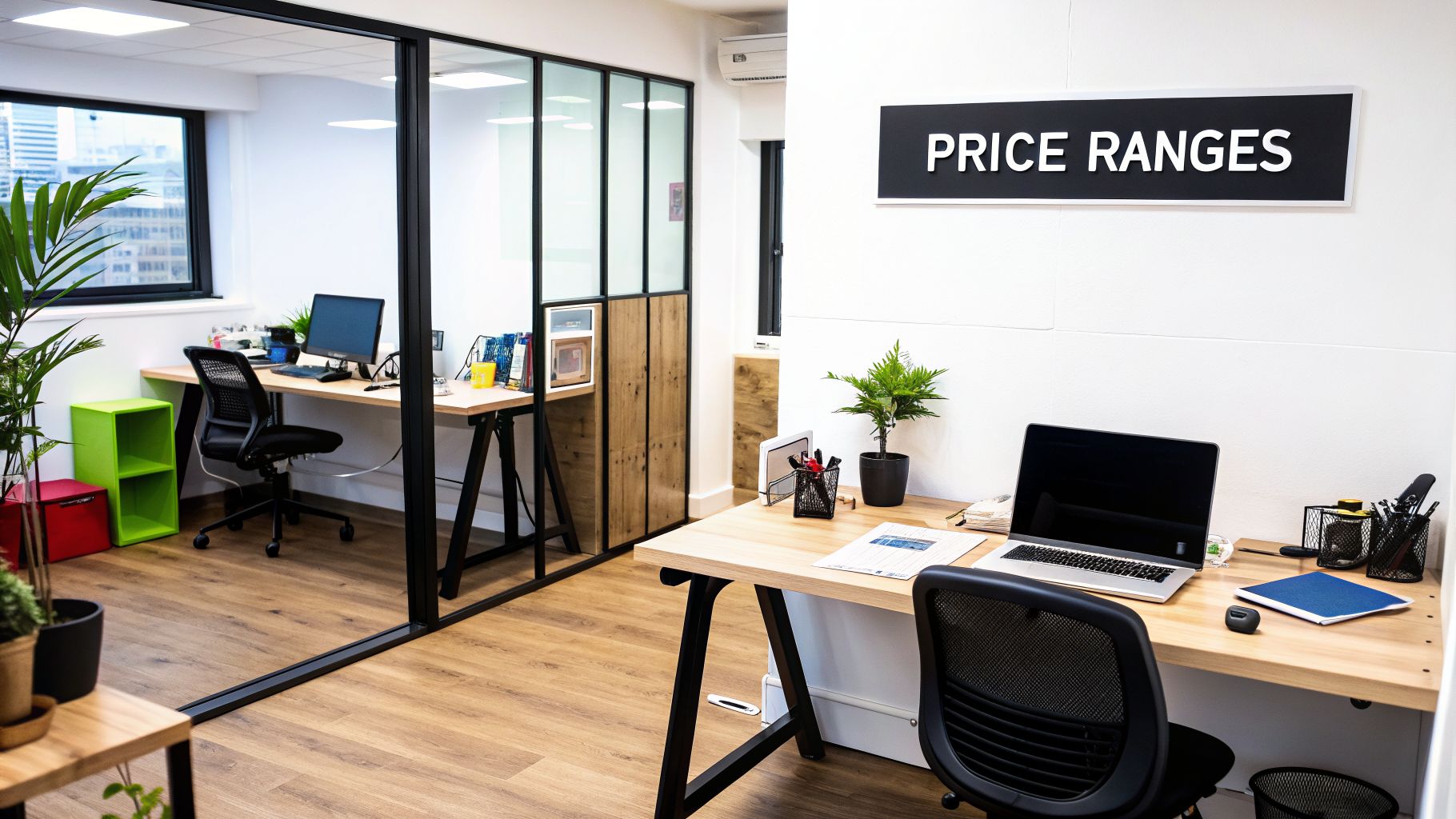
Before we get into the nitty-gritty, let's paint a broad picture of what you can expect to spend. Getting a handle on the typical price ranges for different membership types is the best way to figure out what fits your budget.
I like to compare it to a gym membership. A flexible hot desk is your all-access pass—you can use any open spot you find. A dedicated desk is more like your personal, reserved squat rack, always waiting for you. And a private office? That’s your exclusive studio, giving you and your team the security and dedicated space to focus.
Breaking Down the Membership Costs
When you stack it up against a traditional office lease, coworking pricing in the U.S. makes a pretty compelling case for itself. Median monthly memberships often hover around $225 for hot desks or dedicated spots, which is why they’re such a go-to for freelancers and startups.
On a national level, you’ll find hot desks for about $150 a month. Of course, in a prime urban market like New York City or San Francisco, that can easily jump to $400–$600. Dedicated desks see a similar trend, averaging $300–$400 but stretching to $700–$1,200 in those high-demand locations.
If you only need a workspace for a day or two, you’re in luck. Day passes are a great deal, usually running between $20–$50. Virtual offices, which give you a professional address and mail handling, have a median cost of $159 per month, and meeting rooms are typically bookable for around $45 per hour.
These numbers really drive home how much value is packed into a shared workspace, especially once you start adding up all the included amenities. You can get more insight into the key trends shaping the industry by checking out the latest analysis from Allwork.Space.
Typical Coworking Space Costs in the U.S. (2026)
To give you a clearer picture, here’s a quick-glance table breaking down the average costs for the most common membership types you’ll find.
| Membership Type | National Median Cost (Monthly) | Premium Urban Market Cost (Monthly) | Best For |
|---|---|---|---|
| Hot Desk | $225 | $400 – $600 | Freelancers and remote workers needing flexibility. |
| Dedicated Desk | $350 | $700 – $1,200 | Professionals who need a consistent, personal workspace. |
| Private Office | $650 (per person) | $800 – $1,500+ (per person) | Startups and teams requiring privacy and security. |
| Virtual Office | $159 | $200 – $350 | Businesses needing a professional address without a physical desk. |
This gives you a solid baseline. Now, we can start digging into the factors that will influence your final bill and how different pricing models actually work.
Getting to Grips with Coworking Pricing Models
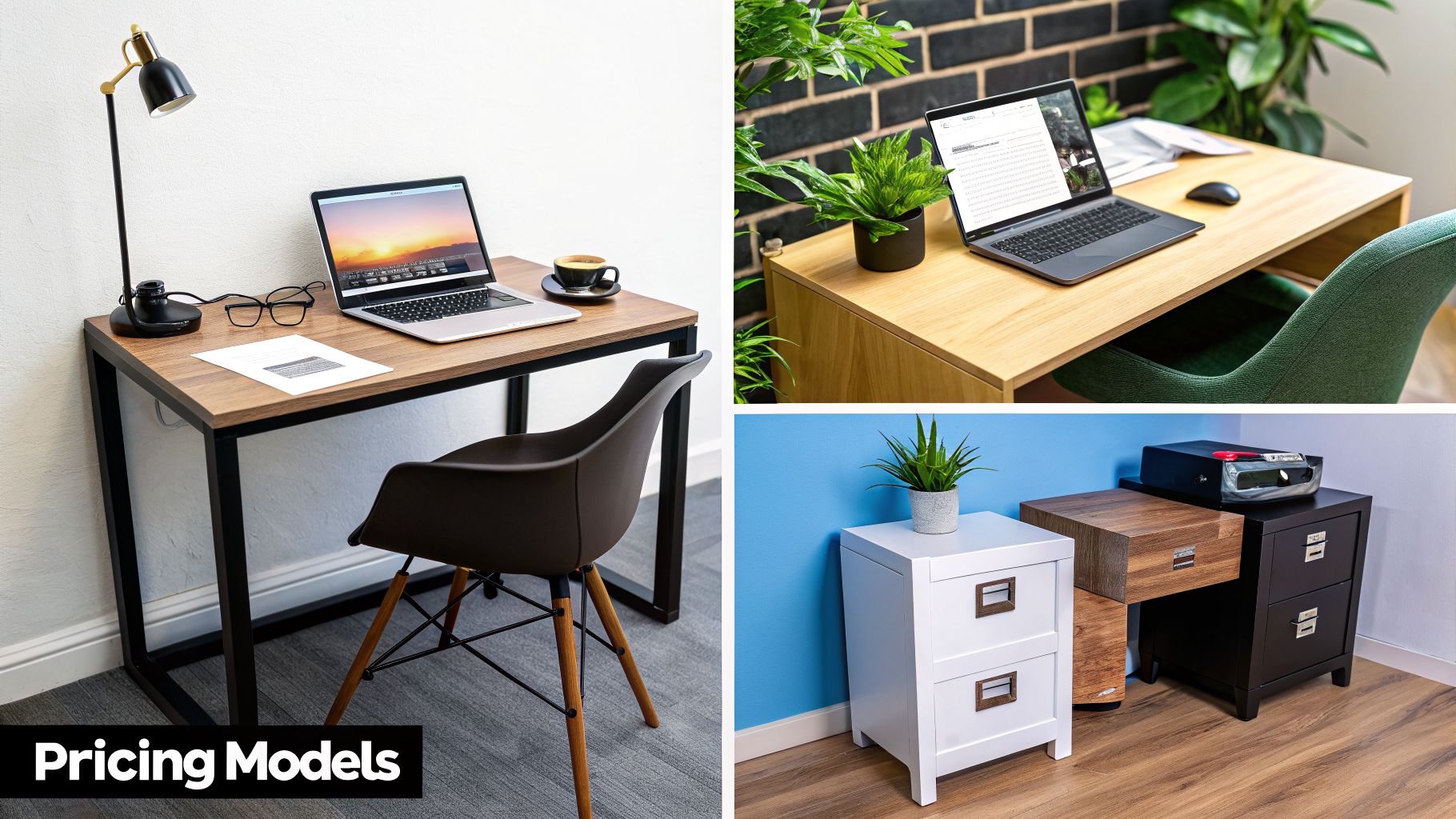
Before you can figure out what you’ll pay, you first have to understand how coworking spaces charge. It's not a one-size-fits-all situation. The pricing models are designed to offer different levels of flexibility and privacy, and what’s perfect for one person might be all wrong for another.
Think of it like picking a phone plan. Some people just need a basic pay-as-you-go option for occasional use, while others need an unlimited plan with all the bells and whistles. Your choice will come down to your daily work habits, how many people are on your team, and where you see your business going. A freelancer who just needs to get out of the house has totally different needs than a growing startup handling sensitive client data.
Let's walk through the main ways these spaces are packaged.
Hot Desks: The Ultimate Flexible Option
The most common and budget-friendly entry point is the hot desk. This is a first-come, first-served setup where you grab any open seat in the common area for the day. You show up, find a spot, and get to work. Simple as that.
This is a fantastic fit for:
- Freelancers and solopreneurs who need a change of scenery from their home office.
- Digital nomads who just need a reliable place to plug in for a few days in a new city.
- Bootstrapped startups trying to keep overhead rock-bottom while still getting access to a professional network.
The only real catch is that you have to pack everything up when you leave. There's no leaving your extra monitor behind. But if maximum flexibility and minimum cost are your top priorities, a hot desk is tough to beat.
Dedicated Desks: Your Personal Spot in the Mix
If you’re tired of the daily hunt for a good seat, the dedicated desk is the logical next step. With this plan, you get your own personal desk in a shared area that’s yours and yours alone. You can set up your monitor, bring in a comfortable chair, and leave your stuff there overnight.
It’s a huge quality-of-life upgrade from hot-desking because it gives you a sense of permanence and a consistent place to land every morning. Many dedicated desk memberships also throw in perks like a lockable filing cabinet and 24/7 access. It really is the sweet spot between the vibrant, open-plan atmosphere and the stability of having your own space.
A dedicated desk is like having your favorite reserved carrel in a busy library. You're surrounded by the buzz of activity, but your spot—and your stuff—is always waiting for you.
Private Offices: For Teams and Total Privacy
When you need to shut the door, make confidential calls, or collaborate with your team without distraction, a private office is the way to go. These are fully enclosed, lockable rooms built for one person or an entire team. You get all the benefits of the coworking community—the coffee, the events, the amenities—but with the focus and security of a traditional office.
This is naturally the most expensive option, but for many, the investment is easily worth it.
- Security: It’s a must-have if you're dealing with sensitive client information or intellectual property.
- Team Cohesion: It gives your crew a home base to build culture and work together effectively.
- Branding: Most spaces will let you put your own logo on the door, making the office feel truly yours.
Virtual Offices: A Professional Address Without the Rent
Finally, there’s the virtual office. This clever option gives you a prestigious business address, mail handling services, and a local phone number for a small monthly fee—all without an actual physical office. It’s perfect for establishing a professional presence in a key market.
Most virtual office plans also give you the option to book conference rooms by the hour when you need to meet clients. It's a game-changer for remote-first companies or freelancers who work from home but want to project a more established image.
Key Factors That Influence Your Final Coworking Cost
Ever wonder why two seemingly identical desks across town have wildly different price tags? It’s a common question, and the answer isn't always obvious. The final cost of a coworking space isn't just one number; it’s a blend of several key factors. Understanding what drives the price is the first step to finding a space that fits your budget and your business needs.
Think of it like booking a hotel. A suite at a five-star hotel right in the heart of downtown will obviously cost more than a standard room at a comfortable spot out near the airport. The logic is the same for coworking—you’re paying for a specific mix of location, services, and convenience.
Location, Location, Location
More than anything else, geography is the single biggest factor determining what you'll pay. A private office with a skyline view in New York City is in a completely different financial league than the same size office in Omaha, Nebraska. Even within the same metro area, costs can swing dramatically from one neighborhood to the next.
- Prime Downtown Core: These are the most expensive spots. You're paying a premium for being in the central business district, where commercial real estate is at its peak and the convenience is unmatched.
- Trendy Neighborhoods: Hip, growing areas are often packed with coworking spaces. They strike a balance, offering a vibrant atmosphere with more mid-range pricing.
- Suburban Hubs: If your top priority is saving money, look to the suburbs. What you trade in location, you gain back in significant cost reductions.
This price variation is a direct result of incredible global demand. The flexible workspace market is on a trajectory to hit $20.96 billion in 2025, with nearly 44,000 spaces expected to be operating by 2026. In a mature market like Greater London, for instance, the value of these spaces is projected to be worth $45–$54 billion by 2026, which shows just how much premium locations drive the entire market.
Amenities and Inclusions
After location, the next thing to look at is what’s actually included in your membership. A bare-bones setup with just a desk and Wi-Fi will always be the cheapest option, but it’s often not the best value. The more a provider bundles into the price, the higher the sticker cost, but the more you get in return.
It’s not just about the free coffee. High-value amenities directly impact your productivity and can save you a surprising amount of money you’d otherwise spend on separate business services.
Look for these common inclusions that influence the price:
- 24/7 Access: The freedom to work when you’re most productive, not just from 9-to-5.
- High-Speed, Redundant Internet: Business-grade internet is non-negotiable. Redundancy means you have a backup so you’re never offline during a big meeting.
- Bookable Conference Rooms: Professional, private spaces to meet with clients or your team.
- Printing and Scanning Services: Having this on-site saves you time and the cost of running to a copy shop.
- Professional Staff: An on-site community manager or receptionist adds a professional touch and handles guest check-ins.
- Networking Events: These are more than just social hours; they’re valuable opportunities to connect with potential clients and partners.
Some of the best providers go even further, rolling in essential operational support like IT services and physical security. When you see a truly all-inclusive package, you’re looking at a model designed to simplify your expenses and boost your value. You can see what a comprehensive package looks like by exploring our own list of inclusions.
Space Size and Contract Length
Finally, the amount of space you need and how long you're willing to commit will move the needle on your monthly cost. It's simple math: a private office for a four-person team will cost more than a single dedicated desk. The price scales directly with the square footage and the number of people it accommodates.
Your contract length is another area where you have some control. Most coworking operators will give you a better deal for a longer commitment. A flexible month-to-month plan costs the most because you’re paying a premium for the ability to leave at any time. But if you’re confident in your plans, signing a 6-month or 12-month contract can easily knock 10-20% off your monthly rate. It’s their way of rewarding loyalty with real savings.
Coworking vs. Traditional Office Leases: A Cost Showdown
When you're scaling a business, one of the biggest decisions you'll face is where your team will work. It often boils down to a choice between a flexible coworking space and a traditional office lease. But if you're just comparing the monthly rent, you're missing the bigger picture. This isn't just about rent—it's about the total, all-in cost of having a physical workspace.
Think about a traditional lease. That attractive monthly rent figure is just the beginning. Lurking beneath the surface are a host of other expenses: a huge security deposit, broker fees, legal costs, and the massive capital needed to furnish and set up the office. And that's before you even start paying the monthly bills for internet, utilities, cleaning, and maintenance.
Coworking completely changes that equation. It bundles nearly all of those variable expenses into one predictable monthly payment. This gives you incredible financial agility, freeing up capital that would otherwise be sunk into a building so you can invest it back into your business.
The Upfront Cost Hurdle
With a traditional lease, the initial cash you need to put down is massive. Landlords often demand several months' rent as a security deposit, tying up thousands of dollars of your working capital. On top of that, you have the "fit-out" cost—turning that empty commercial space into a functional office. This alone can run into the tens of thousands, even for a small team.
In stark contrast, a coworking space demands very little upfront. You'll typically pay a small, refundable deposit (often equal to one month's fee) and your first month's membership. You get to walk into a fully furnished, professionally designed office from day one, avoiding the huge cash drain of a traditional setup.
This infographic breaks down the main things that will influence your monthly bill.
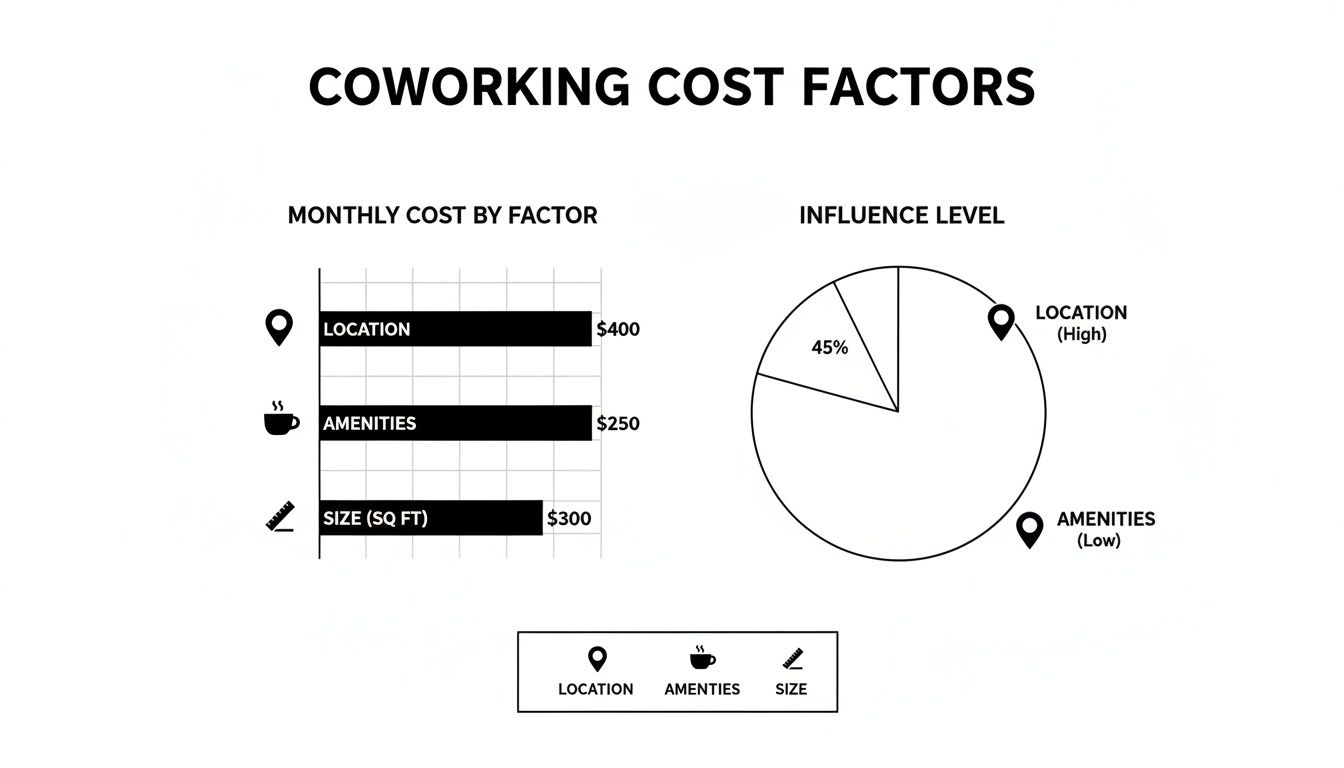
As you can see, location, the amenities included, and the size of your space are the big three. They all play a part in what you'll ultimately pay and the value you get for it.
This kind of financial flexibility is exactly why nearly 60% of companies are now choosing coworking over traditional leases when they expand. For startups and BPO teams, this can mean up to 80% savings on overhead since the provider handles all the IT infrastructure, security, and utilities. It's a plug-and-play model without the financial headaches. This trend has fueled explosive growth, particularly in the Asia-Pacific region, where the market is projected to hit $30.36 billion by 2026. You can dive deeper into these global coworking trends and statistics to see the full scope.
A Real-World Cost Scenario
Let's make this tangible. Imagine you have a 10-person team and you're budgeting for your first year in a new space. To see the true financial impact, you have to look beyond the base rent and account for every single associated expense.
The table below lays it all out, comparing the estimated one-year costs for a traditional lease versus a private office in a coworking space. This is the kind of analysis that truly reveals which option is better for your bottom line.
Cost Showdown: 10-Person Team – Coworking vs. Traditional Lease (1-Year Estimate)
| Cost Category | Traditional Office Lease (Estimated Annual Cost) | Coworking Private Office (Estimated Annual Cost) | Notes |
|---|---|---|---|
| Rent/Membership Fee | $60,000 ($5,000/mo) | $84,000 ($7,000/mo) | Lease rent appears lower, but it’s just the start. |
| Security Deposit | $10,000 (Refundable) | $7,000 (Refundable) | More of your cash is tied up in a traditional lease. |
| Fit-Out & Furniture | $25,000+ | $0 | A huge capital expense you completely avoid with coworking. |
| Utilities & Internet | $7,200 ($600/mo) | $0 (Included) | Electricity, water, and business-grade internet are bundled. |
| Cleaning & Maintenance | $3,600 ($300/mo) | $0 (Included) | Daily cleaning and repairs are handled for you. |
| Office Supplies & Kitchen | $2,400 ($200/mo) | $0 (Included) | Coffee, printing, and other essentials are covered. |
| Broker/Legal Fees | $5,000 | $0 | Significant one-time fees associated only with leases. |
| Total Year 1 Cost | $113,200 | $91,000 | Over $22,000 in savings plus a much lower initial cash outlay. |
The numbers really do tell the story. While the monthly coworking fee might look higher on the surface, the all-inclusive model delivers significant annual savings. By getting rid of massive upfront costs and unpredictable monthly bills, coworking offers a leaner, smarter, and more predictable way to run your business.
The Seat Leasing Advantage For Maximum Savings
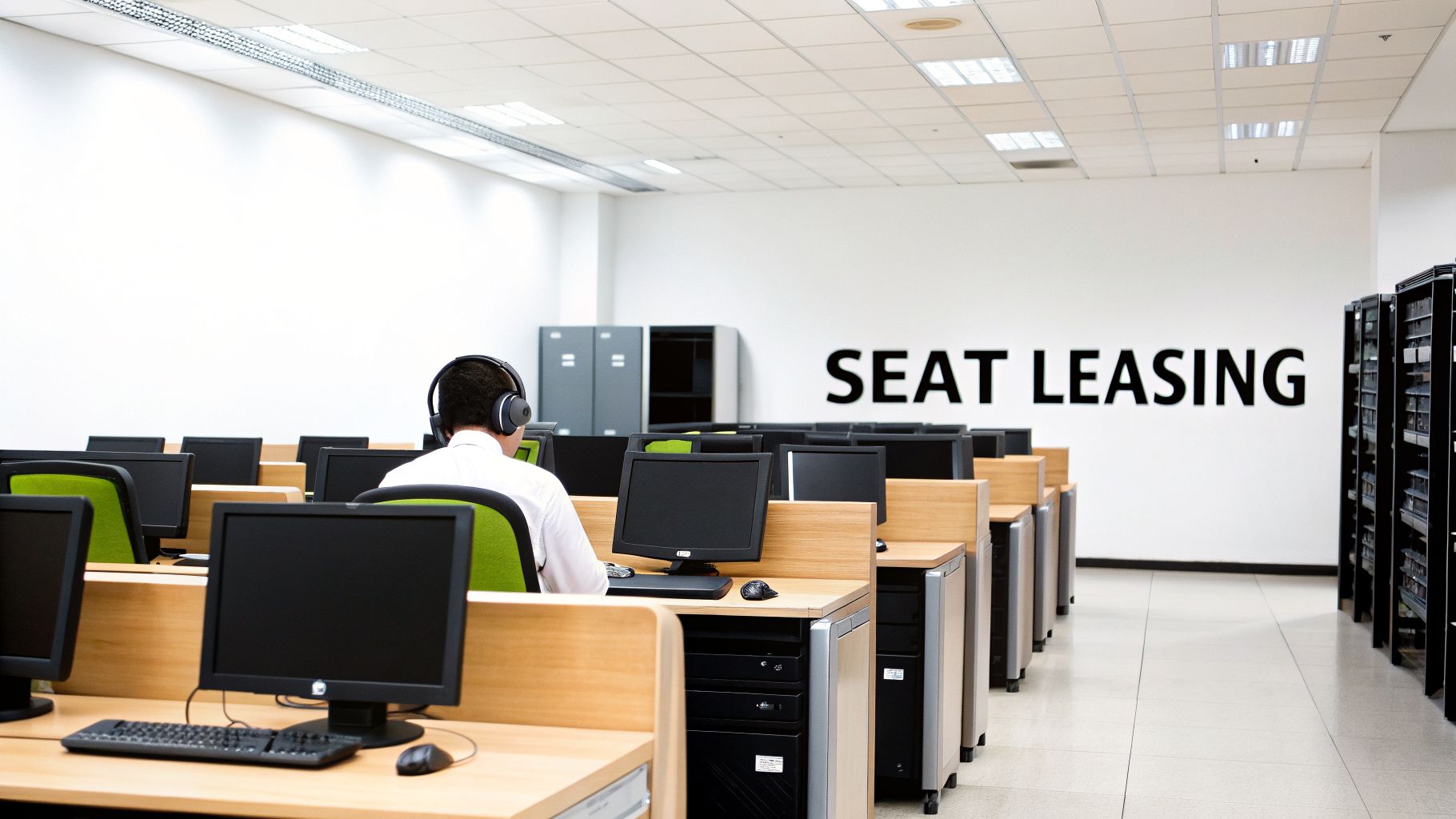
While coworking offers a fantastic financial alternative to a traditional lease, there’s another model that takes the idea of efficiency even further. It’s called seat leasing, and it’s a hyper-focused solution built for businesses that need to be incredibly lean and get the absolute most from every dollar. This approach is a game-changer for startups, SMBs, and Business Process Outsourcing (BPO) companies.
Let's put it this way: if coworking is like renting a fully furnished apartment, then seat leasing is like checking into an all-inclusive resort. It’s not just about giving you a desk—it’s a completely managed partnership where every operational detail is handled for you.
What Makes Seat Leasing Different
The core idea behind seat leasing is simple yet incredibly effective. It bundles everything—the physical workspace, the usual amenities, and the entire backend operational infrastructure—into a single, predictable price per seat. This moves you from just renting space to engaging with a full Office-as-a-Service environment.
With a typical coworking membership, you get your desk, Wi-Fi, and coffee. With seat leasing, you get a business that’s ready to run from the second you walk in. This includes:
- Plug-and-Play Workstations: Every seat is already equipped with a computer, essential software, and all the peripherals you need, ready to go.
- Robust IT Infrastructure: You get business-grade, redundant internet and professional IT support without having to hire your own tech team.
- Advanced Cybersecurity: Managed security protocols are in place to protect your network and data, a critical and costly service you'd otherwise have to source yourself.
- All Operational Overhead: All the bills—from utilities and building maintenance to daily cleaning—are rolled into the price and managed by the provider.
This all-in-one package is precisely what makes it so cost-effective. By handing off these complex and expensive operational tasks, businesses can cut their overhead by up to 80% compared to the cost of setting up a traditional office from scratch.
The Financial and Operational Impact
The benefits of seat leasing aren’t just about the monthly savings; it’s about eliminating huge upfront capital expenses (CapEx) and gaining incredible flexibility. When you need to grow, you can add more seats almost overnight, skipping the long delays and massive costs of a traditional office build-out.
This kind of agility is why the market is shifting so dramatically. Recent data shows that 59–60% of companies now prefer flexible workspaces for expansion because it helps them avoid paying for empty space and high fixed costs. Seat leasing takes this a step further, delivering not just flexibility but also massive savings on setup and ongoing expenses—a huge advantage when a traditional office fit-out can cost a premium of $150 per square foot. You can dig deeper into how the workspace industry is evolving by reviewing these key industry statistics.
By removing the need to manage vendors, purchase equipment, or negotiate separate contracts for internet and security, seat leasing allows you to plug your team directly into a ready-made operational ecosystem. Your focus shifts entirely from managing an office to running your core business.
This streamlined approach means your team is productive from day one, with no downtime waiting for furniture to arrive or the internet to be installed. It’s the perfect setup for any organization that wants to scale quickly and efficiently, without getting bogged down in the headaches of office management. You can see how this model delivers exceptional value by exploring a full-service seat leasing solution for your BPO or startup.
Alright, let's talk numbers. You've got the lay of the land on different pricing models and what drives costs up. Now it's time to figure out what your business should actually be spending.
Building a workspace budget isn't some dark art of financial modeling. It's really just about thinking through your needs in a practical way to land on a realistic number.
I've found the best way to get started is with a dead-simple formula. It’s not fancy, but it cuts through the noise and gives you a solid baseline.
(Number of Seats x Average Cost per Seat) + (Buffer for Extras) = Estimated Monthly Spend
This little calculation forces you to put a real number on your team's needs. It takes your search from a vague idea to a concrete, actionable plan.
Start with Your Non-Negotiables
First things first: you need to separate your 'must-haves' from your 'nice-to-haves.' This is probably the single most important step for keeping your budget in check. Do you absolutely need a private, locked office for compliance reasons, or could you get by just fine with dedicated desks in a shared space?
- Non-Negotiable Needs: These are your deal-breakers. Think 24/7 building access for your night-owl developers, rock-solid internet, a specific location that's easy for clients to get to, or that private office for security.
- Nice-to-Have Wants: These are the perks. They’re great if you can get them, but your business won’t grind to a halt without them. This could be anything from an on-site gym and a podcasting room to free catered lunches.
Drawing a clear line between these two categories helps you zero in on spaces that meet your core needs. You won't get sidetracked by shiny objects and pricey amenities you’ll barely use, ensuring your money goes where it matters most.
Factor in Growth and Flexibility
A smart budget isn't just about today—it's about where you're headed in the next six to twelve months. Planning to bring on two new hires this year? Your budget needs to be able to handle that without forcing you into an expensive and disruptive move.
A good rule of thumb is to build a small buffer into your budget, maybe 10-15% of your estimated monthly total. This cushion gives you breathing room for those one-off costs, like booking a big conference room for a client workshop. More importantly, it gives you the financial flexibility to add another desk when you land that new contract.
This kind of forward-thinking is essential. The global coworking industry was valued at $22.01 billion in 2024 and is expected to rocket to $93.68 billion by 2030, all thanks to the hybrid work boom. With over 8,420 locations in the U.S. alone, you have a ton of options. A well-planned budget is your key to making the most of them. You can dive deeper into this explosive growth with these coworking statistics from Archie.
Got Questions About Coworking Costs? Let's Clear Things Up.
When you start exploring flexible workspaces, it's natural for a few key questions to bubble up. Getting straight answers on the real-world costs and logistics is the only way to make a decision you won't regret later. No one likes financial surprises.
So, let's tackle the concerns we hear about most often.
Are There Hidden Fees in Coworking Spaces?
Yes, they can pop up, but you can usually sidestep them if you know what to look out for. Most membership plans are refreshingly straightforward, but extra charges can appear for services that aren't covered in your core package. Just think of it like the minibar in a hotel room—it’s there for convenience, but it's not part of the room rate.
A few common add-on costs to watch for in your contract are:
- Printing and Scanning: Many plans give you a monthly credit, but if you’re a heavy user, you might start paying per page.
- After-Hours Access: If your membership is for standard business hours, needing to burn the midnight oil or work on a weekend could come with an extra fee.
- Conference Room Use: You’ll likely get a set number of free hours. Book more time than that, and it will show up on your invoice.
The best defense is a good offense: always read your membership agreement carefully. Knowing exactly what's included versus what’s considered an extra service will save you from a headache when the bill arrives.
Can I Negotiate My Coworking Space Cost?
Absolutely. While you probably won't have much luck haggling over a single day pass, you gain a lot more leverage when you're ready to commit to a longer plan or bring in a team.
Operators want stable, long-term members. By signing a 6- or 12-month contract, you give them predictability, which gives you significant negotiating power. Don't be afraid to ask for a 10-15% discount in return for that commitment.
Bringing a team of five or more also puts you in a great position to ask for a group rate. As you work on your budget, it’s also smart to look into proven strategies to save money in business across all your operations to maximize your financial efficiency.
How Does Seat Leasing Differ From Standard Coworking?
This is a big one. While both models offer flexibility, they solve very different problems. Standard coworking gives you the physical space and basic amenities. Seat leasing, on the other hand, provides a fully operational, ready-to-run business environment. It bundles the desk, a high-end PC, full-time IT support, and robust cybersecurity all into one simple, per-seat price.
It's the difference between renting a furnished apartment where you still have to set up utilities and buy groceries, versus checking into an all-inclusive business resort where every single detail is managed for you. The seat leasing model is built for pure efficiency and savings, completely removing the burden of office management. You can find more comparisons of different workspace models on our blog.
Ready to slash your overhead and focus entirely on growth? Seat Leasing BPO offers a fully managed, plug-and-play workspace that delivers up to 80% savings compared to a traditional office. Discover how our seat leasing model can transform your operations today!