The real coworking space cost can be anything from a few hundred dollars for a flexible desk to several thousand for a private office. But focusing only on the price tag misses the point. The true value comes from swapping long-term, locked-in liabilities for short-term flexibility and all-inclusive services—a strategic shift more and more businesses are making.
Decoding Your Workspace Options in 2026
Trying to figure out the modern office landscape can feel overwhelming. The old days of being tied to a rigid, expensive traditional lease are fading fast, making it more important than ever to understand all your options.
Flexible workspaces aren't just for freelancers anymore. They’ve become a core financial strategy for startups, BPOs, and even large corporations that need to stay agile. This guide will break down the pricing so you can find the perfect fit for your team.
The Rise of Flexible Workspaces
The global coworking market is seeing massive growth, projected to hit USD 28.94 billion in 2026 and potentially USD 72.43 billion by 2033. This boom isn't just a trend; it's a fundamental change in how we think about office space.
So, what's behind this shift?
- Corporate Adoption: A surprising 55% of corporations now include coworking as part of their official real estate strategy.
- Startup Culture: New businesses need to keep overhead low and scale on a dime, and coworking is built for exactly that.
- Hybrid Models: As teams split their time between home and the office, the demand for flexible, on-demand space has shot through the roof.
When you start looking at different workspaces, you'll quickly see there are a few key models. Options like hot desking arrangements, where you grab any open seat, offer the most flexibility and are a great entry point for individuals and small teams.
To really understand the difference, a quick comparison helps.
Coworking vs Traditional Lease At a Glance
| Feature | Coworking Space | Traditional Office Lease |
|---|---|---|
| Commitment | Monthly or short-term | 5-10+ years |
| Upfront Cost | Low (security deposit) | High (fit-out, deposit, fees) |
| Services | Bundled (internet, utilities) | Separate (you manage everything) |
| Flexibility | High (scale up or down easily) | Low (locked into a fixed size) |
| Move-in Time | Immediate | Months |
This table makes it clear: coworking is built for adaptability, while a traditional lease is a long-term, high-stakes commitment.
For businesses that want an even more streamlined solution, some providers offer models like seat leasing. This is where you get an all-inclusive package that bundles rent, utilities, IT support, and even furniture into a single per-seat cost. This approach can help companies save up to 80% compared to setting up a traditional office from scratch. It completely removes the huge upfront investment and ongoing operational headaches, letting you focus on growing your business.
To see what this looks like in the real world, you can explore the amenities offered at a modern BPO-ready building like this one: https://seatleasingbpo.com/building-24/
How Coworking Pricing Models Actually Work

Not all coworking memberships are the same, and figuring out the different pricing tiers is the first step to making a smart financial decision. I like to compare it to a gym membership: you wouldn't get the premium package with a personal locker if you just plan on using the treadmill a couple of times a week.
It’s the same logic with office space. The right coworking space cost for you comes down to what you actually need. Most spaces boil their offerings down to three main options: Hot Desks, Dedicated Desks, and Private Offices. Each one strikes a different balance between access, privacy, and price, so you only pay for what you'll genuinely use.
Let's unpack what each of these really means for your budget and workflow.
Hot Desks: The Flexible Drop-In
A Hot Desk is exactly what it sounds like—it’s the most flexible, no-strings-attached option you can find. Think of it as the "day pass" of the coworking world. You walk in, find an open seat in the common area, and start your workday.
This model is a perfect fit for freelancers, remote workers escaping their home office for a day, or anyone traveling for business. It gives you a professional setting with all the essential amenities, but it means packing up your gear when you leave.
- Best For: Individuals, frequent travelers, and anyone who values flexibility and a low price point above all else.
- Key Feature: First-come, first-served seating in a shared workspace.
- Cost Factor: The lowest monthly fee you'll find, built for maximum affordability.
Dedicated Desks: Your Reserved Spot
Stepping up from a hot desk, a Dedicated Desk is your own personal anchor in the shared office. It’s your desk, and only your desk, every single day. You can set up your extra monitor, leave your keyboard, and keep a few personal items right where you want them.
This option gives you a much-needed sense of stability without boxing you into a private room. It’s a great middle-ground for small business owners, startup founders, or full-time remote staff who need a consistent workspace but still enjoy the buzz of a communal environment.
A dedicated desk bridges the gap between total flexibility and a private office. It provides the routine and personalization of your own space while keeping you connected to the vibrant, collaborative energy of the broader coworking community.
To give you a ballpark, the national median for hot desks in the United States is around USD 149 per month. A dedicated desk will naturally have a higher coworking space cost, with U.S. averages typically falling between USD 300 to USD 387 per month. You can read more about coworking pricing trends across different markets.
Private Offices: Your Exclusive Headquarters
A Private Office is the top-tier offering—your own fully enclosed, lockable room within the larger coworking facility. This is your exclusive home base, offering the highest degree of privacy, security, and control over your environment.
These spaces are ideal for small teams, established businesses, or any company that regularly handles sensitive client information. You get the best of both worlds: the community and shared amenities of the coworking space, plus a private headquarters for your team to focus and collaborate without distraction.
Here’s a quick comparison of how the models stack up:
| Feature | Hot Desk | Dedicated Desk | Private Office |
|---|---|---|---|
| Workspace | Any open seat | Your personal desk | Your own room |
| Privacy | Low | Medium | High |
| Cost | $ | $$ | $$$ |
| Best For | Freelancers | Small teams | Growing businesses |
Private office costs can swing wildly depending on size and location, often starting around USD 600 per month in mid-tier markets. But in major hubs like New York City, prices jump significantly—hot desks can start at USD 400, and you might see dedicated desks go for USD 700 or more. Understanding these tiers is key to figuring out where your money is best spent.
Uncovering the Hidden Costs of Coworking
That attractive monthly price you see advertised for a coworking space? Think of it as a starting point, not the final number. It’s a bit like buying a plane ticket—the sticker price gets you on board, but the final cost can creep up once you add luggage, choose a seat, and grab an in-flight snack.
To budget accurately, you have to look beyond the headline number. It's incredibly common for businesses to get blindsided by fees for services they thought were included. Before you sign anything, it’s essential to peel back the layers and understand exactly what you're paying for.
Common Variable Costs to Watch For
These are the sneaky, ongoing expenses that can fluctuate each month depending on what your team actually uses. They’re the most frequent culprits for a bill that’s higher than you expected.
Always ask a potential provider for a clear breakdown of these charges:
- Meeting Room Bookings: Your plan might come with a few free hours, but what happens when you need more? Expect to pay an hourly rate that can run anywhere from $25 to over $100 per hour, especially for larger rooms in prime locations.
- Printing and Scanning: Don't assume the printer is a free-for-all. Most spaces will give you a monthly credit—say, 100 black-and-white pages—but after that, you’re charged per page. For a team that handles a lot of paperwork, this can add up fast.
- After-Hours Access: Need to pull a late night or work over the weekend? Many entry-level memberships only grant access during standard business hours, like 9 AM to 5 PM. If you need 24/7 availability, you’ll likely have to upgrade your plan or pay an extra monthly fee.
- Mail and Package Handling: Using the space’s address for your business is a fantastic professional touch, but it’s rarely a free perk. Providers often charge a separate monthly fee for this service, especially if you need them to receive and forward packages for you.
Getting clarity on these points upfront is the best way to avoid a nasty surprise on your invoice. To get a sense of what a truly all-in-one package covers, it helps to review the typical inclusions found in streamlined workspace solutions.
One-Time Fees and Initial Outlays
On top of your recurring monthly bill, you'll almost certainly run into a few one-time costs right at the beginning. While these don't hit you every month, they are a crucial part of your initial budget.
Scrutinizing the fine print for one-time setup fees and security deposits is non-negotiable. These upfront costs are a standard part of most coworking agreements and must be factored into your initial budget to prevent any day-one financial strain.
Here are the most common one-time fees you'll see:
- Security Deposit: This is standard procedure. You’ll typically put down the equivalent of one or two months' membership fee, which you get back at the end of your contract as long as you haven't damaged the space.
- Setup or Activation Fee: Some spaces charge a one-time fee for each new member or office to cover the administrative work of getting you started. This pays for things like programming keycards and setting up your account in their system.
- Key or Fob Deposit: You might also have to pay a small, refundable deposit for your physical key or access card.
The best defense is a good offense. Ask for a sample invoice and a complete list of every possible charge before you commit. That way, when your first bill arrives, it will hold absolutely no surprises.
Coworking Costs vs. Traditional Leases: A Financial Showdown
Choosing an office space is one of the biggest financial decisions your business will make. It’s not just about finding a place to work; it’s a major commitment that can either fuel your growth or drain your resources.
The sticker price on a coworking membership might seem simple, but how does the total coworking space cost really compare to signing a traditional, multi-year lease? It’s a classic matchup between agility and permanence, and the numbers might surprise you.
To get a real sense of the bottom line, let's break down the costs for a hypothetical 20-person team over one year. We'll look at three options: a traditional office lease, a private office in a coworking space, and a fully serviced Seat Leasing BPO solution. This isn't just about rent—we're talking about every single dollar, from the security deposit to the Wi-Fi bill.
The True Cost of a Traditional Office Lease
Think of a traditional lease as building a house from the ground up. The monthly rent you see advertised is merely the foundation. On top of that, you’re responsible for a mountain of upfront and ongoing expenses.
This is where capital expenditure, or CapEx, becomes a real budget-killer. Before your team even steps foot in the door, you're looking at a massive initial investment to make the space functional. A deep dive into the Cost of an Office Fit Out reveals just how expensive this can be, often running into tens or even hundreds of thousands of dollars for construction, wiring, and flooring.
And the costs don't stop there. You’re also on the hook for:
- Furniture and Equipment: You have to buy every desk, chair, printer, and coffee machine for your 20-person team. That's a huge cash outlay right from the start.
- Long-Term Commitment: Traditional leases often lock you in for 5-10 years. That’s a long time, and a huge risk if your company needs to pivot, grow, or downsize.
- Operational Headaches: You pay for everything. Utilities, internet, daily cleaning, security, and any unexpected repairs are all your problem and your expense.
When you add it all up, the initial cash drain and the long-term liability of a traditional lease create a heavy financial weight that can seriously limit your company's flexibility.
Coworking and Seat Leasing: The All-Inclusive Alternative
Now, let's look at the other side of the coin. Moving into a private office within a coworking space completely sidesteps the need for that massive upfront fit-out. The space is already built, furnished, and ready for you to plug in and get to work. You pay one monthly fee that bundles almost all your operational costs into a single, predictable payment.
Of course, there can be extra charges for things like meeting room credits or printing, but they’re transparent and based on your actual usage.
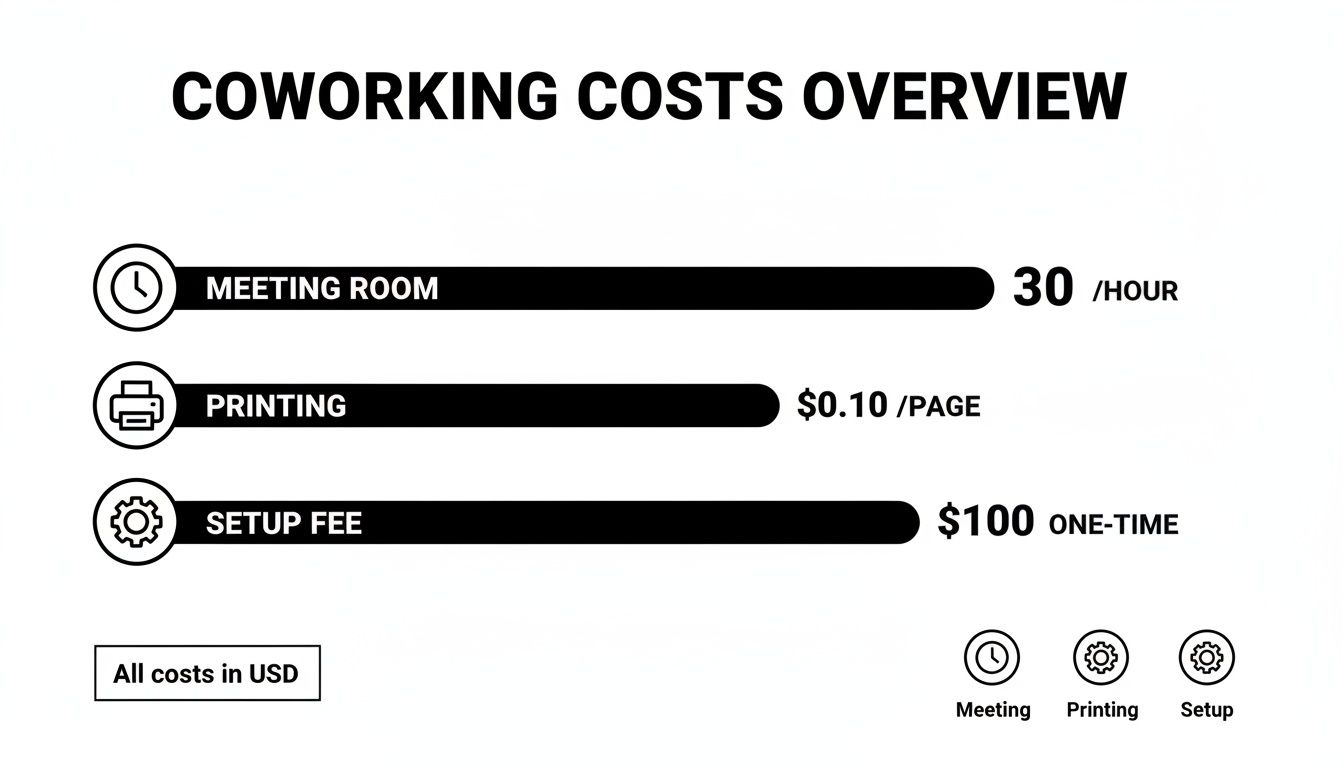
Unlike the unpredictable overhead of a traditional lease, these costs are easy to track and manage.
Seat leasing takes this all-inclusive concept even further. It's a model where everything—and I mean everything—is rolled into a single price per person, per month. It’s designed from the ground up for maximum cost-efficiency and simplicity.
The real magic of seat leasing is that it turns a huge, scary capital expense into a simple, predictable operating expense. It frees up your cash so you can invest it back into what really matters: growing your business.
By bundling all their services and operating at scale, seat leasing providers can offer a complete office solution for a fraction of what it would cost to do it all yourself.
The Bottom Line: Annual Cost Breakdown for a 20-Person Team
So, let's put some real numbers to these ideas. The table below shows a high-level annual cost estimate for our 20-person team across all three office models. Keep in mind these are just illustrative figures—actual costs will vary depending on your city and the specific provider.
| Cost Category | Traditional Lease | Coworking Private Office | Seat Leasing BPO |
|---|---|---|---|
| Annual Rent/Membership | $120,000 | $192,000 | $144,000 |
| Upfront Fit-Out & Furniture | $100,000 | $0 | $0 |
| Utilities & Internet | $24,000 | Included | Included |
| IT Support & Maintenance | $18,000 | Included | Included |
| Cleaning & Security | $15,000 | Included | Included |
| Management Overhead | $10,000 | $0 | $0 |
| Total First-Year Cost | $287,000 | $192,000 | $144,000 |
The difference is night and day. The traditional lease demands an enormous upfront investment, making its first-year cost almost double that of a seat leasing solution. Even a standard coworking office provides huge savings by eliminating CapEx and the daily headaches of office management.
This is how providers can back up claims of saving you up to 80%. When you factor in the initial cash burn, long-term risk, and management time of a traditional office, the all-inclusive nature of seat leasing is clearly a smarter financial move for most businesses. It's not just about a lower coworking space cost—it's about a more efficient way to run your company.
Choosing the Right Workspace for Your Business
Figuring out the right office space is about more than just finding the cheapest deal. It’s about finding the smartest option for where your business is right now—and where it’s headed. Think of your workspace as a strategic investment that helps you grow, not just a number on a spreadsheet.
To do that, you need to shift from being a "price shopper" to a "value investor." That means asking some honest questions to cut through the marketing fluff and find a solution that actually fits your goals, your team's culture, and your budget. Let's break down the key factors to consider.
Team Size and Growth Trajectory
First things first: take a hard look at your team. How many people do you have today? And, more importantly, what’s your headcount going to look like in six months or a year? The needs of a startup expecting to double in size are worlds apart from a stable consultancy.
Think of it like planning a road trip. If you know you'll be picking up friends along the way, you wouldn't start the journey in a tiny two-seater. For teams on a growth spurt, finding a workspace with built-in flexibility is non-negotiable.
- For High-Growth Teams: You'll want a provider that makes it simple to add more desks or even upgrade from a small private office to a larger one without getting tangled in a brand-new contract.
- For Stable Teams: You can focus on a space that fits your current size perfectly. This might even give you the leverage to negotiate a better rate on a longer-term agreement for a dedicated office.
Privacy and Security Requirements
What kind of work are you actually doing all day? The level of confidentiality your work demands will instantly rule out certain options. A team of graphic designers collaborating on a new logo has very different security needs than a law firm handling sensitive client information.
A hot desk in a lively, open-plan area can be fantastic for networking and sparking creative ideas. But if your team handles financial data, health records, or proprietary code, a secure, lockable private office is the only real answer.
Don't forget about your industry's compliance standards. Many fields have strict rules about data privacy and physical security. A private office gives you complete control over who comes and goes, ensuring conversations stay private and documents remain secure. This is a crucial element that goes far beyond the monthly coworking space cost.
Location and Brand Image
Your office address does more than just tell people where to find you; it says something about your company. A prestigious downtown address can be a magnet for top talent and a powerful signal to clients. For another business, a spot with easy highway access and free parking might be the more practical, and smarter, choice.
Ask yourself a few critical questions about location:
- Talent Pool: Is the office in a neighborhood where the people you want to hire actually want to work?
- Client Meetings: How easy is it for clients to visit? A central, well-known location removes friction and adds a layer of professionalism.
- The Daily Commute: What will the location mean for your team's commute and their overall work-life balance? A miserable commute can be a dealbreaker.
Flexibility and Business Agility
Finally, how much wiggle room does your business really need? There's a reason the traditional 10-year lease feels like a dinosaur: modern business is unpredictable. The freedom to scale up, scale down, or pivot without being chained to a long-term liability is one of the biggest draws of a flexible workspace.
Here, you have to weigh your need for agility against the cost. A month-to-month hot desk plan offers maximum freedom but usually comes with a higher per-day rate. Signing a 12-month agreement for a private office will almost certainly get you a discount, but it reduces your ability to make a quick change.
There's no single right answer. It all comes down to your company's appetite for risk and your operational game plan. By working through these factors, you can make sure your workspace is a calculated investment, not a costly mistake.
Actionable Strategies to Reduce Your Workspace Costs
Just because you’ve picked a workspace doesn't mean the opportunities to save money are gone. In fact, some of the smartest financial moves happen after you've signed the agreement. Thinking like a savvy tenant can seriously cut your ongoing coworking space cost.
These strategies don't require a finance degree, just a bit of planning and the confidence to ask for what you want. From locking in better rates with a longer commitment to being smart about how you use the space, every little tweak can lead to big savings over the year. Let's get into a few practical ways you can make your flexible office even more budget-friendly.
Negotiate for a Longer Commitment
Flexibility is a great perk, but it almost always costs more. While a month-to-month plan offers maximum freedom, coworking operators are businesses that value stability and predictable revenue. If you're confident your team is staying put, this gives you some real negotiating power.
Don't be shy. Talk to your community manager about potential discounts for signing a 6-month or even a 12-month agreement. Many are happy to knock 5-15% off your monthly rate in exchange for that security. It's often the single easiest conversation you can have to immediately lower your overhead.
Take Advantage of Location
Everyone loves a prestigious downtown address, but that prestige comes with a hefty price tag. You can often find incredible coworking spaces with all the same perks for a fraction of the cost, simply by looking a few miles outside the central business district.
Think about location-based savings this way:
- Suburban Hubs: Check out spaces in up-and-coming neighborhoods or well-connected suburbs. They're often just a short commute from the city center but worlds apart in price.
- Transit-Oriented Spots: An office right next to a major train or bus station can be just as convenient as a downtown spot, but without the sky-high rent.
For instance, a city like Belgrade offers centrally located, high-amenity spaces where a full-time plan can be as low as €150 per month. It’s a perfect example of how looking beyond the world’s most expensive cities can yield massive savings without sacrificing quality. This approach helps you keep your brand accessible while slashing your biggest fixed cost.
The "perfect" location isn't always the most expensive one. The smartest location is the one that hits the sweet spot between your brand, your team's commute, and your budget—delivering the best overall value.
Right-Size Your Space with a Hybrid Model
Paying for empty desks is like burning money. If your team works on a hybrid schedule, with people splitting time between the office and home, you might be paying for more space than you actually use on any given day.
This is where you can really "right-size" your membership. Instead of a dedicated desk for every employee, you could move to a smaller private office and supplement it with a handful of hot desk passes. This gives your team a home base for collaboration days but stops you from paying for desks that sit empty half the week. It’s all about making your workspace footprint match your team's actual office presence.
Answering Your Questions About Coworking Costs
Even after breaking down all the numbers, it's natural to have a few lingering questions. Making a big change in your workspace is a major decision, so let's tackle some of the most common concerns we hear from businesses weighing their options.
Is Coworking Really Cheaper Than a Traditional Office?
For the vast majority of businesses, the answer is a resounding yes. The real killer with a traditional lease isn't just the rent; it's the mountain of upfront costs for fit-outs and furniture, not to mention the surprise bills for utilities, internet, and repairs that pop up every month.
Coworking neatly bundles all of that into one predictable payment. When you skip the huge initial cash outlay and the ongoing operational headaches, you almost always come out ahead, especially in your first few years of operation.
What Is Actually Included in My Monthly Fee?
Think of your monthly membership as an all-inclusive pass to a productive workday. While the exact details can differ from one space to another, you can count on the basics being covered.
Your fee almost always includes:
- Your Workspace: Whether it’s a spot at a shared table, your own dedicated desk, or a private office.
- Utilities: No separate bills for electricity, water, or climate control. It’s all handled.
- High-Speed Internet: Business-grade Wi-Fi is standard, so you can just connect and go.
- Basic Amenities: Access to kitchens, free-flowing coffee and tea, and common lounge areas are part of the deal.
- Cleaning Services: The space is kept clean and professional without you lifting a finger.
Keep in mind that extras like booking a meeting room beyond your included credits, printing services, or mail handling will usually have their own pay-as-you-go fees.
How Much Notice Do I Need to Cancel?
This is where the flexibility of coworking truly shines. Forget being locked into an ironclad 5-10 year lease. The terms here are built for the modern business world. For monthly memberships like hot desks, you typically only need to give 30 days' notice.
If you're in a private office on a slightly longer 6 or 12-month agreement, the notice period might be a bit longer, but it's nothing like the stiff penalties you'd face for breaking a traditional lease. This agility is a huge part of the appeal. If you want to dive deeper into other ways to make your business more agile, you can find more insights on the Seat Leasing BPO blog.
Ready to slash your office expenses without sacrificing quality? At Seat Leasing BPO, we specialize in providing fully serviced, cost-effective workspace solutions that eliminate high upfront costs and operational burdens. Discover how you can save up to 80% compared to a traditional office lease by visiting us at https://seatleasingbpo.com.