For most of business history, a traditional office lease was just the cost of doing business. It was an inflexible, five-year commitment that locked you in and drained your capital. But the game has changed. Today, a flexible office space rental works more like a subscription service, giving businesses the agility and scalability they need without the crippling upfront costs.
The End of the Five-Year Lease

For decades, the only way to get an office was to sign on the dotted line of a long, iron-clad commercial lease. This wasn't just about rent; it meant sinking a massive amount of cash into fit-outs, furniture, IT infrastructure, and hefty security deposits—all before a single employee could even start working. This old model was built for an era of predictability, not for the speed and constant change of modern business.
Think of the old way as building your own server farm from the ground up. You were on the hook for everything: buying the hardware, wiring the network, managing security, and handling all the maintenance. It's a huge distraction of time and money from what you're actually supposed to be doing: running your company. A flexible office space flips that script entirely.
It's like switching to a cloud service instead of building that server farm. You get instant access to world-class infrastructure, pay only for what you need, and skip the massive upfront expense and management headaches.
This shift gives you an incredible amount of operational freedom and financial control. What was once a niche option for freelancers has become a core strategic tool for companies of all shapes and sizes.
Who Benefits from a Flexible Workspace
The beauty of this model is how it adapts to the specific needs of different businesses. The freedom to grow, shrink, or pivot without being chained to a lease is a massive advantage.
- Startups: For any founder, cash is oxygen. Avoiding a five-year lease is a lifeline. It lets them conserve precious capital for product development and growth, scaling their space up or down as funding and headcount change.
- BPO Providers: The Business Process Outsourcing world runs on speed. When a BPO lands a new client, they often need a fully operational team ready to go almost overnight. Flexible office rentals provide the plug-and-play setup to make that happen, cutting out months of setup time.
- Enterprises: Big companies use flexible spaces as a low-risk way to test new markets. Instead of gambling on a huge regional headquarters, they can deploy a small team to explore an area first. It's also perfect for housing special project teams or building out a "hub-and-spoke" office footprint.
Ultimately, ditching the rigid lease allows companies to get back their two most valuable assets: their capital and their focus. They can pour their energy into innovation and serving customers instead of being forced to act like part-time real estate managers.
Understanding Flexible Office Space Rental
So, what exactly is a flexible office space rental? Forget the dry, textbook definitions. Think of it more like your Netflix or Spotify subscription. You don't build a movie theater just to watch a film; you subscribe to a service that gives you instant access to a massive library. A flexible office works the same way for physical workspace—you get a fully functional, ready-to-use office without the headache and expense of building and managing it yourself.
This is a world away from the old-school approach. With a traditional lease, you’re on the hook for everything. We're talking buying desks, setting up the internet, managing utility bills, and hiring cleaners. Flexible office space rentals wrap all of those necessities (and headaches) into one simple, predictable monthly fee.
The All-Inclusive Advantage
At its heart, the biggest draw of a flexible office rental is its sheer simplicity. One single payment can cover a whole suite of essentials that would otherwise mean juggling dozens of different vendors, contracts, and bills.
Here's what's typically included:
- Fully Furnished Workspaces: Your office is ready to go with professional desks, ergonomic chairs, and modern decor. This alone saves you a massive upfront cost on furniture.
- High-Speed Internet and IT: You get enterprise-grade, reliable internet and IT support from day one. Your team just plugs in and starts working. No haggling with internet providers.
- Utilities and Maintenance: All the basics—electricity, water, heating, and air conditioning—are handled for you. Daily cleaning and general maintenance are also part of the package.
- Professional Services: Many spaces also provide a staffed front-desk reception, mail handling services, and access to shared amenities like kitchens, lounges, and breakout areas.
This isn't just about convenience; it’s a powerful financial strategy. This model is catching on fast, with the global flexible office market projected to grow from $48.33 billion in 2025 to $56.04 billion in 2026—a 16% jump in just one year. Experts predict it could hit $100.4 billion by 2030, showing just how many businesses are making the switch.
The real power of a flexible office space rental is that it lets you pour your capital into growing your business, not furnishing your office. By cutting out huge upfront investments and long-term lease liabilities, you free up cash for what actually matters: your people, your product, and your customers.
Scalability and De-Risking Your Growth
But where this model truly shines is in its agility. Let’s say your startup just closed a funding round and you need to double your team overnight. A flexible space provider can often get you that extra room almost immediately. On the flip side, if you need to downsize a project team, you’re not stuck paying for empty desks for the next five years.
This ability to scale up or down on demand is a massive advantage. It effectively de-risks expansion. You can test out a new market or launch a new department without signing a scary, multi-year commercial lease. This removes one of the biggest barriers to growth, helping companies become more opportunistic and responsive. For a deeper look into a variety of business solutions, you might be interested in other articles on our blog. This kind of operational freedom is a complete game-changer, transforming your office from a fixed cost into a dynamic asset that moves with your strategy.
Comparing the Different Flexible Workspace Models
Trying to figure out which flexible office is right for you can feel overwhelming at first. But really, it all comes down to three main paths. Each one is built for a different kind of business, so the trick is to match the space to your team's specific needs. It's a bit like choosing a vehicle—a solo freelancer needs a zippy scooter, not a tour bus.
Before we dive into the models, this visual shows what they all have in common. They bundle the essentials—space, services, and utilities—into one simple package.
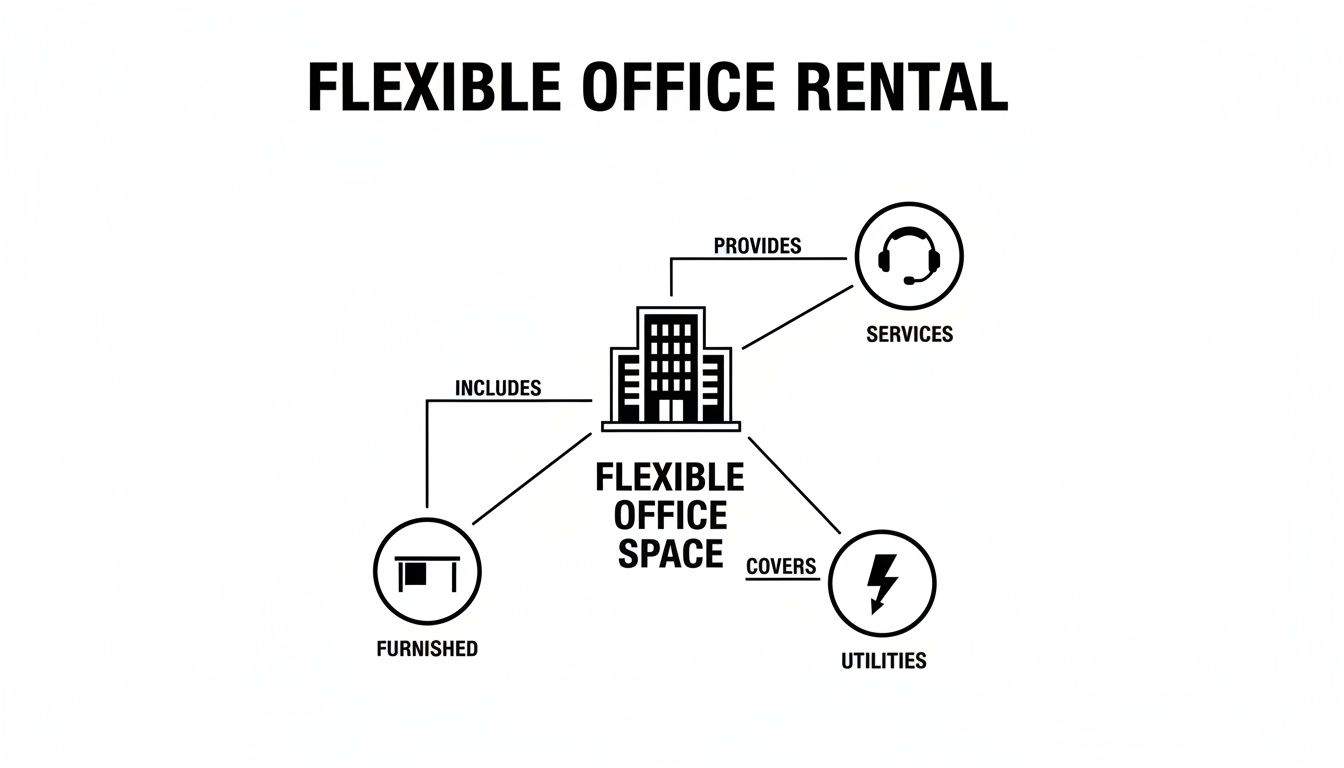
No matter which you choose, the goal is always the same: get you up and running fast, so you can focus on your work instead of office management.
The Collaborative Buzz of Coworking Spaces
On one end of the spectrum, you have coworking. Picture a lively, high-end coffee shop mashed up with a library's reading room. It’s a shared workspace where freelancers, startup teams, and remote employees from all different companies work together in a big, open area. The real appeal is the collaborative vibe and the built-in networking.
You usually pay for a hot desk (first come, first served) or a dedicated spot that’s yours to keep. While the atmosphere can be fantastic for creativity, it’s not for everyone. Privacy is practically non-existent, and the constant hum of activity can be a major distraction. There's a lot of variety among Coworking Spaces, so it pays to explore what different providers offer.
The Professional Polish of a Serviced Office
Moving up a level, we find the serviced office. If a coworking space is a shared house, a serviced office is your own private, fully-furnished apartment in a high-end building. You get a lockable office suite that’s just for your team, but you still share top-notch amenities like a professional reception desk, meeting rooms, and kitchens.
This is a perfect middle-ground for small-to-medium businesses (SMEs) and corporate teams. You get the privacy and professional image you need without the headache and high cost of a traditional lease. It’s the best of both worlds: your own branded space with hotel-like services on demand.
A serviced office gives your team a dedicated home base with the front-desk polish of a corporate building, all without the long-term commitment or capital expense of a traditional lease. It’s about having your own space, with support on tap.
The Turnkey Power of Seat Leasing
But what if you need something more specialized and secure? That’s where seat leasing comes in. This isn't just about renting a room; it’s about leasing fully-equipped, ready-to-go workstations. Think of it like leasing a dedicated, high-security server instead of just using a shared one. It's a true plug-and-play solution designed for serious operational needs.
With seat leasing, each employee gets a complete setup: a PC, a secure network connection, and all the IT infrastructure and support that goes with it. It's an absolute game-changer for BPO companies that need to scale up for a new client overnight or for enterprises that require a highly secure "bubble" for a sensitive project.
To make it easier to see the differences side-by-side, we've put together a simple comparison.
Flexible Workspace Models at a Glance
This table breaks down the core differences between the three main models to help you see where your business fits best.
| Feature | Coworking Space | Serviced Office | Seat Leasing |
|---|---|---|---|
| Workspace Type | Shared, open-plan areas or hot desks | Private, lockable office suites | Private, dedicated, and secured areas |
| Best For | Freelancers, solopreneurs, small startups | SMEs, corporate project teams, satellite offices | BPOs, large enterprise teams, call centers |
| Privacy Level | Low | High | Very High (often with enhanced security) |
| Customization | Minimal to none | Some branding and layout options | High (can be built to client specs) |
| Included Services | Basic Wi-Fi, coffee, community events | Reception, mail handling, meeting rooms | Full IT support, PC units, secure networks |
Ultimately, the right choice depends on your priorities: community (coworking), privacy (serviced office), or operational power (seat leasing).
The True Cost and Savings of Going Flexible
Everyone talks about saving money with a flexible office, but how does it actually work? To really get it, you have to look past the monthly rent of a traditional lease and see the mountain of hidden costs it conceals. Signing a five-year lease is a lot like buying an empty house—the sticker price is just the beginning of what you'll spend.
Before a single employee can even walk through the door, you're facing a wall of massive, one-time expenses. For any business, this initial capital expenditure (CapEx) can be a real shock.
- Fit-Out and Renovation: That "blank canvas" space is almost never ready to go. You’ll be spending a small fortune on construction, painting, and custom work just to make it usable.
- Furniture and Equipment: Every desk, chair, and computer comes straight out of your budget. This can easily balloon into tens of thousands of dollars, even for a small team.
- IT Infrastructure Setup: This is a big one. You're on the hook for designing, installing, and managing your entire network, from pulling cable to setting up servers and Wi-Fi.
- Security Deposit: Landlords typically demand a deposit worth several months' rent, tying up a huge chunk of your cash for the entire lease.
Once you survive that initial hit, the recurring operational costs begin. Think separate bills for electricity, daily cleaning services, building maintenance fees, and paying for your own IT support staff. When you add it all together, the advertised rent is just a small piece of your true total cost of occupancy.
How the Numbers Actually Stack Up
Let's put this into perspective with some real-world figures. Imagine a 20-person team needing office space for a year. The financial gap between a traditional lease and a flexible office solution becomes crystal clear when you see the numbers side-by-side. That initial cash outlay for a conventional office is often the single biggest thing holding a company back.
A flexible office space rental essentially converts massive, unpredictable capital costs into a single, predictable monthly payment. This simple shift frees up your cash to invest in what really matters—hiring talent and growing the business—instead of sinking it into drywall and desks.
This model is a game-changer for companies that need to get teams up and running fast. For specialized options like seat leasing, this means you can practically move in overnight. You pick a location, sign the agreement, and your team arrives at a fully functional office with everything from electricity to high-speed internet already handled.
Corporate demand for this kind of turnkey solution has exploded, with over 106,000 seats absorbed in just six months in key markets. To see exactly how this works, you can check out what’s included in our all-in-one seat leasing packages.
First-Year Cost Comparison: 20-Person Team
The table below breaks down the estimated first-year expenses, showing how a flexible office space rental can deliver on its promise of up to 80% cost savings. The numbers don't lie—they reveal a dramatic drop in both upfront investment and ongoing overhead.
| Cost Item | Traditional Lease (First-Year Estimate) | Flexible Office Space (First-Year Estimate) |
|---|---|---|
| Upfront Capital Costs | ||
| Office Fit-Out | $50,000 | $0 |
| Furniture | $30,000 | $0 |
| IT & Network Setup | $15,000 | $0 |
| Security Deposit | $20,000 | $5,000 |
| Monthly Operating Costs | ||
| Rent/Lease Fee | $120,000 ($10,000/mo) | $144,000 ($12,000/mo) |
| Utilities & Internet | $18,000 ($1,500/mo) | Included |
| Cleaning & Maintenance | $12,000 ($1,000/mo) | Included |
| IT Support | $6,000 ($500/mo) | Included |
| Total First-Year Cost | $271,000 | $149,000 |
This comparison gets to the heart of the financial advantage. Yes, the monthly fee for a flexible space might look a little higher at first glance. But once you factor in the elimination of huge capital costs and all the bundled operational expenses, the overall savings are massive. For any smart business owner, the choice becomes obvious: put your capital toward growth, not just keeping the lights on.
Which Flexible Office Model Fits Your Business?
The real magic of a flexible office space rental is that it's not a one-size-fits-all solution. It’s more like a Swiss Army knife for your business operations, with different tools for different challenges. Whether you're a scrappy startup, a results-driven BPO, or a global corporation testing new markets, there's a flexible workspace strategy that can give you a serious advantage.
The trick is to look past the buzzwords and identify which model solves your specific problems. For some, it’s all about protecting cash flow. For others, it’s about speed, security, and hitting the ground running.
Let's see how this works for three very different types of businesses.
For Startups Conserving Capital and Scaling Fast
For any startup, cash isn't just king—it's oxygen. The early days are a frantic race to build a product, find customers, and grow your team before the bank account runs dry. Sinking hundreds of thousands of dollars into a traditional office lease deposit and fit-out is the fastest way to shorten your runway.
A flexible office space rental completely flips that script.
Instead of a massive, upfront capital expense, you get a professional, fully-furnished office for a predictable monthly fee. This frees up precious cash, allowing founders to pour money into what actually matters: developing the product, marketing, and hiring the best people.
A flexible office lets a startup punch above its weight. You get the polish and professionalism of a much larger company from day one, but you keep the financial agility of a lean, fast-moving team. It takes the real estate headache off your plate so you can focus on building your business.
- Case Study: A FinTech Startup's Growth Spurt
An early-stage FinTech company with a team of eight just closed its first big seed round. They needed to hire ten more engineers within three months, but a five-year lease was out of the question. By choosing a serviced office, they moved into a professional 10-person suite almost overnight, paying a single monthly fee. This saved their funding for critical developer salaries and gave them a credible space to impress future investors.
For BPOs Needing Speed and Security
The Business Process Outsourcing (BPO) world runs on tight deadlines and client expectations. When a BPO signs a new client, they're expected to have a fully trained, operational team ready to go almost immediately. Speed isn't just a nice-to-have; it's a core competitive requirement. You can't afford to spend months finding a building, renovating it, and setting up IT.
This is where a specialized flexible office space rental like seat leasing becomes an operational superpower. It’s a genuine plug-and-play solution designed for this exact scenario.
Ready-to-Go Workstations: BPOs can instantly lease fully equipped seats that come with PCs, secure networks, and robust IT support. Their agents can literally walk in and start working.
Rapid Deployment: A team of 50 or 100 people can be up and running in a few days, not months. This allows the BPO to meet even the most aggressive client timelines.
Enhanced Security: Providers like Seat Leasing BPO specialize in secure, private offices with the IT backbone needed to handle sensitive client data and meet strict compliance rules.
Case Study: An Expanding Call Center
A BPO provider won a huge contract to launch a 100-person customer support team for an e-commerce giant in just 30 days. A traditional office search would have taken at least six months. Instead, they used a seat leasing solution to get 100 fully-equipped workstations in a secure facility. The team was trained and taking calls well before the deadline, locking in a profitable, long-term partnership.
For Enterprises Implementing Agile Strategies
It's not just smaller companies getting in on the action. Even large, established corporations are using flexible office rentals to become more nimble and strategic. The old model of a single, massive, centralized headquarters is giving way to smarter, more dynamic real estate plans.
Enterprises are using flexible spaces for all sorts of strategic moves:
- Market Entry: Launching a small "scout team" in a new city or country without the financial commitment and risk of a long-term lease.
- Project-Based Teams: Setting up temporary "war rooms" for specific projects without disrupting operations at the main office.
- Hub-and-Spoke Models: Creating a network of smaller satellite offices around a central HQ to give employees better work-life balance and shorter commutes.
This approach transforms a company's real estate from a fixed, heavy liability into a responsive asset that can scale up or down as the business evolves.
Your Checklist for a Seamless Transition
Moving into a flexible office space is a totally different ballgame than signing a traditional lease. Forget the long, drawn-out negotiations and construction headaches. This process is built for speed, and with the right plan, you can get your team settled with virtually no disruption to your business.
Think of it this way: you’re not building a house from the ground up. You’re moving into a fully furnished, professionally managed apartment. Your job isn't to worry about the plumbing and wiring; it's to make sure the place has everything you need and to plan a painless move-in day.
This five-step checklist will guide you from making the decision to getting your team plugged in and working.
1. Define Your Core Needs
Before you even glance at a single listing, you have to get crystal clear on what your business actually requires. This is the single most important step. Getting it right upfront saves you from getting sidetracked by cool-looking amenities that don't actually help your bottom line.
Start by mapping out these fundamentals:
- Headcount and Growth: How many people need a desk right now? More importantly, what are your growth projections for the next 6-12 months? This tells you how much space you need today and how much scalability you'll need tomorrow.
- IT and Security Requirements: This is a big one, especially for BPOs and tech companies. Do you handle sensitive client data? You need to define your specific needs for secure networks, firewalls, or any compliance certifications you must maintain. These are non-negotiable.
- Location Priorities: What matters most about where you set up shop? Is it easy access to public transport for your team? Being close to key clients? Or is a prestigious business address critical for your brand's image?
2. Evaluate Potential Providers
Once you know what you're looking for, you can start vetting providers. The temptation is to jump straight to a price comparison, but that's a rookie mistake. You're not just renting an office; you're choosing a service partner who will be responsible for your entire operational environment.
The real value isn't just in the monthly rent. Dig deeper and assess them on reliability, support quality, and the total package. Check online reviews, ask to speak with current tenants, and see how quickly they respond to your own inquiries. A provider who is slow to get back to you now will almost certainly be slow when you have an urgent IT problem.
3. Conduct Insightful Tours
This is where you get to kick the tires. A tour is your chance to look past the glossy marketing photos and see how the space actually functions. This is the time to focus on the infrastructure that will power your business every single day.
Think of a tour as a "test drive" for your business. Don't just look at the view; check the engine. Ask about internet redundancy, the process for booking meeting rooms, and the specifics of their on-site support.
4. Review the Service Agreement
The service agreement is the most important document you'll sign. Thankfully, unlike a convoluted traditional lease, a good flexible space agreement is written in plain English. Still, you need to read it from top to bottom so you know exactly what you're getting into.
Pay close attention to these key clauses:
- Term Length and Exit Clauses: What is your minimum commitment? How much notice do you have to give if you need to leave or downsize?
- Scalability Options: How does the provider handle requests for more (or fewer) seats? Are there extra costs, and what's the turnaround time?
- Service Level Agreements (SLAs): This is the provider's written promise. Look for guaranteed internet uptime (99.9% is standard) and defined response times for IT support tickets.
5. Plan Your Move-In Day
The mark of a truly successful move is that your team and your clients barely even notice it happened. Work hand-in-hand with your provider to map out a zero-downtime transition. You'll want to confirm that every workstation, network port, and phone is set up and tested before your team walks in the door.
If you have any questions about this process, our team is ready to help you plan your seamless move. A great provider will feel like an extension of your own team, making sure your people can arrive on day one, plug in their laptops, and get straight to work.
Your Top Questions About Flexible Offices, Answered
Jumping into a flexible office space is a big decision, and it’s smart to have questions. In fact, before you even think about signing a contract, you should be asking about security, what happens when your team grows or shrinks, and of course, the real cost. Let's walk through the most common concerns we hear from businesses just like yours.
The number one worry is almost always data security. How can you be sure your company’s sensitive info is safe when you're sharing a network? Any provider worth their salt has this locked down with serious, enterprise-level IT.
Think of it like a modern bank. Everyone walks through the same front door, but your money is in its own private, secure vault. A quality flexible office does the same thing for your data, using tools like virtual private networks (VPNs) and dedicated firewalls to create a private "digital vault" for each company.
This setup isolates your network traffic from everyone else's. Even though you're in a shared building, your digital workspace is completely walled off. Always make a point to ask a potential provider to walk you through their specific security measures.
What Happens If My Team Size Changes?
Okay, security is covered. But what about your team? Businesses aren't static. You might land a huge new client and need to double your staff, or maybe a project wraps up and you need to scale back. This is where the flexible model really proves its worth.
Unlike getting locked into a rigid, multi-year traditional lease, a flexible office space rental is built for exactly this kind of change. Most agreements will let you add or remove seats with a fairly short notice period, typically just 30-60 days. This agility means you stop paying for desks you don't need or desperately scrambling for more room when you're growing fast. You just adjust your plan to fit your real-world headcount.
Are There Hidden Fees I Should Know About?
So, what’s the catch? It's natural to wonder about hidden fees. One of the best things about this model is the all-in-one pricing that wraps your major expenses into a single, predictable monthly payment. But you should absolutely get clarity on what’s included versus what’s extra.
Be on the lookout for a few common things that might not be covered in your base rate:
- Meeting Room Usage: Some plans give you a certain number of free hours per month, while others are purely pay-as-you-go.
- Printing and Copying: If you do a lot of printing, you might go past the standard "fair use" amount and see extra charges.
- After-Hours HVAC: Need your team to work late or on weekends? You might have to pay extra for heating or air conditioning outside of standard business hours.
Before you sign anything, read the service agreement closely and ask for a simple list of all potential extra costs. To make sure your transition into the new space goes off without a hitch, it's a great idea to follow a detailed office relocation checklist that maps out every step.
At Seat Leasing BPO, we believe in transparent, all-inclusive pricing so you can budget without any surprises. Ready to find a workspace that actually adapts to your business? Find your perfect office at https://seatleasingbpo.com.