When you think of a call center, you probably picture a massive, sprawling office packed with agents in headsets—a classic "cubicle farm." While that image isn't entirely wrong, it’s becoming an outdated snapshot of a rapidly changing industry. The world of call centers in the United States isn't shrinking; it's evolving into something much smarter and more flexible.
The Modern State of US Call Centers

If you just look at the top-line numbers, you might miss the real story. Total industry revenue has held steady at around $28.5 billion, which suggests a market that’s hit a plateau. But when you dig a little deeper, you find a surprising trend.
The number of telemarketing and call center businesses in the US has actually been climbing. As of 2026, there are 45,130 of them, reflecting a consistent 2.9% annual growth rate since 2021. You can see the full post-pandemic data breakdown over at IBISWorld.com.
So, what’s going on? More businesses but the same total revenue? This isn't a contradiction. It’s a clear sign that the market is fragmenting away from the giant, monolithic centers of the past. We're seeing an influx of smaller, more specialized, and nimbler players carving out their own niches.
A Shift Toward Agility and Specialization
The old way of doing things—building or leasing a huge facility, filling it with expensive tech, and hiring hundreds of agents—is becoming a liability. Today, agility is the name of the game. Companies are actively searching for ways to get the support they need without the massive overhead.
This move toward a more flexible model is driven by a few key pressures that anyone in the industry will recognize:
- Cost Management: Sky-high commercial real estate prices and the capital expense of building out your own IT infrastructure are huge hurdles.
- Technological Demands: Customers now expect you to be everywhere at once—phone, chat, email, social media. That requires a sophisticated tech stack that’s costly to buy and maintain.
- Talent Acquisition: Finding and keeping great agents is a constant struggle, pushing businesses to look for more efficient ways to staff their operations.
The big idea for succeeding in today's market is mastering adaptability. The winners will be the businesses that can scale up or down on a dime, control their spending, and adopt new technologies without breaking the bank on upfront investment.
US Call Center Industry Snapshot 2026
To really grasp the current environment, a few key figures tell the whole story. The table below breaks down the numbers that are shaping decisions for businesses right now.
| Metric | Figure | Implication for Businesses |
|---|---|---|
| Number of Businesses | 45,130 (as of 2026) | The market is getting more crowded, with a rise in specialized providers. |
| Annual Business Growth | 2.9% (2021-2026) | The industry is healthy, offering more partnership and outsourcing options than ever. |
| Total Industry Revenue | $28.5 Billion | Stable revenue points to a focus on cost-efficiency rather than just brute-force growth. |
These stats paint a very clear picture. The future of call centers in the United States isn't about building bigger buildings. It’s about finding smarter, leaner ways to deliver outstanding customer experiences.
This new reality is exactly why different operational models are gaining ground. Solutions like seat leasing, for example, offer a "plug-and-play" alternative that lets companies sidestep the huge capital expenditures and long timelines traditionally needed to launch a US-based support team.
Navigating the US Call Center Workforce and Talent Hubs
Technology and fancy buildings are important, but let's be honest—the real engine of any call center is its people. Even with AI and automation creeping into every corner of the industry, you simply can't replace a skilled human when it comes to solving a tricky problem or making a customer feel heard. But managing this workforce is, without a doubt, one of the toughest jobs in the business.
The sheer scale is staggering. The US call center industry employs a massive 3.8 million people, and that number is still climbing by about 2.5% every year. Why? Because even with all the new tech, experts predict that by 2026, a real person will still handle 90% of customer interactions. That tells you everything you need to know about the enduring value of empathy and genuine human connection.
But here's the kicker: the industry is plagued by a notoriously high agent turnover rate, often hovering between 30% and 45%. This isn't just a staffing nuisance; it's a direct assault on your service quality and your bottom line.
The Challenge of High Agent Turnover
High turnover is a constant drain. Picture a leaky bucket: you're perpetually pouring resources—recruitment funds, training hours—into the top, only to watch experienced, valuable agents drip out the bottom. Every time an agent walks out the door, they take institutional knowledge with them, and you're stuck paying to find and train their replacement all over again.
This is a flashing red light indicating that the work environment itself has to be a top priority. To stop the churn, you have to create a workplace where people actually want to stay. That means moving past the soul-crushing cubicle farms of yesterday and building supportive, modern spaces that make agents feel valued. In fact, purpose-built facilities can offer a huge competitive edge here. You can see what that looks like by exploring the environment and amenities in a modern BPO building.
Mapping the Major US Talent Hubs
Where you decide to open your doors will have a massive effect on your ability to find and keep good people. Different parts of the country offer completely different landscapes when it comes to labor costs, the size of the talent pool, and the local economy.
The Southeast (Florida, Georgia, North Carolina): This region is an absolute powerhouse for call centers. It's known for having large, diverse labor pools and a more reasonable cost of living. States like Florida, in particular, are fantastic for finding a multilingual workforce, which is a huge plus.
The Midwest (Ohio, Michigan, Indiana): Often called the "Rust Belt," this area provides a workforce with a famously strong work ethic and more affordable labor costs than you'll find on the coasts. As manufacturing jobs have declined, a ready supply of workers has emerged, eager for stable roles in the service industry.
The Mountain West (Arizona, Utah, Idaho): This region has quietly become a hotbed for both tech companies and their customer support operations. States like Arizona offer a very business-friendly climate and a growing population, which means a steady stream of new talent.
The key takeaway here is to think geographically. Choosing a location isn't just about real estate; it's a strategic talent decision. The right city can provide a sustainable pipeline of skilled agents, while the wrong one can trap you in an endless cycle of hiring and retraining.
For any business that depends on a large team, especially call centers, mastering effective high-volume recruiting strategies is non-negotiable. By understanding the unique character of each regional hub, you can align your operational needs with the available workforce and set yourself up for real, long-term stability.
Choosing Your Sourcing Model: Onshore, Offshore, or Nearshore?
Figuring out where to base your call center is one of the biggest calls you'll make. It’s a decision that goes way beyond just finding the cheapest option. It directly impacts your customer experience, how people see your brand, and how smoothly your entire operation runs.
Think of it like setting up a production line for a high-end product. You could go with the cheapest factory overseas to save a bundle, but you might run into quality control headaches and communication barriers. Or, you could keep manufacturing local for total control and flawless alignment, but you'll pay a premium for it. A third option is to find a partner in a neighboring country who offers a nice balance of quality and cost.
This is the exact puzzle companies face when building out their customer support. This guide can help you think through which US talent hub might be the right fit, depending on what matters most to your business.
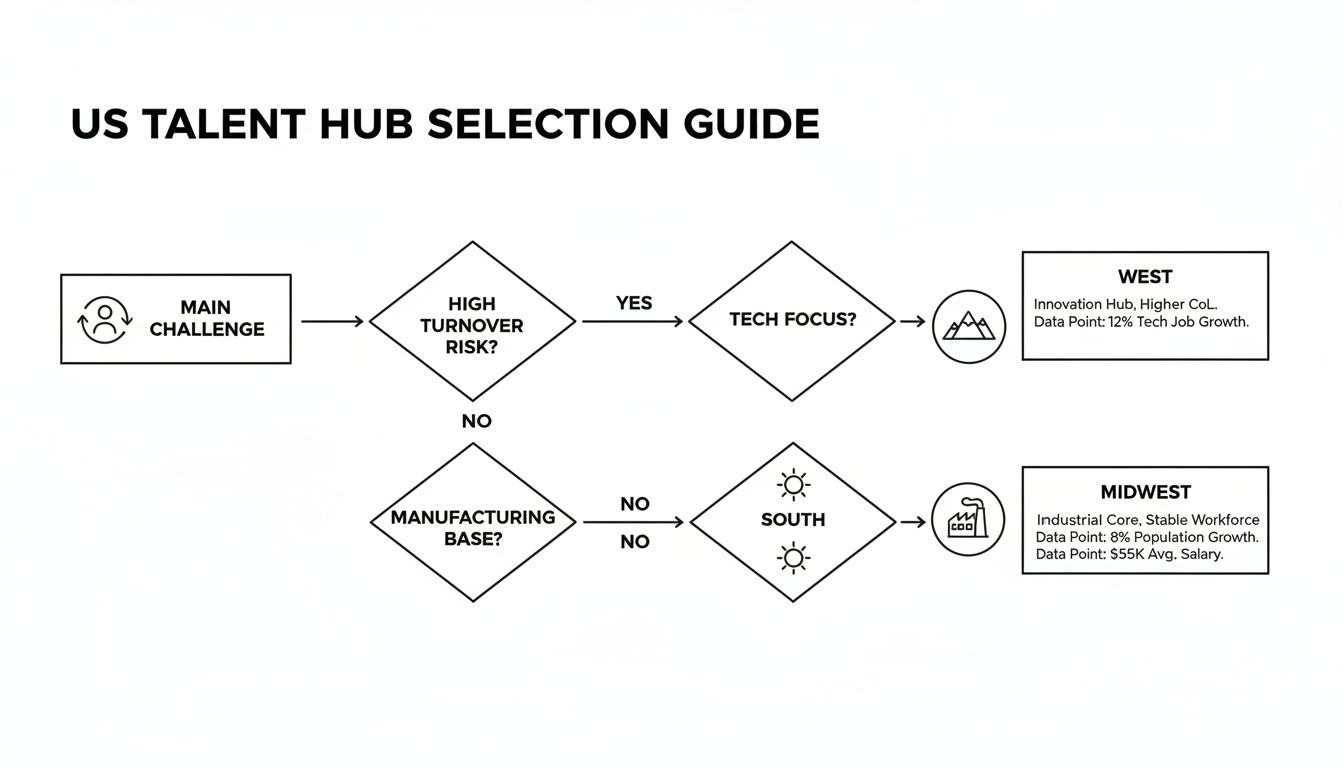
As the chart shows, even within the US, different regions have unique strengths. For example, if agent turnover is a major pain point, the stability of the Midwest's labor market can be a huge asset.
Onshore: The Gold Standard
When you keep your call center inside the United States, that's called onshore sourcing. This approach gives you the tightest grip on brand control, cultural alignment, and regulatory security. Your agents and your customers speak the same language, get the same cultural references, and understand the same local nuances. It just makes for a smoother, more natural conversation.
The biggest win here is compliance. For any business handling sensitive information—think healthcare or finance—staying within the US legal system isn't just a good idea, it's often a requirement. It makes adhering to rules like HIPAA and the TCPA much more straightforward. But this level of quality and security comes at a cost. Hands down, onshore call centers are the most expensive of the three models when it comes to labor and operational expenses.
Offshore: The Cost-Saving Powerhouse
Offshore sourcing means setting up your call center in a distant country, very often in Asia—the Philippines and India are the dominant players. The main motivation is simple: massive cost savings. Labor rates can be 50-70% lower than what you’d pay in the US. This kind of financial leverage allows businesses to scale support teams quickly and offer 24/7 "follow-the-sun" coverage.
Of course, those savings come with a few catches. Big time zone differences can make day-to-day management a real challenge. You also run the risk of language barriers or cultural disconnects that can, at times, create friction with customers. On top of that, you have to navigate an entirely different set of data privacy laws and legal systems, which adds a layer of risk and complexity you have to be prepared for.
Nearshore: A Balanced Hybrid
For many, nearshore sourcing is the "just right" solution. This involves partnering with centers in countries that are geographically and culturally close to the US, like those in Latin America and the Caribbean. You get a significant price break compared to an onshore center but keep a much stronger connection than you would with a typical offshore location.
So, what makes nearshore so compelling?
- Time Zone Alignment: Business hours overlap almost perfectly, which makes real-time collaboration, training, and management incredibly simple.
- Cultural Affinity: Many nearshore countries have strong cultural ties to the US, which helps agents build rapport and connect more naturally with customers.
- Deep Talent Pools: These regions boast large, well-educated, and bilingual workforces that are available at a very competitive rate.
To make the best decision, it helps to see the models side-by-side. Each has a clear place depending on your priorities.
Onshore vs Nearshore vs Offshore Call Center Comparison
This table breaks down how the three sourcing models stack up against key business factors.
| Factor | Onshore (US) | Nearshore (e.g., Latin America) | Offshore (e.g., Asia) |
|---|---|---|---|
| Cost | Highest | Moderate (significant savings vs. US) | Lowest (up to 70% savings) |
| Cultural Alignment | Excellent | Very Good | Moderate to Low |
| Time Zone | Excellent (same) | Excellent (overlapping hours) | Poor (major differences) |
| Talent Pool | Skilled, but high competition | Large, bilingual, well-educated | Very large, strong technical skills |
| Compliance | Easiest (US laws) | Good (often similar frameworks) | Complex (different legal systems) |
| Best For | Complex issues, high-value customers, strict compliance | Balanced cost/quality, bilingual support, sales | High-volume, transactional tasks, 24/7 support |
Ultimately, there's no single "best" model—it all comes down to your company's specific needs, budget, and brand. While cost is always a huge driver, you have to weigh it against the quality of your customer experience and the importance of data security.
For businesses looking for a "plug-and-play" option that cuts through this complexity, it’s worth exploring what is included in seat leasing arrangements. This model provides fully equipped workstations and infrastructure, letting you launch your team fast, no matter which sourcing model you choose.
Meeting Key Regulations and Compliance Standards
Running a call center in the United States isn't just about managing people and technology; it’s about navigating a dense landscape of legal obligations. Getting compliance right isn't just a box to check—it’s a fundamental business strategy that safeguards your customers, your reputation, and your financial stability.
The consequences of getting it wrong are steep. We’re talking about staggering financial penalties and an erosion of public trust that’s incredibly hard to win back. Think of it this way: compliance standards are the rules of the road for how you communicate with customers. Ignoring them is like speeding through red lights—a crash is inevitable, and for a business, that crash takes the form of crippling fines and permanent brand damage.
Understanding the Telephone Consumer Protection Act
For any center making outbound calls, the Telephone Consumer Protection Act (TCPA) is ground zero. This law was created specifically to stop unwanted telemarketing calls and texts, and its entire framework is built on one simple, powerful idea: consent.
Violating the TCPA is a fast track to financial disaster. Fines can run from $500 to $1,500 per single call or text. If you’re running a campaign that makes thousands of dials a day, you can do the math. The penalties can quickly spiral into the millions, posing a very real threat to your company’s existence.
The core message of the TCPA is crystal clear: you need explicit permission before you contact a consumer with an automated system. Having a bulletproof process for tracking and documenting consent isn't just a good idea; it's your main line of defense against devastating legal trouble.
Here are the absolute must-haves for TCPA compliance:
- Express Written Consent: Before sending automated marketing messages, you must have clear, documented permission from the recipient.
- Do-Not-Call (DNC) List Compliance: You are required to scrub your calling lists against the National Do-Not-Call Registry and, just as importantly, maintain your own internal DNC list for people who ask you to stop calling.
- Calling Time Restrictions: You can only place telemarketing calls between 8 a.m. and 9 p.m. in the recipient's local time zone.
Protecting Data with Privacy Laws
It doesn't stop with how you contact people. What you do with their information is facing more scrutiny than ever before. A new generation of state-level data privacy laws, pioneered by the California Consumer Privacy Act (CCPA) and its successor, the California Privacy Rights Act (CPRA), has completely rewritten the rules.
These laws give consumers powerful rights over their personal information. They can:
- Demand to know what personal data you’ve collected on them.
- Request that you delete their personal information.
- Opt-out of having their personal data sold or shared.
For call centers in the United States, this means a secure, well-managed IT infrastructure is no longer optional. You need systems that can securely store customer data, track consent status, and handle consumer requests quickly and accurately. Getting this wrong can lead to fines, but more importantly, it can shatter the trust you have with your customers.
Many businesses discover that the smartest move is to partner with a BPO provider whose infrastructure is already built to be secure and compliant. It’s a practical way to offload a complex and high-stakes responsibility, turning a potential liability into a genuine strength.
How Technology Is Reshaping US Call Centers
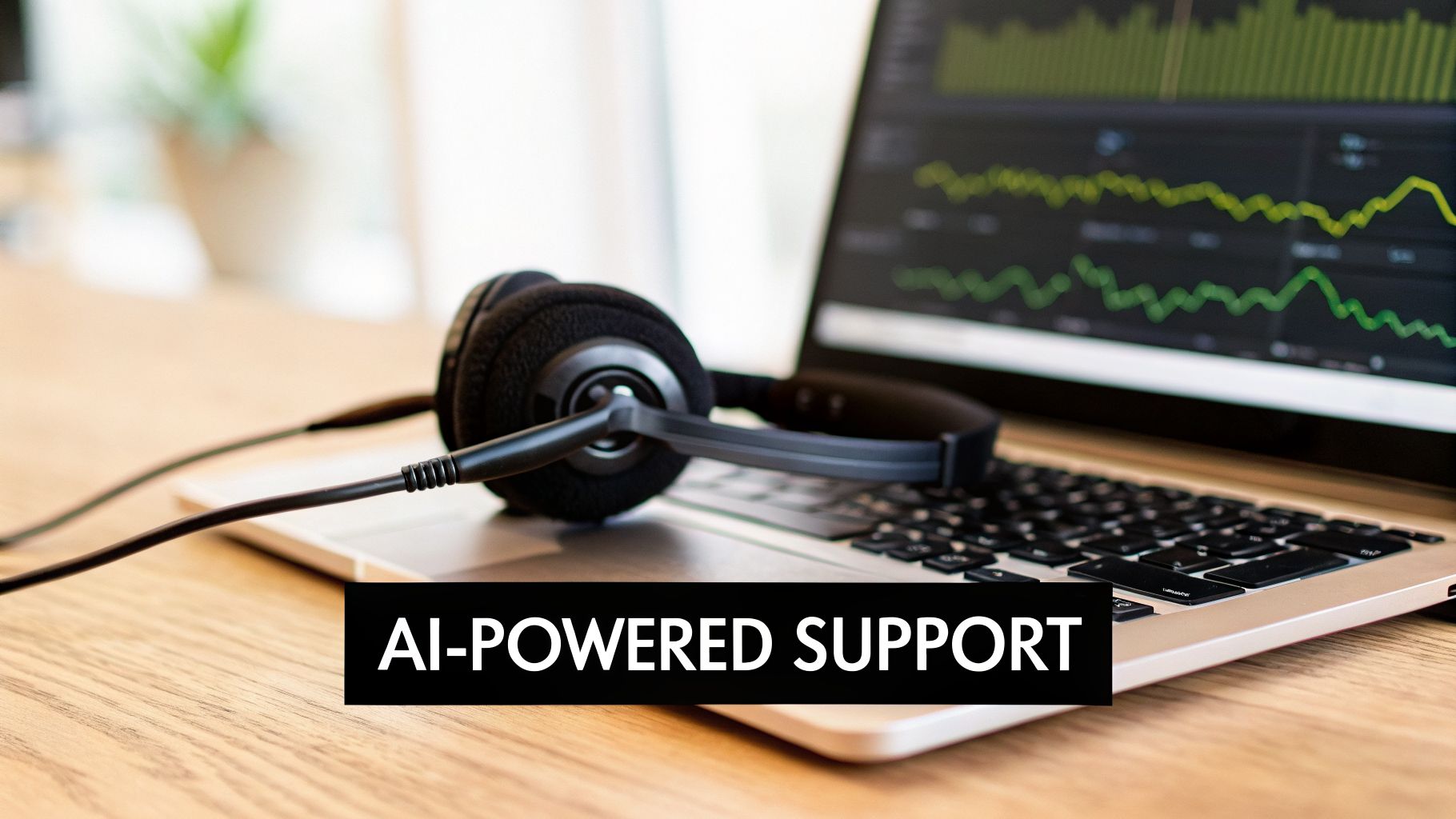
If your mental picture of a call center is still rows of agents just answering phones, it’s time for an update. That model is quickly becoming a thing of the past. Technology isn't here to replace human agents; it's here to supercharge them, turning them into expert problem-solvers who can handle complex issues with incredible speed.
This isn't just about adding new gadgets. It’s a fundamental shift in how call centers in the United States allocate their resources. The real magic happens when smart technology helps human agents work smarter, not harder, allowing them to deliver a level of personal service that was once unimaginable at scale.
The Rise of AI and Agent Augmentation
Let’s clear up a common misconception: AI in the call center isn’t about replacing your team. It’s about agent augmentation. Think of it as giving every single agent a brilliant co-pilot who instantly pulls up relevant information, anticipates customer needs, and offers guidance in real time.
This human-machine partnership is already making a huge impact in several ways:
- Intelligent Call Routing: Forget just sending a call to the next available person. Modern AI looks at a customer’s history and the reason for their call, then routes them to the one agent who has the perfect skill set to solve their problem on the first try. Fewer transfers, happier customers.
- Real-Time Sentiment Analysis: As an agent talks to a customer, the AI can analyze tone of voice and word choice. It then provides on-screen cues if it detects rising frustration, perhaps suggesting a specific de-escalation phrase or a goodwill gesture.
- Predictive Insights: By analyzing mountains of data, AI can predict a customer's next question. This lets the agent proactively offer a solution or information before the customer even thinks to ask for it.
This tech-driven approach is a key reason the global outsourcing market is expected to surge from $381.53 billion in 2026 to nearly $656 billion by 2032. American firms are leading the charge, with the US projected to make up 42% of worldwide AI revenue in 2025. As you can explore in these call center statistics, this investment in AI directly fuels the growth and sophistication of contact center technology.
Moving to the Cloud with CCaaS
The era of clunky server racks and massive, on-site hardware is over. Today, the industry is overwhelmingly moving to Contact Center as a Service (CCaaS) platforms. These are cloud-based solutions that bundle everything a modern contact center needs—voice, chat, email, social media—into one flexible subscription service.
It’s the exact same shift as moving from buying CDs to streaming music on Spotify. Instead of a huge upfront capital expense for hardware and software that will be obsolete in a few years, you pay a predictable fee for a service that is always up-to-date.
A CCaaS platform gives a business the power to scale its operations up or down instantly. It removes the burden of IT maintenance and allows even small companies to access enterprise-grade tools, leveling the playing field.
Creating a Seamless Omnichannel Experience
Your customers don’t think in "channels." They might start a question on your website’s live chat, send a follow-up email from their phone, and then call to get the final answer. They expect you to have a single, continuous conversation with them, and they absolutely hate repeating themselves.
This is the whole point of an omnichannel experience. It’s about breaking down the walls between your communication methods. When an omnichannel system is in place, the agent who picks up the phone can instantly see the transcript from the earlier web chat and the contents of the customer's email. No more "Can you give me your account number again?"
This unified view gives agents the context they need to provide a truly personal and efficient experience. It stops feeling like a transaction and starts feeling like a relationship, which is exactly how you build real, lasting customer loyalty.
A Smarter Way to Launch Your US Call Center
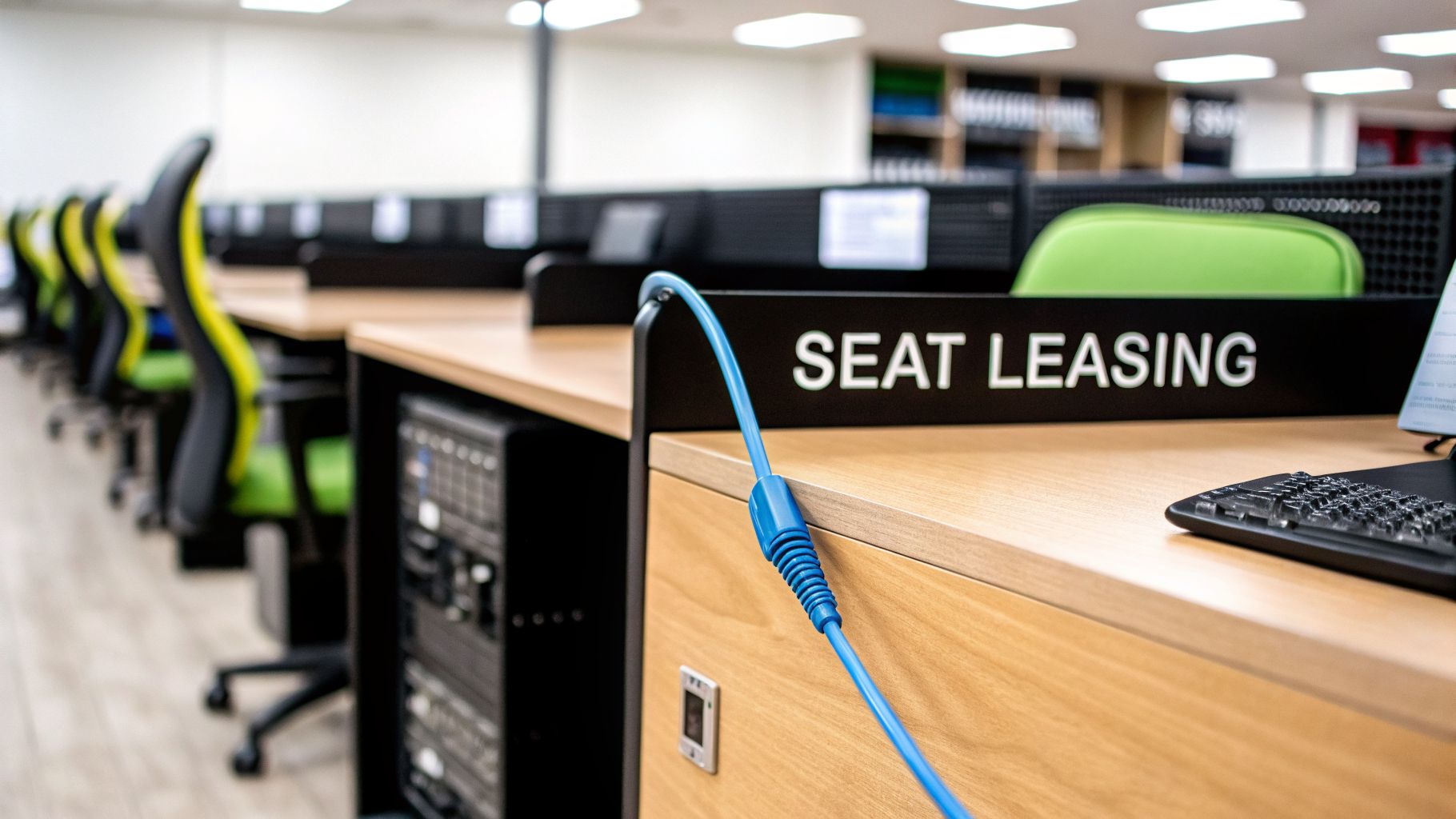
We've walked through all the big hurdles of setting up a call center in the United States—steep real estate costs, a tangle of regulations like the TCPA, and the endless cycle of expensive tech upgrades. It’s enough to make any business wonder if a domestic operation is even possible.
But what if you could sidestep the biggest headaches and expenses altogether?
Think of it like this: you want to open a five-star restaurant. Instead of getting tangled in construction permits, multi-million dollar build-outs, and buying commercial-grade kitchen gear, you find a pristine, fully-equipped professional kitchen ready for you to lease by the day. You could start serving customers tomorrow, focusing all your energy on the food and service, not the plumbing and wiring.
That’s the exact idea behind seat leasing, and it’s a powerful, practical model for getting your US-based team up and running fast.
What Is BPO Seat Leasing?
At its core, seat leasing is a straightforward service that gives your business fully-equipped workstations inside a professional, secure office. Instead of locking into a long-term commercial lease and draining your budget on setup, you simply lease individual "seats" on a flexible, monthly basis.
This completely flips the financial model on its head. It turns a massive capital expenditure (CAPEX) into a predictable, manageable operational expense (OPEX). Suddenly, your company can have a physical footprint without the six-figure upfront investment and months of delays.
Seat leasing is essentially a "plug-and-play" solution. It provides the physical space, furniture, and critical infrastructure so you can bring in your agents and get to work on day one.
The entire service is built to remove operational friction. Rather than juggling vendors for internet, security, and janitorial services, you get everything bundled into one simple package.
How Seat Leasing Eliminates Major Headaches
This approach tackles the main pain points of launching a US call center head-on. By letting a specialized provider handle the backend logistics, you can pour your resources into what actually drives your business—training great agents and delivering top-notch customer support.
Here’s what a good seat leasing provider typically manages for you:
- IT Infrastructure: Your seats are equipped with high-speed, redundant internet and a robust network managed by on-site IT pros. This keeps your team online and productive, period.
- Cybersecurity and Compliance: A quality provider operates from a secure facility designed to meet stringent data privacy standards, giving you a major head start on compliance.
- Utilities and Facilities Management: All building-related costs are covered. Electricity, HVAC, cleaning, and maintenance are all rolled into the fee, so you'll never be surprised by a utility bill or repair cost.
This model provides a clear, cost-effective path for any business needing a fast and flexible presence in the United States. You gain the agility to scale your team up or down as demand changes, without the dead weight of a traditional office. For any company looking to get operational quickly and efficiently, exploring a seat leasing partnership is a game-changing first step.
A Few Common Questions About US Call Centers
As you start thinking about setting up a customer service team in the US, a few key questions always seem to pop up. Let's tackle them head-on with some straight-to-the-point answers based on what we see in the industry every day.
What's the Real Cost to Run a Call Center?
The first thing everyone wants to know is the price tag. While costs can swing quite a bit depending on the city you choose, the biggest expenses are always agent wages, the office space itself, and the technology needed to run it all.
When you factor in salary, benefits, and taxes, the fully burdened cost for an agent typically lands somewhere between $25 and $45 per hour. That makes labor, by far, your single biggest line item. But models like seat leasing can seriously shrink your second-largest expense—infrastructure—which often makes a US-based team more affordable than you might think.
Can a Small Business Actually Afford a US-Based Team?
Absolutely, and that's a huge shift from how things used to be. In the past, the massive upfront investment in real estate and IT simply put an onshore center out of reach for most small businesses.
Thanks to modern solutions like seat leasing, even a small company can get access to a professional, secure, and fully compliant office. The per-seat pricing model means you're not on the hook for a long-term lease or a huge capital outlay, which really levels the playing field.
What's the Biggest Mistake to Avoid When Getting Started?
Hands down, the most critical mistake we see is underestimating the maze of regulations, especially around the Telephone Consumer Protection Act (TCPA) and data privacy laws. Getting this wrong isn't just a slap on the wrist; the penalties can be financially crippling and do long-term damage to your brand's reputation.
The smartest move is to partner with a provider whose entire operation is already built for compliance. It’s one of the biggest risks you face, and this approach helps you sidestep it from day one.
How Do I Choose Between Onshore, Offshore, and Nearshore?
This decision really comes down to what you're trying to achieve. Each model has its own distinct set of pros and cons.
- Onshore: This gives you the best cultural alignment and the most straightforward path to compliance, but it comes at the highest cost. It's the perfect choice for high-value customer interactions or when you're handling sensitive data.
- Offshore: You'll find the biggest cost savings here, but you might run into challenges with language barriers, cultural differences, and significant time zone gaps.
- Nearshore: Think of this as the balanced hybrid. It offers major cost reductions compared to onshore but with much better cultural and time zone alignment than you’d get with most offshore locations.
Ready to launch a cost-effective, onshore team without the upfront investment? Seat Leasing BPO provides fully-equipped, "plug-and-play" workstations in secure, compliant facilities. Visit https://seatleasingbpo.com to learn how you can get your US call center operational in record time.