When smart businesses talk about gaining a real edge, outsourcing companies in the Philippines are often their secret weapon. Think of it less as just cutting costs and more as a global talent accelerator. It’s about tapping into a workforce that’s skilled, fluent in English, and remarkably in tune with Western business culture, making the country a premier destination for high-value work.
Why the Philippines Is a Top Outsourcing Hub in 2026

Imagine not just trimming your budget but actually enhancing your company's core capabilities at the same time. That's the real promise of partnering with an outsourcing firm in the Philippines. For years, the country has evolved far beyond its early reputation as a call center giant into a sophisticated, multi-skilled hub for countless business functions.
This shift wasn't an accident. It's built on a unique combination of strengths that makes the Philippines a stable and incredibly reliable partner for companies looking to grow. It’s the perfect intersection of operational efficiency and top-tier talent.
The Core Pillars of Philippine Outsourcing
So, what's the secret sauce? The country's standing as an outsourcing powerhouse comes down to a few key factors that work together to create the ideal environment for scaling your business.
- Exceptional English Proficiency: The Philippines consistently ranks as one of the top countries for business English proficiency. This means communication is clear and direct, whether it's with your customers or your teams back home, virtually eliminating the language barriers that can plague outsourced operations.
- Strong Cultural Alignment: Thanks to deep historical and cultural ties to the West, Filipino professionals have a built-in understanding of Western communication styles, business etiquette, and customer expectations. This makes for a much smoother training process and a higher quality of service.
- A Deep and Diverse Talent Pool: Every year, universities across the Philippines produce hundreds of thousands of graduates in everything from accounting and IT to creative design and healthcare. This constant flow of educated, motivated talent ensures you can find the specific skill sets your business needs to thrive.
The true advantage here is getting access to a workforce that isn't just technically skilled but also has a genuine service-oriented mindset. This blend of capability and commitment to quality is what truly sets the Philippine BPO industry apart.
The sheer maturity of the industry also plays a huge role. The stability and consistent growth of the Philippine Business Process Outsourcing (BPO) sector aren't just numbers on a page; they represent a reliable, long-term strategic option for your business.
A Story of Consistent Growth
The financial numbers tell a compelling story of global importance and unwavering demand. The BPO sector’s revenue growth is a clear indicator of its strength.
Philippines BPO Revenue Growth at a Glance (2019-2025)
This table showcases the consistent and rapid revenue growth of the Philippine BPO industry, highlighting its stability and increasing global demand.
| Year | Revenue (in Billions USD) | Key Driver |
|---|---|---|
| 2019 | $26.3 | Solidification of voice and non-voice services |
| 2020 | $26.7 | Resilience and quick adaptation during the global pandemic |
| 2021 | $29.5 | Acceleration of digital transformation and remote work |
| 2022 | $32.5 | Expansion into higher-value services (IT, healthcare, etc.) |
| 2023 | $35.5 | Increased demand for specialized skills and AI integration |
| 2024 | $38.0 | Strong global economic recovery and talent demand |
| 2025 | ~$40.0 (Projected) | Continued growth in complex roles and knowledge services |
As you can see, the industry has shown incredible momentum. With a growth rate of around 7%—more than double the global average—the Philippines is on a clear path to solidify its position as a dominant force in global business services. For a deeper dive, you can discover more about the state of outsourcing in the Philippines for 2025.
Key Services Offered by Philippine Outsourcing Firms

When people hear "outsourcing to the Philippines," they often still think of call centers. And while the country certainly earned its title as the world's call center capital, that’s a very outdated picture. The industry today is much, much broader.
Philippine outsourcing firms now cover nearly every function a modern business needs to run smoothly. It's less about offloading simple tasks and more about plugging in strategic partners who drive growth and efficiency. From handling customer support around the clock to managing complex financial records, these teams truly act as an extension of your own company.
Your 24/7 Brand Ambassadors
Customer support is still a massive part of the industry, but it's evolved way beyond just answering phones. Today’s contact centers are sophisticated, omnichannel hubs built to manage the entire customer journey.
- Customer Service: This is the classic service, but now it’s delivered by highly trained agents across phone, email, and live chat. They become the voice of your brand, often available 24/7.
- Sales and Telemarketing: You can tap into skilled teams to run both inbound and outbound sales campaigns. They handle lead generation, prospect qualification, and even closing deals to directly fuel your revenue.
- Technical Support: For tech products, specialized agents are on hand to guide users through troubleshooting, resolve software or hardware issues, and ensure customers have a great experience.
Top-tier firms in the Philippines don’t just train agents to solve problems; they train them to build relationships. The results speak for themselves, as seen in cases like Vodafone's experience in achieving 80% FCR after launching Chatlingual, which shows the real-world impact of specialized support.
The Scalable Tech Backbone
Every modern business depends on technology, and Philippine outsourcing companies can provide the IT backbone you need to keep your operations secure and running at peak performance. This is a game-changer for companies struggling with the global tech talent shortage.
We're seeing a major shift in why businesses outsource. It's not just about saving money anymore. In fact, over 70% of businesses now say their main driver is getting access to specialized skills. IT services lead the pack, with 54% of companies outsourcing them—a clear sign of the high-level expertise available. This includes everything from cybersecurity and system administration to software development.
The Engine Room of Your Business
For every front-office operation interacting with customers, there’s a back-office team handling the crucial work behind the scenes. Outsourcing these administrative and operational jobs frees up your key people to focus on what they do best: growing the business.
Think of back-office support as the engine of your company. While customers may not see it, it’s what powers the smooth, day-to-day operations that are vital for sustainable growth and profitability.
Some of the most common back-office services include:
- Finance and Accounting: From basic bookkeeping and payroll to complex financial analysis and tax preparation. It’s the second-most outsourced function globally at 44%.
- Human Resources: Managing the entire employee lifecycle, including recruitment, onboarding, payroll, and benefits administration.
- Data Entry and Management: This is the bedrock of good decision-making. These teams ensure your business data is accurate, organized, and secure.
Creative and Digital Production Powerhouses
Beyond the traditional BPO services, there's a booming creative sector. A growing number of firms in the Philippines specialize in digital and creative production, giving you access to incredible talent that can elevate your brand.
This opens up a whole new set of possibilities, including:
- Content Creation: Finding skilled writers for your blog posts, articles, and marketing copy.
- Graphic Design: Tapping into designers for logos, marketing materials, and sharp website visuals.
- Web Development: Hiring teams to build and maintain your website and other online platforms.
The sheer variety of services available today really underscores the versatility of the Philippine outsourcing market. To see more on related topics, you can always check out our guides on the https://seatleasingbpo.com/blog/. Whether your needs are operational, technical, or creative, you can find a partner that’s a perfect fit.
Weighing the Benefits and Risks of Outsourcing
Thinking about outsourcing to the Philippines? It's a big move, and it's about a lot more than just cutting costs. Like any major business decision, you've got to weigh the incredible upsides against the potential downsides. Getting a clear, honest picture of both is the first step to building a partnership that actually works.
Everyone talks about the savings, and they're not wrong. But focusing only on the budget is like buying a professional chef's knife just to spread butter—you're completely missing its true power.
The Strategic Advantages Beyond Cost
The first thing you'll notice is the drop in labor and operational expenses, which can be as high as 60-70%. That's a huge number. But the companies that truly win at outsourcing look beyond that initial sticker shock to find the advantages that really fuel growth.
- Tap into a world-class talent pool, instantly. The Philippines has a massive, highly-educated workforce ready to go. You get to skip the painful, months-long recruitment cycle at home and plug directly into skilled professionals in IT, finance, customer support, and more.
- Run your business around the clock. The time difference isn't a bug; it's a feature. When your team in London or New York is heading home, your team in Manila is just getting started. This creates a natural 24-hour work cycle, meaning faster project turnarounds and customers who are never left waiting.
- Scale your team up or down on a dime. Outsourcing gives you incredible flexibility. Need to double your support staff for a product launch? No problem. Need to scale back during a quiet quarter? You can do that too, without the headaches of traditional hiring and firing.
The real game-changer is moving from a rigid, fixed-cost payroll to a flexible, variable-cost operating model. This unlocks cash and, more importantly, frees up your leadership to focus on growing the business instead of getting bogged down in daily management.
This kind of operational freedom is what allows you to jump on market opportunities and outmaneuver competitors. It's a real strategic edge.
Understanding and Mitigating Potential Risks
Of course, no strategy is risk-free, and anyone who tells you outsourcing is a magic bullet isn't being honest. Acknowledging the potential bumps in the road is the only way to avoid them. It's far better to be proactive than to be caught off guard, especially when you're looking to partner with one of the top outsourcing companies in the Philippines.
Common worries often revolve around managing a team across the globe. Even with the Philippines' strong cultural alignment with the West, small differences in communication can pop up. And, naturally, you have to be absolutely certain your sensitive data is secure when it's in someone else's hands.
A Proactive Approach to Common Challenges
The good news is that these are well-known challenges, and they are completely manageable with the right partner and a smart approach. Any seasoned BPO provider has seen it all before and has built-in systems to handle these exact issues.
Here’s how you can turn those potential risks into well-managed parts of your operation:
| Potential Risk | Actionable Mitigation Strategy |
|---|---|
| Cultural & Time Diffs | Set up crystal-clear communication guidelines from day one. Schedule a few overlapping work hours for real-time collaboration and ask your provider about cultural integration training. A good partner will help bridge this gap for you. |
| Data Security Concerns | Don't just take their word for it—ask to see proof. Partner only with a vendor that is compliant with international standards like ISO 27001 or GDPR. Vet their security policies, network diagrams, and disaster recovery plans. |
| Lack of Control | Define your Key Performance Indicators (KPIs) and Service Level Agreements (SLAs) before you sign anything. Use shared project management tools for full transparency and hold regular performance reviews. This builds accountability without you having to micromanage. |
| Hidden Costs | Insist on a completely transparent pricing model. A reputable provider will give you a clear, itemized quote with no surprises. You should never see unexpected bills for things like IT support, utilities, or office space. |
By tackling these concerns head-on during your search for a vendor, you’re not just avoiding problems—you’re building the foundation for a strong, resilient global team.
How to Choose the Right Outsourcing Partner
Choosing from the pool of outsourcing companies in the Philippines is a lot like picking a long-term business partner. This isn't just about signing a service agreement; it's a major decision that will directly shape your brand's reputation, how your business runs, and ultimately, your bottom line. Rushing this can be a very expensive mistake, so a careful, well-researched approach is your best bet.
Your real goal here isn’t just to find any vendor. You’re looking for a genuine extension of your own team. To do that, you need a clear roadmap that starts with a hard look at your own needs and ends with some serious vetting. Let's walk through the steps to get you there.
This flowchart maps out the core stages of your decision-making process, from weighing the benefits and risks to building a solid strategy.
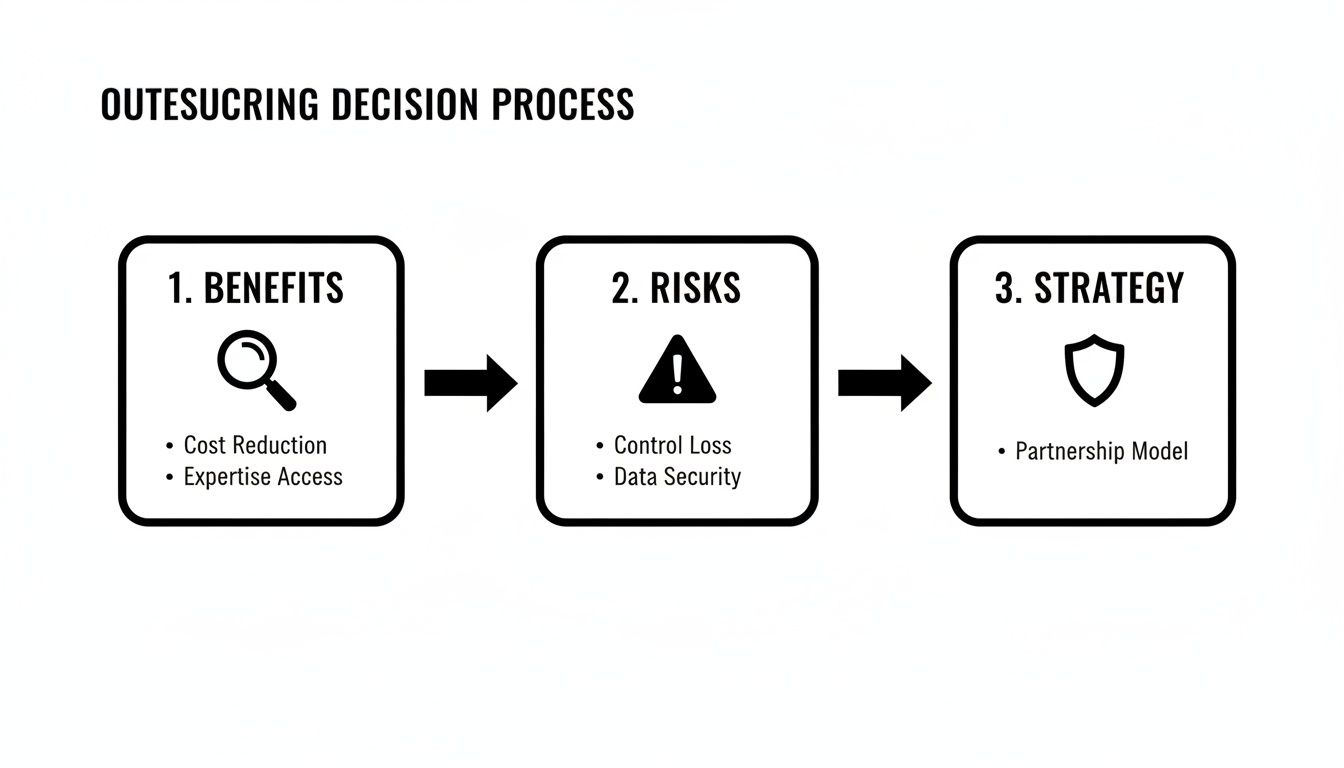
As you can see, a successful strategy is all about balancing the potential wins against the real-world challenges you might face.
Define Your Goals and Scope Clearly
Before you even think about looking at providers, you have to get your own house in order. What, exactly, are you trying to accomplish by outsourcing? Fuzzy goals like "save money" or "be more efficient" just won't cut it.
You need to set specific, measurable targets. For instance, instead of a vague idea, aim for something concrete like, "cut our customer service response times by 40% in the next six months." Or, "add 15 people to our data entry team for a new product launch without taking on more fixed overhead."
With clear goals set, the next step is to draft a detailed scope of work. Think of this as the blueprint for your partnership. It should clearly spell out:
- The specific tasks and processes you're handing off.
- The exact skills and experience level you need from the team.
- The tools, software, and tech access they'll require.
- Your key performance indicators (KPIs) for tracking success.
A well-written scope ensures that everyone—your internal team and any potential partner—is on the exact same page from day one.
Conduct Thorough Due Diligence
Once you know what you need, you can start the hunt. I'd recommend creating a longlist of potential partners and then methodically whittling it down. This is the investigation phase; you can't just take a slick sales pitch at face value.
Your background check needs to be thorough. Here are the critical areas to dig into:
- Reputation and Track Record: How long have they been around? Look for established companies with a history of delivering. Ask for case studies, client testimonials, and—most importantly—references from businesses in your industry and of a similar size.
- Industry Specialization: Do they actually have deep experience in your specific field? A partner who specializes in e-commerce support will understand its nuances far better than a generalist. The same goes for software development or healthcare information.
- Technical and Physical Infrastructure: A provider is only as strong as its foundation. Ask them about their internet redundancy (what happens if one line goes down?), power backup systems, and the quality of their offices. You can see an example of high-quality facilities to get a sense of what a top-tier operation looks like.
- Security and Compliance: This is absolutely non-negotiable. Verify their security certifications, like ISO 27001 for information security. If you handle sensitive data, confirm they are compliant with regulations like GDPR or HIPAA.
Don’t be afraid to ask the tough questions. How do they handle a data breach? What's their disaster recovery plan? A provider who is transparent and confident in their answers is usually a mature and reliable one.
This deep dive will help you filter out the providers that look good on paper but don't have the substance to back it up.
Evaluate Cultural Fit and Communication
At the end of the day, you're hiring people, not just a service. The cultural alignment between your company and your outsourcing partner is one of the most underrated factors for long-term success. The Philippines’ outsourcing market is massive, holding 10-15% of the global market share and growing 8-10% each year. This isn't just because of cost; it's because businesses are looking for sophisticated partners, which makes a strong cultural match even more vital.
Take the time to assess their communication style, management philosophy, and how they treat their employees. Do their company values resonate with yours? A partner that invests in its people and fosters a positive workplace is far more likely to give you a stable, motivated team. For a deeper look at what to weigh before you commit, checking out everything you need to know before outsourcing software projects is a smart move. Picking the right partner is the single most important decision you'll make in this entire process.
Seat Leasing: The Smart Alternative to Full-Scale BPO

What if you want to tap into the Philippines' talent pool but aren't ready to sign a massive, complex BPO contract? There’s a powerful middle ground that gives you control and flexibility without the huge upfront investment: seat leasing.
Think of it as renting a spot in a fully-equipped professional kitchen. You don't have to buy the ovens, install the freezers, or worry about the plumbing. You just bring your chefs (your team) and your recipes (your business processes) and get straight to cooking.
That’s exactly how seat leasing works. You’re essentially renting a plug-and-play office space, giving your team everything they need without you having to manage the property yourself.
How Seat Leasing Works in Practice
The model is surprisingly straightforward. A seat leasing provider owns and manages a modern, professional office. You simply pay a flat monthly fee for each employee, or "seat," that you need.
This single fee rolls all the typical operational headaches into one predictable cost. It almost always includes:
- A fully-furnished workstation: Each team member gets a desk, an ergonomic chair, and a PC ready to go.
- High-speed, redundant internet: Enterprise-grade connectivity is a given, so downtime isn't a concern.
- On-site IT support: Technicians are on hand to manage any hardware, network, or software issues that pop up.
- Utilities and facility management: Things like electricity, air conditioning, and 24/7 building security are all handled for you.
With the provider managing the entire facility, you get to focus on what actually grows your business: hiring, training, and leading your own team. It removes all the operational friction. You can learn more about the specific seat leasing inclusions to see just how comprehensive these services are.
Traditional BPO vs. Seat Leasing Model Comparison
To really see where seat leasing shines, it helps to put it side-by-side with a traditional BPO partnership. While both give you access to talent in the Philippines, they offer fundamentally different levels of control and are built for different types of businesses.
The real difference comes down to control. A traditional BPO is a "done-for-you" service where the vendor manages your people and outcomes. Seat leasing is a "do-it-yourself" model with full infrastructure support, leaving you in direct command of your team and culture.
Here’s a clear breakdown to help you see which model fits your needs.
Traditional BPO vs. Seat Leasing Model Comparison
This table contrasts the two approaches to highlight their core differences in management, cost, and flexibility.
| Feature | Traditional BPO | Seat Leasing |
|---|---|---|
| Management | Vendor manages your team, operations, and KPIs. | You manage your team, operations, and KPIs directly. |
| Recruitment | Vendor recruits and hires staff based on your needs. | You recruit and hire your own dedicated team. |
| Branding & Culture | Team is integrated into the vendor’s culture. | Team is integrated directly into your company culture. |
| Flexibility | Less flexible; often requires long-term contracts. | Highly flexible; scales up or down with monthly terms. |
| Cost Structure | All-inclusive pricing per agent or FTE. | Flat fee per seat, offering greater cost transparency. |
After reviewing the table, the advantages for certain businesses become obvious.
For startups, small to medium-sized businesses, or any company that wants to keep its unique culture and operational DNA intact, seat leasing is often the perfect fit. You avoid the huge capital expense of setting up your own foreign office and can slash operating costs by as much as 70-80% compared to a local lease.
Most importantly, you never lose control over your most valuable asset: your people. This makes it an incredibly effective way for agile companies to grow their teams without the usual financial and administrative burdens.
Common Questions About Outsourcing to the Philippines
Alright, let's get down to brass tacks. As you get closer to making a decision, you’re bound to have some very practical questions. These are the same questions nearly every business leader asks, and getting clear answers is key to moving forward with confidence.
What Is the Typical Cost for a Full-Time Employee?
This is where the numbers get really interesting and the value becomes crystal clear. While rates always depend on the specific role and experience level, the cost savings are significant.
For a skilled customer service agent or a detail-oriented back-office administrator, you’re likely looking at a rate of $8 to $12 per hour. Compare that to the $25 per hour (or more) you might pay for a similar role in the United States, and that’s before you even start calculating benefits, payroll taxes, and office overhead. This isn't about cutting corners; it's about reallocating your budget to build a more powerful team than you thought possible.
How Can I Effectively Manage a Remote Team?
The idea of managing a team on the other side of the world can feel intimidating, but it’s a well-oiled machine for any experienced provider. The trick is to build a solid operational rhythm from day one.
Think of the time difference not as a hurdle, but as a strategic advantage. When your local team is signing off, your Philippine team can be just getting started. This overlap creates a nearly 24-hour work cycle, pushing projects forward and ensuring your customers get support around the clock.
Making this work is surprisingly straightforward. You just need to have the right framework in place:
- Constant Communication: Daily check-ins via chat or a quick huddle, plus weekly video calls, keep everyone aligned and connected.
- Total Transparency: Use shared project management tools. Whether it's Asana, Slack, or Trello, everyone should be able to see who is doing what and where things stand.
- Clear Goals: Define your Key Performance Indicators (KPIs) from the very beginning. When everyone knows what "success" looks like, they can manage themselves toward that goal.
With these simple habits, you’ll find that managing your team in the Philippines feels no different than managing the team in the office down the hall.
What Security Measures Should I Expect?
Data security is a deal-breaker, period. Any outsourcing partner worth their salt understands this and has invested heavily in protecting your information. Don't be shy about asking for the details.
A reputable provider should be able to walk you through their compliance with international standards, like ISO 27001 for information security. Ask them about their specific protocols for network security, data handling, and even physical access to their facilities. What happens in a power outage? What's their disaster recovery plan? A trustworthy partner will have clear, confident answers and will be completely transparent about how they keep your business safe.