If you want to genuinely improve workplace efficiency, you need to look at three key areas: nailing down process clarity, getting the right technology in place, and building a flexible environment. It's not about working harder; it's about removing the friction that slows your team down so they can actually do their best work.
What Workplace Efficiency Really Means Today
Let's be honest, the old-school idea of "efficiency" conjures up images of stopwatches and micromanagers—trying to squeeze every last drop of productivity out of people. That model is completely broken.
Today, real workplace efficiency is about creating a smart, seamless, and adaptive environment. It's about designing systems where your team spends their energy on high-value work, not fighting clunky processes or wrestling with outdated software.
This mindset shift is critical whether you're a freelancer trying to optimize your day, a startup founder building from the ground up, or a BPO provider managing thousands of agents. The goal isn't just to do more things; it's to get better results with less wasted effort. This takes a thoughtful mix of clear workflows, smart automation, and a workspace—physical or digital—that actually helps people focus and work together.
The Three Pillars of Modern Efficiency
Getting to this level of operational smoothness really comes down to three fundamental pillars. When you get these right, they create a powerful flywheel effect, where improvements in one area naturally boost the others.
Process Clarity: This is your foundation. Everyone on your team needs to understand not just what they’re supposed to do, but why it matters and how their piece of the puzzle fits into the bigger picture. Without clear processes, even your most talented people will waste time on rework and miscommunication.
Intelligent Technology: The right tech is a massive force multiplier. I'm not talking about chasing every shiny new app. This is about strategically using tools that automate repetitive tasks, simplify communication, and give you the data you need to make smarter decisions.
Workspace Flexibility: Your environment has a huge impact on how work gets done. A flexible workspace, whether it’s a well-designed office or a solid remote setup, eliminates distractions and gives your team the resources they need for both deep focus and effective collaboration.
This diagram shows how these three elements work together to build a high-performing system.
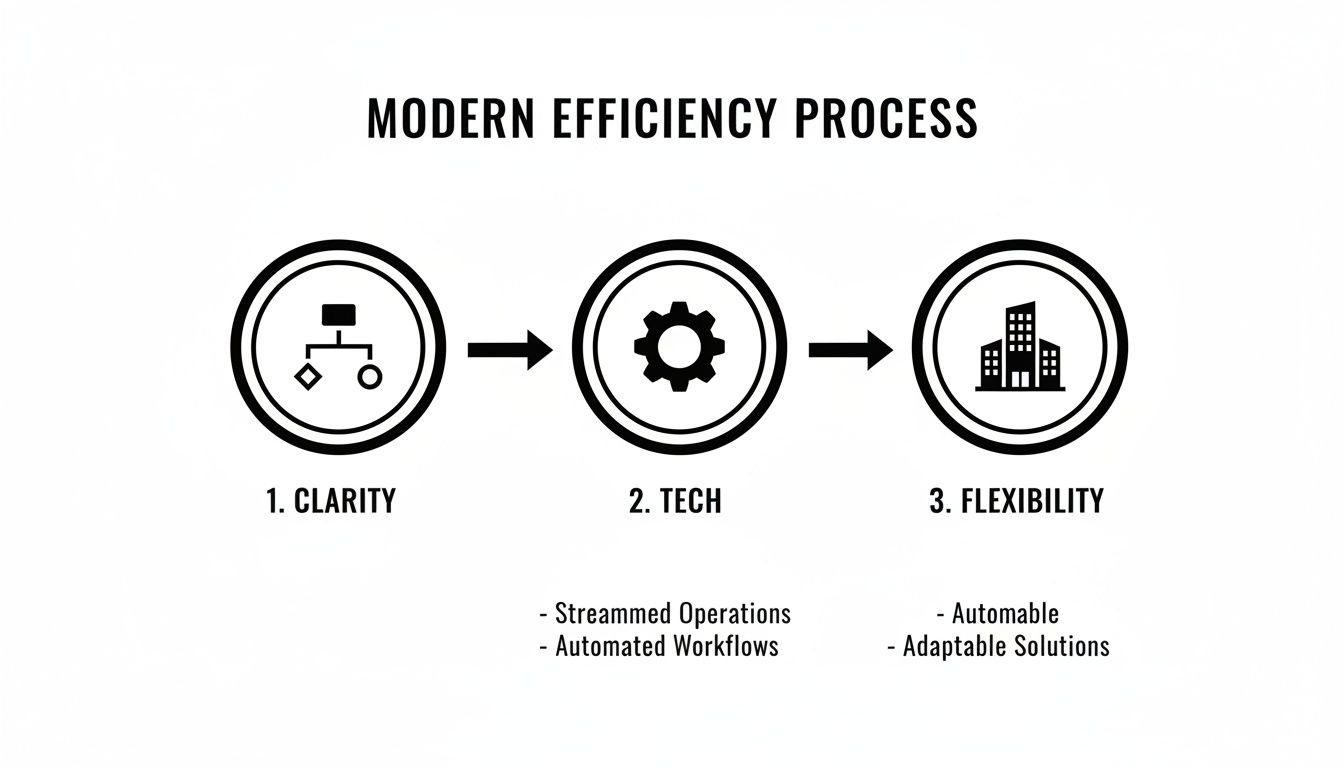
As you can see, getting clarity on your processes is the essential first step. That clarity is what allows you to deploy the right technology effectively, which in turn supports a more flexible and genuinely productive work environment.
Here’s a quick summary of how these pillars function to drive meaningful improvements in how your business operates.
The Three Pillars of Modern Workplace Efficiency
| Pillar | Core Objective | Key Benefit |
|---|---|---|
| Process Clarity | Define and document workflows so everyone knows their role and responsibilities. | Reduces errors, eliminates wasted time, and empowers team autonomy. |
| Intelligent Technology | Automate repetitive tasks and centralize communication and data. | Frees up human talent for strategic work and provides data-driven insights. |
| Workspace Flexibility | Create an environment (physical or remote) that supports different work styles. | Boosts focus, improves collaboration, and increases employee satisfaction. |
Mastering these areas creates a foundation for sustained growth and a healthier, more productive work culture.
For a lot of growing businesses, trying to manage all the complexities of IT infrastructure, cybersecurity, and office logistics becomes a huge resource drain. This is where a model like Seat Leasing offers a massive shortcut. By taking care of all the backend support, it lets companies plug directly into a high-efficiency environment from day one. This frees up leaders and their teams to focus entirely on their core business, helping them grow faster without all the usual operational headaches.
Finding the Real Problems in Your Workflow
Before you can fix anything, you have to get real about where your team's time and energy are actually going. Too often, we jump straight to solutions without a proper diagnosis. It’s like throwing medicine at a problem without knowing the illness—a total shot in the dark. The first step is to create an honest "before" snapshot of your operations to find the friction points that are quietly killing productivity.
This isn’t about micromanaging or pointing fingers. Think of it as a fact-finding mission. You're looking for the hidden snags in your workflow, from the soul-crushing admin tasks that eat up hours to the confusing communication channels that force everyone to do work twice.
How to Uncover Hidden Drains with a Workflow Audit
A simple workflow audit is a great place to start. This just means mapping out a core process from beginning to end. For example, how does a new customer request go from the first phone call to a final resolution? When you visualize each step, you'll be amazed at the redundancies and delays that pop out.
I once worked with a creative agency that was constantly bogged down by client admin. By mapping out their project lifecycle, they made a shocking discovery: 30% of a designer's time wasn't spent designing. It was spent chasing feedback and plugging updates into project management software. That's not a person problem; it's a process problem.
Here are a few practical ways to find these issues:
- Map it Out: Grab a whiteboard or a digital tool and literally draw the process. Make sure to bring in the people who actually do the work every day—their insights are gold.
- Look at Time-Tracking Data: Analyze aggregated, anonymous time-tracking data. You're not spying on individuals. You're looking for patterns, like how many hours the entire team spends on manual data entry each week.
- Ask Your Team: Use simple, anonymous surveys with direct questions. Something like, "What one task takes up the most time for the least value?" or "Where do communication breakdowns happen most often?" can reveal a ton.
A support team at a BPO I know felt like they were always behind. A quick audit showed they were spending nearly two hours per agent, per day, just copying and pasting customer info between three different systems. The bottleneck wasn't their work ethic; it was the fact that their tools didn't talk to each other.
Turning Your Findings into Actionable Insights
Once you've gathered this intel, start grouping the bottlenecks. Are they related to tech? Communication? The process itself? Most of the time, the biggest productivity killers fall into a few common buckets.
| Bottleneck Category | Real-World Example | The Damage It Causes |
|---|---|---|
| Manual & Repetitive Tasks | Pulling numbers from five spreadsheets to create a weekly report. | Wastes skilled employee time on low-value work and is a breeding ground for human error. |
| Communication Gaps | Teams using a mix of email, Slack, and a project tool with no clear rules. | Important messages get lost in the shuffle, leading to delays and people redoing work. |
| Information Silos | The sales team has key customer info the support team needs, but it's locked in their CRM. | Creates a clunky customer experience and makes employees waste time hunting for basic information. |
| Too Many Meetings | That one-hour weekly status update that could have been an email. | Breaks up focus time for "deep work" and clogs up calendars with very little to show for it. |
Pinpointing these specific issues gives you a clear target. Instead of a vague goal like "improve workplace efficiency," you now have a concrete mission, like "automate the weekly sales report" or "create a clear communication guide for all projects."
This targeted approach just works better. For businesses looking to bypass these operational headaches from day one, it's worth understanding what a fully managed service can do. You can learn more about the comprehensive inclusions in a seat leasing model to see how it solves these common pain points right out of the box. This is how you move from just talking about problems to making real, impactful changes that free up your team to focus on what actually moves the needle.
Designing a Workspace That Boosts Performance
Your team's environment is more than just four walls and a roof—it's an active ingredient in their daily performance. It can either fuel focus and collaboration or silently drain their energy and time. A poorly designed workspace creates friction, while a smart one removes it, and that difference shows up directly on your bottom line.

The traditional office model is littered with hidden productivity killers. Think about the time your team loses to a spotty Wi-Fi connection, a jammed printer, or the hours you lose negotiating leases and managing utility bills. These are the administrative burdens that pull you away from your actual business, forcing you to spend valuable time on operational logistics instead of growth.
The Hidden Costs of a Traditional Office
The true expense of a conventional office goes way beyond the monthly rent check. For startups and scaling BPOs, these operational overheads are especially painful. They often include:
- Massive Capital Outlay: You're on the hook for security deposits, furniture, and all the IT equipment before your team even walks through the door.
- IT and Maintenance Nightmares: When the internet goes down, so does your entire operation. You either become the default IT support or pay someone else to be on call—both are costly distractions.
- Rigid, Long-Term Commitments: Signing a multi-year lease is a huge financial gamble. If you need to scale up or down, you're stuck paying for space you either don't have or don't need.
- Utility and Service Management: Time spent paying electricity bills, coordinating cleaners, and managing building security is time not spent winning clients or improving your product.
These aren't just minor annoyances; they are serious drags on efficiency. Every hour a leader spends dealing with a faulty air conditioner is an hour they're not strategizing, selling, or mentoring their team.
Embracing a Plug-and-Play Environment
This is where the power of a flexible, managed workspace really shines. Solutions like seat leasing completely flip the traditional model by providing a "plug-and-play" environment where all the backend support is handled for you. Your team can arrive on day one to a fully functional office with high-speed internet, professional IT support, and all utilities ready to go.
This approach eliminates the operational friction that holds so many businesses back. Instead of worrying about infrastructure, your team can focus 100% on their core work from the moment they sit down. It’s all about offloading the non-essential tasks to a dedicated provider so you can reclaim your time and resources for what truly moves the needle. You can see exactly what this looks like in this tour of a fully-equipped BPO office in Cebu.
The shift to these agile spaces isn't just a trend; it's a strategic move backed by hard numbers. Imagine slashing your office overhead by up to 80% while simultaneously boosting team productivity. According to Eptura's 2025 workplace statistics, there has been a 33% global increase in desk bookings per building year-over-year, which points to a massive move toward flexible, shared spaces. Businesses are discovering that this model delivers more than just savings—it delivers real, tangible productivity gains. You can dive deeper into these workplace productivity trends and statistics on Eptura.com.
From High Overhead to High Performance
For a startup or BPO provider that needs to scale quickly, the benefits are immediate. You completely bypass the huge capital investment required for a traditional office, preserving cash flow for hiring top talent or launching a new marketing campaign. That kind of financial agility is a massive competitive advantage.
By removing the burden of office management, you're not just cutting costs; you're buying back your most valuable asset: focus. This laser focus is the ultimate driver of workplace efficiency and sustainable growth.
A managed workspace is truly designed for performance. It provides a professional, distraction-free setting where your team has everything they need to succeed. This means better concentration, smoother workflows, and a more motivated team ready to tackle business-critical goals without the logistical headaches that slow everyone down.
Using Technology and Automation the Smart Way
Bringing new tech into the workplace isn't about chasing the latest shiny object. It’s a strategic move to give your team back its most precious resource: time. Smart automation and practical AI tools aren’t futuristic pipe dreams anymore; they're what the most productive teams use to move away from tedious, repetitive work and focus on high-value, creative problem-solving.
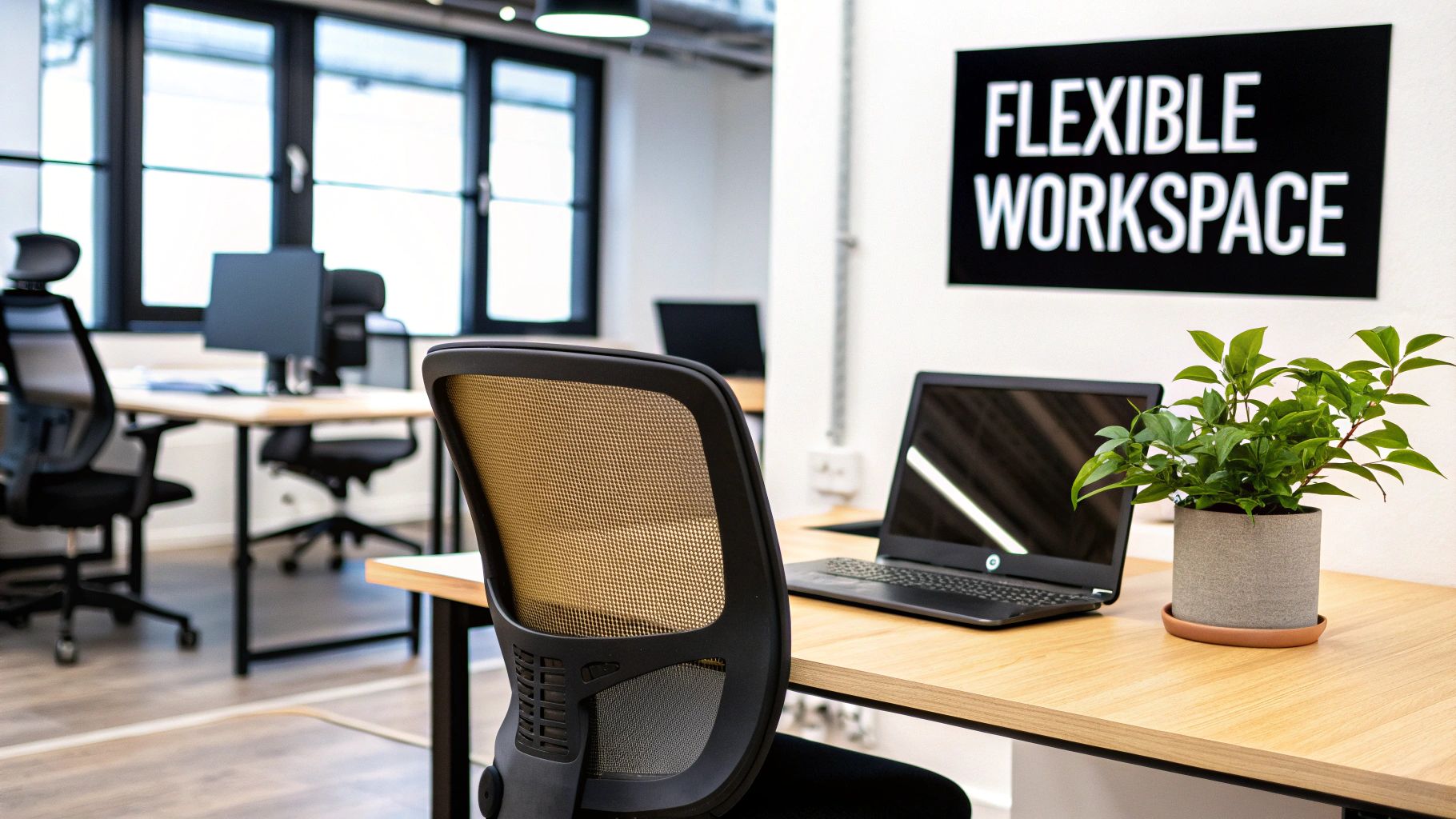
The secret is to focus on automating what’s actually worth automating. Instead of a scattergun approach, you need to pinpoint the low-value, high-volume tasks that eat up huge chunks of your team's day. These are the perfect candidates for a tech-driven solution.
Identifying Prime Targets for Automation
Before you even think about buying software, go back to those workflow bottlenecks you uncovered earlier. You're hunting for tasks that are repetitive, rule-based, and prone to human error. That's your automation sweet spot.
A few common areas are practically begging for an upgrade:
- Data Entry and Reporting: I’ve seen so many smart people waste hours manually pulling data from different places just to build a weekly report. Automation tools can grab that info, format it, and even email it out on a schedule. That's hours of skilled labor reclaimed, right there.
- Customer Follow-ups: Simple, templated messages like appointment reminders or post-purchase check-ins can be automated easily. This ensures nothing slips through the cracks and frees up your support team to handle the truly complex customer issues.
- Social Media Scheduling: Instead of someone having to manually post updates across LinkedIn, Twitter, and Instagram every day, scheduling tools can handle the lot. This lets your marketing folks focus on big-picture strategy and creating great content.
The real win with automation isn't just about speed; it's about shifting human energy. When you automate a tedious reporting task, you don't just get the report faster—you get back a creative, strategic mind that can now focus on interpreting the data instead of just collecting it.
Choosing the Right Tools for the Job
Once you know what to automate, you have to pick the right tool. The market is absolutely flooded with options, so it’s crucial to find software that plays nice with your existing systems and that your team will actually want to use.
When you're weighing your options, think about these key factors:
- Integration Capability: Does this tool connect with the software you already live in every day, like your CRM or project management platform? If it doesn’t, you risk creating new data silos, which just creates another problem.
- Scalability: Ask yourself, will this tool grow with us? A solution that’s perfect for a team of five might fall apart when you hit fifty.
- Ease of Use: If a tool is clunky and complicated, your team will find a way to avoid it. Look for an intuitive interface and good customer support to make sure the rollout is smooth.
This kind of smart tech adoption is paying off in a big way. Recent data shows that 54% of workers have used AI in the past year, and a massive 75% of knowledge workers now use it in their daily routines. The results are undeniable: about three-quarters of these users report a major jump in both their productivity and the quality of their work. While a few feel AI has increased their workload, the industries that have heavily adopted it are now five times more productive than those that haven't. It just goes to show how picking the right tools is central to improving workplace efficiency. Discover more findings about the global workforce on Gallup.com.
The Workspace Advantage for Tech Deployment
Of course, implementing new technology comes with its own headaches, especially around IT infrastructure. A slow internet connection, cybersecurity worries, or the lack of on-call tech support can kill your automation plans before they even get started.
This is where businesses using models like Seat Leasing BPO have a massive advantage. These managed workspaces provide a solid, pre-built foundation for you to deploy tech on.
| Feature of Managed Workspaces | Impact on Tech Implementation |
|---|---|
| High-Speed, Redundant Internet | Ensures your cloud-based tools run flawlessly, without the lag or downtime that kills productivity. |
| Enterprise-Grade Cybersecurity | Protects your data as you plug in new software, taking a huge security burden off your shoulders. |
| 24/7 IT Support | Gives you immediate help for any tech hiccups, stopping a minor glitch from becoming a major roadblock. |
By operating in a workspace where the complex IT backend is already managed for you, you can bring in powerful automation and AI tools almost instantly. It removes the technical hurdles and lets your team start benefiting from day one, so they can focus on what they do best: growing the business.
Building a Culture That Values Efficiency
You can have the most sophisticated software and perfectly mapped-out workflows, but they’ll fall flat without the right people behind them. At its core, real workplace efficiency isn't about the tools you buy; it's about the culture you build. You have to create an environment where working smarter, not just harder, is the default setting for everyone.
This starts by taking a hard look at common workplace habits. Constant multitasking and an endless barrage of interruptions aren't signs of a dedicated team; they're symptoms of a broken system. When your culture rewards being "busy" over being productive, you’re just encouraging inefficiency. The real goal is to create systems that let your team do their best work, not just fill their calendars.
From Digital Noise to Deep Work
One of the biggest enemies of modern efficiency is digital noise. The constant ping of emails, instant messages, and meeting pop-ups creates a state of perpetual distraction. It makes that focused, "deep work" nearly impossible. Building a culture that values efficiency means being deliberate about protecting your team's focus.
This doesn't happen by accident. It takes clear, top-down communication protocols that everyone understands and lives by.
- Kill Unnecessary Meetings: Before hitting "send" on that calendar invite, ask if the goal can be met with a shared document or a quick email. A simple "Is this meeting necessary?" checklist can save hundreds of hours across the company.
- Establish Channel Purpose: Be crystal clear about which tool is for what. For example, use email for formal, non-urgent updates, a project management tool like Asana for task-specific questions, and an instant messenger like Slack only for truly urgent issues.
- Set Response Time Expectations: Kill the "always-on" pressure. Set realistic expectations for email responses. When your team knows they don't have to reply instantly, they can block off uninterrupted time for complex, high-value tasks.
Your team's attention is a finite resource. A culture of efficiency actively guards it, understanding that one hour of uninterrupted deep work is far more valuable than eight hours of fragmented, reactive responses.
This cultural shift is crucial because the cost of distraction is staggering. Recent data reveals that employees are genuinely productive for only about 60% of the workday. That number plummets to a dismal 31% for office staff due to constant interruptions. We also know that multitasking alone slashes output by 40%, while social media eats up an average of 2.35 hours daily. The result is a productivity drain that costs businesses billions. On the flip side, flexible setups that allow for more focused work show that 77% of employees report higher productivity. You can dive deeper into these employee productivity insights on Yomly.com.
Designing Spaces for Focus and Collaboration
Your physical workspace sends a powerful message about what your culture truly values. An office designed purely for open collaboration can, ironically, sabotage the very focus needed to produce great work. To truly improve workplace efficiency, your environment has to support both modes of working.
This is where adaptable spaces come into play. A well-designed workspace gives people a mix of environments to suit different kinds of tasks.
| Space Type | Purpose | Key Features |
|---|---|---|
| Focus Zones | For deep, uninterrupted work like writing, coding, or data analysis. | Quiet areas, individual desks, or bookable private pods. |
| Collaboration Hubs | For brainstorming, team meetings, and spontaneous problem-solving. | Whiteboards, comfortable seating, and easy access to tech. |
| Social Areas | For informal chats and building team camaraderie. | Kitchenettes, lounge areas, and casual seating. |
This kind of intentional design empowers employees to choose the environment that best fits their immediate task, giving them control over their own productivity.
Ultimately, building a culture that values efficiency is about creating a system of shared understanding. When everyone agrees on how to communicate, how to use their time, and how to respect each other's focus, you unlock a level of performance that no single piece of technology can ever achieve on its own. It's about empowering people to work at their best, together.
Your Questions on Workplace Efficiency Answered
Embarking on a mission to boost workplace efficiency always brings up some practical questions. Putting theory into action is where the real work begins, and it's natural to wonder about budgets, results, and when to make big changes. We’ve gathered the most common concerns to give you clear, direct answers so you can move forward with confidence.
What Are the First Steps on a Tight Budget?
You don't need a huge budget to start making a real difference. The trick is to begin with low-cost, high-impact changes that build momentum and prove the value of your efforts.
Start by simply talking to your team. Conduct a quick workflow audit by asking them to name their single biggest time-waster. You'll be shocked at how quickly you can spot redundant processes, pointless meetings, or clunky software workarounds that can be eliminated for free.
Next, get your communication channels in order. Create and share clear guidelines for when to use email versus a chat app. This simple act cuts down on the digital noise and helps your team reclaim precious focus time.
Finally, lean into the free versions of powerful project management tools like Trello or Asana. Using them to clarify tasks, deadlines, and responsibilities brings immediate order to chaotic workflows without any financial investment.
How Do I Know if My Improvements Are Working?
Figuring out if your efficiency initiatives are actually working requires looking at both numbers and people. A balanced approach gives you the full picture, showing you not just if things are changing, but how those changes are affecting your team's day-to-day.
On the quantitative side, you need to track specific key performance indicators (KPIs) that align with your goals.
- Project Completion Time: Are projects getting done faster?
- Customer Response Time: Is your support team closing tickets more quickly?
- Error Rates: Have you seen a drop in mistakes for a specific process?
Compare this data from before and after you made the changes to see the hard evidence of your progress.
But don't ignore the human feedback—it often tells a more compelling story. Regularly check in with your team using simple pulse surveys or informal one-on-ones.
Ask direct questions like, "On a scale of 1-10, how productive was your week?" or "Do you feel you have the right tools for the job?" A noticeable drop in reported frustration is a massive win and a leading indicator of sustainable success.
Ultimately, the best measure is the business outcome. Are you delivering higher-quality projects faster? Is customer satisfaction on the rise? When both the numbers and your team's morale are heading in the right direction, you know you’re on to something.
When Is It Time to Consider Flexible Workspaces?
Moving away from a traditional office is a huge strategic decision, but there are several clear signals that it might be time to look at a more flexible solution like seat leasing.
The first major sign is when you find yourself spending too much time on office logistics. If you or your key leaders are constantly being pulled away from core business activities to deal with internet outages, IT problems, or building maintenance, you have an efficiency problem. Your time is better spent growing the business, not managing an office.
Another trigger is rapid or unpredictable growth. If you’re not sure what your headcount will look like in six months, signing a rigid, long-term lease is a big financial gamble. Flexible options let you scale your space up or down on demand, ensuring you only pay for what you actually use.
Finally, take a hard look at where your capital is going. Would that money be better spent on product development, marketing, or hiring top talent instead of being tied up in office furniture, security deposits, and fit-out costs? If the answer is yes, a "plug-and-play" solution can immediately boost both your efficiency and your bottom line.
If these points sound familiar, your business may have outgrown the traditional office model. Embracing a flexible workspace can remove operational burdens and free up valuable resources, setting you up for smarter, faster growth. For more insights into how modern businesses are adapting, you can explore evolving work cultures in our extensive blog library.
At Seat Leasing BPO, we provide fully-managed, plug-and-play workspace solutions that eliminate operational headaches and let you focus 100% on your core business. Discover how our flexible model can help you scale efficiently and save up to 80% on overhead. Learn more at https://seatleasingbpo.com.