Think of it this way: if you ran a busy restaurant, you wouldn't spend your time fixing the plumbing or rewiring the lights. You’d hire an expert plumber and an electrician so you can focus on what you do best—creating amazing food and serving customers. Network management outsourcing applies that same logic to your company's digital infrastructure.
What Is Network Management Outsourcing
It's a strategic move where you hand over the keys to your network's health to a specialized provider. This partnership covers everything from keeping your servers online and your data secure to making sure your team's Wi-Fi is rock-solid and reliable.
Essentially, you're bringing in a team of seasoned pros to manage the complex, behind-the-scenes technical work so your own people don't have to.
Shifting Focus from IT Problems to Business Growth
At its heart, outsourcing network management is about reclaiming your most valuable assets: your team's time and focus. When your internal staff isn't constantly putting out IT fires, they can dedicate their energy to projects that actually drive revenue and push the business forward.
This simple shift in focus brings some immediate, powerful advantages:
- Access to Specialized Expertise: You're not just hiring one person; you're gaining an entire team of certified engineers and security experts who live and breathe this stuff. They're always on top of the latest tech and emerging threats.
- Proactive Problem Solving: A good partner doesn't just wait for things to break. They use sophisticated monitoring tools to spot potential trouble long before it can cause a costly outage, stopping problems in their tracks.
- Predictable Costs: Say goodbye to the financial shock of a sudden server failure or security breach. Outsourcing moves your IT spending to a fixed monthly fee, which makes budgeting a whole lot easier.
The real win here is turning your IT from a reactive, unpredictable expense into a proactive strategic asset. It’s less about fixing what's broken and more about building a tough, efficient digital foundation that helps you hit your goals.
Ultimately, smart businesses use network management outsourcing to become more nimble. It gives them the freedom to scale up or down without the headache of hiring, training, or sinking capital into new equipment. By offloading these complex responsibilities, you clear the path for smarter, more sustainable growth.
You can discover more strategies for operational efficiency by exploring our other business guides.
The Real Business Impact of Outsourcing Your Network
Handing over the keys to your network management is a big deal. It’s far more than just an IT decision; it's a strategic move that can fundamentally change how your business operates and grows. Done right, it transforms your tech infrastructure from a reactive cost center—full of surprise expenses and frustrating downtime—into a predictable, efficient engine that fuels your company.
The first thing most businesses notice is the impact on the budget. Let's be honest, maintaining a top-tier in-house IT team is expensive. You're not just paying salaries and benefits; you're funding continuous training, certifications, and the hefty capital investment for servers, routers, and security hardware. Outsourcing sweeps away those unpredictable costs and replaces them with a single, fixed monthly fee.
This kind of financial clarity is a game-changer. It makes budgeting a whole lot easier and frees up cash that can be put to work in areas that directly grow your business, like developing new products, launching marketing campaigns, or improving customer service.
From Cost Savings to Competitive Advantage
While saving money is a great starting point, the real magic of outsourcing lies in the strategic firepower it gives you. Overnight, you gain access to a deep bench of specialists—certified engineers, cybersecurity analysts, and cloud architects—whose collective expertise would be nearly impossible and incredibly expensive to hire one by one.
This team doesn't just show up with knowledge; they bring advanced tools and battle-tested processes to your operation from day one. Instead of waiting for something to break, they are proactively monitoring your network 24/7, spotting potential issues and shutting down threats before they can cause any real damage.
Think about what this looks like in the real world:
- A fintech startup can suddenly offer enterprise-grade security and meet tough compliance rules, earning client trust without needing a multi-million dollar security budget.
- A growing BPO can confidently promise 99.99% network uptime in its client contracts (SLAs), helping it land bigger deals and protect its reputation.
- An e-commerce store can seamlessly handle huge traffic surges during Black Friday, ensuring the website never crashes and sales keep rolling in.
This kind of agility and rock-solid reliability is how you get a serious edge over the competition.
Gaining Proactive Security and On-Demand Scalability
In today's world, where cyber threats are getting smarter by the day, having a dedicated security team isn't a luxury—it's essential for survival. An outsourced partner acts as a digital bodyguard for your business, providing constant threat monitoring, vulnerability patching, and a rapid response plan for when things go wrong.
This proactive defense prevents the kind of costly data breaches that can destroy a company's reputation. It’s the difference between finding out you were hacked months ago and having an expert fix a security hole before a hacker even discovers it.
Outsourcing gives you the power to scale your tech capabilities whenever you need to, without the headaches of hiring and procurement. Need to open a new branch or set up a secure network for a remote team? Your partner can get it done quickly and correctly.
The data backs this up. Over 70% of Fortune 500 companies use IT outsourcing, with network management being a huge piece of that pie. It’s a proven model that can boost efficiency by up to 25% and helps 57% of businesses improve productivity simply by plugging into specialized expertise. You can dig deeper into how outsourcing drives business productivity on wezom.com.
At the end of the day, outsourcing your network management is about building a more resilient and future-ready business. It gives you the security, stability, and scalability you need to not just handle today’s challenges, but to confidently jump on tomorrow's opportunities.
Choosing Your Network Management Model
So, you’ve decided to look into outsourcing your network management. That’s a big move. But now you face another critical choice: which engagement model actually fits your business? This isn't a simple one-size-fits-all decision. The perfect setup for a nimble startup will look completely different from what a large enterprise with a seasoned IT team needs.
There are really three main paths you can take. You can keep everything in-house, go all-in with a fully outsourced provider, or find a sweet spot in the middle with a co-managed hybrid approach. Each one strikes a unique balance between cost, control, and expertise. Nailing this choice is the key to building a network that helps you grow instead of holding you back.
The Traditional In-House Approach
Running your own in-house IT team gives you the ultimate say. It's your network, your equipment, your people calling the shots. This approach ensures your team has a deep, intuitive understanding of the business and fits right into your company culture.
But that level of control comes with a hefty price tag. The costs go way beyond salaries; you're on the hook for constant training, expensive certifications, benefits, and massive capital outlays for hardware and software. Worse yet, a small team can become a single point of failure, and keeping them sharp on every new technology and cyber threat is an endless, costly battle.
Fully Outsourced Managed Services
On the opposite end of the spectrum, you can hand the keys over to a managed service provider (MSP). This is often the go-to choice for businesses that don't have an IT department or want to swap unpredictable capital costs for a steady, predictable monthly operational fee.
With this model, you instantly get access to a whole team of specialists and enterprise-level tools you could never afford on your own. You get 24/7 monitoring and proactive support, which means problems often get fixed before you even notice them. The trade-off? You give up some of that direct, hands-on control over the day-to-day nuts and bolts.
The Co-Managed Hybrid Model
The co-managed model is that strategic middle ground, blending your internal team's strengths with an external partner's deep expertise. It’s not about replacing your people—it’s about empowering them. Your team can finally focus on big-picture projects while the MSP handles the daily grind of 24/7 monitoring, patch management, and helpdesk tickets.
This collaborative setup is ideal for companies that already have an IT department but need to plug a few skill gaps, add after-hours coverage, or scale up without adding to the payroll. It gives your team better tools and a safety net of expert support, making your whole operation stronger and more resilient.
To help you visualize the thought process, this decision tree shows how things like cost, uptime needs, and expertise can point you toward the best model.
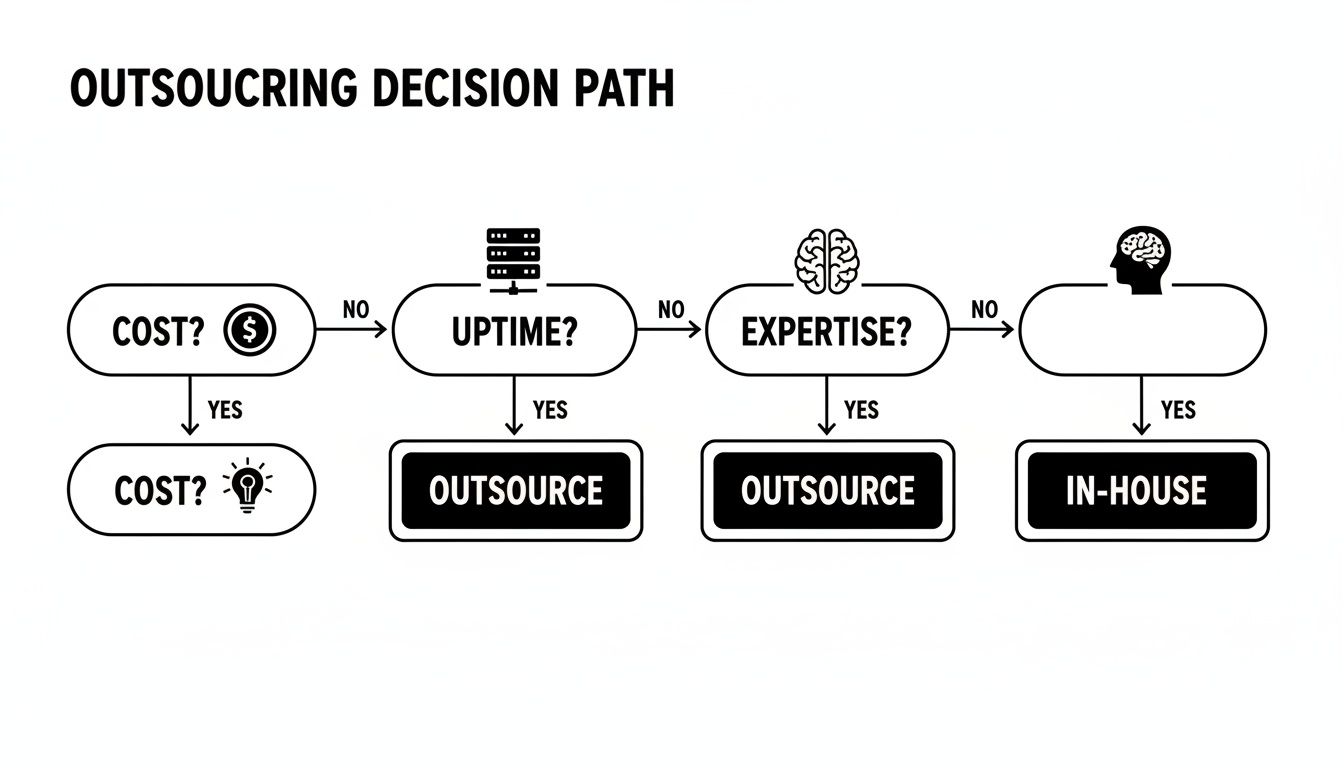
As you can see, when controlling costs and getting top-tier expertise are priorities, outsourcing becomes a very attractive path.
In-House vs Co-Managed vs Fully Outsourced Network Management
To make the right call, it helps to see how these models stack up side-by-side against the things that matter most to your business.
The right choice really depends on what you value most. For some, total control is the bottom line. For others, it's all about cost efficiency and having access to the best talent in the game. This table lays it all out to help you decide.
| Criteria | In-House Team | Co-Managed Model | Fully Outsourced Model |
|---|---|---|---|
| Cost Structure | High capital expenditure (CapEx) and unpredictable operational costs (OpEx). | A balanced mix of fixed OpEx and your internal payroll. | Predictable, fixed monthly OpEx with almost no CapEx. |
| Control Level | Maximum control over every piece of infrastructure and policy. | Shared control, with responsibilities clearly defined between teams. | Lower direct control, relying on the provider's established processes. |
| Expertise Access | Limited to the knowledge and skills of your internal staff. | Access to a broad team of specialists to fill your team's skill gaps. | Immediate access to a deep bench of certified experts. |
| Scalability | Slow and expensive; requires hiring new people and buying more gear. | Flexible. Easily scale specific services up or down when you need to. | Highly scalable, letting you adapt quickly as your business grows. |
| 24/7 Support | Very costly and difficult to staff and maintain around the clock. | A cost-effective way to get round-the-clock monitoring and support. | A standard feature included in most managed service packages. |
Ultimately, the best model for you comes down to one simple question: Where is your team’s time best spent? If you want them working on strategic projects that drive revenue, a co-managed or fully outsourced model can free them from the daily firefighting.
New, innovative solutions are starting to blur these traditional lines. For instance, some providers now offer fully serviced workspaces where high-performance network management is already built into the deal. You can learn more about how integrated service packages provide a true "plug-and-play" solution, so you don't even have to think about managing IT vendors. It simplifies the entire decision and lets you focus completely on your core business from day one.
How to Choose the Right Outsourcing Partner
Picking a partner to manage your network is a big deal. It’s less like hiring a vendor and more like bringing on a chief engineer for the very machine that runs your business. Get it wrong, and you're looking at frustrating downtime and glaring security holes. Get it right, and you’ve just found a powerful lever for growth and a shield for your operations.
The real challenge is to look past the slick sales pitches and zero in on what actually matters. You aren't just looking for a company that can fix things when they break. You’re looking for a genuine partner, a team that acts and thinks like an extension of your own. Your goal should be to find an organization whose technical chops are matched only by their dedication to seeing your business succeed.
Look Beyond the Price Tag
Of course, cost is always part of the conversation, but letting it drive the decision is a classic mistake. The cheapest bid often hides weaknesses in security, support, or raw expertise—gaps that will cost you far more down the road in lost productivity or a security breach. The real value isn’t in the lowest price, but in the reliability and peace of mind a great partner delivers.
Historically, outsourcing network management has been a smart financial move. Since the early 2000s, businesses have typically cut their operational costs by an average of 15%, and some have even seen savings up to 60% by sidestepping the hefty salaries of full-time, in-house network engineers. You can dive deeper into the financial impact of IT outsourcing on sumatosoft.com.
The trick is to find that sweet spot where cost savings meet rock-solid service. A top-notch partner invests in their people and their tech, and that's naturally reflected in their pricing.
Core Vetting Criteria for Potential Partners
To really size up a potential provider, you need to focus on three key areas. These pillars will give you a clear, honest picture of their capabilities and whether you can truly rely on them.
- Technical Certifications and Expertise: Don't just take their word for it—ask for proof. Look for certifications from industry titans like Cisco (CCNA, CCNP) and CompTIA (Network+), along with any relevant cybersecurity credentials. A provider with a team full of certified pros is showing you they invest in their people and stay on top of their game.
- Proven Track Record and Case Studies: A good partner will have a library of success stories. Ask them for case studies or, even better, client references from companies that look like yours in size and industry. This is your chance to get a direct, unfiltered look at how they perform when the pressure is on.
- Transparent Security and Compliance Protocols: Security is the one area where you can't compromise. The provider must be able to walk you through their security playbook, explaining how they handle threat detection, data encryption, and incident response. If you're in an industry with strict rules like HIPAA or PCI DSS, they need to show you they have verifiable experience keeping clients compliant.
Decoding the Service Level Agreement
The Service Level Agreement (SLA) is the single most important document you’ll sign. It’s the rulebook for your entire partnership, defining expectations and holding your provider’s feet to the fire. A vague or wishy-washy SLA is a massive red flag.
A strong SLA moves beyond promises and into guarantees. It should be a clear, measurable document that outlines specific metrics for performance, support, and availability, leaving no room for interpretation during a critical network event.
Make sure your SLA spells out the following in black and white:
- Guaranteed Uptime: This needs to be a hard number, like 99.9% or 99.99%. It should also clearly state what happens—like service credits—if they don't hit that mark.
- Response and Resolution Times: The SLA must define how quickly they’ll acknowledge an alert (response time) and how long they have to fix it (resolution time). These are usually tiered based on how critical the issue is.
- Reporting and Communication: The agreement should set a schedule for performance reports, so you always have a clear, data-backed view of your network's health.
Choosing the right partner takes some real due diligence, but the payoff is enormous. When you find a provider that fits your technical needs and your company culture, you get much more than an IT service. You get a powerful ally in your corner.
If you’re ready to see what a dedicated partnership feels like, reach out to our team of experts and we can talk about your specific needs.
Executing a Seamless Transition to an Outsourced Model
Moving to an outsourced network partner isn't like flipping a switch. It's more like a carefully planned organ transplant for your company's tech infrastructure. Getting it right demands a deliberate, project-managed approach to avoid disrupting operations, losing data, or creating security holes. The real goal here is total business continuity—your team and customers shouldn't notice a thing, except for better performance down the line.
The journey starts with a deep-dive network audit and documentation phase. Before handing over the keys, you and your new partner need a complete blueprint of your existing setup. This means mapping every single device, server, and connection point, along with documenting all software licenses, current configurations, and access credentials. Think of it as creating a detailed inventory and a user manual for your entire network.
This initial spadework is absolutely critical. It forms the bedrock of the whole transition plan, unearthing potential weak spots, untangling dependencies, and preventing nasty surprises during the handover.
Building the Migration Roadmap
Once you have a crystal-clear picture of your current network, you can work with your partner to build a detailed migration plan. This roadmap is your guide to a smooth transition, and it needs to be treated as a major business project. A solid plan will always cover a few key areas.
- Defining the Scope of Work: Get specific. Clearly spell out which services and responsibilities are moving to the outsourced provider. This nips any ambiguity in the bud and makes sure everyone knows who owns what from day one.
- Establishing a Realistic Timeline: Break the entire process into smaller, manageable phases with clear milestones and deadlines. This should cover everything from granting initial access to the final handover of monitoring tools.
- Creating a Communication Plan: Designate a point person on both sides and set up a regular check-in schedule. Keeping stakeholders in the loop—from your own IT staff to department heads—is key to managing expectations and avoiding confusion.
The biggest risk during any transition is a lack of clarity. A detailed roadmap with defined roles, timelines, and communication protocols is your insurance policy against service interruptions and security vulnerabilities.
Mitigating Risks During Handover
The actual handover is where the rubber meets the road. This is the moment your new partner starts plugging their tools and processes into your environment. To make sure this goes off without a hitch, aim for a staged or parallel implementation. For example, you could have the new provider monitor the network alongside your internal team for a week or so before they take full control.
This "shadowing" approach allows for real-time knowledge transfer and helps you catch any configuration quirks before they can cause real problems. You'll also want to run tests both before and after the transition to confirm that all systems are running as expected under new management. By treating the switch as a structured, transparent project, your move to network management outsourcing can be the seamless, strategic win it's meant to be.
A Smarter Path: The Integrated Workspace Solution
Finding the right outsourcing model can feel like a logistical nightmare. You find the perfect office space, and then you have to start a whole new, often painful, process of finding and hiring a completely separate company to handle your network. But what if you could just skip that second step?
There’s a much more direct way to get up and running. Picture this: you lease a fully-equipped workspace, and a secure, high-performance network managed by professionals is already live and waiting for you. This isn't just about convenience—it's about fundamentally changing how quickly and efficiently a business can operate.
This integrated approach basically fuses your physical office with its digital nervous system into a single, cohesive solution. It completely eliminates the headache of sourcing, negotiating with, and managing a separate IT vendor, which cuts down on administrative burdens and complexity in a big way.
The Power of a Single Point of Accountability
When the same company that provides your office also manages your network, you get one massive advantage: a single point of accountability. If your internet goes down, there's no back-and-forth blame game between the building manager and some third-party IT firm. You have one team, one contact, and a straight line to a fast solution.
This consolidation simplifies everything. Instead of juggling multiple contracts, invoices, and support desks, you have a single partnership handling both your physical and digital infrastructure. For any business, that means less time wasted on operational details and more time focused on what actually makes money.
This is really the next step for network management outsourcing. It's a complete solution where your digital backbone is just as turnkey as your physical office. The goal is to be fully operational with the least amount of friction possible.
For companies that need to be nimble and quick, this model offers a serious competitive edge.
"Plug-and-Play" Operations for Startups and BPOs
The benefits of combining a workspace and a managed network are especially powerful for certain kinds of businesses. It creates an environment where companies can be up and running almost instantly, skipping the months it typically takes for a traditional setup.
Think about these two scenarios:
- For Startups: Getting a new company off the ground is a race against the clock and the budget. An integrated solution provides a genuine 'plug-and-play' setup. You can get to market faster because you avoid the huge upfront costs and installation delays of building an enterprise-grade network from the ground up.
- For BPOs and Call Centers: In the BPO world, reliability is non-negotiable. An integrated provider like Seat Leasing BPO can guarantee operational resilience with things like redundant internet connections and first-class cybersecurity built right into the lease. This lets you meet demanding client SLAs for uptime and data security without spending a dime on your own IT hardware.
At the end of the day, this model is all about hitting peak efficiency. By combining the physical office with a solid, pre-built digital infrastructure, businesses can sidestep common operational hurdles. You get the security, performance, and support of a fully outsourced network team, all bundled seamlessly with a flexible and affordable office solution. It builds a powerful foundation for growth, letting you focus entirely on your real mission.
Answering Your Top Questions About Network Outsourcing
Let's be honest, handing over the keys to your network can feel like a huge leap of faith. It’s completely normal for business leaders to have questions about security, cost, and what it really means to give up day-to-day control. We'll tackle the most common concerns right here to give you the clarity you need.
A big one we hear all the time is the fear of losing control. While you are delegating the daily grind of network management, a good partnership isn't about surrendering control—it's about gaining an expert ally. You still call the shots on strategy and business goals; your provider is there to execute that vision.
It’s a bit like hiring a general contractor to build your house. You're still the one who decides on the blueprint, the layout, and the finishes. The contractor just brings the specialized tools and crew to make it happen, saving you from having to lay the foundation yourself.
How Is My Data Kept Secure?
Data security is non-negotiable, and it's rightly at the top of everyone's list. The reality is, reputable providers live and breathe security. They often have far more robust protocols than a typical business can afford or manage on its own. They build layers of defense to keep your information locked down.
Here’s what that looks like in practice:
- 24/7 Monitoring: Think of this as having a security guard watching your network at all times, ready to spot and stop trouble before it ever gets in.
- Advanced Firewalls and Intrusion Detection: These are the high-tech fortress walls and alarm systems protecting your digital assets from outside threats.
- Strict Access Controls: Not just anyone gets a key. Every access point is controlled and logged, ensuring only authorized people can get near your sensitive systems.
A professional managed services provider puts their reputation on the line with every client. Keeping your data safe is how they stay in business.
One of the biggest advantages of outsourcing is you're not just getting tools; you're getting a team of cybersecurity pros. Their entire job is to keep up with the latest threats—something most internal IT teams, buried in daily tasks, simply don't have the bandwidth for.
What Are the Real Costs Involved?
While every provider's model is a bit different, the core financial benefit is shifting from unpredictable capital spending to a steady, predictable monthly cost. Instead of getting hit with a five-figure bill when a server unexpectedly dies, you pay a flat fee that covers everything. This shift can be dramatic, with some businesses cutting their operational IT costs by as much as 70%.
The final price tag will depend on things like the size of your network, how many people use it, and the services you agree on in your Service Level Agreement (SLA). But the real value isn’t just in the line-item savings. It’s in what you avoid paying for: crippling downtime, costly data breaches, and the productivity drain that comes from a slow, unreliable network.
At Seat Leasing BPO, we take this a step further. We build world-class network management right into our workspace solutions. This gives you a seamless, "plug-and-play" office where the IT is secure, stable, and ready to go from the moment you walk in. It lets you forget about the backend and put all your energy into growing your business.
You can learn more about our integrated solutions on the Seat Leasing BPO website.