Ever feel like your company is running ten different races at once, with each department doing its own thing? Imagine ten separate teams all handling their own payroll, IT support, and finances. It's a recipe for duplicated work, inconsistent results, and bloated costs. A shared services center (SSC) is the solution to this chaos.
At its core, an SSC is a dedicated team within your company that takes all those common, repetitive business functions—like HR, accounting, or IT—and centralizes them into one highly efficient hub. It acts like an internal service provider, taking the administrative load off your other departments so they can focus on what they do best.
What Is a Shared Services Center and How Does It Work?
Let’s go back to our company with ten different branches. Instead of each one managing its own administrative tasks, the company creates a single SSC to handle those functions for everyone. This move consolidates all that scattered, redundant work into one streamlined operation.
Think of it like this: instead of ten small, separate kitchens each trying to cook a full menu, you have one large, professional kitchen that prepares specialized dishes for everyone. The quality goes up, the process is faster, and the cost per meal goes down. That's the power of an SSC.
The Core Principle: Centralize and Conquer
The big idea behind a shared services center is achieving economies of scale. When you pool all your transaction-heavy and rule-based work into one place, you start seeing massive improvements. But it's not just about pinching pennies; it’s about building a true center of excellence.
The main goals are pretty straightforward:
- Standardize Processes: You ensure tasks like processing an invoice or onboarding a new hire are done the exact same way every single time. This consistency slashes errors and boosts compliance.
- Improve Service Quality: The SSC team becomes a group of specialists. Since they only focus on specific functions, they get really, really good at them, leading to quicker, higher-quality support for the rest of the business.
- Reduce Operational Costs: Bringing staff, technology, and office space under one roof creates immediate savings. It’s common for companies to see cost reductions of 20% or more.
- Free Up Your People: When your core business units aren't bogged down by routine administrative work, they have more time and energy to focus on what actually drives the business forward—innovation, sales, and delighting customers.
From Cost Center to Value Creator
Years ago, the shared services model was mostly a cost-cutting play. Companies would move their back-office operations to a central location simply because it was cheaper. But that's an old-school way of thinking. The model has grown up.
A modern shared services center isn't just a back-office processing mill; it's a strategic partner to the business. It uses technology and data to deliver insights that sharpen decision-making across the entire company.
Today’s top-tier SSCs are packed with automation, data analytics, and even AI to perfect their workflows. They don't just run payroll; they analyze workforce data to spot hiring trends. They don't just pay bills; they dig into spending patterns to inform smarter procurement strategies.
This shift turns the SSC from a simple cost-saver into a powerful engine for continuous improvement. By handling the essential nuts and bolts with incredible efficiency, it becomes the backbone that supports real, sustainable growth.
Choosing the Right Shared Services Model
Not all shared services centers are built the same. Picking the right operating model is one of the first, and most important, decisions you'll make. It’s a choice that will dictate your costs, your level of control, and ultimately, your success. This isn't just about logistics; it’s a strategic move that needs to fit your company's goals and culture.
Think of it like building a new factory. You could construct it entirely yourself from the ground up, hire a specialized firm to build and run it for you, or blend the two approaches. Each path has its own set of trade-offs when it comes to investment, expertise, and oversight.
The Three Core Operating Models
Your first big decision boils down to a simple question: Do you keep the operation in-house, hand it off to a partner, or create a mix of both? Let's break down what each of these really means for your business.
Captive (In-house) Model: This is the "do-it-yourself" route. You build, own, and operate the shared services center as a direct part of your company. This gives you maximum control over everything—from processes and data security to instilling your unique company culture. The downside? It also demands the biggest upfront investment in real estate, technology, and hiring.
Outsourced Model: Here, you partner with a third-party BPO provider that already specializes in the functions you want to centralize. It's like bringing in a general contractor who arrives with their own expert crew and high-end tools. You get immediate access to top-tier talent and technology without the massive capital outlay, but you do trade away some direct, day-to-day control.
Hybrid Model: This approach gives you a flexible middle ground. You might keep core, sensitive functions in-house (your captive team) while outsourcing more routine, transactional tasks to an expert partner. This lets you strike a smart balance between control and cost-effectiveness, essentially giving you the best of both worlds.
To make this choice clearer, let's compare these models side-by-side.
Comparison of Shared Services Center Operating Models
This table compares the key characteristics of Captive, Outsourced, and Hybrid SSC models to help businesses choose the right approach.
| Model Type | Key Advantage | Primary Challenge | Best For |
|---|---|---|---|
| Captive | Total control over operations, culture, and data. | High initial investment and longer setup time. | Companies with highly sensitive data or unique processes. |
| Outsourced | Lower upfront cost and immediate access to expertise. | Less direct control over daily operations and staff. | Businesses seeking rapid cost savings and specialized skills. |
| Hybrid | Balances cost-efficiency with strategic control. | Requires careful management of both internal and external teams. | Organizations wanting to optimize costs while retaining core functions. |
Ultimately, the best model depends entirely on your business priorities—whether you value absolute control, speed and efficiency, or a flexible combination of the two.
Deciding Where to Set Up Shop
Once you've settled on how you'll operate, the next question is where. The location of your shared services center has a massive impact on your budget, talent pool, and how smoothly things run. This is where you’ll hear terms like onshoring, nearshoring, and offshoring.
- Onshoring: Setting up the SSC right in your home country. This makes communication and cultural alignment a breeze, but it almost always comes with higher labor costs.
- Nearshoring: Placing the center in a neighboring country, usually one with a similar time zone and cultural context. This can deliver solid cost savings without creating major communication hurdles.
- Offshoring: Establishing the SSC in a distant, lower-cost country. This route offers the biggest potential for cost reduction but can bring challenges with time zones, language barriers, and cultural nuances.
The right location is all about what you prioritize. If seamless, real-time collaboration is non-negotiable, nearshoring might be the answer. If your primary goal is to slash operational costs as much as possible, offshoring is likely the front-runner.
The Evolution to Global Business Services
The world of shared services is always moving forward. Today, the most ambitious organizations are looking beyond the traditional SSC and embracing a more integrated, strategic model: Global Business Services (GBS).
A GBS organization isn't just a cost center that handles back-office tasks. It’s a true strategic partner for the entire company. It manages global processes from end to end, drives innovation, and delivers powerful business insights using advanced analytics and automation.
This isn't just a fringe idea—it's quickly becoming the new industry standard. A stunning 85% of shared services organizations are either already running a GBS model or are in the process of transitioning to one. This industry-wide shift shows a clear move toward creating powerful, enterprise-wide hubs that deliver strategic value that goes far beyond simple cost savings. You can explore more about these industry shifts to see where the future is headed.
Building a Rock-Solid Business Case for Your SSC
Every successful shared services center starts long before the first process is moved or the first employee is hired. It begins with a powerful, persuasive business case. This isn't just a box-ticking exercise; it's the blueprint that convinces leadership to sign off on a major investment of time and money. Without it, your project is dead in the water.
A common pitfall is to build the entire case around cost-cutting. While savings are absolutely a huge part of the appeal, a truly compelling proposal paints a much bigger picture. It needs to show how the SSC ties directly into the company's strategic goals—how centralizing functions will not only save cash but also give the business a real competitive advantage.
Nailing the Financials
The numbers are where your business case will face the most intense scrutiny, so they have to be airtight. The main goal here is to prove a clear and attractive return on investment (ROI). This means digging deep into both the upfront costs and the expected long-term benefits.
First, you have to meticulously calculate the total cost of ownership (TCO) for your current, scattered model. This means everything—from salaries and benefits across different teams to rent for office space and duplicate software licenses. Once you have that baseline, you can project the operating costs for the new, centralized SSC.
Your financial analysis should shine a spotlight on these key metrics:
- Projected Cost Savings: This is your headline number. It’s the direct reduction in operational expenses you get from consolidating staff and standardizing how work gets done.
- Return on Investment (ROI): How quickly will the savings from the SSC pay for the initial setup costs? A fast, strong ROI is often the single most important factor for getting that executive green light.
- Net Present Value (NPV): This is a slightly more sophisticated metric that shows the project's long-term value by accounting for the time value of money.
Let’s be clear: cost savings are still the engine driving the shared services center model. In fact, roughly 50% of Global Business Services (GBS) organizations report slashing operating expenses by over 20% by centralizing functions like finance and IT. These kinds of numbers, driven by economies of scale and better technology, are hard to argue with. You can dig into the full survey from Deloitte to learn more about these GBS cost-saving trends.
Telling the Strategic Story
Beyond the hard numbers, your business case needs to tell a compelling story about strategic value. These qualitative benefits are what elevate an SSC from a simple cost center into a strategic weapon that fuels business growth and agility.
A great business case doesn't just promise savings; it promises a smarter, more efficient, and more scalable organization. It answers not only "How much will we save?" but also "How will this make us better?"
You need to connect the dots for leadership, showing them how the SSC is an investment in the company’s future, not just a quick fix for the balance sheet.
Here are the strategic pillars to build your case on:
- Standardization and Consistency: Think about all the different ways the same process is handled across various departments or locations. An SSC eliminates that chaos. This consistency slashes errors, strengthens compliance, and makes the whole company easier to manage and audit.
- Better Data, Smarter Decisions: When you centralize functions, you also centralize data. Frame the SSC as a future hub for business intelligence, giving leaders cleaner, more reliable data to make faster, more informed decisions.
- Fueling Business Agility: Position the SSC as a scalable platform for growth. When the company wants to launch a new product line or acquire another business, a centralized model makes integration far smoother. New units can simply plug into the existing, proven processes.
- A Higher Standard of Service: A dedicated SSC team lives and breathes its functions, developing deep expertise. This focus naturally leads to higher-quality work, faster turnaround times, and ultimately, happier internal "customers."
By weaving together undeniable financial projections with these powerful strategic benefits, your business case becomes more than just a proposal. It becomes a clear roadmap to a more efficient, agile, and competitive future—making it nearly impossible for leadership to say no.
Your Step-by-Step Implementation Roadmap
Moving to a shared services model is a massive undertaking, not something you flip a switch on overnight. Getting it right demands a clear, structured plan that breaks the whole project down into manageable pieces.
Think of it like building a house. You wouldn't just start digging and pouring concrete without detailed architectural blueprints. This roadmap is your blueprint for a successful SSC.
The entire journey usually unfolds across four distinct stages. Each one has its own critical tasks and milestones. Trying to rush any of these steps is a recipe for disaster, leading to everything from bad process design to a full-blown employee revolt. A methodical approach is the best way to get this done right.
Phase 1: Strategy and Feasibility
This first phase is all about doing your homework. Before you lay a single brick, you need to be absolutely sure the project is not only possible but also makes sense for the company’s bigger picture. This is where you build the rock-solid business case that gets the executives to sign the checks.
Key moves in this stage include:
- Defining the Scope: Get crystal clear on which functions are moving. Will it be Accounts Payable? The IT Helpdesk? Part of HR? You need to draw a hard line between what’s in and what’s out.
- Feasibility Study: This is where you run the numbers. Do a deep dive into the potential costs, risks, and, most importantly, the benefits. Benchmark your current operations against what others are doing and project realistic savings.
- Securing Executive Sponsorship: Find a champion in the C-suite. You need someone with clout who can advocate for the project and help you navigate the inevitable political minefields. Their support is non-negotiable.
A good feasibility study stops you from pouring money into a project that’s a bad fit. This is the moment you decide to either move forward with confidence or hit the pause button.
Phase 2: Design and Build
Once the project gets the green light, you roll up your sleeves and get to work on the design. This is where the abstract idea of an SSC starts to look like a real thing. You'll be mapping out how work will actually get done, picking the right technology, and deciding on a physical location.
This stage requires tight collaboration between project managers, the people who actually know the processes, and your IT team. Getting the details right here ensures your SSC is built on a solid foundation. Many companies also dig into different delivery models at this point; you can learn more by checking out our guides on BPO and shared services.
The real success of your SSC is decided here. A well-designed center runs on smooth, standard workflows backed by the right tech. A poorly designed one just becomes a new home for all your old problems.
Here’s what you’ll be focused on:
- Process Mapping and Standardization: Document how things are done now ("as-is") and then design the new, improved, and standardized workflows ("to-be"). This is often the hardest part, but it delivers the biggest payoff.
- Technology Selection: Pick your tools. This includes the core ERP systems, ticketing platforms, and any automation software needed to make the new processes sing.
- Location Strategy: Make the final call on where this center will live. Will it be onshore, nearshore, or offshore? Your decision will hinge on talent, cost, and risk.
- Organizational Design: Figure out who does what. Define the roles, responsibilities, and reporting lines for the new SSC team.
This is the phase where all that planning starts to pay off as you build the operational engine for your new center.
Phase 3: Transition and Migration
This is it—the "go-live" phase. The work actually starts moving from the scattered business units into the new, centralized SSC.
Managing this handoff is critical. You have to minimize business disruption and keep services running smoothly. Your best friends during this phase are strong change management and constant, clear communication.
This flowchart shows how the critical elements of a business case lead to getting that all-important buy-in.
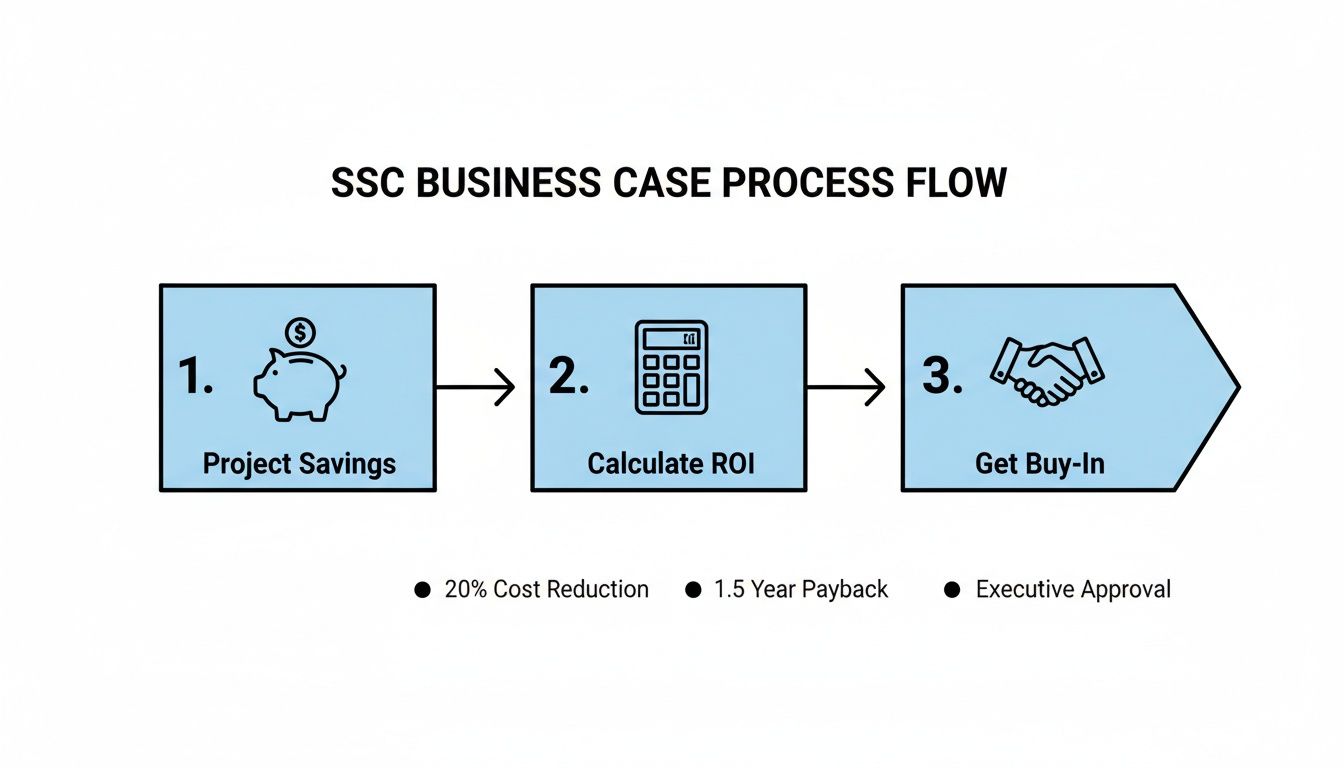
The image drives home the point: a smooth migration is only possible when it’s built on a solid financial case and everyone is on board.
Phase 4: Optimization and Improvement
Getting the SSC up and running isn’t the finish line; it’s the starting line. This final, ongoing phase is all about continuous improvement.
Once things have settled down and the center is stable, the focus shifts. You’ll be looking to boost performance, improve service quality, and find new ways to add real value back to the business.
Your game plan here will be driven by data and feedback:
- Monitor Key Performance Indicators (KPIs): Keep a close eye on metrics like cost per transaction, first-call resolution rate, and customer satisfaction scores to see how you’re doing.
- Gather Feedback: Don't guess. Regularly survey your internal customers to find out what’s working and what isn’t.
- Introduce Automation: Look for chances to use things like robotic process automation (RPA) to handle repetitive tasks, which frees up your team and cuts down on errors.
- Expand Scope: As your SSC proves its worth, you can start thinking bigger. Consider bringing in more functions or tackling more complex, knowledge-based work.
This constant push for improvement is what turns a shared services center from a simple cost-cutter into a genuine strategic partner for the entire company.
Getting Location, Technology, and Governance Right
Launching a shared services center is a massive undertaking, but its long-term success really boils down to three make-or-break pillars: where you build it, what technology powers it, and how you govern it. Get these elements right, and your SSC transforms from a simple cost-cutting play into a true strategic asset. If you drop the ball on any of them, you’re looking at operational headaches, runaway costs, and a failure to deliver on that initial promise.
Think of it like building a high-performance race car. The location is your manufacturing plant—it needs access to top-tier talent and solid infrastructure. The technology is the engine and electronics, giving you the power and intelligence to compete. And the governance is your skilled driver and pit crew, making sure the car performs at its peak and stays on track. You can't win the race unless all three are working in perfect harmony.
Aligning these three is more critical than ever. The shared services center market is absolutely booming, with a global valuation of $59.7 billion projected to hit a staggering $358.2 billion by 2034. That's a compound annual growth rate of 19.6%, which tells you just how many companies are jumping on board. If you want to grab a piece of that growth, you have to nail the fundamentals. You can find more details about this expanding market on globalinsightservices.com.
Choosing the Right Location
Picking a location for your SSC is so much more than just finding the cheapest place to operate. While labor arbitrage is often the initial draw, focusing on that alone is incredibly shortsighted. A truly strategic location choice is a careful balancing act between cost, talent, stability, and infrastructure.
Here are the factors you absolutely have to consider:
- Talent Availability: Does the area have a deep pool of skilled people with the right language skills and technical know-how? A low-cost location is worthless if you can't find anyone qualified to do the work.
- Political and Economic Stability: A stable environment is your best defense against business risk. You need to be confident that your operations won't get derailed by sudden political or economic chaos.
- Infrastructure Quality: Reliable internet, consistent power, and accessible transportation are the non-negotiable foundations of any modern business. Take a look at how top-tier facilities like Building-24 are designed with this in mind.
Building Your Technology Stack
Technology is the engine that drives an efficient shared services center. The right tech stack doesn't just support your processes; it actively makes them better, turning your SSC into a hub for innovation. A modern SSC is built on layers of technology.
At the very foundation is your Enterprise Resource Planning (ERP) system, which acts as the central nervous system for all your finance, HR, and procurement data. Layered on top are specialized tools that make specific tasks easier, like helpdesk ticketing systems or workflow management platforms.
The real game-changers, though, are the technologies that drive automation. Robotic Process Automation (RPA) and Artificial Intelligence (AI) aren't futuristic ideas anymore—they're essential tools for chewing through high-volume, repetitive tasks. This frees up your team to focus on more complex work that actually adds value.
Establishing Strong Governance
Finally, governance is the framework that keeps your SSC running effectively and in lockstep with the broader business goals. It's the collection of rules, roles, and metrics that define what success looks like and holds everyone accountable. A solid governance model is built on crystal-clear communication and concrete measurements.
This framework is built on a few key components:
- Service Level Agreements (SLAs): Think of these as formal contracts between the SSC and the business units it serves. They lay out specific, measurable standards, like a promise to process all invoices within 48 hours.
- Key Performance Indicators (KPIs): These are the specific metrics you use to track how you're performing against your SLAs. They give you hard data on efficiency, quality, and business impact.
- Management Structure: This defines the reporting lines, who has the authority to make decisions, and the channels for communication. A clear structure prevents confusion and ensures problems get solved quickly.
To give you a clearer idea, here's a look at some of the essential KPIs that top-performing SSCs track.
Essential KPIs for Shared Services Center Performance
| Function | Efficiency KPI | Quality KPI | Business Impact KPI |
|---|---|---|---|
| Finance & Accounting | Cost per invoice processed | First-time pass rate (%) | Days Sales Outstanding (DSO) |
| Human Resources | Time to fill open positions | New hire satisfaction score | Employee turnover rate (%) |
| IT Support | Average ticket resolution time | First contact resolution rate (%) | System uptime/availability (%) |
| Procurement | Purchase order cycle time | Supplier compliance rate (%) | Cost savings achieved |
Tracking these metrics isn't about micromanaging; it's about having an objective, data-driven conversation about performance and continuous improvement.
By truly mastering these three pillars—location, technology, and governance—you're building more than just a functional shared services center. You’re creating a resilient, efficient, and strategic powerhouse that will drive real value for your organization for years to come.
Launch Your SSC Faster with Seat Leasing

What if you could skip the most expensive and drawn-out parts of setting up a shared services center? The old way is a grind: months spent hunting for real estate, getting locked into long-term leases, managing office construction, and then buying and installing all your IT hardware. This approach ties up a ton of capital and pushes back the day you actually start seeing a return.
For companies that need to get moving now, this traditional model is a serious bottleneck. The good news is there's a much more nimble way to get your operations running: seat leasing.
The Plug-and-Play Alternative
Seat leasing is exactly what it sounds like. You rent individual, fully-equipped workstations—"seats"—in a professionally managed office. It’s like getting a pre-built operational base instead of having to construct one from the ground up. The physical space, furniture, high-speed internet, and IT support are all bundled into one straightforward monthly fee.
This model instantly takes the biggest headaches off your plate. You're not shelling out massive upfront capital for renovations or equipment. Plus, you avoid getting stuck in inflexible, multi-year commercial leases, which gives you the freedom to adapt as your business evolves.
By eliminating the typical setup hurdles, seat leasing transforms a process that takes months into one that can take just weeks. It allows you to focus your resources on what truly matters: migrating processes and training your team.
For BPO providers, startups, or any business testing the waters with a new SSC, this model dramatically lowers the barrier to entry.
Core Benefits of the Seat Leasing Model
The advantages go well beyond just speed. Choosing a seat leasing strategy delivers some powerful operational and financial perks that are perfectly suited for a modern shared services center.
- Radical Cost Reduction: You can see cost savings of up to 80% compared to a traditional office build-out. All the big expenses—from utilities and security to IT maintenance—are already handled by the provider.
- Immediate Scalability: What happens when you need to grow from 20 agents to 50? With seat leasing, you just add more workstations as you need them. Your SSC can expand right alongside business demand without the pain of finding more office space.
- Zero Infrastructure Headaches: Your team walks into a fully functional office with enterprise-grade IT infrastructure ready to go. You can get straight to work on day one, knowing your technology and connectivity are managed by experts.
This approach gives you a powerful, cost-effective launchpad. If you're curious how this could work for your business, you can learn more about flexible workspace solutions that accelerate deployment. It’s the smart, agile way to get your SSC off the ground and delivering value faster.
Got Questions About Shared Services? We've Got Answers.
As more companies adopt a shared services model to get leaner and more efficient, a lot of the same questions pop up. If you're exploring this strategy, you're probably wondering about some of the same things. Let's clear up a few of the most common questions people have when they're thinking about building a shared services center.
Shared Services vs. Outsourcing: What's the Real Difference?
It's easy to get these two confused, but they're fundamentally different. The simplest way to remember it comes down to one word: ownership.
A shared services center (SSC) is yours. It's a dedicated unit within your own company, staffed by your own employees, following your company's culture. You have full command over the quality, the processes, and the security of your data because it never leaves your organization.
Outsourcing is when you hire a completely separate company to handle a business function for you. You're handing the keys over to a third party. While that can bring specialized skills or cut costs quickly, you naturally lose direct day-to-day control. Some companies even blend the two, keeping sensitive or strategic work in-house with an SSC while outsourcing the more repetitive, high-volume tasks.
What Kind of Work Belongs in a Shared Services Center?
Some business functions are practically tailor-made for a shared services model. These are typically the high-volume, rules-driven tasks that can be standardized and streamlined for maximum efficiency.
The usual suspects include:
- Finance and Accounting: Think accounts payable, accounts receivable, and general ledger work. These are perfect candidates.
- Human Resources: Payroll, benefits administration, and managing employee data are classic examples.
- IT Support: Centralizing things like the IT help desk and basic infrastructure monitoring just makes sense.
But don't think of shared services as just a back-office transaction hub anymore. The model has grown up. Today's best SSCs are moving up the value chain, handling complex work like data analytics, financial planning and analysis (FP&A), and even specialized legal or compliance support.
How Long Does It Realistically Take to Set Up?
This is the big "it depends" question. If you're going the traditional route—building everything from scratch—you're looking at a timeline of six months to well over a year. That's a long haul of planning, process mapping, finding and fitting out an office, hiring a team, and managing the change.
But you don't have to do it the slow way. Modern solutions like seat leasing completely change the game. Instead of spending months on real estate and IT setup, you can walk into a fully managed, ready-to-go office. This approach slashes the setup time from months to just a few weeks, letting you focus on what really matters: getting your processes moved over and your team up and running.
Ready to launch your shared services center faster and with significantly lower costs? Seat Leasing BPO provides plug-and-play office solutions that eliminate the headaches of setup, allowing you to go live in weeks. Learn how our flexible seat leasing can accelerate your success.